Are laser sights really useful on a handgun? Yes, and not just in low-light situations. That said, many folks who own laser-equipped handguns do not train effectively with the laser. For many gun-owners, the laser is just a toy, a gimmick that is used a few times and then ignored. Those gun-owners miss out on some of the most important advantages of a laser sights, benefits you can get from formal training with your laser-equipped pistol.
Crimson Trace has produced a series of TRAINING Videos that may change your mind about lasers. If you shoot a handgun you should watch these videos. They show how laser sights can help diagnose and correct common handgun-shooting errors (such as flinching and anticipating the shot). The videos also show how to improve sight alignment and get your sights on target quickly.
Training with Laser Sights, Full 12-minute Video
Covers Muzzle Awareness, Sight Alignment, Target Acquisition, Trigger Control
This video shows how training with laser sights can: 1) improve muzzle direction awareness; 2) aid with sight alignment; 3) speed up target acquisition; and 4) improve trigger control. The video also demonstrates the obvious advantage of laser sights in low light conditions. Numerous firearms experts are featured in this video filmed at Arizona’s Gunsight Academy.
Training With Lasers — Trigger Control
Training with laser sights helps diagnose and improve trigger control errors by showcasing the importance of “surprise break” and follow-through. Lasers quickly diagnose errors such as recoil anticipation, jerking the trigger, and breaking the wrist.
Training with Lasers — Sight Alignment
Training with laser sights can improve/correct alignment. The laser provides a visual indicator of proper sight alignment, allowing shooters to quickly see any errors before taking a shot. Additionally, lasers can enhance sight alignment on popular sub-compact carry guns with small, low-profile sights.
Muzzle Awareness — All-Important for Safe Shooting
Training with laser sights improves a shooter’s muzzle awareness. A daylight-visible laser shows the gun operator where his or her muzzle is pointing at all times. This helps teach proper safety practices.
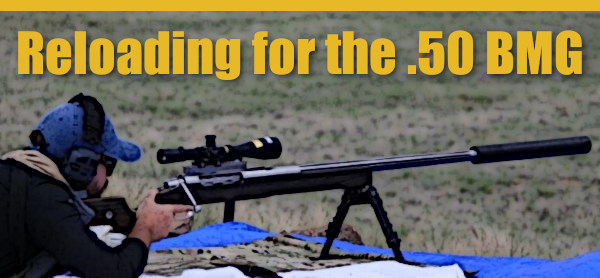
Fans of Heavy Artillery should visit Fifty Caliber Shooters Association (FCSA) website. There you’ll find range maps, photo collections and animated slide-shows On the FCSA photo gallery page, you’ll find a map. Click on any gray range link to see images from that venue. There are also a series of articles covering FCSA competition along with the “care and feeding” of the big 50-caliber rifles.
For today’s Sunday GunDay feature we offer a short history of the legendary .50 BMG cartridge, along with some fun photos from FCSA matches in the Western USA.
About the .50 BMG Cartridge
The .50 Browning Machine Gun (.50 BMG, aka 12.7×99mm NATO or 50 Browning) is a cartridge developed for the Browning .50 caliber machine gun in the late 1910s, entering official service in 1921. Under STANAG 4383, it is a standard cartridge for NATO forces as well as many non-NATO countries.
John Browning had the idea for this round during World War I in response to a need for an anti-aircraft weapon, based on a scaled-up .30-06 Springfield design, used in a machine gun based on a scaled-up M1919/M1917 design that Browning had initially developed around 1900. According to the American Rifleman: “The Browning .50 originated in the Great War. American interest in an armor-piercing cartridge was influenced by the marginal French 11 mm design, prompting U.S. Army Ordnance officers to consult Browning. They wanted a heavy projectile at 2700 FPS, but the ammunition did not exist. Browning pondered the situation and, according to his son John, replied, ‘Well, the cartridge sounds pretty good to start. You make up some cartridges and we’ll do some shooting’.”
Are you a died-in-the-wool .50 BMG fan? Got a hankerin’ for heavy artillery? Then visit the FCSA Photo Gallery page. There you’ll find hundreds of photos from Fifty Caliber Shooting Association (FCSA) matches and 50 Cal fun shoots in eleven states plus Australia, Switzerland, and the United Kingdom. To access the photos from the Gallery Page, start by selecting a state/country and then click on the colored buttons for the event date (e.g. 2015-04).
Photo sets go all the way back to 2002, so you can see the evolution of the hardware over the years. Sample multiple archives to see the differences in terrain from one range to another — from Raton’s alpine setting to the hot, dry Nevada desert. This Gallery is really a treasure-trove of .50-Cal history. Here are a few sample images.
Reloading Powder and Special Tools for .50 BMG
Alliant’s Powder for 50-Caliber Applications
In 2009 Alliant unveiled Reloder 50, a slow-burn-rate powder designed primarily for long-range, .50-caliber rifle shooters. According to Alliant, the burn rate is “a little slower than Winchester 860″ and the powder is showing excellent lot-to-lot consistency. Load density is optimized for the 50 BMG and similar cases. Like Reloder 17, Reloder 50 employs a process which penetrates the kernels with the burn-rate-controlling chemical. This should allow a longer, flatter pressure curve, yielding more velocity than conventional powders can deliver. Alliant says that Reloder 50 offers “superior velocity and the ability to burn cleaner (with less residue)”. Reloder 50 comes in both 1-lb (#150527) and 8-lb (#150528) containers.
Forster and Lyman .50 BMG Trimmers
Big Fifty enthusiasts asked for a dedicated .50 BMG case trimmer, so Forster and Lyman created .50 Cal trimmers specifically for that cartridge. Forster’s cutter tip on its .50 BMG Case Trimmer is much sharper than the cutter on the Lyman 50 Cal AccuTrimmer. However, with the Forster tool you will pay more for that superior cutting ability — the Forster .50 BMG trimmer is $95.53 at Midsouth compared to $75.09 at Midsouth for the Lyman .50 BMG trimmer. Go head and pay the extra money for the Forster — the cutter head is much sharper, and we prefer the Forster’s collet-style case-holder. Bottom line — the Forster gets the job done more quickly, with less effort.
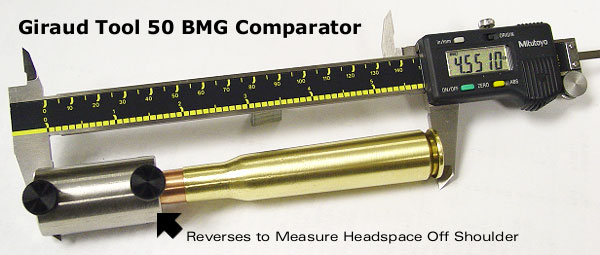
Giraud .50 BMG Case/Bullet Comparator Giraud Tool makes a comparator for 50-Cal cartridges. The double-ended comparator is quite versatile. In one orientation you can measure base-to-ogive bullet length and also measure cartridge OAL from rim to bullet ogive. When reversed, you can use the comparator to measure cartridge headspace. The $33.00 Giraud .50 BMG Comparator gauge is constructed of 303 stainless and fits most any vernier, dial, or digital caliper. CLICK HERE for more info.
What is Parallax?
Parallax is the apparent movement of the scope’s reticle (cross-hairs) in relation to the target as the shooter moves his eye across the exit pupil of the riflescope. This is caused by the target and the reticle being located in different focal planes.
Why is it Important?
The greater the distance to the target and magnification of the optic, the greater the parallax error becomes. Especially at longer distances, significant sighting error can result if parallax is not removed.
How to Remove Parallax
This Nightforce Tech Tip video quickly shows how to remove parallax on your riflescope.
While keeping the rifle still and looking through the riflescope, a slight nod of the head up and down will quickly determine if parallax is present. To remove parallax, start with the adjustment mechanism on infinity and rotate until the reticle remains stationary in relation to the target regardless of head movement. If parallax has been eliminated, the reticle will remain stationary in relation to the target regardless of eye placement behind the optic.
To shoot tight groups and high scores from the bench, or in prone F-Open competition, a quality front rest is essential. And a good rest is also very valuable when zeroing rifles, testing loads, and shooting varmints from a portable bench. Today’s Saturday video showcase includes multiple video reviews of some of the best front rests on the market — great products from SEB, Rodzilla, 21st Century, Lenzi, and Sinclair Int’l. In addition, the lead-off video from F-Class John covers some of the less expensive rests as well as SEB Joy-Pod coaxial bipods.
Review of Many Popular Front Rests from $250 to $2200
If you are shopping for a front rest, definitely watch this comprehensive 42-minute video from start to finish. This is probably the most informative video about premium shooting rests available on YouTube. Top F-Class shooter and video-maker F-Class John covers a wide selection of front rests, with some observations about coaxial bipods as well. John covers the impressive new SEB NEO-X, the easy-to-transport SEB Mini-X, the excellent Rodzilla Rest, the innovative 21st Century Hybrid Rest, the sleek Italian Lenzi Rest. And at the end of the video John reviews the very affordable Caldwell Fire Control Rest ($249.99 on Amazon), explaining how it can be a decent choice for shooters on a limited budget.
NEW SEB NEO-X — Set-Up in the Field
Still in its final prototype stage, the innovative SEB NEO-X raises the bar for transportable coaxial front rests. An innovative design with hinged legs allows the 20-lb NEO-X to be transported in a small case. Once the legs are extended however, the NEO-X has proven to be very stable. And this new coaxial rest offers very precise, easy-to-use controls. A swivel head speeds up deployment, as the allows you to quickly align the rest top to the target. Users have confirmed the NEO-X works great and is very stable. In the video above ace F-Class shooter Erik Cortina (below) shows how to quickly deploy the NEO-X in the field.
Rodzilla T-Rex — High Quality, Big Footprint, Advanced Features
The impressive Rodzilla T-Rex front rest offers outstanding stability with smooth, precise performance. Designer/builder Rod Brakhage (the Rod in Rodzilla) started from the ground up to create a user-friendly, match-ready, modular front rest on the market. The T-Rex weighs just over 21 pounds, and the T-Rex has a large footprint, rivaling the largest rests on the market. That provides exceptional stability, even with heavy-recoiling rifles.
The T-Rex boasts an adjustable joystick that extends from 15.5″ to 21″ in length. With this adjustability, no matter what your stock length or design, you can find a comfortable position without having to stretch uncomfortably. Rodzilla delivers the T-Rex in a custom-designed hard carry case that fits it perfectly and still has room for additional feet and accessories. The T-Rex can be ordered with excellent Sand Feet.
21st Century Hybrid-X Front Rest
Lateral Control Arm, Vertical Elevation Knob
The innovative 21st Century Hybrid-X front rest offers the “best of both worlds”. It allows precise lateral movement (for wind holds) with no elevation change. The entire center section of the rest rotates as one unit for fast, perfect horizontal alignment to target. Then adjust vertical precisely with the rotary knob on the outboard end of the control rod. Our Daily Bulletin Hybrid-X article has a full description with multiple photos of this unique rest. See additional Hybrid-X Video.
Sinclair Int’l Competition Front Rest — Sturdy and Stable Design
The Sinclair Int’l Competition Rest is a classic heavy and very stable rest that works great on the bench. Weighing 30+ pounds, with a 1″-thick steel base, this rest has a very low center of gravity and is ultra-stable. Currently priced at $699.99, the Sinclair Competition Rest is less than half the cost of the more exotic front rests.
Horizontal (windage) movement is controlled with a large rear knob which uses dual sets of twin tapered roller bearings for a non-binding windage operation. Nearly four feet of windage adjustment is offered at 100 yards. Elevation changes are made with the large wheel. With its mass and low COG, this Sinclair Rest is very stable. And because of its ability to hold elevation shot to shot, this rest has been popular with long-range benchrest competitors who often shoot quick strings of 5 or 10 shots.
SEB Mini-X and SEB Mini — Transportable Joystick Tripod Rests
The original SEB Mini was an innovative collapsible tripod rest with a coaxial top. On its introduction the SEB Mini became immediately popular with varminters, F-TR shooters, and anyone who wanted an affordable, easy-to-transport front rest that offered easy, precise and rapid adjustment of windage and elevation with the Joystick. Building on the success of the original SEB Mini, the new SEB Mini-X offers an improved head design, and new adjustable “ankle” units on all three legs. This makes it easier to level the Mini-X on uneven ground. The Mini-X has proven very successful in competition, winning major F-Open matches. Folding into a very compact package, it is easy to transport in airline luggage. Yet it offers a very stable shooting platform with precise, effortless joystick control of elevation and windage.
Hunting season is coming soon in many parts of the nation. If you’re thinking about what bullets to use for your annual game hunt, you’ll find some VERY valuable information here. Federal has created an award-winning Bullet Breakdown Video (below) that demonstrates how various hunting bullets perform in ballistic gelatin. This and other videos are found on Federal Premium Ammunition’s YouTube Channel. The Bullet Breakdown Video features four bullet types used in Federal Ammo: Nosler Ballistic Tip; Sierra GameKing; Trophy Bonded Tip; and Barnes Triple-Shock X-Bullet.
NOTE: You may want to lower the video sound level before playback.
Federal’s high-resolution, slow-motion video-graphy helps demonstrate which loads are the best for specific uses. The ultra-slo-mo footage provides a detailed view of each bullet penetrating ballistic gelatin blocks. These blocks closely mimic animal tissue and clearly display performance characteristics.
“The Bullet Breakdown Video is a great tool for hunters trying to decide on ammunition type,” said Federal’s Jason Nash. “Properly preparing for the hunt is crucial-and not all bullets are made the same. The bullet is the one link between hunter and game and can be the difference between success and failure. This video helps show hunters how different bullet construction affects terminal performance[.]” For more info, visit www.FederalPremium.com.
There’s a new premium First Focal Plane option for PRS/NRL competitors and long-range hunters. ZEISS has just introduced the all-new LRP S3 scope series, with 4-25X and 6-36X models, in both MRAD and MOA versions. These new scopes are impressive, with superb glass and best-in-class vertical elevation. And the prices are attractive, starting at $2199.99. You could pay a lot more for a top-tier FFP scope.
The new ZEISS LRP S3 optics for precision shooting and hunting boast impressive total elevation travel, advanced optics, daytime visible illuminated reticle, ballistic stop, and external locking windage turret. The product family consists of two models: ZEISS LRP S3 425-50 and LRP S3 636-56. Both are available in either Milliradian (MRAD) or minute-of-angle (MOA) configurations.
“With the LRP S3 we have expanded our successful long-range precision scope portfolio to provide more options for highly reliable and precise optics that are ready for competition”, stated Kyle Brown, Director of Marketing and Products for ZEISS Consumer Products USA. ZEISS LRP S3 first focal plane riflescopes are purpose-built for success in the world of long-range shooting and hunting.
While the concept of “buy once, cry once” is a long-held tradition in the competition optics market, ZEISS is trying to break that mold. PRS/NRL competitors and long-range hunters favor first focal plane scopes with large magnification ratios and crystal clear optics. Most of the “alpha” scopes in this arena have price-tags of $4000 or more, but ZEISS is wading in with a more budget-friendly option — the ZEISS LRP S3 series. These new FFP 4-25X and 6-36X scopes have an ample 6x zoom ratio with MOA or MIL reticles (and corresponding click values). MSRPs are reasonable: $2499.99 for the 6-36X and $2199.99 for the 4-25X.
These new first focal plane LRP S3 optics feature multiple lens elements of highest-quality, extra-low dispersion (ED) glass, making them contenders for the brightest, clearest sight picture available. ZEISS promises “90% light transmission for a noticeably brighter image.”
I chose to review the LRP S3 6-36X models in both MOA and MIL formats. Like any top quality scope, the ZEISS offering is well packaged and properly protected for shipment. Upon opening the package, one is immediately struck with the diameter of the turrets. They are large and easy to grasp, unlike many of the competitor’s designs. A truly shooter-friendly feature for PRS shooters and hunters alike is the repositioning of the index marks for both the windage and parallax adjustments to the upper side of the scope body. This is a welcome feature, making pre-stage windage setting much easier.
The turrets are 10 MIL or 25 MOA per rotation, making it unlikely that the shooter will get lost while adjusting. If more than one rotation is needed, a nicely visible micrometer scale rests below the turret, to keep things oriented. The elevation knob features a zero stop to get you back to the starting point reliably, and the windage knob features a lock to prevent accidental adjustment. The turrets themselves have large, unmistakable markings that are easy to read, even without one’s reading glasses.
The scopes were mounted in ZEISS ultralight rings and placed on a double mount side-by-side on a tripod with one of the best pieces of glass the author owns — a Nightforce Competition 15-55x52mm. Looking across the river at the adjacent city 3 miles away told the tale. The glass in the ZEISS was nearly identical in resolution and color to Nightforce’s Japanese glass. Moreover, the ZEISS collected more light, thanks to the larger 56mm objective and 34mm main tube. Through tough conditions on a hazy afternoon, the ZEISS had slightly better clarity than the Nightforce. A day later, looking into the evening sunset as a backdrop, they were identical to the author’s eye at both 36x and 15x respectively. Even the heavy mirage present didn’t seem to differentiate between the scopes.
With excellent HD quality glass, and good magnification options (4-25X and 6-36X), what is missing? Two things got my attention. The first was the lack of a sunshade as part of the scope. ZEISS offers sunshades separately at a reasonable cost, but they really should be offered as part of the scope package in my opinion. The second is the lack of range markings on the parallax knob. Setting parallax with range markings is not ideal, but can be quite helpful in shooting situations on the clock.
Impressive So Far, with More Testing to Come
The LRP S3 636-56 is an option-rich scope at a reasonable price for both PRS/NRL and hunting applications. Will it prove to rival the $4000 “alpha” scopes at a much lower and more affordable cost? We plan to answer that question with a detailed field test in the weeks ahead. Stay tuned. – Keith Glasscock
ZEISS LRP S3 Optics Key Features
Best-in-Class Total Elevation Travel
4-25x50mm: 46.5 MRAD / 160 MOA
6-36x56mm: 32.0 MRAD / 110 MOA
Advanced Optical Design — for a highly detailed and precise image
Ballistic Stop and External Locking Windage Turret for precise shot placement
Daylight Visible Illuminated Smart Reticle – quick and precise to read, with minimum target coverage and red or green illumination settings
Relatively Compact and Tested to Be Tough in Extreme Conditions
With its 34mm aluminum main tube mono-bloc housing, shock tested up to 1,500g-force, waterproofness up to 400 mbar, the LRP S3 is not only compact but also very robust. It is engineered for extreme usage in rough terrain. “The LRP S3 meets all requirements not only for long-range competitions but also for particularly demanding hunting situations over long distances”, notes Kyle Brown of ZEISS. And these scopes are covered by ZEISS’s Limited Lifetime Warranty and 5-Year No-Fault Policy.
Availability: All ZEISS LRP S3 models — LRP S3 425-50 and 636-56 both MRAD and MOA versions — will be available at authorized ZEISS retailers beginning early October 2022 for the North American markets. For more information about the ZEISS LRP S3 scopes, visit www.zeiss.com/lrp-s3.
This is the biggest sale day of the year for hunters. MidwayUSA’s Camo Tuesday is a once-a-year event with some of the best deals you’ll find on hunting clothing, rifles, optics, trail cams, boots, backpacks, ammo, rangefinders, binoculars, GPS units, knives, and everything else a hunter could need. Along with great Camo Tuesday bargains, you can get FREE Shipping for orders over $49 with Code CAMOTUESDAY2022.
CAMO TUESDAY Hunting Sale at MidwayUSA
Camo Tuesday only happens once a year. It is more than just another hunting sale — it’s the ultimate shopping day for the fall hunting season. You can get huge savings on select hunting gear, plus free shipping. MidwayUSA offers big discounts on camouflage clothing as well as hunting boots, rifles, shotguns, crossbows, ammunition, optics, rangefinders, trails cams and more. Here are just a few of the deals:
Camo Tuesday Sweepstakes — Many Prizes
Along with the super sale discounts, MidwayUSA is running a big Camo Tuesday Sweepstakes with prizes totaling $4,749.96 in value. No purchase is necessary, but MidwayUSA requires entrants’ email and phone number. CLICK HERE for contest entry page.
372,000,000 views! Today’s five feature videos have, collectively, been viewed 372 million times on YouTube. Today’s Saturday special features five remarkable animated firearms videos from Matt Rittman, a very talented computer graphic artist. Matt employs multiple software programs to create these incredibly detailed animations. His software tools of the trade include Cinema 4D, Substance Painter, and Corona renderer. Don’t think this is easy. Some of these videos took over 500 man-hours to create. Enjoy!
AR-15 Full Animation — Components and Function
While there are other AR-15 animations on YouTube, we think this is the most accurate and creative, showing the function of a wide variety of components, including the bolt carrier, extractor, trigger, stock buffer, safety system, forward assist, and mag release. It also shows modes of a military M16, showing 3-round burst fire, and full-auto, employing disconnectors and auto sear. If you are planning to assemble/disassemble an AR, this is definitely worth watching start to finish. This video has recorded over 2 million views in just three weeks!
4:00 Auto Fire
4:58 Burst Fire
6:22 Bolt Catch
6:40 Sights
7:33 Adjustable Stock
7:50 Ejection Port Cover
Mauser Kar-98K Bolt Action Rifle video
This elaborate 3D animation shows how a Mauser-type Karabiner 98 Kurz (aka Kar-98K) bolt-action rifle works. Substance Painter was used to create the wood stock texture. Creator Matt Rittman states that this 3.7 minute video took over 500 man-hours to create. You have to admire the dedication involved in that kind of hard work.
This 3D animation video shows the popular Glock 19 (Gen 4) pistol. This modern, polymer-framed, striker-fired pistol has constant trigger pull for all shots. Some folks call this a DAO (double-action-only) trigger but that’s not really correct. Unlike the Model 1911, on a Glock there is no external safety on the frame or slide. The trigger “shoe” (the part that contacts finger) includes a central blade. This prevents the gun from firing unless the trigger is depresses normally. Glock calls this the “safe action”. The creator, Matt Rittman states: “Cinema 4D was used to create each individual part, as well as animating everything. Substance Painter was used to create the main textures. Corona renderer was used to render everything. This animation [with 84.6 million views] took me over 500 hours to create.”
Elements of Video:
0:11 Basic Function
0:39 Case Extraction
0:47 Cartridge Loading
1:02 Trigger Reset
1:28 Trigger Safety
Pump shotguns are essential firearms for hunting and home defense. The clever design of pump-action shotguns make them reliable even when feeding large diameter, blunt-ended 12 gauge shot-shells.
With 226 million views, this AK-47 video might just be the most-watched firearms tech video on YouTube. The video highlights the design features the account for the AK’s legendary reliability. For viewers with an eye to detail Matt adds this clarification: “The firing pin does NOT puncture the bullet primer. It just strikes it against the anvil, initiating the firing sequence.”
As part of NRA Women TV, hunting guide Kristy Titus hosts a series of videos that explain important strategies and shooting skills for hunters. Titus, co-host of the Team Elk TV show, is a certified instructor who has hunted around the globe. She grew up in the outdoors, running pack mules in Oregon with her father. In these videos, Kristy discusses demonstrates field positions that can be employed during a hunt. She also explains preparation for a hunt, including fitness training.
Click each link below to watch other Kristy Titus Hunting Videos.
“When it comes to bolt-action rifle fit, there is no ‘one size fits all’,” says Titus. “When picking out your rifle [consider options] after the purchase to ensure you are as comfortable as possible.”
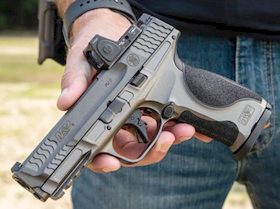
What’s old is new again. The metal-framed pistol is making a comeback. Smith & Wesson has just introduced its new M&P9 M2.0 METAL, S&W’s first full-size M&P pistol in an all-metal configuration. Built with a T6 aluminum frame finished in Tungsten Gray Cerakote, this 9mm Luger pistol includes a 4.25″ barrel, M2.0 flat face trigger, and optics-ready slide.
Why go to a metal frame? The T6 Aluminum frame is heavier than polymer. This increases the overall weight of the pistol and lowers the center of gravity considerably. The gun therefore has less perceived recoil (less “snap”) and noticeably less muzzle flip. The new M&P M2.0 METAL is listed at 30.0 oz. unloaded, while the polymer M&P M2.0 is 24.7 oz. unloaded.
New M&P9 M2.0 METAL is 43% More Expensive Than Polymer M&P9 M2.0
The new M&P9 M2.0 METAL has a $899.00 MSRP, making it 43% more expensive than the polymer-framed M&P9 M2.0 which has a $629.00 MSRP. Is the aluminum frame worth the extra money? It depends. With a lower center of gravity and more mass, the M2.0 METAL will definitely be a better “gun games” pistol. But it will also be 5.3 oz. heavier — not so great for all-day carry.
For persons who use their M&P mostly for target work and gun games, the heavier weight and reduced muzzle flip is a plus. Owners may also like the rigidity of the Cerakoted Aluminum frame. S&W has a new enhanced sear for this model, which delivers a “shorter take-up, and cleaner break”. That also should help action pistol competitors.
Full Compatability with Existing M&P9 Magazines and Holsters
The M&P9 M2.0 METAL will accept any M&P9 M2.0 17-round 9mm magazine and will fit any normal M&P9 fullsize compatible holster. Notable features include enhanced sear for lighter, crisper trigger break, an optics-ready slide, and new “flat face” trigger.
M&P9 M2.0 METAL FEATURES
T6 Aluminum Frame with Tungsten Gray Cerakote® Finish
Optics-Ready pistol slide has mounting recess for red dots
Four interchangeable palmswell grip inserts: S, M, ML, L
Textured polymer front strap
Wide slide stop and reversible magazine release
M2.0 flat face trigger for consistent finger placement
Forward slide serrations and Picatinny-style frame rail
Enhanced sear for lighter, crisper trigger let-off
Fits all standard M&P9 compatible holsters
Accepts any 17-round 9mm M2.0™ magazine
Comes with two 17-round magazines.
Jerry Miculek Tests New M&P9 M2.0 Metal Pistol — Says It Shows Exceptional Accuracy


 Fans of Heavy Artillery should visit



 Alliant’s Powder for 50-Caliber Applications


 The
The 

 Federal’s high-resolution, slow-motion video-graphy helps demonstrate which loads are the best for specific uses. The ultra-slo-mo footage provides a detailed view of each bullet penetrating ballistic gelatin blocks. These blocks closely mimic animal tissue and clearly display performance characteristics.


 T6 Aluminum Frame with Tungsten Gray Cerakote® Finish


