Creedmoor Sports has released a series of helpful “how-to” videos in its new InfoZone web page. In the latest InfoZone video Bill Gravatt shows how to seat bullets using L.E. Wilson Hand Dies and an Arbor Press. The basic process is simple, particularly with a micrometer-top seating die. That makes it easy to adjust and set seating depth. Before you start seating bullets, you want to adjust the height of the arbor so the stroke is appropriate to the height of your die.
Bill Gravatt Shows How to Use Hand Seating Dies — Creedmoor INFOZONE
ARBOR PRESS TECHNIQUE: When using an arbor press, smooth is good. You don’t want to slam the handle down quickly. Try to repeat the same motion each time. You can also experiment by seating the bullet part way, then rotate the cartridge (in the die) and do the final seating with a second stroke. If your arbor press has a force gauge, note both the max value of the gauge needle and how it moves as you seat the bullet. If the needle spikes too rapidly, or bounces back and forth irregularly, set that cartridge aside and/or mark it. You could have neck tension issue with that case or some other fault. You might even have a bad bullet. That’s rare, but can happen. The key to success is moving the press arm in a smooth motion every time, maintaining the same down-pressure with each cartridge.
Here Bill Gravatt Offers a Simple Tip for Adjusting Wilson Seating Dies
One of our Forum readers asked “How can I get a custom in-line seater for my new rifle?”. First, we would say that, if you are not shooting an unusual Wildcat, check first to see if L.E. Wilson makes a stainless Micrometer Seater Die for your rifle. These dies are a joy to use, and we’ve found the fit to be exceptionally good with many calibers. Typically priced from $90-$100, Wilson stainless micrometer-top seaters are available for dozens of cartridge types: .204 Ruger, 20 BR, .222 Rem, .223 Rem, 22 PPC, 22 BR, .22-250, .223 WSSM, 6 PPC, 6mmBR, 6XC, 243 Win, .243 WSSM, 25 WSSM, 6.5×47 Lapua, 6.5 Creedmoor, 6.5-284, 26 Nosler, .270 WSM, 7mm-08, .284 Win, 28 Nosler, 7mm RUM, 30 BR, 30 IHMSA, .308 Win, .300 WinMag, .338 Edge (and MORE).
If you do want a custom seater die, the process is relatively simple. Purchase a die blank from Wilson and have your gunsmith run the chambering reamer in. Forum member Gunamonth explains: “I start with a Wilson seating die blank. They’re available from Sinclair and other vendors. Just run the reamer in. For some of my rifles, where I wanted the stainless die with the micrometer adjustment, I bought a smaller die and had the smith ream it with the chamber reamer. That’s how I had my 6 Dasher and 6mm AI seaters made. With the Dasher I stared with a 6mmBR Micrometer die.”
SEATER STEM TIP: If, on your seated bullets, you are seeing a sharp line around the jacket near the ogive, you may want to smooth out the leading edge of the Wilson seater stem (see above left). Do this by putting a little lapping compound on one bullet and manually spin this around in the stem. Without much effort you’ll have a smooth bullet/stem interface.
Micrometer Top Add-on
We really like micrometer tops on a seating die. But what if Wilson doesn’t make a micrometer top seater for your chambering? Don’t despair, Brownells sells a $39.99 Sinclair Micrometer Top that can be added to Wilson standard seaters or to a custom seater die made from a Wilson die blank.
This week we focus on five classic metal-framed 9mm pistols. These five world-class handguns all shoot the 9mm Luger (9x19mm) cartridge. Most have been used by military and police forces as well as used by civilians for sport-shooting and defense. This Editor has shot all five pistol types and owned three. I can recommend all of them. Metal-framed pistols typically have a lower center of gravity and weigh more than Glocks and other polymer-framed handguns. Consequently, they tend to have less muzzle flip, and less perceived recoil than polymer-framed handguns.
SIG Sauer P226
The SIG Sauer P226 is a high-quality, ultra reliable single-action/double action handgun with a proud Swiss/German heritage. It has a very ergonomic grip that fits most hands very well. Standard P226s do NOT have a manual safety, but the P226 has a decocking lever drops the hammer safely. This Editor has trained new shooters with a Sig P226 and Glock 17. For 80% of my trainees the Sig P226 pointed better due to the superior grip design. This meant that the sight picture was better, and the trainees achieved better results with the P226 vs. the Glock 17. The P226 is also a very reliable firearm. I have over 6000 rounds through my P226 with not one single jam. That’s impressive. The first video, reviewing the SIG P226, has over 1.4 million YouTube views, indicating it is very popular with pistoleros.
HK P7 Series (PSP, P7m8, P7m13)
This Editor has shot a P7m8 extensively. It is superbly accurate. With a very low bore axis, it has much less muzzle flip than most 9mm pistols. And with a fixed barrel, the slide moves straight back during cycling. The HK P7 blowback-operated semi-automatic pistol was designed and manufactured by German gun-maker Heckler & Koch (H&K) from 1978 to 2008. It is thin, superbly accurate, with a precise trigger that shames the Glock. The P7m8 features a unique gas-delayed blowback system, which uses gas from the cartridge to retard the rearward motion of the slide. This works via a barrel port and a piston inside a cylinder under the barrel. The signature feature of the P7 series is the “squeeze cocker” on the front of the grip. Squeezing the cocking lever cocks the firing pin. When the front of the grip is released, the weapon is fully de-cocked, making it safe with a round in the chamber.
Browning Hi-Power
The Browning Hi-Power is a single-action, semi-automatic handgun with a legendary heritage. This handsome all-metal pistol was based on a design by American John Moses Browning, and completed by Dieudonné Saive at Fabrique Nationale (FN) of Herstal, Belgium. J.M. Browning died in 1926, several years before the design was finalized. FN Herstal initially named the design the “High Power”, which alludes to the 13-round magazine capacity, almost twice that of other designs such as the Luger or Colt M1911. The name was later shorted to “Hi-Power”. The Browning Hi-Power has served military forces and police in many countries throughout the world. It is a very well-balanced pistol, with a nice, crisp trigger. After 82 years of continuous production, FN Herstal announced that the Hi-Power would be discontinued in 2018. However, in 2022 FN resumed Hi-Power production, so this classic lives on.
CZ 75
The CZ 75 is the flagship pistol of CZ-USA and has been a staple among 9x19mm fans for over 45 years. Originally introduced in 1975, hence the name, the CZ 75 remains viable as a defensive pistol. CZ claims the CZ 75 is “used by more governments, militaries, police, and security agencies than any other pistol in the world”. The CZ 75 is very reliable and works well for both defense and IDPA competitions. The ergonomics are good, controls are intuitive, and the trigger is very nice. Over the years, CZ has made numerous variations of the CZ 75 pistol, but the original is still an excellent handgun.
Beretta 92FS and Military M9
For Americans, the Beretta 92 series of pistols is best known as the official sidearm of the American military for 30+ years. The United States military replaced the .45 ACP M1911A1 pistol in 1985 with the Beretta 92FS, designated as the “M9″. The M9 and the civilian models 92/92FS have a distinctive, recognizable feature — the cut-away slide which exposes most of the 9mm barrel. The metal frame also has an attractive grip design. The 92FS pistols we’ve shot were accurate and reliability was good. There have been various modifications and upgrades over the years. However the M9 was replaced in 2017 by the new polymer-framed SIG Sauer P320, adopted as the military’s M17/M18 modular pistols.
This Hickok 45 video review of the Beretta 92FS has over 2.5 million views:
This year, for the NRA National Matches at Camp Atterbury, the High Power Rifle course will have electronic targets. This is good news for competitors as there will be NO PIT DUTY required. Relays can proceed much more quickly and efficiently, so matches can be completed in significantly shorter time-spans.
Big news for High Power rifle shooters — Electronic Targets will be employed at the 2022 High Power Rifle National Matches at Camp Atterbury, Indiana. That means faster relays, quicker scoring, and NO PIT DUTY!
Silver Mountain Targets Electronic Targets at Camp Atterbury This Summer
The Silver Mountain Targets electronic target system will be deployed for the High Power Rifle phases of the 2022 National Matches at Camp Atterbury, Indiana. The Silver Mountain Targets (SMT) technology, the “fourth generation of Electronic Target System”, is an OPEN SENSOR system fitted to conventional wood target frames. It uses four sensors to plot shot location (and score value) with great precision. Scores are transmitted via a WiFi network to mobile devices placed at each shooting station. Along with shot location, the score values are listed and recorded on the receiving devices.
The electronic target systems from Silver Mountain Targets provide instantaneous scoring, with scores instantly transmitted to WiFi monitors at each station on the firing lines. This shows competitors their shot locations immediately. That helps with wind calls. For the most part, the system has worked well this 2022 summer. Unfortunately, this year we have heard reports of some e-Target communication glitches, and some “missed” shots that were not recorded properly. It appears that there are still some bugs to work out.
“Silver Mountain Targets is very excited to be chosen for the very first deployment of this technology at the NRA National Matches. Our advanced modular architecture represents the latest in electronic target technology,” said SMT’s David Schnelle. “The system is designed to be easily expandable and provide a high level of reliability. System components are battery-powered to simplify deployment on a military range and allows the system to even operate if there is a power outage. Communications between targets and the firing line is a highly reliable WiFi connection, utilizing any WiFi-capable device to display competitors’ shots.”
Precision Benchrest and F-Class shooters favor premium brass from Lapua, Norma, Peterson, or RWS. (Lake City also makes quality brass in military calibers.) Premium brass delivers better accuracy, more consistent velocities, and longer life. Shooters understand the importance of good brass, but many of us have no idea how cartridge cases are actually made. Here’s how it’s done.
The process starts with a brass disk stamped from strips of metal. Then, through a series of stages, the brass is extruded or drawn into a cylindrical shape. In the extrusion process the brass is squeezed through a die under tremendous pressure. This is repeated two or three times typically. In the more traditional “draw” process, the case is progressively stretched longer, in 3 to 5 stages, using a series of high-pressure rams forcing the brass into a form die. While extrusion may be more common today, RWS, which makes some of the most uniform brass in the world, still uses the draw process: “It starts with cup drawing after the bands have been punched out. RWS cases are drawn in three ‘stages’ and after each draw they are annealed, pickled, rinsed and subjected to further quality improvement measures. This achieves specific hardening of the brass cases and increases their resistance to extraordinary stresses.” FYI, Lapua also uses a traditional draw process to manufacture most of its cartridge brass (although Lapua employs some proprietary steps that are different from RWS’s methods).
After the cases are extruded or drawn to max length, the cases are trimmed and the neck/shoulder are formed. Then the extractor groove (on rimless cases) is formed or machined, and the primer pocket is created in the base. One way to form the primer pocket is to use a hardened steel plug called a “bunter”. In the photos below you see the stages for forming a 20mm cannon case (courtesy OldAmmo.com), along with bunters used for Lake City rifle brass. This illustrates the draw process (as opposed to extrusion). The process of draw-forming rifle brass is that same as for this 20mm shell, just on a smaller scale.
River Valley Ordnance explains: “When a case is being made, it is drawn to its final draw length, with the diameter being slightly smaller than needed. At this point in its life, the head of the draw is slightly rounded, and there are no provisions for a primer. So the final drawn cases are trimmed to length, then run into the head bunter. A punch, ground to the intended contours for the inside of the case, pushes the draw into a cylindrical die and holds it in place while another punch rams into the case from the other end, mashing the bottom flat. That secondary ram holds the headstamp bunter punch.
The headstamp bunter punch has a protrusion on the end to make the primer pocket, and has raised lettering around the face to form the headstamp writing. This is, of course, all a mirror image of the finished case head. Small cases, such as 5.56×45, can be headed with a single strike. Larger cases, like 7.62×51 and 50 BMG, need to be struck once to form a dent for the primer pocket, then a second strike to finish the pocket, flatten the head, and imprint the writing. This second strike works the brass to harden it so it will support the pressure of firing.”
Thanks to Guy Hildebrand, of the Cartridge Collectors’ Exchange, OldAmmo.com, for providing this 20mm Draw Set photo. Bunter photo from River Valley Ordnance.
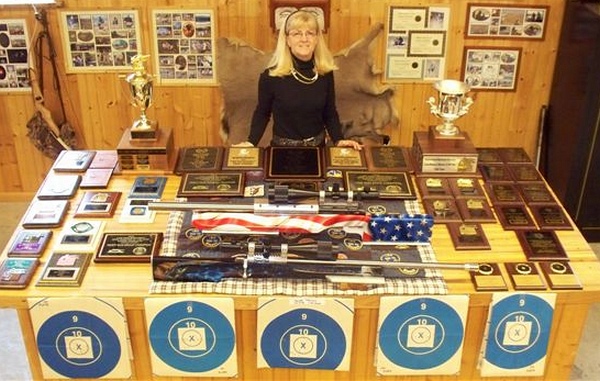
Bauer Power. Today’s Sunday Gunday story features Jim Bauer and Sally Bauer, a “power couple” in the International Benchrest Shooters (IBS) mid-range and long-range benchrest game. Jim and Sally both compete at 600 yards and 1000 yards, and both have been VERY successful. A decade ago, in 2012, Sally was the IBS 1000-yard Shooter of the Year. She had a great season, piloting her impressive Stars & Strips Heavy Gun (shown above). Sally now serves as the IBS Treasurer.
Jim Bauer has also been a top IBS performer shooting a similar, wide-forearm Maxi-Tracker Heavy Gun, with beautiful Eagle-on-black paint scheme. Jim Bauer won the IBS 2015 1000-Yard Nationals shooting a 6mm Dasher in both Light Gun and Heavy Gun classes. And Jim holds the IBS 1000-yard 20-Target Light Gun Aggregate Score Record. He set the record in 2021 with 47.15 Agg Score and 5.4171″ group average — that’s very close to half-MOA for 10-shot groups at 1000 yards!
Jim Bauer Wins 2015 1000-Yard Title with Duel Dashers
Jim Bauer won the IBS 2015 IBS 1000-Yard Nationals shooting a 6mm Dasher in both Light Gun and Heavy Gun Classes. Here’s his match-winning Heavy Gun. Smithed by Gordy Gritters, Bauer’s Heavy Gun featured a BAT action, Krieger barrel (in barrel block), Shehane HG stock, and Nightforce scope.
At the 2015 1000-Yard Nationals, Jim Bauer was both Two-Gun Champion and Overall winner. Bauer shot great in both Light Gun (LG) and Heavy Gun (HG) matches, posting Top 10 finishes in both classes. Bauer ran 6mm Dashers in both Divisions (LG and HG) with Vapor Trail bullets.
Sally Bauer Honored as 2012 IBS 1000-Yard Shooter of the Year
In 2012, Sally Bauer became the first (and only) lady to win the title of IBS 1000-yard Shooter of the Year. Sally earned that honor through hard work, dedication, and a burning desire to “be all she can be”. While helping her husband Jim rise to the top of the 1000-yard benchrest game, Sally was taking notes and working toward her turn at the top. Well friends, Sally took no prisoners in 2012 and earned Shooter of the Year honors. Sally’s handsome 67-lb Heavy Gun, “Stars & Stripes”, is painted with an American flag theme.
Sally Bauer and the IBS 1000-Yard Heavy Gun Record
A decade ago, in 2012 Sally Bauer set a then-pending International Benchrest Shooters (IBS) Score Heavy Gun (HG) record for 1000-yard competition. Her score was 100-5X with a 3.495″ tie-breaker group. Though that record has been surpassed (with a smaller tie-breaking group), Sally was the first lady ever to post a pending IBS 1000-yard benchrest record.
Sally’s Amazing 1K Group
At the end of the Heavy Gun match #10 Sally was directed by Range Officer Gordy Mitchell to leave all of her equipment and rifle setting on her bench. Sally was perplexed by Gordy Mitchell’s direction but he assured her “It is a good thing”. Rumors swirled and Dave Holland was summoned to the pits.
Dave and Gordy brought the target back to the scoring shed and had club officials and some respected competitors measure and sign the target. All agreed Sally had just shot an IBS record score. Sally’s rifle and equipment were measured and photographed and the target sent off to the IBS for final measurement and verification.
Sally’s Heavy Gun Specifications
Sally’s 67-lb Heavy Gun was originally purchased from Bill Shehane, and it uses Bill’s Maxi-Tracker stock. The gun was originally chambered for the 6-6.5×47 Lapua Improved. But the gun didn’t shoot like the Bauers wanted, so it was rechambered to 6mm Dasher by Gordy Gritters. The action is a 2″-diameter, round, chrome moly, 3-lug, 7 ½” BAT. The barrel is a 28″, 1:8″-twist Krieger, with 1.45″-diameter straight tube. The barreled action is secured in the stock with a 9″-long barrel block. The gun uses a 12-42x56mm Nightforce BR scope and a Jewel BR trigger. Gordy Gritters smithed the rifle. Jim Sauer states: “We have known Gordy for years now and trust every phase of our gun projects — all of them are mechanical works of art. When we get our guns from Gordy we know we can put our focus on brass prep and load development and don’t have to worry about the guns being right. That really helps save time.”
Editor’s NOTE: The following information was for the original 2012 load Sally ran in her IBS Heavy Gun. Load details and procedures may have changed now, a decade later.
Reloading Procedure for Sally’s “Stars & Stripes” Maxiby Jim Sauer
With every new rifle we start with new brass. The first step is to run them through a full length sizing die, then over an appropriate expander mandrel. Since we use a .270 neck on our 6 Dasher chambers, neck turning amounts to a 80% cleanup of the new Lapua brass necks. We do the normal primer pocket and flash-hole uniforming.
We fire-form two times to make sure we get nice sharp shoulder corners before competition. We then separate them according to weight using 1/10th of a grain differences for each box. Much of our loading process is geared around time savings. We look for easy-to-use, consistently good products and don’t vary from them unless we have a problem or results aren’t to our standards. We have chosen to shoot Clay Spencer’s 103gr 6mm bullets. We weight-sort and bearing-surface sort them and that’s it. I gave up trimming and tipping simply because it didn’t improve how Clay built them. We also use only one primer, the CCI 450.
We use one of four different powders. Our “go-to” powder is RL15, next we try Varget, then IMR 8208, and if that doesn’t work we try H4895. We have found that these bullets usually shoot best at 2970 fps. This is not an absolute, just what normally works best. We always try higher and lower velocities looking for that special load. Once we find the powder and quantity that works the best we play with the seating depth. Usually this is a fine-tune method and most of the time 15 thousandths into the rifling works the best. But don’t be afraid to jump the bullets as much as 0.100″. When we use this procedure we usually find a combination that will shoot nice, round ¾” groups at 400 yards.
Our reloading regimen starts with ultra-sonic cleaning our brass, then tumbling until shiny. We anneal the brass every time. We proceed to full-length resizing, repriming, and lubing the inside of the necks with graphite. We then charge with our selected powder and seat the bullets. We measure for concentricity, [shooting] the best ones for the record and the others for sighters. The load that Sally shot the record with is 33.0 grains of IMR 8208 XBR, CCI 450 primers, Spencer 103gr bullets, Lapua brass, bullet seated 15 thousandths into rifling, Velocity 2980 fps.
About Sally Bauer – In her “formative years” of competitive shooting, Sally listened to proper and basic instruction and learned at her pace. She developed her own style and discipline. Not wanting to be dependent on others Sally learned to set up her rests and carries Stars & Stripes to the bench by herself.
Jim Bauer reports: “Sally and I would like to thank the kind people we have met in this crazy frustrating game of shooting. For the most part fellow competitors have been helpful and giving of the time, experience and knowledge. Every range owner and operator we have come across has treated us like family and friend. I can think of no other sport where the participants give so freely.”
Bauer Power in Action at the 2017 IBS 600-Yard Nationals
Would you like to see this IBS “power couple” in action? Here are videos of Jim Bauer and Sally Bauer shooting at the 2017 IBS 600-yard Nationals in Memphis, Tennessee.
Jim Bauer sends 5 record rounds down range with his “Eagle” HG in Maxi-Tracker stock
Sally Bauer shoots sighter rounds with her Stars & Stripes HG in Maxi-Tracker stock
Transporting Big Heavy Guns in Style with Slide-out Carriers
The Bauers have created a very smart and clever system for transporting their rifles to matches. The Bauers have a great transport set-up, with custom, slide-out rifle carriers fitted to their van. You can see Jim’s and Sally’s Heavy Guns in the lower drawer.
And here is a close-up of the Light Gun in the Bauer’s second slide-out carrier (top in photo). The patriotic “We the People” message is welcome.
Forum member F-Class John is an avid F-Class competitor and expert handloader. John reviews reloading hardware and shooting-related products for his popular F-Class John YouTube Channel, which now boasts 300+ videos. John also does important product testing for AccurateShooter.com. Through his YouTube channel, John has reviewed many of the latest and greatest reloading tools and accessories. For today’s Video Showcase, we selected eight F-Class John tool and reloading product reviews.
If you like these informative videos, consider joining F-Class John’s Patreon Channel for live video meetings, more in-depth videos, and detailed explanations.
AndiScan Micro A2 Doppler Radar Chronograph
This is break-through technology folks. Imagine a device that replaces a big, bulky chronograph and is a small fraction of the size and weight. The revolutionary AndiScan Micro A2 chronograph records bullet velocity with great precision. Yet it can fit in your pocket, and be easily mounted on your rifle or front rest. This recent video follows up on F-Class John’s initial AndiScan Test Video. And yes folks, this product is now, finally, in production according to the maker: “(6/July/2022) Model A2 will be available on e-shop in several supply batches. Batches of first small production series will be available during July and August.”
The AndiScan Micro A2 is an advanced 24 GHz Doppler radar for measuring velocity of projectiles. This extremely small form-factor device can be directly mounted on your rifle. This makes set-up fast and easy. Plus the AndiScan Micro A2 can be used in dynamic situations, such as multiple distance matches, multi-position stages, or PRS/NRL courses. SEE: AndiScan Micro A2 Product Information.
21st Century Hydro Press and Standard Arbor Press
John notes: “You can’t really talk about precision reloading without taking about inline dies and arbor presses. For my money there’s nothing better than the lineup from 21st Century Shooting. They offer the Hydro Seater which is hands-down the best manual seater out there as well as their standard arbor press which is great for taking on the road to push back bullets as needed.”
Zero Turret Press with Whidden Sizing Die
The new Zero Press from Area 419 is arguably the best turret press ever crafted. It offers unrivaled precision, along with the highest-capacity turret head with NINE die/tool stations. Milled from billet aluminum and stainless steel, this press moves with the help of 14 bearings. In this video, F-Class John shows how to use a Whidden Gunworks full-length sizing die on the Zero Press. And John has two other video reviews of the $1200 Zero Press: 1. Zero Press First Thoughts Video; 2. Loading on a Zero Press.
Dillon 750 Tips and Tricks
The Dillon XL 750 is a favorite of high-volume reloaders. With the optional case feeder, the XL 750 offers high output with great reliability. And Dillon offers one of the best warranties in the business. In this video, F-Class John features upgrades including the Armanov tool-head holders from Europe. These are drilled and tapped for all FIVE stations allowing the user to put threaded dies in any station.
Concentricity Checking with Accuracy One Gauge
Every serious hand-loader needs a quality concentricity gauge. The Accuracy One Concentricity Gauge boasts a smart design that delivers precise, repeatable results. We like the unit’s easy adjustability and its ability to work in a variety of configurations. The Accuracy One Gauge measures internal and external neck runout of cartridge cases as well as seated bullet runout. It can also measure the runout of the ogive, bearing surface, and boat-tail of individual bullets. And it can even measure your primer pocket runout.
Teslong Rigid (Shaft) Borescope with Monitor
Seeing inside your barrel can provide clues to how well you’re cleaning and the bore’s overall health. One of the best tools on the market is the Teslong Rigid Borescope. This features a solid rod for easy use in barrels. Plus it comes with a self-contained high-definition viewing monitor so no smartphones or WiFi tablets are needed. If you’re looking for something more portable and a bit more versatile, try the Teslong Flexible Borescope, $99.99 including monitor. John was impressed with the new rigid Teslong he tested, and he likes having a dedicated monitor (no WiFi required).
Lyman Powered Case Trimmer Review
The Lyman Case Trim Xpress is an efficient, precise unit that allows easy adjustment of trim length with a click-adjustable collar. The trimmer comes with a set of cartridge-specific bushings that index off the case shoulder. One nice feature is a variable speed control. For the price, $154.99 on Amazon, this trimmer delivers excellent performance. F-Class John has another video review of the Lyman Case Trim Xpress which shows set-up and operation.
Primal Rights Competition Priming Seater (CPS) Review
If there is a Ferrari of priming tools, it has to be the Primal Rights Competition Primer Seater (CPS). This impressive bench-mounted tool allows very precise control over primer seating depth. A vertical tube holds primers ready for insertion. The action is smooth and precise. John believes that this is definitely the best priming tool on the market, though it may not be for everyone given its premium $600.00 price.
Gunsmithing Torque Wrench Comparisons
When you are working on custom rifles that might cost $5000+, and mounting scopes that can run $3000 (or more), you need to use very high-quality tools. Precise torque settings are essential, both to avoid damage to valuable parts, and to have the rifle and optic perform optimally. In this video, F-Class John looks at a variety of torque wrenches suitable for gunsmithing duties.
Do you need to pull bullets that have been seated in a case? You can use lever-actuated, collet-type pullers, or inertial hammer-style pullers, but there is a faster solution. The Grip-N-Pull bullet puller is a precision-machined hand clamp that works for multiple calibers. A single Grip-N-Pull can replace several other tools, while being faster to use. With larger-diameter bullets loaded with light-to-moderate neck tension, it works well. The bullets come out pretty easily, with no scuff marks or dents.
For smaller-diameter, .204 to .243 caliber bullets, it may be hard to grip the bullet easily, or you may end up with some jacket damage. And we wouldn’t use this for factory-crimped cartridges. One tip for the smaller-diameter bullets — you can try the tool notch one size smaller than nominal bullet diameter. One Grip-N-Pull owner reports: “I’ve had one for a while and like using it much better than a kinetic puller. I have found with .22 and .24 caliber bullets they pull better using one size down.”
Introduction to Grip-N-Pull — How It Works:
How to Use the Grip-N-Pull
Put your loaded case in the shell-holder on a reloading press. Raise the ram so the bullet is exposed at the top of the press. Then select the correct, caliber-specific slot in the Grip-N-Pull, clasp the bullet firmly, then lower the ram. The bullet withdraws from the case-neck, retained in the tool. Fast and simple. If there isn’t much neck tension (or a crimp), the bullet should come out undamaged.
Not So Great for Small-Diameter Bullets
Watch this video — the tester says the Grip-N-Pull works well with larger-diameter bullets, but there can be slippage with smaller-diameter projectiles, or those with short bearing surfaces. When there is a lot of neck tension, you have to grip extremely hard which can cause your hand to hurt after a while. And the bullets can get marred. (NOTE: For smaller-diameter bullets, it may sometimes work better to use the next size down slot. E.g. use the .22 Slot for .243 bullets.)
This video explains some of the shortcomings of the Grip-N-Pull.
Four Grip-N-Pull Models Available Grip-N-Pull bullet pullers can be used for multiple calibers. For example, the Standard Rifle Grip-N-Pull pulls bullets for these calibers: .17, .20, .22, .24, .25, .26, .27, .28, and .30. The Large Rifle model works with 8mm, .338, .375, .416 and .458. There is a third model for pistol cartridges, and a fourth “Mil-Spec” unit that does 5.56, 7.62, .338 and .50 BMG. Grip-N-Pull bullet pullers are made of 1/4″ heavy-duty #30 stainless steel and are backed by a lifetime warranty.
Speed and Efficiency of Grip-N-Pull
The Grip-N-Pull’s creators claim this hand clamp cuts bullet pulling time in half. For a speed comparison between Grip-N-Pull and a hammer-style (inertial) bullet puller, watch this Extreme Outer Limits video. Bob and Chris Beck do a head-to-head comparison between the Grip-N-Pull and an inertia puller. It’s no contest — the Grip-N-Pull is way faster, and the powder stays in the case.
Pull Comparison — Grip-N-Pull Vs. Hammer-Style Inertial Puller
In June 2020, Hornady introduced the 6mm ARC, a new SAAMI cartridge optimized for AR-platform rifles*. The new 6mm ARC is basically a 6.5 Grendel necked down to 6mm, with the shoulder moved back around .030″. That pushed-back shoulder does reduce case capacity (and velocity), but we assume Hornady did that to create a shorter, proprietary chamber so people could not simply neck-down Lapua 6.5 Grendel brass, as has been done for years with Robert Whitley’s outstanding 6mm AR wildcat.
What Is the 6mm ARC Cartridge? The 6mm ARC cartridge is a new SAAMI-spec cartridge based on the 6.5 Grendel case necked down for 6mm bullets, with the shoulder moved back 0.030. Yes it is designed to run in AR15-platform rifles. You’ll need a new barrel, bolt, and mags. If you already have an AR chambered in 6.5 Grendel, the ONLY thing you need to change is the barrel. Everything else — bolt, magazines, gas system – is compatible with 6mm ARC.
▶ Official SAAMI Cartridge (not wildcat)
▶ Fits standard AR15-platform rifles
▶ Fits Short/Mini action bolt rifles
▶ Efficient short, fat case design
▶ 30-degree case shoulder
What Do I Need To Shoot the 6mm ARC?
Faxon and Ballistic Advantage are already producing barrels, with more manufacturers sure to follow. All the other required components are already on the market for 6.5 Grendel rifles. Aero Precision already offers complete 6mm ARC uppers.
If you’re converting a standard 5.56×45 mm (.223 Rem) AR15 upper to shoot 6mm ARC, you’ll need a 6mm barrel, a Type II 6.5 Grendel bolt carrier group, and new magazines. Some folks have suggested standard AR mags will work, but trust us, you want the magazines that have been designed for 6.5 Grendel. All the hardware you need is currently available at Brownells.
* While 6-6.5 Grendel shooters are known to run stout pressures, the new 6mm ARC cartridge has a relatively moderate Maximum Average Pressure (MAP) rating of 52,000 psi according to the official SAAMI specifications. For a variety of reasons, is wise to keep pressures in a semi-auto rifle moderate. Don’t chase the velocities you might get in a bolt-action gun.
Looking for a very affordable first rifle? Or maybe you’re equipping a Scout troop with rimfires for marksmanship training. Here’s one of the best low-cost options you can find among .22 LR rimfire rigs. The Rossi RS22 is a reliable, semi-auto rifle that comes equipped with barrel-mounted iron/fiber optic sights. There are also dovetails on the receiver for mounting scope rings. The RS22 also takes most Mossberg 702 magazines.
The Rossi RS22 features an 18″ free-floating barrel, adjustable fiber optic sights and a synthetic Monte Carlo stock. For added accuracy, 3/8″ dovetail mounts allow the mounting of a scope or other optic.
Rossi RS22 Specifications:
Model: RS22 Semi-Auto, .22 LR
Barrel: 18″ Free-floating
Stock: Black Monte Carlo Synthetic Stock
Overall Length: 36.25″
Weight: 4.1 lbs.
NOTE: The Rossi RS22 on sale has a matte black stock.
Two Video Reviews of Rossi RS22
The above video review of the Rossi RS22 confirms its reliability and build quality. The reviewer praised the fiber-optic iron sights and liked the magazines. After fitting a scope to the rifle’s built-in dove-tail, the tester got excellent accuracy with CCI ammo at 25 yards. Ten shots basically formed one half-inch hole. (See video 8:24 – 8:50 and target at right.) That’s good enough for an NRL22 match. Pretty impressive for a $120 rifle!
Gunblast.com also tested the Rossi RS22. This “dandy little rifle” performed great, with flawless semi-auto feeding and cycling for hundreds of rounds. Accuracy was quite good. The tester praised the fit and feel of the stock and noted it has sling swivel studs and well-protected sights. The RS22 can also use 25-round Mossberg magazines.
Rimfire tactical-style matches are now one of the fastest-growing types of rifle competition in the country. The USA has seen a big growth in rimfire tactical matches over the last five years. NRL22 and PRS Rimfire matches are held throughout the country. Right now there are probably ten times as many rimfire tactical matches as sanctioned PRS and NRL centerfire matches. The reason is simple — rimfire ammo is much less costly, and clubs can run challenging rimfire tactical matches at nearly any outdoor gun range that allows shooting out to 200+ yards.
The National Rifle League (NRL) started off sponsoring major centerfire tactical matches, similar to PRS competitions. That proved successful so the NRL added a .22 LR Rimfire series, called NRL22. The NRL22 rimfire discipline has been a major success, as rimfire guns are fun to shoot and ammo is very affordable. The most popular NRL22 matches have drawn up to 200 rimfire competitors. And now PRS has its own PRS .22 Rimfire series. The big NETT PRS .22 match in Terrell, Texas takes place today July 2, 2022.
Precision Rimfire Match with Through-the-Lens Video
Here’s an interesting video featuring a top-tier .22 LR MDT-chassis rifle. The host, Pieter “Piet” Malan from South Africa, runs the excellent Impact Shooting YouTube Channel, which now has 320+ videos on target shooting and hunting. This video features a TriggerCam unit attached to the scope, so you can see hits on the targets, just as the shooter does.
NRL22 — Affordable, Challenging Rimfire Competition Series
NRL22 is a great way to get into competition shooting with minimal expense. There are five (5) classes: Open, Base, Ladies, Young Guns (8-16) and Air Rifle. Base Class is for the budget-minded shooter — the combined MSRP of Rifle and Optic may not exceed $1200.00 (so you could spend $700 on a rifle and $500 on a scope for example). That keeps the sport affordable. Open, Youth, and Ladies Classes have no price limits on Rifle and Optic. Visit NRL22.org to find an NRL22 match near you.
Precision Rimfire Competition Match Report
This excellent video covers a big rimfire precision match, the King of 0.28 Miles event, held at the Rush Lake Range in MN. The video shows multiple stages with targets out to 300 yards, followed by a 465-yard challenge. Host Dave shot the match with a Vudoo Gunworks V22 rifle in a Grayboe Ridgeback stock, with a Trijicon Accupower 4.5-30x56mm FFP scope. The ammo was Lapua Center-X, a top-tier choice.
Introduction to the .22 LR Rimfire Precision Game
The Modern American Rimfire Series (MARS) was created to offer “a practical/tactical event” that could be shot at modest distances. David Luu founded MARS (intially as the Mid-Atlantic Rimfire Series) to provide PRS-type competition at shorter ranges with more affordable ammo. Though the distances are shorter, the challenge remains: “Shooting a .22 LR at 200-yards is like shooting a .308 at 1,000-yards”, Luu told Guns.com. In this video, to help beginners get started, Luu provides a shortlist of beginner tips and tricks for rimfire PRS. The lead photo in this article come from the MARS website.
Rimfire Ammo Selection — Why Comparison Testing Is Important
Every gun and barrel is different, so you should test various ammo types in YOUR rifle. Additionally, you can benefit from lot testing with particular ammo types to optimize your ammo choice even more. If you’re serious about rimfire accuracy, lot testing can be very helpful, whether at your own rage or a testing center. There is no replacement for starting with a good lot of ammunition your rifle likes.
First Rimfire Precision Match — Lessons Learned
Here’s a helpful video for folks getting started in the Precision Rimfire game. Our buddy F-Class John, a top F-Open competitor (and YouTube video creator), is getting starting in the .22 LR precision discipline. Here he provides lessons learned from his first .22 LR precision match.
Tripod Review — Options for Precision Rimfire Shooters
The NRL22 match format is a great shooting discipline. NRL22 offers a high fun factor at relatively low cost. You don’t have to reload match ammo. A couple of 50-round boxes of .22 LR ammo will get you through the match. While some people bring lots of gear to matches, that’s by choice and not by necessity. You can keep it simple and still be competitive (and win).
Tips for NRL22 Competitors by Jonathan Ocab
I am a match director at my gun club and run our local NRL22 matches. People often ask me for tips for competing in NRL22. First, I recommend getting the course of fire for the month in advance and practicing those stages at the range. Here are other specific tips that should help NRL22 competitors improve their gun-handling and match results.
1. Dry Fire Practice — If you are not able to do live fire practice at the range, I encourage shooters to practice their shooting positions at home via dry fire. Setup props or barricades with pasters or other faux targets on a wall in the garage or inside the house and run through each stage.
2. Scope Magnification Level — The most common issue I see with newer shooters in NRL22 is the tendency to maximize their scope magnification. The timer will start, and the shooter gets into position on a target, but the scope is set to 15x or higher and the shooter can’t find the target. The shooter lowers the magnification, locates the target, and then increases the magnification again, takes the shot, transitions to another target, and repeats the process of decreasing magnification, locating target, etc. Novice NRL22 shooters should try using the mid-range magnification. Try shooting 7x-12x and learn to balance field of view and target image.


 One of our Forum readers asked “How can I get a custom in-line seater for my new rifle?”. First, we would say that, if you are not shooting an unusual Wildcat, check first to see if L.E. Wilson makes a stainless Micrometer Seater Die for your rifle. These dies are a joy to use, and we’ve found the fit to be exceptionally good with many calibers. Typically priced from $90-$100, Wilson stainless micrometer-top seaters are available for dozens of cartridge types: .204 Ruger, 20 BR, .222 Rem, .223 Rem, 22 PPC, 22 BR, .22-250, .223 WSSM, 6 PPC, 6mmBR, 6XC, 243 Win, .243 WSSM, 25 WSSM, 6.5×47 Lapua, 6.5 Creedmoor, 6.5-284, 26 Nosler, .270 WSM, 7mm-08, .284 Win, 28 Nosler, 7mm RUM, 30 BR, 30 IHMSA, .308 Win, .300 WinMag, .338 Edge (and MORE).


 Precision Benchrest and F-Class shooters favor premium brass from


 The headstamp bunter punch has a protrusion on the end to make the primer pocket, and has raised lettering around the face to form the headstamp writing. This is, of course, all a mirror image of the finished case head. Small cases, such as 5.56×45, can be headed with a single strike. Larger cases, like 7.62×51 and 50 BMG, need to be struck once to form a dent for the primer pocket, then a second strike to finish the pocket, flatten the head, and imprint the writing. This second strike works the brass to harden it so it will support the pressure of firing.”


 Sally’s Amazing 1K Group


