While the King of 2 Miles event kicks off today in Raton, New Mexico this week, another Extreme Long Range (ELR) competition just concluded in Trapani on the west coast of the Italian island of Sicily. The challenging Extreme Shot One Mile Italia in Sicily took place September 22-26, 2021.
Our British friend Gary Costello took top honors. He reports: “The end of a fantastic week in Sicily, competing at the Extreme Shot One Mile Italia competition. It was great to take home the win. All credit goes to my shooting partner/spotter Stuart who did the business! And congratulations to the other podium winners: Second Place Iacono Rosario and Third Place Rod Formosa. A big thanks to the organizers for a great competition. We made many new friends. See you all next year!”
Click below to watch Official Video of Extreme Shot One Mile Italia winner Gary Costello’s final string. The video records the shots in real time as his spotter was seeing it. This last string had steel targets at 1400m, 1500m, and 1640m. The 1400 and 1500m targets were 60x70cm plates while the most distant 1640m target used a 70x80cm plate. 1640 meters is 1.019 miles.
If you watch this video closely, you can see Gary’s 33XC bullets score hits, including a clear hit on the 1640m target (starting at 3:10 time-mark). Gary’s shots produced visible dark spots on the steel.
Gary was shooting the 33XC cartridge with Berger 300 OTM Bullets. His big ELR rifle, built by GS Precision in the UK, features a BAT ‘M’ RBLP action, Manners LRT carbon stock, and Benchmark 34″, 1:7.5″-twist, five-groove barrel. Gary notes that barrel only had 30 shots through it when the match began. The scope was a March 5-42x56mm HM FFP wide angle with MIL FML-3 reticle.
The event offered a long range challenge set in the beautiful Sicilian countryside with targets placed from 500m to 1640m (one mile is 1609.34 meters). We love the location, and participants praised the event.
Gary Costello’s Post-Match Report:
Q: How is the range in Trapani and what were the wind/weather conditions during the match?
Gary: The range is situated in a valley with distant tall hills. This makes a great backstop. The weather, as you would expect, was warm, usually 80-85 degrees F. The wind was strong, predominately from the left going up the valley. However, it was being affected by the topography. Some of the closer targets were as difficult as the long ones due to the conditions.
This shows the target locations at the Sicily range except for the cold bore and “surprise” targets.
Q: What do you like about ELR competition?
Gary: This was my first ELR competition. I have been ‘lurking’ for a while and made a trip to France for KO2M back in 2019 (just to watch). ELR is very different to F-Class. However the fundamentals are similar. I do like the longer ranges and the challenges these create to make contact. An accurate rifle is essential.
Q: How did you like Sicily and the hospitality of fellow competitors?
Gary: Sicily is fantastic, with super-friendly people. All the guys at the range and the organizers bent over backwards to accommodate and help. Plus there were fantastic lunches delivered daily! Logistics and COVID restrictions didn’t make the trip easy. However it was all worth it.
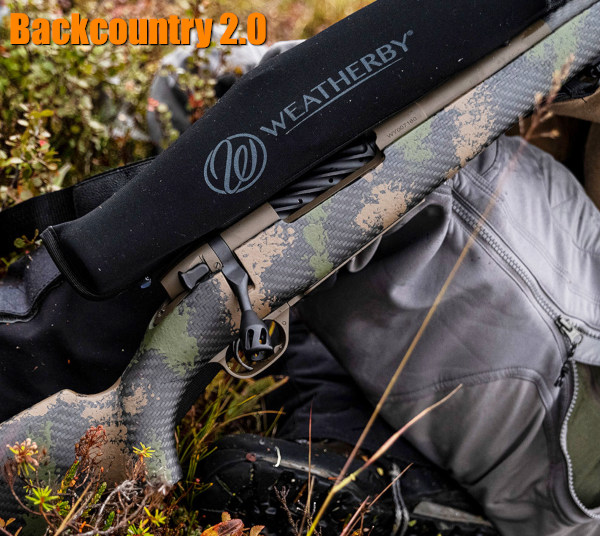
Light is Right — Weatherby’s Backcountry 2.0 rifles weigh as little as 4.7 pounds (before optics).
Here is good news for backcountry hunters. Weatherby’s new Backcountry 2.0 carbon-stocked hunting rifles weigh well under 6 pounds before optics. There is even one titanium action model series that weighs just 4.7 pounds. The 2.0 series now offers both standard steel receivers or even lighter titanium receivers. And Backcountry 2.0 Carbon models are equipped with a new carbon fiber stock that is the lightest in the industry — weight a mere 20 ounces for standard actions. For further weight savings, some models feature a tensioned carbon fiber-wrapped barrel. But all that high-tech doesn’t come cheap — MSRP for the titanium action carbon barrel model is $3749.00!
Ultralight Carbon Stock — Weatherby’s new Blacktooth stock features a Carbon Link™ bedding system which engages the recoil lug and distributes recoil throughout the stock without the weight of a traditional aluminum bedding block. This makes the overall stock lighter and stiffer.
Along with the new ultra-light elements, these Weatherbys have premium Mark V features: 54-degree bolt lift for fast cycling, fluted bolts, TriggerTech triggers, and Cerakote finish on metal parts. All the Backcountry 2.0 series rifles have a sub-MOA accuracy guarantee.
Weights for Backcountry 2.0 Models range with chamberings:
Weight Saving Secrets — How Weatherby Achieved Such Light Weights GunsAmerica Digest reports: “A huge amount of the weight savings comes thanks to the updated carbon fiber Blacktooth stock by Peak 44. This stock uses what they call their Rock Solid Carbon Link bedding system which eliminates the need for a metallic bedding block. The Blacktooth stock weighs less than 20 ounces. The Backcountry 2.0 [series adds] both a carbon fiber stock and either fluted #1 MOD-profile or #2 MOD-profile carbon steel barrels or #4 MOD-profile BSF carbon fiber-tensioned barrel to achieve these light weights.” READ GunsAmerica Review.
To mitigate recoil Weatherby developed its new 3DHEX® recoil pad — the gun industry’s first production 3D-printed pad. The 3DHEX’s three-dimensional honeycombed design extends the duration of the recoil pulse — taking away the sharp kick. Weatherby explains: “With the same amount of recoil spread out over a much greater time period, felt recoil is greatly reduced[.]” Backcountry 2.0 rifle recoil is also reduced by factory-fitted Accubrakes, contoured to match barrel profile.
Today is National Hunting and Fishing Day. To help the avid hunters among our readers, here are Twenty Tips that can help ensure a safe and successful hunt. These tips have been compiled from our AccurateShooter Hunting Forum, with help from Hunting Editor Colton Reid (who has already been out hunting this month). Some items are preparatory — such as working with maps, sighting in the rifle, and improving physical fitness. We also talk about equipment — having the right gear, from proper boots to a GPS for multi-day hunts.
Of course there are entire volumes written on hunting, but these 20 Tips can benefit all hunters. Follow these suggestions and you should have a safer hunting experience with greater likelihood of success. If you liked these pointers, you’ll find two dozen more helpful hints on the NSSF Website.
Preparations Before The Hunt
1. Map Your Hunt and Notify Others — Before your hunt, make a plan and notify friends and family members about WHERE you are going and your intended return date and time. Print out a Google Satellite map and locate landmarks and trailheads. Mark where you plan to park your vehicle and give a copy of this map to friend and/or family members. A hunter may injure himself by falling off a rock, or tumbling in a creek-bed. After that kind of injury the hunter may be confused or unable to walk. If you get stranded in the wilderness, you want trusted persons to know where you are. So, before you leave on a trip, provide a map to a friend or family member. Show them where you will leave your vehicle, and where you expect to be every day of your hunting adventure.
2. Licenses and Permits — Make sure you have a valid hunting licenses and all the necessary tags. Begin this process with ample time before your intended hunt(s). The NSSF adds: “If you are crossing state or national borders, find out about any special considerations you must take care of. Border crossings can mean knowing about firearm transport laws or Chronic Wasting Disease-related regulations.”
3. Work on Your Fitness — On a multi-day hunt you may be trekking many miles. You need to be in good shape. If you are out of shape you may be putting yourself in a precarious situation, particularly if you underestimate the terrain difficulty. As the NSSF says: “Not being able to handle the conditions lessens your chances of success, can turn a great experience into an agonizing one and can endanger your health.”
4. Do Your Homework — Study the area you will be hunting. Talk to other hunters. Look at satellite photos. Get a real sense of the walking and terrain challenges. For a multi-day hunt, MAKE a PLAN. The NSSF states: “Eliminate surprises. Learn as much about where you will be staying, the area you will be hunting, what the weather might be like and what you need to bring[.]”
5. Rifle and Ammo — Make sure your rifle is sighted-in and your ammo is tested. Sight-in your rifle with the ammo you plan to use on your hunt. CLICK HERE for 4-Shot Sight-in Method. After sighting-in from the bench, confirm your zero by shooting from typical hunting positions (kneeling and with forearm supported on a rock or post).
6. Shooting Positions — Practice the shooting positions you will use in the field. Practice sitting, kneeling, and prone positions. You should also practice with shooting sticks, using your day pack as a rest, and with a bipod. Try to have a rock-steady rest before taking your shot.
7. Back-Up Irons — If possible, select a rifle with back-up iron sights. While modern scopes are very durable, they can and do fail (glass can crack). If you’ve invested a lot of time and money in your hunt, back-up iron sights can keep you in the game even if your riflescope fails.
8. Communications and GPS — Bring a GPS if you are in a wilderness area far from civilization. It’s a good idea to bring a cell phone, but you may not have coverage if you’re quite a distance from populated areas. A smart-phone also doubles as a digital camera to record your trophies. For navigation and safety, consider getting Garmin inReach Explorer+. This high-tech handheld unit features interactive SOS, connecting you to the GEOS 24/7 search-and-rescue monitoring center. They also allow you to send and receive text messages, no matter where you are, via advanced inReach satellite technology. Yes you can communicate even if you are miles from the nearest cell tower.
9. Select Good Gear — Make sure you have GOOD BOOTS that are comfortable — you’ll spend a lot of time on your feet. You may want a pack with harness for your rifle so you have both hands free. On a multi-day trip, make sure you can carry enough water, and that you will stay warm enough at night. Good practices for backpacking apply to multi-day hunts.
10. Make a Gear Checklist — Create a complete checklist of the gear and supplies you need. That includes arms, ammunition, rangefinder, binoculars, proper clothing (including spare clothes), hunting accessories, sleeping gear (on multi-day hunts), toiletries, medications. Don’t forget a good first aid kit — lots of bad things can happen during any wilderness trip. You can cut a hand, break an ankle or worse.
During The Hunt
11. Have a Plan — know where you plan to go and when. Try to be where you want in the early morning and early evening hours when deer are likely most active.
12. Take Your Time — If you spot a deer and get too excited and don’t take your time you may spook him. Go slow and glass. If possible, wait for the animals to bed down and relax. Then work out the best way to approach your prey. Remember, “You get so few opportunities, don’t screw it up!”
13. Glass More, Walk Less — Let your eyes do the walking — get good binoculars and use them. With their heightened senses of smell and hearing, deer/elk are able to spot you way better than you can spot them. If you are walking around a lot, chances are you are getting spotted by your prey.
14. Riflescopes Are Not Binoculars — Never use a riflescope as a substitute for binoculars. The temptation to do so is real, but when one does this, one is by definition pointing the muzzle of the gun at unknown targets. We like binoculars with built-in rangefinders. When glassing at long range, try supporting your binoculars on your pack.
15. Be Sure of Your Target before Shooting — Every year during whitetail season, farmers are forced to spray-paint their cattle or risk having them “harvested” by hunters who don’t bother confirming the species in their sights. Hunters with “buck fever” can make mistakes. When in doubt, don’t shoot.
16. Know When to Unload — When finished hunting, unload your firearm before returning to camp. You should also unload your gun before attempting to climb a steep bank or travel across slippery ground.
17. Bring Hearing Protection — While pursuing and stalking your prey you’ll want full sensory use of your ears. But when you’re finally ready to take the shot, slip in hearing protection. A shot from a large-caliber hunting rifle can exceed 170 decibels. Unprotected exposure to noise from a SINGLE 170+ dB shot can cause permanent hearing damage. (Source: ASHA.org). If you make a follow-up shot, you double that noise hazard. Therefore a hunter with a non-suppressed rifle should have hearing protection available.
You can keep a pair of quick-insert plugs on a cord around your neck. Or, get a lightweight neck band with earbuds, such as Howard Leight Quiet Band QB2HYG, 3M Safety Band, or Sellstrom Band, all with a good 25 dB Noise Reduction Rating. You can keep these lightweight bands around your neck, for quick deployment before you shoot.
“Once a hunter is successful, the REAL work begins.” — Colton Reid
18. Harvesting the Animal — When dressing your animal, be careful with the meat. You’ll want very sharp knives. Some hunters prefer knives with replaceable, razor-sharp blades. Don’t rush the task. Make sure you don’t get moisture or dirt on meat. The three spoilers of meat are heat, moisture, and dirt.
19. Pace Yourself When Packing Out — If you DO succeed, and bring down a big buck, will you be able to dress the animal and carry out the meat? Always be prepared to hike out with extra weight. If you are successful, make sure not to waste the meat you worked so hard for. Choose a pack that can help you carry a heavy load. Remember, this is not an insignificant challenge — you may be carrying 60 to 100 extra pounds in addition to your other gear. Again, take your time. Rest as needed. Don’t hurt yourself.
20. Remember to Enjoy the Experience — Our Hunting Editor, Colton Reid, offers this sage advice to all hunters, but particularly to novices: “Have fun, and appreciate your hunt, whether you bag a buck or not. It is a privilege to experience the wilderness and to get away from the city. Enjoy it while you’re out there. And keep your spirits up. You may get tired, but remember that ‘comes with the territory’. At the end of the day, yes you may be exhausted. And you may want to quit and go home. But stay positive, stay focused. Be patient, the experience is worth it.”
CLICK HERE for Hunter Training/Mentoring Programs State-by-State.
Prepare For Your Hunt — Get Fit and Practice Positions
As part of the NRA’s Tips & Tactics video series, Kristy Titus explains how to prepare for a hunt. Titus, co-host of the Team Elk TV show has hunted around the globe. She grew up in the outdoors, running pack mules in Oregon with her father. In this video, Kristy discusses fitness training and demonstrates field positions that can be employed during a hunt.
Kristy explains: “Hunting can lead you into some steep, rough country. It’s really important that you train both your body and your mind to handle the elements and the rigors of hunting So, if you plan on going on a mountain hunt, get out and train your body. Train with your firearm. Get off the bench and have some fun with this. Do some positional shooting or, if you want to add a stress dynamic… have someone put you under a time parameter.”
Visit WhereToHunt.org
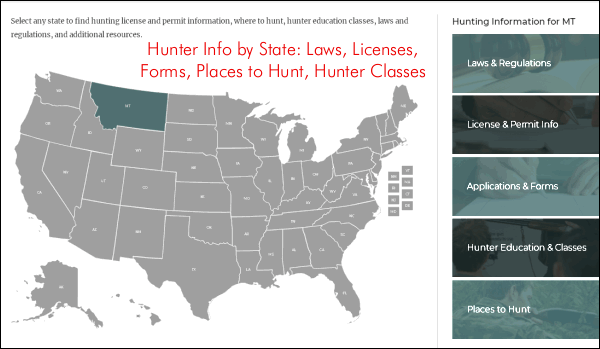
There’s a great online resource for hunters that will help you find game locations in your state and ensure you have all the proper permits and game tags. WheretoHunt.org features an interactive map of the country. For all 50 states, the NSSF has compiled information about hunting license and permits, where to hunt, hunter education classes, laws and regulations and more. For each state you’ll also find a link for required applications and license forms.
Tomorrow, September 25, 2021, is National Hunting and Fishing Day. Hunting season is here — and we know many of our readers will soon head to the woods in pursuit of deer, elk, or other game. To make a good shot, it’s wise to rest your rifle when possible. In this video, methods for stabilizing a rifle in the field are demonstrated by Forum member Thomas Haugland, who hails from Norway. Thomas focuses on practical field shooting skills for hunters. Thomas (aka ‘Roe’ on Forum and Sierra645 on YouTube) shows how to verify his zeros from bipod and then he demonstrates improvised field rests from the prone, kneeling, and sitting positions.
Thomas explains: “In this video I focus on basic marksmanship techniques and making ready for this year’s hunt. As a last check before my hunting season, I got to verify everything for one last time. My trajectory is verified again, the practical precision of the rifle is verified. I also practice making do with the best [improvised] rest possible when an opportunity presents itself. After getting knocked in the face by a .338 Lapua Magnum rifle during a previous filming session, I had to go back to basics to stop [flinching]. I include some details from bipod shooting that hopefully some hunters will find useful. Fingers crossed for this years season, good luck!”
How to Stalk Game — Tips from Thomas
If you liked that video, here is another valuable video from Thomas. In this “How to Approach Deer” video, Thomas explains the basics of a successful stalk. If you are headed into deer country this fall, definitely watch this video.
SCI Convention Returns to Las Vegas in 2022 Safari Club International celebrates 50 years of defending the freedom to hunt. The International Hunters’ Convention returns to Las Vegas in 2022. The Convention will run January 19-22, 2022 at the Mandalay Hotel complex. This is the world’s largest hunting convention, and should attract thousands of visitors. Convention seminars will cover the full spectrum of hunting, fishing, shooting and outdoor adventure.
The SCI Convention has 320+ exhibitors registered currently. These will include gun-makers, optics companies, gear manufacturers, outfitters, and top hunting resorts. Outdoor industry companies will showcase the latest products — from firearms and accessories to optics, ammunition, archery, gear and equipment. Other offerings include furs, jewelry, furnishings, and outdoor clothing.
SCI auctions offer exclusive firearms, once-in-a-lifetime hunts and adventures, and fine artwork. Proceeds from SCI’s auctions support SCI Foundation’s conservation and education programs.
Established in 1971, SCI will mark its 50th year at the Mandalay Bay Resort in Las Vegas, January 19-22, 2022. Exhibits and daytime activities will be held at the Mandalay Bay Convention Center. The host hotel will be Mandalay Bay, a 43-story luxury resort and casino on the Las Vegas Strip.
This year’s lineup of guest speakers includes top pro-hunting political voices Tucker Carlson and Donald Trump Jr.; other special guests include Craig Morgan, Edward Byers, and Jim Shockey.
“We are pleased to be able to bring the SCI Convention back to Las Vegas in 2022,” said W. Laird Hamberlin, SCI CEO. “We know our exhibitors and members will look forward to being a part of this special event[.] This year we will be celebrating 50 years of SCI defending the freedom to hunt with the convention of a lifetime. From our lineup of special guests to our top-drawer exhibitors from around the world, the 2022 SCI Convention will be one for the record books.”
This video shows highlights from Past SCI Conventions
About Safari Club International
For 50 years, Safari Club International (SCI) has been the leading defender of the freedom to hunt and supporter of wildlife conservation worldwide. SCI is the only hunting rights organization with a Washington, D.C.-based international advocacy team and an all-species focus. SCI mobilizes our 152 chapters and affiliate network representing 7.2 million hunters around the world. SCI’s sister organization, the SCI Foundation, supports research, management, and rural communities in North America, Africa, and Central Asia.
In this article we cover a better barrel cooler you can build yourself for under $15. This uses a high-speed inflator fan sold on Amazon, along with a piece of temp-stable tubing. Forum member (and popular YouTube host) F-Class John devised this system. He found it cools his barrels in less than half the time of some other products. And the system can also serve as an Empty Chamber Indicator (ECI).
Barrel coolers perform an important function — reducing barrel operating temperatures. This can definitely help preserve barrel life and help maintain good accuracy in competition. In addition, keeping barrels cool can reduce the chances of excess chamber pressure, an important safety concern.
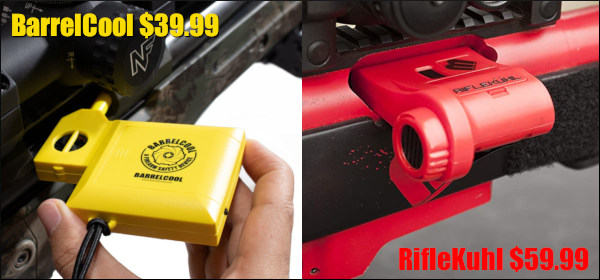
There are a variety of commercially-available barrel cooling systems. There are external fans, as well as internal, slip-in systems than can do double duty as an Empty Chamber Indicator (ECI). You can get the original yellow $39.99 BarrelCool or the red $59.99 RifleKuhl from Magnetospeeed. Both are good products. But F-Class John came up with a system that works even better — one you can build for a fraction of the cost of those yellow or red fans.
Build Your Own Barrel Cooler for Under $15
This system is easy to put together. Order a $11.99 YIVAR pump from Amazon. This is a small, high-output pump designed to inflate air mattresses. Then get some high-temp-rated tubing from a local supply shop. Then trim the case-head off an old piece of brass. Taper the end of the tube a bit and fit it in the case. NOTE: Use of the fitted case is optional. Having the case provides a nice fit in your chamber. But the system works pretty well just with the tubing and Yivar air pump.
In his .284 Win barrel, the Yivar pump system blows air at 10+ mph out the muzzle. F-Class John says that is “about three times the velocity of other systems”. The Yivar pump “holds about 45 minutes of charge” so he can use it for 15 minutes after each of three strings in a match. And then it can be recharged from a USB-compatible battery pack at the range. John notes the fan continues to blow about the same speed for the full 45-minute charge duration.
Key Benefits of this system
1. Faster Cooling
2. Low Cost (under $15)
3. Longer run time on battery
4. Fan battery is USB rechargeable
5. Finally a use for that worn-out brass
John confirmed the effectiveness of his barrel cooler using a stick-on temperature tape placed on the barrel. This showed that his fan system cooled the barreled in less than HALF the time as the plastic commercial fan systems. In addition, his run time was excellent, and the Yivar’s built-in Lithium-Ion battery is fully rechargeable so he never has to buy expensive batteries.
What are the downsides? Not many. The fan IS somewhat noisy — watch video at 4:04-4:28 time mark to hear the fan. F-Class John notes, however, that the Yivar fan is about 4 decibels (dB) quieter than a Magnetospeed RifleKuhl, so the Yivar’s noise is not that bad.
Here are comments from YouTube viewers who like F-Class John’s invention:
Finally something affordable! It’s compact and can be recharged at the range. I have room for this but not all the other gadgets you show. And a poor pensioner like my self can afford it! Thanks for the tip.
Ingenious and awesome idea! I bought one as soon as I saw this. I’ve been thinking about getting a cooler when I’m testing my loads. Thanks!
Brilliant… Brilliant… Brilliant! I have been deferring buying a barrel cooler for years now on account of wanting to spend my toy fund budget on other things. Considering how cheap it is to build, there is no excuse to not make one now.
Fan with Plain Hose Also Works Well (No Brass Case Cutting/Fitting Required)
F-Class John likes the custom fit he achieves with the hose inserted into a piece of modified brass. However he notes that the system also works well with no brass at all — i.e. just hose and fan. If you have a small diameter chamber, this may actually work better. Simply put the hose on the fan, trim/taper the forward hose end to fit and you are good to go.
F-Class John explains: “The heavy duty tubing and the motor works just fine without a brass case. The hose can sit in the chamber by itself. Obviously not every brass case will easily allow for you to put it on the end of the tube. For many people simply using the tube (without brass) may be the simpler option.”
Bang Clang! The 2021 Steel Challenge World Speed Shooting Championship will be featured on Shooting USA TV tomorrow. The Shooting USA Steel Challenge episode runs September 22, 2021 on the Outdoor Channel. Show times are: Wednesdays, 9:00 PM Eastern and Pacific, 8:00 PM Central.
This past April, the fastest speed shooters in the nation showcased their skills at the Steel Challenge Championship at Alabama’s Talladega Marksmanship Complex in Alabama. The Steel Challenge course consists of multiple 5-target close-range stages. This discipline has been called “drag racing with guns”. Draw and shoot 5 steel targets with time as your score. The shooter with the lowest overall time wins.
There are multiple pistol and revolver classes, both rimfire and centerfire, iron sights and optics. Increasing in popularity (and speed) are the rimfire rifle and pistol-caliber centerfire rifle classes. There are 13 gun classes in total, the most for any shooting championship. In the centerfire handgun match, the fastest times are posted by competitors using enhanced open guns with compensators and red-dot optics. This year, KC Eusebio has set out to become the only eight-time World Speed Shooting Champion.
Here is a full length Shooting USA Steel Challenge Episode from 2017:
Shooting USA Video covers Course of Fire, Firearms Classes, and Target Layouts (1:20)
Definitely watch the 4-minute video (above) produced by Shooting USA. It explains the classes, shows the stages, and illustrates ALL the different gun classes, pistol AND rifle. You can also see some of the world’s fastest shooters including Jessie Harrison (1:47, 3:44) and Max Michel (3:48). Be amazed by the speed of semi-auto rimfire rifles — five targets hit in under two seconds!
Here is Jessie Harrison, the fastest lady pistol shooter on the planet. At the 2021 World Speed Shooting Championship, Jessie won the Ladies Overall Open title for the 13th time with a total time of 93.03 seconds. Full Report on SSUSA.org.
The Steel Challenge was founded in 1981 by Mike Dalton and Mike Fichman, in Southern California. The two Mikes wanted an exciting alternative to paper targets and came up with the all-steel format. The Steel Challenge World Speed Shooting Championships have grown to one of the largest professional pistol competitions in America. In 2021, scores of competitors competed at the Talladega Marksmanship Park for glory and cash prizes. The Steel Challenge is governed by the Steel Challenge Shooting Association (SCSA) that consists of eight standardized stages with three types of steel targets: small circle, big circle, and square. Here is a steel challenge layout in Germany.
Ace tactical shooter and gunsmith Jim See of Elite Accuracy LLC recently tested a Frankford Arsenal rotary brass tumbler. Like the older Thumbler’s Tumblers, this can tumble your cases in a liquid solution. The wet-tumbling process worked very well Jim reports. Posting on Facebook, Jim noted: “I was super impressed with the Frankford Arsenal rotary tumbler and cleaning packs they sent me. I ran 350 pieces of brass for one hour. They now look great.” Jim appreciated not having to deal with dry tumbling media, such as crushed walnut shells. Dry media produces dust and can leave residues or clog flash-holes.
Interestingly, Jim recommends you try wet-tumbling WITHOUT using stainless media. At least give it a try. Tumbling without media simplifies the process and you don’t have to worry about pins stuck in flash-holes or case-necks*. Jim reports: “Stainless steel pins come with the Frankford kit, but mine hit the trash right out of the box. There is no need to clean the inside of your cases 100% and that’s all the pins add to the equation. The brass bumping brass with hot water and Frankford’s liquid cleaner works great all by itself.” One wag stated: “That’s great to hear. Stainless steel pins are a PITA.”
Other Facebook posters concurred with Jim’s evaluation of the Frankford Arsenal Rotary Tumbler:
“I’ve had one for a couple years, and it works well. I usually run about 250-300 Dasher cases at once in it. But I use the pins because I’m OCD about clean brass.” — David W.
“I’ve had one for a year and a half and it definitely works with or without pins.” — Luke C.
“I got one about six months ago and have yet to use any SS media. I just use some dawn, distilled water, and Lemi Shine®. Turns nasty 5.56 range brass bright and shiny.” — Brian D.
“I don’t use the pins either and use a combination of Dawn soap and Lemi Shine.” — Jon N.G.
This video shows how to assemble and operate the Frankford rotary tumbler. But note, Jim See does NOT feel that it is necessary to use stainless media.
How to Dry Your Brass — Hair Dryer Vs. Machine
The downside of wet tumbling is that you end up with a pile of wet brass at the end of the cleaning cycle. There are many ways to dry brass, from drying in the sun to using a kitchen oven (be careful not to “overcook” your brass). One Facebook poster asked Jim: “What is your drying method for wet brass, and how long does it take?”
Jim See replied: “To start I just drain off the dirty water, and rinse the brass with clean hot water. Then I roll the brass on a towel for 30 seconds and put the brass in a one-gallon bucket. Next I insert a hair dryer in the bucket (with the brass) and let it run for about 5 minutes. With this procedure, the drying process for me is done in less than 10 minutes.”
Jack Lanhart has another method: “I use a food dehydrator. It takes 30 to 45 minutes.”
For those who don’t want to mess with towels and hair dryers, Frankford Arsenal offers a matching Platinum Series Case Dryer that simplifies the process of drying brass. Lyman also makes an excellent Cyclone Case Dryer. These drying machines each cost about $65.00 and both have multiple levels so you can separate different types of cartridge brass. Lyman states that “The forced heated air circulation of the Cyclone will dry your brass inside and out within an hour or two, with no unsightly water spots.” The Lyman dryer can also be used for ultrasonically-cleaned gun parts.
*The Frankford Rotary tumbler does include media separators if you choose to use the provided pins or other media. CLICK HERE for diagram showing how to use media separators.
.223 Rem for Long Range Palma, by John Whidden (5-Time Nat’l LR Champion)
We’ve seen quite an amount of interest in recent years in .223s for Long Range Palma shooting. Yes, the .223 Remington is a pretty light cartridge for long range use, but the specific rules of Palma shooting make it a choice worth considering.
Back in 2019, the Int’l Confederation of Fullbore Rifle Associations (ICFRA), the international governing body for Palma shooting, made a rule change allowing .223 Rem rifles to use bullets of less than 91 grains. Previously the rule allowed the use of bullets less than 81 grains in the .223 Rem, and we have long had the popular option of .308s shooting bullets less than 156 grains. These heavier bullets such as the 85.5gr Berger LR Hybrid and 90gr Berger VLD make the .223s quite competitive in the wind with the old standby .308 Winchester. The .223 does hold the obvious advantage of much lower recoil than the .308. [Editor: The reduced recoil is quite noticeable in the video below where John is shooting his .223 Rem rifle.]
John Whidden Shoots .223 Rem Palma Rifle with 90gr Berger VLDs
Watch video at 00:25 and you’ll see the recoil of Whidden’s .223 Rem Palma rifle is significantly less than a .308 Win Palma rig. John joked: “With the .223 Rem there is just a pop and a wiggle after the shot.”
.223 Rem Palma Rifle — Barnard Action, Tec-Hro Stock
The Barnard P action imported by Whidden Gunworks is the foundation for many winning Palma rifles. As soon as our USA shooters returned from the New Zealand Palma match in 2019 they were immediately requesting bolts to convert their actions to .223 Remington.
Given all of this interest in the .223 Rem, I decided to build one myself and see if all of these theories about wind performance held water. Starting with my Barnard P action, I worked with Tec-Hro in Germany to use one of their Fanatic stocks for the project. The Fanatic is a modern aluminum stock suitable for prone or Three Position use. The stock uses adapter blocks to work with a wide variety of rimfire actions such as Anschutz, Walther, and Feinwerkbau. As far as I know we were the first to test it out for centerfire use. After shooting the stock with my .308 Win barreled action installed to refine a few details and ensure the stock would stand up to recoil, I then mounted my .223 Rem barreled action and went to the range.
Prior to my range visit a decision was made concerning bullets and twist rate. After discussion with Mark Buettgen at Bartlein Barrels I ordered two barrels — a 1:7″-twist and also a 1:6.25″-twist. Mark was looking for some data using the Sierra 90gr MatchKing bullet and we expected that the faster twist rate might give the best success with that MatchKing bullet. When the barrels arrived they were chambered and installed on the rifle.
John uses a Warner rear adjustable sight with a Centra front sight.
Fast Twist-Rate Barrels for Long .223-Caliber Bullet
First up the 1:6.25″-twist barrel was installed and testing commenced. The barrel shot extremely well right out of the gate. All loads used Lapua brass and Vihtavuori N140 powder. I tested the Berger 85.5gr and 90gr bullets as well as Sierra 90gr and 95gr bullets. Testing with the 6.25-twist barrel went well with both of the Berger bullets looking especially good. Later the 1:7″-twist barrel was mounted and tested.
While both barrels were very accurate we decided that the 1:6.25″-twist barrel outshined the 1:7″-twist tube. Now we all know that some barrels are just a little more accurate than others. With such a small sample of data here (just two barrels) I’m not saying that a 1:6.25″-twist is decidedly better. In fact we have a number of customers shooting 7-twist barrels who are shooting them very well. With this particular rifle however, the 6.25-twist seems to be the more accurate of the two.
.223 Rem Load Development for Palma Competition
The load I settled on is Lapua brass, Vihtavuori N140 powder, and Berger 90 grain VLDs which I moly-coat. I soft-seat the bullets into the lands with only .001″ neck tension or a little less.
Why the Berger 90gr VLD? The secret sauce is that the 90gr VLD is much superior in the wind after we point it up with the Whidden Pointing Die. The 85.5gr Hybrid bullet comes from Berger with this treatment already done while the 90gr VLD does not. When the 90-grainer is pointed up, the wind drift is a few percent better than the 85.5, given the velocities that I feel comfortable achieving with the rifle.
I settled on 2840 fps for the 90gr VLD and 2880 fps for the 85.5gr Hybrid from a 32″ barrel. When pointed up, the 90-grainer shoots flatter to 1000 yards by 1 MOA which indicates a G7 BC of .289 in my combination. Wind Drift in a 10 mph direct crosswind at 1000 yards is 70.8″ with this 90gr combination compared to 76.8″ for the 85.5gr load.
Testing in Competition — at Camp Perry
This past August 2021 at the CMP Long Range National Championships at Camp Perry I finally had the chance to shoot the rifle on a big stage. Winds that day were from almost directly 12:00 to about 1:30 switching headwinds. Velocity was around 8-10 mph meaning not the easiest or the hardest of conditions. I managed a third place finish in the Palma match. That proves the .223 Rem is definitely competitive in elite Palma events.
.223 Rem Performance in the Wind
My sense of the .223 Rem’s wind performance was that it was in line with the performance I’d expect from my .308 Win Palma gun. Of course the lack of recoil made the .223 Rem much easier to shoot well.
How to Order a Rifle Like This Whidden Gunworks can build a rifle like this for Palma competitors who want to move to .223 Rem. John tells us: “We’ve built a number of these combinations of the Barnard P action, Tec-Hro Fanatic stock, and Bartlein barrel. They all shoot incredibly well and the ergonomics are top notch. One of the good points is that the current price of $3875.00 (without sights) makes it a bargain for a top-tier Palma rifle.”
About John Whidden
5-Time National Long Range Champion
John Whidden is founder and owner of Whidden Gunworks and a lifelong competitive shooter. Major shooting accomplishments include being a 5-Time U.S. National Long Range Champion, winner of the Australia National Queen’s Prize, and member of three USA Palma Teams. John is currently active in Long Range Highpower, 300 Meter Prone, and Smallbore prone events. John tells us that one secret of his success is having top equipment: “The mental component of Long Range competitive shooting is always challenging but having tremendous confidence in the accuracy of your equipment is a huge benefit. There’s nothing to start your Palma match off well like knowing that you are shooting the most accurate Palma rifle you’ve ever owned.”
Whidden Gunworks stands ready to help with your shooting and reloading needs. Whidden Gunworks specializes in custom bolt action rifles, reloading dies, other reloading tools, and reloading components. Well known for match-grade custom rifles and high-quality reloading dies, Whidden Gunworks’ growing lineup includes components from Berger, Lapua, Vihtavuori, and SK rimfire ammunition. Learn more by visiting www.WhiddenGunworks.com.
Hunting season is starting soon. We know many readers have acquired a new hunting rifles, or perhaps are using new ammo or a new optic. If you’ve got new gear, you’ll want to sight-in and zero your hunting rig properly. Here’s how…
Here’s a simple procedure that lets you get a solid zero in just four shots. Of course you probably want to fire a few more rounds to confirm your zero before you head off to your hunting grounds, but this will let you get on-target with a minimum amount of time and ammo expended. (This assumes your scope is securely mounted, and the bases are not drastically out of alignment.)
QUICK-TIP: The Key to this procedure is Dialing to Shot One Point of Impact (POI). Re-aim at center of target after SHOT ONE. Then with the rifle motionless, use the turrets to put the middle of the cross-hair (reticle) on the first shot location. Be sure NOT to move your rifle while clicking.
1. First, remove the bolt and boresight the rifle. Adjust the position of the rifle so that, looking through the bore, you can see the center of the target with your eyes. Secure the rifle in the rests to maintain its position as boresighted. Then, without moving the rifle, center the reticle. That should get you on paper. With the rifle solidly secured in front and rear rests or sandbags, aim at the center of a target placed at your zeroing distance (50 or 100 yards). Confirm there are no obstructions in the barrel! Then load and fire SHOT ONE. Then, return the gun to the exact position it was when you pulled the trigger, with the cross-hair centered on the target as before.
2. Locate, in the scope, where your first bullet landed on the target. Now, while you grip the rifle firmly so it doesn’t move, have a friend adjust the turrets on your scope. While you look through the scope, have your friend turn the windage and elevation turrets until the cross-hairs, as viewed through the scope, bisect the first bullet hole on the target. Use the turrets to move the center of the reticle to the actual position of shot number one. IMPORTANT: Dial the crosshairs to the hole — don’t move the rifle.
3. After you’ve adjusted the turrets, now re-aim the rifle so the cross-hairs are, once again, positioned on the target center. Keep the rifle firmly supported by your rest or sandbag. Take the SECOND SHOT. You should find that the bullet now strikes in the center of the target.
4. Take a THIRD SHOT with the cross-hairs aligned in the center of the target to confirm your zero. Make minor modifications to the windage and elevation as necessary.
5. Finally, shoot the rifle from a field rest (shooting sticks, bipod, or rucksack) as you would use when actually hunting. Confirm, with SHOT FOUR, that your zero is unchanged. You may need to make slight adjustments. Some rifles, particularly those with flexy fore-arms, exhibit a different POI (point of impact) when fired from a bipod or ruck vs. a sandbag rest.
Don’t Rush the Process
One more important point comes from reader Bruce: “DO NOT rush the procedure. Hunting rifles need a cold zero. When you go for a walk in the weeds for that freezer-filler with a hat-rack your FIRST (and likely ONLY) shot will be from a COLD barrel. Bambi is not going to hang around while you fire warming shots”.
This Video Shows the Process Described Above:
Fouling Shots and Cold Bore Condition
If you recently cleaned your rifle, you may want to fire two or three fouling shots before you start this procedure. But keep in mind that you want to duplicate the typical cold bore conditions that you’ll experience during the hunt. If you set your zero after three fouling shots, then make sure the bore is in a similar condition when you actually go out hunting.





 Tomorrow, September 25, 2021, is National Hunting and Fishing Day. Hunting season is here — and we know many of our readers will soon head to the woods in pursuit of deer, elk, or other game. To make a good shot, it’s wise to rest your rifle when possible. In this video, methods for stabilizing a rifle in the field are demonstrated by Forum member Thomas Haugland, who hails from Norway. Thomas focuses on practical field shooting skills for hunters. Thomas (aka ‘Roe’ on Forum and


 Key Benefits of this system





 Testing in Competition — at Camp Perry
 About John Whidden


