Precision Rifle Challenge on Shooting USA This Week
This week, Shooting USA TV features a show that should interest PRS/NRL fans, tactical marksmen, and long range hunters. Run in Utah’s backcountry, the Hornady Precision Rifle Challenge is a unique long range competition with serious wind and elevation changes.
This isn’t a typical PRS Pro Series match by any means. Participants in this challenging Precision Rifle match encounter tough conditions not typically seen in other tactical matches.
This video is great — lots of equipment closeups, stage set-ups, plus drone footage of range.
This Shooting USA episode airs Wednesday, February 24, 2021, at 9:00 PM Eastern (8:00 PM Central) on the Outdoor Channel. If you miss that, it runs again on Thursday afternoon. In addition, you can watch all episodes of Shooting USA on the VIMEO channel by subscription. Each episode is just $0.99.
Former Army Ranger sniper instructor Ryan Cleckner is the author of the best-selling Long Range Shooting Handbook. Cleckner hosts a series of videos that cover shooting techniques appropriate for tactical and PRS-type disciplines. Here are five short videos that cover various aspects of shooting techniques and rifle set-up. We think PRS/NRL competitors (and long-range hunters) can benefit from these videos.
“Consistency is the key to accuracy.
You need to think about a system of how you’re going to shoot that is not only comfortable, but [is] repeatable when you’re shooting.” — Ryan Cleckner
In this first video, Cleckner explains proper scope position. Ryan finds that some shooters place the scope too far forward or too far rearward. If the scope is too far back you may have issues with eye relief and stock reach to shoulder. If it is too far forward, you may have cheek-weld problems or get neck strain.
Cleckner offers a simple method to check your scope position: “To see if your scope is set up properly … close your eyes, lay your head on your gun, get completely comfortable, and only when you are set-up, then open your eyes. If you can’t see clearly through your scope, CHANGE something [such as comb height or scope position]”. “When you open your eyes, if you see some scope shadow [i.e. the black ring around the edge of the scope picture], figure out which way you need to move your head to get rid of that shadow, and then make adjustments to either your position, the rifle, or the scope.”
Cleckner prefers shooting off a bag when in the prone position, when that is practical. The bag provides a more stable support than a small Harris-type bipod, doesn’t require pre-loading the rifle, and there is less bounce or hop on recoil.
Former Army Ranger sniper team leader Ryan Cleckner explains how important it is to keep your rifle straight up and down when long-range precision shooting. Cleckner demonstrates with an AR-10 modern sporting rifle how slight cant to your rifle can cause a miss over long distances.
Here Cleckner covers some of the basic points of trigger control on tactical-style rifles. These basic principles apply to both single-stage and two-stage triggers. NOTE: For benchrest rigs, with ultra-light pull weights, more refined techniques may be appropriate.
In tactical events, when you’re shooting on the clock and loading from a detachable magazine, you should manipulate the bolt smoothly but strongly. Here Cleckner demonstrates how to cycle a tactical-type rifle. He says, “You should be running the bolt on your rifle with authority. Run it like you mean it!” NOTE: Completely different techniques are appropriate for custom benchrest rifles that manually feed.
Long Range Shooting Handbook — A Good Resource
Cleckner’s Long Range Shooting Handbook covers a wide range of topics important for precision marksmanship — both shooting skills and technical matters. You can view Sample Chapters from Ryan’s Book on Amazon.com. Cleckner’s book is designed as an intro to key concepts such as MOA vs. Mils, External Ballistics, and Environmental Effects. Included are personal tips and advice based on Cleckner’s years of experience as a sniper instructor and special operations sniper.
The Long Range Shooting Handbook is divided into three main categories: What It Is/How It Works, Fundamentals, and How to Use It. “What It Is/How It Works” covers equipment, terminology, and basic principles. “Fundamentals” covers the theory of long range shooting. “How to Use It” gives practical advice on implementing what you’ve learned, so you can progress as a skilled, long range shooter.
In a recent Federal Season Podcast, Federal Ammunition’s President Jason Vanderbrink discusses the shortages of loaded ammunition we have experienced for many months now. And it’s not just loaded ammo — powder and primers are very hard to find and prices are crazy, with 1000 primers selling for $300 or more in recent Gunbroker auctions.
This Federal Podcast episode attempts to answer key questions about the unprecedented demand for ammunition. Ammo buyers want to know what caused the shortage, when supplies will become normal again, and what Federal and its sister brands are doing to meet consumer needs.
Click Green Arrow to Start Podcast Audio:
Fast forward to 00:45 to skip intro.
We applaud Federal for addressing the issue. Many shooters think there is some kind of conspiracy — suggesting that the Federal Government is buying all the ammunition, or that companies such as Federal or Hornady have halted production. That’s nonsense. In fact Federal, Hornady, and Olin (Winchester) are all running at full capacity.
However, consumer demand has increased dramatically. This is because of political developments, with tens of millions of gun owners fearful that the new Democratic administration will impose new taxes or restrictions on ammo. In addition, demand has been driven by new gun owners. The NSSF tells us that over 7,000,000 Americans purchased their first firearm in 2020. If each new gun buyer purchased just two, 50-round boxes of ammo, that equates to 700,000,000 rounds of ammo. Think about that… the gun industry would have to produce an additional 1.91 million rounds of ammo EVERY DAY just to fill the demands from new gun owners.
In the podcast Federal’s President Vanderbrink emphasized that Federal is running at full capacity. Vanderbrink also discusses the shortages of components, particularly primers, which are produced by both Federal and sister company CCI.
Vanderbrink pointed out that Federal had been at less than full capacity in 2017-2019, but Federal had also invested in new capacity over the last five years and that investment is now paying off: “We are investing where we need to invest… we have hired hundreds of new workers.”
Primers Are in Short Supply Because They Are Being Used in Loaded Ammunition
Vanderbrink explains why primers are not getting to retail outlets. The answer is that Federal is using a larger percentage of its own primer production for loaded ammunition. “We are making a lot more ammunition today. Our internal primer needs have gone up exponentially as we are shipping more ammunition. [Previously] we’d sell excess [primer] capacity to the reloading market. As the ammunition business picked up in March 2020, it came at the expense of the reloading primers. We are taking a bigger share just to make our ammunition” (Podcast 08:30 – 09:50)
Remington Bankruptcy DID Affect Ammo and Primer Supplies
Remington’s business problems HAVE reduced ammo supply said Vanderbrink: “When we acquired Remington, that factory wasn’t making hardly any ammunition, so that just starved that market already that was constrained. As we’re getting Remington up and going right now, we’re going to make more ammunition, so the market WILL have more ammunition[.] Along with the social unrest, along with the Pandemic fears that people had… you had Remington not making much ammunition, so that just added to the backlog.” Vanderbrink noted that Federal acquired the Remington factory in October and it plans to increase Remington ammo production significantly over previous levels.
(Podcast 10:20 -11:20)
Ammunition Shortage is NOT Caused by Federal Government Buying Everything
Vanderbrink also said flat out that the shortage has NOT been caused by huge new government ammo buys or Federal redirecting production to the government. The allocation to the commercial sector is actually higher than in recent years.
Vanderbrink asked for patience. While conceding that the pandemic has created challenges, Vanderbrink declares that the ammo plants are running at full capacity: “We know, ammo seems hard to come by right now. But rest assured, we are building and shipping more and more every day[.]”
Applied Ballistics Founder Bryan Litz and Former USAMU and Team USA coach Emil Praslick III share their wisdom in an informative Guns Magazine Podcast. Along with being a true ballistics guru, Bryan Litz is an outstanding competitive shooter, having won F-TR National Championships, and both Sling and F-TR divisions at the Berger SW Nationals, along with many other matches. Emil is considered one of the world’s great wind-readers and team coaches, having coached 20+ championship teams.
Guns Magazine podcast host Brent Wheat asks Bryan and Emil about multiple topics including: exterior ballistics, bullet design, wind reading, ballistic solvers, BC myths, and more.
Brent reports: “Together, Bryan and Emil understand what happens from the time a bullet leaves the muzzle until it impacts the target, including the atmospheric affects along the way. Grab a pencil, listen in, and get ready to take notes.”
This Long Range Grad School podcast features Berger’s Chief Ballistician, Bryan Litz, and Berger’s Emil Praslick. Both have extensive long range competitive shooting experience, with championship titles (as shooter and/or coach) in a multitude of long range disciplines. CLICK arrow below to start podcast audio:
Emil Praslick (left) confers with Bryan Litz (right) at King of 2 Miles ELR Event.
In this Video Emil Praslick explains his methods for determining wind direction.
Bryan Litz coaching Team USA in Canada using a WIND PLOT.
Bryan Litz at 2011 World Long Range (Palma) Championships in Brisbane, Australia
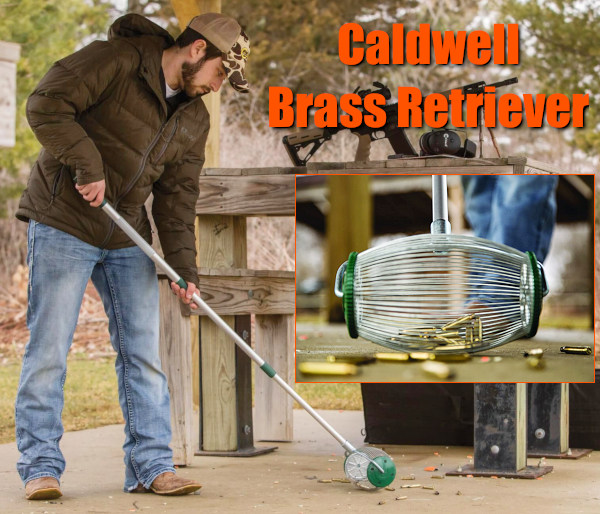
Caldwell Brass Retriever
Tired of bending over or kneeling down to retrieve your fired cartridge brass? For older shooters (including this Editor) getting down on the ground to pick up brass is tough on the lower back and knees. Here’s a product that makes brass retrieval quick, easy, and pain-free. The Caldwell Brass Retriever works quite well with a little practice, once you apply the correct pressure. While it won’t always grab every fired case, it will capture nearly all, and that can really make the job go much faster. These days cartridge brass (along with other components) is getting more expensive — so you want to recover your brass after every shooting session.
One owner praises this as a “very good tool” that is “a lot easier on my back.” While it can work on grass, gravel, and hard-packed earth, the unit works best on smooth, hard surfaces. The Brass Retriever is under $40 at Amazon.
Caldwell states: “Spend less time bending over and picking up brass at the range and more time shooting. The Caldwell® Brass Retriever picks up brass, saving your back and time. Picking up spent brass is as easy as pushing a mop. The Brass Retriever can pick up rifle and pistol brass quickly and efficiently. The Brass Retriever works anywhere, even on grass and gravel. The retriever comes complete with a roll cage separator that allows you to dump the collected brass into a bucket quickly. It is collapsible as well, making it convenient to transport. The retriever’s handle expands from 28″ up to 57″ tall.”
Caldwell Brass Retriever Owner Reviews
Here are Amazon reviews from actual purchasers. The device is not perfect and can miss a case or two. However, as you can see from the video, the Brass Retriever does pick the vast majority of brass on the ground, sized .223 Rem or larger diameter. This will save time and reduces stress on your back and joints:
“This thing … does a terrific job of collecting the brass from a standing posture quickly and efficiently. It helps to have the cases on a smooth surface like concrete or dirt without a lot of vegetation. But we used it on open desert yesterday and it collected nearly every case with a single pass.” — Hans H.
“This WILL save your back. The only drawback is you can’t overload it with brass. After couple dozen pieces (or less) it will start dropping brass while you’re attempting to collect others. That’s the limitation (one of them). There is a short learning curve (15 min.) in which you’ll learn how much brass is too much and how you need to orientate the wires to pick up the brass. It doesn’t do as well on gravel or high grass as it does on a smooth, firm surface. Even with its limitations, it’s a keeper. Just empty every dozen or so pieces and it works very well.” — Jeff M.
“It’s not perfect. But neither is using a broom or picking it up by hand. Sure, a 9mm might drop out while you’re picking up a .45 ACP. But you roll back over the 9mm and pick it up again. I now pick up my brass in a fraction of the time it used to take me and I stand upright while doing it.” — Johnny C.
How is a modern, metal-chassis rifle built? This very cool video from Masterpiece Arms answers that question. The nicely-edited video shows the creation of a Masterpiece Arms tactical rifle from start to finish. All aspects of the manufacturing process are illustrated: 3D CAD modeling, CNC milling of the chassis, barrel threading/contouring, chamber-reaming, barrel lapping, laser engraving, and stock coating. If you love to see machines at work, you will enjoy this video…
Many Remington 700 rifle owners swap out the factory trigger. This is not a difficult task, but you need to follow the proper procedure so you don’t damage any important parts during installation, and so that you don’t interfere with the operation of the bolt and safety. This Do-It-Yourself video from Brownells leads you through step by step how to safely and correctly replace your Remington 700 trigger. This installation video covers the common methods used to install most of the popular after-market Rem 700 triggers. Importantly, the video also shows how to function test after installation, and how to make sure your safety is working properly.
Many Rem 700 owners fit Timney triggers to their rifles.
Video find by EdLongrange. We welcome reader submissions.
Watch this video to see how a sound suppressor (aka “silencer”, “moderator”, or “can”) is constructed, start to finish. It’s more complicated than you might expect — there are quite a few stages in the process. The video below shows the fabrication of a SilencerCo Octane 45 suppressor:
SilencerCo writes: “What, exactly, goes into making a silencer? It may be more than you’d expect. From cutting metal to chemical baths, to extensive quality control every step of the way, our streamlined process is more than just a few steps. Watch our newest video, HOW IT’S MADE: Octane 45, to catch a glimpse behind SilencerCo’s doors.”
How Loud Are Unsuppressed Rifles?
Firearms Are Loud — 140 dB to 175 dB. ASHA explains: “Almost all firearms create noise that is over the 140-dB level. Exposure to noise greater than 140 dB can permanently damage hearing. A small .22-caliber rifle can produce noise around 140 dB, while big-bore rifles and pistols can produce sound over 175 dB. Firing guns in a place where sounds can reverberate, or bounce off walls and other structures, can make noises louder and increase the risk of hearing loss. Also, adding muzzle brakes or other modifications can make the firearm louder. People who do not wear hearing protection while shooting can suffer a severe hearing loss with as little as one shot[.]” Source: ASHA, Recreational Firearm Noise Exposure.
How Much Does a Good Suppressor Really Reduce Firearm Sound Levels?
That depends on the rifle, the cartridge, and the effectiveness of the suppressor. American Hunter explains: “Suppressors retard the speed of propellant gases from the cartridge that rapidly expand and rush out of the barrel. It’s these gases that produce the loud boom that’s heard for miles. A suppressor’s series of internal baffles slows these gases so they are not all released at once, thereby muffling the sound.” Many good commercial suppressors can achieve 30-35 dB sound suppression. However, Zak Smith of Thunder Beast Arms says: “There are a bunch of manufacturers who publish values that are not reproducible, or use an ad-hoc test instead of a mil-spec test. In many cases we’ve tested the exact same suppressors they’ve advertised with 30-40 dB reductions and found they are actually in the high 20s instead.”
Again, for this reason, we recommend that hunters use ear protection, such as electronic muffs, even when shooting suppressed.
Over the past year, large-scale social unrest and calls to “defund the police” inspired millions of Americans to buy their very first handguns. Pistol sales set new records. Americans were looking to acquire handguns for personal protection, both in the home and while away from the house. Thus, many folks are looking for slim, relatively lightweight pistols that can be carried comfortably and discretely. There are dozens of carry guns on the market currently. Here are three good choices, as reviewed by our friends at GunsAmerica.com. In this article, we cover three of the best “micro-compact” 9mm pistols: SIG Sauer P365, Smith & Wesson Shield, and the Glock 43.
After looking at a variety of factors, including accuracy, reliability, ergonomics, build quality, size/weight, and price, GunsAmerica’s tester Jeff Cramblit concluded that the SIG P365 was the best of the three: “Bottom Line — The SIG P365 wins this shootout in my humble opinion. The MSRP of $599 is a bit higher than the other guns but SIG brings a bit more to the game. The outstanding grip design, higher capacity, great sights, lighter trigger pull, smaller length, light weight and just a great overall feel make it a winning product. The other two guns are great, they have been the cornerstones of concealed carry for many years, and I have personally carried both of them, but SIG has changed the game.”
Choosing a Carry Pistol — Performance, Reliability, Value
This Editor owns two SIG Sauer pistols, a P226 and P232. Both are “old school” metal-framed handguns. I can attest to their quality and reliability over many years. So I’m not surprised to see that SIG’s new P365 took top honors in this recent test. But I also think the Smith & Wesson Shield also offers excellent value for the dollar. The S&W 9mm Shield is ON SALE now for $289.99 at Palmetto State Armory.
This YouTube Video Compares the SIG P365 and the S&W Shield
Accuracy with Various Ammo
In the GunsAmerica Test, the SIG P365 had the best accuracy, based on five (5) different types of 9x19mm ammo shot off-hand at 25 yards. The SIG’s average 5-shot, 25-yard group size was 1.45″, vs. 1.7″ for the Glock 43, and 2.1″ for the S&W Shield. The P365’s accuracy edge may be due in part to its lighter, 5.1-lb trigger pull compared to 6 lbs. for the S&W Shield, and 6.25 lbs. for the Glock 43.
Dimensions — Width and Weights
Size matters — particularly when it comes to a carry pistol. The S&W Shield is the narrowest of the three guns at 1.03″ wide vs. 1.11″ for the P365 and 1.36″ for the Glock 43. Though it has the highest round capacity, the SIG P365 actually has the smallest grip circumference and grip depth. Weight-wise, the Glock 43, at 18 oz. unloaded, is the lightest. The SIG P365 is 18.8 oz., while S&W Shield is the heaviest at 20.5 oz. weight.
Capacity — SIG P365 Has the Edge
The SIG P365, holding 10+1 rounds, has the highest ammo capacity. This is remarkable as the P365 has the smallest grip circumference of the three pistols. Kudos to SIG for clever design. The S&W Shield has an 8+1 capacity, while the Glock 43 only holds 6+1. Advantage SIG.
Bill Gravatt has been named President of Creedmoor Sports. Bill has worked in the shooting and reloading industry for over 30 years. His experience includes: former owner and President of Sinclair Int’l and President of Capstone Precision Group (Berger, Lapua, Vihtavuori, and SK). Now that Bill has achieved important goals with Capstone (for whom he continues to serve as a board member), he is taking over as President of Creedmoor Sports, after serving as its Managing Director since the spring of 2020.
Greg Kantorovich, Creedmoor Sports CEO states: “We are excited to have Bill assume the role of President. His innovative leadership will continue to enhance our team’s mission of managed growth through strategic planning. Bill’s wealth of industry knowledge and ‘customer first’ mantra is second to none! This philosophy aligns perfectly with Creedmoor’s passion to serve our customers like family”.
As the President of Creedmoor Sports, Bill will direct operational and marketing activities for the company. He will also help with informational programs. Gravatt has previously served Creedmoor Sports as a Managing Director since the spring of 2020, and served as a consultant before that.
Bill Gravatt told us: “I am joining a great team at Creedmoor Sports. They are all driven in pursuit of exemplary customer service, they create well-made products, passionately participate in the shooting sport, and enjoy the daily satisfaction that comes from helping fellow shooters achieve their best.”
Reloading Procedures with Bill Gravatt
Bill Gravatt has decades of knowledge about reloading tools and procedures. Here are three helpful videos Bill Gravatt created for the Creedmoor Sports InfoZone:
How to Seat Bullets with Inline Press
How to Trim Cases with L.E. Wilson Trimmer
How to Clean Cartridge Cases
About Creedmoor Sports, Inc.
Since 1979, Creedmoor Sports has been supplying the precision rifle shooter with quality equipment. Specializing in competitive centerfire, smallbore, and air rifle accessories, as well as reloading components and tools, Creedmoor seeks to provide their customers with the right gear to help them achieve their personal shooting goals.




 Dimensions — Width and Weights


