In this video, gunsmith Alex Wheeler explains how to ensure that your full-length sizing dies fit your brass properly. With many cartridge types, it’s not unusual for factory dies to be slightly large in the bottom section. When the diameter of a FL-sizing die is too large near the base, this can leave the bottom section of fired cases “unsized”, with the result that you can have extraction issues and stiff bolt lift, or what Alex calls “clickers”. At the same time, it’s not unusual for dies to over-size fired cases at the shoulder (i.e. reduce the shoulder diameter by .004″ or more).
We strongly recommend that all hand-loaders watch this video, particularly if you load cases 6+ times with relatively high-pressure loads.
Alex explains that a key dimension is the diameter of a fired case 0.200″ above the case head. If your die does not size your fired cases at this point, you should get a FL die that does. This could be a custom die ground to fit your chamber, or it could be a “small-base” die specifically designed to “hit” the bottom section of the case. Alex also notes that some FL dies have an inside chamfer at the mouth of the die, right at the very bottom. (See video at 3:55). This can leave the section of the case right above the extractor groove unsized, which can also lead to “clickers” and stiff bolt lift.
Paint Your Brass to Find Problem Areas
If you are having stiff bolt lift or extraction issues, Alex explains that you can “paint” your brass with magic marker (or dye-chem), and then place the case in your chamber. On the “hot spots” where the case contacts the chamber wall, the marking will rub off, allowing the brass metal to shine through in the problem area(s). This will illustrate where you need better sizing from your die.
“You can ink up the case with some magic marker or dye-chem. If you are getting clickers, go ahead and mark up the case and chamber it and see where it’s wearing. This will help you diagnose [whether the problem] is coming from the base, is it coming maybe from a score in the chamber… it can even happen at the shoulder although that’s pretty rare. Usually the dies size enough at that point.”
Did you find this video helpful? View more informative Tech Tip Videos on WheelerAccuracy.com.
Video Tip from Boyd Allen. We welcome reader submissions.
This story is about safety — how you must be extra careful when shooting on public lands. Don’t assume that other people will hear your firearms or respect the posted boundaries of a shooting range. To drive this point home, we feature a video that should send chills up and down your spine. This scarey movie about two-legged creatures that appear out of nowhere… while you’re shooting. Watch this video carefully. Something happens at 0.38″ that will make your heart race. Warning: Adult language — Not suitable for playback at work.
Why You Must Always, Always Be Careful When Shooting on Public Lands…
LESSON Learned: Always be aware of your backstop and beyond. If there is any possibility of someone venturing into the “danger zone”, mark off the target area, and designate a person to watch the area around the target. That designated spotter should instantly call a halt to shooting if any person or vehicle appears. It is also a good idea to place warning signs, but don’t count on these to be headed.
This video was filmed on BLM land out in the Nevada desert. In such public areas, one must be very careful about shooting. There may be hikers, bikers, explorers, and horse-riders nearby. An offroad motorcyclist might be moving at 65 miles an hour. At that speed he’ll cover 32 yards in just one second! With that possibility, you really have to be ultra-careful. To be forewarned of potential risks, you need to watch way out to the left and right, not just focus on the backstop and the bullet’s flight path.
The shooting area shown above is located on BLM land. All BLM rules and regulations apply. Remember it is everyone’s desert so always think “safety first”. The video-maker, JFComfort (aka “Joe”), explains: “We do the majority of our shooting on BLM land surrounding the Las Vegas Valley. We have found shooting in small groups in the desert works well for us. We have spent a lot of time out there in the past. I advise you not to shoot alone and be very mindful of off-road enthusiasts. Guys on quads, dirt bikes, and Rhinos seem to pop out of nowhere. Also keep a close eye out for other shooters, not everyone is safe, respectful and courteous.”
Safety Risks Can Occur Anywhere
This kind of safety risk can appear at any shooting venue. Robert Whitley, reports a similar incident on the East Coast: “Had a situation like that happen years ago. I was shooting at 400 yards on a 500 meter range that was completely fenced. Unbeknownst to me some guys on ATVs broke through the fence so they could get across the range to a path on the other side. Heard some engine noise and held up firing and about a second later a guy on an ATV went by right in front of my target — very unnerving. The guy on the ATV was … completely oblivious to the peril he placed himself into by breaking through the fence.”
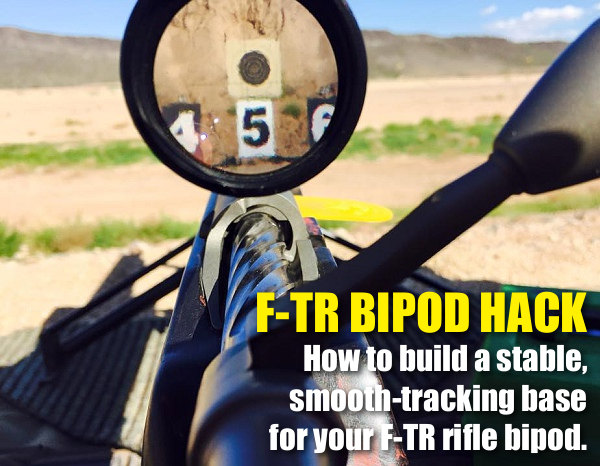
The Berger Southwest Nationals (SWN) is coming up next week at Ben Avery in Phoenix. Many of the nation’s top F-Class shooters will be there. Here are some tips that can help F-TR shooters competing at the SWN. These suggestions will also benefit any F-TR shooter who is looking for a more stable set-up under his bipod, and easier adjustment of the vertical when using a Phoenix-style (non-joystick) bipod.
How to Set up a Stable Front Pad for Your F-TR Bipod
To get peak performance from your F-TR rig, you need good support under the bipod. You want the base to be firm, but you also want a smooth, low-friction surface so the bipod feet can slide properly. Some guys just shoot off a carpet or a slab of wood with some rubber on top. There is a better way.
Forum member PBike shows how a three-element front set-up offers the best of both worlds — a firm platform with low-friction top. PBike’s set-up has three elements. Layer 1 is a thick rubber mat. Layer 2 is a steel plate with thin neoprene glued top and bottom. Layer 3, on which the bipod feet rest, is a thin neoprene door-mat with a low-friction surface, like the top of a MousePad. The video below shows how the three layers are arranged.
Pbike explains that, under F-TR rules, “You can use any series of pads or plates, so long as they are flat and do not include [tracking channels/slots] for the bipod feet”. The plate can be 12″ fore and aft, and the overall width may not extend more than 2″ beyond the bipod feet on either side.
F-TR Bipod Support Components (Bottom to Top)
LAYER ONE (bottom): Thick Rubber Pad, such as a heavy doormat
LAYER TWO (middle) Steel Plate, approximately 12″ x 24″, with attached neoprene
LAYER THREE (top): Neoprene Upper pad (slick upper surface like a MousePad)
NOTE, if the surface is not level, you can use wood shims to level the surface both left to right and front to back. The shims slide under the lowest pad. With a small saw, these can be trimmed so they don’t extend past the pad’s dimensions, maintaining compliance with F-Class rules.
The Phoenix bipod is an excellent product, but some folks like to run their rifles lower for better tracking and less hop. This can be accomplished with the PBike Aetkinz Engineering Lowering Kit. That Kit lowers the entire assembly 1.7 inches. For more information contact Pbike257 [at] gmail.com.
Phoenix Bipod “Rear Drive” and Steering Kit
F-TR rifle stock fore-ends are getting longer, allowing competitors to mount their bipods further forward. This longer “wheelbase” can deliver more stability, less hop, and better tracking. There’s a problem, however — if the bipod is attached way out front, it can be difficult to reach the bipod’s elevation controls. Some shooters grab the back end of the ski foot to adjust the rifle’s lateral position, but that doesn’t help with vertical.
PBike has developed a new accessory that lets you adjust the Bipod’s Mariner wheel easily and precisely. Basically this is a rotating, anodized aluminum tube that extends rearward. It has a 90° gear drive that replaces the Mariner wheel, allowing vertical adjustment by rotating the tube clockwise or counter-clockwise. See how it works in this video, starting at 1:40:
Pbike explains: “This is a really comfortable way to shoot. With this handle I can adjust for elevation and I can also steer the rifle fore and aft, left/right — anywhere I need to. I can make minute adjustments up and down, as needed, with the knurled handle.”
Video Suggestion by Boyd Allen. We welcome reader submissions
The Swarovski Optik website features a blog with interesting technical articles. In the “On Target” series of blog stories, Swarovski has provided a handy explanation of how optics systems work, with exploded diagrams of rifle scopes, spotting scopes, and binoculars. CLICK HERE for Swarovski Optics Blog.
Scope Terminology Focusing Lens
The focusing lens is an adjustable lens inside the optical system for focusing the image at different distances…. In the case of rifle scopes, apart from focusing, the focusing lens also facilitates parallax compensation.
Diopter Adjustment
For rifle scopes, the reticle can be focused using the diopter adjustment on the eyepiece, thereby correcting any visual impairment. [Editor’s Note: Movable eyepiece diopter adjustment is not offered on all rifle scopes. It is a useful feature on Swarovski and other premium scopes. This allows shooters who need eyeglasses to get a sharply focus image even without wearing corrective lenses. Of course shooters should always wear ANSI-certified eye protection. With the diopter, folks who need correction can use inexpensive, non-Rx safety eyewear instead of expensive prescription safety glasses.]
Reversal System
The purpose of the reversal system is to reverse the image by means of prisms in binoculars and telescopes, and lenses in rifle scopes….The lens reversal system is needed in rifle scopes to control the variable magnification and move the exit pupil[.]
Parallax Explained
What is Parallax? What problems can Parallax create when you are shooting? Many novice shooters can’t answer those questions easily. Likewise, many folks don’t understand how to use their front or side-focus parallax controls most effectively. Yes the parallax control basically sharpen focus at different target distances — but there’s more involved. This video offers helpful insights.
Resource tip by EdLongRange. We welcome reader submissions.
Our friend, ace S&W pro shooter Julie Golob, stars in a series of handgun instructional videos for Shooting USA. While Julie uses pistols mostly for competition, this U.S. Army veteran also values handguns for self-defense. In this video series, Julie first talks about important gun safety rules, then she offers training advice for persons who carry concealed handguns. The third video covers options for carry a weapon “off-body”, i.e. not in a normal holster on concealment rig on one’s person.
1. GUN SAFETY — Whether you own 1 gun or 100, gun safety must always be your main priority. Here Smith & Wesson Team Captain Julie Golob covers the basics of gun safety.
2. PRACTICE for CONCEALED CARRY — Engaging a threat from concealment could be the most important skill of your life and it takes practice to be proficient. In this video, S&W’s Julie Golob demonstrates some practice drills for concealed carry.
3. OFF-BODY CONCEALED CARRY OPTIONS — There are instances where carrying a concealed weapon on your body in a holster (or deep cover pouch) is not always practical. Here Julie explains various techniques to carrying a concealed handgun “Off Body”.
Julie — pistol champion, Army veteran, wife and mother, is also an accomplished author, who has written about the shooting sports in many shooting publications, newswires, and internet blogs. Her book, Shoot: Your Guide to Shooting and Competition, serves as both an introduction to firearms for novices and a primer to help experienced shooters improve their skills.
Miles of Aisles and thousands of new products. SHOT Show, held each January in Las Vegas, is a near-overwhelming circus. There is so much to see, with new products from countless manufacturers, large and small. Here is the last official Highlights video from SHOT Show 2018. This 19-minute video provides a comprehensive summary of all there was to see and do at SHOT Show.
Weatherby Moves to Wyoming — Interview with Adam Weatherby
One of the biggest industry new items was Weatherby’s exodus from California. We reported this move in detail, explaining the TOP FIVE REASONS gun companies leave California. In this video, Weatherby President Adam Weatherby explains his company’s goals in relocating to Sheridan, Wyoming. Unlike California, Wyoming is a Second Amendment-friendly state. Plus Wyoming also has no state tax on corporate earnings (California is 8.84%):
Featured New Products — Video Previews
The Firearm Blog (TFB) had a large presence at SHOT Show, with multiple video teams covering Range Day and then the main event at the Sands Expo Center. Here are some TFB product highlight videos, showcasing interesting new products released at SHOT Show 2018 and/or Industry Day at the Range:
Lithgow LA105 Tactical Rifle from Australia
Australia’s Lithgow Arms has a new rifle for the PRS game. Called the LA-105 Woomera (named for an Aboriginal spear-throwing device), this is basically a Lithgow Arms LA102 barreled action in a Kinetic Research Group (KRG) chassis similar to the Whiskey-3 and X-Ray chassis systems. Initially, the LA105 Woomera will be released in two calibers, 6.5mm Creedmoor (1:8″ twist) and .308 Win (1:10″ twist). The barrel twist rates should stabilize High-BC match bullets. Thanks to the KRG chassis, the LA105 Woomera takes the popular AICS magazines, rather than the Tikka T3 magazines of its predecessor.
Click to View Full-Page Specifications (easier to read):
Sako Carbon Fiber Stocks and New TRG 42 and 22
Sako has new, ultra-light carbon fiber stocks for the Sako 85 hunting rifle series. There are two carbon offerings, the CarbonLight and Carbon Wolf. The latter has cool push-button adjustments for comb height and length of pull. The Sako 85 Carbon Wolf features a nice ergonomic grip that’s very comfortable in the hand. We thought this was one of the nicest new stocks at the Show. At Industry Day at the Range, Sako also showcased new “AI” versions of the TRG 42 and 22 models. Both versions feature improved folding buttstocks, with adjustable cheekpiece and LOP. TRG tested the .338 Lapua TRG 42 on Industry Day at the Range.
Brownells Retro AR15 and AR10 Rifles
After testing Brownells’ Retro AR-15s at Industry Day at the Range, TFB’s Corey Wardrop checks out the new AR-10A and AR-10B at Brownell’s SHOT Show booth. Brownell’s 7.62x51mm AR10 is faithful to the original, with important upgrades. The BRN10B (“late style”) is also shown. For the keen-eyed, Gene Stoner makes an appearance in the background. CLICK HERE to view Brownell’s entire Retro AR line-up, both AR15 and AR10.
EDITOR: Given the flood of SHOT Show product reporting this week, we thought a little comic relief was in order this Friday, the last day of SHOT Show 2018. This clever video pokes fun of some of the oddballs you’ll find at shooting ranges. Crack open a cold one and have a laugh…
This very funny video that should put a smile on your face — especially if you’ve ever competed in action shooting events. This tongue-in-cheek video from the SuperSetCA team identifies seven (7) annoying/insufferable types of shooters you’ll find at shooting matches. You can’t help but chuckle watching this video. The satire is “dead on” — we’ve all met these kind of clowns at one time or another.
Among the personality types lampooned by the video are the “way too serious” type, the completely unprepared type, the “Hollywood” show-off, the “always an excuse” type, and of course the “I’m too old for this” competitor. As a shooter past age sixty, this Editor might even fall into that category — at least when it comes to “run and gun” games. When I’m asked to gallop around a range carrying heavy gear, yes I’ve been known to mutter: “I’m too [insert swear word] old for this….”
Here’s an extra challenge for you. According to the video’s producers, there are several TV and/or Movie references sprinkled throughout. Can you name them all (with run-times)? (Hint, look for Lethal Weapon and Matrix spoofs).
There is an excellent article about primers on the Shooting Times website. We strongly recommend you read Mysteries And Misconceptions Of The All-Important Primer, written by Allan Jones. Mr. Jones is a bona fide expert — he served as the manager of technical publications for CCI Ammunition and Speer Bullets and Jones authored three editions of the Speer Reloading Manual.
This authoritative Shooting Times article explains the fine points of primer design and construction. Jones also reveals some little-known facts about primers and he corrects common misconceptions. Here are some highlights from the article:
Size Matters
Useful Trivia — even though Small Rifle and Small Pistol primer pockets share the same depth specification, Large Rifle and Large Pistol primers do not. The standard pocket for a Large Pistol primer is somewhat shallower than its Large Rifle counterpart, specifically, 0.008 to 0.009 inch less.
Magnum Primers
There are two ways to make a Magnum primer — either use more of the standard chemical mix to provide a longer-burning flame or change the mix to one with more aggressive burn characteristics. Prior to 1989, CCI used the first option in Magnum Rifle primers. After that, we switched to a mix optimized for spherical propellants that produced a 24% increase in flame temperature and a 16% boost in gas volume.
Foiled Again
Most component primers have a little disk of paper between the anvil and the priming mix. It is called “foil paper” not because it’s made of foil but because it replaces the true metal foil used to seal early percussion caps. The reason this little disk exists is strictly a manufacturing convenience. Wet primer pellets are smaller than the inside diameter of the cup when inserted and must be compacted to achieve their proper diameter and height. Without the foil paper, the wet mix would stick to the compaction pins and jam up the assembly process.
For folks in the gun industry, the third Monday in January is the best day of the year. Held in conjunction with SHOT Show, Industry Day at the Range lets us try out dozens of new rifles and pistols, as well as meet top gun designers and friends in the shooting sports. We saw some very great new products this year. Here are some of the most interesting “take-aways” from Industry Day at the Range, held in Bolder City, Nevada on January 22, 2018.
New Guns + Old Friends
Meeting old friends, and shooting new guns. That’s what Monday was all about at the annual Industry Day at the Range, a “hands-on” preview the day before SHOT Show opens in Las Vegas. Your Editor met with old buddy Jason Baney at the crack of dawn and headed out to the Boulder City (NV) range.
We were not disappointed — there was plenty to see this year. On display were a bunch of new precision rifles, a slew of new handguns, and some very exotic optics.
Most Interesting New Rifles
Tikka T1x — Tikka’s New Rimfire Rifle is a Winner
The new Tikka T1x doesn’t disappoint. The bolt operates smoothly. The action feels solid and refined — like a good centerfire action. The trigger is excellent — it breaks cleanly with no creep or grittiness, and we’re told it can be easily adjusted below 2 pounds pull weight. The stock has a good feel in the hand and doesn’t flex — unlike some cheap Tupperware stocks you’ll find on some domestic rimfires. In addition, the action has the same footprint as the Tikka T3, so you can swap this .22 LR action into any stock that fits a T3. Overall this was the single rifle this Editor shot on Industry Day that I would really want to own.
Ruger Precision Rimfire — Baby Brother to the Ruger Precision Rifle
We test-fired the new Ruger Precision Rimfire. Unfortunately, with the wobbly setup and no paper targets, we could not really evaluate accuracy. Function is good, but we couldn’t call the bolt movement smooth. The trigger is not bad. Most of the chassis from the handguard rearward is reinforced polymer so the gun is pretty light. The + 30 MOA Picatinny rail is nice.
Above you can see the Ruger Precision Rimfire with its big centerfire brother, the Ruger Precision Rifle. Initial reports say that Ruger’s new rimfire rifle shoots well with affordable .22 LR ammo. Here’s a report from Forum Member RICHK: “Took mine to the range today, and ran eight (8) brands of ammo through it. Three worked really well. The best, Federal Match 22, shot .145 inch groups at 50 yards. Fine rifle.”
SAKO TRG 42 A-1 in .338 Lapua Magnum
Here is a handsome, beautifully-machined big-bore tactical rifle with all the bells and whistles. Firing from a high-tech tripod with Crux Ordnance rifle mount, our buddy Jason drilled steel at 500+ yards with the big .338 Lapua Magnum Sako. It’s awfully nice when you don’t have to pay for the ammo and they don’t mind if you take home the superb Lapua brass. This is a high end rig for serious engagements.
Savage Model 110 Line with AccuFit Comb and Buttpad Inserts
Savage showed off its new-for-2018 Model 110 Line-Up with the new Accufit system of cheekpiece/buttpad extensions that allow shooters to customize comb height and LOP. But, we were more interested in what you can’t see — the new internal aluminum chassis.
As part of Savage’s new Accustock system, a long aluminum sub-chassis serves as a bedding block for the action and provides general stiffening for the stock. That’s smart engineering. This video shows how the Savage internal chassis works. We highly recommend you watch this video:
Ritter & Stark SX-1 Modular Tactical Rifle
We liked the new Ritter and Stark Rifle SX-1 Modular Tactical Rifle from Germany. Fit and finish is very good. This is an honest competitor to the Accuracy International rifles. This rig is designed to allow rapid barrel changes for three chamberings: .308 Winchester, .300 Winchester Magnum, and .338 Lapua Magnum. Ergonomics were good — the grip was comfortable and we like the fact that the butt adjusts for vertical position. Notably, the scope rail is mounted on the barrel itself, and the bolt locks directly into the barrel. This patented system allows scope, rail, and barrel to be swapped out as one integrated assembly, which should definitely help maintain zero when barrels are exchanged.
Kriss Vector SBR — Full-Auto Fun and Firepower
We got a chance to shoot the 9x19mm version of the Kriss Vector Gen II SBR (Short Barrel Rifle) in FDE (Flat Dark Earth). This is a full-auto, pistol cartridge short-barrel rifle that uses Glock mags. It has a handy fire control selector so you can shoot it in single-shot, two-shot, or full-auto modes. This was a hoot to shoot. We’ve shot full-auto 9mm Uzi subguns in the past and this Kriss was easier to hold on target (and more accurate). Recoil was negligible. This is offered in four calibers: .357 Sig, 9x19mm, 10mm, and .45 ACP. MSRP is $1569.00, but civilians can’t buy this.
Best New Handguns
We viewed hundreds of pistols, shot a dozen or so, and came away with three we really liked. Here is a stunningly expensive 1911-type STI race gun, a handsome new 9mm Kimber, and a very innovative new polymer pistol from Europe, the Archon Type B.
STI 2011 DVC Open Race Gun — Four Grand Worth of Zing and Bling
At $3999.00, this is probably the most expensive comp pistol we’ve ever seen. This STI 2011 DVC Open features a host of “go-fast” features including relieved slide, gold-tone TiN barrel with extended compensator, over-size Dawson Precision Magwell, mounted C-More 8-MOA optic, and a special lever for fast slide racking. If you want to win, this might be a good investment, but this Editor kept thinking “this pistol costs more than my car is worth…”
Kimber Aegis Pro 9mm with 4″ Barrel
This is a 1911-style pistol with some interesting features. It combines a full-size bobtail frame with a shorter 4″ barrel. This makes the gun balance very nicely and it’s a bit more compact for carry. The trigger pull was outstanding, and recoil was mild with the 9mm Luger chambering, so this gun was a pleasure to shoot. This Editor would like to have one of these. The slide is machined to fit a Red Dot sight. For gun games and action pistol comps, the Red Dot really speeds up the aiming process.
Archon Firearms Type B with Ultra-Low Bore Axis
Developed in Italy, Made in Germany, and backed by the big RUAG company, the new Archon Type B 9mm pistol is one of the most innovative semi-auto handguns we’ve seen in years. The Type B boasts a patented barrel system. It is not the classic Browning tilting barrel. The Type B’s barrel is not fixed; however, it moves only a few millimeters up and back as the slide retracts. That barrel geometry allows the slide to be exceptionally low. And the frame design puts the web of your hand up high. Those design features really do help tame perceived muzzle lift. This gun was easy to shoot, and the sights came back on target very quickly.
Trends in Ammunition
On Industry Day at the Range, all ammo is free. So you can shoot to your heart’s content without worrying about cost (or picking up your brass). This year we noted that many gun-makers supplied Federal Syntec ammo with distinctive red, polymer-encapsulated bullets. The polymer coating cuts barrel fouling, and also reduces ricochets and “splashback” on steel targets:
Winchester also unveiled an interesting line of Hybrid-X ammunition. This has a dual-element bullet. The rear section of the bullet is jacketed with a heavy element core. The front half of the bullet has a shaped, polymer matrix cone. This hybrid design offers improved penetration PLUS greater energy delivery inside the target as the bullet separates into multiple elements. You can see how this works in the Ballistic Gelatin photo below.
Suppressed Weapon Systems (SWS) had a rack of rifles with very fat barrels — barrels that served double duty. These barrels are, effectively, extremely long suppressors. The conventional barrel unit is combined with a full-length sound moderator, offering exceptional noise reduction. In the photo above, every rifle in the front side of the rack has an SWS integral suppressor/barrel system. This is interesting technology.
With two dozen shooting bays, plus an elevated shooting station with targets out to 400 yards, there is plenty of action. Here’s the layout:
Next best thing to being there — this 5-minute video, filmed in 2015-16, shows all the activities on Media Day at the Boulder Rifle and Pistol Club. It’s a great overview of the event where over 1700 media members and buyers gather to test and evaluate the latest (and greatest) guns and shooting accessories introductions from over 200 manufacturers.
Over the past year, this was one of the TOP TEN most-read Daily Bulletin articles. We are reprising it today for readers who may have missed it the first time around…
When shooting pistols do your shots normally land smack dab in the middle of the target? If not, you may have some technique problems that are causing your shots to move off center. Top Shot Champion Chris Cheng has produced a good video for the National Shooting Sports Foundation (NSSF) that helps handgunners diagnose accuracy issues. By shooting 3-shot groups and looking at the pattern and location of the shots, you can see what you’re doing wrong (or right). Here are some examples. Note, this process works best for shooters whose shots fall typically in one target zone. If your shots are all over the target, your form is inconsistent and problems will be harder to diagnose.
1. Low Left — Jerking Trigger: Here we see three (3) shots at the 7 O’clock position. This shows that the shooter is jerking the trigger, meaning that the shooter is pulling the trigger too quickly and therefore forcing the barrel to drop when breaking the shot. This is a very common problem, particularly with novices who are reacting to the noise/recoil of the pistol.
2. 9 O’Clock — Too Little Trigger Finger: If we see three (3) shots at the 9 O’clock position, what this can be indicative of too little trigger finger on the trigger. And therefore with every shot, the shots are getting pushed to the left. Try moving your trigger finger on to the pad of your index finger. Also try dry firing drills.
3. High Left — Anticipating Recoil: In this next example, we see three shots around the 11 O’clock position. What could be happening here is that the shooter is anticipating the recoil, and is actually lifting the gun up when he shoots. We recommend slowing down, working on your breathing, and, again, do dry-firing drills.
4. 3 O’Clock — Too Much Trigger Finger: Finally, if you see three (3) shots at the 3 O’clock position, this can indicate that there is too much trigger finger on the trigger. Therefore when the shot breaks the shooter is pulling each shot to the right. Note: Each of these descriptions is for a RIGHT-handed shooter. If you are a left-handed shooter you’ll want to reverse those descriptions.




 Savage showed off its new-for-2018 Model 110 Line-Up with the new Accufit system of cheekpiece/buttpad extensions that allow shooters to customize comb height and LOP. But, we were more interested in what you can’t see — the new internal aluminum chassis.


