Creedmoor Sports has released a series of helpful “how-to” videos in its new InfoZone web page. In the latest InfoZone video Bill Gravatt shows how to seat bullets using L.E. Wilson Hand Dies and an Arbor Press. The basic process is simple, particularly with a micrometer-top seating die. That makes it easy to adjust and set seating depth. Before you start seating bullets, you want to adjust the height of the arbor so the stroke is appropriate to the height of your die.
Bill Gravatt Shows How to Use Hand Seating Dies — Creedmoor INFOZONE
ARBOR PRESS TECHNIQUE: When using an arbor press, smooth is good. You don’t want to slam the handle down quickly. Try to repeat the same motion each time. You can also experiment by seating the bullet part way, then rotate the cartridge (in the die) and do the final seating with a second stroke. If your arbor press has a force gauge, note both the max value of the gauge needle and how it moves as you seat the bullet. If the needle spikes too rapidly, or bounces back and forth irregularly, set that cartridge aside and/or mark it. You could have neck tension issue with that case or some other fault. You might even have a bad bullet. That’s rare, but can happen. The key to success is moving the press arm in a smooth motion every time, maintaining the same down-pressure with each cartridge.
Here Bill Gravatt Offers a Simple Tip for Adjusting Wilson Seating Dies
One of our Forum readers asked “How can I get a custom in-line seater for my new rifle?”. First, we would say that, if you are not shooting an unusual Wildcat, check first to see if L.E. Wilson makes a stainless Micrometer Seater Die for your rifle. These dies are a joy to use, and we’ve found the fit to be exceptionally good with many calibers. Typically priced from $90-$100, Wilson stainless micrometer-top seaters are available for dozens of cartridge types: .204 Ruger, 20 BR, .222 Rem, .223 Rem, 22 PPC, 22 BR, .22-250, .223 WSSM, 6 PPC, 6mmBR, 6XC, 243 Win, .243 WSSM, 25 WSSM, 6.5×47 Lapua, 6.5 Creedmoor, 6.5-284, 26 Nosler, .270 WSM, 7mm-08, .284 Win, 28 Nosler, 7mm RUM, 30 BR, 30 IHMSA, .308 Win, .300 WinMag, .338 Edge (and MORE).
If you do want a custom seater die, the process is relatively simple. Purchase a die blank from Wilson and have your gunsmith run the chambering reamer in. Forum member Gunamonth explains: “I start with a Wilson seating die blank. They’re available from Sinclair and other vendors. Just run the reamer in. For some of my rifles, where I wanted the stainless die with the micrometer adjustment, I bought a smaller die and had the smith ream it with the chamber reamer. That’s how I had my 6 Dasher and 6mm AI seaters made. With the Dasher I stared with a 6mmBR Micrometer die.”
SEATER STEM TIP: If, on your seated bullets, you are seeing a sharp line around the jacket near the ogive, you may want to smooth out the leading edge of the Wilson seater stem (see above left). Do this by putting a little lapping compound on one bullet and manually spin this around in the stem. Without much effort you’ll have a smooth bullet/stem interface.
Micrometer Top Add-on
We really like micrometer tops on a seating die. But what if Wilson doesn’t make a micrometer top seater for your chambering? Don’t despair, Sinclair Int’l sells a $39.99 micrometer top that can be added to Wilson standard seaters or to a custom seater die made from a Wilson die blank.
We’ve been fans of the Howa Mini Action rifles since they were introduced a couple years ago. With actions that are nearly an inch shorter than typical “short actions”, these Mini Action rigs work great as a compact “truck gun” or carry-around varminter. Current chamberings are: .204 Ruger, .222 Rem, .223 Rem, 6.5 Grendel, and 7.62×39. There are 20″ lightweight, 20″ heavy contour, and 22″ standard contour barrel options.
6.5 Guy Ed Mobley Tests the 7.62×39 Howa Mini Action Rifle
The Howa Mini Action rifles come with the excellent HACT 2-stage trigger and a 5-round or 10-round, synthetic detachable box mag (depending on caliber). The Mini Action’s bolt is 13% shorter than on regular short actions, providing a shorter, faster bolt throw. Weight is also reduced. This makes for a nice, compact (and very shootable) package.
6.5 Guys Test Howa Mini Actions in 6.5 Grendel and 7.62×39
The 6.5 Guys recently secured a pair of Howa Mini Actions, one chambered in 6.5 Grendel and the other in 7.62×39 Russian: “After trying out the Howa Mini Action rifles at SHOT Show 2017, we got a couple of loaners in 6.5 Grendel and 7.62×39 courtesy of Legacy Sports. These rifles are known for their smooth cycling and lightweight actions, as well as some unique chamberings for bolt rifles (6.5 Grendel, 7.62×39). Long story short, we really enjoyed them.” In fact Steve liked his 6.5 Grendel enough that he plans to purchase the gun. Get the full scoop in this VIDEO REVIEW:
The folks at Legacy Sports also conducted extensive accuracy tests of commercial ammunition in 6.5 Grendel and 7.62×39. The most accurate 6.5 Grendel ammo, with a stunning 0.29″ group, was Alexander Arms with Lapua 123gr Scenar; second best (0.56″ group) was Hornady with 123gr A-Max bullet. The most accurate 7.62×39 ammo was Hornady 123gr SST with a 0.62″ group in the 20″ Heavy Barrel version. View Howa’s Test Reports with these links:
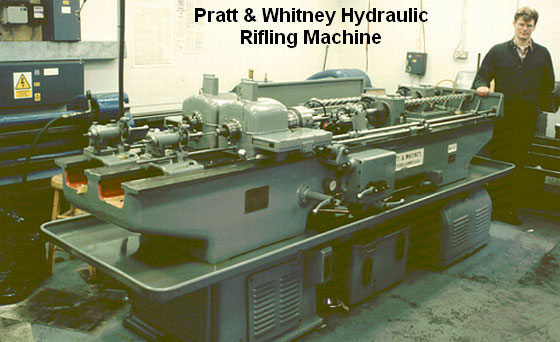
“At the start of World War Two, Pratt & Whitney developed a new, ‘B’ series of hydraulically-powered rifling machines, which were in fact two machines on the same bed. They weighed in at three tons and required the concrete floors now generally seen in workshops by this time. Very few of these hydraulic machines subsequently became available on the surplus market and now it is these machines which are sought after and used by barrel makers like John Krieger and ‘Boots’ Obermeyer. In fact, there are probably less of the ‘B’ series hydraulic riflers around today than of the older ‘Sine Bar’ universal riflers.” — Geoffrey Kolbe, Border Barrels.
How Krieger Builds Barrels
This video shows the process of cut-rifled barrel-making by Krieger Barrels, one of the world’s best barrel manufacturers. Krieger cut-rifled barrels have set numerous world records and are favored by many top shooters. The video show the huge, complex machines used — bore-drilling equipment and hydraulic riflers. You can also see how barrels are contoured, polished, and inspected.
Click Arrow to Watch Krieger Barrels Video:
For anyone interested in accurate rifles, this is absolutely a “must-watch” video. Watch blanks being cryogenically treated, then drilled and lathe-turned. Next comes the big stuff — the massive rifling machines that single-point-cut the rifling in a precise, time-consuming process. Following that you can see barrels being contoured, polished, and inspected (with air gauge and bore-scope). There is even a sequence showing chambers being cut.
Here is a time-line of the important barrel-making processes shown in the video. You may want to use the “Pause” button, or repeat some segments to get a better look at particular operations. The numbers on the left represent playback minutes and seconds.
Krieger Barrel-Making Processes Shown in Video:
00:24 – Cryogenic treatment of steel blanks
00:38 – Pre-contour Barrels on CNC lathe
01:14 – Drilling Barrels
01:28 – Finish Turning on CNC lathe
01:40 – Reaming
01:50 – Cut Rifling
02:12 – Hand Lapping
02:25 – Cut Rifling
Want to see new-born Pandas? No, not the furry kind — rather Stolle Panda actions produced with state-of-the-art CNC machinery. If you’ve ever wondered how precision benchrest, long-range, and tactical rifles are built, check out video from Kelbly’s. You’ll see actions finished, barrels chambered and crowned, pillars installed in stocks, barreled actions bedded, plus a host of other services performed by Kelbly’s gunsmiths and machinists.
CLICK Triangle to Launch Kelbly’s Video
If you’re a fan of fine machine-work, this video should be both informative and entertaining. You can see how precision gun work is done with 21st-Century technology. Tip of the hat to Ian Kelbly and crew for producing this excellent video visit to the Kelbly’s production center.
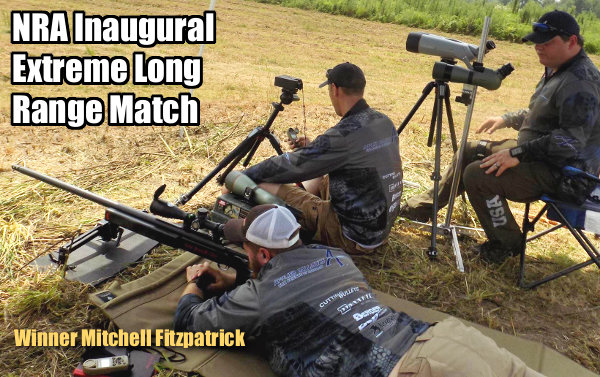
The first-ever NRA Extreme Long Range (ELR) Match took place this past week at Camp Atterbury in Indiana. Also labeled the “One-Mile Match”, this inaugural event ran as a side-match between the NRA’s Mid Range and Long Range Championships at Atterbury. The event drew many of the nation’s top marksmen, including multi-time National High Power and LR Champion David Tubb, recent F-TR National Champion Bryan Litz, and 2016 KO2M winner Mitchell Fitzpatrick.
It was a tightly-fought match. Showing exceptional skills (along with great rifles and ultra-accurate ammo), both Corbin Shell and Team Applied Ballistics’ Mitchell Fitzpatrick were perfect for 15 shots — making every shot at 1400, then 1575, and finally 1788 yards (1.016 miles). With the score tied, a 1000-yard target center (bullseye) was set on a target backer at 1988 yards (1.13 miles). Mitchell hit the target, but sadly Corbin had his first miss of the match. With that 1988-yard hit, Mitchell went down in the history books as the first-ever NRA ELR Champion. Winning at Extreme Long Range is nothing new for Mitchell, who was the winner of last year’s King of 2 Miles match in Raton, NM.
Mitchel posted: “We pulled off the win by shooting clean, never missing a shot! It was a great event and I look forward to competing in the coming years. They are trying to extend the facility to make it a 2400-yard match. With the NRA having such a rich competitive shooting history… I am beyond honored to have won the inaugural NRA ELR match. As ELR grows … it will be awesome to look back and know we were in at the ground level. Also, it should be noted that my extractor broke on the second shot at 1788 yards, and I ended up having to fire the last thre shots while extracting my cases with a cleaning rod from the muzzle end…”
Overall Standings NRA ELR One-Mile Match
1. Mitchell Fitzpatrick
2. Corbin Shell
3. Randy Pike
4. Paul Phillips
5. Dan Pohlabel
6. M. White
7. Rusty Phillips
8. Kent Reeve
9. Bryan Litz
10. David Tubb
Corbin’s Big Rig Built for Extreme Long Range
Runner-Up Corbin Shell was shooting his impressive .338 Lapua Magnum Improved barrel-block rifle, originally built for the KO2M event. It performed superbly in Indiana. This rifle was showcased here on AccurateShooter last month. READ Corbin Shell .338 LM Story.
ELR TECH — Confirming Hits at a Mile (and Beyond)
Confirming hits at extreme yardages is a challenge. With a conventional spotting scope you can see a target swinging but it is very difficult to see actual impact at extreme ranges. For this match, wireless remote TV cameras were placed near each of the targets down range. These fed video signals to monitors and tablet computers, allowing scorers to confirm hits on steel. In addition to the Targetvision target cam systems, GSL Technology had a drone to get aerial footage and augment streaming video coverage on Facebook. Sheri Judd, NRA ELR Match Manager, also captured some great still images of the event, including the images you see in this article.
Like Father, Like Son — Rusty and Paul Phillips
The NRA ELR match was a family affair for the Phillips clan. Paul Phillips shot with his father Rusty. The elder Phillips, at the ripe young age of 80, had multiple hits at one mile, earning his official “One Mile Club Certificate”. You can see Rusty shooting in the video below. Paul says: “I had a great day shooting with my dad at the inaugural NRA ELR match. My dad went four for five at 1 mile (1788 yards) on a 36″ plate and earned his One Mile Club membership. This was his first competitive match ever shot at 80 years old and he finished 7th overall! Bryan Litz and myself help keep him centered up.” Paul and his father Rusty used GSL .375 Lethal Mag Copperhead Suppressor and the .338 Lapua Copperhead.
Rusty Phillips, at 80 years, shot 4 for 5 at 1788 yards (1.016 miles) to earn his One Mile Club Certificate. Congratulations Rusty!
Today is living history day at Camp Perry. The CMP hosts the popular M1 Garand Match as well as the Springfield M1A Match. This writer’s father carried a Garand in WWII. That was reason enough for me to want one. But I also loved the look, feel, and heft of this classic American battle rifle. And the unique “Ping” of the ejected en-bloc clip is music to the ears of Garand fans. Some folks own an M1 Garand for the history, while others enjoy competing with this old war-horse. Around the country there are regular competition series for Garand shooters, and the CMP’s John C. Garand Match is one of the most popular events at Camp Perry every year.
M1 Garand Manual
Recommended M1 Garand Manual
Among the many M1 Garand manuals available, we recommend the CMP’s U.S. Rifle, Caliber .30, M1: ‘Read This First’ Manual. This booklet covers take-down, reassembly, cleaning, lubrication, and operation. The manual, included with CMP rifles, is available for $3.25 from the CMP eStore. The author of Garand Tips & Tricks says: “It’s one of the best firearms manuals I’ve seen. I highly recommend it.”
M1 Garand Slow-Motion Shooting Video
What really happens when an M1 Garand fires the final round and the En-Bloc clip ejects with the distinctive “Ping”? Well thanks to ForgottenWeapons.com, you can see for yourself in super-slow-motion. The entire cycling process of a Garand has been captured using a high-speed camera running at 2000 frames per second (about sixty times normal rate). Watch the clip eject at the 00:27 time-mark. It makes an acrobatic exit, spinning 90° counter-clockwise and then tumbling end over end.
2000 frame per second video shows M1 Garand ejecting spent cartridges and En-bloc clip.
M1 Garand History
Jean Cantius Garand, also known as John C. Garand, was a Canadian designer of firearms who created the M1 Garand, a semi-automatic rifle that was widely used by the U.S. Army and U.S. Marine Corps during World War II and the Korean War. The U.S. government employed Garand as an engineer with the Springfield Armory from 1919 until he retired in 1953. At Springfield Armory Garand was tasked with designing a basic gas-actuated self-loading infantry rifle and carbine that would eject the spent cartridge and reload a new round. It took fifteen years to perfect the M1 prototype model to meet all the U.S. Army specifications. The resulting Semiautomatic, Caliber .30, M1 Rifle was patented by Garand in 1932, approved by the U.S. Army on January 9, 1936, and went into mass production in 1940. It replaced the bolt-action M1903 Springfield and became the standard infantry rifle known as the Garand Rifle. During the World War II, over four million M1 rifles were manufactured.
The U.S. Army Marksmanship Unit (USAMU), in cooperation with Shooting USA TV, has created a series of instructional Pro Tip pages covering a wide range of shooting disciplines. All totaled, there are more than 50 USAMU Pro Tips. Most relate to rifle marksmanship but there are also numerous tips for shotgunners and pistol shooters. Each Pro Tip entry includes multiple photos and 6-15 paragraphs, in an easy-to-follow format. Many Pro Tips also include an instructional video produced by Shooting USA. Here are three Pro Tip videos, and links to seven more Pro Tip web pages.
USAMU TOP TEN PRO TIPS
1. Reading the Wind with SGT Sherri Gallagher.
Apart from gravity, wind has the most pull on the bullet as it travels down range. Being able to accurately read the wind and mirage will greatly enhance your performance on the rifle range. National Champion, SGT Gallagher gives you some of her tips.
2. Angle Shooting with SFC (Ret.) Emil Praslick.
SFC Praslick shows you how to determine the angle to your target, and then how to include that to change your data necessary to hit your target on the first shot.
3. Rifle Grip, Stance and Body Position for 3-Gun with SFC Daniel Horner.
Professional 3-gun marksman SFC Daniel Horner, U.S. Army Marksmanship Unit (USAMU), give tips on how to properly handle a semi-automatic rifle, including grip, stance and body position.
In this video, Bryan Litz of Applied Ballistics focuses on training. Bryan says that training is key for success in Long Range shooting: “Training in the sense that you want to want to refine your fundamentals of marksmanship — your sight alignment, your trigger control. You should practice those things enough that they become second nature and you don’t have to think about them. Keep in mind, it’s not just good enough to train, you have to learn how to train. You need to learn how to practice effectively, to get the most out of everything you do.”
Bryan says that success in Long Range shooting is not just about the hardware. It’s what’s between your ears that really counts: “The most important element in Long Range shooting is your knowledge — your understanding and practice of fundamentals of marksmanship, as well as your understanding of ballistics. You have to be able to fire the rifle, execute good shots that will put your rounds on target, but you also need to make intelligent sight corrections that will accurately account for the effects of gravity drop, and wind deflection, to center your group on those targets”.
Litz Competition Shooting Tips
Competition TIP ONE. Improving your scores in long range competition is a constant process of self-assessment. After each match, carefully analyze how you lost points and make a plan to improve. Beginning shooters will lose a lot of points to fundamental things like sight alignment and trigger control. Veteran shooters will lose far fewer points to a smaller list of mistakes. At every step along the way, always ask yourself why you’re losing points and address the issues. Sometimes the weak links that you need to work on aren’t your favorite thing to do, and success will take work in these areas as well.
Competition TIP TWO. Select your wind shooting strategy carefully. For beginners and veterans, most points are typically lost to wind. Successful shooters put a lot of thought into their approach to wind shooting. Sometimes it’s best to shoot fast and minimize the changes you’ll have to navigate. Other times it’s best to wait out a condition which may take several minutes. Develop a comfortable rest position so you have an easier time waiting when you should be waiting.
Competition TIP THREE. Actively avoid major train wrecks. Sounds obvious but it happens a lot. Select equipment that is reliable, get comfortable with it and have back-ups for important things. Don’t load on the verge of max pressure, don’t go to an important match with a barrel that’s near shot out, physically check tightness of all important screws prior to shooting each string. Observe what train wrecks you and others experience, and put measures in place to avoid them.
In recent months, Creedmoor Sports has expanded its selection of reloading tools and gear, under the guidance of Bill Gravatt, former President of Sinclair International. And Creedmoor recently launched the Creedmoor InfoZone, an online source for Shooting News, Reloading Tips, Gear Reviews and basic gunsmithing information. Visit CreedmoorInfoZone.com.
Bill Gravatt is an expert on reloading processes and gear. He developed many of the popular tools marketed by Sinclair Int’l, and now he’s lending that expertise to Creedmoor Sports. Bill is hosting a series of “how-to” videos produced for the Creedmoor InfoZone.
Here Creedmoor’s Bill Gravatt demonstrates several methods to clean your cases. Bill tells us: “Powder residue should be removed before you insert your cases into your reloading dies. There are several ways to clean your cases. Many shooters use a combination of various methods…”
1. Manual Cleaning — You can use 0000 Steel wool for the outside of the case and a Case Neck brush for the inside. A paper towel can remove any remaining residue. This is a handy way to clean if you load at the range.
2. Vibratory Tumbling — This traditional method works well, particularly for pistol brass. Experiment with both Corn Cob and Walnut media. You can get a brighter shine by putting a small amount of liquid brass polish in the media.
3. Wet Tumbling with Stainless Media — This process can get your brass clean inside and out. Do check to ensure no pins are stuck in the flash-holes. Watch for peening of case mouths that can occur over time.
4. Ultrasonic Cleaning — Ultrasonic cleaning works great for small parts as well as brass. The ultrasonic process removes all carbon and traces of lube, which can leave the inside of case necks too dry. To smooth bullet seating, try putting a tablespoon of Ballistol in the cleaning solution.
Cleaning Reloading Dies
Cleaning your reloading dies is something that many hand-loaders neglect. In this 60-second Tech Tip, Bill Gravatt provides some smart advice on cleaning your dies. Bill notes: “After heavy use, case lube and carbon can build up in your reloading dies. It’s important to keep them clean. Also, with new dies, give them a good cleaning before first use, because they ship with a corrosion inhibitor.”
1. Step 1 — Prior to cleaning, disassemble the die and spray it with a good degreaser. Do this with brand new dies too.
2. Step 2 – Take a patch and run it in the die to remove old lube and gunk. Don’t forget the decapping assembly and other internal parts.
3. Step 3 — After cleaning the die, but before reassembly, spray the die with a good corrosion inhibitor, such as Corrosion-X or Starrett M1.
Rimfire Benchrest can be fun and rewarding. It can also be frustrating because sourcing superior lots of ammo is a never-ending challenge. Still we like rimfire benchrest because you don’t need to load at the range. Plus rimfire barrels last a very long time (our friend Joe Friedrich set an ARA Benchrest record with a 100,000+ round-count barrel). Here’s a great video from the National Rimfire Benchrest Association of Ireland (NRBAI). Production quality is excellent! We highly recommend you watch this video, which does a great job illustrating both the fun and challenge of rimfire benchrest competition.
If you’ve never seen 50m Rimfire Benchrest competition, this video is well worth watching:
“If you need to get your mind away from everything… then look down a scope, concentrate, and be disciplined.”
“Comradery is one of our organization’s key traits… there are no barriers of gender, age or mobility. Just a very diverse, bunch of good people enjoying a sport together.”
“The skill, in brief, is having the ability to hit the equivalent of the top of a pinhead at 50 meters, in all conditions with a .22 round. Not easy, especially when you have to do it 50 times to get a maximum score of 500 [points], 250 per sheet.”
Credit Boyd Allen for finding this NRBAI Benchrest Video, released on 6/28/17.


 One of our Forum readers asked “How can I get a custom in-line seater for my new rifle?”. First, we would say that, if you are not shooting an unusual Wildcat, check first to see if L.E. Wilson makes a stainless Micrometer Seater Die for your rifle. These dies are a joy to use, and we’ve found the fit to be exceptionally good with many calibers. Typically priced from $90-$100, Wilson stainless micrometer-top seaters are available for dozens of cartridge types: .204 Ruger, 20 BR, .222 Rem, .223 Rem, 22 PPC, 22 BR, .22-250, .223 WSSM, 6 PPC, 6mmBR, 6XC, 243 Win, .243 WSSM, 25 WSSM, 6.5×47 Lapua, 6.5 Creedmoor, 6.5-284, 26 Nosler, .270 WSM, 7mm-08, .284 Win, 28 Nosler, 7mm RUM, 30 BR, 30 IHMSA, .308 Win, .300 WinMag, .338 Edge (and MORE).