We had a chance to meet with Jerry Miculek and his wife Kay at SHOT Show. These are very nice people who also happen to be superb shooters. They are great ambassadors for the shooting sports. We talked about Jerry’s many titles and match wins over recent decades. He explained: “It didn’t come easy… the winning comes after years of hard work”. Jerry’s name is synonymous with revolvers. But Jerry is also one heck of a rifleman, as he demonstrates in this video.
Three Shots Standing at 400 Yards in 4.37 Seconds
For those of use who usually shoot from the bench, hitting a silhouette target at 400 yards from an standing position (unsupported) would be a big challenge. Here Jerry Miculek makes it look easy.
In this video, Jerry hits not one but THREE c-zone targets at 400 yards. And — get this — he does this in under 4.4 seconds starting with his rifle laying on a support. It took Jerry two tries (on his first run he hit 2 out of 3 in 4.65 seconds). On the second attempt (see video starting at 2:19), it takes Jerry just 4.37 seconds to shoulder his rifle, aim, and fire three shots, each hitting a separate steel target. Wow. That’s truly remarkable. Most of us would need ten seconds (or more) just to get the scope on the first target.
Trust us folks, this ain’t easy. It takes remarkable marksmanship skills to shoot with this kind of precision at this kind of pace. As Jerry would say himself, “Not bad for an old guy who needs glasses”.
At SHOT Show 2016 we visited the Sellier & Bellot pavilion. You may not have heard of this company, but it is one of Europe’s older ammunition manufacturers. The video below shows ammunition being made from start to finish, starting with raw materials. This is a fascinating video that is well worth watching. It shows some amazing machines in operation:
Based in in Vlašim, Czech Republic, Sellier & Bellot was founded in August 5, 1825 by a German businessman of French origins called Louis Sellier. His family were royalists who fled France during the French Revolution. Louis Sellier began manufacturing percussion caps for infantry firearms in a factory in Prague, Bohemia on the request of Francis I, the Emperor of Austria. Sellier was joined by his countryman Jean Maria Nicolaus Bellot.
At the S&B booth, we also saw an interesting CGI video that shows what happens inside a rifle chamber and barrel when a cartridge fires can’t be seen by the naked eye (unless you are a Super-Hero with X-Ray vision). But now, with the help of 3D-style computer animation, you can see every stage in the process of a rifle round being fired.
In this X-Ray-style 3D animation illustrates the primer igniting, the propellant burning, and the bullet moving through the barrel. The video then shows how the bullet spins as it flies along its trajectory. Finally, this animation shows the bullet impacting ballistic gelatin. Watch the bullet mushroom and deform as it creates a “wound channel” in the gelatin.
Watch Video – Cartridge Ignition Sequence Starts at 1:45 Time-Mark
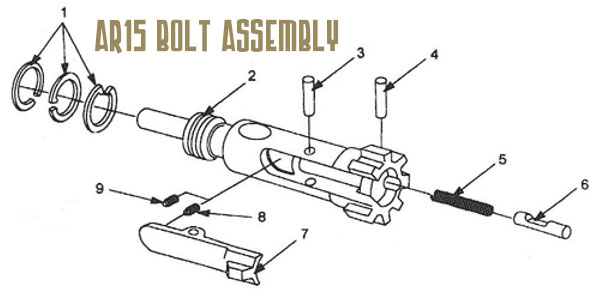
AR-platform rifles can be maintenance-intensive beasts. But some AR owners make the situation worse by not regularly cleaning important small parts, or by using too much oily/greasy lubricants in the wrong places. A properly maintained and lubricated AR15 can shoot hundreds of rounds (between cleanings) without a problem. If you learn where (and where not) to apply lubricant, you’ll find that your AR will run more reliably and the task of cleaning the bolt and bolt carrier will be less of a burden.
Here is a good video that explains AR-15 Cleaning and Maintenance. In this 30-minute NSSF video, Gunsite Academy instructor and gunsmith Cory Trapp discusses the proper way to clean and maintain the AR-15 carbine. Very knowledgeable, Trapp provides rock-solid advice for AR owners. Along with cleaning producedures, this video explains how to inspect key components and how to function-test your AR before each shooting session.
This important video shows what really happens when loaded ammunition burns. You will probably be surprised. Contrary to Hollywood notions, the ammo doesn’t ignite in a massive explosion. Far from it… basically the rounds “cook off” one by one, and the bullets release at relatively low velocity. We’ve featured this SAAMI research project before, but it is worth reprising for those who have not yet seen the burn tests.
A couple years back, SAAMI released an important video concerning ammo and fire. With professional fire-fighters standing by, over 400,000 rounds of ammo were incinerated in a series of eye-opening tests. If you haven’t had the chance to view this video yet, you should take the time to watch it now
The Sporting Arms and Ammunition Manufacturers’ Institute (SAAMI) has produced an amazing 25-minute video that shows what actually happens to sporting ammunition involved in a fire. This video shows the results of serious tests conducted with the assistance of professional fire crews. We strongly recommend you watch this video, all the way through. It dispels many myths, while demonstrating what really happens when ammunition is burned, dropped, or crushed.
Watch SAAMI Ammunition Testing Video
Video Timeline
2:10 Impact Test (ignited outside firearm)
3:40 65-foot Drop Test
5:08 Bullet Impact (.308 Win firing)
7:55 Blasting Cap Attacks
9:55 Bulldozer and Forklift Tests
12:20 Boxed Ammo Bonfire
15:37 Bonfire without Packaging
17:21 Retail Store Simulation Burn
20:55 Truck Trailer Burn
Over 400,000 rounds of ammunition were used in the tests. Some of the footage is quite remarkable. Testers built a bonfire with 28,000 rounds of boxed ammo soaked in diesel fuel. Then the testers loaded five pallets of ammo (250,000 rounds) in the back of a semi-truck, and torched it all using wood and paper fire-starting materials doused with diesel fuel.
The video shows that, when ammo boxes are set on fire, and ammunition does discharge, the bullet normally exits at low speed and low pressure. SAAMI states: “Smokeless powders must be confined to propel a projectile at high velocity. When not in a firearm, projectile velocities are extremely low.” At distances of 10 meters, bullets launched from “cooked-off” ammo would not penetrate the normal “turn-out gear” worn by fire-fighters.
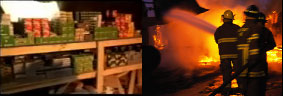
We are not suggesting you disregard the risks of ammo “cooking off” in a fire, but you will learn the realities of the situation by watching the video. There are some amazing demonstrations — including a simulated retail store fire with 115,000 rounds of ammo in boxes. As cartridges cook off, it sounds like a battery of machine-guns, but projectiles did not penetrate the “store” walls, or even two layers of sheet-rock. The fire crew puts out the “store fire” easily in under 20 seconds, just using water.
Additional Testing: Drop Test, Projectile Test, Crush Test, Blasting Cap Test
Drop Test
The video also offers interesting ammo-handling tests. Boxes of ammo were dropped from a height of 65 feet. Only a tiny fraction of the cartridges discharged, and there was no chain-fire. SAAMI concludes: “When dropped from extreme heights (65 feet), sporting ammunition is unlikely to ignite. If a cartridge ignites, it does not propagate.”
Rifle Fire Test
SAAMI’s testers even tried to blow up boxes of ammunition with rifle fire. Boxes of loaded ammo were shot with .308 Win rounds from 65 yards. The video includes fascinating slow-motion footage showing rounds penetrating boxes of rifle cartridges, pistol ammo, and shotgun shells. Individual cartridges that were penetrated were destroyed, but adjacent cartridges suffered little damage, other than some powder leakage. SAAMI observed: “Most of the ammunition did not ignite. When a cartridge did ignite, there was no chain reaction.”
Bulldozer Crush Test
The test team also did an amazing “crush-test” using a Bulldozer. First boxes of loaded ammo, then loose piles of ammo, were crushed under the treads of a Bulldozer. A handful of rounds fired off, but again there was no chain-fire, and no large explosion. SAAMI observed: “Even in the most extreme conditions of compression and friction, sporting ammunition is unlikely to ignite. [If it does ignite when crushed] it does not propagate.”
Blasting Cap Test
Perhaps most amazingly, the testers were not able to get ammunition to chain-fire (detonate all at once), even when using blasting caps affixed directly to live primers. In the SAAMI test, a blasting cap was placed on the primer of a round housed in a large box of ammo. One cartridge ignited but the rest of the boxed ammo was relatively undamaged and there was no propagation.
Sharpshooter (and competitive smallbore shooter) Kirsten Joy Weiss tried a special New Year’s trick shot for 2015. In keeping with the festive New Year’s spirit, Kirsten attempted to shoot the cork off a champagne bottle. After a few unsuccessful tries, she managed to hit the cork with at least two shots. But alas the cork did not fly. She actually hit the cork, but it did not release. That was surprising…
Undaunted, Kirsten changed her strategy, aiming for the neck of the bottle. This duplicates the process of “sabering” a champagne bottle — a method of liberating the bubbly by slashing off the end of the neck with a blade. Aiming for the neck of the bottle, Kirsten successfully blew off the top of the bottle. (Apparently, when “sabering” it is actually the pressure within the champagne bottle which does most of the work).
SHOT Show 2016 kicks off in two weeks in Las Vegas. While at SHOT Show next month, we plan to get the “inside scoop” on new bullet designs from Berger, Hornady, Lapua, Nosler and Sierra.
A while back, at SHOT Show 2012 we chatted with Berger Ballistician Bryan Litz about Berger’s popular line of Hybrid bullets. Berger now offers a wide range of Hybrids in multiple calibers and weights. In fact, for .30-Caliber shooters, Berger now offers seven different Hybrid match bullets, with weights from 155 grains up to 230 grains. Two .338-caliber OTM Tactical Hybrids were introduced in 2012 (a 250-grainer and a 300-grainer).
Bryan tells us: “The hybrid design is Berger’s solution to the age old problem of precision vs. ease of use. This design is making life easier for handloaders as well as providing opportunities for commercial ammo loaders who need to offer a high performance round that also shoots precisely in many rifles with various chamber/throat configurations.”
For those not familiar with Hybrid bullets, the Hybrid design blends two common bullet nose shapes on the front section of the bullet (from the tip to the start of the bearing surface). Most of the curved section of the bullet has a Secant (VLD-style) ogive for low drag. This then blends in a Tangent-style ogive curve further back, where the bullet first contacts the rifling. The Tangent section makes seating depth less critical to accuracy, so the Hybrid bullet can shoot well through a range of seating depths, even though it has a very high Ballistic Coefficient (BC).
In the video we asked Bryan for recommended seating depths for 7mm and .30-Caliber Hybrid bullets. Bryan advises that, as a starting point, Hybrid bullets be seated .015″ (fifteen thousandths) off the lands in most barrels. Watch the video for more tips how to optimize your loads with Hybrid bullets.
What could be more fun than decorating a Christmas tree? Well how about busting Xmas ornaments with a .50 BMG. Boys will be boys, right? This 50 Cal Days of Christmas video features some fantastic slow-motion footage of a Barrett .50 Caliber M82. This bad boy pumps out some serious muzzle flash. Watch carefully at the 1:05 mark and you can see the .50-caliber projectile exit the muzzle brake and spin through the ball of smoke and flame.
The video carries “overkill” to the max, as the shooter uses his big Barrett to blast Christmas ornaments and a snow-globe. To top things off, at the 2:50 mark, the shooter fires the .50 cal at a pyro-equipped gingerbread house. (The gingerbread shot is taken from a standing hold no less!) The results (at 3:22) are impressive — gingerbread house becomes flaming gingerbread pudding.
Lots of slots — that’s what you’ll find on the top of RCBS’s new Pro-Chucker 7 progressive reloading press. This thing has SEVEN (7) stations, which gives you great flexibility when reloading. You have plenty of extra slots for special dies such as crimp dies or powder-check dies. The 7-hole interchangeable die-plate (aka tool-head) is am impressive bit of engineering — it looks like the cylinder for a super-sized revolver.
Our friend Gavin Gear of UltimateReloader.com got his hands on one of the first production models of the new Pro Chucker 7 progressive press. Gavin reports: “This 7-station auto-indexing progressive is the ‘big brother’ of the RCBS Pro Chucker 5, and is built on the same frame. While it shares most of the same internals, there are a few differences”. Key differences include a seven-station shellplate and seven-station die-plate (vs. five stations on the Pro Chucker 5). In addition the priming system is slightly different and the Pro Chucker 7 comes with a much larger powder hopper.
Watch Pro Chucker 7 Unboxing Video:
To demonstrate the new features of the Pro Chucker 7, Gavin has produced an unboxing video that shows the components of the system. This is a completely different design than the RCBS 2000 system progressive press (which this editor owns). The Pro Chucker series 5 and 7 presses have a more compact frame and a more conventional, vertical column priming system. They don’t take up much more space on your loading bench than a turret press, yet they offer full progressive capability, creating one loaded round with every pull of the handle.
If you are considering purchasing a progressive press (whether green, red, or blue), you should watch the video and see the press features. Gavin Gear will demonstrate how the Pro Chucker 7 works with another video to be released in the near future.
The new Star Wars movie, The Force Awakens, opens this Friday in theaters nationwide. The latest film in the Star Wars saga (and the first in a decade), The Force Awakens will surely entertain Sci-Fi fans. But gun enthusiasts will also find items of interest in this film. It may surprise you, but many of the notable prop guns in Star Wars movies were created from actual firearms — from competition air pistols to military carbines. Take a look at that poster above. Check out the “blaster” in Harrison Ford’s hand — that’s based on a real firearm. To test your knowledge of Stars Wars firearms, take the quiz below, created by the NRA Blog. Enjoy the quiz and “may the Force be with you….”
There’s a chap in Poland named Łukasz Pietruszka, who is a bonafide “Wizard of Wood”. Lukasz handcrafts unique custom stocks, selling them through his LP Gunstocks company. Many of his most eye-catching stocks are for airguns (particularly Field Target rifles), but he also produces fine stocks for rimfire and centerfire hunting rifles. Lukasz is a master carver who includes exquisite details on many of his stocks. Some of these designs, crafted from exotic hardwoods, raise stock-crafting to an art form.
Check out the figure on this Turkish Walnut stock by Łukasz Pietruszka.
You can see a variety of Lukasz’s stocks in a video sampler. If you’re a fan of fine wood, you’ll love this video. So pull up a chair, grab your favorite beverage, and enjoy this 16-minute video interlude.
Watch Video in High Definition
NOTE: We recommend you view this video in high definition, in wide screen format. To do this, start the video, then click on the gear-shaped icon at the lower right-hand corner of the video frame (it’s located just to the right of the clock icon). If you have a fast internet connection, select 720P or 1080P from the pop-up menu. (1080P is the highest resolution.) Now select theater mode or full-screen mode using the small icons on the lower right of the frame.
Radical ‘Shockwave’ from LP Gunstocks
Here is a truly amazing bit of craftmanship. The images below show a one-of-a-kind Shockwave stock created by Łukasz for a Steyr Field Target air rifle. Over the top? Perhaps… but you have to admire the imaginative design and exquisite worksmanship.
Video find by Boyd Allen. We welcome reader submissions.




 The Sporting Arms and Ammunition Manufacturers’ Institute (
 We are not suggesting you disregard the risks of ammo “cooking off” in a fire, but you will learn the realities of the situation by watching the video. There are some amazing demonstrations — including a simulated retail store fire with 115,000 rounds of ammo in boxes. As cartridges cook off, it sounds like a battery of machine-guns, but projectiles did not penetrate the “store” walls, or even two layers of sheet-rock. The fire crew puts out the “store fire” easily in under 20 seconds, just using water.
 Sharpshooter (and competitive smallbore shooter) Kirsten Joy Weiss tried a special New Year’s trick shot for 2015. In keeping with the festive New Year’s spirit, Kirsten attempted to shoot the cork off a champagne bottle. After a few unsuccessful tries, she managed to hit the cork with at least two shots. But alas the cork did not fly. She actually hit the cork, but it did not release. That was surprising…


 Watch Video in High Definition


