The Deep Creek Range near Missoula, Montana, is one of the best 1000-yard ranges in the country. Many long-range benchrest records have been set in this scenic, tree-lined facility. Now, thanks to Forum member David Gosnell (aka “Zilla”), you can see Deep Creek from the air. David attached a High-Def video camera to a quad-rotor drone. He then flew the drone over the Deep Creek Range, soaring from firing line to the target bay and back again. We think you’ll like this video. It gives you a “birds-eye view” of one of America’s elite ranges. Enjoy.
Here’s an example of world-class benchrest shooting. Charles Huckeba of Texas was the top individual shooter at the 2013 World Benchrest Championships (WBC) held near Sydney Australia in October 2013. In this video, 2013 WBC Two-Gun Overall winner Charles shoots a 1/8th MOA group at 200 yards — “a little bitty dot” as a fellow Team USA shooter observes. That’s impressive. If you can describe Huckeba’s style in a nutshell it would be “smooth, consistent, and rapid but not hurried”.
Charles also employed some unusual hardware. In the video, take a close look at the joystick on the Farley Coaxial front rest. There’s no knob at the end. In its place is a small, wood ammo caddy. Charles removed the standard knob from the handle of his Farley rest and replaced it with a home-made wood block that holds cartridges for the record target. The 10.5-lb Light Varmint rifle is chambered in 6PPC with a BAT Machine Action and a composite wood and carbon-fiber stock.
Watch Charles Huckeba Shoot 1/8 MOA, 200-yard group at World Benchrest Championships
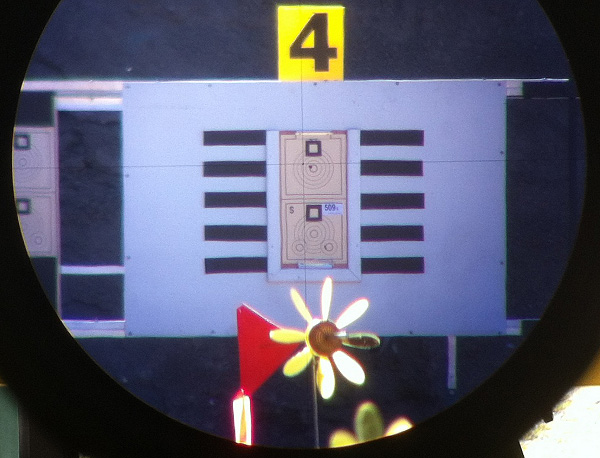
Here is the actual 200-yard, 5-shot group Charles shot in the video. Photo (by Stuart Elliot) taken through the lens of Huckeba’s 50X March scope (reticle has 1/16th MOA Dot).
Analyzing the Fine Points — What Makes Huckeba So Good
Short-range benchrest shooter Boyd Allen saw some interesting things in Huckeba’s WBC performance, as captured on video. Boyd noticed Huckeba’s smooth gun-handling and efficient loading. But Boyd also spied some interesting equipment, including an innovative joystick “handle-caddy”.
1. Low Friction Bags — When Huckeba slid his rifle, there was very little apparent friction. The front bag features the new 3M material (ScotchLite) on the sliding surfaces. The rear Protektor bag has ears of the same low-friction material.
2. Pause Before Chambering — While he was watching the flags and deciding when to start firing, Charles kept his first round in the action, but out of the barrel’s chamber, probably so as not to heat the cartridge and change the round’s point of impact.
3. Ammo Caddy on Joystick Arm – Charles shoots a Right Bolt/Left Port action, so he pulls his rounds with his left hand. Note that Huckeba’s record rounds rest in a small, wood ammo caddy attached to the end of the joystick shaft. Look carefully, you’ll see the wood ammo block in place of the normal black ball at the end of the joystick. That allows Charles to pull shots with the absolute minimum of hand movement. Ingenious! Huckeba is very fast, with a great economy of motion. I believe that because his ammo was literally at hand, Charles was better able to keep his focus on aiming and the flags.
4. Smooth-Cycling BAT Action — Note how smoothly Huckeba’s action operates. When Charles lifts the bolt handle (to extract a round and cock the firing pin), this does not disturb the rifle. Likewise, as he closes the bolt, the gun doesn’t wobble. The smooth action allows Charles to hold point of aim even when shooting relatively quickly. Huckeba’s BAT action is chrome-moly steel. Some shooters believe this metal makes for a smoother action than stainless steel or aluminum.
5. Long-Wheelbase Stock — The wood and carbon fiber stock is light, long, and stiff. Yet, importantly, the stock is also well-damped. The longer-than-average stock length (with extended forearm) seems to help the gun track well without jumping or rocking. The longer forearm allows a longer “wheelbase”, effectively shifting the weight distribution rearward (less weight on the front, more weight on the rear). This places a greater share of the gun’s weight on the rear bag, as compared to a more conventional benchrest stock. Huckeba’s stock, built by Bob Scoville, is at the cutting edge of short-range benchrest design. Its light-weight balsa wood and carbon fiber construction provides a combination of stiffness and vibration damping that allows its relatively long fore-end to be fully utilized to increase the weight on the rear bag (always an issue with 10.5-pound rifles).
To learn more about this benchrest stock design, read the comments by stock-builder Bob Scoville in our PPC with Pedigree story in our Gun of the Week Archives. Bob observed:
“There is a lot more to the structure of the stocks than meets the eye. The carbon fiber skin with which I cover the stocks creates a light, tough exterior surface. However, this contributes very little to the overall performance of the stocks. The real strength and stiffness is the result of an internal beam utilizing balsa core/carbon fiber technology.
This type construction can be found in aircraft, race cars, powerboats, and sailboats. It is interesting to note, balsa has the highest strength to weight ratio of all woods and carbon fiber is one of the lowest stretch (modulus of elasticity) relative to weight of all materials. The marriage of these two materials is common in the high-performance world. Additionally, balsa is used commercially for vibration dampening and sound reduction.”
Video find by Boyd Allen. Video by Stuart Elliot of BRT Shooters Supply, Brisbane, Australia.
This evening (Wednesday, April 15th), Shooting USA television spotlights the National Matches and CMP events at Camp Perry, Ohio. This is a “must-watch” episode for anyone interested in High Power shooting. The National Matches at Camp Perry are the World Series of American shooting sports, attracting the nation’s top pistol and rifle marksmen. There are individual competitions, such as the Vintage Sniper Match, or the M1 Garand Match featuring legendary firearms. Then there’s the National Trophy Infantry Team Match, known as the Rattle Battle among competitors, simulating an assault by an Infantry Squad. Catch this episode of Shooting USA on the Outdoor Channel. Vintage military rifle fans take note — this week’s show also features an American classic, the m1903 Springfield.
Eastern Time – 3:30 PM, 9:00 PM, 12:30 AM (Thursday)
Central Time – 2:00 PM, 8:00 PM, 11:30 PM
Mountain Time – 1:30 PM, 7:00 PM, 10:00 PM
Pacific Time – 12:00 Noon, 6:00 PM, 9:30 PM
The 1903 Springfield on Tonight’s Show
The U.S. Rifle, Model of 1903, better known as the 03 Springfield, continues to attract praise today. While its design was initially borrowed, its accuracy, quality and service record proved to be a fine military bolt-action rifle in the trenches of WW I and on into World War II. “It was a beautifully made gun, extremely, extremely well balanced,” says Firearms Historian Garry James.
History of the National Matches and Camp Perry
In 1903, President Theodore Roosevelt’s vision of skilled marksmen among American citizens came to life as the National Matches; civilians on the firing line with the service weapon of the day, preparing for training in case of a time of war. T.R.’s vision is now a tradition, attracting thousands of people for five weeks of shooting competitions each year at Camp Perry in Ohio.
The National Matches have been held at Camp Perry since 1907. The range is located along the shores of Lake Erie in northern Ohio near Port Clinton. The site was first acquired in 1906, in response to the need for a larger facility for military training and the NRA’s shooting programs. In 1906 Gen. Ammon B. Crichfield, Adjutant General of Ohio, ordered construction of a new shooting facility on the shores of Lake Erie, 45 miles east of Toledo, Ohio. The original land for Camp Perry was purchased in 1906, and the reservation was named after Commodore Oliver Hazard Perry, the American naval commander who won the Battle of Put-in-Bay during the War of 1812.
On August 19, 1907, Cpl. L. B. Jarrett fired the first shot at the new Camp Perry Training Site. And that year, 1907, Camp Perry held its first National Pistol and Rifle Championship events. This location has hosted the annual NRA National Matches ever since. Today, over 4,000 competitors attend the National Matches each year, making it the most popular shooting competition in the western hemisphere.
Here’s a great video from German ammo-maker GECO (part of the Swiss RUAG group of companies). Employing advanced 3D rendering and computer graphics, this animation unveils the inside of a pistol cartridge, showing jacket, lead core, case, powder and primer. Next the video shows an X-ray view of ammo being loaded in a handgun, feeding from a magazine.
Then it really gets interesting. At 1:32 – 1:50 you’ll see the firing pin strike the primer cup, the primer’s hot jet streaming through the flash-hole, and the powder igniting. Finally you can see the bullet as it moves down the barrel and spins its way to a target. This is a very nicely-produced video. If you’ve ever wondered what happens inside a cartridge when you pull the trigger, this video shows all. They say “a picture’s worth a thousand words”… well a 3D video is even better.
For Best Viewing, Click Gear Symbol and Select HD Playback Mode
Report by John Morgan-Hosey
Civilian Service Rifle (CSR) is a shooting sport in the United Kingdom shot with bolt action rifles and ‘Straight-Pull’ derivatives of semi-auto centerfire rifles. Why do the UK shooters use manual-operating versions of popular self-loaders? Well, that’s because of legal restrictions. Civilian ownership of semi-auto centerfire rifles was banned in the United Kingdom in 1987.
Give credit to the ingenuity of competitive shooters in the UK. The ban on semi-autos has not stopped shooters from adapting modern rifles such as the AR15. In fact, CSR is the UK NRA’s fastest growing shooting discipline. There are four classes for competitors:
1. Historic Class — Vintage Rifles, mostly Lee Enfields with iron sights.
2. Iron Sights Class — all non-Historic Rifles with Iron (open) sights.
3. Practical Optic Class — Rifles with bipods (and scopes 4.5X or greater magnification).
4. Service Optic Class — Rifles without bipods (and scopes with no more than 4.5X power).
Surprisingly, shooters in the Service Optic Class dominate these matches. So you don’t need a high-magnification scope or a bipod to do well. The most popular rifles are modified AR-platform rifles. These are set-up in the UK with no gas system to ensure they comply with our laws. Side-charger cocking handles are fitted to allow the rifles to be operated easily while in the shooting position. You can see in the photo above a modified AR with the Union Jack on the buttstock. Notice the bolt handle on the right. This opens and closes the bolt.
This video clip shows the side-charging ARs in use.
Note the side bolt handle that cycles the action on this non-semi-auto AR.
Here shooters advance 100 yards to engage the targets at the next firing line.
Dave Wylde Sets Impressive Record at the Civilian Service Rifle League Match.
The last matches in the 2014/15 CSR League took place on Sunday, 5 April. With final places in all four classes up for grabs, the fine weather and light winds made for some impressive scores, none more so than Dave Wylde in Service Optic Division. Dave scored a mighty impressive 246 (of a possible 250) in the PM Match. Breaking 235 is tough enough and scoring over 240 a rarity with the match includes standing snap shooting at 100 yards, a sitting rapid at 200 yards, and prone snap shooting at 300 yards with and two run downs to raise the shooters heart rate.
The most popular class, Service Optic, had Peter Cottrell retaining the trophy for the fourth consecutive year with a score of 993. Adam Chapman pushed him hard all season to finish a close second on 987 points, with Bill Ellis, one of the most consistent CSR shooters, third with 972.
Civilian Service Rifle Grows in Popularity
As CSR continues to grow in popularity, the sale of ‘Straight-Pull’ AR-platform rifles is increasing year after year. Accordingly, the United Kingdom NRA is allocation more range space at the Bisley National Shooting Centre to accomodate the increasing number of competitors.
On April 9, 2015, the California Fish and Game Commission (CFGC) adopted regulations to ban the use of traditional lead-component ammunition for all hunting in the state by July 1, 2019. The Daily Caller reports: “In a unanimous vote, the Commission opted to phase out lead bullets, which hunters’ groups are calling a de-facto ban on hunting in the state.” The new regulations will be implemented in multiple phases, starting with the 2015 hunting season. These tough new regulations were issued pursuant to legislation passed in 2013 by the California legislature and signed by Gov. Jerry Brown.
The National Shooting Sports Foundation is worried that California-style ammo bans will be adopted in other states. To some observers, California’s ban on lead-based ammunition was designed more to reduce gun sales and halt hunting than it was ever intended to help the environment. The NSSF has shown that the elimination of traditional lead ammo will do little, if anything to improve the environment in any meaningful way. What such bans WILL do is raise the cost of ammo and make it more difficult to hunt. The NSSF explains: “Anti-hunting groups use the supposed harm caused by traditional ammunition as a wedge issue to further their ultimate political agenda of banning hunting across the country.” The NSSF has provided the real facts via an infographic and the YouTube video embedded below.
R. Lee Ermey, aka the “Gunny”, has a new Television Show on the Outdoor Channel. We’ll be tuning in to GunnyTime with R. Lee Ermey when it debuts April 15, 2015 (yep, Tax Day). Ermey has an impressive resume — An 11-year veteran of the U.S. Marine Corps and active High Power competitor, the Gunny has appeared in numerous feature films and has also starred in critically-acclaimed TV series on HBO, TNT, Showtime and History Channel.
The all-new, half-hour series produced features weapons and weapons technology – past, present, and future. While consulting with top experts, Ermey will demonstrate both historic weapons and modern high-tech firearms and military gadgets. The Gunny also test-drives a variety of weaponized vehicles, such as a Tomcar TM5 with an M249 S.A.W. mounted on it.
Watch Show Preview Trailer
In the show Ermey will be assisted by knowledgeable experts including Craig “Sawman” Sawyer, a retired U.S. Navy SEAL, Grady Powell, retired U.S. Army Special Forces Sergeant, and our friend Kirsten Joy Weiss, ace rifle shooter and host of the popular Sharp Shots YouTube Channel.
When evaluating firearm finishes, one should consider hardness, chemical resistance, lubricity, abrasion resistance, and color. However, none of these factors are as critical as corrosion protection. The average firearm owner deals with corrosion more than any other finish-related problem. Accordingly, when selecting an exterior finish for the metal components of your guns, you should look for a product with superior corrosion resistance. Thanks to Cerakote, we now have some science to help you make that decision….
How well do various firearm finishes resist corrosion?
Watch the video below to find out.
Eight Gun Finishes Tested — With Surprising Results
Eight (8) various finishes are tested, including Blueing, Cerakote, DuraCoat, FailZero, Ion Bond, KG Gun Kote, NiBX, and Phosphate (Parkerizing). Eight metal firearm components (each with a different finish) are placed into the salt chamber to see how long it takes for each finish to show initial signs of corrosion. To provide a baseline for comparison, a “naked” 416 stainless steel barrel was also placed inside the test chamber. The test was started, and for each coating, the time was recorded when corrosion started to appear. FYI, if you thought “stainless steel” can’t rust, think again. The stainless barrel sample (along with the blued metal sample) showed visible corrosion after just 24 hours!
After 24 Hours in Salt Chamber
After 48 Hours in Salt Chamber
After 172 Hours in Salt Chamber
Salt Chamber Testing — 5% Salt Concentration at 95°F
According to ASTM B117-03, the Corrosion Test provides a controlled corrosive environment which has been utilized to produce relative corrosion resistance information for specimens of metals and coated metals exposed in a given test chamber. The salt chamber is set to a temperature of 95 degrees Fahrenheit with a 5% salt concentration. Salt Chamber testing is used to draw a comparison between metals and finishes and does not correlate to a specific number of hours of real world use.
Story tip by EdLongrange. We welcome reader submissions.
Update — Rich Wyatt Arrested for Theft
Rich Wyatt, owner of the Gunsmoke gunshop, was arrested Friday, April 10, 2015. He turned himself into the Jefferson County Sheriff’s office after being charged with felony “theft from at ‘at-risk’ adult”. This charge stemmed from alleged conversion of property from an individual who had consigned guns with Wyatt. According to CBS 4 Denver, “The victim in the case had consigned a rare and antique gun collection with Wyatt in 2013. Repeated efforts by the victim at recovering the weapons had failed.”
Lesson: Don’t sell firearms if you don’t have a valid Federal Firearms License.
Gunsmoke, the Wheat Ridge, Colorado firearms emporium featured on the Discovery Channel’s reality TV show American Guns, has been raided by the Feds. ATF and IRS agents swooped into the Gunsmoke shop last week, culminating an investigation into alleged improper gun transactions. Firearms were seized from Gunsmoke’s inventory and carted away in federal vans.
Run by Rich Wyatt and his wife Renee, Gunsmoke earned notoriety for Rich’s salesmanship and the revealing clothing worn by his wife and his daughter. The show highlighted Rich’s ability to sell firearms for what were often shockingly high prices. There was one problem though… Wyatt had voluntarily surrended his FFL some time ago. Consequently, Gunsmoke’s firearms transfers were being conducted through a third party. Apparently the Feds did not like the arrangement.
Those who have watched the Wyatts on the Discovery Channel may not be surprised by this outcome. It seemed like Rich Wyatt’s signature talent was selling guns at outrageously inflated prices (if the sales price quoted on the show are to be believed). As for the alleged “gunsmithing” done in the Gunsmoke shop… well it certainly was creative. You could definitely learn what NOT to do to a fine firearm by watching the Gunsmoke TV show.
No arrests have been made. The GunsAmerica Blog reports: “This is not the first time Gunsmoke Guns was investigated by a federal agency. In 2013, the IRS searched the store as part of an ‘ongoing financial investigation.’ So far, no charges have been filed against the owner of the store Rich Wyatt, according to the U.S. Attorney. But local CBS4 investigator Rick Sallinger learned the shop may have been selling guns illegally.”
In this video, Forum member Erik Cortina shows how to create a custom modified case for use with the Hornady Lock-N-Load Overall Length Gauge (formerly the Stoney Point Tool). While Hornady sells modified cases for many standard cartridges, if you shoot a wildcat such as the 6mm Dasher or .284 Shehane, you’ll need to create a custom modified case*. And even if you shoot a standard cartridge such as the .308 Winchester you can get more consistent measurements if you make a custom modified case from a piece of brass fired in your chamber.
The process is straight-forward. Take a piece of brass fired in your chamber and full-length size it (with about .002″ shoulder bump). Then you need to drill out the primer pocket. Erik uses a mini-lathe for the operation, but this general process can be done with a drill press or other tools. Erik shows how to do this with a 0.290″ HSS (High Speed Steel) drill bit on a mini-lathe. After drilling the hole comes the tricky part — you need to tap the case with the precise 5/16″ x 36 threads per inch (tpi) right-hand thread that matches the male thread on the O.A.L. Gauge. This 5/16″ x 36 tpi tap is pretty uncommon, but you can order it from Amazon.com if you can’t source it locally.
If you use a mini-lathe, Erik suggests loosening the tailstock slightly, so it can float while cutting the threads. Erik also says: “Make sure you get the tap on pretty tight — it’s going to want to spin.” Erik turns the case at about 100 rpm when tapping the threads. Once the case and tap are rigged, the actual tapping process (see video at 6:00) takes only a few seconds. While the mini-lathe makes the tapping process go more quickly, the threading can also be done with other systems.
TIP: Don’t just make one modified case, make three. That gives you one for your range kit, one for your home reloading bench, plus a spare (since you WILL eventually lose or misplace one).
Here’s the Stuff You Need
5/16″-36 TPI Threading Tap
The required thread is somewhat uncommon. You need a 5/16″ – 36 tpi Right Hand Thread Tap. If you can’t find it locally, Amazon.com carries the correct tap. Erik notes: “The 5/16-36 tpi tap is not a common size. I think Hornady did this on purpose to make it more difficult for the average guy to make his own modified cases.”
0.290″ Drill Bit
Erik uses an 0.290″ HSS “L” drill bit. (This “L” Letter Gauge code designates a 0.290″ diameter bit). A close metric equivalent would be 7.3 mm (0.286″). Erik says: “A 9/32″ drill will also work but it will be harder to run the tap in since the hole will be .281″ instead of .290″ with the Letter Gauge L bit.”
Tips for Using O.A.L. Gauge with Modified Case
We’ve noticed that many folks have trouble getting reliable, consistent results when they first start using the Hornady O.A.L. Gauge (formerly the Stoney Point Tool). We’ve found this is usually because they don’t seat the modified case properly and because they don’t use a gentle, consistent method of advancing the bullet until it just kisses the lands.
Here is our suggested procedure for use the O.A.L. Gauge. Following this method we can typically make three of four measurements (with the same bullet), all within .001″ to .0015″. (Yes, we always measure multiple times.)
1. Clean your chamber so there is no build-up of carbon, debris, or lube. Pay particular attention to the shoulder area.
2. Screw the modified case on to the O.A.L. Gauge. Make sure it is seated firmly (and doesn’t spin loose). Note, you may have to re-tighten the modified case after insertion in the chamber.
3. Place your selected bullet so that the ogive (max bullet diameter) is behind the case mouth. This prevents the bullet from “snagging” as you insert the tool in the action.
4. Insert the O.A.L. Gauge into your chamber smoothly. Push a little until you feel resistance. IMPORTANT — You need to ensure that the shoulder of the modified case is seated firmly against the front of your chamber. You may have to wiggle and twist the tool slightly. If you do not have the modified case seated all the way in, you will NOT get a valid measurement.
5. Advance the bullet slowly. (NOTE: This is the most important aspect for consistency!). Push the rod of the O.A.L. tool gently towards the chamber. DON’T shove it hard! Easy does it. Stop when you feel resistance.
6. IMPORTANT. After gently pushing on the rod, give the end of the rod a couple forward taps with your finger. If your bullet was slightly skewed, it may have stopped too far back. Adding a couple extra taps will fix that. If the bullet moves after the taps, then again push gently on the rod. NOT too much! You just want to push the bullet until it just “kisses” the lands and then stops. Do NOT jam the bullet into the rifling. If you do that you will never get consistent results from one measurement to the next.
* For a $15.00 fee, Hornady will make a custom modified case for you if you send two fired pieces of brass. Send fired cases and $15.00 check to: Hornady Manufacturing, Attn: Modified Cases, 108 S. Apollo St., Alda, NE 68810. More Info HERE.



 3. Ammo Caddy on Joystick Arm – Charles shoots a Right Bolt/Left Port action, so he pulls his rounds with his left hand. Note that Huckeba’s record rounds rest in a small, wood ammo caddy attached to the end of the joystick shaft. Look carefully, you’ll see the wood ammo block in place of the normal black ball at the end of the joystick. That allows Charles to pull shots with the absolute minimum of hand movement. Ingenious! Huckeba is very fast, with a great economy of motion. I believe that because his ammo was literally at hand, Charles was better able to keep his focus on aiming and the flags.
 The 1903 Springfield on Tonight’s Show
 Here’s a great video from German ammo-maker


