They say a picture is worth a thousand words. In this case a video is way more illuminating than anything we can write. The video below, produced by Savage, demonstrates how the new 17 HMR Savage A17 rifle works. The video includes nicely-done 3D Graphics that illustrate the function of the A17’s delayed-blowback action with “interrupter lug”. Using “X-Ray View” animation, the video shows what happens INSIDE the chamber as rounds are fired. The video also explains how the 17 HMR presents a tougher engineering challenge than the lower-pressure .22 LR cartridge.
Watch this Video — You’ll Learn Something about Semi-Auto Rimfires
NOTE to Readers: Watch the video! If you have any interest in how guns work, check this out (full-screen if possible). For some reason (maybe slow connections), most readers skip over the videos we embed in our stories. In this case, take 3 minutes to watch. Click arrows button to view Full-Screen.
Savage officially launched the A17 this month, after previewing the new 17 HMR rifle at SHOT Show in January. We tested the gun on Media Day and came away very impressed. The A17 fed and functioned flawlessly. It is fun to shoot, and it will be affordable. MSRP is $469.00 so street price should be about $425.00. READ AccurateShooter A17 Report.
We plan to test one of these very soon. If the field test goes as well as I expect, your Editor will probably buy one of these rifles. The A17 has a barrel nut system just like centerfire Savage rifles. This means it will be easy to fit an aftermarket custom barrel to the A17. We already have some ideas for a suppressed A17 project gun with upgraded stock and barrel(s). Stay tuned….
The Magic Chicklet
Look below at the A17 bolt. The little black hardened metal piece (called a “chicklet” by the Savage engineers) is the secret ingredient. This “Interrupter Lug” retracts, allowing the A17 to operate in delayed blow-back mode. That permits the A17 to function flawlessly with the 17 HMR cartridge.
“Forever”. That’s a serious concept. In a world where many products are guaranteed for just 30 days (or not at all), the Brownells “forever” 100% satisfaction guarantee is pretty darn impressive. In this video, Pete Brownell, company CEO, explains how the Brownells guarantee works. If any product Brownells sells ever proves unsatisfactory, at any time, Brownells will replace it or refund your money. That applies to both Brownells-branded products as well as third-party manufactured items sold by Brownells. Think about that the next time you buy a trigger or scope rail or other firearm accessory.
“One thing about Brownells that sets it apart from any other organization inside or outside the firearms industry is our return policy. Here’s how it is… it’s guaranteed forever. What this means is, if you buy [a product] from Brownells… whatever it is, it’s guaranteed forever. Not just lifetime, but forever.” — Pete Brownell, CEO
100% Satisfaction Guarantee on Everything We Sell
If you aren’t completely, 100% satisfied with any purchase you receive from Brownells, for any reason, at any time, return it for a full refund or exchange. No hassle, no problem. And, we won’t bog you down in endless paperwork. [This statement appears on Brownells.com].
In the video below, Forum Member Thomas Haugland (from Norway) shows how to install a Picatinny-type rail on a Sako action. Every stage of the process is illustrated — removing the barrel from the action, drilling/tapping the action, aligning/attaching the rail, and finally mounting the scope and test-firing the rifle. Note that the action is removed using a large adjustable-end wrench with brass disks to protect the finish. This is possible because this particular Sako action has a flat bottom and top. With a different action you’ll want to use a custom action wrench.
In the video, Thomas and his assistant actually fabricate the rail from scratch. That’s probably beyond the ability of most do-it-yourselfers. You can purchase precisely machined Picatinnny rails from Seekins Precision and other sources instead. Still, it is interesting to see the milling of the rail. Note that, before screwing the rail to the top of the action, Thomas applies a marine epoxy (timeline 3:18). This effectively beds the rail to the top of the action and provides a more secure installation.
You can find more interesting gunsmithing, hunting, and long-range shooting videos on Thomas Haugland’s YouTube Channel.
The IWA Outdoor Classics trade show, aka “Euro SHOT Show”, opened today, March 6th, in Nuremberg, Germany. For the next four days (March 6-9), 1383 exhibitors will show their products at the Nuremberg Exhibition Centre. This is a hugely popular event — last year’s IWA Outdoor Classics trade show attracted 39,244 visitors from 117 countries, and attendance should be even higher this year. IWA is Europe’s biggest combined trade show for the hunting, shooting, and civilian/military security industries. And this year, IWA Outdoor Classics was coordinated with EnforceTac, a two-day Law Enforcment/Security trade show held in Nuremberg March 4-5, 2015.
IWA even features an indoor Archery Range. For many years, the Archery Range (located in Hall 5) has been a popular gathering place where exhibitors and visitors can practice their skills and learn about the latest archery products up close and personal.
About the IWA Outdoor Classics Trade Show
What is now the IWA Outdoor Classics trade show began 42 years ago as Germany’s national product show for gunsmiths and gun retailers. That product show started modestly in 1973 with less than 100 exhibitors. Over the past four decades IWA Outdoor Classics has grown into a massive event, drawing the major players in the hunting, security, and shooting sports industries. In the firearm universe, the IWA event is second only to America’s SHOT Show in importance. This video (produced in 2013) shows IWA highlights from the past four decades:
They say “things are bigger in Texas”. Well shots are longer too. In this video, a shooter successfully hits a 1-MOA target at 3600 yards with a .375 CheyTac rifle. That required plenty of elevation to compensate for the bullet’s drop over its 2.045 mile trajectory. The shooter, Jim Spinella of New Jersey, needed a whopping 60.2 Mils of elevation (26.8 in rail, 22.6 in turret, 10.8 hold-over). Jim had to wait a long time to confirm the hit — with the metal gong situated more than than 2 miles from the firing line, it took the bullet 7.2 seconds to hit the target.
Big 350gr Bullets with a Wicked BC
The 3600-yard hit was made with CheyTac factory ammo using 350gr CNC-turned bullets. Spinella was impressed: “The ammo chronographed out at 3080 fps with velocity differences at no more the 7 fps, which was outstanding. We found the true BC over 3600 yards to average 0.810 (G1)”.
NOTE: You see three shots in the video, but Spinella took many more before a hit was achieved: “We peppered the 2 MOA area around the target with a couple of dozen rounds. We hit the rack the target is hanging on twice. This was a fun experience, and we took a lot of data away from it. We put a lot of work and planning into this in order to be in position to be lucky. So many things are ridiculously magnified at that distance. Every 1 mph change in wind [moves the bullet] about 6 feet. As the barrel heats up the velocity changes with it [and] 10 fps velocity differences, shot to shot, are almost 5 feet.”
This ultra-long-range adventure took place last September at the FTW Ranch in Texas. Spinella worked with a team of experts from Hill Country Rifles, builders of the custom .375 CheyTac rifle, to achieve a 3600-yard shot on a 36” round steel target. Hitting a target at 2.045 miles is no mean feat. That 36″ gong represents slightly less than 1 MOA at that range. A lot can happen to send a bullet off target during a 7.2 second flight.
Rifle: Hill Country Rifles custom .375 Cheytac, Stiller Precision action, 29″ Krieger barrel
Optics: Schmidt & Bender 5-25X56mm PM-2 scope
Actual Measured Distance: 3606.41 Yards
Target: 36″ circular steel plate
Altitude: 2000 feet
Temp: 70 degrees
Elevation: 60.2 mil
Windage: 3.5 mil left
CheyTac Caliber Comparison — .375 vs. .408
The shooter, Jim Spinella, prefers the .375 CheyTac to its .408-caliber Big Brother: “I shoot both the .408 and .375. Both are great ELR rounds and will get you out there a long way. In my experience, the .375 will get you out there a little bit further. My preference is the .375 Cheytac over the .408. This has nothing really to do with external ballistics. It has to do with fouling. My .408 will go from stellar accuracy to terrible between 40 and 45 rounds. It happens that quickly and accuracy returns after cleaning the barrel. I have never experienced this with the .375. After 100 rounds there is minimal copper fouling with the .375, but I clean around this round count. I don’t know why there is heavy cooper fouling in the .408, but it is common to this round and other shooters who shoot it regularly. That said, I lightly clean the .408 using Wipeout and go back to having fun with it after about 30 minutes.”
At the 2015 Berger Southwest Nationals, Forum member Erik Cortina cornered Bryan Litz of Applied Ballistics. Erik, the F-Open winner in the 600-yard Mid-Range match, was curious about bullet sorting. Knowing that bullets can be sorted by many different criteria (e.g. weight, overall length, base to ogive length, actual bearing surface length etc.) Erik asked Bryan to specify the most important dimension to consider when sorting. Bryan recommended sorting by “Base to Ogive”. Litz noted that: “Sorting by overall length can be misleading because of the nature of the open-tip match bullet. You might get a bullet that measures longer because it has a jagged [tip], but that bullet might not fly any different. But measuring base to ogive might indicate that the bullet is formed differently — basically it’s a higher resolution measurement….”
Ballistics Q & A in Shooter’s Forum
Got more questions about bullets? Our Shooters’ Forum has a special area for Bullets & Ballistics topics. There you can get your own questions about bullets and ballistics answered by Bryan Litz and other experts from Applied Ballistics.
Starline Brass offers a series of videos with helpful reloading tips. Focused primarily on pistol cartridges, these short videos can help anyone get started with metallic cartridge reloading. If you load pistol rounds on a progressive, this video series is particularly helpful. The on-camera host is Hunter Pilant, son of Carroll Pilant of Sierra Bullets.
Preventing Double Charges
Tip: Use a bulky powder that fills your case more than half way with a correct charge. This will overfill the case if it is double-charged, making it very difficult to seat a bullet.
Tumble New Brass Before Loading the First Time
Tip: Tumble new pistol cartridge brass in used media for 30 minutes before loading for the first time. This will add enough graphite (carbon residue) to smooth case entry into dies. You can also lube the case mouths with graphite, or use spray lube.
Powder Through Expander — How to Eliminate Hang-ups
Tip: When loading pistol brass with a progressive press, sometime the powder-through expander is hard to remove, especially with short cases. There are two fixes — first, try deburring the inside of the case mouth on your cases. Second, the radius of the powder through expander plug can be modified to smooth entry and exit (see photo). Starline will do this modification for free.
Tonight American Rifleman TV visits Herstal, Belgium, to examine the rich heritage of Fabrique Nationale d’Herstal (FN Herstal), a company originally founded in 1889 to produce one gun — the Belgian Mauser. FN Herstal has now been producing firearms for more than 125 years, including iconic designs of John Moses Browning. FN Herstal’s firearms are now used by the armed forces of over 100 nations.
The FN Herstal episode (on the Outdoor Channel) is previewed in this video starting at 00:30. You may learn some surprising facts. Did you know that FN’s factories also produced bicycles, cars, trucks and motorcycles?
Preview Fabrique Nationale Episode on American Rifle Television
Fabrique Nationale d’Herstal (aka FN Herstal) is a major firearms manufacturer located in Herstal, Belgium. This enterprise is currently the largest exporter of military small arms in Europe. Firearms manufactured by FN Herstal include the Browning Hi-Power pistol, Five-seven pistol, FAL rifle, FNC rifle, F2000 rifle, P90 submachine gun, M2 Browning machine gun, MAG machine gun, and Minimi machine gun.
History of Fabrique Nationale d’Herstal
FN Herstal originated in the small city of Herstal, near Liège. The Fabrique Nationale d’Armes de Guerre (French for National Factory of Weapons of War) was established in 1889 to manufacture 150,000 Mauser Model 1889 rifles ordered by the Belgian Government. FN was co-founded by the major arms makers of the Liège region, with Henri Pieper of Anciens Etablissements Pieper being the driving force and the primary shareholder of the new company. In 1897 the company entered into a long-lasting relationship with American Gun Designer John Moses Browning.
American gun designer John Moses Browning did the preliminary design work for the Browning GP35 ‘High Power’ (sometimes written as Hi-Power) pistol, the GP standing for Grande Puissance or “high power” in French. However, the weapon was finalized by Dieudonné Saive and did not appear until nearly a decade after Browning’s death.
The American Connection — Winchester and Browning
FN Herstal is a subsidiary of the Belgian Herstal Group, which also owns U.S. Repeating Arms Company (Winchester) and Browning Arms Company. FN Herstal is the parent company of two United States entities: FN Manufacturing and FNH USA. FN Manufacturing in Columbia, SC, is the manufacturing branch of FN Herstal in the United States, producing firearms such as the M249 and M240 machine guns and M16 rifle, among others. FNH USA, located in McLean, VA, is the American sales and marketing branch of FN Herstal.
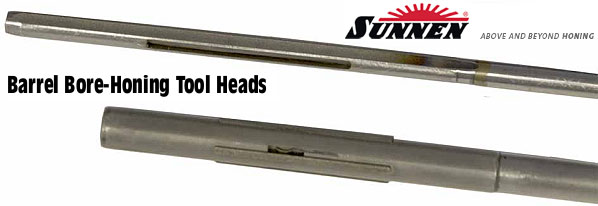
Some custom barrel makers are now honing barrels (after drilling) to improve bore diameter uniformity, smooth the interior finish, and reduce barrel lapping times. For years, large-scale manufacturers of hammer-forged barrels have employed honing. Now the process is being used by smaller, “boutique” barrel-makers. This article explains how and why barrel honing is done. Take the time to watch the video. For anyone with an interest in barrel-making, this video is an eye-opener…
Barrel Honing Process Demonstrated (Worth Watching!):
For custom barrel makers, honing is a time-saver and cost cutter. A few minutes on a honing machine can cut lapping times in half, leaving a cross-hatched surface finish in single or low double-digit Ra. Honing is the same process used to make diesel fuel injectors with bore roundness and straightness controlled to fractions of a micron (<0.000040"), with surface finish Ra ≤0.15 µm (6 µin).
A key manufacturing process used for hammer-forged barrels is now getting attention from the makers of custom button-rifled barrels. This process is precision bore-honing. Honing produces a high-quality bore surface fast, which is critical to hammer forging. (Why is honing so important with hammer forging? Surface finish is the one feature of the barrel that cannot be controlled in hammer forging. Surface imperfections in a barrel blank tend to be amplified as the blank is formed on the rifling mandrel. And if the bore is chromed afterwards, imperfections in the surface finish become even more obvious.)
Honing dramatically improves bore diameter size uniformity and accuracy, surface finish and roundness throughout the length of the barrel. It can certainly be used in place of a pre-rifling lap. The chief difference between a lapped and honed bore is the direction of the finish lines in the bore. Honing leaves fine spiraling crosshatch lines, while a lap leaves lines going longitudinally in the bore. After rifling the manufacturer can remove the crosshatch finish with a quick lap if desired. Honing is fast, accurate, and can be automated. Its surface quality and geometry can duplicate lapping, except for the longitudinal lines of the lapped finish.
Frank Green of Bartlein Barrels told us: “We worked with Sunnen and we did all the initial testing on the prototype machine for them. The machine works great! We ordered and received last year a new manufactured machine with the changes we wanted on it and we just ordered a second one a month or so ago. Should be here next month.”
Computer-Controlled Bore-Honing
Honing can be done with great precision through the use of advanced, computer-controlled honing machines. Sunnen Products Company recently introduced a new machine for .17 to .50-caliber barrels (see control panel below). The spindles on this machine can correct bore size imperfections so small only an air gauge can measure them. The consistency this allows improves bore uniformity, which, in turn, produces more accurate barrels for the precision market.
Sunnen Products Company is the world’s largest vertically-integrated manufacturer of honing systems, tooling, abrasives, coolants and gauging for precision bore-sizing and finishing. Sunnen’s customers include manufacturers of diesel and gas engines, aerospace components, hydraulic components, oil field equipment, and gun/cannon barrels. Sunnen, which just celebrated its 90th anniversary, employs more than 600 people worldwide.
How would you like to “reach out and touch” someone 110 nautical miles away? Well America’s Navy may soon be able to do exactly that with an amazing new, high-tech weapon system. BAE Systems has developed (and successfully test-fired) an electro-magnetic rail gun that fires a 23-lb projectile at Mach 7 — (about 5300 mph or 7800 fps). This futuristic weapon can send its projectile 110 nautical miles (126 mi / 203 km), five times the range of the big 16″ guns on WWII-era battleships. This railgun has serious “knock-down” power — at Mach 7, that projectile carries a whopping 32 megajoules of energy. BreakingDefense.com says: “23 pounds ain’t heavy. But it sure hurts when it hits you going at seven times the speed of sound.”
Watch Video to See Navy Rail-Gun in Action:
The latest prototype of the railgun developed by defense contractor BAE, in conjunction with the Office of Naval Research, can accelerate a projectile up to Mach 7 within 10 milliseconds. The gun uses no gunpowder to generate propelling force. Compared to an item on a smaller scale, the railgun projectiles resemble crossbow darts, except they deliver such massive Kinetic Energy they don’t need to carry explosive ordnance. The railgun can strike targets 110 nautical miles away.
To prepare a charge, the ship stores electricity in the pulsed power system. Next, an electric pulse is sent to the railgun, creating an electromagnetic force accelerating the projectile. Because of its extreme speed, the projectile eliminates the hazards of storing high explosives in the ship. Each shot costs about $25,000 — but that’s cheap compared to the price of a missile.
“It’s like a flux capacitor,” chief of Naval research Rear Admiral Mathias Winter said in a video posted by Reuters Friday. “You’re sitting here thinking about these next generation and futuristic ideas, and we’ve got scientists who have designed these, and it’s coming to life.”
The Electromagnetic Railgun Innovative Naval Prototype (INP) was initiated in 2005. The goal during Phase I was to produce a proof-of-concept demonstration at 32 mega-joule muzzle energy, develop launcher technology with adequate service life, develop reliable pulsed power technology, and assess component risk reduction for the projectile.
Phase II, which started in 2012, advanced the technology to demonstrate a repeatable-rate fire capability. Thermal-management techniques required for sustained firing rates will be developed for both the launcher system and the pulsed power system. The railgun will begin testing at sea in 2016.




 Tonight