The Kelbly clan had an impressive new action on display at SHOT Show. This new Kelbly Atlas Tactical action features a super-hard, durable black nitride external coating. This is a not a spray-on or bake-on finish. It is actually a surface layer treatment of the metal that increases the toughness of the finish to 84 Rockwell while making it super-smooth. This allows the action to work well with minimal lubrication.
Ian Kelbly says this action was designed with input from tactical gunsmiths and PRS competitors. The action comes standard with a fluted bolt, APA oversized bolt-knob, and a +20 MOA Picatinny rail on top. The fluted bolt helps keep channel dirt and dust out of the contact surfaces. Ian says this black nitride finish should provide superior function in sandy, dusty, or dirty environments because it can run with almost no lube/grease that attracts and retains grit. Visit Kelbly.com for action specifications and current pricing.
Over the past few years, interest in F-Class competition has grown dramatically. SHOT Show opens tomorrow, so we thought we’d reprise an interesting interview captured two years back. At the 2013 SHOT Show we had a chance to talk about F-TR competition with U.S. National F-TR Team members Mike Miller and Stan Pate, two of America’s top F-TR shooters. We are reprising this interview for readers who may have missed it the first time around. If you shoot F-TR (even if you’re a High Master), we think you’ll learn a few things from this interview.
In this interview, Mike and Stan agreed to share their vast store of knowledge about long-range shooting. In a wide-ranging dialog, we discussed many topics of interest to F-Class shooters: position set-up, bipod shooting techniques (and hardware), gun-handling, and bullet selection. In addition, Mike and Stan offer some great advice on wind reading and precision reloading. These general tips will benefit all competitors, no matter what their discipline.
If you shoot F-TR or you are considering getting involved in this fast-growing shooting sport, definitely watch this 14-minute video interview from start to finish. Mike and Stan are true F-TR gurus whose knowledge of the F-TR game has been gleaned from years of top-level competition. If you shoot a .308 from a bipod, we guarantee you can learn much from Mike and Stan. If you follow their advice, we bet you’ll see your scores improve in future matches.
Watch Video for Tips from U.S. National F-TR Team Members Mike Miller and Stan Pate
Story by T. Logan Metesh forNRABlog.com
Since beginning in 1979, SHOT Show has become one of the premier firearms industry event of the year. As I was packing up amazing and historic guns from the NRA Museums for SHOT Show, I was led down a path of historical whimsy — what would SHOT Show have been like 160 years ago in 1855?
All of the today’s household names in firearms would have been in attendance: Remington, Colt, Smith & Wesson, Winchester, and others. Some of them were already well established; others were on the edge of greatness. Eliphalet Remington (right) would have been there. Already a well-known and respected businessman, he would have been representing the company he founded 39 years before in 1816.
Samuel Colt would have been in very good spirits. He had just renamed his company — Colt’s Patent Fire Arms Manufacturing Company — and had broken ground on a new factory that would open the following year in 1856. His revolver patent was also set to expire in 1856. Colt had recently fired Rollin White, a trivial matter at the time, but it would come back to haunt him.
Horace Smith and Daniel Wesson would have been there, too. At this point, the now-venerable firearms company had only been a partnership for three years. They would likely have been joined by one of their investors, Oliver Winchester, and showcasing their lever-action “Volcanic” arms.
Very shortly, Winchester would buy Volcanic, Rollin White would patent a bored-through cylinder that Colt had rejected, and Smith and Wesson would form Smith & Wesson Revolver Company utilizing White’s new patent.
As you can see, many of the technologies we consider antiquated were, at the time, revolutionary. Some of the designs we take for granted today were in their infancy in 1855.
Other lesser-known (and less successful) gunmakers hoping to capitalize on their new products would have been there as well. After all, there’s no better place to unveil new designs than at SHOT Show!
Thomas Wright Gardener Treeby (often known as T.W. Treeby) would likely have been at SHOT Show displaying his new 14-shot, .54 caliber chain rifle. Designed in 1854 and patented in 1855, these rifles were made in an attempt to create a successful repeating rifle design. The British military tested the gun with a 30-round chain, but the idea never caught on.
Rare, Antique Firearms on ForgottenWeapons.com
See the Treeby Chain Gun and other rare firearms on ForgottenWeapons.com. It is believed that only two Treeby Chain rifles were ever made. The 14 chain-linked “chambers” rotated into place via a sprocket (like on a bicycle), and each had a separate percussion cap. Watch this ForgottenWeapons.com video to see how it worked.
Forum member Erik Cortina recently launched his own YouTube Channel dedicated to precision reloading and accurizing. Erik’s videos demonstrate the proper use of specialized reloading tools and provide helpful hints. Erik’s latest video is about the “mother of all brass trimmers”, the Giraud powered case trimmer. Erik says: “It you do volume reloading… this is the only trimmer to get. It not only trims to length but it also chamfers your case mouth inside and out.” In his video, Erik offers some very clever and useful tips that will help you get the most from your Giraud.
The Giraud trimmer is very precise. When set up correctly, it can trim brass with amazing consistency. In the video, Erik trims 5 pieces of brass in 15 seconds (6:32 mark). He then measures all five with precision calipers (7:00-8:08). All lengths are exact within .0005 (half a thousandth). Erik notes that the Giraud trimmer indexes off the case shoulder. As long as you have fire-formed brass with consistent base-to-shoulder dimensions, you should get very consistent trim lengths.
The secret to the system is a 3-way cutting head. This cutter can be swapped in and out in a couple minutes with wrenches provided with the kit. Erik has three different heads; one each for 6.5mm, 7mm, and .30 caliber. The video shows how to adjust the cutting heads to match caliber diameter (and to get the desired amount of inside/outside chamfer).
This is a manufacturer’s photo showing an older model.
To trim and chamfer cases, you simply insert them nose-first into the cartridge-specific case-holder. Erick offers a smart tip — He uses a die locking ring to position the cartridge holder (3:15). This can be locked in place. Erik says die locking rings work much better than the hex-nuts provided by Giraud (with the hex-nut, one must re-set cut length each time you change case-holders.)
The Giraud can be used in either horizontal or vertical modes. Erik prefers to have the trimmer aligned vertically, allowing him to push cases down on the trimmer head. But the trimming unit has twin sets of rubber feet, allowing horizontal or vertical orientation.
Improved Case-Holder Made with Chamber Reamer:
For his .284 Shehane, Erik had to create his own case-holder (Giraud does not make one for that wildcat cartridge). Erik used his chamber reamer. To his surprise, Erik found that the brass was easier to trim in the custom case holder (compared to the Giraud-made spring-loaded holders). With a perfect fit, trimming and case extraction went more smoothly and the process was easier on his hands. (See 9:00-10:00). Based on Erik’s experience, you may want to create your own custom case-holder.
Trim Bullet Meplats Also
With a special bullet-holder fitting and meplat cutter head, the Giraud power trimmer can be used to trim bullet meplats. Trimming meplats can help make the Ballistic Coefficents of a batch of bullets more consistent. Uniforming meplats is also often done as a first step in the process of “tipping” bullets to improve BC.
Just another YouTube video … NOT. This video is a winner. If you want to see state-of-the-art 21st Century rifle-building, with advanced CNC milling operations, watch this clip. It shows how man and machine combine to create a fine custom rifle.
One of the best short features of its kind, this video shows the creation of a high-end, 22-250 varmint rifle from start to finish. All aspects of the build are covered. The rifle was crafted by Chad Dixon for O’Neill Ops. Once the build is complete, the video shows the rifle being tested at 440 yards. With the camera filming through the scope, you can even watch the trace, starting at the 2:36″ time mark (this is very cool).
Watch this Video in HD!
Any person with an interest in gunsmithing should watch this video. It shows barrel profiling, tenon-thread cutting, chambering, CNC stock inletting, bedding, and stock painting.
For this build, Chad Dixon of LongRifles, Inc. teamed up with O’Neill Ops. The video shows the “Coyote Rifle” build, step by step, from the cutting of the tenon threads, to the 440-yard field test at the end of the build. To learn more about this rifle’s components and its performance in the field, contact James O’Neill, www.oneillops.com, (605) 685-6085.
Chad Dixon of LongRifles, Inc.
Chad Dixon’s introduction to firearms began in 1991 as a marksmanship instructor and competitive shooter in the U.S. Marine Corps. Chad began building rifles in 2000 at the Anschutz National Service Center, where he worked with U.S. Olympic shooters. In 2003 Chad took a position with Nesika Bay Precision/Dakota Arms. After leaving Nesika, Chad deployed to the Middle East as a security contractor for the U.S. Dept. of State. On his return to the USA, Chad started LongRifles Inc., a custom rifle-building company.
Dixon-built rifles combine modern CNC manufacturing methods with traditional expert craftsmanship. Chad’s rifles have won major int’l and national level competitions in Smallbore, Smallbore Silhouette, High Power, and Long Range Palma disciplines.
Werner Mehl of Kurzzeit.com produced a 10-minute video for the 2010 SHOT Show. This amazing video became a huge hit on YouTube, with over 45,600 “likes”. With the 2015 SHOT Show coming up, we thought you’d like another view. This super-slow-motion video has been watched over 10 million times, making it one of the most popular shooting-related videos in history. Employing cameras recording at up to 1,000,000 (one million) frames per second, Mehl’s bullet flight video has been called “astounding”, “mesmerizing”, and a “work of art.” If you haven’t seen it yet, sit back and enjoy!
LINK: Kurzzeit.com Video System and BMC-19/PVM-21 Chronograph
Click the link above to learn more about Werner Mehl and his super-sophisticated camera systems that can record at 1,000,000 frames per second. On the same linked page you can learn about the advanced PVM-21 chronograph (now sold as the BMC-19) designed by Werner. Operating “all-infrared, all the time”, the PVM-21 is the best optical chronograph we have tested for very low light conditions, or very tricky light conditions.
Mark your calendars for the “Mother of all Airgun Matches”. The 33rd Annual Canadian Airgun Grand Prix, the largest airgun competition in North America, will be held in Toronto on February 6 – 8, 2015. Competitors from several countries will be in attendance. All events will take place in the International Plaza Hotel conveniently located only 5 kms from the Toronto Pearson airport.
70-Position Shooting Range with Electronic Targets for Finals
The main shooting range for the Canadian Airgun Grand Prix features 70 positions for air rifle and air pistol, including positions designated for access by adaptive athletes, with electric target carriers on all positions. This will provide state-of-the-art hardware for the competitors.
See How Electronic Targets Work:
The Grand Prix Finals will be shot on SIUS electronic targets and will follow the new ISSF format. The top 8 in each of the Men’s and the Women’s events, including International Juniors and Sub-juniors will compete in Finals to determine the “Open” winners. For more info and updates, visit the Canadian Airgun Grand Prix Facebook Page. Competitors can register at: http://nfap.ca/cagp/cagp.nsf.
Get an inside look at the how ammunition is made with this step-by-step production guide from Hornady. The video begins by showing the stages in production of a lead-core jacketed bullet with exposed tip, such as the Hornady Interlock. Next, at the 1:38″ time-mark, the video shows how cartridge cases are made, starting with small brass cups (photo right). The brass is lengthened in a series of stages involving annealing, drawing, polishing, and the formation of the case head with primer pocket. Finally, at the 2:40″ time mark, the video shows how bullets and powder are seated into cartridge cases on the Hornady assembly line. In the final production stages, the completed ammunition is tested and packaged.
What can happen when the bottom-most primer in a primer feed tube goes off? A big bang, that’s what. Some or all of the primers in the vertical feeding tube can go off in a chain detonation. That’s exactly what happened to Dustin Ellermann, Top Shot Season 3 Champion. Scary experience, but thankfully Dustin was not injured. He writes: “Super thankful that I was wearing my Wiley X eye protection this weekend when I was reloading some .223 rounds. My press detonated nearly 100 small rifle primers. Shown here is the magazine feed tube. Not fun but it could have been much worse. Stay safe!”
When working with progressive reloading presses, you should definitely wear eye protection. Dustin’s chain detonation experience proves that — without a doubt. Remember you only have one set of eyes!
APS Strips — Alternative to Primer Tubes When you stack a column of primers in a single metal tube, you’re asking for trouble. As Dustin Ellermann learned, when one primer fires, the entire column can follow suit in a chain detonation. Thankfully, you do have options when it comes to primer feeding on a progressive press. RCBS developed an innovative primer system for its Pro-2000 progressive press. Instead of being stored in a vertical tube, primers are placed in flat, plastic “APS” strips, with a ring of plastic separating each primer. Moving horizontally, primers are never stacked, so the chance of a chain detonation is reduced dramatically. The re-usable APS strips are color-coded for different primer types. You can buy CCI “pre-loaded” primer strips, or you can insert any brand of primers into strips using an RCBS strip-loader tool.
RCBS Pro-2000 with APS Strip Priming System
AccurateShooter.com Editor Uses Strip Primers
This Editor owns an RCBS Pro-2000 progressive press (manual-indexing version). The RCBS strip-priming system was one key reason I selected the RCBS Pro-2000 over similar-priced progressives from Dillon and Hornady. I believe the strip primer system is safer, more positive, and easier to use. Before I purchased my RCBS progressive, I “road-tested” the competition. I loaded hundreds of rounds on each of four different progressives: Dillon 550B, Dillon 650, Hornady Lock-N-Load, and RCBS 2000. I was concerned about the primer feed tubes on the Dillons, and I found the RCBS rotary powder measure was much more precise (and easier to adjust) than the sliding bar system on the Dillon machines. The RCBS priming system was definitely more fool-proof than the system on the Hornady press (a first-generation L-N-L that had issues with primer feeding). After “test-driving” blue, red, and green brand progressives extensively, I settled on the RCBS Pro-2000. A decade later, I still think I made the right choice. I like the APS strips for big jobs, and I can also use them in the RCBS hand-priming tool (shown below). With the strips, its easy to prime 20 or 40 cases at a time, and then switch to another type of primer for comparison testing.
This week’s episode of Shooting USA TV, the first of the new year, is definitely worth watching. The lead story focuses on the 35th Annual Bianchi Cup — the richest and most prestigious match in the handgun shooting sports. Competitors shoot four stages over a three-day period, and everyone aims for that perfect score: 1,920. Watch this episode on Wednesday, January 7, 2015 to see the world’s best handgunners in action.
The Legendary Lee Enfield
This week, Shooting USA also features the Lee Enfield MK III, also known as the SMLE for “Short Magazine Lee Enfield”. Introduced in 1907, the SMLE was the primary British infantry weapon during WWI. The Lee Enfield’s speed of cycling, versatility, and reliability made it one of the great 20th-Century battle rifles. “I’ve never read a disparaging word by a WWI British soldier against his Enfield,” says Firearms Historian Garry James. “His government [gave] him a really good firearm.”
Julie Golob Talks About Carry Handguns
In the Pro Tip segment of the January 7th broadcast, Smith & Wesson Pro shooter Julie Golob offers advice for first-time gun buyers. Julie reviews various options among revolvers and semi-automatic pistols. She discusses factors to consider: weight, balance, firepower, ease of use and concealability.


 Over the past few years, interest in F-Class competition has grown dramatically. SHOT Show opens tomorrow, so we thought we’d reprise an interesting interview captured two years back. At the 2013 SHOT Show we had a chance to talk about F-TR competition with U.S. National F-TR Team members Mike Miller and Stan Pate, two of America’s top F-TR shooters. We are reprising this interview for readers who may have missed it the first time around. If you shoot F-TR (even if you’re a High Master), we think you’ll learn a few things from this interview.

 All of the today’s household names in firearms would have been in attendance: Remington, Colt, Smith & Wesson, Winchester, and others. Some of them were already well established; others were on the edge of greatness. Eliphalet Remington (right) would have been there. Already a well-known and respected businessman, he would have been representing the company he founded 39 years before in 1816.


 Just another YouTube video … NOT. This video is a winner. If you want to see state-of-the-art 21st Century rifle-building, with advanced CNC milling operations, watch this clip. It shows how man and machine combine to create a fine custom rifle.

 Get an inside look at the how ammunition is made with this step-by-step production guide from Hornady. The video begins by showing the stages in production of a lead-core jacketed bullet with exposed tip, such as the Hornady Interlock. Next, at the 1:38″ time-mark, the video shows how cartridge cases are made, starting with small brass cups (photo right). The brass is lengthened in a series of stages involving annealing, drawing, polishing, and the formation of the case head with primer pocket. Finally, at the 2:40″ time mark, the video shows how bullets and powder are seated into cartridge cases on the Hornady assembly line. In the final production stages, the completed ammunition is tested and packaged.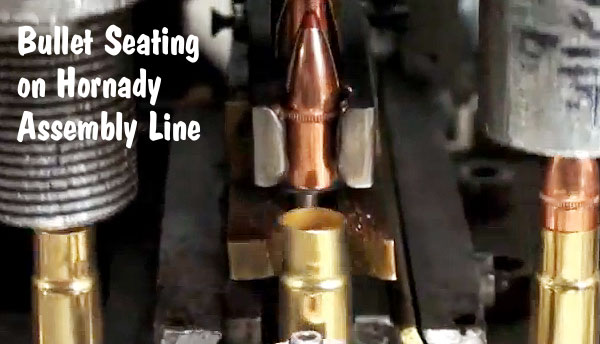

 When you stack a column of primers in a single metal tube, you’re asking for trouble. As Dustin Ellermann learned, when one primer fires, the entire column can follow suit in a chain detonation. Thankfully, you do have options when it comes to primer feeding on a progressive press. RCBS developed an innovative primer system for its Pro-2000 progressive press. Instead of being stored in a vertical tube, primers are placed in flat, plastic “APS” strips, with a ring of plastic separating each primer. Moving horizontally, primers are never stacked, so the chance of a chain detonation is reduced dramatically. The re-usable APS strips are color-coded for different primer types. You can buy CCI “pre-loaded” primer strips, or you can insert any brand of primers into strips using an RCBS strip-loader tool.


