What anti-corrosion products really fight rust effectively? You’ll hear many opinions, but what do actual field tests reveal? One rifle shooter, who posts on YouTube as BlueonGoldZ, wanted to separate myth (and marketing claims) from reality, so he completed his own long-term rust test using metal samples. First he used ordinary tap water spray, and then he did a second, longer-duration test with a salt-spray solution. Nine different products were tested: Break Free CLP, Corrosion-X, Frog Lube, M-Pro 7, Outers, Pro-Shot Zero Friction, Rem Oil, Slip 2000, and Tetra Gun Triple Action CLP.
BlueonGoldZ initially examined each product for its “beading” properties with a normal tap water spray. But the main test involved many multiple weeks of exposure after a “dense” salt-water spray. (No rust formed after two weeks tap water exposure, so the test was accelerated with salt-water exposure).
The clear winners in the test, as shown by the screen shot above, were Corrosion-X (Best), and Frog-Lube (Second Best). The photo shows the test samples two weeks after being sprayed with salt water. The results are pretty dramatic — you can see with your own eyes what happened. We think this is a very useful bit of real-world research.
Results from Similar Long-Term Salt Exposure Test
Unfortunately, BlueonGoldZ’s test did NOT include Eezox, which we have found to be extremely effective (on a par with Corrosion-X). In another long-term test of corrosion preventatives, the two best rust fighters were Eezox and Corrosion-X in that order. Since that test was completed, Corrosion-X, already an excellent product, has been enhanced. CLICK HERE for Long-Term Salt Exposure Test Report.
Our friend Dennis Santiago recently recreated the “Mad Minute”, a marksmanship drill practiced by the British Army in the decades preceding World War I. Dennis, an active high power rifle competitor and instructor, enjoyed his “Mad Minute” exercise, though he assures us that this takes practice to perfect. Dennis tells us: “Here is a ‘Mad Minute’ drill, done using a period correct Lee-Enfield (SMLE) No.1 Mk III rifle and Mk VII ammo. I got to the Queen’s Regulations (15 hits in one minute) on the second run and put a good group on the target at 200 yards. This is ‘jolly good fun’ to do every once in a while. This is ‘living history’ — experiencing a skill from a time when the sun never set on the British Empire.”
“Mad Minute” was a pre-World War I term used by British Army riflemen during training at the Hythe School of Musketry to describe scoring a minimum of 15 hits onto a 12″ round target at 300 yards within one minute using a bolt-action rifle (usually a Lee-Enfield or Lee-Metford rifle). It was not uncommon during the First World War for riflemen to greatly exceed this score. The record, set in 1914 by Sergeant Instructor Alfred Snoxall, was 38 hits. (From WikiPedia.)
Want to See More “Mad Minute” Action with a Modern Tubegun?
In 2012, Gary Eliseo ran a “Mad Minute” exercise using a modern, .308 Win Eliseo RTM Tubegun of his own making. Gary ended up with 24 hits on a bull target set at 300 yards. (Gary actually had 25 hits in 25 rounds fired, but the last round hit just after the 60-second time period expired.) Note how Gary pulls the trigger with the middle finger of his right hand. This allows him to work the bolt faster, using his thumb and index finger. CLICK HERE for Eliseo Tubegun Mad Minute story.
Watch Gary Elesio Shoot the ‘Mad Minute’ (Starts at 4:47 on Video)
NOTE: In an interesting coincidence, Dennis Santiago was actually in the pits pulling targets for Gary during Eliseo’s 2012 “Mad Minute” exercise.
History of the Mad Minute Commentary by Laurie Holland
The original military requirement of the “Mad Minute” saw the soldier ready to fire with a round in the chamber, nine in the magazine, safety on. This course of fire is still followed by the GB Historic Breechloading Arms Association and other bodies in their recreated “Mad Minute” competitions.
The first 10 would go quickly, but reloads were critical, this not done by a magazine change as Gary did with the RTM or in a modern tactical or semi-auto rifle, but through slick use of ‘chargers’. It is this aspect which fouls so many of my colleagues up as it is very easy to cause a jam and a large part of 60 seconds can go in sorting it out!
Charger clips were selected for those that just held the rounds firmly enough to stop then falling out, were sand-papered and polished with a stove / fireplace polish called ‘Zebrite’ so that the rimmed rounds would slip through the clips like corn through a goose.
If you’re unfamiliar with the cock-on-closing Enfield action, it seems clumsy. With intensive practice it is very smooth and can be operated incredibly quickly. The trick is to whip the bolt back onto its stop and initiate a rebound movement that takes it and the cartridge well into the chamber thereby reducing the effort required to close the bolt and chamber the round.
New handloaders often ask us for advice on reloading techniques and equipment selection. It’s always best for novice reloaders to work under the guidance of an experienced mentor. Nothing beats “learning the ropes” with an experienced reloader at ones side. In addition, new handloaders should acquire one or more good reloading manuals, such as the Hornady Reloading Handbook (9th Ed.). We recommend reading the introductory chapters of a reloading manual to get a good understanding of the basic principles involved.
Along with print manuals, instructional DVDs are available. RCBS sells a 32-minute, step-by-step Precisioneered Handloading DVD, narrated by Shooting USA’s Jim Scoutten. This $9.19 DVD covers the basics of metallic cartridge reloading and shotshell reloading.
For those who have already mastered the basics, Redding offers a 45-minute instructional DVD, appropriately named Advanced Handloading: Beyond The Basics ($17.52 at Amazon.com). The Redding DVD, produced with help from Sierra Bullets, is narrated by John Barsness, field editor of Rifle and Handloader magazines. The Redding DVD does go “Beyond the Basics” but it really is more an intermediate resource — it doesn’t reveal some of the most sophisticated methods of case prep and load tuning used by competitive benchrest shooters. Nonetheless it is a good resource for those getting started with rifle cartridge reloading.
Federal has created an award-winning Bullet Breakdown Video (below) that demonstrates how various hunting bullets perform in ballistic gelatin. This and other videos are found on Federal Premium Ammunition’s YouTube Channel. The Bullet Breakdown Video features four bullet types used in Federal Ammo: Nosler Ballistic Tip; Sierra GameKing; Trophy Bonded Tip; and Barnes Triple-Shock X-Bullet. (Note: you may want to turn down the volume before playback.)
Federal’s high-resolution, slow-motion video-graphy helps demonstrate which loads are the best for specific uses. The ultra-slo-mo footage provides a detailed view of each bullet penetrating ballistic gelatin blocks. These blocks closely mimic animal tissue and clearly display performance characteristics.
“The Bullet Breakdown Video is a great tool for hunters trying to decide on ammunition type,” said Federal’s Jason Nash. “Properly preparing for the hunt is crucial-and not all bullets are made the same. The bullet is the one link between hunter and game and can be the difference between success and failure. This video helps show hunters how different bullet construction affects terminal performance[.]” For more info, visit www.FederalPremium.com.
Where did all the .22 LR ammunition go? Why are the prices so high? Why can’t the rimfire ammo-makers step up production? Across the country, firearm owners are asking these questions, and demanding answers.
Part of the explanation comes down to production capacity. America’s rimfire ammo production facilities are already running at full capacity. There is no easy way in increase production. In the video below, the crew from Shooting USA Television visits the ATK production facility in Lewiston, Idaho. This plant can produce 4,000,000 rounds of CCI rimfire ammo in one 24-hour period. This informative video shows the complete process of rimfire ammunition production from start to finish.
This is a ‘must-watch’ video that reveals some very interesting things. Did you know that 1200 cases (in one large tray) are filled with powder in a single operation? (See 05:45 mark). Likewise, bullets are also lined up in a matching 1200-count tray (See 6:00 mark). This way 1200 bullets can be seated into 1200 rimfire cases in one efficient procedure.
When you watch the video, and see the complex, expensive machinery involved, you’ll realize that it’s no easy thing to increase rimfre ammo production. The rimfire plants are already running at full capacity. To produce significantly greater quantities of .22 LR ammunition, manufacturers would have to make huge capital investments.
Saving Private K-9, a new, original television show, debuts tonight on the Sportsman Channel. Hosted by ‘Gunny’ R. Lee Ermey, Saving Private K-9 features the dedicated working dogs who perform important tasks for the U.S. Armed Services as well as law enforcement agencies. For the 2,500 teams of canines and handlers who serve with America’s military and law enforcement organizations, the idea of a dog being “man’s best friend” is no overstatement.
Each episode of Saving Private K-9 highlights the featured dogs’ specialized training, battlefield accomplishments, and relationships with their handlers. Many episodes include inspiring accounts of courageous acts by military dogs, as told by those who fought beside them. Additionally, the show will focus on the dogs’ post-service lives, which often involve rigorous rehabilitation prior to adoption.
Watch ‘Saving Private K-9′ Trailer
Saving Private K-9 premiers Thursday, May 15 at 8:30 pm ET/PT. Hosted by actor and former Marine R. Lee Ermey, the series is part of Sportsman’s Salute to Service initiative.
What happens when a round goes off unsafely in an AR? Watch this video and see. At about the 00:40 time-mark the shooter has a malfunction (click no bang), with a round. He then removes the magazine, and clears the chamber (we think). On the next round, at 00:53 you hear a “Bang” and see a big puff of smoke coming out of the upper receiver (see photo at right). This has been called a “detonation” by the video-maker, but we’re not 100% sure what happened. What do you guys think? Watch the video carefully, and state your conclusions in the comment section if you wish.
What Caused this Malfunction? Watch Video…
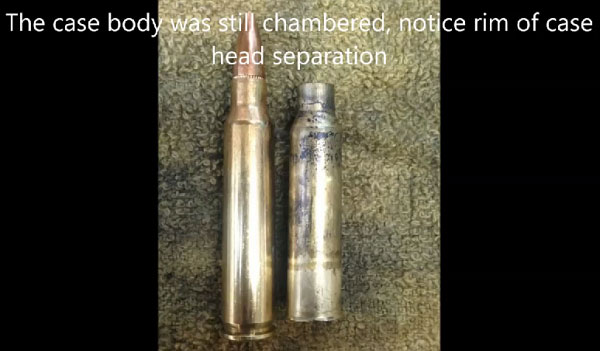
In any event, the shooter is fortunate his upper did not completely fracture, launching shrapnel into his face or other body parts. This could have turned out much worse. Here are screen-shots from the video, showing details of the gun after the accident, along with the recovered brass case, which separated near the case-head.
Sinclair International has produced an eight-part video series on metallic cartridge reloading, hosted by Sinclair’s former President Bill Gravatt. The entire series can be viewed (for free) via Sinclair’s “How-To Videos” archive. While this set of videos starts with the basics, it covers many more advanced aspects of reloading as well. Accordingly, both novice and experienced reloaders can benefit from watching the eight videos. We think everyone should watch Video No. 2, which outlines the hazards of reloading and provides guidelines for safe reloading practices.
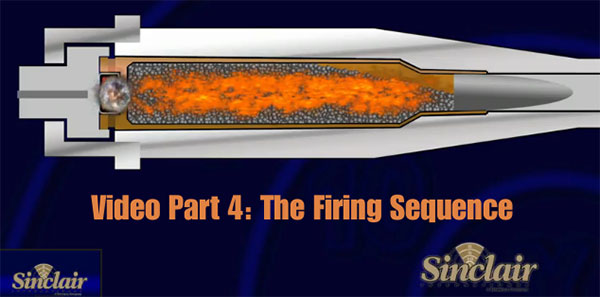
We also strongly recommend Video No. 4 to readers who are getting started in reloading. This “How Things Work” segment covers the sequence of events inside the chamber (and barrel) when the cartridge is fired. The video includes helpful graphics that show what happens to the primer, powder, cartridge, and bullet when the round is fired. The video also illustrates “headspace” and explains how this can change after firing. We think this video answers many common questions and will help reloaders understand the forces at work on their brass during the firing process.
Here’s something you’ve probably never seen before — a rimfire tracer bullet split in half on the blade of a machete. This pistol trick shot is performed by 22Plinkster, a young marksman who has posted a number of rimfire trick shot videos on YouTube. This impressive split bullet demonstration was filmed with high-speed cameras. This lets you see the bullet fly onto the machete blade in slow motion, with red tracer particles streaming behind. And then a freeze-frame clearly shows the two bullet halves after they have passed through two balloons. Check it out:
The high-speed camera (which allows super slow-motion playback) was provided by RatedRR studios. The .22 LR tracer ammunition was provided by Piney Mountain Ammunition Company.
This Wednesday, April 30th, Shooting USA will feature STI International, an employee-owned company based in Georgetown, Texas. STI builds great pistols. In fact, STI has claimed more modern-era national pistol titles than any other manufacturer. This week’s episode of Shooting USA will provide an inside look at STI, showing how STI’s match-winning handguns are crafted and assembled.
STI SteelMaster
STI International’s SteelMaster is a shorter, lighter race pistol optimized for faster target acquisition and faster follow-up shots. With a STI 2011 frame, 4.15″ classic slide, STI Recoilmaster, and Trubor compensated barrel system, the SteelMaster delivers the advantages of a full-size race pistol in a smaller, lighter, faster reacting, and less violent package. And unlike many other compensated pistols, the SteelMaster runs factory ammo without a hiccup.
The Steelmaster’s shorter Trubor barrel system and shorter slide combine to decrease slide cycle time allowing the shooter to achieve faster follow-up shots. The slide has lightening cuts front and rear to reduce weight, and “Sabertooth” serrations. With an overall weight of 38.9 oz, the SteelMaster is significantly lighter than full-size race pistols. MSRP for the STI Steelmaster is $3,048.00 with one magazine.
STI International Edge
Integrating patented 2011 technology with classic 1911 design, the STI International Edge is a high capacity pistol that carries John Browning’s design into the 21st Century. Since its introduction in late 1997, the STI Edge has become the standard for USPSA/IPSC Limited Division competition. Built on the STI Modular Steel 2011® frame with polymer grip, the Edge delivers the traditional features of a 1911 with the benefit of high capacity magazines. The Edge frame preserves the 17° grip angle (like the original 1911). The design allows for double stack magazines without over-sizing the grip.
Along with its distinctive full-length dust-cover frame, the STI Edge features traditional front and rear cocking serrations. The Edge comes standard with a stainless, high-rise, knuckle-relief grip safety, stainless ambi-thumb safeties, and a stainless, fully-supported and ramped bull barrel. The Edge costs $2,180.00 with one 126mm magazine.


 Lee-Enfield No. 4 Rifle (1943), courtesy


 Federal’s high-resolution, slow-motion video-graphy helps demonstrate which loads are the best for specific uses. The ultra-slo-mo footage provides a detailed view of each bullet penetrating ballistic gelatin blocks. These blocks closely mimic animal tissue and clearly display performance characteristics.
 Where did all the .22 LR ammunition go? Why are the prices so high? Why can’t the rimfire ammo-makers step up production? Across the country, firearm owners are asking these questions, and demanding answers.


 What happens when a round goes off unsafely in an AR? Watch this video and see. At about the 00:40 time-mark the shooter has a malfunction (click no bang), with a round. He then removes the magazine, and clears the chamber (we think). On the next round, at 00:53 you hear a “Bang” and see a big puff of smoke coming out of the upper receiver (see photo at right). This has been called a “detonation” by the video-maker, but we’re not 100% sure what happened. What do you guys think? Watch the video carefully, and state your conclusions in the comment section if you wish.