If you want a good, solid portable bench that doesn’t wobble, or move unpredicatbly from shot-to-shot, consider the Stukey Sturdy Shooting Bench. No it doesn’t spin, and it doesn’t have an attached seat. But the very simplicity of the Stukey bench is why it works so well. The legs lock up absolutely solid, and there is no attached seat to bounce the bench. As Royal told us: “I don’t like hookin’ my butt to my reticle”. If you have a seat attached to your bench, a slight movement of your body on the seat can impart a wobble to the bench top. That’s no good if you’re trying to shoot 1/4-MOA groups or hit varmints at very long range. As Royal says: “You’re never going to tag that 900-yard prairie dog is you have any wiggle in your bench. It just translates to too many minutes of angle out there.” Makes sense.
The Stukey bench has a patented leg attachment system — a floating nut plate/socket/collar arrangement that assembles quickly without tools. The patented connection provides a rock-solid lock-up between the legs and frame. And these benches are strong — check out the photo of Royal’s pick-up truck supported by four of his benches.
Currently, the Stukey bench does not have adjusting leg heights. However Royal says that the triangle leg design accommodates most terrain. He just takes a level with him into the field and adjusts the bench orientation until the top is not tilted. Stukey benchtops have cut-outs on both sides, so they fit both right- and left-handed shooters. Simply move the seat to your preferred side. Total bench weight is roughly 65 pounds (30 lbs. for the top and 35 lbs. for the legs.) For more info, visit Royal’s website, www.ShootingBenches.com. The Stukey bench costs $545.00 (without shooting stool).
Dave Kiff of Pacific Tool & Gauge showed off some trick products and specialty tools at SHOT Show 2012. First he showed his new Remington bottom metal. Designed originally for a Remington M5 installation, there is also a BDL version that requires minimal stock modification to put in place. This allows you to convert a BDL to accept the reliable AICS detachable box magazines (DBM). Call PT&G at 541-826-5808 and ask about the SHOT Show Special price for AccurateShooter.com readers. (Limited Time Only, subject to availability.)
Micro-Adjustable Reamer Depth Stop
Dave also showed us the handy micrometer-adjustable reamer depth-stop jointly developed by PT&G and gunsmith Nat Lambeth, one of our long-term Forum members. This clever little device give you ultra-precise control over cutting depth. It can save any gunsmith considerable time when cutting chambers, as it assures positive depth control with no guesswork — so you can spend less time measuring incrementally. At right is Nat Lambeth holding the Lambeth-Kiff Adjustable Reamer Stop.
Spiral-Fluted Throat Reamer
Some gunsmiths prefer to start chambers with zero freebore, and then cut the throat in a second step with a throating reamer. You can also use a throating reamer to extend the freebore as needed to shoot a longer type of bullet. PT&G offers an excellent throating reamer with spiral-cut flutes. We have received very positive feedback on this product from respected gunsmiths. One smith raved about the spiral-fluted reamer, saying it “cuts smoothly, with zero chatter, leaving a very fine throat finish”.
At SHOT Show 2012 we met with Andreas Krüger, managing director of Kruger Premium Targets, a family-owned business that has printed high-grade targets for over 40 years. Andreas takes great pride in the quality of his company’s targets. Andreas explained: “My family’s name is on every target we sell, therefore we want the quality to be the very best”. Kruger is the official target supplier for the International Shooting Federation, and FITA, the International Archery Federation. And now Kruger is producing official NRA targets for American shooters.
Shooting competitions are often won or lost by fractions of a centimeter in shot placement. Accordingly, it is important to use high-grade targets that provide sharp-edged bullet holes that can be measured with great precision. We are fortunate that Kruger produces official NRA targets for a wide variety of shooting disciplines — air pistol, air rifle, smallbore pistol, smallbore rifle, and centerfire competitions. These targets can be purchased through Kruger-US-Targets.com.
Kruger uses the best paper stock, and operates state-of-the-art printing machines, including one automated printing press that cost over two million Euros. The high quality of Kruger’s 210-gram board made from short-fiber raw materials, ensures that shot-holes have clean, well-defined edges. This makes a big difference, particularly with the low-velocity pellets used in airgun competition.
We met up with Justin Juarez of Kinetic Research Group (KRG), producers of after-market stocks for SAKO TRG 22/42, and the new Whiskey 3 Chassis (W3C) system for Tikka T3 and Remington 700.
We were pleased to get a first-hand look at a Whiskey 3 rifle build because Zak Smith is currently testing a KRG Whiskey-3 tactical rifle for AccurateShooter.com. We hope to publish Zak’s field report in February. While Zak’s W3C-fitted rifle is chambered as a Rem .260, Justin showed us a .223 Rem version with an innovative carbon-wrapped barrel. This rifle, shown at right, recently won a F-TR match — no mean feat for a .223 competing against a field of .308 Win rifles.
The modular W3C combines tool-less adjustments, (length-of-pull and cheek piece height) with good ergonomics and very durable construction. Rounds feed through the reliable AICS-type magazines. The W3C Gen II is currently available in fixed and folding stock versions for Tikka T3 (non-magnum length calibers) and Remington 700 short action (and 700 clones). KRG currently taking pre-orders (no money down required) with an open delivery date for other versions such as the Sako M995/TRG-S and Badger M2008. Price: Fixed $890; Folding $1260.
At the Pyramyd Air booth we ogled high-end competition air rifles from Feinwerkbau and Anschutz. These are Olympic-grade rigs, with prices (for the Anschutz) approaching four grand fully outfitted with all the accessories, plus premium sights. It’s obvious the Germans take accuracy very seriously when it comes to airgun engineering.
New Full-Auto Pneumatic Rifles from Evanix
We were quite surprised to see a full-auto offering among the many new products on display. Evanix of South Korea is now producing a pair of self-loading, pre-charged pneumatic air rifles that can shoot in either semi-auto or full-auto modes. When running full auto, the electronically-controlled servo breach can cycle pellets at the equivalent of 400 rounds per minute. We’re not sure why full auto capability is needed, but this certainly offers a new experience for the air gun crowd. An airgun is definitely the cheapest way to go if you have a hankering for “hosing down targets” (quoting the AirGun Reporter video below). We do like the self-loading feature for general plinking and “fun gun” use, and the 2.5-lb trigger is decent for bench use. The Evanix Conquest sells for $1699.99. Being a brand new product, the Conquest is not yet in stock but Pyramyd is taking pre-orders now. To see how the Conquest operates in full-auto mode, watch the video below.
Vince Bottomley, editor of Target Shooter online magazine, is one of the UK’s best shooters. Vince has excelled in both “point-blank” benchrest and long-range target shooting (F-Class and Benchrest). We had a chance to chat with Vince while he attended Media Day and SHOT Show in Las Vegas. During his SHOT Show sojourn, Bottomley enjoyed a week of American firearms freedom. On Media Day, Vince sampled a wide selection of firearms now banned in Britain, including black rifles, full-auto AKs, and assorted handguns. Vince even got to shoot his favorite Smith & Wesson 586 revolver under the tutelage of legendary wheelgunner Jerry Miculek. Watch the video below for a Brit’s take on SHOT Show, and the Second Amendment freedoms we take for granted here in America. Vince also chats about his work on the Target Shooter web site.
At SHOT Show, we had the chance to meet with German software engineer Hartmut Broemel, creator of QuickLOAD software. This software program, while not a substitute for conventional load manuals, allows shooters to evaluate a wide range of powders and bullets, comparing potential loads on the basis of predicted pressures, velocities, load density and projectile in-barrel time.
We took the opportunity, in the video below, to explain some of the fine points of QuickLOAD for our members. QuickLOAD, sold by Neconos.com, helps reloaders understand how changing variables can affect pressures and velocities. It can predict the effect of changes in ambient temperature, bullet seating depth, and barrel length.
In the video below we explain how to adjust the program for true case capacity, bullet seating into the lands, and other important factors. If you are a new QuickLOAD user, or are contemplating buying the $152.95 program, you should watch the video. The program isn’t perfect, but it can accelerate the load development process, and it can save you money by narrowing down the list of appropriate powders for your cartridge.
No other product currently available to serious reloaders offers as much predictive power as QuickLOAD, and you’ll find your money well spent just for the vast collection of data on bullets and cartridges. With a couple mouse-clicks you can instantly get the specifications of hundreds of bullets and cartridges. Likewise, in a matter of seconds, you can compare load density for a half-dozen powders, or compare the projected velocities of one cartridge versus another.
We dropped by the Stiller Precision Firearms SHOT Show booth to see the latest product roll-out from Jerry Stiller and his crew. Jerry showed off some of his hot new action designs, including the long-awaited Copperhead rimfire benchrest action. Along with two rimfire actions, Jerry unveiled his hot-selling P1000 Benchrest Action, and his new TAC30 AW bottom metal system for Rem-clone actions.
The advanced Copperhead rimfire BR action, “in development” for years, is finally a reality. This is a pure benchrest-quality action, built from the ground up to deliver the smallest groups with today’s rimfire ammo. The Copperhead’s innovative design features DUAL firing pins at 6 and 12 o-clock. This serves to make rimfire ignition as consistent as possible. This action also has an Anschutz-style feed ramp to aid feeding of single-shot rounds. Being very complex to manufacture, the Copperhead commands a fairly high pricetag — roughly $1300.00. For those in the highly competitive rimfire benchrest game, who demand the very best rimfire receiver available, the high price is can be justified by the action’s superior performance. Prototypes have already earned top places ijn many notable rimfire BR matches.
Along with the Copperhead, Stiller Precision offers a nicely-detailed, smooth-running 40x clone rimfire action that will fit any stocks inletted for the Remington 40 Rimfire rifles. This 40X Rem clone action is in stock and available know for about $950.00.
Yet another unique action from Stiller Precision is the Tac-30 AW. This is a Rem-footprint action made as a purpose-built tactical rifle foundation. It has beefy #8 screws for scope base attachment along with the ability to add rail pins to a picatinny rail to reduce the possibly of any screw failures. Along with that, it is specifically made to work in concert with Stiller’s detachable magazine bottom metal and Accuracy International AW magazines. The entire action, bottom metal and magazine combination is available for about $1,100.00. The AW magazine is superior to the standard AICS mag; the AW design is easier to load, and it holds ten rounds in a more compact (shorter) box.
Last but not least, Stiller showed us a P1000 action which is becoming more popular in the long range benchrest realm and is available in standard and magnum bolt faces for short and long action calibers. This dual-port action is only available in a right-bolt, left-port, right eject configuration. It is also available in 2 diameters – 1.350” and 1.550” in case weight is an issue. Interestingly, the P1000 is made to work without the standard recoil lug as you can see it has recesses cut in the bottom that will act as a recoil lug surface. Similar to other Stiller’s actions, the P1000 has a small size (0.068″ diameter) firing pin for enchanced accuracy.
Stiller Precision is working hard to catch up on existing orders as well as continuing to develop innovative, state-of-the-art actions for discerning customers. Most of the actions on display at SHOT show are in stock and ready to ship. In addition, Stiller hopes to resume production of his popular Viper and Diamondback actions in just a few months. Jerry cautions “be patient” if you are looking for a drop-port or other classic benchrest not currently in inventory.
Our 2012 SHOT Show Media day adventure kicked off with some serious firepower. After arriving at the Boulder City Rifle range and signing the obligatory legal release forms, Jason Baney and I made a beeline for the Colt shooting bay where an amazing Bulldog 1877 repro Gatling Gun was on display. These fully-functional, authentic replicas are crafted by the Bulldog company for Colt. You can buy one if you have a cool $50,000.00 to spend. You heard it right — fifty thousand dollars.
Jason is friends with Gatling project director John Buhay, who let both of us send some 45-70 rounds downrange. While the Bulldog Gatling can dispense a prodigious amount of lead in a few seconds (rate of fire determined by how fast the operator cranks), this firearm is not considered an NFA machine gun. Because an advancement of the crank is required for each shot to be fired, this Gatling is not subject to the severe restrictions imposed on Class III arms. You can purchase a Bulldog Gatling, so long as you would otherwise qualify to legally own a long gun.
Three things surprised me about this Gatling. First was the stunning appearance of the unit. It is beautifully machined and every polished metal component shown like gold in the morning sun. The stability of the unit was also surprising. Because the Bulldog is so big and heavy, it barely bobbles as it sends round after round through its five barrels. And surprisingly little force is required to work those barrels. The crank spins easily. I could see how a trained team of Gatling operators could, back in the 19th century, burn through thousands of rounds of ammunition in a few minutes.
Eleven-Time NRA National High Power Champion David Tubb knows a bit about long-range shooting. One of the key factors in long-range accuracy is making sure that the tilt/cant of your rifle does not change throughout your shot string. In the clip below, the first in McMillan’s Master Class Video series, David Tubb explains the importance of keeping your rifle level. He explains that, at 1000 yards, your Point of Impact can change dramatically by canting the rifle either right or left. David states that, when shooting at 1000 yards, if your rifle is level and your shot is centered-up on a 72″ (six-foot) square target, you can actually put your next shot OFF PAPER by canting your rifle. That means you can move Point of Impact (POI) three feet or more, just by canting your rifle! Bryan Litz confirms Tubb’s observation. Bryan tells us that, as a general rule of thumb (for common cartridges), a 1° cant will produce five (5) inches of lateral displacement at 1000 yards. Thus, if you cant your rifle just 8°, the POI would move 40″ from the center of the target, putting the shot off the edge of a 72″-wide target.
David explains that, after one of his students has made two or three 1000-yard, X-Ring hits with a LEVEL rifle, “then I’ll have him take his rifle, and cant it to the right. I’ll have him shoot a shot. He will MISS the six-foot-square frame off to the right. Then I’ll have him cant his gun to the left and shoot another shot. He will miss the six-foot-square frame to the left.”
Rifle Hold and Canting — Consistency Counts Remember that you must maintain the exact same amount of rifle cant from shot to shot. Yes, some iron sights shooters do tilt their rifle slightly to achieve a better hold or to index their sights better. However, these shooters do not change the tilt from shot to shot — the amount of cant remains the same on every shot.
When shooting prone with a scoped rifle it’s probably best to keep the rifle dead level, with the scope’s vertical crosshair straight up and down. Use a rifle-mounted bubble level to maintain a level hold, and avoid canting the gun either to the left or to the right. Affordable bubble levels that mount to your scope or scope rail can be purchased from Brownells and other vendors, starting at about $15.00.


 Dave Kiff of
 Micro-Adjustable Reamer Depth Stop
 At SHOT Show 2012 we met with Andreas Krüger, managing director of


 We met up with Justin Juarez of


 Vince Bottomley, editor of
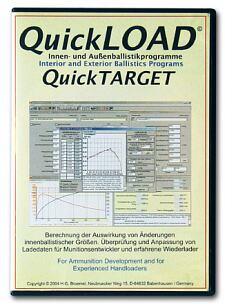 At SHOT Show, we had the chance to meet with German software engineer Hartmut Broemel, creator of QuickLOAD software. This software program, while not a substitute for conventional load manuals, allows shooters to evaluate a wide range of powders and bullets, comparing potential loads on the basis of predicted pressures, velocities, load density and projectile in-barrel time.


 Jason is friends with Gatling project director John Buhay, who let both of us send some 45-70 rounds downrange. While the Bulldog Gatling can dispense a prodigious amount of lead in a few seconds (rate of fire determined by how fast the operator cranks), this firearm is not considered an NFA machine gun. Because an advancement of the crank is required for each shot to be fired, this Gatling is not subject to the severe restrictions imposed on Class III arms. You can purchase a Bulldog Gatling, so long as you would otherwise qualify to legally own a long gun.

 Remember that you must maintain the exact same amount of rifle cant from shot to shot. Yes, some iron sights shooters do tilt their rifle slightly to achieve a better hold or to index their sights better. However, these shooters do not change the tilt from shot to shot — the amount of cant remains the same on every shot.


