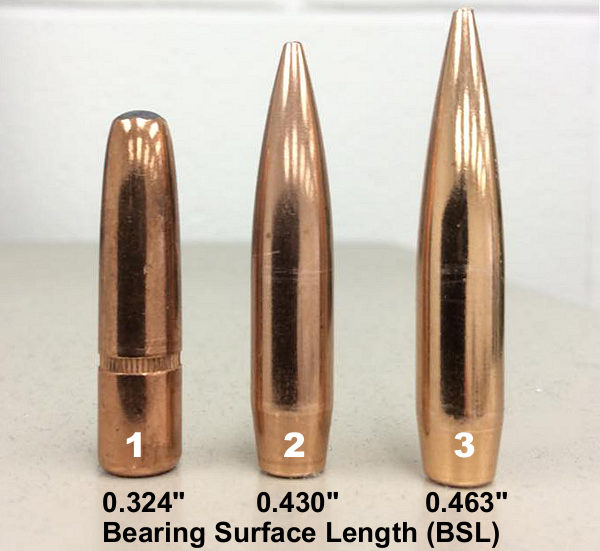
Three near-equal-weight 7mm bullets with different shapes and bearing surface.
This article, from the USAMU Facebook Page, concerns reloading safety. In the relentless quest for more speed and flatter ballistics, some hand-loaders load way too hot, running charges that exceed safe pressure levels. Hint: If you need a mallet to open your bolt, chances are your load is too hot. Stay within safe margins — your equipment will last longer, and you won’t risk an injury caused by over-pressure. In this article, the USAMU explains that you need to account for bullet shape, diameter, and bearing surface when working up a load. Don’t assume that a load which is safe for one bullet will be safe for another even if both bullets are exactly the same weight.
Today, we continue our handloading safety theme, focusing on not inadvertently exceeding the boundaries of known, safe data. Bullet manufacturers’ loading manuals often display three, four, or more similar-weight bullets grouped together with one set of load recipes. The manufacturer has tested these bullets and developed safe data for that group. However, seeing data in this format can tempt loaders — especially new ones — to think that ALL bullets of a given weight and caliber can interchangeably use the same load data. Actually, not so much.
The researchers ensure their data is safe with the bullet yielding the highest pressure. Thus, all others in that group should produce equal or less pressure, and they are safe using this data.
However, bullet designs include many variables such as different bearing surface lengths, hardness, and even slight variations in diameter. In fact, diameters can occasionally range up to 0.001″ by design. Thus, choosing untested bullets of the same weight and caliber, and using them with data not developed for them can yield excess pressures.
This is only one of the countless reasons not to begin at or very near the highest pressure loads during load development. Always begin at the starting load and look for pressure signs as one increases powder charges.
Bullet Bearing Surface and Pressure
Bullet bearing surface length (BSL) is often overlooked when considering maximum safe powder charges and pressures. In Photo 1, note the differences in the bullets’ appearance. All three are 7 mm, and their maximum weight difference is just five grains. Yet, the traditional round nose, flat base design on the left appears to have much more BSL than the sleeker match bullets. All things being equal, based on appearance, the RN/FB bullet seems likely to reach maximum pressure with significantly less powder than the other two designs.
TECH TIP: Bullets of the same weight (and caliber) can generate very different pressure levels due to variances in Bearing Surface Length (BSL).
Bullet 1 (L-R), the RN/FB, has a very slight taper and only reaches its full diameter (0.284 inch) very near the cannelure. This taper is often seen on similar bullets; it helps reduce pressures with good accuracy. The calculated BSL of Bullet 1 was ~0.324″. The BSL of Bullet 2, in the center, was ~0.430″, and Bullet 3’s was ~ 0.463″. Obviously, bullets can be visually deceiving as to BSL!
Some might be tempted to use a bullet ogive comparator (or two) to measure bullets’ true BSL for comparison’s sake. Unfortunately, comparators don’t typically measure maximum bullet diameter and this approach can be deluding.
Note: Due to time constraints, the writer used an approximate, direct measurement approach to assess the bullets’ different BSLs. While fairly repeatable, the results were far from ballistics engineer-grade. Still, they are adequate for this example.
Photo 2: The Perils of Measuring Bearing Surface Length with Comparators
In Photo 2, two 7mm comparators have been installed on a dial caliper in an attempt to measure BSL. Using this approach, the BSLs differed sharply from the original [measurements]. The comparator-measured Bullet 1 BSL was 0.694” vs. 0.324” (original), Bullet 2 was 0.601” (comparator) vs. 0.430” (original), and Bullet 3 (shown in Photo 2) was 0.602” (comparator) vs. 0.463” (original). [Editor’s comment — Note the very large difference for Bullet 1, masking the fact that the true full diameter on this bullet starts very far back. You can use comparators on calipers, but be aware that this method may give you deceptive reading — we’ve seen variances just by reversing the comparators on the calipers, because the comparators, typically, are not perfectly round, nor are they machined to precision tolerances.]
Thanks to the U.S. Army Marksmanship Unit for allowing the reprint of this article.
A while back, Cal Zant at PrecisionRifleBlog.com did a big muzzle brake comparison test. Along with measuring recoil reduction, Cal’s team recorded sound levels in PRB’s exhaustive muzzle brake field test. In the PRB archives you’ll find comprehensive muzzle brake sound test results, with hard data on 20 different muzzle brakes.
Sound can be a tricky subject, but Cal Zant, the editor of PrecisionRifleBlog.com, presents everything an informed shooter should know about muzzle brake noise in a straightforward and practical way. Most sound tests are measured from the side of the muzzle, in accordance with mil-spec standards, and Cal did that. But he also measured the sound level of each brake from behind the rifle, closer to the shooter’s position. This provides a more accurate indicator of the actual sound levels firearms operators will encounter while shooting.
Muzzle brakes ARE really loud — that’s something most active shooters have observed. But this study finally gives us some hard data and makes objective comparisons. The difference between brakes was quite significant. Some brakes were ear-splitting — more than twice as loud as other brakes tested.
As a bonus, Cal also provides data on how the new Ultra series suppressors from Thunder Beast Arms Corp (TBAC) compare in terms of sound level behind the rifle.
Is The Challenge Of Big Bore Extreme Range Shooting Right For You? By James Patterson
This article originally written for the Sinclair Reloading Press
Handling a .50 BMG Rig
Is a .50 BMG caliber rifle difficult to shoot? Not at all. The relatively heavy weight of a standard rifle at 30 pounds or more combined with a very efficient muzzle brake makes it a pleasure to shoot. The typical recoil can be compared to a .243 rifle or a 12 gauge trap load. On the other hand, the burning of a typical load of 230 grains of powder combined with that muzzle brake makes the muzzle blast experience exhilarating. A first time shooter will fire, pause for a moment in awe at the muzzle blast, and then break out into what has become known as “The 50 Caliber Grin”, almost impossible to wipe from ones face. My daughter started competing with the .50 BMG at 18 (115 lbs of tall skinny girl) and happily shoots 100+ rounds in the course of a match, her grin on the last round is as wide as on the first! Many members and competitors in the FCSA are women and many have distinguished themselves as excellent marksman having set world records on numerous occasions.
Cost of Big-Bore Shooting
Is owning and shooting a .50 BMG caliber rifle expensive? Relatively speaking yes, but one must put it into perspective. Rifles may run from $2500 to $7000, maybe even more for a top of the line custom rifle. A good scope will set you back $1000 to $3500. And while excellent commercial ammo is made, it is hard to find these days and runs from $4 to $6 a round. Most serious shooters start reloading for the rifle as soon as practical, not only for the economics of reloading but also for the ability to fine tune custom ammo for their specific rifle. It’s a very rare match that is won shooting commercial ammo. I recently compared the cost of my hobby — owning, shooting, and competing with the 50 BMG — with a friend whose hobby is snowmobiling. Factoring in the cost of equipment, licensing, gasoline, clothing, etc. it was soon obvious that my hobby was significantly less expensive than his.
Getting Started So how does one get started? You could do as I did, purchase a rifle not knowing what you were really getting into; or you could come out to a FCSA-sponsored event, shoot a number of different rifles, rub shoulders with those who have already taken the plunge, and see if this sport is right for you. While membership in the Fifty Caliber Shooters Association (FSCA) is required to compete at a FSCA event, membership is not required to come and experience first hand what is going on. If you have any inclination that you are interested in the extreme sport of long rang, big bore shooting then a year’s membership in the FCSA is only $60 ($20 for active duty military) a significant bargain if it helps you make just one well-informed equipment choice. In addition one of the primary functions of the FCSA is helping to identify active members near you who can help you understand just what is involved and help you ‘get your feet wet’ in this challenging sport.
The National Matches at Camp Perry are a great American tradition. Over the past 114 years, hundreds of thousands of competitors have enjoyed the rifle and pistol matches at Perry on the shores of Lake Erie. Today’s story, from an avid shooter now in his 80s, recounts the halcyon days of pistol competition at Camp Perry, when thousands of shooters competed on the pistol firing lines each summer.
My Camp Perry Experience…
More than 40 National Pistol Matches since 1963
by Don Weihl, 83, Swansea, Illinois
Shooting at Camp Perry has been the experience of a lifetime….
Best Camp Perry times were in the Sixties
The 1963 through 1967 years were the best…
There were more than 2,000 competitors each year. There were 600 targets — numbered 1 through 600, from left to right — across the ranges and grouped into six ranges, 100 targets wide. The matches ran like a well-oiled machine. There was a print shop on the base. All competitors could get a printed match report for each match, not too long after scores were in.
Most nights in those years, there were movies for the competitors and their families in the base theater. The mess hall in those years served three meals a day to over 3,000 hungry mouths – every day.
Favorite memory of Camp Perry — A Record Performance
My favorite memory of Camp Perry [was] in 1966. I was on the line firing next to the Army Team when MSGT Ralph O. Thompson (shown above) fired a 100 on the first .22 cal. pistol target. R.O. then fired another 100 on the second target, setting a National Record of 200×8. That is still unforgettable.
What I like Best about Camp Perry…
Each morning, the day begins with the roar of the cannon and colors. The National Anthem is played as the smoke clears and all stand at attention. Only first relay shooters are on the line, but many second and third relay shooters are there, as well as the match support community – all to observe the colors. Other matches begin with the National Anthem, but at Camp Perry, it is better.
What Was My Favorite Perry Pistol Match?
Actually, There is no favorite match in bullseye shooting. At Camp Perry, you are there to compete against yourself and everybody else. You also compete against the elements, where a slight breeze can turn into a gale, while the grass beneath your feet turns into a muddy obstacle.
What have I Learned on the Firing Line with Other Competitors over the Years?
Everyone learns they are among friends. If there is a problem, the shooter next to you or the shooter next to him will help. If your pistol breaks, the back-up pistol of a nearby competitor will be offered quickly, and the match will proceed.
Advice for First Time Camp Perry Competitors?
Learn to concentrate on something unique to YOUR target. With so many targets so close together, cross-fires are common. Don’t let it be you.
National Matches at Camp Perry Returns in 2021
The National Trophy Pistol and Rifle Matches have been an honored American tradition for generations. The National Trophy Matches have been held at Camp Perry, Ohio, since 1907, 114 years ago. Participants in the 2021 National Pistol Matches can choose from a number of competitions, as well as attend the Pistol Small Arms Firing School. There, trainees will receive classroom instruction before heading to the range for live firing and one-on-one match training.
Civilians and military shooters competed together at the 2019 NTT Pistol Match.
The 2021 National Matches will feature multiple pistol competitions, including a Centerfire Pistol 900 Aggregate, a .45 Pistol 900 Aggregate, and a CMP Revolver Match. To learn more about the CMP’s scheduled events at the upcoming 2021 National Matches at Camp Perry, visit the CMP Nat’l Matches Website. Registration is NOW OPEN.
It took decades of competition to acquire all those patches — that’s dedication to the sport.
Sinclair International has a good article on Case Lubrication which shows the various products and application methods available. Part of Sinclair’s Step-By-Step Reloading series, the article shows how to apply Spray Lube, Die Wax, or conventional lube from a Pad. The story also explains how to use dry lube to slick up the inside of your case necks.
Spray Lubes
High-volume reloaders often turn to spray-on lubricants such as the RCBS Case Slick (#749-001-341WB) or the Hornady One Shot (#749-016-818WB) to quickly lubricate large numbers of cases at once. An indispensable piece of gear that helps make spray lubing easy is a polymer lube rack that holds cases upright and arranged to maximize their exposure to the spray.
Editor’s Note: Ballistol Aerosol is other good spray product for regular full-length sizing (not heavy case-forming). It goes on clear (no chalky residue), it is ultra-slippery, and it will remove the carbon from your case necks as you apply Ballistol with a patch. This is my primary spray lube — but many folks dislike the distinctive Ballistol smell. Try before you buy.
Sizing Die Wax
Over the years, many benchrest shooters have come to trust Imperial Sizing Die Wax (#749-001-052) for their case lube needs. It offers high lubricity and easily wipes off with a paper towel. In fact, its lubricity makes it a popular choice for case forming, for those wildcat folks who need to form their own unique or obsolete cartridges. Unlike lube pads or spray lubes, sizing wax is applied more naturally. You just put a little on your fingers and transfer it to the cases by handling them. As simple and easy as Imperial Sizing Die Wax is to use, it’s probably best for low-volume applications.
Dry Lubricant
Redding’s Imperial Application Media (#749-001-166) is a dry neck lube used to lube the inside of the neck, whether you’re full-length sizing or neck-sizing only. It consists of ceramic spheres coated with a fine graphite-based powder. You simply dip the neck into the container for a second to pick up the right amount of lube. This lube lets the expander ball move smoothly throughout the case neck instead of “grabbing” or “chattering”. That minimizes case neck stretching.
Editor’s Note: Dry Lube is also very useful if you ultrasonically clean your cases. After the ultrasound process, the inside of the case neck can be so “squeaky clean” that bullets don’t seat smoothly. A quick application of dry lube on the insisde of the necks will help bullets slide into the neck easier. As a result, the neck “grip” on the bullets should be more consistent from round-to-round. Consistent neck tension is key to accuracy and uniform velocities.
Tired of spending $15-$25 for a can of spray lube that doesn’t last very long? For about the same price as a single 10 oz. can you can make your own effective spray lube that should last for multiple seasons and lube thousands of cases quickly and easily.
In the YouTube video above Gavin Gear of UltimateReloader.com shows how to make your own case lube using simple, inexpensive ingredients. First recommended by the 6.5 Guys, this Liquid Lanolin + Isopropyl Alcohol mix works well and is very cost-effective. Here’s what you need:
Bushnell offers a good FREE new Ballistics App powered by the Applied Ballistics Ultralite Engine. The new Bushnell Ballistics App easily calculates ballistic solutions for any popular cartridge type once you input velocity, BC, and atmospherics. The App features trusty Applied Ballistics bullet data, and it can even pull in atmospheric data from web weather sources. This allows you to calculate hold-overs and make precise wind corrections. The App is offered in both iOS (Apple) and Android OS versions.
“The Bushnell Ballistics App is powered by the Applied Ballistics Ultralite engine, the most trusted ballistics data-cruncher in the industry,” said Bushnell Marketing Manager Matt Rice. “This App allows users to easily build and modify gun profiles and build range cards to calculate firing solutions based on their specific scope and ammunition choices. All of our Bushnell scopes and reticles have been pre-loaded [in the App].”
The Bushnell App features AB Connect, a live library of G1/G7 data, plus the Applied Ballistics Bullet Library with 740+ pre-loaded bullet profiles. The Bushnell scope library features 150+ scopes and 30 reticle options. Atmospheric data can be updated manually or directly from the internet (when connected). Angle range compensation is also calculated. Gun profile management provides up to five saved profiles with reticle-based firing solutions. A multiple target feature saves up to five targets. Range cards can be shared or printed using the Email Range Card Function.
The FREE App works on both Android and iOS operating systems, and is available on Google Play and the Apple App Store. It is optimized for Bushnell riflescopes and reticles, but is compatible with all optics. Once downloaded, the App functions off the grid — no cell service required.
“The new Bushnell Ballistic App puts the power of long-range, first-shot accuracy into the hands of any shooter,” Rice said. “it was designed to perform in any condition and to offer our consumers true value, with features that far exceed the price — which, in this case, is free!”
This story features a unique, American-designed rimfire rifle, chambered for the potent .17 HMR round. The current generation T-Bolt has a tang-mounted ambidextrous safety, a choice of barrel contours, lengths, and finishes, and a variety of stock options. What sets the T-Bolt apart from other rimfire rifles is the way the action cycles. There is not a conventional bolt that requires four distinct motions (lift bolt handle up/pull back/move forward/rotate handle down). With the T-Bolt you simply pull the handle straight back to extract a round, then return it forward to chamber a new round from the Double Helix magazine. The cocking effort is divided between back pull and forward movement so the effort is relatively light and easy.
Among current rimfire rifles, the Browning T-Bolt ranks high for fit and finish. The bluing is very nice and the T-Bolt even boasts a gold-plated trigger shoe. Many different stock types have been offered in recent years including some very nice AA Maple stock models as shown below (click to zoom). These T-Bolt rifles exhibit very fine craftmanship. Current models are made in Japan under license to Browning.
Click image for full-screen T-Bolt photo with detail.
Browning T-Bolt Sporter AA Maple Model
RECEIVER – Steel; High polished finish; Drilled and tapped for scope mounts
BARREL – Medium Sporter; Blued finish; Free-floating; Semi-match chamber; Recessed crown
ACTION – Straight pull bolt action; Top-tang safety; Adjustable trigger
STOCK – AA Maple; Gloss finish; Checkered
FEATURES – Sling swivel studs installed
PRODUCTION – Limited quantities
T-Bolt Owner Talks about Function and Accuracy
“I have a Browning T-bolt in .17 HMR, but with the maple stock. It is probably my favorite .17 HMR rifle (also the most expensive). The rifle feels smaller than some of my other .17 HMR rifles. I think the length of pull is a little shorter. I do like the light weight and trim handling of the rifle and the straight-pull bolt can be cycled really quickly. Mine is quite accurate and will shoot one-inch groups at 100 yards with both Hornady ammo and the CCI A17 ammo.” — RexRay, Varminter.com Forum member.
Pros and Cons of the Browning T-Bolt
The T-Bolt has a reputation for good accuracy, provided you have a good lot of .17 HMR ammo (we recommend checking for bullet run-out before you shoot for groups). The straight-pull action works as advertised — it is fast, smooth, and easy-to-operate. The Double Helix magazine (covered below) is excellent. It is very compact yet ultra-reliable. Another plus is that the T-Bolt has been produced in many different versions, with a variety of stocks, and even a stainless action version.
What are the negatives? Some of the stocks have a somewhat short length-of-pull, but this is easily solved with spacers. The main complaint is the factory trigger — some owners say it is too heavy at about 4 pounds, though the break is clean. For varmint work, we could live with the stock trigger and put money saved into optics.
If you prefer a very light trigger, JARD makes a T-Bolt replacement trigger. Featuring an aluminum housing, the JARD T-Bolt trigger can be ordered with 12-, 16-, or 20-ounce pull weights. The JARD trigger offers a crisp, clean break significantly lighter than stock. But at $249.99 the JARD trigger is fairly expensive. Additionally there have been a couple complaints about slam fires at the lowest weights so we recommend the 20-ounce. Here is one owner review, from a Rimfire Central thread: “The new Browning T-Bolt is a great rifle in all aspects except for the trigger. In my case when I received my JARD trigger it was an almost drop-in installation with very little adjusting or fooling around. For me it made a decent little rifle a great little rifle.”
Browning Double Helix 10-Round Magazine
The T-Bolt’s patented 10-round rotary Double Helix™ magazine is a unique design that feeds very reliably and is easy to load. The Double Helix magazine uses a torsion drive spring and interlocking gear design to maintain correct timing and exact cartridge alignment for smooth, reliable feeding. The translucent gray body allows for easy verification of the number of remaining cartridges. We like the fact that the Double Helix provides TEN-round capacity while fitting nearly flush with the bottom of the action.
The Browning Double Helix rotary box magazine system is easy to load, easy to carry, and easy to use. The smooth, rounded exterior contours of the Double Helix, along with twin gripping grooves, tapered shape and a slightly extended baseplate design make insertion positive, while the spring-assisted drop-free magazine ejection feature allows for rapid magazine changes. T-bolt owners confirm that feeding and reliability is excellent — the magazine design puts cartridges in perfect alignment with the chamber.
Other Browning T-Bolt Variants
In recent years, Browning has produced T-Bolt rifles in a variety of models, with many different stock types and various barrel lengths/contours. Most of the photos above showcase the AA Maple Sporter T-Bolt, which is currently out of production, though still available from some dealers (if you search). We like the looks of the AA Maple T-Bolt, but there many other stock options including dark brown, Black, Green, and various camouflage finishes. Use the links below to see all the T-Bolt configurations.
Here are 4 other T-Bolt variants, first the new-for-2021 T-Bolt Target with muzzle brake, then the Limited Edition Cerakote T-Bolt Speed model, and two discontinued T-Bolts, a composite-stocked carbon finish model and a Varmint Special with stainless action and thumbhole laminated stock. Current production T-Bolts are offered in three rimfire chamberings: .17 HMR, .22 LR, and .22 WMR. Barrel contours and lengths (from 16.5″ to 22″) vary from model to model.
Do you like the T-Bolt? Well there is a 5% Off Rebate Program available right now that covers the T-Bolt and all other Browning firearms.
.17 HMR Cartridge — Fast and Deadly on Small Varmints
We are big fans of the .17 HMR round. It’s just about perfect for ground squirrels, and is effective on prairie dogs out to about 200 yards. The three main .17 HMR producers have been CCI, Federal, and Hornady. Choose from 17gr or 20gr bullets — both work well in the varmint fields. Norma also makes .17 HMR ammo with 17gr V-Max bullets. This Norma .17 HMR ammo has shown very good accuracy.
CCI .17 HMR TNT offers 2650 FPS Velocity
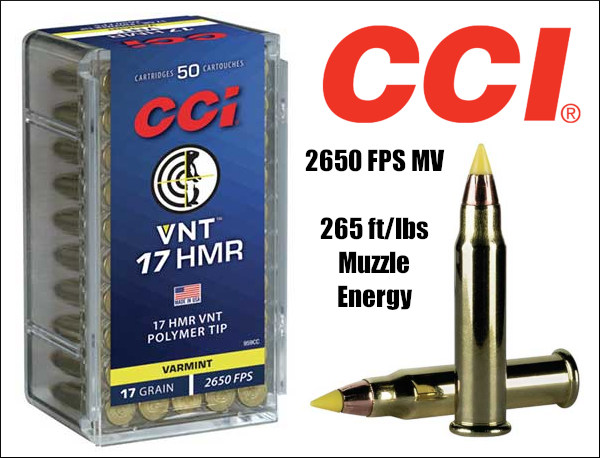
For varmint work we like CCI’s latest .17 HMR VNT ammo. This boasts class-leading 2650 FPS muzzle velocity. Engineered to combine good accuracy with high impact energy, this CCI TNT ammo features a 17gr polymer-tipped bullet designed for rapid expansion. We also like the Norma .17 HMR ammo. “With outstanding accuracy and excellent energy transfer… The .17 HMR has a very loyal following among hunters and target shooters alike”, said Paul Lemke, G.M. for Norma/RUAG.
By means of an Executive Order signed yesterday, U.S. President Joe Biden has ordered a ban on ALL military words/terms considered sexist or culturally insensitive. The President has ordered the Pentagon to immediately determine replacement nomenclature for offensive words such as “cockpit” and “chief”. Starting today, all military communications must be “gender-neutral” and not male-centric. To address the issue, the Pentagon is now forming a “Rapid Gender Neutralization Force” with top generals and admirals from the Army, Navy, Air Force, and Marine Corps. Phase One funding of $126.9 million has been allocated from the 2021 U.S. Special Operations budget to handle the Gender Neutralization project.
Among the military nouns, verbs, adjectives and acronyms that will be banned are the terms listed below, with the reason for the ban, and proposed replacements.
Cockpit — Not Gender Neutral (New: Pilot Enclosure) Airman/Airmen — Not Gender Neutral (New: Aviator/Aviators) Broadside — Offensive to Female Navy Personnel (New: Full Fire Sequence) Chief and Chief of Staff — Native American Cultural Appropriation (New: Leader, Leader of Group) Foxhole — Offensive to Female Infantry Personnel (New: Person Pit) ASDIC — Offensive to Female Navy Personnel (New: Anti-Submarine Sonar ASS)
Military Phonetic Alphabet Changes (Mandatory Immediately)
In addition to the ordered changes in specific military terminology (as listed above), all U.S. Armed Services will immediately start using new Radio Phonetic Call-outs for particular letters of the alphabet. Here are the new Mandatory Radio/Telephone Comms Alphabet terms (with others pending):
“G Golf” (Issue — Golf, favored by white elites, perpetuates systemic racism) Replaced with “G Grim”. “P Papa” (Issue — Not LGBTQ tolerant) Replaced with gender-neutral “P Parent”. “K Kilo” (Issue — Promotes drug trafficking) Replaced with “K Kamala”. “R Romeo” (Issue — Promotes male patriarchy) Replaced with “R Reset”. “W Whisky” (Issue — Promotes alcohol abuse) Replaced with “W Woke”. “Z Zulu” (Issue — Racism, Cultural Appropriation) — Replaced with “Z Zealot”
The phonetic alphabet is a list of words used to identify letters in a message transmitted by radio and/or telephone. The phonetic alphabet can also be signaled with flags, lights, and Morse Code.
Is it Time for Major Changes in Our Military Language?
For many years, U.S. and NATO military leaders have called for progressive, inclusive terminology changes. Here are three recent articles in highly-respected military journals discussing the issue:
We need gender-neutral words to attract female service personnel:
“Why is adopting gender-neutral language so difficult for the Armed Forces? In 2017, a training establishment was widely ridiculed in the press for having suggested a fairly mild list of gender-neutral terms to replace words such as ‘chaps’ and ‘manpower’. Gendered language does more than just give offence[.] The real effects are … insidious, perpetuating stereotypes, damaging recruitment and retention and undermining the ability of the Armed Forces to harness the talents of its people. At the most severe, it affects mental health, damages unit cohesion and undermines operational effectiveness.”
The horrible effects of military-forged toxic masculinity spills over into the business world:
“Military language infused in business systematically elevates traditionally ‘masculine’ qualities and traits as most … valued and important for moving up into the ranks of leadership. Those who don’t fit the mold struggle to rise. The cycle of ‘institutionalized masculinity’ represents a textbook example of how any ‘ism’ becomes institutionalized — racism, sexism, ageism, and anything else that gets ingrained and perpetuated into culture, ultimately reinforcing the status quo and keeping others on the fringe.”
U.S. Male and Female Soldiers Show New Gender-Neutral Combat Uniforms
Along with gender-neutral words, many military leaders now favor gender-neutral uniforms for all personnel. Shown above are U.S. soldiers field-testing a new gender-neutral combat uniform. It is believed that the U.S. Army is seriously considering issuing this type of combat clothing for the U.S. Army Rangers, which will be renamed the “Rangerettes” in accord with President Biden’s Executive Order.
_______________
UK Military leaders agree we must rid the English language of oppressive gendered language:
“Gendered language permeates the very fabric of the UK’s Armed Forces, from personnel answering the phone with ‘Sir’ to the widespread use of terms such as ‘unmanned’ and ‘airman’. The use of language that is male-centric only serves to create an image that the armed forces are made up only of men, when increasingly they are not.
It’s not about being ‘woke’ — Defense consultant Dr. Alex Walmsley said the debate around the use of gendered language is ‘evolving in a good way’ adding that the push to change the language used in defense was not just about ‘being woke’.
The idea of a woman performing a job whose title implies she is a man, even though women are able to serve in every role in the UK’s Armed Forces, means that change is a ‘no-brainer’. It is not a big deal; we’re not asking for HMS Prince of Wales to be called ‘Princess of Wales’, Walmsley pointed out.”
Gendered language is not only damaging to women, but also non-binary or transgender service members and defense industry professionals. Changing the words you use is such a minor thing[.] Retiring the term ‘manpower’ in favor of ‘personnel’ does not suddenly mean the UK can no longer conduct a freedom of navigation exercise in the South China Sea. — Emma Salisbury Ph.D.
In response to the growing number of first-time gun buyers during the Coronavirus outbreak, the NRA’s Education & Training Division is offering four new Online Gun Safety Courses that can be done online at home. The six NRA Online Gun Safety Courses ARE:
Each course, lasting from one to eight hours, is available online at NRAInstructors.org. To Access the 0nline training options, first CLICK HERE. Then under the Heading “DISTANCE LEARNING”, you will see options. CLICK the small gray box at the left of the title to select the course. IMPORTANT — Next you MUST SCROLL to the bottom of the NRA webpage to SEARCH. Select your state or Zip code, then you will get a list of the moderated online courses in your area.
Here is the Procedure to Follow:
1. CLICK HERE to Access ALL Course Listings
2. Select a “Distance Learning” Course.
3. Scroll Down and SEARCH for your State or Zip Code.
4. Review Course Dates and Times.
For example, here are the listed NRA online safety courses for California only. Elsewhere (in other states), YOUR list will be different!
NRA ONLINE Training Courses Sample List
“These courses will provide an option for first-time gun owners who don’t have the ability to take an NRA certified instructor-led class at their local shooting range at this time,” said Joe DeBergalis, Exec. Dir. of NRA General Operations. “While there is no replacement for in-person, instructor-led training, our new online classes do provide the basics of firearm safety training for those self-isolating at home.”
Though range time is an important part of the classes, there is still a wealth of knowledge available in the online programs. “The NRA recommends that all new gun owners seek professional training at the range, but that doesn’t mean you can’t get a head start on learning the basics of firearm safety at home. Taking one of these classes moderated by a certified NRA instructor, can only make you safer…” DeBergalis added.
This Sunday we feature an impressive .300 WSM Heavy Gun shot by a superb long-range shooter. With this rig, at age 83, Arizona benchrest ace Charles Greer drilled a remarkable 2.862″ 100-10X group, beating all known 1000-Yard HG 10-shot records on the books. If this record is approved (which is likely), Greer’s .300 WSM can rightfully be hailed as the most accurate 1000-yard gun in history.
Story compiled with help from Jason Peterson
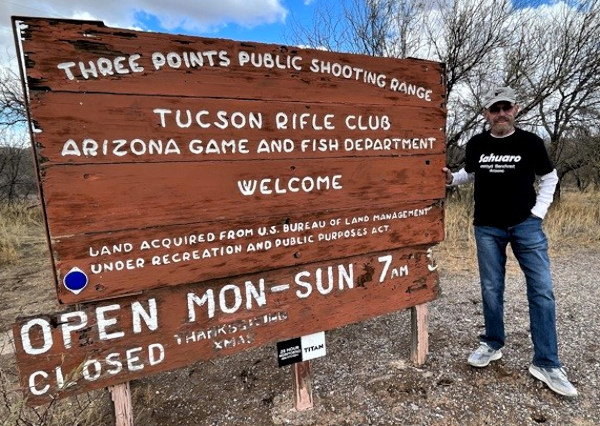
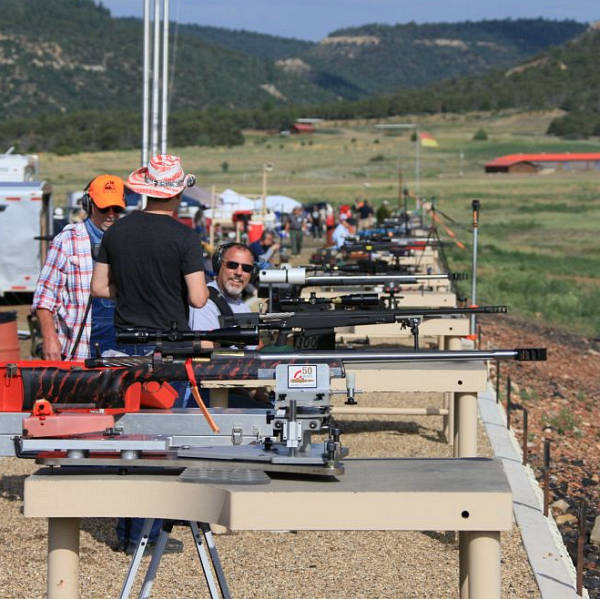
This would be an excellent 10-shot NBRSA Heavy Gun group at 600 yards, but this target was shot at 1000 yards by Charles Greer (aka “chuckgreen” on AccurateShooter forum) on February 13, 2021 at an NBRSA Match in Arizona. Chuck was shooting his .300 WSM Heavy Gun with Borden action, Krieger barrel, and Berger 220gr Hybrids. The event was hosted by the Sahuaro 1000 Yard Benchrest Club, at Three Points Range, outside Tucson, Arizona. Though it is pending final approval, it appears this is the smallest 10-shot Heavy Gun group ever shot, anywhere, at 1000 yards, and it was centered for a 10X. That’s doubly impressive when you consider that Charles Greer achieved this at age 83! Yes “Old guys rule”!
Amazing 100-10X 2.642″ (unofficial) 10-Shot Group at 1000 Yards.
This group is perfectly centered for an amazing 100-10X score. The group was range measured at 2.642 inches. For reference, the 1000-yard X-Ring is 3.00″ in diameter. The “X” itself is about 1.2″ tall. Pending final verification, this amazing target should shatter two NBRSA records. This handily beats the current single target HG score record of 100-6X held by Bill Schrader since 2005, and the single target HG group record of 3.650″ held by Tim Height (2019). For comparison, the current IBS 10-Shot 1000-yard HG group record is 2.871″ by Michael Gaizauskas from 2016. So it appears that this may be the smallest 10-shot group ever shot in competition in history. And from what we can determine, this is the first potential HG size record that also has a 100 score with TEN Xs.
Because shots are not marked in this discipline, this stunning group was a surprise to Greer: “I had no idea that I was shooting a world record target until I went back to the pits after my relay. Just as well. If I’d seen nine rounds in the X on the target, staying steady [for the last shot] would have been challenging….”
Forum member “Tom” (2016 IBS 1000-yard Nat’l Champion and holder of several IBS 1000-yard records) unofficially measured Greer’s 1K group at 2.680 inches (0.256 MOA), using Ballistic-X software. Awaiting final group measurement by the NBRSA Long Range Committee, as currently measured, this target is just under existing IBS and Williamsport 10-shot HG 1000-yard records: The current IBS HG 1000-yard group record is 2.871″ held by Michael Gaizauskas. The current Williamsport HG 1000-yard group record is 2.815″ held by Matthew Kline.
Benchrest Shooting — Sport for All Ages Charles Greer reminded us that even senior citizens can succeed in benchrest competition: “One of the benefits of benchrest shooting is that it is a sport accessible to us even as we age. I cannot run and gun anymore like I used to do in IPSC and IDPA but as long as I can get my body and my equipment up to a bench, I can still be very competitive. That is not possible for us old guys in most sports and shooting disciplines. As I am ‘only 83′ I am hoping to squeeze a few more years of competition out of the old body before I have to pack it in for good.”
Charles is thankful for what he has achieved in this sport over many decades: “The Shooting Gods have certainly smiled on me from time to time during my brief shooting career and for that I am incredibly grateful.”
This target may also be the smallest 1K 10-shot group ever shot in competition, in ANY Class. In 2014, Jim Richards fired a 10-shot, 2.6872″ Light Gun group under Williamsport Rules at Deep Creek Range in Montana. However, Jim’s record small group was NOT centered in the 10-ring and it appear that Greer’s group could measure smaller. [Editor: Charles is no stranger when it comes to 1000-yard records. Charles is the current listed holder of two NBRSA 1000-yard score records: 3-Target HG Score: 294-8X (2010); 6-Target 2-Gun Score: 441-13X (2010).]
100-10X at 1000 — This May Be a First
After looking at all the 1000-yard records from different organizations, it appears that Greer’s 100-10X score could well be a first! And it may be many years before another 100-10X score is ever shot in competition.
Arizona’s Three Points Range is known for its windy conditions. So much so that small groups are not common in match reports. 6mm cartridges that are commonly shot at other 1000-yard benchrest competitions are rarely shot at Sahuaro 1K BR Club matches. The bigger calibers dominate here.
Charles Greer NBRSA 1000-Yard Heavy Gun Specifications:
Action: Borden BRMXD drop port
Barrel: Krieger 30″ 4-groove, 1:10″ twist, custom contour 1.35″ tapered to 1.00″
Chambering: .300 Winchester Short Magnum (WSM)
Chamber Specs: .337 neck with .280 freebore
Stock/Weight: McMillan/Wheeler LRB (solid fill) stock at 27 pounds
Gunsmith: Gerald Reisdorff
Optics: Vortex Golden Eagle 15-60x52mm
Front Rest: Sinclair Competition with 4″ Edgewood bag
Rear Rest/Bag: Wahlstrom mechanical rear rest with custom Edgewood bag
Load Details: Norma .300 WSM brass, Alliant Reloder 23 powder, Federal 210M primers, Berger 220gr LR Hybrid bullets at 2800 FPS
Greer has done something clever with his McMillan/Wheeler benchrest stocks. He has flipped over (inverted) the adjustable metal rudder (or keel) that runs on the underside of the buttstock. This provides a wider, flat tracking surface. The inverted rudder runs in a special sandbag on a Walhstrom mechanical rest. NOTE: Mechanical rear rests ARE legal for BOTH Heavy Guns and Light Guns under current NBRSA rules (see page 24). Shown at right is Greer’s Light Gun, but his Heavy Gun has the same system.
Charles explains: “Both my LG and my HG are of the same configuration except for additional weight in the stock of the HG. I decided to do this so that I would not need a separate rest system for each gun which saves on expense and makes it much easier to switch the LG out for the HG during competition. No need to change rest systems and re-align everything. Both of my stocks are McMillan/Wheeler LRB models with the adjustable rudder that can be repositioned horizontally to improve tracking. The rudder has a 3/4 inch-wide base that is usually fit into an Edgewood gator bag with a flat top. I did not like the way the rifle tracked with this set up and wanted something more solid and stable.
So I found that if I turned the rudder upside down and re-installed it that way on the stock, using the same screws and holes, the top of the rudder when turned down provided me with a base 1.5″ wide with a 1/4″ rail on each side. I got a Wahlstrom mechanical rear rest and had a custom Edgewood front bag made for it with a 1.5″ separation between the ears. The rail tracks perfectly in the bag and I can tighten the ears to make it quite solid and steady. I have noticed a huge improvement in tracking with this set up. I am still refining this arrangement but plan to continue using it on both rifles. I have never seen this done and was thinking maybe your readers would be interested.”
Questions & Answers with Charles Greer
Hall of Fame short-range shooter Gary Ocock interviewed Charles Greer. This interesting Q&A dialog covers shooting styles, equipment selection, recoil management and other notable topics.
Q: Tell us about your rifle, accuracy standards, and choice of calibers and bullets for the 1K game.
Greer: I set up two rifles, Light Gun and Heavy Gun. Both will shoot 100-yard 5-shot groups in the high ones and low twos. In Arizona I want a heavy, high-BC bullet in both guns to buck the wind and want to keep the ES under 10 FPS. I’m finding .300 WSM with Berger 220 LRHT bullets and a 4 groove Krieger barrel will provide the performance I need, and I shoot this round in both rifles.
Q: Explain your rest set-up, tracking, and recoil management. And how fast do you typically shoot your strings of fire?
Greer: I am using a Sinclair Competition Front Rest along with a mechanical rear rest, both with Edgewood front bags, to give me the stability necessary to provide consistent tracking even with these relatively high recoil rounds. Almost perfect tracking and consistent return to battery in the same spot is necessary to get a record string off quickly and smoothly. I try to get my strings off in a time of between 6 and 10 seconds per round depending on conditions. Any faster and I get sloppy.
Q: What were conditions like when you shot that amazing 10-shot group?
Greer: On the day I shot the record-pending target I had the first relay. There was wind but it was light, maybe 4-5 mph and seemed steady. The flags were about halfway up to horizontal and seemed to be holding that way. My procedure is to shoot 5 sighter rounds, two to adjust my initial round on paper to the X-Ring and then three more during the last minute to check for changes in the wind. If these last three rounds stay in the Ten Ring it is usually a sign that the wind may be steady enough for me to shoot a good group. On the “record” day the last three sighters were right in or near the X-Ring and when the record target came up I quickly but carefully dumped my 10 rounds holding the scope dot right on the X. The wind apparently held absolutely steady, and I got the result you see on the target.
That is my normal shooting technique. I pretty well know during the last minute of the sighter period whether a good group will be possible. If each of my last three sighters ends up inches away from the X in different directions, I know the wind is shifty and a good group on that target is unlikely. I adjust the last sighter to the X and then dump the string the same way just hoping the wind may hold for a minute or so. Sometimes it does, but often not so much.
During the record strings there is no way to know where the rounds are going. They are not marked, and the holes cannot be seen through the scope at that distance. The 1K flags are big and heavy and not very indicative of minor wind changes so I do not try to hold off or change my point of aim unless a flag completely reverses direction during a string. I’ve found that over the years adjusting my point of aim to the X after the last sighter and then dumping my strings gets the best results overall.
Q: What is your highest shooting accomplishment so far?
Greer: Well, the highest accomplishment (if one can call it that) would have to be this 100-10X target. This may end up being the best 10-shot target ever shot in a sanctioned match. 0f course, there is a tremendous amount of luck involved in this coming together but I certainly am pleased.
I had set four NBRSA world records when I was shooting previously: Light Gun Agg in 2008, and all three possible Highest Three Target Score records in 2010, two of which still stand. The first was probably the most satisfying as was my performance in the 2010 Nationals where I placed high in several categories and was Heavy Gun Champion for Score.
Q: Who do you attend matches with?
Greer: During the last year my son, Brian, has become my match shooting companion. We go out together every month. Brian was able recently to purchase the great 300 Ackley HG that I competed with and set world records with in 2010. I sold the rifle to a friend who never shot it and it found its way back into our family. Brian is now becoming a serious competitor.
Photo Right: Charles Greer with son Brian.
Q: What are your future shooting goals?
Greer: To keep on shooting our local match each month and to try to get to the Nationals once or twice more before I get too damn feeble. And to be able to see my son take my place as a regular winner when I can no longer compete.
Q: Is there any advice you would like to share with new shooters?
Greer: Make a commitment to excel at whichever discipline you choose. Get the best equipment and components that you can afford and consider each match a learning experience. At some point anything that can go wrong will go wrong and one must learn from these mistakes. Most importantly, be patient and keep coming back. In Arizona good shooting conditions are rare. You gotta be “in it to win it”. If you show up at every match you can attend eventually a great condition will appear on your relay and you will have a chance to shoot a spectacular score.
Q: What is your shooting background?
Greer: I started shooting rabbits as a kid in the Mojave Desert, trained on various firearms in the military in the fifties and sixties and over the years hunted birds and large game and played with various handguns. In 2005 I moved to Tucson from Mexico the first time and, looking for an activity, started shooting IDPA and IPSC pistol matches at Pima Pistol Club. Shortly thereafter I bought a .308 Savage tactical rifle and got interested in shooting for accuracy. One thing led to another and before long I bought a better Savage varmint rifle in .300 WSM and started shooting the 1K match at Tucson Rifle Club at Three Points around 2007. I kept upgrading my equipment, started winning matches, set some world records.
After the 2011 NBRSA Long Range Nationals I felt rather burnt out on shooting. I sold all my guns and equipment and headed South looking for perhaps one more adventure. I found some but they did not include shooting as South of the border folks tend to shoot back when they hear anything go bang. I returned to Tucson in May of 2019, built a couple of new rifles, and got involved again in the monthly Sahuaro match where the most recent world record target was shot. I would like to resume shooting the NBRSA Long Range Nationals. Will not be ready this year but probably will in 2022.
Q: Have you tried other disciplines at different ranges?
Greer: I have only competed in Long Range, mostly 1000 yards but 600 yards a few times at the Nationals. I would like to try shooting “Score” and there is a monthly match at our range. May try it if I can get an appropriate rifle.







 So how does one get started? You could do as I did, purchase a rifle not knowing what you were really getting into; or you could come out to a FCSA-sponsored event, shoot a number of different rifles, rub shoulders with those who have already taken the plunge, and see if this sport is right for you. While membership in the


 What have I Learned on the Firing Line with Other Competitors over the Years?


 Sizing Die Wax


 In recent years, Browning has produced T-Bolt rifles in a variety of models, with many different stock types and various barrel lengths/contours. Most of the photos above showcase the AA Maple Sporter T-Bolt, which is currently out of production, though still available from some dealers (if you search). We like the looks of the AA Maple T-Bolt, but there many other stock options including dark brown, Black, Green, and various camouflage finishes. Use the links below to see all the T-Bolt configurations.




 Charles Greer reminded us that even senior citizens can succeed in benchrest competition: “One of the benefits of benchrest shooting is that it is a sport accessible to us even as we age. I cannot run and gun anymore like I used to do in IPSC and IDPA but as long as I can get my body and my equipment up to a bench, I can still be very competitive. That is not possible for us old guys in most sports and shooting disciplines. As I am ‘only 83′ I am hoping to squeeze a few more years of competition out of the old body before I have to pack it in for good.”


 Greer has done something clever with his McMillan/Wheeler benchrest stocks. He has flipped over (inverted) the adjustable metal rudder (or keel) that runs on the underside of the buttstock. This provides a wider, flat tracking surface. The inverted rudder runs in a special sandbag on a Walhstrom mechanical rest. NOTE: Mechanical rear rests ARE legal for BOTH Heavy Guns and Light Guns under current
  Q: Who do you attend matches with?