Here is an article Glen Zediker wrote for the Midsouth Blog. In this article Glen gives important advice on selecting, handling, seating, and testing primers. The right primer choice can and will affect your load’s performance and accuracy. And proper primer handling is essential for safety.
by Glen Zediker
The primer is one component in the collection that might not get all the attention it warrants. That’s because it is the one thing, above all other components, that you don’t want to just swap and switch around. We’ve all heard cautions about testing new lots of every component, especially propellant, but primers not only change lot to lot, they vary greatly in their influence on any one load, brand to brand.
The difference in one brand to the next can equal a good deal more or less pressure, for instance. While there are “general” tendencies respecting the “power” of various-brand primers, always (always) reduce the load (propellant quantity) when switching primers.
This has become more of an issue over the past few years as we’ve faced component shortages. I can tell you without a doubt that going from a WW to a CCI, or from a Remington to a Federal, can have a major influence on a load. I establish that from chronograph readings. No doubt, it’s best to have a good supply of one primer brand and lot that produces good results, and when that’s not possible, it’s a hard sell to convince someone to stop loading ammo and get back to testing. But. It is important. I can tell you that from (bad) experience. How I, and we all, learn most things…
When I switch primers, whether as a test or a necessity, I reduce my load ONE FULL GRAIN. There can be that much effect.
The Elements of a Primer
A primer is made up of a brass cup filled with explosive compound (lead styphate). Lead styphate detonates on impact. Primers don’t burn – they explode! In the manufacturing process, this compound starts as a liquid. After it’s laid into the cup, and while it’s still wet, a triangular piece or metal (the “anvil”) is set in. When the cup surface is struck by the firing pin, the center collapses, squeezing the explosive compound between the interior of the cup and the anvil. That ignites the compound and sends a flame through the case flash hole, which in turn lights up the propellant.
Primers Can be Dangerous — Particularly When Stacked
Don’t underestimate that. I’ve had one experience that fortunately only created a huge start, but I know others who have had bigger more startling mishaps. These (almost always) come from primer reservoirs, such fill-tubes. Pay close attention when charging up a tube and make sure all the primers are facing the right way, and that you’re not trying to put in “one more” when it’s full! That’s when “it” usually happens. What will happen, by the way, is akin to a small grenade. Static electricity has also been blamed, so keep that in mind.
Sizes and Types of Primers
Primers come in two sizes and four types. “Large” and “small”: for example, .223 Rem. takes small, .308 Win. takes large. Then there are pistol and rifle in each size.
Rifle primers and pistol primers are not the same, even though they share common diameters! Rifle primers [normally] have a tougher cup, and, usually, a hotter flash. Never swap rifle for pistol. Now, some practical-style competitive pistol shooters using their very high-pressure loads (like .38 Super Comp) sometimes substitute rifle primers because they’ll “handle” more pressure, but they’ve also tricked up striker power. That’s a specialized need.
Further, some primer brands are available with a “magnum” option. Some aren’t. My experience has been that depends on the “level” of their standard primer. A magnum primer, as you might guess, has a more intense, stouter flash that travels more “deeply” to ignite the larger and more dense powder column. It reaches further, faster.
Flash Consistency Counts Flash Consistency is very important, shot to shot. The consistency of every component is important: bullet weights, diameters, case wall thicknesses, and all the way down the list. We’re hoping to get more consistent behavior from a “match” or “benchrest” primer, and we’re paying more for it. I can tell you that some brands that aren’t touted as “match” are already consistent. That all comes from experience: try different primers, just respect the need to initially reduce the load for each test.
Primer Dimensional Differences and Primer Tools
One last thing — there are small variations in primer dimensions (heights, diameters) among various brands. These variations are not influential to performance. However — small diameter variations can influence feeding through priming tools. This can be a hitch especially in some progressive loading machines. Manufacturers usually offer insight (aka: “warnings”) as to which are or aren’t compatible, so find out.
This article is adapted from Glen’s books, Handloading For Competition and Top-Grade Ammo, available at Midsouth HERE. Learn more about Glen’s books at ZedikerPublishing.com.
Brownells is a well-known retailer of guns, gun parts, tools, accessories, ammo, and pretty much everything gun related. What you may not know is that Brownells has a very active video production department that releases new “how-to” and product information videos every week. These videos offer helpful advice on gun cleaning/maintenance, reloading, as well as selecting/assembling components for various kinds of rifles. And every week Brownells serves up a new products video. There now over 1000 videos on the Brownells YouTube Channel, this really is a remarkable resource.
Here are six of our favorite recent videos from Brownells. AR owners will find some good advice on spare parts, new reloaders can learn how to use the OAL tool, and all gun owners should watch the video on ammunition storage.
Introduction to PRS Competition
In this video, Tom Beckstrand, former Special Forces Sniper Team Leader and Guns & Ammo magazine staffer, looks at the Precision Rifle Series (PRS). Tom covers the types of stages in a typical PRS match using unconventional, real-world shooting rests. He also discusses the equipment you’ll need including bag supports, bipods, tripods, and optics. As most ranges aren’t set up for PRS, Tom offers tips on how to train at your local range.
How to Use Hornady OAL Tool and Hornady Bullet Comparator
Gun Tech Steve Ostrem explains how to properly use Hornady’s Overall Length Gauge to determine length-to-land precisely. The OAL Gauge uses a “Modified Case” that theads onto the tool and holds a bullet. Push on the back of the gauge until you feel the bullet just touch the rifling. (We do this gently at first, tapping the rod a couple time to ensure the bullet is aligned correctly). Once you’ve got the length, then use the tool with a comparator on your calipers to get the lenght-to-lands. NOTE: We recommend taking the measurement 3-4 times in a row to get a reliable number. With a little practice your should be able to get repeatable measurements within .0015″.
New Bog Pod Tripod and Caldwell Electronic Muffs
Brownells staffer Paul Levy showcases the impressive new DeathGrip Tripod from Bog Gear. The DeathGrip’s adjustable jaws clamp firmly to the rifle’s forearm. This is a useful device for both PRS shooters and hunters. The head assembly has 25-deg front/rear tilt and 360-deg swivel. And the jaws’ non-slip, rubberized padding won’t scratch that stock. The legs snap open to three pre-set hard stops, and there’s plenty of length extension. Easily switch between rubber feet and steel spikes without removing a single part from the trippod. This video also features Caldwell’s E-Max™ Pro noise-cancelling electronic muffs. These affordable 23 dB NRR units boast dual microphones and digital volume controls, and two sizes are offered — Youth and Adult.
How to Store Ammunition Safely and Securely
Notably, this is the single most popular Brownells video this year, with 494,000 views since March 2020. Here’s the deal — ammunition WILL keep for a long time if you store it properaly. DO store ammunition in a cool, dry place that doesn’t have wide temperature swings. Temperature cycling will also degrade primers and powder. Put it in airtight ammo cans to keep out the moisture. Tupperware containers will work too. Brownells also recommends putting moisture-absorbing silica packs in your ammo containers. DON’T just keep ammo in factory cardboard factory boxes stacked in the basement, attic, or garage — especially not on the floor! The ammunition boxes will absorb moisture which will degrade primers and powder and corrode the brass cases. Yes, sealed military ammo will usually handle this kind of storage for quite a while, but it’s still not wise.
Must-Have Spare Parts for AR-Platform Rifles
This is one of Brownells most popular recent videos, with 154,000 views in just four months. Two gun technicians answer the question: “What spare parts should I keep on hand for my AR-15?” On the list are: Gas Rings, Buffer Spring, Extractor Spring and Pin. NOTE: You may want to try the one-piece spiral gas ring rather than the standard rings which require alignment. The cotter pin and cam pin can also easily get lost when the Bolt Carrier Group is disassembled for cleaning. On the lower receiver you’ll want spare springs and detents for the pivot/takedown pins. If you’re using lighter-power springs, keep standard-power spares on hand. If your rifle stops working, swap in the factory-spec springs to find out if the problem is the gun or your ammo. Also, if you have upgraded your trigger, always keep the original trigger as a backup.
Cleaning Advice for .22 LR Rimfire Rifles
Gun Techs Steve Ostrem and Caleb Savant debunk some myths about cleaning .22 LR barrels. One myth is that cleaning will harm the accuracy of a .22 LR barrel. Caleb thinks this myth is the result of people cleaning a barrel from the muzzle and damaging the muzzle crown, which CAN diminish accuracy. If it’s done right, cleaning won’t damage the bore. However, you certainly do NOT have to clean your 22 LR’s bore every time you go to the range. But DO clean the action every time you shoot the rifle, especially on a semi-auto. What about shooting a lot of lead bullets? Won’t that lead up the bore? The guys give us the straight skinny on lead fouling, too. When you see your .22 LR rifle’s groups opening up, you may want to consider cleaning.
Jeff Quinn, founder of GunBlast.com, was a good-hearted, southern country boy who loved firearms. Sadly he passed away on July 27, 2020. He will be missed. His reviews were always honest and thoughtful. Notably, Jeff was a true internet pioneer. With help from his brother Boge Quinn, Jeff created Gunblast.com back in 2000. He was one of the first independent writers publishing gun reviews on the internet. And he also was one of the very first to release gun test videos on YouTube. Over the past two decades the GunBlast YouTube channel has racked up over 64 million views. Jeff Quinn led the way for popular YouTube video hosts such as 22Plinkster and Hickok 45.
This Sunday Gunday, to mark Jeff’s passing and recognize his influence in the world of firearms videos, we are reprising six of his videos from the past decade. There are a wide selection here — both rifles and pistols, rimfire and centerfire. We’ve even included a special video where Jeff tests a pre-WWI era Maxim machine gun.
The Patriot — Accurate .22-250 AI Benchrest Rifle
While Jeff Quinn focused on factory handguns, hunting rifles, and defensive shotguns, he did occasionally sample accurate custom rifles. Here he tested a unique “Patriot” .22-250 AI rig built on a sleeved Remington 700 action. This handsome rifle boasts a custom-painted, thumbhole benchrest stock with a stars-and-stripes motif. One side says “In God We Trust”, while the other side carries the message “The Right to Keep and Bear Arms”. This “Patriot” rifle delivered three-shot ragged-hole groups at 100 yards.
Tales from the Vault — Winchester 1895 Lever Gun
Along with his regular field tests, Jeff hosted videos that focused on the historical heritage of some of his favorite firearms. In the “Tales from the Vault” episode, Jeff showcases a prized example from his personal gun collection. This is an original Winchester Model 1895 lever-action rifle chambered in 30 Army, also known as 30-40 Krag.
Smith & Wesson Performance Center M629 .44 Magnum
Smith & Wesson builds some of the best wheelguns on the planet, and Performance Center models are the top of the S&W lineup. This Editor owns two S&W Performance Center revolvers, and they are both outstanding, with great triggers and accuracy that puts most semi-auto handguns to shame. In this video, Jeff Quinn tests a Performance Center six-shot Model 629 Hunter Revolver with a 8 3/8″ fluted barrel. S&W includes a Weaver-type optics rail with this capable wheelgun.
Shooting the Savage A17 in 17 HMR
The Savage model A17 delayed-blowback semi-auto in .17 HMR is one of our favorite budget varmint rifles. It is affordable, reliable, and surprisingly accurate with good .17 HMR ammo. Here Jeff Quinn tests the basic A17. We like the upgraded version with a laminated thumbhole stock, shown below. But both versions utilize the same well-designed action. This is a good choice for small varmints, such as ground squirrels, out to 200 yards.
Ruger GP100 .22 LR 10-Shot Revolver
We believe every gun enthusiast should have a good rimfire revolver, and Jeff Quinn would concur. The small size of the .22 LR cartridge allows modern wheelguns to have 10-round cylinder capacity. That’s great for target shooting, fun plinking, and gun games. Here Jeff reviews the sturdy .22 LR GP100 from Ruger. Jeff says this pistol offers “a good tight barrel/cylinder gap” and “positive ejection that kicks spent cases out really well.” He noted that this pistol was “amazingly accurate”. He tested 9 different ammo types and got 1.5″ average TEN-shot groups at 25 yards. (See video at 2:40 for targets.)
BONUS Video — Maxim Machine Gun (1914 Vintage)
The Maxim machine gun was one of the earliest successful fully-automatic weapons. Many of its revolutionary design features are still used in modern machine guns. Here Jeff Quinn tests a belt-fed, wheeled-carriage Maxim with Joe Meaux of Aklys Defense from Aklys Defense.
What is Parallax?
Parallax is the apparent movement of the scope’s reticle (cross-hairs) in relation to the target as the shooter moves his eye across the exit pupil of the riflescope. This is caused by the target and the reticle being located in different focal planes.
Why is it Important?
The greater the distance to the target and magnification of the optic, the greater the parallax error becomes. Especially at longer distances, significant sighting error can result if parallax is not removed.
How to Remove Parallax
This Nightforce Tech Tip video quickly shows how to remove parallax on your riflescope.
While keeping the rifle still and looking through the riflescope, a slight nod of the head up and down will quickly determine if parallax is present. To remove parallax, start with the adjustment mechanism on infinity and rotate until the reticle remains stationary in relation to the target regardless of head movement. If parallax has been eliminated, the reticle will remain stationary in relation to the target regardless of eye placement behind the optic.
Presumed Democratic presidential nominee, Joe Biden, called the firearm industry “the enemy” from the debate stage one year ago. Now the Democratic Party’s Official Platform lays out an agenda to dismantle the firearm and ammunition industry and destroy Second Amendment rights in America.
How do the Democrats plan to attack your gun rights? CLICK HERE to find out. The Democratic National Committee (DNC) posted the party’s draft platform online. This platform will be formally adopted during the Democratic convention in Milwaukee in mid-August. Just two paragraphs of the 80-page document are dedicated to firearms, but the message is clear. The DNC Draft Platform includes:
Halting and criminalizing online firearm and ammunition sales
Forcing states to require licenses for owning any firearms
Instituting delay processes for background checks
Criminalizing private firearm transfers
Banning the manufacture and sale of modern sporting rifles
Banning the manufacture and sale of 10+ Rd capacity magazines
Enacting ex parte “red flag” laws to seize guns without legal recourse
Mandating home storage requirements under penalty of law
Repealing the Protection of Lawful Commerce in Arms Act
Require Licenses for Firearm Ownership
The right to “keep and bear arms” is a fundamental right recognized by the Second Amendment of the U.S. Constitution. However, the Democrats want to restrict Second Amendment freedoms by requiring that all Americans first obtain a license before being allowed to purchase any firearms. This licensing scheme would be carried out by incentivizing “states to enact licensing requirements to own firearms[.]
Ban and Confiscate ARs and other Modern Sporting Rifles
The DNC platform contemplates the confiscation of modern sporting rifles. Biden has told voters he would appoint former U.S. Rep. Robert Francis “Beto” O’Rourke as his gun control sheriff, after O’Rourke said “Hell, yes…” to forcibly confiscating modern sporting rifles. Biden answered CNN’s Anderson Cooper when he asked if his federal buyback plan would mean the government would confiscate firearms. “Bingo,” Biden said. “You’re right, if you have an assault weapon. The fact of the matter is they should be illegal, period.”
Authorize Delays in FBI NICS Background Check System
Changes called for in the DNC platform will cause delays in the FBI’s National Instant Criminal Background Check System for gun sales. Right now, 91% of all NICs background checks are completed within a few minutes. Just 9% are delayed. Of those, 88% are finalized within three working days. The Democrats want to see background checks held up and delayed for many reasons.
Repeal of Protections for Gun Makers against Litigation
The DNC also seeks to revoke the Lawful Commerce in Arms Act, which blocks lawsuits against gun-makers arising from criminal activity by individuals. Such lawsuits threaten a vital American industry. Allowing a lawsuit against a firearms company for the actions of a deranged criminal would be like allowing a lawsuit against an automaker if a drunk driver runs a red light or deliberately runs over a pedestrian. The maker of the car, or firearm, should NOT be financially responsible for the illegal actions of product users.
Time flies, even during a pandemic. August is just two days away, and that means it’s time to get ready for National Shooting Sports Month (NSSM). To help grow the ranks of shooters, the National Shooting Sports Foundation (NSSF) asks you to bring a new shooter to the range in August. That’s a good mission — adding to the ranks of shooters is the best way to preserve our Second Amendment rights.
This coast-to-coast celebration spotlights the fun and enjoyment of target shooting. Newcomers can take their first shots, and experienced shooters can invite someone new to the range or help an erstwhile shooter rediscover the fun of target shooting. This month-long event involves all the shooting sports — rifle, pistol, and shotgun.
Find Shooting Sports Events Near You
The NSSF’s ShootingSportsMonth.org website offers a comprehensive, searchable database. This lets you search by state, to find ranges, events, and sales promotions near you. Visit the NSSF online database of NSSM shooting events to find matches, clinics, training sessions, special sales — and much more.
Great FREE Targets for Fun at the Range
To promote National Shooting Sports Month, the NSSF has created a dozen FREE Downloadable Targets. There are regular bullseyes, as well as Darts, Golf, and more. We really like the Billiards target and kids love the Water Balloons target. You can download all 12 targets for free, and then print them out, ideally with a color printer. Have at it!
What Shooters Can Do to Promote National Shooting Sports Month:
The NSSF says: “As shooters, you serve a critical role in the continued growth of gun ownership and shooting sports participation. We urge you to join us this August for National Shooting Sports Month.” There are a variety of ways you can help this August:
— Introduce a family member, friend, or group of friends to the shooting sports by taking them to a local range that’s hosting an event.
— Spread the word to family/friends and encourage them to get out to the range in August.
— Encourage the ranges and retailers near you to host an event this August and add them to the official events calendar at www.ShootingSportsMonth.org.
The Czech Republic could add the right to armed self-defense to its document of fundamental rights. (Photo: Self-defense class in Czech Republic, Wikimedia commons)
The U.S. Constitution’s guarantee of the right to keep and bear arms is unique on the world stage. And while courts and legislators routinely ignore or warp the words of the Second Amendment, it has stood as a bulwark against the worst kinds of anti-gun policies in places like Canada, Australia, and Europe.
This year, one of those European counties may be taking a step towards what Americans have enjoyed since 1789 [When the Bill of Rights was created].
For several years, conservatives in the Czech Republic’s parliament have been pushing to add the right to armed self-defense as one of the “fundamental human rights and freedoms”, according to David Harsanyi writing in National Review.
The proposed Amendment reads: “The right to defend one’s own life or the life of another person with a weapon is guaranteed under the conditions laid down by law.”
Conservatives passed the amendment through the lower house of parliament, but it failed in the upper house. But now they’ve earned a majority in the senate, and the Czech government unexpectedly announced it would endorse the plan to add the language.
The Czech Republic was the only European country to challenge the draconian European Firearms Directive passed by the European Union in the wake of the Charlie Hebdo terror attack in 2015. As GunsAmerica reported at the time, the Directive banned most types of semi-automatic firearms even in countries with high rates of firearm ownership and low rates of crime.
The Czech Republic lost its challenge to the directive in the European Court of Justice, but the Czech Senate first proposed a right to firearms several years ago after it had received a petition with more than 100,000 signatures. It’s unclear whether the pro-gun amendment will pass or if it will be able to override the EU’s Firearm Directive if it does. The amendment requires a 60% majority of both chambers of Parliament to join the country’s Charter of Fundamental Rights and Freedoms, but the center-right Civic Democratic Party may not be able to reach that threshold.
Czech Republic Firearms History
The Czech Republic ranks in the middle of the pack on the rankings of firearm ownership among European countries, but the country has a long history of firearm use and manufacturing. Rates of ownership have been increasing, and of course, the Czech Republic is also the home of the legendary firearms maker CZ.
The Czech Republic remains one of the safest countries in Europe and Prague remains one of the safest cities in the world. No doubt it would become even safer if every law-abiding citizen had protected right to keep and bear arms for self-defense.
Even with surging firearms sales in 2020, Remington Arms Company (Remington) found itself in financial trouble — with overwhelming obligations to creditors and investors. Accordingly, on July 27, 2020, Remington filed for Chapter 11 Bankruptcy — the second time in recent years.
Remington, based in Madison, North Carolina, filed for Chapter 11 in March 2018. With major loan reorganizations, Remington “emerged nearly two months later, having converted more than $775 million in debt into equity for its lenders.” (Source: Syracuse.com.) However, despite this debt-restructuring, the company has struggled with high interest costs and litigation related to the 2012 Sandy Hook Elementary School shooting. The perpetrator had a Bushmaster XM15-E2S rifle sold by Remington.
This time, there are more challenges — and it’s unclear how the company’s operations will fare in the months and years ahead. According to the Wall Street Journal, the debt-burdened firearms maker will seek buyers for its assets:
Remington Arms Declares Bankruptcy Despite Surging Gun Demand
Firearms maker Remington Arms Co. filed for bankruptcy protection for the second time since 2018, weighed down by more debt than it can repay even as fearful Americans buy more guns than ever.
Remington … sought chapter 11 protection and will try to sell its business at a time when civil unrest and worries about personal safety have driven firearm sales to record highs.
The chapter 11 petition in the U.S. Bankruptcy Court in Decatur, Alabama, marks Remington’s second restructuring since 2018, when it filed for chapter 11 and transferred ownership to investors including Franklin Resources Inc. and JPMorgan Chase & Co.
Remington has been searching for potential buyers and was in talks to sell itself out of bankruptcy to the Navajo Nation before negotiations collapsed in recent weeks, leaving the company without a lead bidder, or stalking horse, in place.
The manufacturer’s firearms and ammunition businesses could be sold off separately, according to a person familiar with the matter.
Remington Has a Storied History
Founded in 1816 by Eliphalet Remington in New York, Remington is the oldest continuously-operating gun manufacturer in the United States. Even with its present difficulties, Remington still sells more sporting rifles and shotguns than any other American company. Remington has developed more cartridges than any other U.S. company. And it is the only American company that sells firearms AND ammunition under its own name.
Our friend Gavin Gear of UltimateReloader.com often gets to test the latest and greatest reloading tools before they hit the market. He does a good job showing the features of new products with informative videos. Today we present three interesting products that Gavin has reviewed. First off is the impressive new RCBS Rebel reloading press. Next is the versatile three-head Case Prep Trio machine from Hornady. Third, Gavin reviews new Die Lock Rings and Breech Lock Die Bushings from Lee Precision.
RCBS Rebel Single-Stage Reloading Press
Most hand-loaders have used an RCBS Rock Chucker press at one time or another. Recently RCBS unveiled its new Rebel single-stage press. Like the Rock Chucker, the Rebel has a Cast Iron frame, but with a bigger base and taller arch (for a larger opening). The most important change is that this new Rebel press ejects primers out the bottom of the ram. This a big deal — just put a bin under the press to collect spent primers. However — take note — the Rebel has no on-press priming. You need to prime your cases separately. That’s not really a major issue, as we know the majority of our readers prime separately using hand or bench priming tools.
In this video Gavin loads ammo on the new the Rebel single-stage press and explains its notable features, including the primer ejection through the ram.
Note, RCBS is currently running a Buy Green Get Green Rebate Program. The Rebel Press qualifies for a $50.00 Rebate. And right now, MidwayUSA has the Rebel Press on sale for $186.99. So your net cost, after RCBS Rebate, is just $136.99. That’s a great deal on an excellent press.
Hornady Lock-N-Load Case Prep Trio
Hornady’s compact Case Prep Trio machine (item 050160) packs a lot of functionality in a small package. This triple-threat tool has a small footprint, yet it can perform three tasks as well as much more expensive, tower-style case prep units.
Gavin Gear does a nice job explaining the features of the Case Prep trio. Watch this video to see how it can help you perform chamfering, deburring, and pimer pocket uniforming tasks more efficiently.
With three active stations, you can chamfer, deburr and clean primer pockets without having to change tools. The Case Prep Trio ships with inside chamfer, outside chamfer, and deburr tools. You can also use the machine with other optional 8/32 threaded accessories such as primer pocket reamers and case neck brushes. We’ve used this machine and it works well. The only negative is that you will get metal shavings on your bench (unlike some of the larger case prep centers). We’ve seen some guys put a small pan under the power head — then you can just dump the shavings out of the pan.
New Lee Die Lock Rings and Spline Drive Breech Lock Bushings
New basic lock ring in left hand. Older non-splined ring in right hand.
In this recent video Gavin Gear reviews three types of die accessories from LEE. These work for virtually all standard dies, not just LEE-brand reloading dies. The new LEE basic silver-finish die lock rings now feature splines for enhanced grip and compatibility with LEE’s new die lock ring wrench (photo right). They still boast a rubber 0-Ring that helps “float” the die for improved cartridge concentricity.
LEE’s new Ultimate Die Lock Rings have two major improvements — a colorful anodized finish, and a split-ring design with a tensioning screw, that allows these rings to be clamped securely to your dies. Available as a set, this package includes three ultimate die lock rings, and a plastic die lock ring wrench.
Gavin also reviews Lee’s new Spline Drive Breech Lock Bushings for use with presses fitted with LEE’s Breech Lock system. These new Breech Lock bushings allow rapid change-out of dies without modifying the setting. The colorful new bushings feature splines on top that work with the new Lee Lock ring wrench shown above. In addition, the Breech Lock Bushings have a clamp to preserve die depth setting.
Summer’s here, so many folks will head to the hinterlands on prairie dog safaris. On a good P-Dog adventure, you may shoot hundreds of rounds over a long weekend. So you’ll need plenty of ammo. With these ammo volume requirements, you probably won’t have time to load to benchrest standards, and you may not have the budget for match-grade bullets. To save time you may throw (rather than weigh) your charges, or even load on a progressive press. This all raises the question of ammo accuracy — how good is “good enough”? A Sierra Bullets expert answers that question here — explaining how to efficiently load ammo for varmint work.
Ammunition Accuracy Requirements 101 — Varmint Ammo
This story based on article by Sierra Bullets Chief Ballistician Tommy Todd
I load and shoot ammunition for a living. In my duties here at Sierra I constantly test bullet accuracy for our production needs. Because of this, I shoot a variety of different calibers and cartridges on a daily basis and a large demand of this shooting is keeping the guns and loads tuned for optimum accuracy. I have a very narrow window of tolerances to maintain in order to provide our customers (you) with the most accurate bullets on the market.
I have learned many tricks and techniques over the years to tuning a load, prepping brass, and cleaning barrels to keep a gun shooting. I often utilize the things I have learned and take them to extreme levels when competing in a shooting event. I also often ignore most of these things (other than safety) and simplify the process if the shooting I will be doing does not warrant.
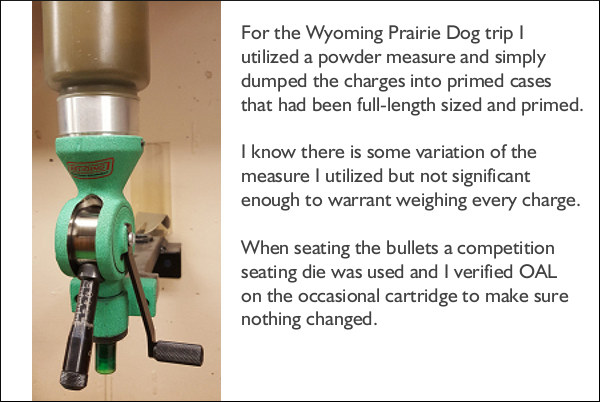
Recently I went on a prairie dog shoot in Wyoming with some good friends. The targets cooperated as did the weather with the exception of some challenging winds we experienced. We had a great time and make a lot of hits on those small rodents. When loading for the .223 Remington rifles and the TC Contender, I cut a few corners in the ammunition-loading process due to both time constraints and accuracy needed. When shooting at a prairie dog a miss is simply that, but when shooting at say the X-Ring at 1000-yard competition, a poorly-placed shot [harms your] placing in the match. Because of this, I can afford to miss an occasional shot at a varmint due to ammunition capability without worry but will not allow the same tolerances in my match ammo. For the Wyoming trip I utilized a powder measure and simply dumped the charges into primed cases that had been full-length sized and primed.
I had measured enough for length to know that while there was some variance all were under maximum length. I know there is some variation of the measure I utilized but not significant enough to warrant weighing every charge. When seating the bullets a competition seating die was used and I verified OAL on the occasional cartridge to make sure nothing changed.
This varmint ammo, with thrown charges, put TEN shots inside ONE inch at 200 yards. That’s half MOA. Good Enough? Absolutely!
The ammo produced shot under one inch at 200 yards in one of the guns I planned on taking on to Wyoming with me. [Editor: That was for TEN Shots — see above.] I knew I had loaded ammunition that was quite suitable for the task at hand which was evidenced by the number of hits I was able to make at fairly long range.
NOTE: The author, Tommy Todd, explains that, when loading ammo for F-Class matches, he uses more exacting methods. He weighs every charge and seats his bullets carefully with an arbor press. Todd adapts his methodology for his particular application. The lesson here is to load to the level of precision demanded by your discipline. READ Full Story HERE.




 Flash Consistency is very important, shot to shot. The consistency of every component is important: bullet weights, diameters, case wall thicknesses, and all the way down the list. We’re hoping to get more consistent behavior from a “match” or “benchrest” primer, and we’re paying more for it. I can tell you that some brands that aren’t touted as “match” are already consistent. That all comes from experience: try different primers, just respect the need to initially reduce the load for each test.
 Get Midsouth products HERE







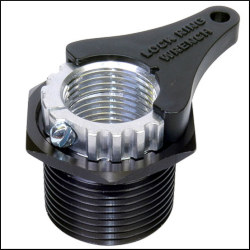 In this recent video Gavin Gear reviews three types of die accessories from LEE. These work for virtually all standard dies, not just LEE-brand reloading dies. The new LEE basic silver-finish die lock rings now feature splines for enhanced grip and compatibility with LEE’s new die lock ring wrench (photo right). They still boast a rubber 0-Ring that helps “float” the die for improved cartridge concentricity.