Cheaper Than Dirt (CTD), a Texas-based gun product retailer, has compiled a great resource that can benefit gun owners. CTD has created a “BANNED LIST” which catalogs firearms, ammo, and gun-related products (such as magazines) that are banned in particular states. This Overview of Restricted Guns, Ammo and Parts in Each State is searchable by state, so you can quickly identify the guns, ammo, and gun-related products banned in your location.
Wilburn Roberts, CTD Blog editor, explains: “You must be aware of local laws. I have authored more than 6,000 firearm-related articles, written 14 books on the topic of firearms and served as a peace officer and security professional for decades. I’m still learning new things related to laws every day.
Why read up on this topic? For starters, some things you would never have guessed are illegal. As an example, did you know that some states ban ‘wallet holsters?’ These are holsters that allow you to carry a handgun like a Beretta .25 ACP (or sometimes a small revolver) in the back pocket.
Be careful, as many things you are able to purchase easily online could be illegal in your home state. Some are patently illegal, others are illegal only if you carry them.
That being said, this is a report on certain items that are banned in one state or another. Feel free to use it as a reference for your own research. It contains pertinent gun laws nationwide and is separated on a state-by-state basis. It is ultimately your responsibility to study your own state laws and those of the states you travel in. Lawws might be … more complex than they first appear. Double-check the laws for your state. Also, remember that these laws are subject to change. At the end of the day, you should never order anything that is illegal in your state.”
DISCLAIMER: This is not intended to be a comprehensive or complete list of gun laws. The information provided is not intended as legal advice or a restatement of law. For any particular situation, it is highly recommended that a licensed local attorney be consulted for an accurate interpretation. The opinions and statements expressed in this article belong to the author and do not necessarily represent Cheaper Than Dirt, nor is the company at fault for any gun-related legal decisions you make.
Report by Andrew Murtagh
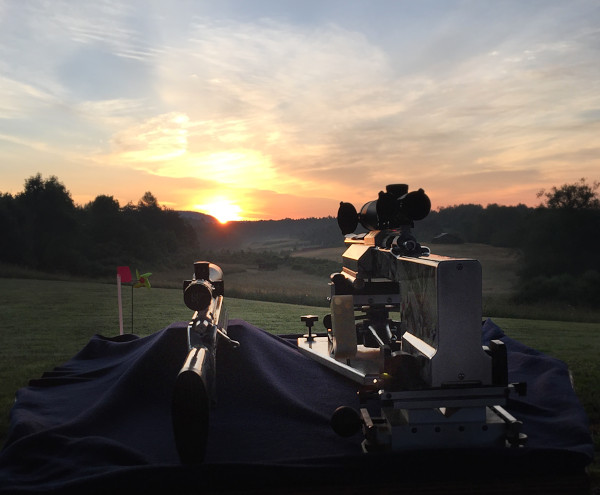
I’ve been a long range shooter for the past 17 years. Like most shooters in this game I’ve built, bought, and sold numerous rifles during my tenure. Here’s my tale of two special rifles, a Heavy Gun and a Light Gun, both sporting Patriotic stock graphics. I shoot both of these rifles in competition at Reade Range and The Original Pennsylvania 1000-Yard Club, aka “Williamsport”, where I serve as Club Vice-President.
My two Patriots were both acquired second-hand from a fellow shooter, Mike Bonchack. As purchased, they were very different from what they are now. I first decided to rechamber them using my reamers. The Light Gun (LG) is now chambered in 6×47 Lapua with 0.267″ neck, while the Heavy Gun (HG) is a 6mm Dasher with 0.266″ neck. After re-chambering the barrels, next I decided to get both guns up to maximum weight. The LG already had an adjustable weight system so it was easy to get it to 17 pounds. For the HG, I added an additional 25 pounds of lead/epoxy fill which was milled into the barrel channel and butt stock.
The Story Behind the Patriotic Graphics
I was initially going to have the LG painted until a close friend and fellow shooter, Tom Murtiff, suggested hydrographics. I landed on the patriotic theme because I’m a right-wing leaning Constitutionalist who still believes in the principles upon which our Founding Fathers built this nation. I wanted to express my support of our country’s Constitution and its Amendments. The search for the perfect patriot print was on.
This was my first hydrographic print experience and I was overwhelmed with the sheer number and variety of prints available. I spent a few days searching when I found the Amendment print. I then contacted Rick Schuh, owner of Boyzhid Hydrographics. He then prepped, hydro-dipped, and clear-coated the LG. Late in 2017 I purchased the HG and through a lengthy process in 2018 the metal work and stock additions were completed. I was now back in search of the perfect print. This was also lengthy, and I couldn’t find anything that spoke to me except for a suggestion to have “twin” rifles. I liked the idea — a pair of “Patriots!”
Rick was again employed to dip the Heavy Gun. That became a real undertaking because the stock alone (no metal attached) now weighed 35 pounds. He had to manufacture reinforced hangers to apply the graphics without flaw. The stock came out perfect to my eye, but not to his. On the bottom, which is rarely seen on any HG, he airbrushed a small flag to cover an area that stretched the print. Rick also made a jeweled plate for the toe of the butt.
I’m including this image so everyone can see Rick’s extra effort to make the HG perfect. I often joke with him about the added work no one would see. Well now the world can view his workmanship.
1000-Yard Heavy Gun Specifications:
Kelbly Stolle F-Class Panda dual-port, right eject with Kelbly Picatinny rail
Modified Ryan Miller HG stock bedded/pillared/weighted by David Powley
Bartlein 1:8.5-8″ gain-twist 0.236″ bore barrel
— chambered in 6mm Dasher 0.266″ neck by David Powley
Ryan Miller barrel-block fitted with nylon bushing by David Powley
Harrell’s muzzle brake
Jewell trigger
Optic One: NightForce 12-42x56mm NXS in Vortex rings
Optic Two: Leupold 7-35x56mm Mark 5 HD in Leupold rings
1000-Yard Light Gun Specifications:
BAT Machine B Action RB/LP/RE
McMillan MBR stock bedded by David Powley
Bartlein 1:8″-twist 0.237″ bore 30″ barrel
— chambered in 6×47 Lapua 0.267″ neck by David Powley
Harrell’s radial muzzle brake
Jewell trigger
NightForce 15-55x52mm Competition Scope in Harrell’s rings
Stock Graphics: Both rifles share a Patriot Constitution Hydrographic print (and clear-coat) by Rick Schuh of BoyzHid Hygrogaphics.
How to Succeed in the 1K Benchrest Games — Q & A with Andrew
Q: How Do You Choose a Chambering/Cartridge for a particular Match or Relay?
Andrew: Cartridge choice depends on the wind forecast. I always have several rifles with particular cartridge/loads for each depending on the forecast. If it’s a light wind day, say 4 to 8 mph with light gusts, I’ll be shooting either a 6×47 Lapua or a 6mm Dasher. If it’s blowing around 10 to 12 mph, I’ll campaign a 6×47 on its high node to get it down range flat. But if it’s really blowing or constantly changing direction, I shoot a big .300 WSM with either 200gr or 210gr bullet.
Q: What Is Your Load Development Method?
Andrew: Initial load development is always done over the chronograph at 100 yards until I get low ES/SD for 5 shots utilizing the same 10 pieces of absolutely perfect brass. Once I’m satisfied with the raw data I move to 1000 yards with a set of match brass and shoot 5-shot strings to find the best-performing exact powder charge. I have found this is usually within 0.20 grains of what performs well over the chronograph.
Q: What Brass, Primers, Powders, and Bullets Do You Use?
Andrew: I use Lapua brass for all things 6mm and Norma brass for my big .30 Cal stuff. I never change primers and shoot CCI BR2s or BR4s. I’m a Varget and H4350 fan. I’ve tried other powders, but they never were fruitful at 1K. Currently the only bullets I shoot are Sierra Match Kings. In the 6mm Dasher and 6×47 Lapua I use the 6mm 107gr SMK. In my .300 WSM I use .308-cal 200gr and 210gr SMKs.
Q: What Advice Do You Have for Novice 1000-Yard Competitors?
Andrew: Leave your ego at home and be willing to learn each and every time you come to the range. The discipline evolves rapidly and so must the shooter. It won’t take long to get left behind and become extremely frustrated with the game if you are not willing to learn and adapt. Find a tutor who is a great shooter and who is willing to mentor you. John Hoover and Tom Murtiff helped me and are very dear friends and great 1000-yard shooters. Believe me, having a good mentor takes years off the learning curve. Lastly, enroll in the Benchrest Shooting School offered by The Original Pennsylvania 1000 Yard Benchrest Club. I’m an instructor there and I, along with all the cadre, will help new shooters rapidly advance their skills.
Q: What’s the Secret to Judging the Wind? (In this discipline there are no target markers after each shot.)
Andrew: That’s the million-dollar question. What I do is find the condition that seems to hold. Once I’m committed into the record string, I follow it to the end. At Williamsport the wind flags can change at every distance so you simply need to pick one flag and hope it’s the one that remains truthful.
Long Range Competition Advice from a Leading 1K Benchrest Competitor
FIVE Key points to remember when shooting 1000-Yard benchrest
1. Be positive and have a clear state of mind when competing.
2. Bench set-up and shooting mechanics must always be the same — every shot. Then follow the shot through your optic.
3. Shoot two (2) shots before making a scope adjustment unless you’re under a minute of the sighter period.
4. Trust yourself and your equipment. You never want to second guess anything you put on the line.
5. Once you commit to shooting your record string, DO NOT STOP.
Invitation to Join Andrew at Williamsport in Pennsylvania
I currently serve as Vice President of The Original Pennsylvania 1000 Yard Benchrest Club, PA1000yard.com. Situated near the municipality of Williamsport, Pennsylvania, it has become known as the “Williamsport Club”. We would like to invite any shooting enthusiast to come out and visit our club during a match weekend. My rifles are only a sampling of the beauty and craftsmanship that is often on display at Williamsport’s 1000-yard line. Please stop by and visit with us.
Here are UPCOMING EVENTS at our club this summer and in 2021:
Light Gun and Heavy Gun Match #5, August 22/23, 2020
Light Gun and Heavy Gun Match Match #6, September 12/13, 2020
Light Gun and Heavy Gun Match Match #7, September 26/27, 2020
Long Range Benchrest School June, 2021
Annual 1000-Yard World Open Match July, 2021
Andrew wanted to give credit to the many talented guys who have helped with his rifle builds and his reloading equipment. In alphabetical order, these are Mike Bonchack, John Hoover, Tom Murtiff, David Powley, and Rich Schuh (Boyzhid Hydrographics).
One recent trend in F-TR competition is the use of low-profile, benchrest-type stocks shot with a light hand-hold and little or no face contact. For this method of F-TR shooting to work, you need the right equipment, and practice a “minimalist” shooting technique. One of the pioneers in this style of F-TR shooting is action-maker John Pierce of Pierce Engineering. Above you can see John shooting one of his F-TR rifles at the 2015 Canadian F-Class Championships. Note the straight-line stock and see how the adjustable bipod is set quite low to the ground (in fact the bipod’s arms are almost straight out).
Members of the Michigan F-TR Team, including Bryan Litz, have used similar rigs with success. Bryan said it took a while to adapt his shooting technique to this kind of rig, but there is a pay-off. Armed with a Pierce-built F-TR rifle, Bryan won his first-ever F-TR Match. Bryan explains the technique he uses when shooting this kind of rifle:
“Coming over from sling shooting, I knew there would be unique challenges to F-TR which I wanted to learn prior to (not during) a major tournament. I learned a new shooting position which doesn’t involve drawing the right knee up. For F-TR I get more straight behind the gun rather than at an angle. I found that the rifle shoots best with very light cheek, shoulder and grip pressure, approaching free recoil. This is how Eric Stecker shot his similar rifle into second place in the SW Nationals [with high X-Count by a large margin]. I learned the rifle’s sensitivity to different bipod and rear bag supports, and found the best buttplate position to allow the rifle to track and stay on target after recoil. This set-up shot best with a mostly free-recoil approach, that means ‘hovering’ over the comb, rather than resting your head on the stock. This took some ‘getting used to’ in terms of neck and back muscle tone. These are the kind of details I think it’s important to focus on when entering a new discipline.”
Bryan’s Pierce-built F-TR rig is a tack-driver: “I can certainly vouch for this set-up! In [a 2015] mid-range State Championship in Midland, MI, I shot my Pierce rifle into first place with a 598-44X (20 shots at 300, 500 and 600). Once you get used to the positioning and way of shooting these rifles, they just pour shots through the center of the target.”
Pierce F-TR Rifles with Scoville Stocks
Shown below are three complete Pierce F-TR rifles, along with a barreled action for comparison. The carbon-fiber/composite stocks are built by Bob Scoville. These Scoville stocks are very light, yet very strong and very stiff.
Main photo from NRAILA.org. The NRA supports Second Amendment rights.
Article by AccurateShooter.com Editor-in-Chief
In the last month, a half-dozen acquaintences have asked me about getting a handgun for self-defense at home and while traveling. What is notable is that all of these persons have never owned a handgun before. Moreover, two of the six are pretty staunch liberals who, prior to 2020, thought the Second Amendment was a “historical anachronism” that should be repealed. With the widespread riots and “defund the police” activism, that has all changed. These six people now realize that there are real threats in current society and they may find themselves in a situation where armed self-defense is the only option.
Try Before You Buy — Find a Gun with Good Reliability, Controls, and Ergonomics
These six persons asked for recommendations on handguns. I explained that there was no one “best gun” for every person. I also stressed the importance of training, and of trying various handguns to compare ergonomics, weight, balance, sight arrangement, controls, and trigger pull.
Folks, ergonomics and grip shape DO make a difference. I used to give pistol instruction at a local club. I provided four 9x19mm pistols: Beretta 92, HK USP, SIG P226, and Glock 19. Two-thirds of the students shot best with the SIG P226, and only 10% shot best with the Glock 19. The majority of the students kept “pulling shots” with the Glock, even with a lot of practice. Not so with the SIG P226. I attribute that to lower center of gravity and more ergonomic grip shape/angle.
Caliber Choice — Factors to Consider
We are not going into the long caliber debate today. I have owned semi-auto pistols in .380 ACP, 9x19mm Parabellum, .40 SW, .45 ACP. Each cartridge has its pros and cons. But for a first-time gun owner, looking for a self-defense round, I will recommend the 9mm. It will have noticeably less muzzle flip than the .40 SW, but still carries much more energy than a .380 ACP. I love the .45 ACP for target shooting, but it is more expensive for practice, and there are fewer pistol options. For revolvers, the .357 Magnum is a great defense round, but some of the smaller carry pistols are limited to .38 Special.
Semi-Auto 9mm Carry Gun Recommendation: S&W M&P9 Shield EZ
I have considered a wide range of 9mm carry pistols from Glock, Ruger, SIG Sauer, Smith & Wesson, Taurus, and Walther. There are many very good pistols out there. But what I recommended to my acquaintances was the new Smith & Wesson M&P9 Shield EZ 9mm. This gun features a back-strap grip safety and is offered with or without thumb safety. There is also a M&P9 EZ model with built-in Red Laser.
Here are the key reasons I recommended the M&P9 EZ 9mm pistol:
1. Good Accuracy and Balance
2. Integral Grip Safety and optional Thumb Safety
3. Good Ergonomics: 18-degree grip angle for natural point of aim
4. Reasonable 4.5-lb Trigger Pull (some other pistols are 7+ pounds*)
5. Easy-to-Rack Slide
6. Take-Down does NOT require trigger pull (unlike Glock)
7. Availability of built-in laser or accessory rail-mount lights/lasers
8. Good Price: $479.00 base MSRP with $399.99 street price
9. Outstanding Smith & Wesson reliability, warranty, and customer service
This detailed, authoritative M&P9 EZ video review also covers the M&P .380 Shield EZ:
Small Deep Concealment Carry Gun Recommendation — S&W Model 638
I am a big fan of revolvers. I have probably put more rounds through my S&W Model 617 .22 LR revolver than all my other handguns combined. Revolvers are accurate, solidly built, and the shorter-barrel models conceal easily. In addition, revolvers are inherently simple — they can be put into action without racking a slide or dealing with mag latches and the like. I’ve actually seen trainees drop magazines on the ground when they were drawing pistols from holsters — they hit the mag release by accident. If this can happen in a class, it can happen in a threat situation.
For concealed carry, I recommend the Smith & Wesson Model 638 revolver. IMPORTANT — the Model 638 has a hammer so it can be shot single-action OR double-action. Having the single-action option is great when a slower, more precisely-aimed shot is needed. Unique among S&W revolvers, the 638’s hammer is shielded — this way the hammer will not snag when the gun is carried in purse or pocket.
As for accuracy, you will be surprised with the Model 638 with good self-defense ammo. Despite the short site radius, the little 1.875″-barreled Model 638 will easily outshoot most self-loading .380 ACPs. With my 638 Airweight, slow-fire, I can put all five rounds inside 2″ at 20 feet with ease.
* Some folks may criticize this S&W Shield 9mm EZ because it lacks a heavy 7-9 pound trigger pull. The thinking is that a heavy DA pull is better for novices. We understand the argument. However, in the real world we found that novices shot much worse with very heavy trigger pulls, even after much training. We believe a 4.5-lb pull is moderate and will actually allow better accuracy for the average shooter. A typical Glock pull-weight is about 5.5-6 pounds.
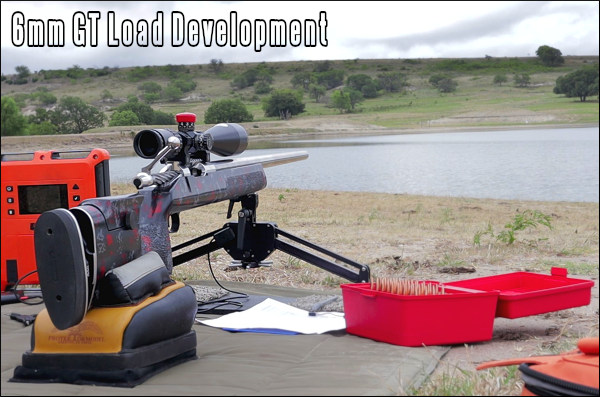
The 6mm GT (aka 6GT) cartridge was conceived as a “bigger Dasher” for PRS and NRL competition. The 6mm GT’s creators wanted 6mm Dasher accuracy and moderate recoil delivered via a cartridge with a slightly longer case body for better mag-feeding, longer neck for seating flexibility, and more moderate pressures. So far the 6GT has performed very well in PRS competition. Today’s story is a bit different — this is about an experiment — running a 6mm GT in an F-TR type rifle. Understand that, under current NRA rules, you may only shoot .223 Rem (5.56×45) or .308 Win (7.62×51), in official, sanctioned F-TR competition, but the 6GT is fine for F-Open. Mike McCasland wanted to see the potential of the cartridge for long-range target shooting, so he put a 6mm GT-chambered Bartlein barrel on a nice custom rifle with McMillan XIT stock and Kelbly F-Class Panda action. The results were impressive.
6mm GT — New Cartridge with Multi-Discipline Potential
Story by Mike McCasland, Texas Precision
The 6mm GT began garnering attention within PRS circles in early 2019. It promised to shoot 105-110gr 6mm bullets at 2950-3000 FPS, yet not suffer from mag-feed issues sometimes found with 6mmBR variants such as the 6 Dasher, 6BRX, and 6BRA. Moreover, since it burned less powder, the 6mm GT promised increased barrel life compared to the 6mm Creedmoor or 6XC. The 6mm GT case size should still work with the accurate powders in the Varget burn-range. I found the 6GT also worked great with H4350.
As someone who aspired to building a repeater and jumping into the PRS game, and had a spare F-TR rifle sitting around, I thought it would be fun to build up a 6mm GT to see if there was any merit to the hype. My smith, Wes Ripley of RIP Precision in Texas, builds a lot of PRS rigs, and already had the reamer on hand (a 0.120″ freebore variant).
Whidden Gunworks had some 6mm GT FL bushing die kits in stock, so I figured why not see what all the fuss was about? At the very least I could play around with the 6mm GT in F-Open Class at local club matches to see how it compared to the 6BRA, 6 Dasher, and other popular 6mm cartridges.
How the Project Got Started with Backup F-TR Rig
My 6mm GT build really started as a project spawned purely from COVID-19 Isolation boredom. This rifle primarily serves as a backup F-TR gun, and it had been relegated to performing some load development on .308 barrels, so I could spin new ones on my main match rifle. The only problem was, I had run out of .308 barrels that needed load development. So, I basically had an ideal test platform just collecting dust in the safe. All I needed was a 6mm GT-chambered barrel, since (like the 6mmBR) the 6mm GT works in a short action with a .308 Win-sized bolt-face.
6mm GT Rifle Specifications:
Action: Kelbly Panda F-Class SA RB/RP
Stock: McMillan XIT with RAD 2A
Barrel: 30″ 5R Bartlein 1:7.5″-Twist, HV Contour
Scope: Vortex Golden Eagle 15-60x52mm
Trigger: Jewell Benchrest, about 2 ounces
Bipod: Phoenix Precision
About the 6mm GT Cartridge
BRASS — The first thing you’ll find is cartridge brass choices for the 6mmGT are rather limited currently. At present, the only commercial options are Hornady and Alpha Munitions. For the die-hard Lapua fans, you can technically make 6mm GT brass from 6.5×47 Lapua, however that process is very labor-intensive.
I have used both Hornady and Alpha brass in this rifle and haven’t noticed much difference between the two. I will say that my batch of Alpha brass was slightly softer than Alpha brass I’ve used in other calibers; you could feel a difference when neck turning cases. I’m unsure if that’s a batch issue, or something specific to their 6mm GT brass as a whole. As far as performance, there was little discernable difference. Oddly enough, the Hornady brass seemed to have slightly less case capacity than the Alpha; with most other cartridges it’s the other way around.
POWDERS — The 6mm GT was designed with Hodgdon Varget in mind, and that popular powder works exceedingly well in this platform. That said, the 6mm GT can work with a wide variety of powders, some yielding better performance than Varget.
I’ve tried a multitude of powders during my initial 6mm GT load development: Varget, Shooters World Precision, RL16, VV N140, H4350, and RL-15 to name a few. In my barrel, Hodgdon H4350 seems to deliver the best velocity/accuracy combination. SD and ES also seemed to be the lowest with H4350.
Load Development for the 6mm GT — Many Powders Tested
BULLETS — The most common 0.120″ freebore chamber allows for the majority of high-BC 6mm projectiles found in both F-Class and PRS. I had good luck with the pointed 107gr Sierra Match Kings (SMK), as well as the 110gr Hornady A-Tips in my rifle. For those looking to run the heavier 112-115 grain 6mm offerings, I believe GAP designed a 0.160″ freebore reamer that gets those bullets out of the neck/shoulder junction. Shown below is the 0.120″ freebore JGS reamer print:
SUMMARY — Good Cartridge with Much Potential
Generally speaking, I think the 6mm GT is a good little round. Some may not subscribe to this theory, but I believe some cartridges are inherently easier to tune than others. I’m not sure the 6mm GT is as easy-to-tune as a 6mmBR, 6 Dasher, or 6 BRA, but I don’t think it lags that far behind.
With relatively little trouble, I was able to find loads with both Varget and H4350 that would consistently shoot very well — 0.2 to 0.3 MOA. Moreover, I found the 6GT cartridge lives up to the velocity claims made by G.A. Precision. I was easily able to push the 110gr A-Tips to 2950 FPS, and the 107gr SMKs to low 3000 FPS range without any pressure signs, or unnecessary wear and tear on the brass.
As a fun test, I ran my 6mm GT rifle in a local 1000-yard F-Class match with the 110gr A-Tips, just to see just how well they would perform. Although wind conditions of the day and some E-Target issues prevented my 6mm GT rig from getting the better of the larger 7mm and .30-Cal rifles, the 6mm GT proved itself an accurate little round at distance. Here is a 1000-yard ShotMarker target:
After putting several hundred rounds through my 6mm GT rifle, I anticipate building another 6GT on a repeater action to give PRS a try. I think if you are looking for a dual-purpose rifle that can run tactical matches (with 100% feeding reliability), and can also be used for mid-range, F-Open Class competition, the 6mm GT would be a very good option.
About the author, Mike McCasland:
Mike McCasland is an avid shooter who competes regularly in F-Class matches. Based in Texas, Mike is the creator of the Texas Precision YouTube Channel. There you’ll find many videos covering reloading, gun projects, and marksmanship. Mike has done some notable product reviews including a comparison test of Micrometer Competition Seating Dies. To access Mike’s YouTube Channel, CLICK HERE.
Review by F-Class John
Walk the line at any F-Class or Benchrest match and you’ll see plenty of SEB rests — for good reason. SEB produces some of the most popular competition shooting rests available today. With their ease of use and smart design, it is no wonder why SEB rests are so popular. But as good as they are, there are ways SEB rests can be made even better — such as making them easier to align precisely to the target during set-up. It was while shooting with his SEB NEO one day that inventor, fabricator, and competitive F-Class shooter Rod Brakhage decided to make a better mouse trap — to improve the SEB series of rests. He identified aspects of the NEO/MAX rests and SEB Mini tripod rest that could be enhanced and he then set out to improve their already great performance.
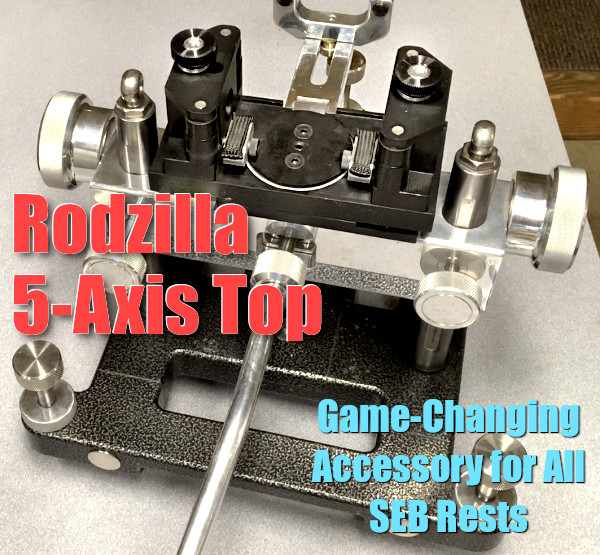
This photo shows the new Rodzilla 5-Axis top installed on a SEB Mini tripod rest. There are also Rodzilla tops for the SEB NEO and MAX two-column front rests.
Nearly a year and countless prototypes later, Rod unveiled his new Rodzilla 5-Axis Top to a select group of shooters to test and it’s been a wild ride ever since. Best of all, his top is drilled and tapped so that it can be fitted to a SEB NEO, MAX, or Mini front rest without altering the rest base in any way. To make things easy, if you don’t want to install it yourself, you can send just the bridge from your NEO/MAX or top from a Mini and Rod will install the 5-Axis unit. You pay for the Rodzilla top, and Rod will install it for free. The Rodzilla NE0/MAX tops currently sell for $549.00, while the Rodzilla Mini top is $584.00.
Watch Video to See All Features of Rodzilla 5-Axis Rest Top:
Rodzilla Top Swivels Independently of Rest Base
The first thing Rod did was allow the top to swivel independently of the base. On a NEO this makes a HUGE difference because you can now set your rest down in the general direction of your target and make final adjustments once you’re down behind the gun. This is a huge departure from the normal procedure where you find yourself moving your NEO repeatedly until it’s just right. You can do the same thing on a Mini which is actually a nice feature despite the head already swiveling because you can now lock down the Mini head and make your final adjustments behind the gun as well. This is probably the feature that stood out the most to me when I first set it up. Being able to lock the front end down and get comfortable immediately behind the gun without having to get up again was a time-saver. This also left me feeling very confident in my gun alignment to the target.
Delrin Rollers on Side Guide Stock during Recoil
The second major innovation is the addition of Delrin rollers along the side. The unit has two easily adjustable jaws that each contain a set of rollers. These rollers allow for as much or little contact as you want along the sides of your stock and provide a smooth if not near frictionless experience whether during recoil (breakaway) or when returning the gun to battery. the departure from traditional sandbags on the side quite revolutionary, and yes it is legal under NRA rules. Current NRA High Power F-Class rules have no limits on what material contacts the sides of the stock. As someone who has owned a number of front rests and filled countless small sandbags this comes as a welcome relief! The Rodzilla’s rollers give me confidence that I’ll have consistent contact with the stock without the side bags constantly shifting and needing my attention during a match.
Small, Separate Sandbags Provide Consistent Contact at Any Gun Angle
Another major Rodzilla advancement is the design of the left and right sandbags. Conventional sandbags are stationary and oriented to the rest itself meaning that if you’re shooting uphill or downhill then you may not have stock contact with the full bag surface or the stock may be at a weird angle to the sandbag. Plus, with time, conventional front sand bags can form crowns or lumps that require attention. Those problems are solved with the Rodzilla’s tilting mini-sandbags. Rod’s sandbags are very small yet still meet NRA High Power guidelines as they are filled with sand and can be visibly deformed when pushed. But otherwise, they are unlike anything you’ve seen before. Each bag is mounted on a pivoting arm allowing the gun to always keep consistent contact with each bag regardless of the angle of your rest. This provides confidence that your stock is always riding on the same amount of sandbag no matter how the rest has been placed, or the ground angle relative to target.
CONCLUSION: The Rodzilla 5-Axis Top is a Game-Changer If you have a SEB Rest you will definitely want this…
The innovative design features of the Rodzilla 5-Axis Top make SEB rests work even better. The Rodzilla Top delivers an incredibly smooth and repeatable shooting experience. Recoil seems smoother, and it is easier to align the rest on target during set-up. If you own a SEB rest and are looking to make your set-up on the line easier and faster, have near-zero breakaway force on each shot, and have consistent follow-up shots to your point of aim, then give the Rodzilla 5-Axis Top a try.
This Video shows how to install the Rodzilla 5-Axis Top on SEB Mini tripod rest:
This Video shows how to install the Rodzilla 5-Axis Top on SEB NEO or MAX Rest
Sellier & Bellot is one of Europe’s older ammunition manufacturers, producing a wide variety of rifle and pistol ammo. The video below shows ammunition being made from start to finish, starting with raw materials. This is a fascinating video that is well worth watching. It shows some amazing machines in operation.
EDITOR: Guys, this really is an exceptional video that shows every aspect of production. I have watched dozens of videos about ammo making. This is definitely one of the BEST. Take the time to watch.
Based in Vlasim, Czech Republic, Sellier & Bellot was founded in August 5, 1825 by Louis Sellier, a German businessman of French lineage. His family were royalists who fled France during the French Revolution. Louis Sellier began manufacturing percussion caps for infantry firearms in a factory in Prague, Bohemia on the request of Francis I, the Emperor of Austria. Sellier was later joined by his countryman Jean Bellot.
Sellier & Bellot has also produced an interesting CGI video that shows what happens inside a rifle chamber and barrel when a cartridge fires can’t be seen by the naked eye (unless you are a Super-Hero with X-Ray vision). But now, with the help of 3D-style computer animation, you can see every stage in the process of a rifle round being fired.
In this X-Ray-style 3D animation illustrates the primer igniting, the propellant burning, and the bullet moving through the barrel. The video then shows how the bullet spins as it flies along its trajectory. Finally, this animation shows the bullet impacting ballistic gelatin. Watch the bullet mushroom and deform as it creates a “wound channel” in the gelatin.
Watch Video – Cartridge Ignition Sequence Starts at 1:45 Time-Mark
The state of New York, through NY Atty. General Letitia James, has filed suit against the NRA attacking actions by its leadership, claiming that funds were spent improperly. The purpose of the suit, said James, is “to dissolve the organization in its entirety”. This lawsuit originates from New York because the NRA is a New York-chartered organization. In a coordinated legal action, likewise motivated by partisan politics, District of Columbia Attorney General Karl Racine brought suit against the NRA Foundation, claiming the Foundation gave money to the NRA without proper oversight.
About the New York Lawsuit: The NY suit claims NRA CEO Wayne LaPierre, Wilson “Woody” Phillips (former NRA treasurer/CFO), Joshua Powell (former chief of staff) and John Frazer (corporate secretary/general counsel) diverted tens of millions of dollars for their personal benefit and enrichment. NY alleges that the “The NRA was serving as a personal piggy bank” for these four men.
About the DC Lawsuit: “Key to the D.C. complaint are a pair of $5 million loans in 2017 and 2018 from the Foundation to the Association. In addition to those loans, the suit alleges the Foundation paid millions in fees to the NRA with no oversight, essentially placing the NRA’s interests above its own. That is a violation of the Foundation’s articles of incorporation.” Source: The Shooting Wire, 8/7/2020.
The NRA Responds — And Files Suit for First Amendment Violations
LaPierre stated that the action by New York is “an unconstitutional, premeditated attack aiming to dismantle and destroy the NRA”. Immediately the NRA began to fight back, filing a countersuit on 8/6/2020 stated that the NY AG’s lawsuit has violated the NRA’s First Amendment rights. NRA President Carolyn Meadows called the NY lawsuit a “baseless, premeditated attack on our organization and the Second Amendment freedoms it fights to defend”.
Lawsuits filed against the NRA will be the major issue at the NRA Annual Meeting next month.
The National Shooting Sports Foundation issued a statement condemning the NY Atty. General’s politically-motivated scheme to dissolve the NRA:
“NSSF, the trade association for the firearm industry, is troubled by the politically-driven decision of New York Attorney General Letitia James to seek to dissolve the National Rifle Association, America’s oldest civil rights organization.
The lawsuit filed today by Attorney General James seeks to punish the over five million members of the National Rifle Association based on mere allegations of possible wrongdoing by a few individuals.
NSSF is deeply concerned about the apparent political agenda to silence the strongest voice in support of the Second Amendment ahead of the election in November.
This lawsuit, and one filed today by the District of Columbia Attorney General, should concern all Americans who cherish both the First and Second Amendments to our Constitution regardless of their views on what laws and regulations are appropriate to address the criminal misuse of firearms.”
Check out that bolt assembly. It features a fluted stainless bolt body, laser-engraved Titanium shroud, and Titanium dragon-scale bolt knob with polished stainless handle.
You haven’t seen a Ruger Precision Rifle (RPR) like this before. Forum member TerryH has customized his Second-Gen 6.5 Creedmoor RPR with a wicked purple finish, snazzy stainless/titanium bolt, and slick HDPE (polymer) bag-riders front and rear. The mods on this Hot Rod Ruger don’t stop there. Terry added a Seekins hand rail, Timney trigger, ergonomic grip, and more…
For his Hot Rod Ruger, Terry has the right skill set, learned on the job: “I work in a body shop and have pretty much custom-painted all my stuff for many years. For this 6.5 CM RPR, colors of choice are House of Kolor PBC-65 Passion Purple and black covered with Cerakote MC-161 matte clear.” Terry even painted his Bald Eagle rest purple to match his Hot Rod RPR.
Terry reports: “I’m shooting an RPR in 6.5 CM. It has a Patriot Valley Arms 26″ barrel. Josh at PVA is making a thread protector for me so I can remove the Mad Scientist brake. The butt stock has a V-Tab adjustable butt plate and Wiebad check rest pad. Glass is a currently a Vortex Gen I PST 6-24x50mm but I have a Golden Eagle on layaway”. To learn more about this rifle or ask TerryH questions about the build, visit this Shooters’ FORUM THREAD.
Ruger Precision Rifle Modifications: Chassis and Handguards Painted Passion Purple
Patriot Valley Arms 26″ Barrel with Brake
Timney Trigger with Ambi Safety
Custom HDPE (Polymer) Bag-Riders front and Rear
V-Tab adjustable butt plate and Wiebad cheek-pad
Seekins Rail
Good Accuracy with Factory Ammunition
Terry reports: “The RPR is shooting .3 MOA @ 100 with factory Fed American Eagle 140s.” Terry plans to start handloading for the rifle with the goal of shooting F-Class matches next year: “I’ve successfully shot steel out to 1140 yards on the range but [I don’t know] if that will actually translate well in a match. I’m committed to practicing as much as I can and starting to shoot some matches in 2018.”
Front and Rear Bag-Riders with Protektor Rear Bag and Upgraded Bald Eagle Rest
Terry has engineered a slick set-up for F-Open competition and load testing. Up front is a Bald Eagle rest upgraded with windage knob mod, stainless F-Class feet, and longer adjusters. Terry also “changed the hardware to all stainless and added a couple of levels”. In the rear, Terry runs a Protektor Doctor rear bag with 1″ ear spacing.
Impressive additions are the custom HDPE bag-riders Terry crafted himself: “I realized that the butt stock wasn’t going to cut it on the rear bag and even though I got the 2 1/4″ front bag and the Seekins rail is 2″ wide and flat that it wasn’t as stable or smooth as I’d like.” So Terry made his own front and rear bag-riders from HDPE, a material similar to Delrin. Currently the front unit is 2.25″ wide, but Terry will be changing that to a 3″-wide front sled: “I decided that I’d get a 3″-wide front bag and mill a new front bag-rider. I’m going to recess the center to fit around the hand guard and I’ll mill a recess on the bottom of that one.”
Shown below is the Hot Rod Ruger before Terry added the HPDE Bag-Riders front and rear. Terry says the rifle now handles much better with the bag riders, and he plans to upsize the front sled to 3″ width.
Bling’s the Thing. Below is the Hot Rod Ruger’s bolt assembly. It features a custom flat-fluted bolt shaft, laser-engraved Titanium shroud and Titanium dragon-scale knob with polished stainless handle. Terry confesses: “I simply can’t resist anything shiny!”
NOAA photo of flooding after Hurricane Floyd in 1999. The Colt Python Revolver once belonged to Elvis Presley (Rock Island Auction).
This past week, Tropical Storm Isaias has hammered the East Coast of the USA. The BBC reported: “From North Carolina up to New York, Isaias left more than 3.4 million residents without power. It spawned tornadoes, uprooted trees, damaged homes and caused floods and fires.” This article explains what to do if you have experienced flooding.
Firearms owners who have seen their guns and stored ammunition submerged by flood waters in storm-wracked areas are probably wondering if their firearms and ammunition can be salvaged and safely used. To answer these questions, the NSSF and the Sporting Arms and Ammunition Manufacturers’ Institute (SAAMI®) created two documents outlining the proper response to submersion of guns and ammo. If you’ve got wet guns and/or ammo, download these two PDF files and read them carefully.
The SAAMI document “Guidance on Firearms That Have Been Submerged or Exposed to Extensive Amounts of Water” points out two major concerns about firearms that have been exposed to water: parts susceptible to moisture and rust damage such as metal parts, wood stocks and grips, and optics; and, secondly, infiltration of the action, barrel and safety systems by grit, silt and other foreign debris.
#1 Always unload firearms before beginning any treatment process.
It’s important to limit moisture and corrosion damage to the component parts of the firearm. This can be accomplished by disassembling the component parts and using up to two coats of a moisture-displacing lubricant such as Hoppes #9 MDL or WD-40 to clean and stabilize the parts while, importantly, following the product’s directions so as not to damage, for instance, plastic or synthetic parts. Another tip is to allow wood stocks and grips to air-dry and not be force dried by exposure to heat.
The document emphasizes that once the firearm has been thoroughly dried, consideration must be given to having the firearm inspected and serviced by the manufacturer, an authorized service center, or a qualified gunsmith before putting the firearm back in service.
Dealing with Ammunition That Was Submerged
Bottom Line, if your ammo has been submerged — DON’T USE IT. SAAMI explains why…
To help firearms owners determine what to do with ammunition that has been affected by water and moisture, SAAMI offers another helpful document, “Guidance on Ammunition That Has Been Submerged in Water.” This document covers differences in moisture resistance between centerfire, rimfire and shotshell ammunition, and potential hazards associated with “drying out” cartridges, including possible deterioration and damage to cartridges due to drying methods.
Another serious hazard that could result from using compromised ammunition is the potential for a bore obstruction due to partial ignition of either the priming compound or the propellant powder charge, or both. Firing a subsequent round through an obstructed barrel can result in bodily injury, death and property damage.
SAAMI provides the following cautionary conclusion: “It would be impossible to ascertain for certain the extent of the deteriorating affect, if any, the water may have had on each individual cartridge. Therefore, the safe answer is that no attempt be made to salvage or use submerged ammunition. The ammunition should be disposed of in a safe and responsible manner. Contact your local law enforcement agency for disposal instructions in your area.”






 As someone who aspired to building a repeater and jumping into the PRS game, and had a spare F-TR rifle sitting around, I thought it would be fun to build up a 6mm GT to see if there was any merit to the hype. My smith, Wes Ripley of
 BRASS — The first thing you’ll find is cartridge brass choices for the 6mmGT are rather limited currently. At present, the only commercial options are Hornady and

 SUMMARY — Good Cartridge with Much Potential



 “NSSF, the trade association for the firearm industry, is troubled by the politically-driven decision of New York Attorney General Letitia James to seek to dissolve the National Rifle Association, America’s oldest civil rights organization.


