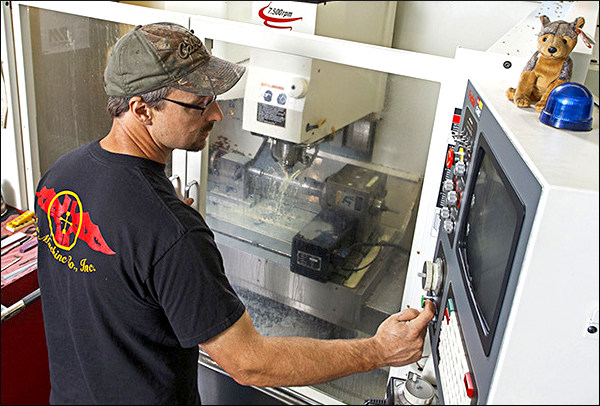
If you have ANY interest in custom rifle actions, you MUST watch this video from UltimateReloader.com. Folks, definitely watch the video — it is VERY informative! To produce this video, Ultimate Reloader’s Gavin Gear visited the BAT Machine facility in Post Falls, Idaho, and interviewed BAT owner Bruce Thom.
In the video Bruce Thom demonstrates how BAT Machine actions are created from start to finish. Bruce shows every stage of the process, employing multiple high-tech machines. It’s impressive — Forum members say that this is a “must-watch” video. Gunsmith Jackie Schmidt noted: “Great Video. Even though I have been in the machine shop business for 50 years, I still marvel at the new innovations in precision machining. Bruce has a very down-to-earth, common sense approach to explaining what to many seems like machining wizardry.” And Mark T. posted: “Watched it last night. Excellent video and excellent machining practices — precision from beginning to end.”
Click Arrow to Watch Video
For further explanation of the action production processes, with step-by-step listing of how receivers and bolt assemblies are created, read Gavin Gear’s full BAT Machine Article on UltimateReloader.com.
BAT Machine Company Was Started 29 Years Ago
Back in 1991, Bruce Thom started BAT Machine Company, which was incorporated later in 1996. Bruce’s shop stared with manual machines, quickly moving to CNC machines later in the 1990s. BAT Machine quickly achieved a following among benchrest shooters for crafting superb actions that exhibited flawless function and superb machining. Those qualities, benchrest competitors realized, helped produce tiny groups, win matches, and set benchrest records. BAT Machine now makes rifle actions for a wide variety of disciplines: F-Class, PRS, ELR, hunting, and of course short- and long-range benchrest.
BAT Action Body Machining Stages
As shown in the video, here are the major stages for the fabrication of a BAT Machine receiver body:
1. Start: raw 17-4 stainless round bar (higher toughness than typical barrel/receiver steel)
2. Heat treat
3. Bore central hole (for EDM wire), face ends
4. EDM machining (cut bore and raceways)
5. True OD, cut receiver threads and lug seats
6. Cut tang and related features
7. Finish machining including body OD, integral lug (if equipped)
Final Production Stages — Polishing and Deburring
After the receiver body and bolt are machined, they go through a deburring and polishing process.
In the image above you can see the stages. At left is a receiver body straight from machining. Some hand work is typically performed to break interior edges that are sharp from machining. In the center, the receiver shows can see the initial polish stage. During this stage, machining marks are removed by coarse polishing. Additionally for receivers that will be nitrided, that will be done next. But for actions that are NOT nitrided, a final polish brings the parts up to a high luster, as show on the right.
After polish (and nitriding if that applies) the bolts and receivers get a finish assembly, and testing for proper smooth functioning. The receivers are then registered with the ATF and shipped to the customer.
Election Day is just 61 days away. On November 3, 2020, Americans will head to the polls. For gun owners, this may be the most significant Presidential election in a generation. The Democratic Party, as stated in the DNC platform, intends to severely restrict gun rights, and ban whole classes of firearms.
Nearly 5 million Americans are first-time gun buyers. We hope they, along with ALL gun owners, will vote on November 3rd, and remember which candidates support the Second Amendment. As the National Shooting Sports Foundation (NSSF) states: “Current events across the United States demonstrate why the Founding Fathers 230 years ago had the foresight to recognize why the right to keep and bear arms would still be vital today.”
Smith & Wesson Contributes $500,000 to 2020 Gunvote Effort
#GUNVOTE is a vital NSSF campaign to encourage America’s gun owners to register to vote and vote for candidates who support the Second Amendment and gun rights. Go to Action.gunvote.org to learn how to register to vote in your state, and find your polling place.
Firearm manufacturer Smith & Wesson has contributed $500,000 to the NSSF’s #GUNVOTE® voter registration and education campaign. This is the largest donation the campaign has received to date.
“This election cycle marks a crossroads in the future of the firearms industry and of our very freedom to bear arms,” said Mark Smith, President and CEO of Smith & Wesson. “We must ensure the Second Amendment is protected at every level. It is critical that hunters, recreational target shooters, and all those seeking to exercise their constitutional right to protect themselves and their families be educated and vote in November. [Voters’] choices at the polls will impact the future of all Americans’ free exercise of their constitutional rights.”
Six Companies Will Match NRA-ILA Donations Dollar-for-Dollar
The NRA-ILA has joined forces with with six companies that have pledged to match $1 million in donations made to NRA-ILA through November 15, 2020. The six participating companies are: SIG SAUER, Kel-Tec, Credova, Rock Island Auction Company, Taurus, and Davidson’s Gallery of Guns. If you make a donation to the NRA-ILA, your donation will be matched, dollar-for-dollar, by these six companies. If you give $50, they give $50. If you give $100, they give $100. The maximum matching is $1,000,000.
“These patriotic businesses are pledging vital resources to support and defend the Second Amendment because they understand that our right to own a gun in defense of ourselves and our families is on the ballot in November. By working together with such partners, our membership intends to defeat those … trying to strip our rights away”, said Jason Ouimet, executive director, NRA-ILA.
Through this Partners for Patriotism campaign, anyone who makes a donation to NRA-ILA between now and 11/15/2020 will have their donation matched. Folks can make donations of any size — whatever they can spare. Whatever individuals donate will automatically be doubled by the six participating companies.
With the Presidential election looming, the stakes have never been higher. Joe Biden and his VP candidate Kamala Harris have pledged to enact new laws that could result in rifle confiscation, criminalization of private sales, and banning of online guns and ammo purchases. In addition, Biden and Harris have called for new gun taxes, while Harris has advocated banning guns by Executive Action — rule by fiat, bypassing the legislative process.
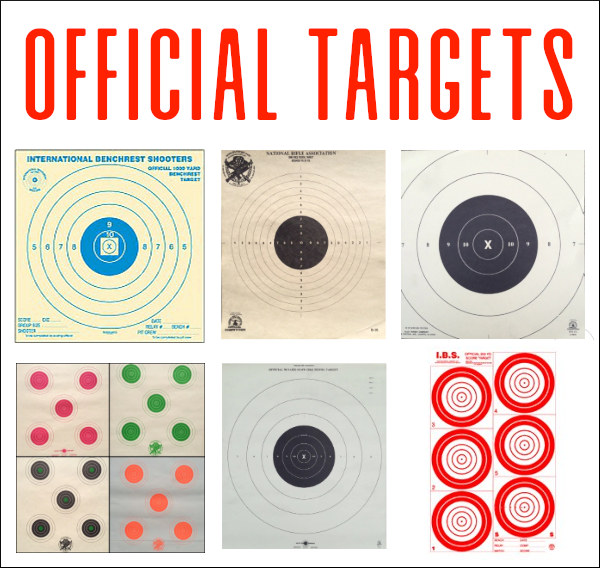
Need targets — not just any old targets, but the correctly-sized targets for specific shooting disciplines (such as NRA Smallbore, F-Class, and 1K Benchrest)? Well you won’t find them at your neighborhood gun store. Precise, dimensionally-correct competition targets are produced by a half-dozen specialty printers. In this article we provide links to the leading target sellers, with a chart showing “who’s got what”. Look for your particular discipline and the vendors will be specified.
Sources for Official Shooting Competition Targets:
AccurateShooter.com offers dozens of FREE, printable targets for target practice, load development, and fun shooting. We also offer a few of the most popular NRA Bullseye targets. One or more of these printable targets should work for most training purposes. However, some readers have asked: “Where can we get the real targets… exactly like the ones used in NRA, IBS, and NBRSA shooting matches?”
All these vendors carry nearly all the NRA High Power and Smallbore targets, including the smaller F-Class targets. National Target has the F-Class and High Power targets, including 100-yard reductions of the 200, 300, and 600-yard military targets.
Germany’s Kruger Targets sells all the important NRA targets, and international (ISSF) air rifle and smallbore targets too.
Orrville Printing currently sells IBS targets for rimfire (50 yard) benchrest, short-range centerfire Benchrest (100, 200, 300 yards), Hunter BR Rifle (100, 200, 300 yards), plus the official 600-yard and 1000-yard IBS targets. National Target Company also has most of the IBS targets. NBRSA short-range, 600-yard, and 1000-yard benchrest targets are available directly from the NBRSA Business Office. Send an email to nbrsa@icloud.com or call (434) 993-9201.
Need Steel, Cardboard Silhouettes or specialty targets? ALCO Target Company in Duarte, California is the USA’s leading producer of the full spectrum of shooting targets including paper targets, cardboard targets, steel targets, and target stands.
On the Shooting Sports USA website, there’s a great profile of Kevin Nevius, one of America’s leading competitive marksmen. Kevin is best known for his smallbore success — Kevin won smallbore National Championships in 2008, 2010, and 2014. Kevin also has also an impressive record in long-range centerfire competition. He won the NRA 2018 Long Range Championship, while in 2005 and 2006 he won the Sierra Trophy at Camp Perry in 1000-yard competition. This story, penned by gunwriter Hap Rocketto, covers Kevin’s career, which has included multiple championships and many records.
“My brother got me into long range varmint hunting and I started building my own guns very early,” Nevius told Dan Holmes in a Pronematch.com interview. “I had a hunting friend who shot indoor smallbore who started me in three position and I was hooked.”
At the 2018 NRA Long Range Championships, Kevin Nevius went head to head against the nation’s top long-range aces this past week, and emerged on top. Besting the likes of past multi-time Long Range Champions David Tubb and John Whidden, Kevin Nevius shot superbly at Camp Atterbury to win his first NRA National Long Range Championship.Kevin built his own rifles for the match, using Kelbly centerfire actions in a Grunig & Elmiger smallbore stock. Here is Kevin’s first-hand report of his 2018 LR Championship victory.
Smallbore shooting is where I learned to build a good position, and so much of that carries forward to Long Range High Power. It was a huge shock though, the first time I looked at a 44” aiming black through aperture sights at 1000 yards! Smallbore aiming blacks are twice as big, at one tenth the distance — the fact that we can hit something at 1000 yards with that sight picture still amazes me!
Here are highlights from Hap Rocketto’s Profile of Kevin Nevius:
Champion shooter Kevin Nevius grew up in a household that did not allow firearms, an unlikely beginning for one of the United States’ premier prone rifleman and gunsmiths. Once out on his own he fell in with his brother who enjoyed long-range varmint hunting. His natural bent for things mechanical (he is a professional structural engineer) soon had him tinkering with rifles, which eventually led him to building his own.
Everything fell into line for him in smallbore during the 2008 season. After shooting a series of training matches in which he was most successful, he arrived at Camp Perry at the peak of performance and won his first National Smallbore Rifle Conventional Prone Championship. Kevin came back strong in 2010, winning the inaugural individual National Smallbore Rifle Metric Prone Championship, as well as the team title at Bristol, IN. [Kevin then won the Smallbore Conventional Prone Championship in 2014 with a practically perfect score of 4799-390X (LINK).]
Along the way, Nevius has won some impressive national records. In conventional competition he co-holds the 1200-shot metallic sight aggregate record of 1200-102X. He was just one shot short of perfection in the 480 aggregate, where he holds the civilian record of 4799-412X, just one point behind, and 11 Xs ahead of, Joe Hein’s 4800-401X open record.
Kevin Nevius hopes to build a smallbore rig capable of 3/8-MOA at 100 yards.
Building the Ultimate Rimfire Prone Rifle
Kevin is not just a great trigger-puller. He also smiths his own rifles. His current goal as a gunsmith is to build a rimfire rifle that will shoot 3/8″ groups at 100 yards. That’s a big challenge — 3/8-MOA represents very good accuracy for a centerfire rifle with handloaded ammo. But if any rimfire smith can build a rifle that will shoot that well at 100, it’s probably Kevin.
Range photo from Athena Gun Club in Houston, TX. Athena has 26-lane indoor shooting range.
A Girl & A Gun (AG&AG) is a club by women shooters for women shooters. With a network of instructors and affiliated ranges, AG&AG operates training clinics and competition events throughout the country. AG&AG recently sponsored a nationwide survey of 6000 club members. This survey revealed interesting trends in gun purchases by females. By way of background, a previous survey by the National Shooting Sports Foundation (NSSF) estimated that about 40% of 2020 gun sales are to first-time buyers, and that roughly 40% of those first-time gun buyers were women.
AG&AG did a follow-up survey of club members who were first-time gun buyers. This showed that the leading motivator in gun acquisition were concerns over riots and civil unrest. This was followed by worries over the upcoming election and possible future gun bans.
There were some very interesting comments by AG&AG members, who expressed their personal reasons for buying guns and seeking firearms training:
Kathryn in Texas: “I’m a trauma surgeon and have treated a fair share of gunshot victims in Chicago and Houston. I have been pretty ‘anti-gun’ as a result up until COVID. At that point, I figured I might as well get comfortable with at least handling firearms in case I had to use one.”
Theresa in Nevada: “I’ve never felt the need to own a gun or want a one. However, with the extreme levels of crime, every individual should learn to protect themselves. With our political leaders allowing the police to be torn apart, this made me feel the need to step up and take measures for my protection.”
Jan in Michigan: “As a history teacher with 35 years of teaching experience I know that the first thing revolutionaries and tyrants do upon seizing power is to take away the public’s guns. As a child my family lived in inner city Detroit in the heart of the 1967 riots….More recently, the rioters came down my street after their burning and looting rampage downtown in my city of Kalamazoo, Michigan. I decided that I have to defend myself and not allow myself to be a sitting duck. “
Anonymous in Connecticut: “I [was] interested in joining A Girl & A Gun Club for a while and in the wake of the protests and defunding of police I thought this was extremely important. Being from the Northeast it is difficult to find others with the same ideals so I thought this would be the best place to start.”
About A Girl & A Gun
AG&AG is now moving into its 10th year of educating women on the safe use and storage of firearms, and promoting women’s interest and participation in training and competitive and recreational shooting sports. The club’s mission is especially relevant today and the organization is stronger than ever.
2020 has been a challenging year for the shooting sports. The CMP National Matches at Camp Perry and NRA National Championships at Camp Atterbury were cancelled due to Pandemic health concerns. Other major matches have been dropped from the calendar due to COVID-19. That’s why we are pleased to report that the IBS was able to conduct the 2020 Benchrest for Score 100/200 Meter National Championships. Attendance was solid, and competitors had a good time. Here is the match report from IBS member Todd Payseur.
IBS 100/200 Score Nationals at Mid-Carolina Gun Club
Report from Todd Payseur
The morning light breaks and shooters begin to set the final touches on their wind flags. Yes, it’s time for the Nationals! For what has been a crazy COVID-impacted year with a lot of cancelled matches, dates being changed, and some states still not able to hold matches, many shooters had cabin fever for the Nationals.
Several people had concerns beforehand with even having a match in August at the Mid-Carolina Gun Club because of how brutal our summers can be, but Mother Nature really blessed us with a calm weekend. Saturday started with overcast skies and projected highs around 87 degrees, which for August is almost unheard of. A few showers during the day, but nothing that really amounted to much or effected any of the relays. The winds stayed calm and 20 VFS shooters stayed clean and 2 Hunter guns went for 250-10X with Peter Hills creedmooring Ronnie Milford for the top 6-power at 100 meters. In VFS a familiar face, Wayne France shot a great 250-21X edging out rookie shooter Will Till at 250-20X.
Lisa Moore, grandmother of Gage and Remy Logsdon, prepares for the next relay with bolt removed.
This is Will’s second season in VFS and he has steadily improved. His second place finish at 100 meters is the start of many great finishes ahead for this young man. Speaking of young people, I’m pleased to say we had a great showing of Junior shooters this year and they all deserve to be mentioned. Defending rookie of the year Tori Allen (below right) was the top junior, followed by first-year rookie Remy Logsdon. Gage Logsdon rounded out the top three junior shooters. With such young talents coming into the benchrest game, we are very optimistic about the future of our sport.
Wayne France (Left) with 100-yard 1st Place Agg patch. Tori Allen (Right) was the top Junior shooter.
Sunday at 200 meters was the Lin Smith show! Lin shot both a Heavy and a Light Varmint rifle and turned in a very impressive 500-17X for the day. This fine work led him to two of the top three places at 200 meters and a first and fourth in the Grand Agg. I can’t say enough about how happy everyone is for Lin. He is one good man that those of us in the southeast region are honored to compete with and call a friend.
Grand Agg winner Lin Smith really put on a display of fine shooting this weekend.
In the 6-power Hunter Rifle class, Jim Cline turned in an impressive 249-5X at 200 meters for the win and that led him to his first place finish in the Grand Agg followed by a solid 245-4X by Ronnie Milford who took second-place in the Grand Agg.
Here are all the winners with their wood. Left to Right: Will Till, Gage Logsdon, Lee Martin, Tori Allen, John Bosley, Lin Smith, Peter Hills, John Ridgeway, Remy Logsdon, Wayne France, Jim Cline and Ronnie Milford.
CLICK Chart for Full Spreadsheet with Results for ALL Shooters
View back to the benches from the 100-meter targets at Mid-Carolina Gun Club. the Orangeburg swirl is lurking in those trees… just waiting to push bullets where they just shouldn’t go!
Great Competition, Great Food, Great Location
Overall we had a good turnout with 35 VFS guns and 8 V/VH guns on Saturday and 34 and 7 on Sunday. Competitors came from as far away as Maine and Michigan and everywhere in between. The food was outstanding with meals available both Friday and Saturday evenings at the range along with lunches Saturday and Sunday. One thing is for certain, if you enjoy great food and great company, then the IBS VFS circuit is something you should come check out, I’m sure you won’t be disappointed!
About the Mid-Carolina Gun Glub in South Carolina CLICK HERE for more information on the Mid-Carolina Gun Club in Orangeburg, South Carolina. This club boasts a great facility with plenty of room for cleaning/loading, plus a large, covered eating area with serving line. There is also parking for campers on the club property. I would like to personally thank Jim Cline and the whole Mid-Carolina Crew for another great weekend and cherished memory!
Jerry Powers from the Ashe County gang setting up a SEB MAX. SEB rests, both MAX and NEO, are very popular with score BR shooters.
Sierra BulletsBallistic Technician Gary Prisendorf has written a nice essay about how reloading can become a life-time hobby, a rewarding pastime that can bring together a father and son…
Memories of My Father — Reloading As a Life-Time Hobby
by Gary Prisendorf
For as long as I can remember I have been around reloading. I have tons of childhood memories of my father reloading and shooting. I remember how he would let me help him load his ammunition, by letting me clean primer pockets or wipe the sizing lube off of his cases. I really thought I was doing something. Well, I guess I was, I was spending quality time with my father doing something that would become a great hobby and eventually land me a great job working for Sierra Bullets.
If you are a reloader, teach someone. You may just give them a hobby for the rest of their life and who knows, you could help them find an enjoyable career, doing something that they love.
— Gary Prisendorf
I remember watching my father sizing cases on his Herters press, dropping his powder charges with a Belding & Mull powder measure and weighing powder charges with his Texan scales. Heck, I can even remember when he would buy powder at a local pawn shop, and they would weigh it out and put it in a paper sack. He would save his empty powder cans, wrap them with masking tape and write what the powder was on them with a black magic marker.
When I was in Junior High, I got my first shotgun, a 20 gauge Mossberg 500 and within a couple of weeks my father came home with a 20 gauge Lee Load-All and a pound of Blue Dot. He gave me a crash course on how to use it, and got me up and running with a couple of safe loads. I put a lot of shells through that old 20 gauge.
From that day forward I was hooked. If I got a new gun, I was loading ammunition for it. I don’t buy factory ammunition unless I just want to shoot it up so I can get some once fired brass. I reload everything that I shoot, except for rimfire stuff, and if I could figure out how to do that safely, I would probably load that too.
Through the years I have learned to appreciate things — such as once-fired military .30-06 cases that can be converted to obscure cartridge types. And I know the value of a five-gallon bucket of lead wheel weights that will be melted down and cast into bullets.
I remember finding 19 once-fired Norma 7.7×58 Arisaka cases laying on the ground at a public shooting range, and it was like Christmas came early. I must have looked for that 20th case for about thirty minutes, but I never did find it.
I can’t thank my father enough for getting me started in reloading, he gave me a great hobby, many wonderful memories and taught me the skills that gave me a career doing something that I love.
SUMMARY: Powder can have a very long shelf life. You need to watch for changes in smell and color. A reddish tinge, almost like rust on the powder, is a bad sign, as is a foul odor, not to be confused with a normal chemical smell. Either of these signs indicate it is time to dispose of your powder by means other than shooting.
Ever wondered about the stability of the propellants in your reloading room? There are some important things you should know about powder storage, to ensure consistent powder performance and safety. On its website, Western Powders (vendors of Accurate, Norma, and Ramshot powders) published an informative Q & A series entitled Dear Labby: Questions for our Ballistics Lab. Here are some excerpts that pertain to powder storage and shelf life. Worried that your powder may be too old? Western’s experts explain how to check your propellants for warning signs.
Proper Powder Storage
Q: I live in southern Arizona where it is very hot. I am told powders will become unstable if stored in an area not air-conditioned. My wife says no powder or primers in the house. Can powder be stored in a refrigerator? What about using a fireproof safe? I would appreciate your ideas. — M.C.
Lab Answer: SAAMI guidelines are pretty clear on issues of storage. They recommend storing smokeless powder in containers that will not allow pressure to build if the powder is ignited — ruling out gun safes and refrigerators.
In their original containers smokeless powder’s lifespan is quite long, even in your hot, arid climate, typically longer than the average handloader would need to store them. Stored safely in a garage or outbuilding, your powder should last years. If you see the powder developing a reddish tint, or giving off a foul odor, it is time to discard it.
Clumps in Powder Container
Q: I ordered some of your Accurate 1680 powder back about in December. I just now opened it … and it is full of clumps. My knowledge tells me that means moisture. Am I wrong? I just now broke the seal and it has been stored in a ammo can with desiccant packs around it and a dehumidifier running 14-16 hours a day. I can’t imagine this being my fault, if this does indicate moisture. I don’t know if the pink part on the label is suppose to be red or not, but it is definitely pink, so if it was red I am wondering if I was shipped an old container? I hope that this isn’t bad and I am stuck with it…
Lab Answer: All powder contains a certain amount of moisture. When the powder is stored or during shipping, it can go through temperature cycles. During the cycling, the moisture can be pulled to the surface and cause clumping. Clumping can also be caused by static electricity if too dry or the powder has limited graphite content. You can break up the clumps before metering and they shouldn’t be a problem. This will not affect the powder performance, so your product is fine. Accurate 1680 labels are designed in Pink. As a side note, specification for testing powder is at 70° F and 60% humidity.
Shelf Life and Packaging Dates
Q: Does powder ever get to old to use and what identifying marks does your company put on the canister for when it is made, You have helped me out a while ago when I asked about keeping my cowboy shooting under 950 fps and it works great less stress on the hand and the recoil is very minimum. — R.B.
Lab Answer: On one pound bottles, the number is on the corner in a silver box. If the powder was poured today, it would read 012815 followed by a lot number. The whole number would look something like 012815749. Eight pound bottles have a sticker on the bottom with an obvious date code. The lot number appears above the date.
Every serious, long-range shooter needs a modern, accurate wind meter. And the higher-level Kestrel Wind Meters include a sophisticated ballistics engine that can calculate drops and wind-holds at any distance. These “smart” Kestrels can communicate (via Bluetooth) with a powerful App on your mobile device(s). For this exclusive review, our Editor F-Class John field tests the Kestrel 5700 Elite Weather Meter with Applied Ballistics, and explains its many impressive features. This unit offers great functionality for a $699.00 MSRP. Shop at KestrelBallistics.com or Amazon.com. For this article, F-Class John has created THREE (3) videos which are well worth watching.
Kestrel 5700 Elite Ballistics Review, Video Part 1
Kestrel 5700 Elite — Field Test and Evaluation
by F-Class John
In order to make accurate shots at long range, whether in the desert knocking down steel at a mile or shooting paper at 1000 yards, you need to know and understand the effects of your environment (wind, temperature etc.), along with your bullet’s ballistics. Traditionally, shooters gauge wind speed/angle with a wind meter and then input the data into a ballistic program on a mobile device. That program then produces a firing solution after calculating bullet drop and wind drift. While this method works, it can be time-consuming and cumbersome, and there’s always the potential for error when transposing the information from wind meter to mobile device.
Enter the Kestrel 5700 Elite Applied Ballistics with Kestrel LiNK. This all-in-one unit allows for incredibly accurate firing solutions by using a variety of measurements such as average, head, and cross winds as well as other atmospheric conditions which are then analyzed by built-in Applied Ballistics software. This yields ultra-accurate results from a handheld unit that easily fits in your pocket. Describing the 5700 Elite can be a little difficult. Yes, it is an anemometer at its core, but it is also a complete weather station, a ballistic calculator, and a target card creator.
The Kestrel 5700 Elite’s own menu has three Mode options: Weather, Easy, and Ballistics. The Weather Mode option (great on its own) features the ability to measure altitude, barometric pressure, crosswind, density altitude, dew point temperature, headwind/tailwind, heat stress index, relative humidity, station pressure, temperature, wet bulb temperature, wind chill, wind direction and wind speed/air speed. These readings are available both on the screen by themselves or grouped three at a time. Access is quick and easy with readings updating constantly so you always have the most accurate information at hand.
In addition to Weather Mode, the Kestrel 5700 Elite Ballistics boasts two other Modes, EASY and BALLISTICS. NOTE — before using Easy Mode or Ballistic Mode I recommend creating gun profiles and bullet profiles in the Kestrel directly or through the Kestrel App. This is easy, as the Kestrel Ballistics App connects directly to any LiNK-enabled Kestrel unit. After the initial startup you’ll want to begin with Gun Profile Management tab. This tab allows you to enter both your gun information as well as your loads. The Elite allows up to 30 gun profiles to be created. Notably, the Elite’s included Applied Ballistics software constantly updates bullet profiles. In fact, during my testing, new bullet profiles were added twice. So I was assured I had the most up-to-date bullet choices when creating load profiles.
Kestrel 5700 Elite Ballitics Review, Video Part 2
Along with gun profiles, the Kestrel 5700 Elite Ballistics allows you to create 10 separate Target Profiles. This can be done a couple different ways. The first is Easy Mode — a great option for those want to get a firing solution but don’t need or want to enter a lot of information. It allows you to set up your target range (distance), target data (wind, direction, etc), and choose your rifle profile. Other variables are muzzle velocity, compass, and latitude. Easy Mode allows you to enter the most vital information without feeling overwhelmed, yet Easy Mode still provides for a very accurate solution.
Kestrel 5700 Elite Ballistics Review, Video Part 3
Switching from Easy Mode to Ballistics Mode provides even more options. These include setting up your target (target angle, target speed, wind direction, and more), wind input, gun profile, environment (temp, barometric pressure, altimeter humidity, etc.), target cards, and range cards (with fixed distances). You also get full access to the Applied Ballistics calculator as well as your ability to manage gun profiles. The target card is a really great feature for multi-target disciplines such as PRS where you may be able to range targets ahead of time. The target card allows you to enter any 10 exact distances and the Applied Ballistics software will calculate solutions for all of them in an easy-to-access chart. This is a great feature that can save you time and improve scores.
The Kestrel 5700 Elite’s associated Applied Ballistics software offers additional advanced functionality. For example you can calculate the actual BC of your bullet and adjust for transonic bullet flight. Once you get the hang of how to use these additional features, they really make you realize how powerful this tiny unit is. The App is configured for easy data entry and it even has the classic Snake game as a fun hidden feature in the “About” section of the menu.
SUMMARY — Outstanding Handheld Device with Full Ballistics Functionality
The Kestrel 5700 Elite with Applied Ballistics demonstrated that it is truly the most feature-packed handheld weather meter/ballistic calculator available on the market today. In fact, after several weeks of testing I feel there were still more minor features that I could have used to get even more information about my ammo, firing solutions, and environment. If you’re a technology-driven shooter looking for the ultimate Weather/Ballistics tool at the range, the Kestrel 5700 Elite is for you. This is an outstanding product.
Our friend Bill Marr of Rifleshooter.com has done it again — conducted a fascinating 6mm Creedmoor barrel cut-down test that reveals how velocity changes with barrel length. This time Bill started with a 24″ Proof Research stainless steel barrel on a Howa action. Bill says this was a well-used barrel, with over 1800 rounds through it. So, the velocities might be a bit different than a new barrel of similar length. Bill cut the barrel down in one-inch increments. Here are some results from the test:
For this latest test, Rifleshooter cut the barrel in one-inch increments from 24″ to 16.1″ (just over legal minimum). Velocities were measured with a MagnetoSpeed V3 chronograph mounted on arm attached to the stock. This allowed the chrono to be adjusted inwards as the barrel was cut shorter, inch by inch.
For the 6mm Creedmoor cartridge, Bill loaded Hornady 108gr ELD Match bullets over 41.5 grains of Hodgdon H4350 with CCI 200 primers in new Starline brass.
The results were interesting to say the least. Bill reports: “Muzzle velocities ranged from 2,893 ft/sec at 24″ to 2,598 ft/sec at 16″ for a decrease in muzzle velocity of 295 ft/sec. Muzzle velocity changes per inch of barrel length ranged from 6 ft/sec per inch between 20 and 19 inches to 63 ft/sec per inch between 19 and 18 inches. Average velocity change per inch of barrel length was 37.9 ft/sec.”
Bill concludes: “An average drop of 37.9 ft/sec/inch of barrel is fairly significant and is what would be expected with a fast moving 6mm cartridge like the 6mm Creedmoor. While I’m used to seeing 6mm Creedmoors with slightly longer barrel lengths than 24″, when coupled with a sound suppressor the additional length can make moving the rifle quickly more difficult.
I’d suggest staying with longer barrel lengths wherever possible with this cartridge. At shorter lengths, it does give up more performance than its big brother the 6.5 Creedmoor.”
More 6mm Creedmoor Velocity Data from 2017 Cut-Down Test
If you’re curious about 6mm Creedmoor velocities at longer barrel lengths, back in 2017 Rifleshooter completed a 6mm Creedmoor barrel cut-down test from 31 inches all the way down to 17 inches. The test included four bullet types from 95 grains to 110 grains. With the 110gr Sierra MK, velocity at 31″ was an impressive 3110 fps. Surprisingly the velocity didn’t decrease that much for the first few inches. Even at 26″ (a five-inch reduction), measured velocity with the 110s was 3073 fps, a loss of 7.4 fps per inch on average. With a barrel shortened all the way to 20″ however, velocity had dropped down to 2949 fps, a significant (161 fps) loss. CLICK HERE for complete results from that 31″-17″ Barrel Cut-Down Test.






 Champion shooter Kevin Nevius grew up in a household that did not allow firearms, an unlikely beginning for one of the United States’ premier prone rifleman and gunsmiths. Once out on his own he fell in with his brother who enjoyed long-range varmint hunting. His natural bent for things mechanical (he is a professional structural engineer) soon had him tinkering with rifles, which eventually led him to building his own.




 For this latest test, Rifleshooter cut the barrel in one-inch increments from 24″ to 16.1″ (just over legal minimum). Velocities were measured with a


