For this Sunday GunDay feature, we’re presenting a new, made-in-USA rifle system for rimfire competitors. If you’re a Palma shooter and want to shoot rimfire with a rifle with identical ergonomics and “feel” as your centerfire tubegun, Gary Eliseo’s new Universal Match Rimfire Rifle (UMRR) is your logical choice. Or if you are looking for a high-quality bolt-action chassis rifle for NRL22 (rimfire tactical) competition, this is a great option. Running a smooth Tikka T1x action, the UMRR offers match-grade performance at an attractive price — $1699.00 for Sport-Target model (without sights or scope).
Gary Eliseo, head honcho of Competition Machine in Arizona, explained the features of his new UMRR: “Our newest addition to our rifle series, the Universal Match Rimfire Rifle system has all the features of its big brother the Universal Match Rifle System (UMRS) and will accept all the same accessories and attachments. The rimfire UMRR is identical in size to the centerfire version so it’s possible to have your centerfire and rimfire rifles set up exactly alike.” That’s ideal for guys who compete in both centerfire and smallbore matches, and likewise it is ideal for cross-training using lower-cost rimfire ammo.
The UMRR is built around the excellent Tikka T1x platform. Gary notes: “We have accurized and tuned the T1x to give the best possible performance from factory barrel and trigger. The UMRR can also be customized with a high-end match barrel and trigger. By just changing the attachments, the UMRR can be used in multiple shooting disciplines like NRL22 and NRA rimfire competitions.”
Centerfire Accesories Work on UMRR
All the centerfire Universal Match Rifle attachments will fit the UMRR — handstop, rear balance weights, Picatinny rail, ARCA accessory rail, rear bag-rider, bipod mount, and front bag riding attachments. This easy adaptability makes the UMRR a true multi-discipline system for smallbore matches, NRL22 competition, and cross-training.
Sport-Target UMRR Shows Excellent Accuracy with Factory Barrel
Eliseo confirms that the Sport-Target UMRR with factory Tikka barrel and trigger is easily capable of sub-MOA precision. Check out those five-shot groups shot at 50 yards. The smallest group (.210″) works out to 0.40 MOA, while the largest group (0.39″) is 0.74 MOA. Remember this is with Tikka factory barrel!
The UMRR can be easily configured to NRL or NRA rimfire competitions by just changing the attachments. The UMRR is built on the excellent Tikka T1x barreled action that’s been accurized and bonded into the UMRR chassis system. Gary says the UMRR feeds .22 LR rounds flawlessly from the Tikka 10-round magazine. The UMRR is currently available in two basic configurations, both of which can be customized to your specifications.
Two Versions — Sport-Target and Match-Target
The Sport-Target version of the UMRR uses the factory 20″ Tikka barrel with threaded muzzle. Gary can tune the excellent Tikka T1x trigger down to a pull weight of around one pound, though for tactical work he says you may want to leave it stock. Gary tells us the Sport-Target is a great choice as an XTC/LR prone trainer or NRL22 competition rifle. And the price is very reasonable — $1699.00 (before optics).
Match Target UMRR with Benchmark Custom Barrel
The Match-Target version comes with a top-of-the-line Benchmark match barrel and Eley match chamber with the muzzle configured for your application to accept a front sight, tuner, or suppressor. There are several aftermarket single- or two-stage match triggers available.
Tikka T1x — Quality Rimfire Technology from Finland
Gary Eliseo’s impressive UMRR is based on the smooth, reliable Tikka T1x rimfire action shown below. Note the nice craftsmanship of action, bolt, mag system, and trigger group. There is an extensive review of the T1x (.17 HMR version) on Britain’s GunMart.net website.
Gary Eliseo of Competition Machine. Here is UMRR designer Gary Eliseo at the 2017 Berger SW Nationals. Gary is a talented rifle marksman who competes in both smallbore and high power disciplines.
Story tip from ELR Researcher. We welcome reader submissions.
Gun sales are up, way up. So far in 2020, there have been 32% more NICS gun background checks run than there were in the same time period in 2019. And April 2020 saw the fourth-highest number of monthly NICS checks in history, after March 2020 set an all-time monthly record for background checks conducted through the FBI’s National Instant Criminal Check System (NICS). The FBI conducted 2,911,128 NICS background checks last month — a nearly 25% increase from the previous April.
More than 2.9 million NICs checks were run in April 2020. By the numbers, there were 984,872 checks related to the transfer of a handgun; 508,122 checks related to the transfer of a long gun; 68,746 checks related to “other” transfers; and 34,779 checks related to multiple transfers. There were also 311,568 permit checks and an additional 888,385 permit rechecks.
April continued the 2020 trend of record-setting months for the NICS office. January was (at the time) the sixth-busiest month ever. February saw even more checks than January, making it the third-busiest month ever (at the time). March 2020 reset the all-time record with more than 3.7 million checks.
NRA-ILA Comment on the Significant Rise in Gun Sales
This is not an emerging trend. December 2019 saw more than 2.9 million NICS checks and was the second-busiest December ever. Before that, each of these months in 2019 had set the record for that respective month: April, May, June, August, September, October, and November. Of course, April 2020 and May 2020 shattered those respective records.
There were more NICS checks run in 2019 than in any other year[.] The four busiest years for the NICS offices have been the last four years. So far this year, there have been 32% more NICS checks run than there were in the same time period in 2019.
To Protect Their Rights, Gun Owners Must Vote!
We respect the millions of Americans who have decided to become law-abiding gun owners in 2020, but their rights may be revoked if they do not vote this November. Protecting our rights will take every one of us. Every single American that applied for a permit and/or purchased a firearm this year must do everything they can to help us protect our rights. Volunteer. Spread the word. Get your family and friends registered to vote. Vote and make your friends and family vote, too.
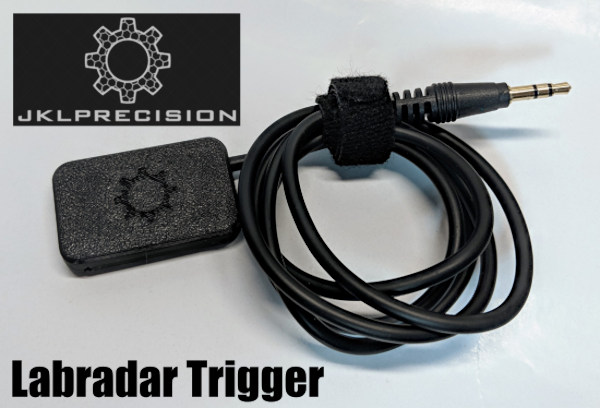
SUMMARY: This article reviews a device that “triggers” the LabRadar chronograph to register bullet speed. Rather than activate by sound or Doppler reading, this $35 JKL Inertial Trigger works from the rifle’s instantaneous recoil pulse when a shot is fired. After some frustration with his LabRadar when shooting at a range with reflective surfaces, our tester is now reporting that 100% of his actual shots are being captured correctly by his LabRadar chrono equipped with the JKL Inertial Trigger. He won’t use his LabRadar without it now. Other users have become instant fans of this inertial LabRadar trigger as well. It is very affordable and it works great. VIEW LARGE PHOTO.
JKL Inertial Trigger for LabRadar Chronograph
Product Review by F Class John
The LabRadar chronograph has been one of the most revolutionary tools in the shooting world because of how it collects velocity data, how it reports (and stores) that data, and, ultimately, the ease with which it can be positioned and operated. However, it’s not a perfect system. A majority of the complaints come from users whose LabRadar’s sometimes fail to record all the shots fired in a string. For the average plinker, this may not be an issue. But for serious shooters trying to do ladder tests or load development requiring all shots to be reported, it can be frustrating when a shot is missed.
Traditionally, LabRadar has recommended trying different settings that compensate for the gap between the unit and muzzle as well as well as having different options for how the unit recognizes a shot fired. While these options work to some degree, they aren’t a guaranteed fix especially when shooting at ranges with concrete baffles or with roofs, walls, and dividers that can alter sound waves. While nobody can precisely explain why shots are lost under certain circumstances, the fact remains it DOES happen. In addition, the default system can sometimes pick up stray shots from nearby rifles.
Not willing to give up on this sophisticated chronograph, many shooters have looked for a foolproof way to prevent such failures from happening. In fact, for this shooter, the frustration was so high that I actually sold my first LabRadar and went back to another chronograph before ultimately buying another LabRadar almost a year later. But I made that repeat purchase only after vowing to finding a way to make the LabRadar work — EVERY time, for EVERY shot.
See How JKL Inertial Trigger Works in this Video
JKL Inertial Trigger — Outstanding Product That Works Great
Enter the JKL Trigger for the LabRadar. This is an easy-to-use, inertial-driven trigger that activates simply from the recoil of your gun. The unit consists of a small rectangular pad attached to a long audio cable. All you do is plug in the audio cable, attach the pad to your gun with the provided hook and loop (Velcro) material. Then (important), you must change the LabRadar trigger settings from “Doppler” to “Trigger”. The unit works great and is easy to set up. In my experience, the unit will activate no matter where you place it on a stock. However the recoil of every gun is slightly different, so you will need to make sure you find a location that doesn’t interfere with your shooting setup.
An unexpected benefit of using the JKL trigger is that it gives you a larger area in which to place your Labradar unit, making it more convenient to setup on benches or range stations. I found this a welcome relief since the LabRadar originally seemed somewhat fussy about where I placed it. Now I can place the LabRadar in more convenient locations — as long as it’s still near my gun and pointed at the target correctly, I get consistent bullet speed data.
Are There Issues with “False Positives”?
If there is any downside to using the JKL Inertial Trigger, it’s that a very hard bump or aggressive working of the action can trigger a false reading. However these are easy to identify in your data, because the speed value is way lower than true fired shot values. Simply remove that low entry or otherwise ignore it in your calculations. To be fair, this “bump activation” really doesn’t happen very often once you get used to using the inertial trigger.
SUMMARY — Outstanding Accessory for LabRadar Users
Bottom line — if you own a LabRadar, then definitely get a JKL Inertial Trigger. Priced at just $35.00 this device is not expensive, yet it’s one of the most effective accessories you can buy for the LabRadar. I’ve recommended these inertial triggers to dozens of shooters. Every one of those guys who did buy a JKL trigger says they can’t imagine using a LabRadar without one. If you love what the LabRadar can do, but have been frustrated with shots not getting recorded 100% of the time, then definitely get yourself a JKL Inertial Trigger. It turns a good system into an amazing system. JKL Industries states that its inertial trigger “will work on anything from a .22 LR to a suppressed system or with standard rifle and brake.”
Emily was just 8 years old when this photo was taken back in 2017. She’s now 11 but still enjoying shooting. Emily has won many awards — including a screamer at 1000 yards — and her accomplishments have not gone unrecognized.
English Emily and Her Record-Breaking 6mmBR Stolle
Report by Vince Bottomley
Turning back the clock a decade or so to 2006 and Accurateshooter’s Gun of the Week #71 you will see my smiling face and my 7mm WSM BAT which had just set a new UK Light Gun record for 1000-yard benchrest with a 5-shot group measuring 2.67 inches. That record has now been broken — sadly not by me but by Emily’s Grandfather with a gun I built for this talented schoolgirl. Here’s the story of the precocious Emily and her record-setting rifle…
In 2006, when I set the record, young Emily Lenton wasn’t even born but, a couple years later she arrived – into the shooting-mad Lenton family. Both father Bruce Lenton and Granddad Tony have represented their Country at European and World Benchrest Championships and it was no surprise to see Emily, at just eight years old in 2017, shooting in her first 1000-yard benchrest competition.
Emily Shoots 6mmBR Heavy Gun at 1000 Yards.
Recoil is always going to be a problem for a very young shooter, so Emily’s first bench-gun was Granddad’s 1000-yard Heavy Gun chambered for the 6mmBR cartridge. It hardly moves when Emily pulls the trigger and she soon became a serious contender. [Emily was 8 when she started, and is now 11 years old.]
Under her father Bruce Lenton’s careful supervision, Emily loads all her own ammunition.
Of course, she wanted her own gun and who better to ask to build it than the current record holder — me of course! Emily chose a Stolle action RBLP as this was to be a 17-lb Light Gun, bedded into a UK-made Joe West laminate stock. The barrel was a heavy-profile 1:8″-twist Krieger chambered in 6mm BR Norma (6BR) with a ‘no-turn’ neck (reamer from Pacific Tool & Gauge) and fitted with a UK Tier One muzzle-brake.
Emily’s Light Gun begins to take shape…
It was down to Granddad to help Emily with load-development and of course, he could also shoot it in competition — after all Emily had just about shot-out Granddad’s Heavy Gun with a full season of rapid-fire 10-shot groups!
Granddad Tony gets ready to shoot Emily’s gun.
Then something happened – Granddad went and broke my ten-year old record with Emily’s gun! Well, I suppose there was some consolation — at least I’d built the record-breaking gun. The new UK Light Gun 1000-yard five-shot record now stands at 2.462 inches. For those who like load details, Emily uses Lapua brass, Vihtavuori N150 powder, CCI 450 primers, and Berger 105 grain VLD bullets loaded with Wilson hand dies.
Tony Lenton with Emily’s gun just after he broke my 1000-yard record. I’m doing my best to smile!
Emily in New Zealand at 2017 World Benchrest Championships Down Under
Emily traveled down under to New Zealand in 2017 with her family. She helped her father and Granddad who were part of the United Kingdom squad competing at the 2017 World Benchrest Shooting Championships in Nelson, NZ.
Vince Bottomley reports: “Emily was a huge hit over in NZ — she was given the honor of hoisting the New Zealand flag at the opening ceremony, she drove the target changer’s buggy, did some impressive shirt-swapping”. Here she is wearing a Team Canada Jersey — a bit big for pint-size Emily.
The folks at Sierra Bullets asked a few staff bulletsmiths a classic question about guns: “If you could own only one firearm which one would you choose?” There were many interesting answers including a “cheater” response — the drilling — which is really two guns in one. The most-often mentioned chambering was the venerable .30-06. Respondents cited its versatility, hunting prowess, and ready availability of ammo. The popular .308 Winchester, as expected, got mentions as did its cousins the .243 Win and 7mm-08. There were quite a few votes for classic lever guns, as well as 12-gauge shotguns. Two bulletsmiths cited the .22 LR, and we can certainly see the logic in that answer. The little rimfire cartridge is versatile, quiet, and inexpensive.
We ask our readers the same question — if you could only have one long gun, what type of firearm would it be? List the gun type and chambering in the comments section.
If You Could Have Just One Long-Gun — ANSWERS:
Media Relations Manager Carroll Pilant answered: “I would NEVER own only one gun. If I HAD to pick one, it would be a drilling in 12 gauge over .30-06.”
Ballistic Technician Rich Machholz answered: “The early tang safety Ruger M77s pretty much have all you could want in a bolt gun, but I do like the Winchester lever guns and the combination guns, particularly the drillings. Since I have the first two, I’m going for a Doug Turnbull 1886 or a side by side 20 gauge over .223 drilling.”
Ballistic Technician Philip Mahin answered: “More than likely it would have to be a bolt action .30-06. The reliability is legendary on a wide range of game animals and factory ammunition has still been available at my local stores even in these tough times.”
Ballistic Technician Duane Siercks answered: “If I had to boil it all down to one gun, it would probably be a .30-06. I have a Remington 700C (custom shop gun) that has worked very well for anything and everything I have ever wanted to do with it.”
Ballistic Technician Paul Box answered: “A .22 Rimfire.”
Chief Ballistician Tommy Todd answered: “Remington 700 in .308 Winchester.”
VP – Sales & Marketing Matt Reams answered: “A light weight Kimber in 25-06.”
Production Toolsetter Brad Vansell answered: “Savage weather warrior 7mm-08 is my rifle of choice.”
Production Toolsetter Dan Mahnken answered: “The .308 Winchester rifle — [based on the] wide range of bullets made and the wide range of things that one can hunt with it.”
Process Engineer David Palm answered: “Savage action 243 Winchester.”
Ballistic Technician Gary Prisendorf answered: “Probably a .22 LR. It may not be the best choice, but you could use it for about anything if you really had to.”
Production Manager Chris Hatfield answered: “Beretta A300 Outlander 12 gauge.”
U.S. Olympic shooter Eric Uptagrafft in prone position, LARRC 2012. CC photo by Tony Chow.
Eley sponsors many of the world’s top rimfire shooters, who have shared their Tips from the Top. Five ace smallbore shooters provide advice on how to shoot better, how to train more effectively, and how to stay motivated even when “the going gets tough”. If you’re a competitive shooter (in any discipline) you can benefit from reading these words of wisdom from world-class shooters.
Henri Junghaenel, Past #1 ranked, 50M prone rifle shooter.
Focus on Fundamentals: Good performance requires a solid technical foundation. One can hunt after personal bests or one can try to work on the technical basics. The latter will probably lead to better results sooner.
Stay Motivated Over Time: Be persistent and don’t lose your motivation on your way to success. Shooting, like every other sport, requires a learning process which takes a lot of time.
Don’t Yield to Outside Pressures: Don’t let the expectations from others impact yourself. If some people try to put pressure on you (consciously or unconsciously), don’t let them!
Bill Collaros, 2013 Australian WRABF World Cup (Benchrest) and RBA team captain.
Don’t Skimp on Hardware: Ensure your equipment is a good as you can buy. This includes: rests, bags, rifle, scope, and ammunition.
Tune to Your Ammo: Ensure that the ammunition you have is tested and your rifle is tuned to it, to get the smallest possible group.
Train in All Conditions: Train in all sorts of wind and conditions so you know how your rifle and ammunition react in all circumstances.
Stine Nielsen, 2012 Olympic finalist for 3-Position Smallbore Rifle.
No Excuses: When I train, I train by my motto: “A loser has excuses. A winner has a plan.” And when I shoot in competitions I think about that mantra.
Stay Focused: When I stand at a shooting range, I have a good focus on my shooting and myself. I also have a good will to want to shoot 110%.
Zorana Arunovic, Past world #2 ranked, 25M women’s pistol shooter.
Never give up: No matter how hard it is you should always find something that will inspire you to keep going further. I find my inspiration in the success of other athletes. They inspire me to work more and harder. I would say to any young athletes, never give up, no matter how hard it is.
João Costa, Past world #2 ranked, 50m pistol shooter.
Breathing is Key: In shooting as in life, breathing is of paramount importance. So, when shooting try to be calm and quiet. On the bench in front of me I have my pistol, the scope, the magazine and my choice ammo then I count:
Leveling your scope can be a time-consuming and tedious process. The Fix It Sticks folks have changed that with the introduction of the Scope Jack. This simple unit levels a scope through contact with the flat on the bottom of the scope (opposite the elevation knob). You can do this quickly, with one hand, leaving the other free to tighten your rings once the scope is aligned. This really is a clever, effective, easy-to-use tool, as you can see in this video:
You attach the Scope Jack to the Picatinny rail on your rifle, then lossen the rings so the scope can rotate. Then simply elevate the Scope Jack with a quick twist, using a 1/4″ driver. The Scope Jack’s horizontal roller will contact the scope’s bottom flat, rotating the scope it into proper alignment, square to the rail.
Operating Instructions from Manufacturer Fix It Sticks
The Scope Jack works with any 1/4 inch driver to quickly and easily level your scope to your rail. Just mount the scope jack to the pic rail under your scope and turn the drive handle until the lifting arm engages with the flat section under your turrets. Once the scope is level, maintain pressure while tightening your ring screws to keep optic level throughout the process.
Requirements:
1. Scope much have a central flat section under turrets
2. Needs a minimum of 1/4″ clearance between rail and scope
3. Picatinny Rail must be accessible under optic
TECH TIP: You Still Must Check the Reticle Orientation INSIDE Your Scope
The Scope Jack works fast, but it is NOT the “final solution”. Why? Some scopes have a reticle that is not perfectly aligned with the turrets and/or bottom flat. We have seen scopes with vertical reticle line off as much as three degrees (3 °) from true plumb. With such a scope, you CAN set the reticle square, but then your turrets will be canted relative to the receiver. That creates issues when shooting at long range. Accordingly, if your scope has a badly canted reticle, you should send it back to the manufacture for warranty repair. Three degrees may not sound like much, but it is actually quite noticeable:
For all scopes, AFTER using the Scope Jack, we recommend you test your reticle with a plumb line. You can hang this line from a door or ceiling fixture with a weight on the bottom. Important — when using a plumb line make sure your rifle is 100% level or your results may be off. We recommend using a bubble level to help align your rifle properly.
Here’s a feel-good story about two young people excelling in the shooting sports. We can use this kind of positive message in these times, when shooting ranges have been closed and major matches have been cancelled. It’s good to see two very talented young ladies making their mark in the shooting sports.
Colt’s Manufacturing Company (Colt) has signed two talented young ladies to the Colt professional shooting team – Jalise Williams and Justine Williams. This talented twosome will now represent Colt at shooting competitions and industry events. Jalise and Justine bring exceptional young talent to the sport. Justine is a USPSA Production Grand Master and Jalise is a Single Stack Master — that means these young ladies, even as high schoolers, rank among the top USPSA shooters. Both ladies continue into 2020 with full competition schedules, including Safariland Single Stack Classic Nationals, IPSC Nationals, and IPSC World Shoot XIX in Pattaya, Thailand.
Before Joining Team Colt, the Williams Sisters Shot for Team Springfield
Jalise Williams, 17, competes in USPSA, IPSC, 3-Gun, and Steel Challenge. At the young age of 15, Jalise became the youngest Single Stack Lady National Champion in USPSA history at the age of 15. She now holds more than 100 titles. Her 2019 titles include:
Limited Lady National Champion
Single Stack Lady National Champion
L-10 Lady National Champion
L-10 A-Class National Champion
IPSC Classic Lady National Champion
“My whole world revolves around my love for the shooting sports”, said Jalise. “Colt is a legendary company and I never imagined that I would have the opportunity to represent the brand. I am beyond excited…”
Justine Williams, 15, has competed in a variety of shooting disciplines for six years. At age 13 she became the youngest-ever Production Grandmaster and at age 15 earned the PCC Grandmaster title. The first and only female to become a two-time USPSA Grandmaster, Jusine won FIVE national titles in 2019:
USPSA High Lady in the Open, Carry Optics, and Productions Divisions
USPSA High Junior National Production Champion
IPSC High Lady Production Division
Interview with the Williams Sisters
Want to learn more about the Jalise and Justine Williams? Follow the girls on their Facebook Page. There’s also a great interview with the two young talents on GunGoddess.com.
Q: When was the first time you shot a gun, who taught you and why?
Jalise was 4 and Justine was 3 when we shot our very first gun. The gun was a .357 Marlin because our parents didn’t own any .22s. My dad is a big hunter and wanted us to learn how to hunt and shoot. Our dad taught us how to shoot shotguns and rifles.
Q: What drew you to competition and what do you like best about it?
We have always been thrill seekers. We look for the biggest adrenaline hype we can find. We love to find the biggest roller coasters or scary ride we can find. We participated in swimming, gymnastics, dance, and got our black belts in Karate. But when we started shooting, it was unlike anything we had done before.
We love the rush the timer gives you. The way you move through a stage like a dance or a form in karate. The way you have to be precise like hunting. It is so different and so interesting that we can’t stop! The people are also great — they are the nicest people you will meet.
And the girls keep on winning — Jalise Williams recently took home the High Lady and High Junior titles at the Western States Single Stack Championship. Justine Williams recently shot the Mesquite Mayhem Steel Challenge Match, taking home the 1st Overall Match title and 1st Overall PCC title.
Report by Jay Christopherson
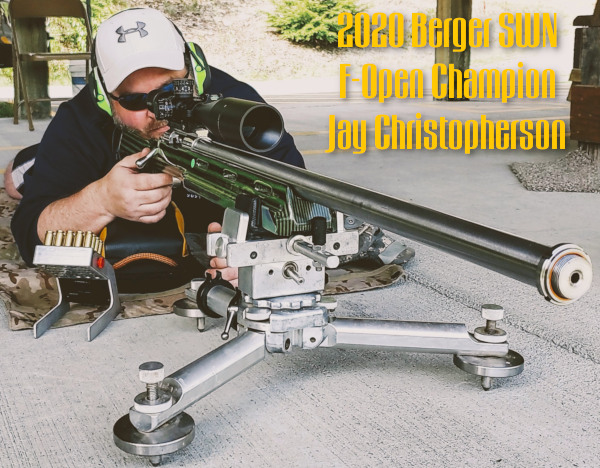
2020 Berger SW Nationals F-Open Champion Team Member, Team Lapua-Brux-Borden
I’ve been shooting F-Class for about 9 years now. In fact, I shot my very first match, a 600-yard mid-range match, using a 6mm Dasher, on March 19, 2011. My first relay was a 188-4X and my overall score was 582-19X. I remember shooting a really nice group in the 9-ring, because I dialed the scope the wrong way and I shot lots of “verification” shots before making adjustments. I also remember wondering if that was a good score for that range in those mostly calm conditions (it wasn’t). I’ve tracked every match I’ve ever shot and I’ve come a long way since then. I’ve always been a competitive person and F-Class gave me an outlet to indulge both my competitiveness and my fondness for details. In what other individual sport does a thousandth of an inch (or less!) become important? Or a tenth of a grain?
Some of my greatest pleasures in this sport come not necessarily from winning a match (though I won’t turn that down), but in identifying something small in what I am doing that has a material effect on paper. Maybe it’s a tiny change in seating depth. Maybe it’s a slightly modified strategy for making wind calls. Maybe it’s a tiny position or hold change. Whatever it is, when it works, there’s no better feeling.
I have a full-time job to go with this hobby, so finding the time for productive training is difficult. You have to really plan ahead to maximize the time you spend reloading, developing loads, and training at the range. To that end, I invest a lot of time in reducing the things that I do at the loading bench. I load ammo on a progressive press, though modified to produce ammo to my standards. I don’t clean brass. I don’t do a lot of things that most shooters would call traditional in the loading room. Because frankly, I don’t have the time between family, work, and other interests.
If it doesn’t make a difference on paper, I mostly don’t do it. Still, there are one or two loading habits I’m trying to get rid of. I also pre-seat all my ammo for matches — whatever I show up at the match with, is what I have. I don’t clean my rifle between days at the match. I had well over 200 rounds without cleaning by the time the last shot was fired at the 2020 SWN. It took a lot of time for me to get comfortable with that. That works for what I do, but I wouldn’t dare try it with any other loads or rifles, at least, not without a lot of testing to be comfortable. My original 6MM Dasher shooting Reloder 15 couldn’t go that many rounds without cleaning and building up a carbon ring. Unfortunately, I learned a tough lesson on that one my first year.
I do all my own gunsmithing, including chambering, bedding, and stock work. I’m no Keith Weil, Alex Wheeler, or some of those other guys, but I feel pretty good about the work I do. I know that when there’s a mistake or imperfection, it’s MY mistake and I can live with that. I like to keep things as minimal as possible, so I shoot off a SEB Mini (no mods) and SEB rear bag.
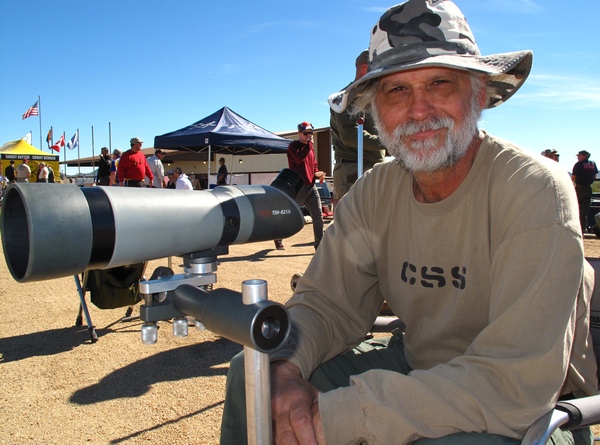
I also shoot with a spotting scope at Long Range, using a Kowa TSN-663 with 25X LER eyepiece and a relatively new spotting scope stand by Rod Brakhage who is a fine F-Class shooter himself. I really like how smooth and adjustable it is on the ground compared to some other rigs I’ve used.
The 284 Wheeler — Slightly Modified .284 Win
This year at the SWN, I shot a 284 Wheeler, which is a straight .284 Win that has some small modifications designed by Alex Wheeler. I think that the work and experimentation that Alex does with reamer design really shows up on paper. In 2019 I was testing the reamer in a couple barrels, looking for the right load. I shot some great relays and team practices with it that year, but this was the first time I brought enough ammo to shoot the entire week with it. Coupled with Berger’s 7MM 180 grain Hybrid Target bullets which I point to increase BC consistency, and Lapua brass, it’s an effective combination. In particular, the brass has lasted me for 13 firings with no signs of fatigue, so I expect I’ll be able to use it at Worlds in 2021 and beyond.
I also shot the entire 2020 SWN with a Vortex Golden Eagle 15-60x52mm scope, my preferred scope for individual matches. It’s a rock-solid reliable scope in my experience, with a great eye box, reliable and repeatable mechanical controls. The Vortex ECR-1 reticle has quickly become my favorite reticle. All four of my Open rifles are built on Borden BRMXD actions, Brux barrels, and sitting in X-Ring F-Open stocks, which are Robertson clones (more on that below). I’ve tried to make each of my rifles as much of an identical clone as possible.
I am not sponsored by anyone as an individual shooter, only through team sponsorship with Lapua-Brux-Borden. Which means that for individual matches, I am free to use what I think gives me the best opportunity to win for individual matches. In practice, the only difference tends to be the scope that I use, as mentioned above.
Jay Christopherson F-Open Rifle Specifications:
Cartridge: 284 Wheeler (variant of .284 Winchester)
Optics: Vortex Golden Eagle 15-60x52mm
Stock: X-Ring F-Open Stock with R.A.D.
Barrel: Brux 1:9″-twist, 32″-long barrel
Action: Borden BRMXD action
Trigger: Flavio Fare
Q: What was your biggest challenge at the 2020 Berger SWN?
Jay: The biggest challenge for me at this year’s SWN was purely mental. At past SWN matches where I had done well, I was trying to focus on not thinking about the different things going on around me. Where I was ranked on the score sheet. How well other shooters were doing. How many points or Xs I was ahead (or behind). Being worried about conditions or whether my ammo would hold up. And so on. And sooner or later, I think those things break your focus.
Going into a relay calculating the points or Xs that you can’t afford to drop is a recipe for losing. It’s like trying NOT to picture a pink elephant with purple dots when somebody challenges you try to not think of a pink elephant with purple dots. In previous SWN events, I came up just short three times in a row, for one reason or another. So, in 2020 I went in with a mental game plan.
Mental Game Plan — Envisioning Success
I pictured what it would take to be successful and what winning would feel like. First relays, then days, and then the match. I started that process months before the match actually happened. I thought about who I was shooting against and how much pressure there was to make every shot count. I thought about how I had performed or reacted in similar situations in the past. And I planned out what I would do and how I would handle those things. I strived to be neither negative nor positive — I wanted to be neutral. I wanted to be ready to win, instead of being surprised by it.
Q: What gear/hardware items give you an edge over the competition?
Jay: There’s no single piece of gear that I can think of that gives someone an edge over somebody else. It all sort of works — it’s more about being consistent with whatever hardware you have. But one piece of new gear that I tried out at the SWN was a single-piece scope mount called the Alphamount (photo below), by Richard Near of NEAR Manufacturing.
I think scope mounts are the most overlooked piece of equipment in F-Class right now — whether they be improperly aligned, improperly torqued, or just plain junk. I think people put a lot of blame on their scopes that can be traced back to mounts. The Alphamount (and single-piece mounts in general) are something that I believe in now, having done a lot of testing. It worked out OK for me at the SWN.
Action for Back-Up Rifle Is Glued and Screwed into Stock
One of the new things I am trying this year is a “glue and screw” action set-up. At the 2019 US F-Class Nationals in Raton, we got rained on a little and when I pulled my rifle apart, I found water between the bedding and action (the bedding is about 2 years old). At the SWN, I found that something had moved enough that I could torque the front action screw and bind the bolt. Not good, but luckily this was my backup rifle that I shot for Mid-Range (badly) and not my lead rifle. There could have been stock movement or other factors as well, but there was no question the bedding had shrunk when I stuck a dial indicator on it and found that my pillars were now standing proud.
Some people had been goading me to try a “glue-and-screw” procedure. Since I had nothing better to do during the COVID-19 lockdown, I pulled out the Dremel, scuffed up the action and bedding, removed the recoil lug, and glued the action into the stock. I’ve had it out a couple times since and it seems to be shooting well, but we’ll see how it holds up and what sort of difference it might make as time goes on.
Q: What is your advice to newcomers in F-Class and Long Range competition?
Jay: Find a nemesis. Someone local who puts in the same effort that you do and is as competitive as you are. Be friends, share info, but work your behind off to make sure you win on match day. I guarantee you someone reading this knows what I’m talking about. The best thing you can do is have someone who pushes you to perform better each time out. You love to win against them, but not as much as you hate to lose to them.
Q: What do you like most about Long Range and F-Class competition?
Jay: I like the challenge of F-Class — it’s a nice blend of working to get the most out of your equipment and the most out of yourself as a shooter. You can have the greatest shooting rifle in the world and it won’t matter a bit if you can’t be consistent pulling the trigger or making good wind calls. By the same token, you can be the greatest wind caller and most consistent trigger puller in the world — but it won’t matter a bit if you can’t wring the best possible performance out of your rifle for that tiny little target at 1000 yards. I like Long Range because everything is magnified — there are rarely easy shots.
Q: What do you prefer, individual events or team matches?
Jay: Team matches. No contest. Most of the reason I travel to matches is for the team events. But just throwing together a team of great individual shooters is not enough to consistently win. You have to operate as a team, which at times means subsuming your own individual goals for the good of the team. I’ve gone into big matches knowing that my team rifle is my best rifle by a mile — but knowing that the best thing for the team’s current and future success is for me to not burn that barrel out (or burning up known good components) in the individual events. And that’s fine with me. Being part of a team of shooters with the same goal, with the same drive, the same focus on team rather than individual — and able to deliver the goods — that’s the reason why I do this.
Q: What kind of stock do you use and how does it behave?
Jay: I use an X-Ring Open stock, which is basically a Robertson clone. I’ve been using X-Ring for about 4 years now. I’ve been through a lot of different stocks to find the one that fits me and the way I like to shoot, and X-Ring has done that for me. There’s a lot of focus recently on lowering the center of gravity and extending the stock length through various methods to solve problems like torque, jump, etc. — those are just problems that I don’t experience or, at least, that don’t bother me while I’m shooting. So, I don’t tend to worry about them. The X-Ring fits nicely and runs very well in the bags that I use. I do think that you have to spend some time finding the right bag setup for the stock you are using. I have at least 9 different rear bags that I have tested at one time or another until I settled on my current bag.
Q: Do you have any specific Gun Handling Tips for F-Open shooters?
Jay: As for gun handling, I prefer a light hold — my cheek indexes off the stock with a very light touch and my trigger hand indexes off the stock also with a light touch so that I have a consistent trigger finger position. What I do is in the style of “free recoil”, but is NOT fully “free recoil”, since I DO lightly touch the stock. For the butt, I run the R.A.D. recoil reducer at its lowest setting, which means that I can barely touch off for indexing purposes and still not interrupt the recoil pulse because the R.A.D. absorbs it. This was a suggestion that Will McCloskey made to me a couple years ago in place of leaving space.
This video, from a past Berger SWN, illustrates Jay Christopherson’s shooting style. He employs a very light touch on the gun. The front rest is a SEB Mini. If this Facebook video doesn’t load,CLICK HERE.
My hold for F-Class has evolved over time into what it is now. There are lots of successful shooters that are using varying degrees of holds, from light to hard. Again, It all sort of works — the most important part is that whatever you do is consistent and repeatable, hence my touch points that ensure my head, shoulder, and trigger finger are in the same position every time. There are shooters out there that will rant about “the fundamentals of shooting” and insist that your legs have to be a certain way, your cheek has to be a certain way, your breathing has to be done a certain way. I’m sure that’s valid for what they do and I’m fine with them looking down on me for it, but I do what produces results for me. For certain, my position and hold when shooting sling is completely different. All it means is that you have to be prepared to adapt.
PARTING SHOT — Have Guns, Will Travel
Here is one of Jay’s other F-Open Rifles. When traveling he separates the stock from the barreled action. He uses a custom-cut foam piece that holds the components very securely. Note the separate slots for barreled action, stock, scope (in rings), bolt assembly, and spotting scope.
In an unprecedented move, the central government of Canada, without parliamentary vote or debate, has banned a vast number of rifles, including most modern mag-fed, semi-auto rifles currently for sale. This action banning the firearms was done by Prime Minister Justin Trudeau via “Order-in-Council”, with no political debate and no vote of elected representatives. It was essentially an Executive action, rule by fiat, like a decree issued by a dictator.
Starting now, around 1,500 models of long-arms have become illegal to sell, transport, import or use in the Canada, according to CBC News.
“The government implemented the ban immediately, and without the need for legislation in Parliament, by reclassifying about 1,500 firearm models as prohibited. In the meantime, a two-year amnesty is now in effect for Canadians who own the banned firearms and government officials said gun owners will also have the option to be ‘grandfathered’ in with weapons they currently own, although no details were available for that program yet”. Source: NationalPost.com
Nova Scotia Killer Posed as Police Officer
This action came in response to the Nova Scotia killings by a madman, Gabriel Wortman, who dressed in a police uniform and used vehicles with law enforcement markings and lightbars. Wortman was NOT licensed to possess his weapons and had obtained his firearms illegally. According to Global News: “During the shooting, the gunman was traveling in a replica police vehicle and wearing an authentic police uniform.”
Canadian Investigators said Gabriel Wortman had several semi-automatic handguns and at least two semi-auto rifles, which may have been AR-type rifles, but we are not certain about the exact configurations of Wortman’s long guns. Notably, most if not all of Wortman’s guns were already ILLEGAL for Wortman to own under existing Canadian laws. The crazed shooter had violated multiple firearms laws already on the books, and did NOT possess his weapons legally (it is believed he sourced them from outside Canada). AR-type rifles required a special permit in Canada. And of course he violated multiple laws in impersonating a law enforcement officer.
Trudeau Exploits Nova Scotia Shooting to Ban Guns without Normal Legislation
Prime Minister Trudeau used the Nova Scotia mass killing as the impetus to fulfill his campaign promises to ban so-called “assault-type” weapons. Seven months ago, Trudeau pledged to ban modern semi-auto rifles, which he called “assault rifles”. Trudeau opportunistically leveraged the mass shooting to execute his plan with no public debate and no vote by elected officials.
Trudeau’s actions were criticized by many in Canada. Conservative Leader Andrew Scheer declared: “Taking firearms away from law-abiding citizens does nothing to stop dangerous criminals who obtain their guns illegally”. Alberta Premier Jason Kenney stated: “Today’s order does little to target criminals … instead, Ottawa is singling out law-abiding gun Canadians who purchased their property legally”. And Alison de Groot, Director of the Canadian Sporting Arms and Ammunition Association, said Trudeau’s gun ban “will strand somewhere between $200 to $300 million worth of pre-paid merchandise in stores”. READ MORE.
Q: Would a Ban on Semi-Auto Rifles Have Prevented the Nova Scotia Tragedy?
A: No. The killer Gabriel Wortman also used pistols, and could have been just as deadly with a pump shotgun. And nine of the 22 killed “died in house fires” set by Wortman. (Source: RCMP per Reuters.) Remember that fact — 40% of the victims were burned to death: “Of the 22 people killed, 13 were shot and nine died in house fires.” Source: CNN.com.
The real reason for the high kill count was that Gabriel Wortman was an insane maniac wearing a police uniform and driving a police car. The important questions to ask are how did he get the uniform and why were vehicles sold complete with police markings?
Terms of Canada’s Broad New Gun Ban
Under the Canadian gun ban, owners of prohibited firearms now have two years to turn in their rifles. According to CTV News: “Owners will also have the ability to be compensated through a buyback program, though the details of these options have yet to be outlined. Gun owners must be in compliance with the law by April 2022. Those who have not disposed of any banned firearms by that time may face sanctions under the Criminal Code.”
Was Trudeau’s massive gun ban necessary? Consider this comment from a Canadian gun owner: “Handguns and AR15s in Canada [were] highly regulated already. To get the license you go through a 2-day course. There was a 3- to 6-month wait for your application. Spouse must sign. No history of metal disorders. [Authorities conduct] phone interviews with credible people who know you. When you get your licence you must join a shooting club[.] Now you have your restricted license … and a government issued travel licence.”
Here is a list of all the firearms that have been banned (without Parliamentary vote) by Trudeau’s government. This includes AR15-platform rifle, AR10 rifles, Ruger Mini-14s, Semi-Auto M14-type rifles, and many other varients. Some big bolt-action guns will banned as well. ELR Researcher notes: “Read down to section 96: ‘Any firearm capable of discharging a projectile with a muzzle energy greater than 10,000 joules[.]’. Well 10,000 joules is 7375 foot-pounds, meaning [this would ban] ALL firearms chambered for most commercially-available .408 CheyTac, .416 Barrett, and .50 BMG ammo.”
Use the scoll bar (on right) to move through the list of prohibited firearms.







 I do all my own gunsmithing, including chambering, bedding, and stock work. I’m no Keith Weil, Alex Wheeler, or some of those other guys, but I feel pretty good about the work I do. I know that when there’s a mistake or imperfection, it’s MY mistake and I can live with that. I like to keep things as minimal as possible, so I shoot off a SEB Mini (no mods) and SEB rear bag.


