The mainstream media (CNN, MSNBC, CBS, ABC, the N.Y. Times, etc.) loudly report that the USA is experiencing a tidal wave of gun-related killing and violence. From the barrage of anti-gun stories in the news media, you’d think that deaths caused by firearms (especially those fearsome “Assault Rifles”) are increasing dramatically.
In fact, the truth is just the opposite — overall violent crime is declining, and firearm-related gun violence has DECREASED significantly. We are NOT seeing more murders-by-gun than ever before. In fact, “Homicides with firearms were down 7% from 2017″. Read on to get some REAL facts…
VIOLENT CRIME CONTINUES TO TREND DOWNWARD
Report by Elizabeth McGuigan for NSSF.org
The FBI has released its crime data for 2018 and the news is good. Violent crime dropped 3.3% in 2018 compared to 2017. According to the report, a decrease was seen across nearly every type of violent crime.
Looking at a 10-year trend, the numbers of violent crimes were down a full 9% from 2009 through 2018. The rate shows a more dramatic drop: “There were an estimated 368.9 violent crimes per 100,000 inhabitants in 2018, a rate that fell 3.9 percent when compared with the 2017 estimated violent crime rate and dropped 14.6 percent from the 2009 estimate.” (Source: FBI Report)
Homicides with firearms were down 7% from 2017. And in stark contrast to the theatrics of last week’s House Judiciary Committee hearing on banning modern sporting rifles, rifles were again only used in 2% of homicides, far less than the share committed with knives (11%) or hands and feet (5%).
Modern Sporting Rifle Ownership is UP… And Violent Crime is Down
This chart says it all. Through 2016, there have been over 16 million modern sporting rifles in the hands of law-abiding citizens. Meanwhile, violent crime is declining. The message is clear. Tragic criminal actions must be addressed. Banning certain types of firearms is not the answer.
Real Solutions from the NSSF
The firearms and ammunition industry shares the goal of finding the root causes of criminal violence and has created programs over the years to help address safety practices and problems of unauthorized access. The firearms and ammunition industry prides itself on high rates of compliance and on our voluntary programs, often in partnership with local, state and federal government agencies, to help curtail the actual problems of guns illegally getting into the wrong hands.
We work to make sure states are submitting all prohibiting records to NICS. We provide millions of free gun locks and educational materials in all states. We train our members to spot straw purchasers, to comply with all laws, and to use discretion when making transactions and keeping their inventory secure.
ARs in PRS? Yes PRS has a “Gas Gun” division. And frankly, shooting a PRS match is one of the most fun and challenging things you can do with your Black Rifle (Beto O’Rourke notwithstanding). Since the early days of the PRS, Gas Gun shooters have wanted to play. Recognizing the interest among semi-auto shooters, the PRS now offers a Gas Gun Series for semi-auto rifles such as AR15s and AR10s. The Gas Gun Series started in 2017, and has quickly become quite popular.
Photo Credit Michael Cage.
Gas Guns to 800 yards — Yes there are targets down there somewhere.
PRS Gas Gun Series Rules
For the new PRS “Gasser” Competition, the PRS developed rules on gun types, scoring, match timing, penalties, safety and other key topics. CLICK HERE for Full PRS Gas Gun Series Rules.
Open Division: Open Division rifles will not exceed a caliber of .30 or a velocity of 3,200fps. A match DQ will result any rounds over the speed limit of 3,200 fps (+/- 32 fps for environmental factors and equipment discrepancies). Match Officials may request at any point during a match that a competitor fire their rifle through chronograph. If the bullet exceeds the 3,200 fps speed limit, the shooter will receive an automatic match DQ. [“For Ammo in Open Class, 6mm and 6.5mm Creedmoor are popular.” — John Parker, SSUSA]
Tactical Division: Tactical Division: Intended to allow competitors the opportunity tocompete using traditional military and law enforcement caliber. This promotesActive Duty military and law enforcement competitors use of their Service and Department issued rifles. Tactical Light Division rifles are restricted to 5.56 NATO/.223 Remington and 7.62 NATO/.308 Winchester calibers only. .223 Bullet weight cannot exceed 77 grains and muzzle velocity cannot exceed 3,000 fps, .308 bullet weight cannot exceed 178 grains and muzzle velocity cannot exceed 2,800 fps. No modified wildcat rounds permitted to shoot in the Tactical Divisions. Tactical Division shooters will shoot the exact same COF as Open Division shooters. [NOTE: This division now replaces the previous Tactical Light and Tactical Heavy divisions.]
Scoring and Penalties
The Gas Gun Series utilizes a time plus penalty based scoring system for all match scoring. This means your score is your total combined time on all stages plus any penalties you may have accrued.
Stage Course of Fire and Targets
No more than 50% of the stages at a match can utilize an unlimited round count. At least 25% of the targets in Gas Gun Series match must be 2 MOA or smaller. Maximum distance is 800 yards.
The preferred rifle color choice at the first PRS “Gasser” Match was definitely black…
Gas Gun Match Loads — Short Range vs. Long Range
“The .223/5.56 [Tactical Light] guns had some lag time waiting on shot impacts. I believe the long-term solution may be to find a light and fast load for closer stages for near-instant reaction time and use a heavy load for the long shots to see splash and get the target to move a little more.” — Sean Murphy, Nightforce
Gear Options for PRS Gas Guns
There are many buttstock options for ARs. For the PRS game, we like the Magpul PRS stock. This features a quick-adjustable cheek-piece and butt-plate — allowing you to easily adapt head position and LOP for your discipline of the day. (You may want a different LOP for prone shooting vs. bench shooting). The Magpul stock works well in a rear bag.
We recommend something like the Blackhawk grip which is more comfortable than the typical grips supplied by most black rifle makers. Up front, you’ll want a handguard with adaptability. Shown is a handguard with Picatinny rails on top and on both sides, affording lots of options. We might move one of the rails to the bottom, however, so it could be used for a bipod mount.
Add Your Favorite Premium Barrel:
PRS with a Gas Gun — Gavin Gear’s Experience
Thinking of trying out the Precision Rifle Series, starting off with a gas gun? Well Gavin Gear of UltimateReloader.com did just that, competing in his first-ever PRS match up in Washington State. With its timed stages (some just 90 seconds long), Gavin learned that PRS is about speed as well as accuracy. As a PRS newbie, Gavin found the competition fun but challenging. Gavin’s account of his experiences, set forth in two articles with accompanying videos, will help other novice PRS competitors prepare for PRS-type matches and assemble the right equipment.
This video has cool Aerial Drone footage, and in-depth explanation of stages:
Gavin enjoyed his first match: “Overall, the match was more fun and more laid back than I thought it would be. The guys in our squad were all really helpful, and even loaned me gear to try out when they noticed my gear wasn’t right for a particular shooting activity. One such case was when Ken Gustafson (of KYL Gear) offered to loan me one of the bags he had made. Below you can see me shooting off the infamous unstable tippy tank trap with a KYL Gear bag, and I’ll have to say [the bag] was amazing. It helped me lock down my rifle and get on target. What a great feeling!”
How fast can you shoot a bolt-action rifle? We doubt you can out-pace the ace “Stangskyting” shooters from Scandinavia. Some of these guys can run more than two rounds per second, including mag changes! That’s impressive. Bulletin reader C. Lemmermann from Denmark told us: “In Scandinavia we have this competition called ‘Stangskyting’. It’s similar to the ‘Mad Minute’ but we only have 25 seconds to hit the target [at] 200-300m distance with a 6.5×55 [target rifle].” In the Stangskyting video below a shooter named Børklop puts 16 rounds on target in just 25 seconds. (He starts with a round in the chamber and cycles through three, 5-round magazines).
Børklop’s performance, with just a sling and iron sights, is impressive. He’s shooting a Sauer 200 STR target rifle with 5-round magazine. Note that Børklop manipulates the Sauer’s bolt with his thumb and index finger, while pulling the trigger with his middle finger. As good as Børklop is, some Stangskyting competitors are even better. Roy Arne Syversrud from Oslo, Norway tells us: “The best shooters in Norway can do 21 shots in 25 seconds, changing the mag three times.”
Here’s another Stangskyting video. Check out the speed with which John Olav Ågotnes works that action — simply amazing!
This Guy Could Break the “Mad Minute” Record
Børklop’s rate of fire, 16 rounds in 25 seconds, is the equivalent of 38.4 rounds in 60 seconds. That’s a notable number because the record for the “Mad Minute”, a British Army marksmanship drill, is 38 rounds in one minute. That record was set in 1914 by Sergeant Instructor Alfred Snoxall, and still stands. So as you watch Børklop, keep in mind that Snoxall shot that fast for a full minute with a Lee-Enfield nearly 100 years ago!
Børklop has an average cycling time of 1.56 seconds per shot, starting with a round in the chamber. To beat the record of 38 rounds, he would need to make seven mag changes in sixty seconds. All those mag swaps could reduce his average time per shot, making it difficult to achieve 38 hits in a minute. But, if Børklop could use 10-round mags with his Sauer STR, this guy has the skills to break the record.
To emphasize the capabilities of the WWI-era British shooter who set the record, Snoxall shot as fast as Børklop does, but Snoxall reloaded with stripper clips. Snoxall’s SMLE (Lee-Enfield) rifle also had relatively crude open sights and the stock was far less ergonomic than Børklop’s Sauer STR stock.
Here’s another Stangskyting video showing John Ågotnes shooting rapidfire with his Sauer 200 STR (Scandinavian Target Rifle) chambered in 6.5×55. By our count, Ågotnes manages 17 shots within the 25-second time period. That rate of fire (17 in 25 seconds) equates to 40.8 rounds in one minute!
Could your gun club or youth shooting group use money to upgrade range facilities or run training programs? Well here’s a chance to get some cold, hard cash to help with operations. Every year, the NRA Foundation Grant Program provides hundreds of grants to deserving organizations. The 2020 Grant Application is now available. CLICK HERE to Apply for a Grant.
Since its inception, the NRA Foundation has funded over 40,000 grants totaling over $368 million. Grants went to qualified local, state and national shooting sports programs, hunting and conservation programs, Second Amendment education and for the preservation of historical firearms.
Grant money comes from generous donors and volunteer fund-raising efforts. Through its Grant Program the NRA Foundation seeks to: 1) Promote shooting sports and hunting safety; 2) Help educate individuals in proper firearms use and marksmanship; and 3) Enhance shooting range facilities and support active shooting sports organizations.
Range Improvement Grants
Helping clubs improve shooting range facilities is one of the main missions of the NRA Grant Program. Such programs might include: Berm improvements (example below), Clubhouse improvements, Target pits, Covered firing lines, Road improvements, Trap Machines, Storage buildings and other permanent improvements to club properties and/or facilities.
It’s not often when a gun accessory designer/builder shoots a high-level international competition and finishes on the podium. Well Sebastian (“Seb”) Lambang did just that recently, earning the Silver Medal for finishing second overall (F-TR) at the West Australian Rifle Association (WARA) Queens Prize Meeting at the Pinjar Range in Western Australia. Seb shot in F-TR division, piloting a handsome new .308 Win rifle supplied by Seb’s Aussie friend Jason Mayers, the F-TR Match winner. Here is Seb’s account of his visit to Perth, Australia to shoot the WARA Queens Match. SEE Match Results HERE.
WARA Queens Prize Meeting in Western Australia Report by Sebastian (“Seb”) Lambang
My wife Lily and I arrived in Perth, Australia, on September 23, two days before the competition began. At first, I wanted to attend the Australian Nationals in Brisbane which I have participated in before. I thought that would be bigger and more exciting than the WARA Queens. However, I received a recommendation from Jason Mayers to participate in the Queens instead. I was told that more shooters would come to this match because there would be a State team match and pre-qualification for the World Championship.
About the Pinjar Shooting Range in Perth, Australia
The Pinjar shooting range near Perth (on Australia’s West Coast) is excellent both in its facilities and management. Ranging from ample parking space, clean toilets, spacious hall and canteen, wailing walls, water reservoir, very nice electronic targets etc, they have it all. It even offers a special preparation area for fouling shots on the far right side of the range.
The Target boards downrange are at 300, 400, 500, 600, 700, 800, 900 meters from right to left. One interesting thing about Pinjar is that all the firing stations are along the same horizontal track. Shooters only need to move sideways to change the shooting distance — e.g. from 300 to 500 or from 600 to 800.
Twin Rifles for Seb and F-TR Match Winner Jason Mayers
My rifle is one of the two identical builds put together by Jason Mayers with the help of some local gunsmiths and shooters. This rifle, loaded with moly-coated Berger 200gr Hybrids, shot like a laser.
Both Seb and F-TR match winner Jason Mayers used the new, prototype ski-feet on their Joy-pods.
The stock was designed over a period of time with local stock maker Robert Eager based in Goulbourn, NSW, Australia. Jason worked with Bob over several years trialing various shapes until they settled on the design seen in the photos. The stocks are made from Spalted Blackbean wood.
For the twin rifles, Barnard actions were chosen and Bartlein 1:10″-twist .308 barrels were fitted to both by Matt Parroz of LRP Solutions. The barrels are chambered for Berger 200gr Hybrids. Both rifles are running moly-coated projectiles. Huntsman Tuners, made in Brisbane, are fitted to both rifles.
Impressive F-TR Second Place for Seb at 2019 WARA Queens Match
Here F-TR Silver Medal Winner Seb Lambang (466.22V) stands with F-TR Match Winner Jason Mayers (469.38V). They shot identical .308 Win rifles!
“Thank you my brother Jason Mayers who took care of everything for me, and shared your knowledge[.] Without your help I wouldn’t have been able to place 2nd in the WARA Queens F-TR! Congratulations on your 1st place Jason, it was absolutely outstanding! I am sure this is the toughest and biggest F-TR match in Australia ever held so far … with the best Australian shooters qualifying for the Worlds. Congratulations to all winners in the WARA Queens! See you again next time!” — Seb Lambang
About SEB Products — Coaxial Rests, Joystick Bipods, Accessories
Seb told AccurateShooter: “I always try to make my products better over time, not just keeping them ‘as is’. Quality has and always been my top priority. I am grateful that many friends around the world always willing to help through their input, suggestions, and field testing. I am also grateful for what we have achieved today. Yes there have been some who copied my rests and bipod but people know which one has the best value for them. My thanks to all our loyal customers around the world!”
SEB Max rest set for 1200 yards in Coonabarrabran, Australia (Jenni Hausler photo).
Chalk up a legal victory for the gun industry. The U.S. District Court (Southern District of Ohio) has dismissed, with prejudice, the Primus Group v. Smith & Wesson, et al lawsuit. The decision was delivered October 9, eliminating the plaintiff’s claims against several prominent AR-15 firearms manufacturers, including Smith & Wesson, Remington Arms Company, SIG Sauer, Sturm, Ruger & Company, Colt Manufacturing, and Armalite.
“This decision by the federal judge to dismiss with prejudice this frivolous case is pleasing, if not unexpected,” said Lawrence G. Keane, NSSF Senior Vice President of Government Relations and Public Affairs and General Counsel. “These are lawful and federally-regulated AR-15 modern sporting rifle manufacturers that make semiautomatic rifles for lawful purposes. The judge was absolutely correct to assert that the proper venue to establish public firearms policy is through the legislature and not the courts.”
Primus Group, LLC, is a small entity in Columbus, Ohio with a vague business model. The limited liability company filed suit after the tragic murders in El Paso and Dayton, Ohio. They claimed racketeering, intentional misrepresentation claims, and “a clear and present danger” of all American lives due to “assault weapons”. The modern sporting rifles manufactured and sold by the companies named as defendants are semi-automatic rifles, meaning one round is fired for each trigger pull.
The court found the plaintiffs had no standing to bring the case against the defendants. This decision rightfully asserts that those who purposefully and criminally misuse firearms are the ones who are responsible for those crimes. It further affirms that activist lawsuits to prompt judicial action are not the proper avenue to establish policy.
RCBS has a new, high-speed, high-precision electronic powder scale/dispenser, the black-bodied RCBS Matchmaster. This new device features TWO dispensing tubes (high-speed and low-speed), plus optional software control via a smartphone App. It has a standard mode for fast dispensing and a “Match Mode” for ultra-precise dispensing to a claimed 0.04 grains. The Matchmaker has a nice LCD touchscreen and a unique anti-spill “Open Drain Alert” system.
How FAST is the Matchmaster? RCBS says, with the dual tubes, the Matchmaster can dispense a charge in under 20 seconds in Standard Mode.
How PRECISE is the Matchmaster? RCBS is claiming 0.04 grains precision. That’s four hundredths of a grain. This is close to one or two kernel accuracy with an extruded powder such as H4350. Watch Video:
How much will it COST? RCBS has not officially released an MSRP, but we’re told the list MSRP could be $899.00, with a “street price” around $770.00. Stay tuned for updated pricing information from vendors.
Is this a Force Restoration Scale? No. We have been told the RCBS Matchmaster does NOT employ Magnetic Force Restoration weighing technology.
RCBS Matchmaster Product Information:
RCBS… has released the company’s fastest and most accurate powder dispenser with the launch of the new RCBS Matchmaster. Featuring precise 0.04 grain consistent measurements and a new patent-pending dual tube dispensing technology for enhanced speed, the new RCBS Matchmaster saves users precious time on the reloading bench while promoting maximum accuracy.
Among its many design enhancements, the one-piece Matchmaster unit features an LCD touchscreen display that is Bluetooth compatible with the new RCBS App. This exclusive compatibility provides complete user control to calibrate scales and dispense powder in auto or manual modes. With pre-configured powder types readily accessible, handloaders now have the ability to create and or modify their own customized powder configurations in order to easily fine tune their favorite loads.
Through the MatchMaster’s patent pending dual tube dispensing technology, the dispenser is capable of delivering quick charges, each delivering between 0.10 and 0.04 grain accuracy every time.
The MatchMaster delivers charges in two mode configurations: Standard mode and Match mode. Standard mode drops charges to 0.10 grain accuracy in under 20 seconds while the Match mode drops charges to 0.04 grain accuracy.
[There is also] a patent-pending Bottom Drain function with Open Drain Alert. This exclusive combination ensures users will never experience unwanted powder on their bench when filling the dispenser.
“The new RCBS Matchmaster has taken powder dispensing and weighing to the next level,” said Will Hemeyer, Sr. Product Line Manager for RCBS. “With its user adjustable powder settings, Bluetooth compatibility, and revolutionary dual tube dispense technology, the Matchmaster reduces reloading time and simplifies the entire operation all while maintaining zero impact to charge accuracy.”
Over 100 Top Shooters Competed at the 2019 IBS 1000-Yard Nationals.
Match Report by Blake Wilson, IBS Match Editor
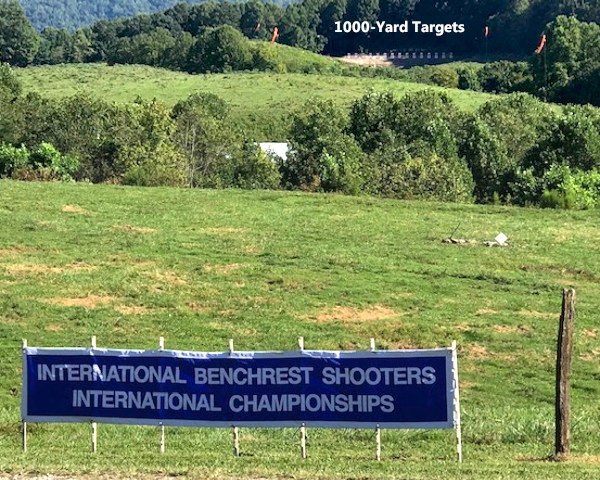
The International Benchrest Shooters (IBS) 1000-Yard Nationals were, once again, a success. The Hawk’s Ridge Gun Club in Ferguson, North Carolina, hosted a flawless event over Labor Day Weekend. Over 100 of the nation’s top shooters, from 19 states, gathered to compete for the crown of “National Champion”. Events such as this take an army to make work and the 2019 IBS Nationals were no different. But the event was a big success, despite some challenging conditions on Day One. We congratulate Glenn Hiett, who shot superbly to win BOTH the Two-Gun Overall AND Light Gun Overall 2019 Championships. Well done Glenn! We also recognize IBS Heavy Gun Overall Champion Sam Edwards.
Ideal Conditions Change Quickly on Saturday
Hawk’s Ridge is a very beautiful range. But “The Ridge” can sometimes have very tricky, unfriendly winds. Labor Day weekend 2019 was no different. Conditions started near perfect early Saturday morning — the day began with mild temps and wind flags hanging low. Things then changed for the worse. The great conditions only lasted a handful of relays as winds became unpredictable, showing the competitors how tough Hawk’s Ridge can be. Tiny groups and high scores quickly become scarce and shooters began to feel the effects of switching, hard-to-read winds.
2019 IBS 1000-Yard National Championships Top Competitors
Two-Gun Overall Champion: Glenn Hiett
Light Gun Overall Champion: Glenn Hiett
Heavy Gun Overall Champion: Sam Edwards
Highest-Placing Female: Donna Matthews
Junior Champion: Hunter Hall
Light Gun Group Winner: Scotty Powell
Light Gun Score Winner: Robert Banner
Heavy Gun Group Winner: Sam Edwards
Heavy Gun Score Winner: Tod Soeby
1000-Yard Nationals Course of Fire
IBS 1000-Yard Nationals is a 6-target Aggregate event over a two-day period for Light Gun and Heavy Gun. Light Guns must not exceed 17 lbs. weight and shoot 5 rounds per target. Heavy Guns have no weight limit and shoot 10 rounds per target. At the Nationals each shooter gets three Light Gun targets and three Heavy Gun targets. The results are aggregated together to determine Two-Gun Overall, Light Gun Overall, Heavy Gun Overall. There are also separate awards for Light Gun Group and Score and Heavy Gun Group and Score.
Day 1 included a Light Gun target, Heavy Gun target and ended with a second Light Gun target. After two Light Gun targets, several shooters were feeling great about their chances — Robert Banner, Brian Buttrick, and Dan Pantinski all had 99 scores, just one from perfect. Jerry Powers had the best Day 1 Light Gun Agg, a 3.472″ average (0.33 MOA). Justin Morrow shot the smallest Light Gun Group — 2.604″. That works out to a very impressive 0.249 MOA at 1000 Yards!
Donna Matthews shot this excellent 50-2X, 3.257″ LG target on Saturday.
Participants Rewarded with Famous Hawk’s Ridge BBQ
As Saturday came to an end, the smell of chicken had taken over the range. Range owner Mike McNeil is known for his famous secret sauce BBQ chicken. From the comments of the crowd as they sunk their teeth into chicken, potato salad, fresh baked desserts — they had no complaints whatsoever. Bellies full, guns cleaned, everyone headed to their rooms for some much anticipated rest.
More Readable and Consistent Conditions on Day 2
Feeling refreshed and excited for the challenge and anticipation for the final day, shooters showed up raving about the BBQ chicken and ready to shoot. For the most part, Day 2 was much more forgiving and calm than Day 1. The format was the opposite of Saturday — Heavy Gun relays were conducted first and last with Light Gun in the middle.
Perfect scores, small groups and everything in between was shot. Shooters made adjustments and for the most part they worked. But some made the wrong choices and the price was paid.
IBS 1000-Yard Nationals Equipment List (CLICK to Zoom): CLICK PHOTO to view LARGE Equipment List.
Editor’s Comment: Looking at the Two-Gun Top 20 Equipment List above, we see the Light Gun Ranks were dominated by 6mm Dashers, and 6 BRAs (BR Ackleys), most using Hodgdon H4895 powder. There were quite a few 300 WSMs among the top Heavy Guns. Krieger, with 10 selections, was the most popular barrel choice, followed by Bartlein (4), and Brux (3).
More than Marksmanship — Competitors Appreciate the Camaraderie
These events are always a pleasure to attend. You get to put faces with the names you’ve heard, compete against the best across the country, and see how you stack up to them. It’s fun to shake hands with the likes of Tom Jacobs (Vapor Trail Bullets past National Champion), Bart Sauter (Bart’s Bullets and current holder of 600-yard records), Mike Wilson (Current Light Gun Group and score record holder), the Hornady Team and many more.
This wonderful sport has no shortage of great men and women from many different states and cultures. Match director David Matthews, as well as Robert Smithey and the entire Hawk’s Ridge Gun Club staff, definitely showed how to put on a nearly flawless event. We cannot forget Kent Bratten for his tireless efforts in finding prize donations for the match. The IBS gives a special thanks to all our great sponsors who make the prize tables so abundant. Thanks for your generosity!
Can sustained rapid-fire shooting with no cool-down period wear out a quality barrel more quickly? The answer is “Yes” according to Forum member LCazador, who did an interesting comparison test with two .243 Winchester barrels. He started off with two, identical, match-grade HV taper stainless barrels. Both were NEW at the start of testing, and LCazador shot the same load through each: 95gr match bullets with 38 grains of Hodgdon Varget. After giving both barrels the same, gentle 20-round break-in, 300 rounds were then fired through each barrel — in very different ways. Barrel condition and wear were monitored with a borescope.
Barrel One — Slow Fire, Cool Down Periods, Cleaning Every 50 Rounds
At the end of the 300-round test, Barrel One looked brand new. There was none of the severe fire cracking found in Barrel Two. This barrel was shot no more than 10 times without a cool down and firing was done at a much slower pace. Cleaning for this barrel was done every 50 shots.
Barrel Two — Fast Firing, No Waiting, Cleaning Every 100 Rounds
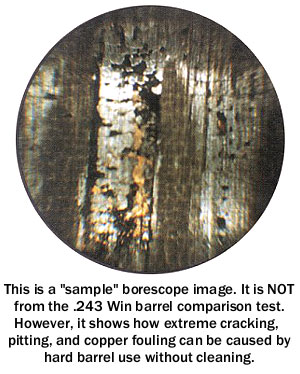
The second barrel, which received hard use and minimal cleaning, was severely damaged with severe fire cracking at the leade and throat. As a result, the barrel had to be re-chambered. This barrel was shot 100 rounds at time without cleaning and was shot up to 20 times in succession without a cool down.
LESSON LEARNED — Heat Kills Barrel Life
Don’t let your barrel get too hot, and keep it clean. One afternoon can ruin a barrel!
Monitoring Barrel Wear with Borescope
Some folks worry too much about what their borescopes reveal — many barrels do not have to be “squeaky clean” to perform well. In fact some barrels run better after ten or more fouling shots. However, a borescope can be very helpful when your barrel starts losing accuracy for no apparent reason. Forum member FdShuster writes:
“A borescope is a positive way of backing up your suspicions when the rifle starts to throw an occasional (soon followed by more frequent) wild shot. Using the scope is also an excellent way to determine that the cause is barrel wear and not simply a need for a concentrated cleaning session to remove built up copper and more importantly, carbon fouling.
I’ve had a few barrels that gave every indication of being shot out. But I ‘scoped them out and found the cause to be nothing more than requiring a good cleaning. They then returned to their usual performance. There’s no guessing involved when you are able to get ‘up close and personal’ using the scope. The borescope also provides an excellent view of the all-important condition of the crown. My borescope is one of the most valuable investments I’ve ever made.”
Chris Nichols with potential world record (1.297″ 4-Target Agg) Heavy Gun Targets!
Report by Bart Sauter, Bart’s Custom Bullets
Chris Nichols is one of the best 600-yard shooters in the game. This 2019 season he compiled one of the most impressive mid-range benchrest seasons ever. Check out the stats — Chris’s nine-match, Two-Gun Group Aggregate (Agg) for the year is 1.983″! That’s under two inches average at 600 for 72 record targets fired in competition. Many 600-yard shooters aspire to shoot a single, 4-target Agg that measures 1.983″, but doing that for 72 targets is amazing!
And of the nine matches Chris shot, he took SIX Overall Two-Gun wins — a 67% win ratio. And in the process Chris also shot what is possibly the smallest 4-target Heavy Gun Agg ever recorded — 1.297 inches. Hey readers — that Agg works out to 0.206 MOA average group size — well under quarter-MOA for four, 5-shot groups at 0.34 MILES (600 yards)!
Chris with 0.665″ group at 600 yards. This is the smallest HG group fired in the IBS in 2019.
The Equipment: 6mm Dasher Light Gun and Heavy Gun
Chris likes to run 1.550 stainless steel Bat “B” actions, Jewell triggers, Brux or Bartlein barrels. He prefers wooden stocks as he feels they produce a better resonance for Long Range rifles. Chris has his own stock design crafted by Johnny Byers. Imagine a Wheeler LRB stock front half mated with an McMillan ST 1000 rear section and you have Chris’ stock! It features a Wheeler-type, 4″-wide fore-end with an ST 1000 low-comb profile in the back. Both Light Gun and Heavy Gun sport Vortex 15-60x52mm Golden Eagle scopes mounted with Harrell’s double screw tall rings. Chris does NOT use either muzzle brake or tuner.
Here is Chris at his home range with his Light Gun (17 lbs. max).
Chris Nichols’s Heavy Gun is a true heavy coming in at around 42 pounds. It was responsible for the HG Agg of 1.297″ (potential new world record). His season-long aggregate with his Heavy Gun was 1.861″ for 36 targets! This rifle has similar components as his Light Gun, except the barreled action rides in a barrel block in a McMillan HBR 50 BMG stock.
Both rifles ride a top of a Sinclair competition rest with a Protector DR Flat Top rear bag. When Chris goes to HG gun he simply switches tops (made by Daniel Greenlaw) on his front rest to accommodate the larger forend. As Chris says ,” This keeps things simple and exactly the same. ” Just the way he likes it.
Reloading for the 6mm Dasher
Chris’s load choice for both LG and HG is Hodgdon Varget pushing 105gr Berger VLDs. He uses CCI 450 primers, seated with an old Lee hand primer. When it comes to reloading, Chris likes to keep things as simple as possible. “If people saw me reloading they’d probably laugh!” Chris revealed that he doesn’t anneal or clean his cases. He just sprays them down with Hornady One Shot Case Lube, resizes, then runs a brush down the necks, and cleans the primer pockets. The only cleaning his cases get is when he wipes the lube off of them. Chris WILL trim and chamfer as needed.
Chris says seating consistency is critical — he uses a K&M Arbor press with force dial indicator. I asked if there were certain numbers he looks for when seating. Chris replied, “I’m only concerned with consistency and not a certain number, 5 pounds or 60 pounds. It doesn’t matter as long as they are the same. I take what the brass gives me.”
Tuning the 6mm Dasher for Record-Setting Accuracy
I asked Chris what was special about his Dasher and how he kept it tuned and so competitive? His reply is something all shooters should pay careful attention to: “[Success] starts with having a good reamer, bullets and barrels. But more than that, it’s KNOWING your Cartridge, KNOWING your bullets, and KNOWING your barrels! I’ve shot it so much I just know what to do. I’m comfortable with it. I know how to get it to shoot and when it’s not, I have a pretty good idea how to get it back in tune. Once you know your equipment, then you can learn how to get the most out of it.”
Chris has a range at his house and he tunes at 300 yards. He looks for consistent, 300-yard 5-shot groups of 0.600″ or less! He wants to see nice round groups! Not groups with four in and one out or vertical strings. Chris starts by finding “touch” (to the lands) then he moves the bullets .002″ off the lands and begins tuning. Chris has found that usually somewhere around .008-.012″ off the lands is where his Berger 105gr VLDs shot best. I asked Chris what’s the biggest factor contributing to his success? He said, one big thing was that he can do his own work. That’s a huge advantage.
Look for Accuracy First, Velocity Second
Early on Chris had it in his mind that for a 6mm Dasher to shoot best he needed to achieve a certain velocity range — 2990 to 3030 FPS. The problem was he wasn’t paying attention to what the target was telling him. He’d get to the speed he was looking for but the accuracy wasn’t there. Once he started slowing the speeds down and giving the barrel what it wanted, then the accuracy came! Also with the slower speeds came better consistency.
Chris Nichols’s Tuning Tips for 6mm Dasher:
• Take consistency over speed.
• Only change one thing at a time and run it to the ground.
• Every barrel is a little different, so give it what it wants.
• Pay attention to what your target is telling you.
• Don’t be afraid to REDUCE your powder load.
Chris Nichols’s Advice for New Shooters
Chris says the best thing a new shooter can do is align themselves with knowledgeable people, and if they will talk, listen! Next, be ready to buy the best equipment or be ready to buy it twice. Chris also says: “Don’t cheap-out on sighters. Sighters need to be just as good as your record rounds.”
In the Beginning — Learning the 600-yard Benchrest Game
Chris’s shooting career began in 2012. His first win came in 2014. He was shooting beside guys like Sam Hall, Larry Isenhour, Mike Hanes, Jeff Godfrey James Coffey, and Chad Jenkins, who are very tough competition indeed. He said when he won he was ecstatic and he’ll never forget it! That first trophy had him feeling like he’d just won the Nationals! Chris shot a 6BR for the first two years of his career, before switching to the 6 Dasher. I asked him why he switched? He said, “guys were starting to shoot the Dasher and winning with it!”
I asked Chris if he had a mentor and he said, “not really”. He learned by watching the guys who consistently finished Top 5 at matches and occasionally asked them a question. Not two questions, just one! Chris didn’t want to push his luck by asking too much. Then Chris would take that information and test it and apply it to his own shooting. Chris says, “he learned mainly by the ‘school of hard-knocks’. The good thing about learning that way is it sticks with you!”
Chris Nichols 2019 600-Yard Win List and Statistics


 “This decision by the federal judge to dismiss with prejudice this frivolous case is pleasing, if not unexpected,” said Lawrence G. Keane, NSSF Senior Vice President of Government Relations and Public Affairs and General Counsel. “These are lawful and federally-regulated AR-15 modern sporting rifle manufacturers that make semiautomatic rifles for lawful purposes. The judge was absolutely correct to assert that the proper venue to establish public firearms policy is through the legislature and not the courts.”



 1000-Yard Nationals Course of Fire


 Monitoring Barrel Wear with Borescope


