|
|
February 7th, 2013
How Easy it is to Have Fun with Rifles and Equipment You Probably Already Have….
Forum member Rod Vigstol (aka Nodak7mm) has written a great Introduction to F-Class for shooters getting started in this rewarding discipline. Rod’s article, which appears in German Salazar’s Rifleman’s Journal website, covers F-Class basics and addresses concerns that “newbies” may have when trying a new shooting sport. Rod stresses that most guys who own a varmint-hunting or tactical rig likely have nearly all the gear they need to give F-Class competition a try.

CLICK HERE to read Rod Vigstol’s ‘Getting Started in F-Class’ article on Rifleman’s Journal.com
Rod explains: “If you’re reading this, you have more than just a general interest in the shooting sports and in the awesome rifles that shoot tiny groups at insane distances. You probably even have friends that enjoy shooting as much as you do. The quandary you may find yourself in is your friends haven’t quite jumped into it head-first like you have and they haven’t spent a lot of money and time obtaining the equipment you have to go shoot these matches. But you know what? Your prairie-dog shooting buddy or coyote-hunter friend can attend these matches and shoot alongside with you. He or she more than likely already has the basic equipment needed to shoot a match.” Most varmint shooters already have a suitable, accurate rifle and the following equipment:
• A variable-power scope in the 4.5-14x range or higher.
• A front bipod like the trusty old Harris 9″-13″, or maybe even a basic pedestal front rest.
• A rear sand-bag or similar sand-sock to rest the butt stock.
• A basic shooting mat from Midway or at least a piece of carpet or canvas to lay on.

Rod also provides a handy checklist of items to bring to the range. These include: Canvas or carpet strip (to set under bipod), Notebook, Kitchen Timer, Cleaning Rod, Camp Chair, Elbow Pads, Shooting Hat, and Open Bolt Indicator (OBI). Along with rifle, bipod (or front rest), rear bag, and ammo, that’s pretty much all you need.

Rod encourages all shooters to give F-Class a try — even novices. Rod explains: “We have all been rookies, newbies, new kids on the block or whatever. So we all have a good idea of what may be going on in your mind, the questions and concerns you may have. I’m telling you this sport is full of fantastic people who deep down find it far more fulfilling to help a new shooter get started than running a clean target. You just have to take the first step to get involved.”
CLICK HERE To read the entire article on Rifleman’s Journal.com. We’ve only provided a small sample of Rod’s article; it is definitely worth reading in its entirety.
January 15th, 2013
 At Media Day, we had a chance to try out a new Smith & Wesson Pro Series C.O.R.E. pistol in 9mm. Despite the wicked cold weather, we enjoyed shooting this pistol. It is accurate, comfortable, and has a decent trigger.
This M&P variant features a slide that has been milled to fit modern, compact red-dot optics. Six optic types will fit: Trijicon RMR, Leupold Delta Point, Jpoint, Doctor, C-More STS, Insight MRDS The slide cut positions the red dot optic (a Trijicon on our test gun) so that the conventional iron sites are still usable below the red-dot. That’s smart, because the front blade sight can still be used to steer the gun towards the target, and then, as you bring the muzzle down on target, the red dot appears. This is a very fast, efficient system.

This C.O.R.E. model, like other M&P series pistols, has a comfortable, ergonomic grip-shape that is far superior to the grip on Glock handguns in this reporter’s opinion. I also like the grip better than the blocky grip on my older H&K polymer .45 ACP. Grip angle feels “just right” (unlike the Glock), and the corners are rounded (an improvement on the blocky HK). Plus the M&P has three (3) optional backstraps, so the user can “fine-tune” the grip to his or her hand. For 2013 the stipling on the backstraps has been modified for better grip and comfort.

This is a nice, intelligent upgrade on a gun which was already very good. And even with the special “optics ready” slide, the gun remains affordable with a $729.00 MSRP (not counting optics).
January 11th, 2013
 The latest January 2013 issue of Shooting Industry Magazine is available now in a FREE online digital edition. To read the January issue — and sign up for a free subscription to the Shooting Industry all-digital edition — visit www.shootingindustry.com/digital-editions.
CLICK HERE to READ January eZine.
This January edition is a “must-read” for SHOT Show attendees. The January issue features a comprehensive directory of exhibitors with booth locations, plus an update on improvements for the 35th annual show.
In addition, you’ll find Part II of the 2013 New Product Showcase, which features hundreds of new firearms, optics, shooting accessories, reloading tools, and more. The hard copy January issue also provides a handy, pull-out floor map from the convention center. (No floor map in digital edition.)

Shooting Industry Magazine is an important resource for those headed to Las Vegas next week. Visit FMG at SHOT Show, booth #16327, to receive a free hard copy of the January issue of Shooting Industry Magazine, with floor map.
January 1st, 2013
 On his Riflemans’ Journal blog, German Salazar wrote an excellent article about cartridge Case-Head Separation. We strongly recommend that you read this article. German examines the causes of this serious problem and he explains the ways you can inspect your brass to minimize the risk of a case-head separation. As cases get fired multiple times and then resized during reloading, the cases can stretch. Typically, there is a point in the lower section of the case where the case-walls thin out. This is your “danger zone” and you need to watch for tell-tale signs of weakening.
The photo below shows a case sectioned so that you can see where the case wall becomes thinner near the web. German scribed a little arrow into the soot inside the case pointing to the thinned area. This case hadn’t split yet, but it most likely would do so after one or two more firings.

One great tip offered by German Salazar involves using a bent paper clip to detect potential case wall problems. Slide the paper clip inside your case to check for thin spots. German explains: “This simple little tool (bent paper clip) will let you check the inside of cases before you reload them. The thin spot will be immediately apparent as you run the clip up the inside of the case. If you’re seeing a shiny line on the outside and the clip is really hitting a thin spot inside, it’s time to retire the case. If you do this every time you reload, on at least 15% of your cases, you’ll develop a good feel for what the thin spot feels like and how it gets worse as the case is reloaded more times. And if you’re loading the night before a match and feel pressured for time — don’t skip this step!”

December 22nd, 2012
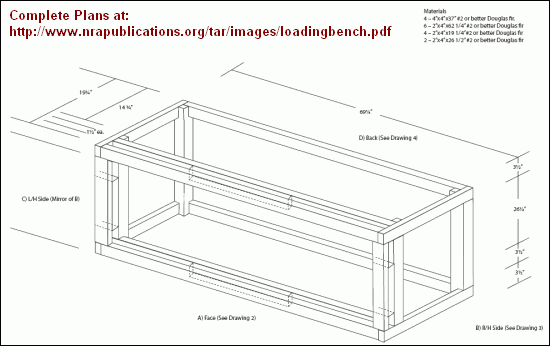
The NRA’s American Rifleman Online website has an excellent article showing how to construct a rock-solid Reloading Bench. There are plenty of photos, and a detailed set of Bench Blueprints showing all dimensions and listing all needed materials. This bench is very well designed, with many deluxe features, such as an upper drawer with fitted slots for die boxes, and large lower drawers with 100-lb rated slides to store heavy materials or tools. If you have good wood-working skills this would be an excellent project.
CLICK HERE to Download Article with Photos | CLICK HERE for Bench Blueprints

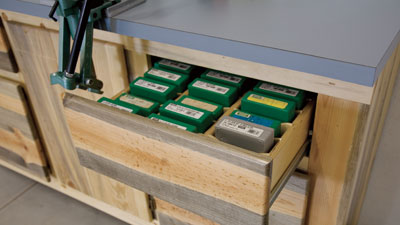
The author, Dave Campbell, offers good advice on building the bench top: “I ripped a sheet of 3/4″ AC plywood into two 24″ wide pieces and cut them to 72″ long. Then I glued them together to form a 72″ long, 1 1/24″ thick top. The trick here is to keep the edges smooth and flat so that the laminate will adhere properly and without voids. I chose a light grey laminate finish for the top because it’s easier to see what I am working on and keep clean. If you have never worked with laminate, remember it’s prudent to glue and rout the edges flush before gluing on the top. The top was attached to the carcass with eight steel L-shaped angle brackets and No. 10×1 1/4″ wood screws.”
Photos Copyright © 2008 The National Rifle Association, used by permission
December 18th, 2012
 Christmas Day is just one week away. Books have always been popular Xmas gifts. If you haven’t completed your holiday shopping, here are some recommended titles that should please the serious shooters and firearms enthusiasts on your shopping list. For Shooting Clubs, books also make great end-of-season member awards. Most of us would rather have a useful book than one more piece of wood to toss in a box in the closet.
Here are six recommended titles, in alphabetical order:
 |
Applied Ballistics for Long-Range Shooting (2nd Ed. + CD)
by Bryan Litz, $44.95 (Hardcover)
If you’re a serious long-range shooter you NEED this book. Since its initial release Bryan Litz’s treatise has become the definitive resource on long-range ballistics and bullet design. While Bryan covers some very advanced topics, Bryan does a very good job of making the text comprehensible to the layman. You don’t need a degree from MIT to read this work. Bryan’s book comes compete with a CD packed with ballistics software and additional reference materials. AND, Bryan includes Ballistic Coefficient data for over 236 long range bullets. |
 |
A Hunter’s Wanderings in Africa
by Frederick Courteney Selous, $19.95 (Softcover)
Frederick Selous was a legendary African hunter. It was for him that Tanzania’s famous Selous Game reserve was named. If you have an interest in big game hunting in Africa, you should get this book. As readers have noted, this is “Classic Africana”… “one of the very best exploration/hunting history books about Africa”. It is an excellent book, well-written and “all about hunting”. Selous’ life was full of adventure, and his book lets readers experience, vicariously, the danger and excitement of African hunting in a bygone era. |
 |
Precision Shooting Reloading Guide
Edited by Dave Brennan, $22.95 (Spiral Bound Softcover)
This handy reference guide contains scores of useful tips from many top shooters. However, this is NOT a load manual. Rather, it explains the techniques for precision reloading, and offers advice on how to get the “Nth” degree of accuracy from your handloads. Each topical chapter is authored by a different expert. Chapters include: Reloading for Extreme Accuracy, High Power (Bolt Guns), High Power (Gas Guns), Benchrest, Magnums, Wildcats, Cast Bullets, and working up an accuracy load. Readers have praised this compact (5.5″ x 8.5″) reference: “I’ve been reloading for many many years, and [this] book still managed to contain pearls of wisdom I’d never heard before.” –T. Pratt. |
 |
Prone and Long-Range Rifle Shooting (2nd Edition)
by Nancy Tompkins, Price TBA (Coming in February 2013)
Tompkins’ treatise is a must-read for serious Palma,
F-Class, and High Power shooters. The revised and updated edition is set for release in 2013. Topics include Mental & Physical training, Reading Wind & Mirage Shooting Fundamentals, International Competition, and Loading for Long Range. Nancy Tompkins is a 4-time winner of the National Long Range Championships, and has won countless other major events. Nancy has been on six Palma Teams (as both a shooter and a coach). |
 |
Rifle Accuracy Facts
by Harold R. Vaughn, $34.95 (Softcover)
Decades after it was written, Vaughn’s work remains a seminal treatise on accuracy. Vaughn was a serious scientist, working for the Sandia National Laboratories. Many “gun writers” toss out hunches about rifle accuracy. Vaughn, by contrast, did serious empirical testing and statistical analysis. Vaughn wondered why some guns shot well while seemingly identical rifles did not. Rifle Accuracy Facts covers a wide variety of topics, including internal ballistics, chamber design, barrel vibration, bullet imbalance, external ballistics, scope design and more. Writer Boyd Allen notes: “If you are serious about precision shooting, Vaughn’s book belongs in your library.” |
 |
Rifleman’s Guide to Rimfire Ammunition
by Steven Boelter, $29.95 (Softcover)
Steven Boelter’s 352-page book is a comprehensive study of all types of rimfire ammunition (including 17s and 22 mags), with over 600 photos. In a remarkable undertaking, Steven Boelter fired every brand and sample of rimfire ammo he could acquire (including 22LR, 17 Mach 2, 17HMR and 22 WMR), and recorded all the results. In all, Steven tested 11 brands and 137 different rimfire rounds, firing over 32,000 test rounds. |
December 17th, 2012
How to Set Up Your Full Length Sizing Die
by Ron Dague, Sinclair International Technician
From Sinclair’s Reloading Press Blog
At Sinclair International, we are often asked for a fool-proof method to set up a full-length sizing die, and begin reloading our fired cases. The method used by many target shooters today is to set up your full length die to closely match your rifle chamber and minimally full-length size your cases –as little as .001″ for bolt-action rifles. I prefer to use this method for all of my bolt-action cartridges.
STEP ONE
I like to de-prime five (5) cases (de-prime only, do not full length resize) and measure from the base of the case to the shoulder with our Sinclair Comparator Body (09-1000) and Bump Gage Insert(09-10200). We refer to this as our headspace measurement. Our Electronic Caliper (#MIC-14) works well and may be pre-set at .000” making this headspace measurement easy to capture. The Sinclair Comparator/Gauge Body and Bump Gage Inserts make this task fairly simple. L.E. Wilson Tools & Gages, Hornady Manufacturing, and RCBS all make similar units to achieve your headspace measurement.
 STEP TWO
With your full-length die threaded into your reloading press, loosen the lock ring and run the press ram up toward the full length die with a shell holder in place (with no case). Then, screw the die toward the shell holder until it stops. Back the die out of the press and away from the shell holder one full turn and set the lock ring finger tight.
STEP THREE
Lubricate each of the cases with your favorite sizing lube (my favorite is Imperial Sizing Die Wax) and resize a case. Again, take a headspace measurement from base to shoulder. [When running the case up into the die, be sure the press ram moves the full limit of its upward travel.] If there’s no change in the measurement from the fired dimension, loosen the die lock ring and turn the full length sizing die downward 1/8 of a turn. [Editor’s Note: You’ll need to use smaller turn amounts as you get close to the desired amount of bump. We suggest moving just a few degrees of die rotation at a time once you’ve reached the point where the die hits the shoulder without moving it back.] Now repeat the sizing process with a second lubricated case and take the measurement again. Keep rotating the die downward gradually (in small increments) and repeat the case sizing process until you see approx-imately .001”-.002” reduction to your fired headspace measurement. We prefer a headspace reduction of approximately .001″ – .002″ for bolt action rifles and .003″ – .005″ for semi-auto rifles. You can adjust to your rifle as to what works best. Don’t forget to load 10 rounds or so and try them from the rifle’s magazine to make sure they function properly.
Full-length Sizing vs. Neck-Sizing
Just a quick word on neck sizing…..I have personally never been a big fan of neck sizing. Often times when I put neck sized cases back in the rifle, the bolt would close with some drag, or it would be a bit “snug”. This was mostly recognized with factory rifles. I didn’t have any problems with accuracy, just with cycling the action for a follow up shot. If your rifle is custom chambered with the action straightened and trued, neck sizing will work well on 4-5 firing’s and then you will need to full length size or use a body die to set the shoulders back when the cases begin to “stick”. Hope these tips help make the use of a headspace gauge and full length die set up much easier.
Ron Dague
Sinclair Tech and Reloading Instructor
800-717-8211
rond@sinclairintl.com
Reloading Tip Courtesy Sinclair Int’l; Story Sourced by Edlongrange
November 27th, 2012
 The National 3-Gun Association, which operates the 3-Gun Nation Pro Series and 3-Gun Nation TV, has launched a new e-Zine dedicated to 3-Gun Competition. Entitled “3GN Magazine”, this new e-Zine features match reports, gear reviews, and shooting tips. You’ll find a host of 3GN videos, including match footage, product reviews, and instructional segments. Ace 3-gunners will contribute to the articles along with leading outdoor industry journalists. Comprehensive match coverage will include local club matches, regional tournaments, national Outlaw matches, and, of course, the 3GN Pro Series Tour.
The first installment of 3GN Magazine can be previewed now on the 3gunnation.com website. There is also a mobile version of 3GN Magazine optimized for smartphones and tablets. 3GN Magazine is offered free to the public, but you can choose to be added to a subscriber list to be notified directly of new releases and special offers for fans of the 3-Gun sport.
Read 3-Gun Nation Magazine Issue #1 (Use Slider Bar to Scroll)
November 26th, 2012
 We’ve learned that many first-time visitors to AccurateShooter.com may come in via a link to the Daily Bulletin rather than through our home page. As a result, they may not be aware that there is a wealth of other content available to our readers. Our Shooters’ Forum, with 19,300 registered members, is one of the best places on the web to discuss precision shooting and advanced reloading. We also offer FREE Forum Classifieds. On the editorial side, AccurateShooter.com offers hundreds of pages of content, with thousands of photos. Our Cartridge Guides are definitive one-stop resources for popular match calibers, while our Guns of the Week articles spotlight outstanding custom rifles, most with competition pedigrees. In addition, we offer videos, gear reviews, book reviews, gunsmithing tips, and even FREE downloadable targets.
If you’re a new visitor to AccurateShooter.com, you should check out all that we have to offer. There are hundreds of informative articles to read … and they’re all FREE.
 AccurateShooter.com Features:
November 22nd, 2012
Readers know Jim Borden as a Hall of Fame shooter and the owner of Borden Accuracy/Borden Rifles. Jim won 10 IBS National Championships, set 10 IBS world records, and was inducted into the Benchrest Hall of Fame in 1996. But Jim is not just a great shooter. This highly-trained engineer is very much a Renaissance man. He is as skilled with cameras as he is with benchrest rifles.

 Jim is a talented outdoor photographer who has compiled an impressive portfolio of wildlife and landscape photographs. For our Thanksgiving-day edition of the Daily Bulletin we are featuring some of Jim’s favorite nature images. We hope readers enjoy them as much as shooters prize Borden’s Rimrock benchrest and Rimrock hunting actions.
Growing up in rural Pennsylvania, in a hunting household and hunting community, Jim learned about shooting at a very early age. He started hunting at the age of nine with his father and grandfather. His grandfather had an avid interest in photography while they were on hunts and Jim became interested as well. Jim began using SLR cameras in the 1970s, often carrying cameras on his hunts. As the years passed, Jim became more interested in “shooting” the animals with a camera versus a gun. Jim converted from film to digital in 2006 and in 2007 Jim’s wife Joan started accompanying Jim on the photo safaris. Jim has a particular passion for elk, moose, and eagles and Jim also enjoys scenic photography. Jim and Joan both shoot Nikon professional equipment. Their photographs can be viewed at www.BordenPhotography.com. You’ll also find Jim’s images (along with photography tips) on his JandJB Wildlife Photography Blog.


All in the Family
Jim’s grandfather was a gunsmith who taught Jim the trade when Jim was very young. Jim’s father and grandfather ran a country business that included an auto repair shop, welding, a small lathe, and a forge. Jim earned a degree in Mechanical engineering at Penn State University. For 23 years he worked for Procter and Gamble (P&G) as an engineer and as an engineering manager/project manager.

 Borden Rifles — A Success Story
Borden Accuracy/Borden Rifles has been a source for precision benchrest and hunting rifles for many years. Jim started doing his own gunsmithing while competing in benchrest and high power silhouette matches. Jim launched his business in 1987, working nights and weekends while still employed at P&G. The business became full-time in 1995 with Jim and his wife Joan doing the work. The business was expanded in 1999 with the construction of the new Springville, PA facility and the addition of sons Jim Jr. and John to the staff. Son-in-law John Mecca came onboard in January 2000.
Jim and company began making Rimrock benchrest and Rimrock hunting actions in 2001. They added Borden Alpine and Timberline actions in 2006. These actions are made in an advanced manufacturing facility which has three CNC vertical Machining centers, three CNC lathes, three manual lathes, a manual knee mill, a surface grinder, a cylindrical grinder and wire EDM machine. To learn more, visit BordenRifles.com, call 570-965-2505, or send email to info [at] bordenrifles.com .
|
Jim Borden
Thanksgiving
Voice Message: |
[haiku url=”http://accurateshooter.net/Video/bordenvoice.mp3″ title=”Jim Borden Voice Message”] |

|


