The October issue of Shooting Sports USA is now available. The October issue features complete coverage of the 2011 National Rifle and Pistol Championships at Camp Perry in an extended 42-page issue. The Smallbore, High Power, and Long Range phases of the National Rifle Championships are all covered in this issue, as well as the National Defense Match. You’ll find links to videos describing the National Trophies. There’s even a special note on how to stay in one of the historic huts on the Camp Perry base.
Shooting Sports USA Editor Chip Lohman interviews Philip Hemphill, the 10-time National Police Pistol Combat Champion. Hemphill won his first National Pistol Championship at Camp Perry this summer.
The October issue also features the second installment of a three-part series on how to deal with the pressure of competition. This segment features expert advice from top shooters such as Bianchi Cup Ladies Champions Jessie Harrison and Julie Golob.
Portrait Photographer Lindsay McCrum’s new book, Chicks with Guns, is drawing welcome attention to the growing number of women who own firearms for target shooting, hunting, personal defense and collecting. [Editor: Over 15 Million American women are packing heat according to Msnbc.com.]
The book’s intent is described this way: “Because gun ownership and shooting cut across class, age, occupation, background and geography in America, guns are resolutely democratic. And the women depicted in ‘Chicks with Guns’ represent this variety. They reside in all regions of the country, come from all levels of society, and participate seriously in diverse shooting activities. From policewomen to hunters, ranchers to competition shooters, the collection of portraits in ‘Chicks with Guns’ defies stereotypes often associated with aspects of the popular culture of both guns and women.”
McCrum’s photographs tell a powerful story, just as these statistics do: Participation by women in target shooting has increased 46.5 percent from 2001 to 2010 and in hunting by 36.6 percent in the same period, according to the National Sporting Goods Association. In an NSSF survey of firearms retailers, 61% of respondents saw an increase in female customers in their store in 2010 over 2009.
Other evidence, too, such as the strong turnouts by women in concealed carry classes nationwide and in NSSF’s First Shots seminars, helps confirm this trend. (First Shots introduces newcomers to target shooting by providing both a classroom overview and supervised live-fire experience.) This is nothing new to the hunting and shooting community, but we think the compelling photographs in “Chicks with Guns” will bring the trend to life for those less familiar with our traditions and our pastimes.
Editor’s Comment: I wouldn’t rush out to buy this book for your coffee-table, though it might make a nice gift for a lady shooter in the family. I’ve looked through the book. The photography is professional, but overall, mostly static and uninspired. I’d give it a B+ grade. This book wouldn’t have received much media attention but for the somewhat controversial subject matter and the catchy title. Still, ‘Chicks with Guns’ presents female shooters in a positive light, and that’s a good thing.
Let’s face it — economic times are still tough, so it’s important to save money whenever possible. Prices are going up, but wages aren’t following (for most of us). Here are seven ways shooters can save money on gear purchases and other shooting-related expenses.
1. Share a Ride to Matches. With gas costing close to $4.00 per gallon in many areas of the country, fuel has become a significant part of an active shooter’s hobby budget. Yet over 90% of shooters drive solo to matches, often in large, gas-guzzling trucks. If you drive 100 miles roundtrip to attend a match in a 20-mpg vehicle, you’re going to burn nearly $20.00 worth of gas total out and back. By simply sharing the ride with one fellow shooter you can cut your fuel expenditures in half.
2. Use Discount Codes to Save. It’s always smart to check for discount codes before you buy. In the Daily Bulletin, we regularly highlight important sales, and we provide discount Coupon Codes when available. By using discount codes when shopping online, you can typically save 10-15% on your purchases. For example, right now Sinclair Int’l is running a Labor Day Promo with discount codes. To find recent discount codes, just type in “Coupon Code” or “Discount” in the search box at the top of this page. If you can’t find a Coupon Code for your preferred vendor here, visit RetailMeNot.com and/or SlickGuns.com. Both those sites list current coupon codes, and RetailMeNot.com covers thousands of vendors.
3. Gang Powder and Primer Purchases. Every time you order powder and primers you’ll need to pay a hazardous materials (hazmat) transport fee, which costs $25.00 – $30.00. If you do a joint buy with other shooters, you can ship more powder and primers on a single hazmat fee, effectively reducing your components cost. For example, if you buy 3 pounds of powder at $20/lb with a $25.00 hazmat fee your actual cost (before shipping) is $28.33 per pound. If instead if you buy 30 pounds of powder at $20.00/lb, the actual cost with hazmat is just $20.83 per pound. Moreover, when you buy in bulk, you can usually save significantly on the powder itself. At Powder Valley, one pound of Varget costs $19.75, while an 8-lb jug of Varget costs $139.50 ($17.44/lb).
4. Shop for “Demo” Optics. Modern high-quality optics can easily cost $1500.00 or more, often exceeding the value of the rifle on which they are mounted. However, you can often save 20-30% by purchasing demo optics. These are normally display units used at trade shows. They may have slight ringmarks, but otherwise they are “as new”, having never been carried in the field or used on a rifle that has fired live ammo. When purchasing demo scopes, you should always ask about the warranty before consummating the sale. However, most demo scopes from name-brand manufacturers come with full factory warranties. EuroOptic.com and SWFA.com are two respected vendors that offer a good selection of demo optics.
5. Train with Rimfire Rifles. The true cost of shooting a match-grade centerfire rifle, when you consider barrel wear, approaches $1.00 per round. READ Shooting Cost Article. By contrast .22LR Wolf Match Extra costs just $0.17 per round and other good rimfire ammo can be purchased for even less. Good rimfire barrels last a long, long time, so you don’t have to be concerned about wearing out your barrel quickly. A quality rimfire barrel can retain its accuracy for 7,000 rounds or more. If you run the ballistics, a .22LR round at 100 yards can emulate the wind drift experienced by a centerfire cartridge at long range. This allows for effective cross-training with much less expensive ammo.
6. Check Out the Forum Classifieds. There are great deals to be found every day in the AccurateShooter Shooters’ Forum. The latest deals are listed on our home page. To see all the listings, browse through the Forum MarketPlace section which has four main categories:
Guns, Actions, Stocks, & Barrels
Tools, Dies, Rests, Reloading Components & Misc
Scopes, Optics, Sights, Rings, Bases Etc.
Commercial Sales by Paid Sponsors
You can find some great deals on complete rifles, optics, and reloading gear in our classifieds. Before purchasing, however, read our Advice to Online Classifieds Shoppers.
7. Take Advantage of Factory Rebates. There are some amazing rebates available right now from quality manufacturers such as Bushnell, Leupold, RCBS, Sightron, and Zeiss. You have to be a bit wary because rebates are typically used to move less-popular merchandise. But some rebates, such as the current RCBS $50.00 rebate, apply to very wide range of merchandise, so it’s hard to go wrong. Just make sure that, when you buy a product, you retain the sales slip and the original packaging. To qualify for the rebate, you may need to mail in a product identification code found on the box, along with your original sales receipt.
The August 2011 digital edition of Shooting Sports USA is available online — free for the reading. This issue contains a “must-read” expert symposium on the subject of Eye Dominance, as it affects both rifle and pistol shooting. No matter whether you have normal dominance (i.e. your dominant eye is on the same side as your dominant hand), or if you have cross-dominance, you’ll benefit by reading this excellent article. The physiology and science of eye dominance is explained by Dr. Norman Wong, a noted optometrist. In addition, expert advice is provided by champion shooters such as David Tubb, Lones Wigger, Dennis DeMille, Julie Golob, Jessie Duff, and Phil Hemphill.
Development of the 6.5 Creedmoor Cartridge
Also in the August Edition of Shooting Sports is a feature on the 6.5 Creedmoor cartridge. This story covers the origin of the cartridge and its performance both as a match cartridge and as a hunting round. Hornady Chief Ballistician Dave Emary explained: “the original intent of the cartridge was as an across-the-course match cartridge. We envisioned it as an off-the-shelf round that would produced the accuracy and ballistics to compete in all match disciplines right out of the box. At the same time we realized that the same characteristics would make an exceptional hunting cartridge with the right bullets.”
6.5 Creedmoor Brass No Longer Washed After Annealing
Here’s an interesting update on Hornady 6.5 Creedmoor brass and loaded ammo. In a move to improve case quality and neck uniformity, Hornady recently changed the 6.5 Creedmoor production process, eliminating the case-washing step after annealing. So now you will see annealing coloration on 6.5 Creedmoor brass, just like on Lapua brass. Dennis DeMille of Creedmoor Sports wanted to improve the consistency/uniformity of 6.5 Creedmoor case-necks. At Dennis’ suggestion, Hornady conducted tests which showed that the “standard industry practice” of washing brass could potentially alter the necks in undesirable ways. Bottom line, unwashed annealed brass was determined to have an accuracy edge over washed brass. Looking at these results, Hornady decided to forgo the post-anneal washing process. As a result, the latest 6.5 Creedmoor brass now displays the distinctive coloration left by neck/shoulder annealing. Learn something new every day, eh?
Would you like to increase attendance at your matches and expand the membership of your shooting club? Then check out the latest issue of The Range Report, NSSF’s magazine for shooting facilities. The free digital edition can be viewed online, or downloaded for future reference. Feature stories include how to attract traditional shooters and re-enactment groups for traffic and revenue, one range’s strategy for maximizing exposure on a limited budget and how a statewide gathering sparked Wisconsin ranges to organize. To access more resources for shooting ranges, visit nssf.org/ranges.
Frank Galli, aka “Lowlight”, runs the popular SnipersHide.com website. Frank recently completed a gunsmithing course with Robert Gradous. Frank recounts the learning process in an informative, nicely-illustrated article on the ‘Hide. Frank explains how he put together a new 6.5 Creedmoor tactical rifle using a Bartlein barrel, Bighorn Action (Rem clone with floating bolt-head), and a “lightly used” Accuracy International 1.5 chassis. The HD video below shows the process start-to-finish. READ Full Article.
During Frank’s “hands-on” training sessions with Gradous, Frank learned to thread and chamber a barrel, fit a recoil lug, and install the barreled action in the AI chassis. Chambering was done with great care: “We spent the better part of the day working the barrel. I feel this is a critical component and seeing the attention to detail in Robert’s approach confirmed it for me. When it came time to chamber Robert had a custom tight chamber reamer there for a 6.5CM but I’m shooting a tactical rifle, tight chambers aren’t for me, and this was clear, as out came the standard SAAMI reamer.”
Frank also learned how to modify an aluminum chassis: “the AI chassis had the recoil lug opened up, but it was opened in the wrong direction. This was going to require milling increasing the gap to at least a 1/2″ in size. Robert was really leery of this, but my attitude was, ‘it’s just a chassis and nothing a little Marine Tex can’t handle’.” Thankfully the chassis mod came out OK.
Once the barreled action was complete and the AI chassis was successfully milled, Frank applied a tan Cerakote finish to the barreled action. This would give a proper tactical look to the rifle, while providing superior corrosion resistance for the metal parts. To learn more about Cerakote finishing, check out the Cerakote Application Video, published last week in the Daily Bulletin.
When the rifle was complete, Frank took it out for testing with a variety of ammo, both factory fodder and handloads. There were some initial worries about accuracy as it took a while for the barrel to break in. A few sessions of bore cleaning were required before the barrel stopped fouling and then — like magic — the rifle started printing really small groups.
By the end of his load testing session, Frank was getting good groups with Hornady 120gr GMX factory 6.5 Creedmoor ammo, and really superb groups with handloads. The 120gr GMX ammo “was going 3100 fps with no ill effects”. The best handloads were approaching 1/4 MOA for three shots, and Frank’s load with Berger 130 VLDs shot even smaller than that: “In my opinion the load development we did was worth its weight in gold. Where else can you build in a rifle in two days, then go out and develop a baseline load using everything from 120gr ammo to 140gr ammo with a few in between? My favorite load and clearly the rifle’s too, was the [Berger] 130gr VLD. This gave us great velocity, awesome groups [with some one-holers] and really nice results at distance.”
Lowlight’s Gunsmithing Story is a ‘Must-Read’
We recommend you read Frank’s story. It shows that, with the right tools, and the supervision of a master smith, even a novice can produce an ultra-accurate rifle. For those of you who have considered taking a gunsmithing class, Frank’s successful experience with gunsmith Robert Gradous should give you plenty of motivation.
Last month, Vortex Optics sponsored a new kind of rifle competition that tested competitors’ fitness along with their marksmanship skills. The inaugural Vortex “Extreme Invitational” was held July 16, at the Spirit Ridge Rifle Golf facility near Tremonton, Utah. At most traditional long-range rifle matches, the only hiking required of the shooters is from their vehicles to the firing line, and to the pits if target-pulling duties are required. Vortex has created a new game. At the Extreme Invitational, participants walked, jogged, and sometimes ran over a six-mile course –- all the while knowing a portion of their score was based on how quickly they finished. Strong legs and lungs were a big asset. The event tested long range shooting skills, but it was also was physically challenging (and hot).
Competitors at the start of the match. Christensen Arms Team #1 (top left) ran most of the course.
Demanding Course of Fire Required Position Shooting Skills and Mastery of Angled Shots
At the Extreme Invitational, two-man industry teams vied for honors on a challenging mountain course. Final scores were based on course time and how well each two-man team shot. Shots ranged from 200 to 1200 yards. Each station featured a tough standing, sitting, kneeling or prone shot (no shots from benches). Even highly experienced shooters found the course quite humbling. There were a variety of firearms on the course. Some participants favored the lightest weight rigs possible, while others toted fairly heavy tactical-style rifles with stout barrel contours.
“The goal of the event was to bring industry leaders together for a day of hard-core shooting in a new format that tested physical fitness, long rage marksmanship, team communication and strategy,” said Mark Boardman, Vortex Optics marketing manager. Scenarios mimicked many of the same pressures faced when that big game trophy steps out and you only have precious seconds to find the target, get a range, dial elevation, dope wind and execute a shot — often times with an increased heart rate and breathing heavily. No easy task.”
Wasatch Arms Team Finishes First
In this game, like golf, the lower the score (which factored both time and hits), the higher the finishing position. Wasatch Arms’ team of Kevin Norman and Landon Gines finished in first place with a 39 score. In second place, with a 55 score, was the G7 duo of Todd Sholly and Tyler Scoffield. The Christensen Arms #2 Team (Courtney Crane, Andy Christiansen) scored 62 to finished third . According to Vortex’s Mark Boardman, “Andy Christiansen from Christensen Arms was using one of our new Viper HS LR riflescopes and finished in the top three. He’s a heck of shooter and climbed those hills like a billy goat.”
Starting up the “Hog’s Back”. The course was very challenging, given the hot conditions.
To view more event photos, CLICK HERE to access the Vortex Facebook Photo Album.
Check out gun industry insider info in the latest issue of SHOT Business magazine, now available online at www.shotbusiness.com. This month the magazine explores the growing interest of female shooters in “modern sporting rifles” — ARs aren’t just for guys anymore. Those of our readers who sell firearm gear will appreciate this month’s analysis of hot selling new products. The interesting new Vortek muzzle-loading pistol is reviewed. This is a long-barrel hunting pistol, similar in appearance to a T/C Contender (but without the break-open action). Other features in this month’s issue include a Q&A discussion about ATF regulations, a feature on air rifles, and a commentary on the upcoming 2012 SHOT Show.
Ultra-Long-Range Shooting by Bryan Litz
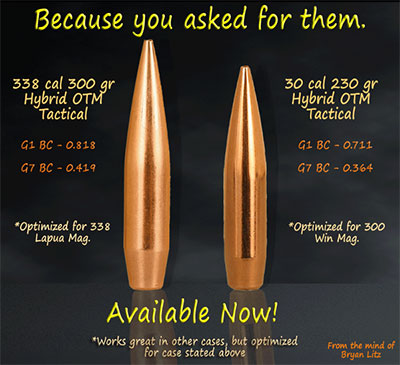
We recently did some extended long range shooting with several rifles at a “secret range” where we could shoot out to one mile. I teamed up with Paul Philips, a highly successful National and International F-TR shooter with several National records. We started out shooting a Sako TRG-42 at 1200 yards. This is the same rifle I shot in Wyoming last year at distances out to 2400 yards. This rifle shoots the new Berger 300gr Hybrids, at 2700 fps. We were pleased to find that the Nightforce NXS 5.5-22x56mm scope has plenty of elevation to get to 1200 yards with this bullet, especially when mounted on a Near Mfg. +45 MOA rail. The drop from a 100-yard zero to 1200 yards was predicted to be 34.75 MOA. The size of that 5-shot group was nothing to brag about (1.5 MOA), but what I found satisfying is that the group center was exactly centered for vertical on the target. That means the calculated .418 G7 BC and all of the other variables that went into this trajectory prediction were spot on.
New .30-Cal Tactical Bullets
Next, we shot the LaRue 7.62 OBR rifle at 1200 yards. This rifle produced a 5-shot group of 9.7″ (.85 MOA) with off-the-shelf Applied Ballistics Tactical ammo loaded with .30-cal 175gr Berger Tactical bullets. These bullets only have a muzzle velocity of 2572 fps from this short barrel, which means that in our conditions they were subsonic past 1000 yards, running 1080 fps at 1200 yard. Going subsonic didn’t prevent the 175gr bullets from shooting a sub-MOA group.
However, I was a little disappointed that the group center was 9″ high (0.8 MOA) compared to the predicted trajectory (657″ drop from a 100-yard zero). Note this 9″ error in predicted drop could be produced by small variances. The 9″ shift could be explained by a 14 fps error in muzzle velocity, or a 2% error in bullet BC, or a 5-yard error in range measurement.
For our final test, I shot Berger’s newest Tactical bullet; the .30-caliber 230gr OTM projectile. This bullet has a tested G7 BC of .368, and a G1 BC of .719. Now this isn’t my most accurate rifle and I haven’t had an opportunity to really work up a good load. As a result, I shot an unimpressive 20″ group (1.8 MOA). But the predicted drop was only off by 2″ (less than 1 click) based on the BC’s listed above.
Shooting .338 Lapua Magnums at One Mile
After shooting at 1200, we lobbed some bullets on an 8’x8′ target at 1760 yards (1 mile). At this range, the TRG-42 put the 300gr Bergers on target with four of five shots in 1/2 MOA with a flyer to make the total group 21″. At this range my group center was 18.5″ (1.1 MOA) higher than predicted. Paul Philips* shot his custom .338 Lapua Magnum rifle. This is a Dave Tooley-built Tac-338 with 30″ Brux barrel, Stiller action, McMillan A-5 stock, and Nightforce NXS 12-42×56. Paul shot at the same target and was able to hold between 1/2 and 1 MOA groups with the same 300gr Berger Hybrid bullets. Paul’s group centers were also about 1 MOA higher than predicted. This small error in prediction isn’t very troubling though, as we’re not entirely confident in the range measurement. As 1760 yards (one mile) is too far for a direct laser rangefinder measurement, the distance was determined with a combination of GPS and Google maps. At that distance, a range error of just 15 yards (out of 1760) could cause the percieved 1 MOA error in predicted drop. So, if the target were really at 1745 yards, instead of 1760 yards, it would explain why we were hitting 1 MOA high. Alternatively, if BC error were the reason for hitting high, it would suggest the G7 BC for the .338-cal 300gr Berger Hybrid is .427, as opposed to the currently advertised .418; a 2% difference.
The Joy of Ultra-Long-Range Shooting
For me, the thrill of shooting these extreme long ranges isn’t just about the group sizes, but the accuracy with which the trajectory can be predicted. The shooter who understands ballistics and inputs the right variables should be able to center a 1.5 MOA group well past 1000 yards. He can be more effective, on targets at extreme ranges, than someone who can shoot an 0.5 MOA group but can’t keep it centered. Of course the most impressive of all is the shooter who can combine precision with accuracy and center the 0.5 MOA group at extreme distances!
In this article, Bryan analyzes the design of long-range bullets, from .22 to .30 caliber. He notes that while 30-caliber bullets can have very high ballistic coefficients, 30-caliber bullets must be very heavy to match the BCs of the 6.5mm and 7mm projectiles. As the chart below shows, it takes a 240gr 30-caliber bullet to match the G7 BC of a 180gr 7mm VLD. But most 30-caliber shooters don’t use those ultra-heavy projectiles because the recoil is excessive and because it takes a monster cartridge burning lots of powder to drive 240-grainers to optimal velocities. Litz notes: “Heavy recoiling rifles are harder to shoot accurately. Even if a shooter overcomes the mental aspect of heavy recoil, the ‘system’ is more sensitive to minor imperfections in shot execution. This may be another reason that drives .30 cal shooters down to the ‘middleweight’ 190-grain class bullets instead of the proportionally heavy 220-240 grain bullets.”
Litz concludes that the heavy 7mm bullets are a better choice than the biggest 30-calibers (except in unlimited weight “heavy guns” where recoil is not a factor.) Bryan writes: “Even a moderate 7mm chambering is capable of delivering 2800 to 3000 fps with the heavy 7mm bullets, much faster with magnums. The heaviest .30 cal bullet requires a big magnum just to get to 2800 fps. So the first problem is: you can’t get the heavy .30 cal bullets going as fast as the heavy 7mm bullets! Even if you could get the same muzzle velocities from the heavy .30 cal bullets, it would take much more powder to do it, barrel life would suffer, and you’ve only achieved parity with the 7mm. The various negative effects of the incredible recoil are really just the ‘nail in the coffin’ for the heavy .30 caliber bullets.”
Bryan’s Updated Second Edition Ballistics Book
If you are interested in learning more about bullet design and ballistics, check out Bryan’s book, Applied Ballistics for Long Range Shooting. This highly-respected resource, now in its second edition, includes experimentally-measured Ballistic Coefficient (BC) data for over 236 long range bullets of various makes. The new edition of Applied Ballistics was upsized to 7″x10″ and Bryan added two new chapters, while updating the existing chapters. Bryan’s book comes complete with a CD containing Version 2.0 of the Point Mass Ballistics Solver. CLICK HERE to order Litz’s book and CD for $49.95.


 The October issue of Shooting Sports USA is now available. The October issue features complete coverage of the 2011 National Rifle and Pistol Championships at Camp Perry in an extended 42-page issue. The Smallbore, High Power, and Long Range phases of the National Rifle Championships are all covered in this issue, as well as the National Defense Match. You’ll find links to videos describing the National Trophies. There’s even a special note on how to stay in one of the historic huts on the Camp Perry base.


 1. Share a Ride to Matches. With gas costing close to $4.00 per gallon in many areas of the country, fuel has become a significant part of an active shooter’s hobby budget. Yet over 90% of shooters drive solo to matches, often in large, gas-guzzling trucks. If you drive 100 miles roundtrip to attend a match in a 20-mpg vehicle, you’re going to burn nearly $20.00 worth of gas total out and back. By simply sharing the ride with one fellow shooter you can cut your fuel expenditures in half.
 2. Use Discount Codes to Save. It’s always smart to check for discount codes before you buy. In the Daily Bulletin, we regularly highlight important sales, and we provide discount Coupon Codes when available. By using discount codes when shopping online, you can typically save 10-15% on your purchases. For example, right now Sinclair Int’l is running a
 3. Gang Powder and Primer Purchases. Every time you order powder and primers you’ll need to pay a hazardous materials (hazmat) transport fee, which costs $25.00 – $30.00. If you do a joint buy with other shooters, you can ship more powder and primers on a single hazmat fee, effectively reducing your components cost. For example, if you buy 3 pounds of powder at $20/lb with a $25.00 hazmat fee your actual cost (before shipping) is $28.33 per pound. If instead if you buy 30 pounds of powder at $20.00/lb, the actual cost with hazmat is just $20.83 per pound. Moreover, when you buy in bulk, you can usually save significantly on the powder itself. At
 4. Shop for “Demo” Optics. Modern high-quality optics can easily cost $1500.00 or more, often exceeding the value of the rifle on which they are mounted. However, you can often save 20-30% by purchasing demo optics. These are normally display units used at trade shows. They may have slight ringmarks, but otherwise they are “as new”, having never been carried in the field or used on a rifle that has fired live ammo. When purchasing demo scopes, you should always ask about the warranty before consummating the sale. However, most demo scopes from name-brand manufacturers come with full factory warranties.
 5. Train with Rimfire Rifles. The true cost of shooting a match-grade centerfire rifle, when you consider barrel wear, approaches $1.00 per round.
 6. Check Out the Forum Classifieds. There are great deals to be found every day in the AccurateShooter


 6.5 Creedmoor Brass No Longer Washed After Annealing


 Once the barreled action was complete and the AI chassis was successfully milled, Frank applied a tan Cerakote finish to the barreled action. This would give a proper tactical look to the rifle, while providing superior corrosion resistance for the metal parts. To learn more about Cerakote finishing, check out the
 By the end of his load testing session, Frank was getting good groups with Hornady 120gr GMX factory 6.5 Creedmoor ammo, and really superb groups with handloads. The 120gr GMX ammo “was going 3100 fps with no ill effects”. The best handloads were approaching 1/4 MOA for three shots, and Frank’s load with Berger 130 VLDs shot even smaller than that: “In my opinion the load development we did was worth its weight in gold. Where else can you build in a rifle in two days, then go out and develop a baseline load using everything from 120gr ammo to 140gr ammo with a few in between? My favorite load and clearly the rifle’s too, was the [Berger] 130gr VLD. This gave us great velocity, awesome groups [with some one-holers] and really nice results at distance.”


 New .30-Cal Tactical Bullets


 Litz concludes that the heavy 7mm bullets are a better choice than the biggest 30-calibers (except in unlimited weight “heavy guns” where recoil is not a factor.) Bryan writes: “Even a moderate 7mm chambering is capable of delivering 2800 to 3000 fps with the heavy 7mm bullets, much faster with magnums. The heaviest .30 cal bullet requires a big magnum just to get to 2800 fps. So the first problem is: you can’t get the heavy .30 cal bullets going as fast as the heavy 7mm bullets! Even if you could get the same muzzle velocities from the heavy .30 cal bullets, it would take much more powder to do it, barrel life would suffer, and you’ve only achieved parity with the 7mm. The various negative effects of the incredible recoil are really just the ‘nail in the coffin’ for the heavy .30 caliber bullets.”


