The Pew Pew Tactical website has interesting article on rifle and pistol cartridges and bullet types. This contains a large selection of interesting photographs and illustrations. If you load and/or shoot for a wide variety of cartridge types, you’ll find that article well worth reading. It has nearly 50 photographs and more than a dozen short videos. READ FULL Article.
The article shows all types of pistol bullets, along with a variety of rifle projectiles. It even illustrates multiple types of shotshell cartridges.
The article also explains the basic components of modern cartridges –bullet, case, powder, and primer:
Photo courtesy Ammunitiontogo.com which sells ammo from many leading brands.
Popular Cartridge Types Profiled
The article provides quick summaries of popular ammunition types including 9mm Luger (9x19mm), .357 Magnum, .40 SW, .45 ACP, .223 Rem, and .308 Winchester. The author’s favorite pistol round is the 9mm Luger: “9mm is my personal favorite and if there was a “Goldilocks” round, this would be it. The very first gun I bought was a 9mm. They’re fun at the range. They’re good for defense. It is the standard round for NATO countries and the majority of police forces around the world. It is mild shooting, can vary in weight from 115 to 147 grains, and has varying stopping power based on the type of bullet.”
This Pew-Pew Tactical guide to cartridge types also provides a quick explanation of cartridge ignition — both centerfire and rimfire: “The rimfire’s primer is built into the rim while the centerfire cartridge has the primer in the center. Pro tip — if you can see a circle in the middle…it’s a centerfire cartridge.”
There are two common types of centerfire primers — Boxer and Berdan. This helpful Wikipedia illustration shows how Boxer, Berdan, and rimfire primers ignite the powder in the cartridge:
This centerfire and rimfire ignition animation is by BBODO – Own work, CC BY-SA 3.0 licensed under the Creative Commons Attribution-Share Alike 3.0 license.
With major forest fires this past year in Western states, many have wondered about hazards faced by gun owners in fire zones. This important video shows what really happens when loaded ammunition burns. You will probably be surprised. Contrary to Hollywood notions, the ammo doesn’t ignite in a massive explosion. Far from it… basically the rounds “cook off” one by one, and the bullets release at relatively low velocity. We’ve featured this SAAMI research project before, but it is worth reprising for those who have not yet seen the burn tests.
A few years back, SAAMI released an important video concerning ammo and fire. With professional fire-fighters standing by, over 400,000 rounds of ammo were incinerated in a series of eye-opening tests. If you haven’t had the chance to view this video yet, you should take the time to watch it now
The Sporting Arms and Ammunition Manufacturers’ Institute (SAAMI) has produced an amazing 25-minute video that shows what actually happens to sporting ammunition involved in a fire. This video shows the results of serious tests conducted with the assistance of professional fire crews. We strongly recommend you watch this video, all the way through. It dispels many myths, while demonstrating what really happens when ammunition is burned, dropped, or crushed.
Watch SAAMI Ammunition Testing Video
Video Timeline
2:10 Impact Test (ignited outside firearm)
3:40 65-foot Drop Test
5:08 Bullet Impact (.308 Win firing)
7:55 Blasting Cap Attacks
9:55 Bulldozer and Forklift Tests
12:20 Boxed Ammo Bonfire
15:37 Bonfire without Packaging
17:21 Retail Store Simulation Burn
20:55 Truck Trailer Burn
Over 400,000 rounds of ammunition were used in the tests. Some of the footage is quite remarkable. Testers built a bonfire with 28,000 rounds of boxed ammo soaked in diesel fuel. Then the testers loaded five pallets of ammo (250,000 rounds) in the back of a semi-truck, and torched it all using wood and paper fire-starting materials doused with diesel fuel.
The video shows that, when ammo boxes are set on fire, and ammunition does discharge, the bullet normally exits at low speed and low pressure. SAAMI states: “Smokeless powders must be confined to propel a projectile at high velocity. When not in a firearm, projectile velocities are extremely low.” At distances of 10 meters, bullets launched from “cooked-off” ammo would not penetrate the normal “turn-out gear” worn by fire-fighters.
We are not suggesting you disregard the risks of ammo “cooking off” in a fire, but you will learn the realities of the situation by watching the video. There are some amazing demonstrations — including a simulated retail store fire with 115,000 rounds of ammo in boxes. As cartridges cook off, it sounds like a battery of machine-guns, but projectiles did not penetrate the “store” walls, or even two layers of sheet-rock. The fire crew puts out the “store fire” easily in under 20 seconds, just using water.
Additional Testing: Drop Test, Projectile Test, Crush Test, Blasting Cap Test
Drop Test
The video also offers interesting ammo-handling tests. Boxes of ammo were dropped from a height of 65 feet. Only a tiny fraction of the cartridges discharged, and there was no chain-fire. SAAMI concludes: “When dropped from extreme heights (65 feet), sporting ammunition is unlikely to ignite. If a cartridge ignites, it does not propagate.”
Rifle Fire Test
SAAMI’s testers even tried to blow up boxes of ammunition with rifle fire. Boxes of loaded ammo were shot with .308 Win rounds from 65 yards. The video includes fascinating slow-motion footage showing rounds penetrating boxes of rifle cartridges, pistol ammo, and shotgun shells. Individual cartridges that were penetrated were destroyed, but adjacent cartridges suffered little damage, other than some powder leakage. SAAMI observed: “Most of the ammunition did not ignite. When a cartridge did ignite, there was no chain reaction.”
Bulldozer Crush Test
The test team also did an amazing “crush-test” using a Bulldozer. First boxes of loaded ammo, then loose piles of ammo, were crushed under the treads of a Bulldozer. A handful of rounds fired off, but again there was no chain-fire, and no large explosion. SAAMI observed: “Even in the most extreme conditions of compression and friction, sporting ammunition is unlikely to ignite. [If it does ignite when crushed] it does not propagate.”
Blasting Cap Test
Perhaps most amazingly, the testers were not able to get ammunition to chain-fire (detonate all at once), even when using blasting caps affixed directly to live primers. In the SAAMI test, a blasting cap was placed on the primer of a round housed in a large box of ammo. One cartridge ignited but the rest of the boxed ammo was relatively undamaged and there was no propagation.
As a Labor Day Weekend bonus for our readers, we thought we’d celebrate the beauty of highly-figured wood with a collection of custom rifles. In our Shooters’ Forum, there is a long-running Gun Glamour thread that showcases many beautiful wood-stocked rifles. Today we feature some very handsome rifles from that Forum Thread as well as other rifles we’ve featured in the Daily Bulletin.
Two F-Open Beauties with Walnut Laminates
Cerus-stocked Special from Cigarcop
Forum member Keith W. (aka “Cigarcop”) of KW Precision LLC is a talented riflesmith whose projects display outstanding finish work and attention to detail. Keith does some of the best bedding work we’ve ever seen. Back in 2018, Keith built a stunning .284 Win F-Class rig for a shooter in Delaware. It’s a beauty, that’s for sure.
Check out the stunning Cerus F-Open stock. This features multiple laminations with highly-figured Walnut on the sides. This certainly ain’t your “off-the-shelf” laminated stock. This just shows the beauty that can be achieved with carefully-chosen lamination layers (plus 12 coats of clear).
This beautiful F-Open rig features a laminated wood stock with stunning figured walnut on the outside.
A Beauty for the Boss (of Grizzly.com)
This F-Class rifle belongs to Shiraz Balolia, Chairman/CEO of Grizzly Industrial. Shiraz finished the stock himself: “I installed the bottom wider track for my rear bag and also carved out the finger grooves in the grip. The blank was quite long so I cut off approximately two inches from the front end of each stock and also deepened the large tracking cavity under the fore-end. I went ahead and inlaid my name in Mother-of-Pearl on the Walnut stock.” The stock was then sent to Sims Guitar Finishing for clear coating with “wet look” finish. This rifle is chambered for the .300 Shiraz wildcat, an improved .300 WSM.
F-0pen Stock made of highly-figured Walnut with Curly Maple inner laminations.
Beautiful Rifles from our Forum Gun Glamour Thread
Here are a variety of handsome wood-stocked rifles from our Forum Gun Glamour thread. In that thread, member Kurz posted a dream gun owned by a friend in England. Kurz included a quote from a book created by the rifle’s owner: “There, with my father’s words ringing in my ears, I shall take that ‘step forward’ and order a perfect machine based on the Mauser ’98 action, built from metal and wood by master craftsmen who truly understand that ‘reliable’ and ‘mechanical integrity’ have as much relevance today as they did all those years ago.”
A gun can “shoot dots” and still be handsome. Here is a short-range benchrest rifle with a stunning, exhibition-grade Walnut stock. Forum member Josh B found this beauty.
Forum member JRS submitted a stunner from Europe. This beauty features a truly exquisite piece of wood with elaborately engraved receiver. It also has escutcheons and special metal work on the grip.
Lever-action Falling Block rifles can be beautiful too. This one features a color case-hardened receiver and handsome two-piece fancy wood stock. This was submitted by Forum member Kurz who notes: “Besides exhibition grade walnut, I like the variations available in spalted maple for rifle stocks.”
Here is member Oldduc’s Stevens 44 1/2, .38-55 Black Powder Cartridge Rifle, with an extra .218 Mashburn Bee barrel. Very nice blueing along with the figured wood stocks and fore-arms.
A competition rifle must be “performance first”. But that doesn’t mean they can’t be handsome too. Forum member XTR’s rifle, an F-TR rig, features Maple wood with Bubinga tips.
Here is “something completely different” — a classic lever-activated Martini Martini Cadet chambered in .20 Vartarg (rimmed). Look at the figure on that fore-end. Remarkable!
And wood can work for Benchrest rifles too, when cleverly fashioned in thin carbon-reinforced laminates. Photo from member mdman352.
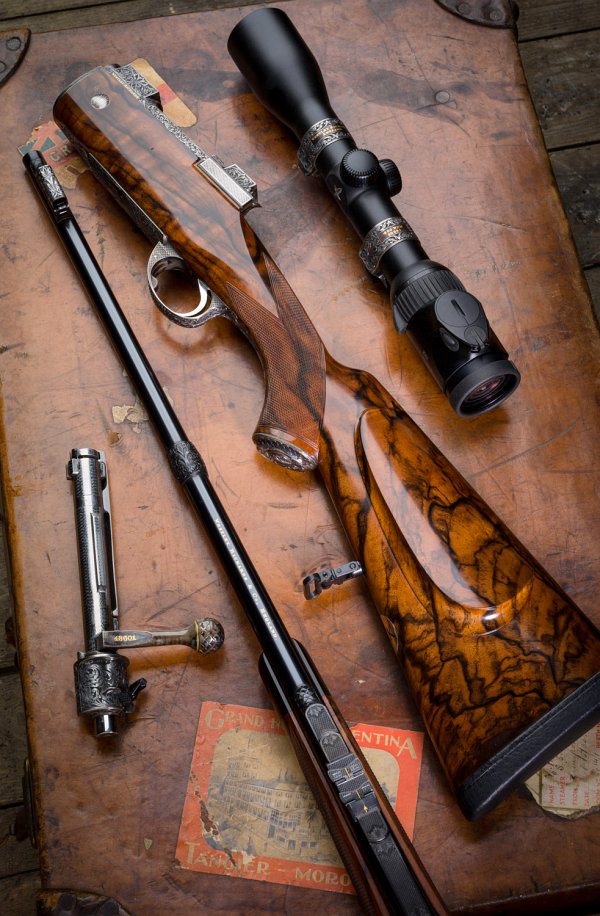
“Wood is Good” — as demonstrated by all the rifles showcased above. In the photo below, master stock-builder Doan Trevor handcrafts a highly-figured wood stock.
Do you occasionally get completely unexplained flyers, or have a shot land straight down at 6 O’Clock, right below your point of aim? That could be caused by poor or inconsistent trigger technique. How you pull the trigger can and does affect your accuracy.
Many gun enthusiasts start with pistols. When they later start shooting rifles they may carry over some not-so-good practices acquired from shooting handguns with heavy 4 to 6-pound trigger pulls. You may want to “re-learn” your trigger techniques to get better rifle results.
Shooting Sports USA has a good article on trigger technique that offers many useful tips. That article also has many helpful illustrations, including the one shown above. Another illustration shows different types of trigger shoes (straight vs. curved) and explains how each makes a difference: “With a lightly curved trigger, the shooter’s finger can contact the trigger either high or low according to preference. Higher contact will increase the resistance.” READ ARTICLE HERE.
The article analyzes common errors, such as pulling the trigger with the very tip of the finger rather than the pad of the index finger: “Using the tip of the finger can lead to lateral pressure on the trigger, which throws off the shot.”
The article also explains that you should check your trigger regularly to make sure it is functioning properly and is not out of adjustment: “Just like any other moving part, the trigger can suffer from wear. In such a precise mechanism, tiny amounts of wear can cause major problems.”
The ergonomics of the Eliseo Tubegun allow a nice, straight trigger pull.
Trigger Tips
Six Suggestions for Making your Trigger Control More Consistent.
1. If your triggers are adjustable, set the pull weight appropriate to the discipline. For a hunting rifle, you don’t want an ultra-light trigger pull. For High Power, you may want a two-stage pull, while on a Benchrest rifle you may prefer a very light trigger.
2. If you have a two-stage trigger, experiment with different combinations of First Stage and Second Stage.
3. Have a friend watch you as you pull the trigger, and maybe even take a close-up video as you pull the trigger. This can reveal a variety of flaws.
4. Practice dry-firing to see if flaws in trigger technique are causing gun movement.
5. As an experiment, try pulling the trigger with your middle finger. Ergonomically, the middle finger has a more straight alignment with the tendons in your hand. This exercise can help you identify alignment issues with your index finger.
6. For stocks with adjustable Length of Pull you may want to set the LOP differently for bench shooting vs. prone or F-Class shooting.
When Only the Best Will Do…
German-made Bix’N Andy triggers, available from BulletCentral.com, are among the very best you can buy. Available in both single-stage and two-stage, Bix’N Andy triggers are extremely precise, repeatable and smooth. The unique internal, friction-reducing roller ball system allows for extremely low reset force, yielding an ultra-crisp let-off. Bix’N Andy triggers can be fitted with a variety of trigger shoes according to shooter preference.
Make sure your firearms are stored securely. The NSSF’s Gun Storage Check Week runs September 1-7, 2024. This national awareness campaign is intended to ensure gun owners store their firearms securely, both to prevent theft and to reduce the risk of misuse and suicide.
Secure firearm storage is the most effective way to help prevent firearm accidents, suicides, and theft. Many secure storage options are available, including lock boxes, cable locks, and full-size safes, to secure firearms when not in use in homes and vehicles. When firearms are not under your direct control, you should place them in locked storage. We recommend large, heavy gun safes for rifle and shotgun storage. It’s best to buy a larger, heavier gun safe than you may think you need initially. We recommend your read our Gun Safe Buyers Guide.
We can do more to help prevent firearm-related accidents, suicides and thefts. During Gun Storage Check Week you should review storage practices and make changes, as needed, to prevent unauthorized access. “No one wants their gun in the hands of an unsupervised child, a person in crisis, an individual who lacks knowledge of safely operating firearms or a thief”, says Joe Bartozzi, President and CEO of NSSF.
Opportunity to WIN a FREE Hornady Lock Box
Those who visit GunStorageCheck.org will have the opportunity to win one of many Lock Boxes donated by Hornady. The NSSF will award gun safe prizes not only during September 1-7 but each week during the month of September during National Suicide Prevention Month.
John Whidden is a 6-time National High Power Long Range Champion. He has also won major Palma matches in the USA and abroad. But John’s stellar marksmanship skills are not just limited to long range centerfire shooting. This month John added to his impressive list of shooting titles with a notable victory in the 2024 CMP Smallbore (.22 LR Rimfire) Championship match held at Camp Perry, Ohio.
In today’s Sunday GunDay story, John examines that CMP Championship match and the smallbore match rifle he used. This is a unique, one-of a kind rig, put together with a combination of premium components from multiple manufacturers. John’s ultra-accurate .22 LR rifle features a PQP 2500X action, Tec-Hro Fanatic stock, MullerWorks barrel, Uptagrafft Tuner/Bloop Tube, and Anschutz trigger. For different segments of the smallbore competition the rifle is fitted with iron sights or a Nightforce scope.
CMP Match Report — Whidden Wins Match with Final Shot
The 2024 National Smallbore Prone 6400 Aggregate Championship came down to millimeters. The event was part of the Civilian Marksmanship Program’s 2024 National Matches and was the culmination of four straight days of prone competition. Tight qualification matches saw the top three places separated by one point each, with John Whidden of Nashville, GA, leading the pack on the last leg of the match.
Whidden had been consistent throughout his entire National Matches appearance, having only dropped five points in the previous 15 rounds of the competition. His confidence continued as he took each shot. Then, unexpectedly, he pulled one left — just grazing the edge line of the 10-ring. An eye opener, to be sure.
Despite the close call, he pressed on. “A Prone 6400 Match is a marathon, and this, essentially, was a photo finish,” said Brad Donoho, CMP Smallbore Manager.
Whidden took his final shot, another 10. With a sigh of relief, John packed up his gear and walked off the firing line with a perfect score of 400 and the overall Open win in the Smallbore Prone 6400 Aggregate with a score of 6395-515X. “He finished out the match really strong”, Donoho said. “To see it all come down to the last shot was really incredible.”
Winning 2024 CMP Smallbore Prone Championship at Camp Perry
Report by John Whidden
The 2024 CMP Smallbore Prone National Championships are in the history books now. On the day before the match started, the CMP held a metric Dewar match. This was a bit of a warmup match and was well attended. The course of fire was 30 shots at 50 meters and 30 shots at 100 meters. I knew the match would be exciting as I got out of the car — the wind almost took the car door out of my hands! Yes, it was that kind of day.
Usually at the range, I can read the wind acceptably well, but there are occasionally some days when it just won’t come to me. The metric Dewar session was one of those days that I just couldn’t understand the wind indicators. I finished with a score of 575-24X which was below what I’d hoped for. I was feeling slapped around at this point!
Fortunately, the first day of the prone Championships was better. While still fairly windy, I found it much easier to read and finished up with 1599-103X leading the event. We shot iron sights for the first two days, and on day 2 Levi Clark shot the highest score and made up a point on my lead.
Days 3 and 4 are both shot with scopes on the gun. Usually with these scores, we see fewer points dropped. Shane Barnhart won day 3 with a blistering 1600-149X. Going into the last day I was only 1 point ahead and behind on X count. I knew with this tough group of shooters if I shot a 9 anywhere on day 4 I probably wouldn’t win it. I shot very carefully and tried to protect my points lead even if it meant giving up a few Xs along the way.
The day went well but I had a big scare on the next to the last shot. The wind picked up and I shot a 10.0 (these electronic targets will score in decimals) which is ALMOST a 9. I gathered myself for the last shot and felt my heart beating hard. I knew it had to be a good one because second place Nick Mowrer was breathing down my neck. Thankfully the shot stayed in the 10 Ring and I knew I had won the match.
Unique Rimfire Rifle with Premium Action, Stock, Barrel, & Tuner
The rifle I used for the match had just recently been built in our shop. Since opening the rimfire ammunition test range in May of 2024 we had the chance to observe some top-quality components in testing. After noting what was shooting really well, I decided to order a PQP 2500X action, a MullerWorks barrel, and a Uptagrafft Tuner/Bloop Tube. I had already purchased a Tec-Hro Fanatic aluminum stock suitable for the project and had an Anschutz trigger set aside.
MullerWorks has a highly respected standing for their barrels, especially in the rimfire community. I chose a MullerWorks 1:16″-twist barrel and finished it at 26″ OAL. I fitted a Tuner/Bloop Tube from Uptagrafft to the muzzle. This allows me to make the sight radius longer for iron sight matches and has a tuner integrated into the design.
The parts went together well. In the stock, I modified an action adapter that was intended to fit an Anschutz 54 into the Tec-Hro stock. I placed the action as far rearward in the stock as I could to make reaching the loading port easier. A benefit of the Anschutz trigger is that the trigger shoe is more forward than the Remington-type trigger, and this was a noticeable benefit in allowing the action to be mounted far back in the stock.
Call to Action-Maker about Fitting Anschutz Trigger
These PQP 2500X actions accept Remington pattern triggers but I use Anschutz triggers on all of my other prone guns. Because of familiarity I really wanted the Anschutz trigger on the new rifle. On the day before my action was to arrive I contacted Jerry Stiller who designed the action. I asked Jerry if the tang was long enough to retrofit an Anschutz trigger onto the action (Anschutz triggers are very large). He said he didn’t think it would fit. Well, things went well and the next evening I sent him a picture of my Anschutz trigger installed on the action. It has performed marvelously.
Once the rifle was all fitted and assembled, it was time to go to the test range. I shot through all of the ELEY and Lapua ammunition that we had available. One particular lot of ELEY Tenex and one lot of Lapua Center-X stood out as the winners. I shot several groups with each one and couldn’t determine a winner. Accuracy was excellent with group sizes averaging about 13.3mm (0.52″) outside to outside at 50 meters. The next evening I shot some more of each lot of ammunition and again neither ammo type was clearly better than the other. NOTE: 13.3 mm outside to outside is .303″ center to center.
Trying to break the ammunition tie, I decided to adjust the tuner on the third evening. I worked the tuner back and forth and arrived at the best setting. Up until now, I had shot the rifle with the tuner set as it arrived in the box, in this case setting number 500. On this particular rifle moving the tuner shrunk the group diameter by 4%. On some of my other rifles, I had seen a larger effect in the 14-15% range. I wasn’t unhappy though as the rifle was shooting well and importantly it was doing so very consistently.
When dry-fire training indoors, the rifle is fitted with a device on the end of the barrel that tracks barrel movement and shot location on a special electronic target. The device and target are sold together as the SCATT USB Dry-Fire Shooter Training System.
Secrets of a Rimfire Prone Champion — Whidden Wisdom 1. Shoot a High Volume of Ammo. There is really no substitute for rounds down range. The picture shows hundreds of spent cases — just a fraction of the several thousand rounds of ammo I shot from prone before the national events this summer.
2. Recognize the Difference between Training and Practicing. Training to me means that I have a defined goal that I’d like to achieve during that session. For example I may go shoot a match for training and my goal is to shoot all of my shots in the exact same wind condition and without making a sight adjustment for wind. This would help further my ability to recognize my desired wind condition.
3. Demand Top-level Accuracy from Your Rifle and Ammo. Often shooters are not objective enough about their testing and will excuse a bad shot with “I must have pulled that one” or similar comments. To win matches one needs reliable and durable accuracy across different temperatures and environmental conditions.
Major Benefits of Extensive Rimfire Ammunition Testing
Before the Championship at Camp Perry, I did significant rimfire ammunition testing, which proved very valuable. First I shot 10-round groups of all of the available lots. Next I shot 3 more 10-round groups of the lots that looked most promising. This is the same procedure we use for customer’s rifles when we test them. The worst of the initial 10 round groups was 25.4mm (1 inch) at 50 meters and the best was 12.4mm (0.49″) at 50 meters (measured outside edge to outside edge).
I want to illustrate the value of testing right here. Among the top ammunitions available one lot shot about half the diameter of a different lot. It’s just not possible to buy ammunition at random and expect the very best accuracy that way. The ammunition I chose averaged 13.3mm (0.52″) outside edge to edge at 50m across several groups. I decided to shoot the ELEY Tenex in the end. The performance of both ammunitions was equal but another of my rifles also shoots well with this lot of Tenex so that’s a bonus. Don’t think I didn’t also grab some of that Lapua Center-X and set it back for the right occasion!
Whidden Gunworks operates a state-of-the-art ammunition testing facility. You can visit the facility or ship your rifle to be tested with different lots of rimfire ammo. The Whidden facility features two testing lanes — one for testing ELEY ammo at 50 meters and a second for testing other brands (e.g. Lapua, SK, Norma, and RWS) at both 50 meters and 100 meters simultaneously, registering results for BOTH distances. For more info, visit Whiddengunworks.com/ammunition-testing.
Are you looking to get started in PRS and NRL practical precision rifle competition? Or perhaps you’d like to advance your skill set so you can place higher in big matches (and get your hands on those prize table items)? Of course there is no substitute for trigger time in the field, but there ARE some great print resources. These four books can help you select the right equipment, improve your shooting skills, make better wind calls, increase your fitness, and develop a more efficient between-match training program.
1. Precision Rifle Marksmanship: The Fundamentals
Frank Galli, $20.50 Paperback, $15.99 Kindle
Frank Galli (aka “LowLight”) is the founder/head honcho of SnipersHide.com, the most active tactical community on the internet. Galli is also a retired USMC scout-sniper. Practical Precision Rifle shooting is one of the hottest trends in competitive shooting today. PRS and NRL matches draw big turn-outs and boast impressive prize tables. Galli’s Precision Rifle Marksmanship (#ad) book covers the fundamentals of precision marksmanship with easy-to-understand methodology. The book uses the same instruction process that Galli uses in his live marksmanship classes.
As Sniper’s Hide guru Frank Galli explains, there is no voodoo when it comes to precision rifle marksmanship, but there are techniques that, when practiced, make the difference between good marksmanship and great marksmanship. Understanding the reasons that a bullet hits or doesn’t hit its intended target at ultra-long distances is a crucial element to learning. Galli’s explanations of how to understand and compensate for wind speed and direction are excellent — great wind-reading advice.
Published in 2020, this 272-page well-illustrated book covers the latest equipment (scopes, LRFs, chassis systems, mags, bags, bipods, tripods) favored by tactical competitors in PRS/NRL type matches.
2. Long Range Shooting Handbook
Ryan Cleckner, $22.46 Paperback, $9.99 Kindle
Ryan Cleckner’s Long Range Shooting Handbook (#ad) is the best-selling modern book on practical rifle skills. A former U.S. Army sniper instructor, Cleckner is knowledgeable, and his text is well-organized and chock full of good information. You can view Sample Chapters on Amazon.com.
Ryan Cleckner’s highly-regarded Long Range Shooting Handbook is designed as an intro to important fundamental concepts such as MOA vs. Mils, External Ballistics, and Environmental Effects. Included are personal tips and advice based on Cleckner’s years of experience as a sniper instructor and special operations sniper.
The Long Range Shooting Handbook is divided into three main categories: What It Is/How It Works, Fundamentals, and How to Use It. “What It Is/How It Works” covers equipment, terminology, and basic principles. “Fundamentals” covers the theory of long range shooting. “How to Use It” gives practical advice on implementing what you’ve learned, so you can progress as a skilled, long range shooter. This book will benefit any long-range shooter, not just PRS/NRL competitors.
3. IMPACT! — Training and Preparing for Precision Rifle Matches
Rodney Maze, $14.99 Paperback, $4.99 Kindle
Impact!, by PRS competitor Rodney Maze, is an entry/intermediate level guide to preparing yourself and your equipment to compete in precision rifle type matches. It will also benefit anyone looking to learn about practical-style long range and precision shooting. We recommend you check it out for yourself — there are 20 Pages of free sample content (#ad) on Amazon. Topics covered include:
— Rifle, optic, and equipment selection
— Setting up your rifle, bags, tripods for PRS/NRL matches
— Understanding ballistics and how to record and use ballistic data
— Techniques for using holdovers for multi-target stages
— Gun skills, rapid fire techniques, clearing malfunctions
— Shooting off of barricades, and specialty stages
— Effects of wind and how to improve your wind calls
— Tips for live fire and dry fire practice
— Preparing yourself and your equipment for a match
— Mental strategies and techniques
Impact! is illustrated with plenty of photographs. Topics are divided logically, and concepts are explained in clear language. Also included is an extensive glossary of terms used in precision shooting and a list of additional resources you can use to further pursue your precision shooting knowledge. This book also includes a handy Appendix with formatted pages for recording data about your rifle, scope, and ammunition. There is also a Wind table for recording your rifle “dope” and wind hold-offs. Lastly, Impact! has a useful table of unit conversions.
4. Practical Shooter’s Guide
Marcus Blanchard, $19.99 Paperback, $9.99 Kindle
Thinking of getting started in the Practical/Tactical shooting game? Looking for ways to be more stable when shooting from unconventional positions? Then you may want to read Marcus Blanchard’s Practical Shooter’s Guide (A How-To Approach for Unconventional Firing Positions and Training) (#ad). Unlike almost every “how to shoot” book on the market, Blanchard’s work focuses on the shooting skills and positions you need to succeed in PRS matches and similar tactical competitions. Blanchard provides clear advice on shooting from barricades, from roof-tops, from steep angles. Blanchard says you need to train for these types of challenges: “I believe the largest factor in the improvement of the average shooter isn’t necessarily the gear; it’s the way the shooter approaches obstacles and how they properly train for them.”
As an Amazon affiliate, this site can earn revenues through sales commissions.
Hunting season is starting soon. We know many of our readers will be driving to other states. If you plan to travel across state lines with your guns, this book can really help. With over 100 changes from last year, the 2024 edition of Traveler’s Guide to the Firearm Laws of the Fifty States is a must-read for anyone planning to travel around the country with firearms. In addition, the book also covers the firearms travel laws for Canada and Mexico.
For $15.95 you can purchase a state-by-state Traveler’s Guide to firearms laws. This book can help ensure you comply with all state laws during your trip. Highways Magazine states: “If you carry a weapon in your rig, you need this book.” This 68-page guide covers all firearms types and all 50 states. It even has info for Canada and Mexico. The Traveler’s Guide to the Firearm Laws of the Fifty States has sold more than 2,000,000 copies since it was first released in 1996.
This 27th edition of the Traveler’s Guide covers important topics such as carry of firearms in a motor vehicle, concealed carry reciprocity, which states preempt local gun regulation, tips on handling a traffic stop, concealed carry in state and National Parks, vehicle carry and possession on college campuses and much more. Best of all, the text is in plain, easy-to-read English.
Written and researched by J. Scott Kappas, an attorney and Class III Firearms Dealer, the 2024 Traveler’s Guide has a preface that defines many key terms important for anyone traveling with a firearm across state lines. The latest edition also has new formatting for easier reading.
The Traveler’s Guide is especially useful for shooters traveling in RVs and motorhomes. The American Rifleman Magazine declared: “This book is a must-have for truck drivers, motor home enthusiasts, campers and other travelers…easy to read and understand, well-organized and concise….” One reader from Texas adds: “I used to think that my RV was the same as my home when it came to gun carry….the Traveler’s Guide set me straight. Now I know my motorhome is subject to the same laws as any vehicle when it comes to guns.”
Many barrel-makers mark the twist rate and bore dimensions on their barrel blanks.
Does muzzle velocity change with faster or slower barrel twist rates? Absolutely, but much less than you might think. Faster twist rates do slow down bullets somewhat, but the speed loss is NOT that significant. With Bartlein .308 Win barrels of identical length and contour, a 1:12″-twist barrel was only 8 fps faster than a 1:8″-twist barrel. That was the result of testing by Applied Ballistics.
The Applied Ballistics team tested six (6) same-length/same-contour Bartlein barrels to observe how twist rate might affect muzzle velocity. This unique, multi-barrel test is featured in the book Modern Advancements in Long Range Shooting, Vol. 1. That book includes other fascinating field tests, including a comprehensive chronograph comparison.
Barrel Twist Rate vs. Velocity — What Tests Reveal by Bryan Litz
When considering barrel twist rates, it’s a common belief that faster twist rates will reduce muzzle velocity. The thinking is that the faster twist rate will resist forward motion of the bullet and slow it down. There are anecdotal accounts of this, such as when someone replaces a barrel of one brand/twist with a different brand and twist and observes a different muzzle velocity. But how do you know the twist rate is what affected muzzle velocity and not the barrel finish, or bore/groove dimensions? Did you use the same chronograph to measure velocity from both barrels? Do you really trust your chronograph?
Summary of Test Results
After all the smoke cleared, we found that muzzle velocity correlates to twist rate at the average rate of approximately 1.33 FPS per inch of twist. In other words, your velocity is reduced by about 5 FPS if you go from a 1:12″ twist to a 1:8″ twist. — Bryan Litz
Savage Test Rifle with Six Bartlein Barrels
Most shooters don’t have access to the equipment required to fully explore questions like this. These are exactly the kinds of things we examine in the book Modern Advancements in Long Range Shooting, Vol. 1. In that book, we present experiments conducted in the Applied Ballistics lab. Some of those experiments took on a “Myth Buster” tone as we sought to confirm (or deny) popular pre-conceptions. For example, here’s how we approached the question of barrel twist and muzzle velocity.
Six .308 Win Barrels from Bartlein — All Shot from the Same Rifle
We acquired six (6) barrels from the same manufacturer (Bartlein), all the same length and contour, and all chambered with the same reamer (SAAMI spec .308 Winchester). All these barrels were fitted to the same Savage Precision Target action, and fired from the same stock, and bench set-up. Common ammo was fired from all six barrels having different twist rates and rifling configurations. In this way, we’re truly able to compare what effect the actual twist rate has on muzzle velocity with a reasonable degree of confidence.
Prior to live fire testing, we explored the theoretical basis of the project, doing the physics. In this case, an energy balance is presented which predicts how much velocity you should expect to lose for a bullet that’s got a little more rotational energy from the faster twist. In the case of the .30 caliber 175 grain bullets, the math predicts a loss of 1.25 fps per inch-unit of barrel twist (e.g. a 1:8″ twist is predicted to be 1.25 fps slower than a 1:9″ twist).
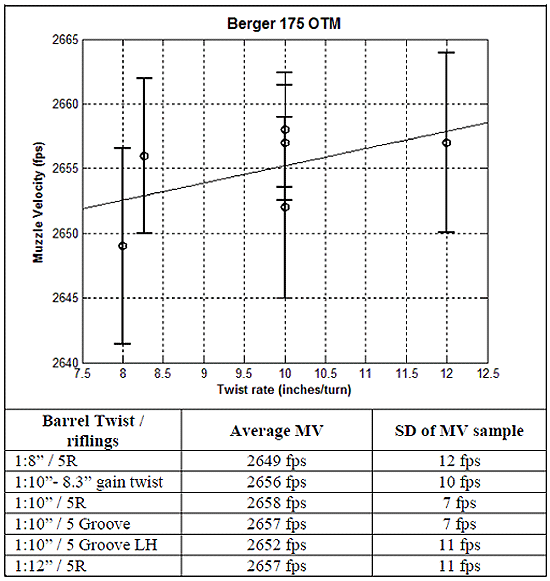
Above, data shows relationship between Twist Rate and Muzzle Velocity (MV) for various barrel twist rates and rifling types. From fast to slow, the three 1:10″ twist barrels are: 5R (canted land), 5 Groove, 5 Groove left-hand twist.
We proceeded with testing all 6 barrels, with twist rates from 1:8″ to 1:12″. After all the smoke cleared, we found that muzzle velocity correlates to twist rate at the average rate of approximately 1.33 fps per inch of twist. In other words, your velocity is reduced by about 5 fps if you go from a 1:12″ twist to a 1:8″ twist. [Editor: That’s an average for all the lengths tested. The actual variance between 1:12″ and 1:8″ here was 8 FPS.] In this case the math prediction was pretty close, and we have to remember that there’s always uncertainty in the live fire results. Uncertainty is always considered in terms of what conclusions the results can actually support with confidence.
This is just a brief synopsis of a single test case. The coverage of twist rates in Modern Advancements in Long-Range Shooting Vol. 1 is more detailed, with multiple live fire tests. Results are extrapolated for other calibers and bullet weights. Needless to say, the question of “how twist rate affects muzzle velocity” is fully answered.
Other chapters in the book’s twist rate section include: · Stability and Drag — Supersonic
· Stability and Drag — Transonic
· Spin Rate Decay
· Effect of Twist rate on Precision
Other sections of the book include: Modern Rifles, Scopes, and Bullets as well as Advancements in Predictive Modeling. This book is sold through the Applied Ballistics online store. Modern Advancements in Long Range Shooting is also available as an eBook in Amazon Kindle format.
Long Range Scope for Hunters — Quigley-Ford Dual Focal Plane
By James Mock
I recently tested a 5-20x50mm Quigley-Ford Dual Focal Plane Scope. This unique $3049.00 optic essentially offers DUAL focal reticles. The primary reticle is in the First Focal Plane while there is a SECOND reticle in the Second Focal plane. How is that possible? The scope is basically a First Focal Plane one, but there is an secondary Second Focal Plane reticle that does not change size (or thickness) when the magnification level changes. Quigley-Ford states: “The ONLY long range scope that is built with dual focal plane capability (without electronics or batteries) to make it effective for both long range shots AND close up.” The design holds U.S. Patent #D943050. This scope is assembled in Canada with German-crafted HD multi-coated lenses and a main tube from China.
The manufacturer explains: “The patented Dual Focal Plane scope provides a super bold Second Focal Plane etched aiming point … on all power settings PLUS a First Focal Plane reticle to provide the ability to shoot at any distance on any power. With this innovative combination a hunter in near darkness, using the lowest power setting can still pick up an aiming point on an animal with ease.” See how it works:
As seen in the photo, the two dark horizontal lines are in the second focal plane and are there to aid the “hunter” when the power is turned down and the fine cross hairs are difficult to see. This is an ingenious arrangement that allows one to use low power settings in dim light without losing sight of the reticle. NOTE: When ordering one of these scopes, one must give Randy Ford the particulars of the load to be shot. The required data includes caliber, bullet weight, bullet BC, and velocity. My load data sent to Randy was: 32.2 grains Varget, CCI 400 SR primer, 108gr Berger BT at 2910 FPS.
Randy emphasized that there are other factors to consider such as altitude, but his reticle is seldom off on distant targets more than 2 inches. He repeated that his system is designed for the hunter to quickly find an aiming point. They recommend a default altitude of 5000 feet. That way the reticle will still be very effective from sea level to 10,000 ft.
To set up the FFP system, one zeroes the rifle at 200 yards. The center crosshair will be for 200 yards with hash marks to 1000 yards with smaller marks between the longer 100-yard marks.
In the photos below, I first shot over the chronograph to check my velocity. It is very important to match the velocity for which the reticle was designed. The velocity was within a few FPS of the velocity I provided to Randy. His system utilizes marks for hold-over rather than having to dial the scope. It is a very ingenious system. Although I am 79 years old, I still enjoy shooting. I wish I could have had a scope like this one when shooting at a mule deer in Colorado back in 1980. After checking velocity, one must obtain a 200-yard zero. I did this at my friend Kent Bennett’s 200-yard range…on which I have shot for many years. My rifle is a Stolle Panda with 28″, 1:7.5″-twist Krieger barrel chambered in 6mm Dasher.
Speaking of Kent, he was impressed with his initial contact with this scope. He stated that the optics were very sharp and clear. I will add that the adjustments were spot on and the parallax was easily removed. My next trip to the range was to another friend’s 600-yard range.
Parallax Adjustment: Side-focus
Click Adjustments: 1/4″ @ 100 yards
Length: 15.75″ plus sunshade
Weight: 25.5 ounces
Finish: Matte black
With the preparations completed, I took my Dasher with the Quigley-Ford scope to a friend’s range. He had targets set up at 200, 300, 400, and 600 yards. The morning was foggy with light drizzle, but the rain held off until I finished the test.
I started by checking my 200-yard zero and it was close, although not perfect. Next, I shot 300 yards, 400 yards, and at a 600-yard steel gong. The 300-yard shot (shown at right) was perfect except for being a tad right. I was very satisfied with the results so far. I skipped 500 yards temporarily, but went to the gong at 600 yards. There was a very satisfying “bong!” when the 108gr bullet arrived. This showed that the scope can provide precise elevations for distances from 200 to 600 yards.
I then set up a plywood dummy deer (crafted by my son years ago) at 500 yards and shot it twice. One shot was with the 108gr Berger BT and the other was with a 105gr, Bart’s VLD. Both were about 2910 FPS and have a BC that is very close. When I went to the target, I was pleasantly surprised in that the bullets were close to center and less than 1 inch apart. Both were 10s and one was an “X”.
Conclusion: I will continue more testing of this Dual Focal Plane scope. So far, I find that it is a very worthwhile addition to a long-range hunter’s rifle. I was amazed at how precise the reticle was from 200 to 600 yards. The Dual Focal Plane functionality is unique and very useful — offering the “best of both worlds” for hunting — you have a highly visible horizontal bar, combined with a FFP reticle which allows precise holds at multiple ranges. Stay tuned, James Mock.


 Popular Cartridge Types Profiled

 The Sporting Arms and Ammunition Manufacturers’ Institute (
 We are not suggesting you disregard the risks of ammo “cooking off” in a fire, but you will learn the realities of the situation by watching the video. There are some amazing demonstrations — including a simulated retail store fire with 115,000 rounds of ammo in boxes. As cartridges cook off, it sounds like a battery of machine-guns, but projectiles did not penetrate the “store” walls, or even two layers of sheet-rock. The fire crew puts out the “store fire” easily in under 20 seconds, just using water.







 Whidden had been consistent throughout his entire National Matches appearance, having only dropped five points in the previous 15 rounds of the competition. His confidence continued as he took each shot. Then, unexpectedly, he pulled one left — just grazing the edge line of the 10-ring. An eye opener, to be sure.


 Written and researched by J. Scott Kappas, an attorney and Class III Firearms Dealer, the 2024 Traveler’s Guide has a preface that defines many key terms important for anyone traveling with a firearm across state lines. The latest edition also has new formatting for easier reading.




 With the preparations completed, I took my Dasher with the Quigley-Ford scope to a friend’s range. He had targets set up at 200, 300, 400, and 600 yards. The morning was foggy with light drizzle, but the rain held off until I finished the test.


