What is Parallax?
Parallax is the apparent movement of the scope’s reticle (cross-hairs) in relation to the target as the shooter moves his eye across the exit pupil of the riflescope. This is caused by the target and the reticle being located in different focal planes.
Why is it Important?
The greater the distance to the target and magnification of the optic, the greater the parallax error becomes. Especially at longer distances, significant sighting error can result if parallax is not removed.
How to Remove Parallax
This Nightforce Tech Tip video quickly shows how to remove parallax on your riflescope.
While keeping the rifle still and looking through the riflescope, a slight nod of the head up and down will quickly determine if parallax is present. To remove parallax, start with the adjustment mechanism on infinity and rotate until the reticle remains stationary in relation to the target regardless of head movement. If parallax has been eliminated, the reticle will remain stationary in relation to the target regardless of eye placement behind the optic.
Based on the questions we get on a daily basis on our 800 (Customer Support) line, twist is one of the most misunderstood subjects in the gun field. So let’s look deeper into this mystery and get a better understanding of what twist really means.
When you see the term 1:14″ (1-14) or 1:9″ twist, just exactly what does this mean? A rifle having a 1:14″ twist means the bullet will rotate one complete revolution every fourteen inches of the barrel. Naturally a 1:9″ turns one time every nine inches that it travels down the barrel. Now, here’s something that some people have trouble with. I’ve had calls from shooters thinking that a 1:14″ twist was faster than a 1:9″ because the number was higher with the 1:14″. The easiest way to remember this is the higher the number, the slower the twist rate is.
Now, the biggest misconception is that if a shooter has a .223 with a 1:8″ twist, his rifle won’t stabilize a 55gr bullet or anything lighter. So let’s look at what is required. The longer a bullet is for its diameter, the faster the twist has to be to stabilize it. In the case of the .223 with a 1:8″ twist, this was designed to stabilize 80gr bullets in this diameter. In truth the opposite is true. A 1:8″ will spin a 55gr faster than what is required in order to stabilize that length of bullet. If you have a bullet with good concentricity in its jacket, over-spinning it will not [normally] hurt its accuracy potential. [Editor’s Note: In addition, the faster twist rate will not, normally, decrease velocity significantly. That’s been confirmed by testing done by Bryan Litz’s Applied Ballistics Labs. There may be some minor speed loss.]
Many barrel-makers mark the twist rate and bore dimensions on their barrel blanks.
Think of it like tires on your truck. If you have a new set of tires put on your truck, and they balance them proper at the tire shop, you can drive down a street in town at 35 MPH and they spin perfect. You can get out on the highway and drive 65 MPH and they still spin perfect. A bullet acts the same way.
Once I loaded some 35gr HP bullets in a 22-250 Ackley with a 1:8″ twist. After putting three shots down range, the average velocity was 4584 FPS with an RPM level of 412,560. The group measured .750″ at 100 yards. This is a clear example that it is hard to over-stabilize a good bullet.
Twist-rate illustration by Erik Dahlberg courtesy FireArmsID.com. Krieger barrel photo courtesy GS Arizona.
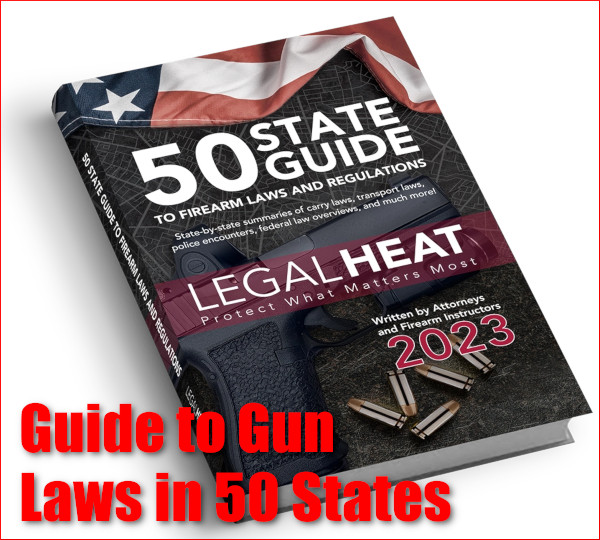
Legal Heat, a major firearms training firm*, offers the impressive 2023 Edition of the 50 State Guide to Firearm Laws and Regulations. For each state, this $20 book covers key firearms laws, lists prohibited areas, and provides key statutory references for further research. With over 20,000 gun laws nationwide affecting concealed carry permit holders, Legal Heat’s 50 State Guide helps gun owners stay informed about important gun statutes and regulations.
The Legal Heat 50 State Guide is an authoritative reference guide on concealed carry and transport laws with concise synopses, including legal citations. Written and edited by attorneys and firearms instructors. This full-color, $20 book provides a comprehensive overview of state and Federal gun laws, serving as a quick reference guide for travelers.
State by State Law Summaries
For every one of the 50 U.S. STATES, there is a dedicated summary covering:
1. All Prohibited Areas for Firearms
This Section Is Essential Knowledge For All Concealed Firearm Permit Holders. 2. Self-Defense and Firearms Laws 3. Reciprocity (Recognition of Other State’s Permits)
This lists ALL firearm permits from other states that are recognized. 4. Self Defense And Firearm Laws Statutory References (For Additional Research) 5. Ratings of Each State for “Friendliness” to gun owners.
GET FREE Legal Heat APP for Android or Apple
Along with the $20 print book, there is a FREE Legal Heat APP that provides the same information at no cost to you. Just download the App to your smartphone or tablet. There are FREE versions for both Android (Google) and iOS (Apple). This is the only APP with comprehensive Concealed and Open Carry Law summaries written by attorneys.
Key Topics Covered in Dedicated Sections
The Legal Heat 50 State Guide has specific sections dedicated to important topics, such as Gun Transport at Airports, Police Stops, Inter-State Travel, and Purchasing/Selling. Having these and other key topics clearly outlined is one of the compelling reasons to buy the book. Here are the Key Topics:
- Airports
– Police Encounters
– State-to-State Firearms Transport in Vehicle
– Purchasing/Selling A Firearm
– Castle Doctrines
– AMTRAK
- U.S. Army Corps Of Engineers Land
– National Parks And Monuments
– BLM Land
– Indian Reservations
– May Issue Vs. Shall Issue States
– Contact Info For Attorney Generals
Video Summary of 50 State Firearms Guide
This video covers the highlights of the Legal Heat 50 State Guidebook. This shows the 2018 Edition, but the latest 2023 Edition contains all those elements, updated with current law changes.
* With over 250,000 certified students, Legal Heat claims to be the nation’s largest firearms training company. Legal Heat provides in-person as well as online training, and works with major gun retailers including Cabela’s, Bass Pro Shops, and Sportsman’s Warehouse. CLICK HERE for more information on Legal Heat Training Programs.
We really like rimfire revolvers here at AccurateShooter.com. A good .22 LR wheelgun will be fun, accurate, reliable, and inexpensive to shoot. Rimfire revolvers also offer much less recoil and noise than a centerfire pistol. Your Editor has owned a Smith & Wesson Model 617 for nearly 20 years. That old S&W has probably fired more rounds than all the other handguns I own, combined — yet it still runs flawlessly and still delivers excellent accuracy.
Ruger offers a big stainless .22 LR wheelgun to compete with the S&W Model 617. This rimfire wheelgun is based on Ruger’s trusted GP100 platform. The Ruger GP100® chambered in .22 LR looks to be a good firearm — strong, versatile, and intelligently engineered. In the video above, the late Jeff Quinn of Gunblast.com tests the Ruger revolver and gives it high marks: “It’s a good hefty gun [42.6 oz.], but not overly large or heavy for a good trail gun. It’s just a really nice, well-made revolver from Sturm Ruger.” The gun Jeff tested had a 3.7-lb SA trigger pull and a 9.8-lb DA pull.
The .22 LR GP100 features a windage and elevation adjustable rear sight with a white outline, a light-gathering fiber optic front sight and the original full-size GP100 rubber grips with hardwood inserts. With all stainless-steel construction, the rimfire GP100 is easy to maintain. Just keep the cylinder chambers and barrel clean and this gun should run forever.
This Review of the .22 LR GP100 by Hickok45 has over 6.7 Million Views:
The 10-shot Ruger GP100 in .22 LR is a durable, well-engineered wheelgun. Ruger’s engineers optimized the GP100’s innards to deliver a smooth double-action pull: “The new GP100 has an improved fire-control system that uses a lighter mainspring than previous Ruger double-action .22 LR revolvers … we’ve done a lot of development on the firing pin location and geometries so that we’re able to put a lighter trigger pull in this gun than you would find in other .22 LR [handguns]. We’ve got a half-underlug barrel, and it’s a smaller diameter so the gun balances real well. We’ve added a narrow-spur hammer and a smooth trigger.”
While this site is primarily about accurate rifles, we know many of our readers enjoy handgun shooting also. Here are four videos that can help readers improve the speed and accuracy of their pistol shooting. You may never win a Bianchi Cup title, but these tips can help in a club IDPA match, or the pistol stages of your next 3-Gun match. The star of these videos is Doug Koenig, 19-time Bianchi Cup champion. Koenig, who has won numerous National and World pistol titles, is considered by many to be the best action pistol shooter on the planet. His speed, consistency, and accuracy are without peer.
Keep Both Eyes Open
When shooting a pistol two-handed, “on the clock”, it’s almost always better to shoot with both eyes open. And during a “move and shoot” action pistol match, you surely want to have both eyes open. Keeping both eyes open improves depth perception and helps with target transitions.
“To me it’s very simple — I wouldn’t drive my car with one eye closed. I wouldn’t walk around the house with one eye closed. To me, it’s all about your vision, your depth perception.” — Doug Koenig
With both eyes open you’ll have better depth perception and peripheral vision, Koenig says. Moreover, you will also be able to transition from target to target more quickly. In a timed, multi-target stage, you’ll want to move your head/eyes to the next target right after you break a shot. You’ll find that you will then reflexively move the handgun on to the new target when you swing your vision on to it. Don’t linger on the target you just shot — move to the next.
Acquire First Target
In this video, 18-Time Bianchi Cup Winner Doug Koenig explains how to acquire your first target quickly, and make sure your first shot is a hit. Doug notes that a perfect first shot will positively affect the many shots that follow in a competition:
Make Fast Follow-Up Shots
In this next NSSF Video Koenig demonstrates how to make Fast Follow-Up Shots and how to transition from target to target quickly. Grip, stance, consistency are all important Doug explains.
Trigger Press and Trigger Control
In this fourth video, Koenig talks about key techniques that apply to all pistol marksmanship — not just speed shooting “on the clock”. With any handgun, Doug explains, you should focus on consistent trigger control. You want to avoid yanking the trigger or anticipating recoil.
Doug Koenig’s List of Championships:
10-time World Champion
19-time Bianchi Cup winner
2016 NRA World Shooting Champion
More than 70 National Championships
6-time World Action Pistol Championship Winner
3-time World Speed Shooting Champion/Steel Challenge
Ever wondered what caused a particular bulge or marking on a case? And more importantly, does the issue make the case unsafe for further use? Sierra Bullets Ballistic Technician Duane Siercks offers some insight into various issues and their causes in two Case Diagnostic articles from the Sierra Blog.
Incipient Case-Head Separation
This is a Winchester .308 Win case that has a real issue. This case has a very obvious incipient case head separation in the process of becoming a complete failure.
This is most commonly caused by over-sizing the case causing there to be excess headspace on the case. After a few firings and subsequent re-sizing, this case is just about ready to come completely apart. Proper die adjustment is certainly a requirement here. Of course this case is not safe to reuse.
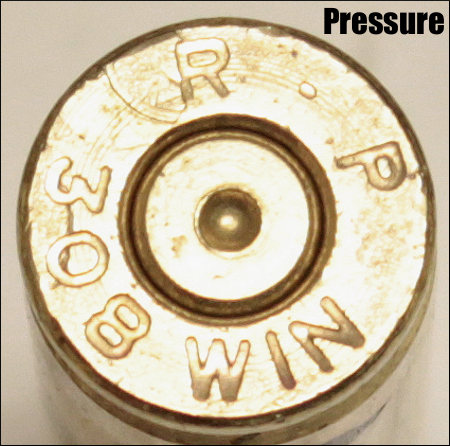
Excessive Pressure (Load Too Hot)
If you will notice in the picture of the case rim, there are two pressure signs to notice. First, look at the primer. It is basically flattened to about the max of what could be considered safe. If this was the only pressure sign noted, I would probably be fine with this load, but would constantly keep an eye on it especially if I was going to use this load in warmer temperatures. This load could easily cross into the “excess pressure” realm very quickly.
There is another sign of pressure that we cannot ignore. If you’ll notice, there is an ejector mark apparent that is located over the “R” of the R-P headstamp. This absolutely tells us that this load would not have been in the safe pressure range. If there were any of these rounds loaded, they should not be fired and should be dis-assembled. This case should not be reloaded.
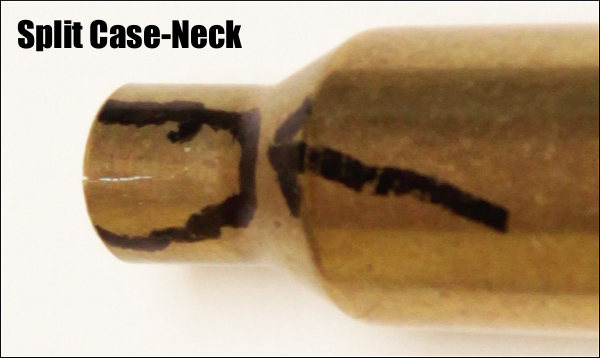
Split Case-Neck
Here we have an R-P .22-250 case that has died the death. Everything looks fine with this case except the neck is split. This case must be tossed.
A split neck is a normal occurrence that you must watch for. It is caused by work-hardening of the brass. Brass cases get harder with age and use. Brand new cases that are stored for a period of time can become hard enough that they will split like this case within one to two firings. I have had new factory loads do the same thing. Then as we resize and fire these cases repeatedly, they tend to get harder and harder. Eventually they will split. The life of the case can be extended by careful annealing practices. This is an issue that would need to be addressed in an article by itself. Of course this case is no longer usable.
In the classes that I teach, I try to use examples like this to let the students see what they should be looking for. As always, if we can assist you, whether you are new to reloading or very experienced, contact us here at Sierra Bullets by phone at 1-800-223-8799 or by email at sierra@sierrabullets.com.
Dented Case Body
Here we have a Lake City 7.62×51 (.308 Win.) case with two heavy marks/dents in the case body.
This one may be a bit of a mystery. It appears as if this case may have been caught in the action of a semi-auto rifle when the firearm jammed or the case failed to clear during the cycling process. I probably would not reload this case just to prevent any feeding problems. This also appeared to be a factory loaded round and I don’t really see any pressure issues or damage to the case.
Multiple Problems — Lake City 5.56×45 unknown year.
This case has suffered multiple failures and cannot be re-used. First its has have a very rounded shoulder that is split. Upon first look it was obvious that this round had been a victim of excess pressure. The firearm (perhaps an AR?) was apparently not in full battery, or there was possibly a headspace issue also. While taking a closer look, the primer was very flat and the outside radius of the primer cup had been lost. High pressure! Then I also noticed that there was an ejector mark on the case rim. This is most certainly an incident of excessive pressure. This case is ruined and should be discarded.
It is very important to observe and inspect your cases before each reloading. After awhile it becomes second nature to notice the little things. Never get complacent as you become more familiar with the reloading process. If ever in doubt, call Sierra’s Techs at 1-800-223-8799.
At the request of our readers, we provide select “Deals of the Week”. Every Sunday afternoon or Monday morning we offer our Best Bargain selections. Here are some of the best deals on firearms, hardware, reloading components, optics, and shooting accessories. Be aware that sale prices are subject to change, and once clearance inventory is sold, it’s gone for good. You snooze you lose.
NOTE: All listed products are for sale to persons 18 years of age or older. No products are intended for use by minors.
1. Natchez — Leupold Scope Sale and VH6-HD Rebate
⏺ Large selection of Leupold optics at significant savings
Leupold scopes rank among the best for hunting or target shooting. Leupold’s VX series of scopes offer a wide variety of magnification ranges and reticles. Right now Natchez is running a major Leopold sale. You can save hundreds on Leupold scopes, ranging from the 1-6x24mm VX-6HD to the powerful 4-24x52mm VX-6HD, now $1899.99, which is $500.00 off the original price. Leupold spotting scopes, binoculars, and laser rangefinders are also on sale.
The Natchez sale prices reflect a manufacturer’s price reduction of $300 on VX-6HD scopes. This Leupold promo applies to select VX-6HD riflescopes purchased from July 24 through September 3, 2023.
2. Creedmoor Sports — Sierra Bullet Sale
⏺ Big savings on popular Sierra match bullets
If you hand-load for hunting or competition you need quality bullets. Sierra makes great bullets in popular calibers with both hunting and match versions such as the Sierra MatchKing. Creedmoor Sports has significant discounts right now on .224, 6.5mm, .308, and .338 caliber Sierra bullets, including the latest generation MatchKings which come with uniformed tips from the factory.
3. Midsouth — New LEE Deluxe APP Processing Press, $109.99
⏺ Unique processing unit does many bulk tasks efficiently
The very affordable LEE Deluxe APP (Automatic Processing Press) performs a number of key reloading functions efficiently. This new Deluxe APP can prime a large number of cases rapidly, employing a clever case-feeding system. The Deluxe APP also has a very good depriming operation. Key features in this upgraded system include: Universal Case Feeder, APP Deprime Kit, Priming System, Deluxe Roller Handle, and Bottle Adapter. This complete set-up is on sale this week for $109.99, a 15% ($20) savings.
4. MidwayUSA — Sierra .223 Rem Hunting Ammo, $9.99/20 rds
⏺ Super deal on quality .223 Rem ammunition for hunting/varminting
Need quality .223 Rem hunting ammo? Right now Sierra .223 Rem Outdoor Master 55gr JHP ammunition is just $9.99 for a 20-rd box. That’s $0.50 per round, a 56% savings off the regular price. This ammo fits AR15 mags for reliable feeding in AR-platform rifles. This ammo features GameKing Hollow Point BT bullets. The cartridges have quality brass cases, so you can reload the brass many times.
5. Amazon — Lyman Universal Press Stand, $79.70
⏺ Strong, versatile stand works with many press types/brands
Do you wish your reloading press was a little higher so it was more ergonomic to use? A great fix for this is the Lyman Universal Press Stand. This is the only press stand on the market that will accept most current single station, turret, and progressive presses of all brands! This heavy-duty steel stand comes with two mounting plates pre-drilled for your favorite press. If by chance you have a press that does not match up with any of the numerous patterns, there is also a blank area where you can drill your own mounting holes. The stand will raise your press 9¼” above your bench surface, which will lessen fatigue from having to bend over to cycle your press. The raised height also provides a clear view of reloading operations. All hardware needed to mount your press is included.
Many CCW holders prefer 9mm handguns that are small and compact, with smooth edges on the slide and frame. The Ruger EC9s Safety model fits the bill. Slim, lightweight, and compact, this pistol features smooth edges and comes with a Hogue grip sleeve. The striker-fired EC9S features both a manual safety and a Glock-style trigger safety. With 7+1 magazine, but not ammo, this pistol weighs just 18 ounces. It is now on sale for just $249.99 — $139 off (36%) the regular price — a real bargain.
7. Amazon — Caldwell E-Max Shadows PRO Plugs, $123.99
⏺ State of the art electronic plugs with NRR 25 protection
All shooters need quality ear protection. Electronic plugs protect your hearing while allowing you to hear conversations and range commands. The Caldwell E-MAX Shadows Pro plugs are quality electronic plugs with a 25 dB Noise Reduction Rating — very good for plugs alone. These E-MAX plugs come with multiple size tips to help ensure a good fit. Controls on each of the ear pieces allow for volume and mode adjustments while an optional lanyard keeps the earbuds secure. NOTE: These plugs will connect with your mobile device via Bluetooth. In addition, the included storage case serves as a charger for the plugs!
8. Amazon — G4Free Sling Pack with Pistol Holster, $27.99
⏺ Sling pack offers ready access plus handgun storage
The advantage of a sling pack is that you can swing it around to the front to easily access the contents. This rugged G4Free Tactical EDC Sling Pack offers multiple pockets plus a Velcro-attached pistol holster. Starting at $27.99, this 10.6″ x 5.9″ x 8.6″ sling pack is offered in four styles: Tan, Green, Black, and Dark Grey Camo. For $5.00 more ($32.99) you can get Sling Pack Combo with an additional 6.3″ x 4.3″ multifunction pouch that can securely hold a pistol plus a mobile device.
9. Amazon — Biometric Pistol Safe, $179.99
⏺ High-tech pistol safe allows instant access with fingerprint or PIN code
If you keep a handgun for defense use at a home or business, you need a secure, but rapid access storage solution. The Biometric Slider Handgun Safe is a good product that allows instant gun access via your fingerprint. This product has a 508 dpi Biometric sensor capable of storing 20 unique fingerprints for ultra-fast entry. You can also use manual keys or a 4-8 digit PIN code. This system easily mounts to the inside of a desk or the side of a nightstand.
10. Amazon — Vortex Bubble Level, From $31.20
⏺ High quality scope level for 1″, 30mm, 34mm, and 35mm optics
All serious competitive shooters should have a bubble level because rifle cant (angle rotated off bore axis) will alter shot Point of Impact. The Vortex bubble level is a high-quality level that is available for 1″, 30mm, 34mm, and 35mm scope diameters. This level features a quick and easy mounting system.
A few seasons back, I wrote an article on cartridge choices for F-Class shooters. CLICK HERE to READ ARTICLE. Since the first article I wrote, F-Class has continued to grow, and push the limits of precision and accuracy. While the .284 Win and its variants are still the most common F-Open cartridges, more and more top F-Open shooters are using magnum cartridge types to win competitions and set new records. In this article, I will list some of the advantages and disadvantages of the most commonly used magnums, and will cover the strengths and weaknesses of each one of them.
Performance factors we will consider for magnum F-Open cartridges include:
1. Equal or better accuracy than standard chambers
2. Better ballistic performance
3. Enhanced case life
4. Barrel life
Accuracy Potential of Magnum Cartridges for F-0pen Competition
John Meyrs has won four National Mid-Range Championships using the .300 WSM. Tim Vought used the same cartridge to win two Mid-Range Nationals and used a 7-6.5 PRC to win the long range Nationals. Standard .437″ case head (.308 Win head size) cartridges still have more Nationals wins overall, but the magnums are quickly catching up, and my prediction is that magnums will dominate soon.
The accuracy and precision potential of magnums used in F-Class (.300 WSM, 7-270 WSM, 7mm RSAUM or “7 SAUM”, 7-6.5 PRC) is better than non-magnum cartridges because their shapes are closer to the ideal “fat/short” body associated with wider nodes and extreme precision. For example a .300 WSM is proportionally much closer to the 6 PPC, 6 Dasher, and 6 BRA than is the .284 Winchester.
Stunning F-Open rifle with SEB Mini front rest with Blake Machine accessories.
The first thing that comes to mind when magnums are discussed is power and speed. In my humble opinion most shooters are missing out on accuracy because they push their magnums right past the most stable and accurate nodes. Recently I met my good friend from the Army Marksmanship Unit, SFC Brandon Green, at a shooting competition. We discussed the latest and greatest in long-range shooting. I knew that the USAMU had switched from 6.5-284 Norma to 7mm RSAUM several years back, but didn’t know what load they are currently using. Brandon told me that the load featured Berger 180gr hybrids in Nosler cases at 2820 fps. We all know that the 7 SAUM is capable of much higher speeds, “but at around 2820 fps the load/rifle combo will hammer the X-Ring anywhere under any conditions” SFC Green said.
F-Open rifles on the firing line at the Ben Avery Shooting Facility in Phoenix, Arizona.
Most shooters jump right into magnum territory velocities when testing, missing out on better precision at standard chamber speeds. For example, my 30 KMR can easily reach 2880 fps with 230gr Hybrids, and it actually shoots pretty good. But the same rifle at around 2770 fps will absolutely hammer the X-Ring in any condition anywhere. When it’s all said and done, F-Class is a long-range shooting competition at a known distance which requires extreme precision and accuracy. It is not a speed race.
IMPORTANT — Case-Head Dimensions Do Make a Difference
Magnums, when shot within reasonable velocities, on average will give better case life due to the bigger case + lower pressure and “more meat” in the case-head area. For example a 7 SAUM case will outlast a .284 Win case when both are loaded to around 2900 fps.
Disadvantages of Magnum F-Open Cartridges
Perhaps the biggest disadvantage linked to magnums is recoil. Some people complain about developing the “gun shy” syndrome after shooting a magnum for a while. Muzzle blast and recoil are significantly more pronounced in magnums, but that can be easily managed with a properly-built rifle equipped with appropriate recoil mitigation hardware such as RAD and the various butt plates.
F-Open rifle equipped with recoil reduction buttpad system.
Barrel Life — “Barrels are Expendable Components”
It is true that certain magnums can torch a barrel in just a few hundred rounds. But the same is true when improving a 6BR to 6 Dasher for example — barrel life might be reduced significantly. More powder = more heat = diminished accuracy after a certain round count. In my experience, a F-Open magnum’s barrel life is very close to high-performance standard cartridges such as the .284 Shehane or .284 KMR. I “retire” my barrels around 1200 rounds regardless of the cartridge being a magnum or not. After that many rounds most barrels will still shoot OK but will copper up, and you will start seeing those unexplained vertical 9s. The bottom line is this, barrels are expendable components very much like brass. You can’t get the performance of .300 WSM and the barrel life of the .308 Win at the same time. If you want to race in NASCAR, fuel mileage should not be the top priority!
Top Magnum Cartridge Types Used in F-Class Open Division
.300 Winchester Short Magnum
The .300 WSM (Winchester Short Magnum) tops the popularity chart in F-Class Open division. It has been used to win numerous National championships and has set many National records. The .300 WSM’s short/fat case shape, with minimal body taper and 35-degree shoulder, contribute greatly to its outstanding performance at long range. Components are readily available as well. Best brass remains to be Norma, although ADG is just as good and some would even say better, but it is more expensive and harder to get at this time.
The .300 WSM has been described as a “super-sized Dasher”.
For the .30-cal magnums, in my opinion, the best bullets by far are made by Berger. If your rifle does not shoot 215gr, 230gr hybrids, or 210gr VLDs well, you likely have a rifle problem, NOT a bullet issue. My “go to” bullet is the Berger 230gr Hybrid. The 215-grainer is a close second, followed by Berger’s accurate but ballistically inferior 210gr VLD, which I use in calm and steady conditions.
Top powders for the .300 WSM are Hodgdon H4831SC and H4350. I know there are many more powders suitable for the .300 WSM cartridge, but none I have used can match Hodgdon’s consistency when shot in different geographical locations and weather conditions.
7mm Remington Short Action Ultra Magnum
The 7mm RSAUM (aka 7 SAUM) used to be the darling of F-Open. Its case capacity and shape are about perfect for launching 180gr pills with great ballistics and precision. Its popularity faded a little, due to the lack of good brass, and the rise of the improved versions of the .284 Win which can almost match the RSAUM performance. Norma still makes 7 RSAUM brass which is pretty good but little on the soft side and hard to find. ADG is arguably producing the best RSAUM brass right now. It is very uniform, reasonably priced, and seems to hold up very well even when pushed hard. The best bullets are again made by Berger, and those are the 180gr hybrid, 184gr hybrid, and 180gr VLD. Best powders are H4831sc, H4350, and Alliant Reloder 16 and Reloder 23.
7-270 WSM, 7-300 WSM, and 7 WSM
The first two are pretty much identical, the only difference being that the 7-270 WSM is necked up .270 WSM while the 7-300 WSM is a .300 WSM necked down to 7mm. I personally prefer the first one since necking-up is easier than necking-down (with fewer doughnut issues).
The WSM case-based 7mms will give you great velocity flexibility as well as superb precision when tuned well. In the 2013 world championship in Raton NM, I was scoring for a gentleman from Canada who was shooting 7-270 WSM. The wind was blowing pretty hard that day. On one of his shots, just before he pulled the trigger the wind gusted. I remember thinking that’s going to be an 8 for sure. The target came up a line 10! I asked him after the match what he was shooting, and he replied 180s at 3100fps. Although capable of such speeds, I think that potentially better and more consistent accuracy can be achieved at much slower speeds. The best powders and bullets are again Hodgdon and Berger respectively. Best cases are made by Norma and ADG, with Winchester being a third option.
7-6.5 PRC — Popular Wildcat
Last but not least on our chart is the 7-6.5 PRC. This particular cartridge is actually a wildcat. It is a 6.5 PRC necked up to 7mm. It is pretty much identical to the 7 RSAUM with the only differences being a shorter neck and .01″-narrower body. Currently the 7-6.5 PRC is the most requested cartridge that I offer when building new rifles. It seems to fill the gap between the .284 Win and the larger magnums very nicely. It is capable of reaching 3000fps but most shooters are getting their best results around 2920-2950 fps. The biggest advantage of this wildcat is brass. Lapua makes super high-quality, readily-available 6.5 PRC brass. Best powders are H4831sc, H4350, Reloder 16, and Vihtavuori VV 555. The best bullet in my opinion is the 180gr Berger. I am yet to hear about a better-performing bullet in this chamber.
Conclusion In conclusion, magnums are not perfect but their performance advantages should be very seriously considered when building a rifle for long-range F-Class. In part three, I will list the most common wildcat magnums, and present the KMR magnums which will make you (if you haven’t already) buy a magnum action and get a magnum build for sure!
– 2014 F-Class Open National Champion
– 2015 F-Class Open National Championship, Silver Medal
– F-Class Open National Championship Teams, 2015, 2014, 2013, Shooting Team Member
– Over 15 wins in Regional and State Championships in Palma, F-TR, F-Open
– 2013 U.S. National Team Member
– 2023 F-Open Gold Medal Team USA Member, 2023 World Championship in South Africa
Report by Craig Arnzen, Area 419
As the PRS and other tactical/practical competitions continue to grow, a guy tends to wonder, just how good are the top competitors? And what are they actually doing (and viewing) as they complete a stage? Well, a great video from the Long Range Precision Shooters YouTube Channel let us see what the best in the sport see through their scopes when they shoot.
This video features Dave Preston, 2015 National Champion and consistent top performer, shooting the PRS Skills barricade. Dave Preston has been considered among the very best in the nation running this PRS stage. Dave nearly always shoots 100% with the fastest recorded time. In this video you’ll see him successfully engage all eight shots in under 43 seconds — that’s crazy fast. This includes a POV sequence (4:35 time-mark) showing the actual view through Dave’s scope as he completes the stage.
Watch this video! Dave offers excellent advice on gun-handling and body positioning for barricades. Listen to what he says and you WILL shoot better.
This video features the PRS Skills Barricade, an 8-round, 4-position stage featured at the majority of PRS matches throughout country. It’s called a “Skills Stage” as it is run the same way at every national match and gives shooters the ability to compare skill levels based on hit percentage and speed.
The target is a 10″ plate at 400 yards. There are four different positions, with two shots each. Most people run this stage in about 70 seconds, some in the mid-60s, the greats in the high 50s, and Dave does it in the low 40s… mighty impressive!
The Right Gear Aids Stability and Lets You Shoot Faster
Let’s also take a look at two pieces of gear that really helped Dave Preston get stable and shoot fast.
1. BARRICADE BAG — To Get Stable, Really Stable
In the video Dave is using a Solo Sac from Short Action Precision This bag was designed by USMC Solomon Mansalala. It’s a very soft/dense bag and is popular at matches.
The other bag that sees a LOT of use, and is far and away the most used, is the patented Gamechanger Bag from Reasor Precision Solutions and Armageddon Gear.
2. MUZZLE BRAKE — To Make Your Follow-Up Faster
You’ll notice that in the video the rifle is very steady through firing, even though he is not applying a lot of pressure to the rifle. Dave is using a Hellfire Muzzle Brake from Area 419. Combined with the soft-recoiling 6mmBR cartridge he is able to spot his impacts and make adjustments, and can also make very fast follow-up shots as his rifle hasn’t bounced way off target.
Savage Arms offers a series of Shooting Tips in the Savage Blog. Here is a helpful article from Team Savage Shooter Stan Pate. This covers how to ship your rifle safely, and then re-establish zero properly when the gun is reassembled after transport.
Traveling with Firearms — Important Advice
Traveling with firearms can be stressful. You must comply with multiple regulations and then trust your expensive guns to airline baggage handlers. And after arrival you’ll need to put your rifles back together and confirm the zeros. This article offers helpful travel advice from Team Savage shooter Stan Pate. Pate has traveled the globe competing with match rifles. Here he shares his tips for making trips easier on you and your firearms.
Easier Air Travel With Firearms
TSA isn’t nearly as careful with your rifles as you are. Proper storage before sending your firearm up a conveyer belt and into the belly of a plane is critical. Stan Pate spends lots of time each year traveling the skies and has devised a system for keeping his rifle safe when going to and from.
“Never travel with your firearm completely assembled,” Pate cautions. “A fully assembled firearm is much heavier [as a total unit] than one that has been broken-down and stored [in separate sections]. More weight creates more in-the-case movement, which can result in damage. I learned this the hard way years ago. My rifle was actually broken in half when traveling to an international competition. Record your torque settings, use those settings during reassembly and your return to zero should be no problem.”
“Be sure to check on current TSA rules and regulations before travel to be aware of any changes that may effect how you pack your rifles,” says Pate.
Rifle Reassembly and Resetting Zero
The quicker you can reestablish your zero, the quicker you can relax and stop worrying about if your rounds are going to hit their mark during competition. Pate, over the years, has developed a system for rifle reassembly and getting back to zero as quickly as possible. While his torque settings may not be the same as yours, the process can still be used.
“The barreled-action goes back on the stock, and then I tighten all three receiver screws finger tight,” says Pate. “Next, I tighten the front two receiver screws down to 35-inch pounds. The rear receiver screws on this particular rifle likes 15-inch pounds. [Note: Proper torque settings will vary with your action and stock type. Most actions have TWO screws, not three.] Scope attachment comes next, and I follow manufacturer settings when tightening it down. All that’s left to do now is go zero your rifle.”
This video explains an efficient method to Re-Zero your rifles






 In conclusion, magnums are not perfect but their performance advantages should be very seriously considered when building a rifle for long-range F-Class. In part three, I will list the most common wildcat magnums, and present the KMR magnums which will make you (if you haven’t already) buy a magnum action and get a magnum build for sure!


