Every serious hand-loader benefits from a precise, repeatable, and efficient powder dispensing system. There are many electronic powder dispensers on the market, starting at about $230 for a Frankford Arsenal Intellidropper and $240 for a Lyman Gen6. At the high end, the ultimate powder weighing/dispensing system would be an Auto-Trickler V4 mated to an top-tier electronic Force Restoration scale. Such a system can run $1200 or more, depending on scale cost.
In today’s Saturday video showcase we feature eight videos about electronic powder dispensers, as well as Auto-Trickler systems (both V3 and V4). If you are in the market for a new powder scale/dispenser system, we recommend you watch these videos. You may be surprised by some of the findings, and you will certainly learn more about these machines — their pros and cons. That knowledge can help you decide what electronic powder dispenser best deserves your hard-earned dollars.
Five Powder Dispenser Comparison Test (All Units Purchased)
If you are in the market for a sub-$500 electronic powder dispenser, definitely watch this review. This Backfire comparison test is notable because the tester spent his own money to purchase all five powder dispensers being reviewed. That means Backfire could tell the full truth, both good and bad, about the machines. In fact, Backfire bought TWO ChargeMaster Lites because one failed (See 14:12 time-mark). The reviewer liked the RCBS ChargeMaster Supreme, but his top choice overall was the Hornady Auto Charge Pro. He favored the overall design, and really liked the way the dispensing speeds could be easily set faster or slower. Here are highlights from the video review:
00:08 Speed Test
03:09 Accuracy Test
07:57 Frankford Arsenal Intellidropper
09:08 Lyman Gen 6
10:44 RCBS Chargemaster Supreme
12:03 Hornady Auto Charge Pro
14:12 RCBS Chargemaster Lite
14:41 Conclusions
AutoTrickler V3 vs. Hornady Auto Charge Pro
In the Backfire comparison video above, the Hornady Auto Charge Pro powder dispenser earned top marks among sub-$500 units. Here the Auto Charge takes on some tougher competition — an ultra-precise Force Restoration scale fitted with an Auto-Trickler V3, a system that cost upwards of $1150.00 U.S. Dollars. The Australian duo running the comparison found the Auto-Trickler system was more accurate and consistent. Notably, with a dispense speed of just 14 seconds. the Auto-Trickler V3 system was significantly faster than the Hornady machine. The Auto-Tricker V3 has been superseded by the new Auto-Trickler V4 which retails for $490.00 USD. Add $625 or more for a good Force Restoration scale such as the A&D FX-120i.
RCBS New ChargeMaster Supreme and Other ChargeMasters
In this well-made video, Gavin Gear of UltimateReloader.com does a detailed review of the new-generation RCBS ChargeMaster Supreme. He puts it through his paces, verifying its accuracy and repeatability. He shows how the unit can be programmed. At the 17:20 time-mark, Gavin employs an A&D FX-120i Force Restoration scale to check the ChargeMaster Supreme’s charge-weighing precision. The results were good.
Frankford Arsenal Intellidropper vs. RCBS ChargeMaster Link
The Frankford Arsenal Intellidropper, now just $230 on sale at Midsouth, was very innovative when first released, offering remote Bluetooth access and a wide range of programmable features. The downloadable App stores your load data and has preloaded bullet and powder databases. This video compares the Intellidropper with another Bluetooth-enabled modern powder dispenser, the RCBS Chargemaster Link. A free RCBS App allows you to control settings remotely.
Hornady Auto Charge Pro Review by Ultimate Reloader
As the $350 Hornady Auto Charge Pro dispenser was top-rated in the Backfire comparison at the start of this article, we thought we’d include a detailed review from Gavin Gear of UltimateReloader.com. If you are thinking of buying a Hornady Auto Charge Pro, definitely watch this video, as it is the most thorough Auto Charge Pro review on the web and Gavin is by far the most articulate tester. SEE FULL TEST.
AutoTrickler V4 and Force Restoration Scale
The AutoTrickler V4, paired with a quality Force Restoration scale, is the “Rolls Royce” of electronic powder dispensing systems, offering unrivaled charge-weight accuracy, great repeatability, and ultra-fast dispensing speeds. If you have the budget — $490 for the V4 plus $625+ for scale — the AutoTrickler V4 is a superb system that lets you load extremely accurate, consistent ammo. This detailed F-Class John video shows how to set up the system properly and control the dispensing and trickling functions.
RCBS MatchMaster vs. AutoTrickler V3 with A&D FX-120i Scale
This video is interesting because it compares the most advanced and expensive mass-market electronic dispenser, the $899 RCBS MatchMaster, with an AutoTrickler V3 mated to an ultra-precise Force Restoration scale. The AutoTrickler V3 + scale system offers wicked fast dispensing while delivering near-single-kernel precision and great repeatability. The MatchMaster has some interesting features, including dual dispensing tubes and a special slower, “Match Mode” dispensing function which provides enhanced precision.
BONUS Video: RCBS ChargeMaster Dispenser vs. Four Scales
This video answers the question “How does a common powder dispenser’s weighing accuracy compare to stand-alone scales?” Here the tester compares the weighing precision of an early-model RCBS ChargeMaster with four dedicated scales: A&D FX-120i (Force Restoration), Hornady G2-1500, Hornady GS-1500 (Gen 1), and a WAOAW milligram scale. These scales range significantly in price, with the FX-120i Force Restoration the most expensive by far. The features/prices of the four scales are listed at 4:41 time-mark. Accuracy/repeatability comparison testing with test weights starts at 10:12 time-mark.
Enjoy the Shooting Sports USA Archives
As fall becomes winter, many Americans will be spending more time indoors at home. For some folks that means long sessions in front of the boob tube. Here’s a better idea — there’s a vast resource of great gun-related content available online for FREE. Check out the Shooting Sports USA Articles Archive. SSUSA maintains a vast digital library with hundreds of articles going back to June 2009.
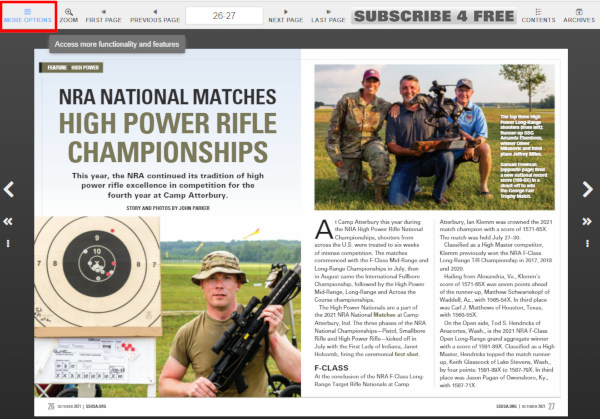
It’s easy to find back issues of Shooting Sports USA magazine. Here’s how: First, navigate to the current SSUSA Online Issue. Then click on the “ARCHIVES” icon in the upper right area (indicated with red arrow). When you click on “ARCHIVES”, a window will open with a selection of Shooting Sports USA magazine covers/dates in a vertical column. The most recent issue (September 2022) will appear at the top. You can then scroll down — use the vertical scroll bar to go from September 2022 (the latest issue) all the way back to June 2009. Click any issue cover to read.
How to Find and Save Articles
To search back issues, select “MORE OPTIONS” from the toolbar (top left). Then click the “SEARCH” button. When that opens, select either “Search Archives” for ALL back issues or “Search Only this Issue”. When you’ve made your choice, enter your search term(s). For example, you can search for “Camp Perry” or “Palma” or “F-Class Championship”. You can also save any archived issue as a PDF for viewing offline. Just click “SAVE” to download the article you’re currently viewing/reading.
Read Sample Articles
Here are a couple of our favorite SSUSA feature stories from recent years. There are hundreds of other informative articles worth reading.
New York state’s cynical response to the landmark NYSRPA v. Bruen case, which affirmed a Constitutional right to carry firearms, was to defy that decision completely. New York’s politicians, lead by authoritarian N.Y. Governor Kathy Hochul, passed legislation (S51001) that put nearly all of the state “off-limits” to persons with carry permits. The goal was to render New York CCW permits essentially useless because CCW use was geographically forbidden throughout the state. Thankfully, Second Amendment advocacy organizations FPC and SAF have now challenged these new restrictions in New York state.
The Firearms Policy Coalition (FPC) has filed a motion for preliminary injunction in Boron v. Bruen*, its lawsuit challenging New York’s “sensitive location” handgun carry bans in public parks, public transportation, and all private property without express consent. The motion can be viewed at FPCLegal.org. That new legislation, S51001, banned carry nearly everywhere, including public buildings, shopping centers, parking lots, train stations, parks, and countless other locations.
The FPC’s lawyers note: “Under S51001, ‘ordinary, law-abiding citizens’ … are again prevented from carrying handguns in public for self-defense in almost all corners of the State, except in what Governor Hochul said were, ‘probably some streets’.” The FPC’s motion to enjoin enforcement of the new law adds that: “S51001 makes a mockery of the Supreme Court’s holding in Bruen, which reaffirmed that personal security “emphatically extends to include ordinary, law-abiding Americans ‘outside the home’.”
“The New York Legislature appears to think that when the Supreme Court closed the door on New York’s may issue permit regime it opened a window for equally onerous location restrictions,” said FPC Director of Legal Operations Bill Sack. For more on FPC’s pro-Second Amendment initiatives, visit FPCLegal.org
About the Firearms Policy Coalition
Firearms Policy Coalition (firearmspolicy.org), a 501(c)4 nonprofit organization, exists to create a world of maximal human liberty, defend constitutionally protected rights, advance individual liberty, and restore freedom. FPC’s efforts are focused on the Right to Keep and Bear Arms and adjacent issues including freedom of speech, due process, unlawful searches and seizures, separation of powers, asset forfeitures, privacy, encryption, and limited government. The FPC works through litigation, research, scholarly publications, legislative and regulatory action, and other programs.
* On September 28, 2022, the original first-named plaintiff, John Boron, has been voluntarily dismissed from the action. Plaintiffs Brett Christian, Firearms Policy Coalition, Inc., and Second Amendment Foundation will continue in the case as plaintiffs. A motion to change the caption and short title of this action has been filed. If that goes through, the lawsuit may be re-titled “Christian et al v. Bruen”.
KEY FEATURES: Ballistics Solver, GPS Tagging, Weather Forecast, Field Notes with Photos
Hunters, here’s a great FREE mobile APP for both Apple and Android systems. The ZEISS Hunting App offers many practical functions: full-featured ballistics calculator, field notes with photo archive, compass function, GPS tagging for documentation of hunting experiences, and a detailed weather forecast service. The Hunting App is offered as a FREE download for Android and iOS (iPhone/iPad) mobile devices.
Three Minute Video Explains Zeiss Hunting App Features:
The Zeiss Hunting App integrates multiple useful features — ballistics solver, compass, GPS tagging, hunt history. The “Field Notes” function can record a wide variety of info — you can save photos, record your shots and hits, log animal sightings during the hunt, and even plot game locations on a map. Zeiss explains: “This allows users to optimally record events, the game population in the hunting territory, and their own hunting experiences.” Shots can be tagged via GPS through the shooter’s and the target’s position, and then displayed on a map. The Field Notes hunt diary shows all entries in chronological order.
Full-Featured Ballistics Solver
The integrated ballistic calculator allows hunters to easily customize the settings to suit their favorite cartridges. You can enter your own data, or choose bullet/cartridge info from a database containing over 7000 ammunition types from a variety of manufacturers. The ballistics solver can be programmed for for current weather conditions (temp/humidity), and the angle (inclination) of the shot.
Weather Functions
The weather tool offers a Five-Day Forecast, and you can choose multiple locations. In addition to the current location, users can also display the weather for their hunting areas of choice. The weather forecast includes temperature, precipitation, wind direction, wind speed, humidity, and air pressure. (Note: For precise ballistics solutions, you must input the ACTUAL conditions at your shooting location).
This video explains how to define a hunting zone and set GPS location tags on the map:
Hunt Log and Photos
The Field Notes function can do many things. You can log all your shots and hits, and you can plot game sightings during the hunt. Events can be augmented with photos and GPS data. With the Field Notes mapping function, you can even locate game populations in the hunting territory. A compass and automatic night mode round off the list of smart features.
Henry Repeating Arms will offer two limited-edition models to mark company’s twenty-fifth anniversary. The two rifles, one rimfire and one 44-50 Centerfire, pay tribute to the beginnings of Henry Repeating Arms as a company and the origins of the lever action rifle’s enduring legacy in America.
25th Anniv. Edition .22 Rimfire
Twenty-five years ago, from a small factory in Brooklyn, New York, Henry Repeating Arms began shipping the now world-renown model H001 Classic Lever Action .22. Since then, the company has sold more than one million of the rifles.
Now, the company is introducing the 25th Anniversary Edition (model H001-25), which features semi-fancy genuine American walnut furniture and an engraved, nickel-plated receiver cover with 24-carat gold plated highlights. The handsome rifle comes with a fully adjustable semi-buckhorn rear sight, and a hooded blade front sight. The tube magazine holds 15 rounds of .22 Long Rifle, 17 rounds of .22 Long, or 21 rounds of .22 Short. The Classic Lever Action .22 25th Anniversary Edition is limited to 5,000 units with a $1,130 MSRP.
25th Anniversary .44-40 Henry Original Deluxe
The rifle is a faithful recreation of the original patent except for more robust materials and the concessions needed to accommodate the more modern .44-40 WCF cartridge, of which the rifle can carry 13 rounds. Other features include a folding ladder rear sight, a brass blade front sight, a hardened brass crescent buttplate with a period-correct storage compartment, and near full coverage engraving on the hardened brass receiver flats. The H011D-25 New Original Henry Deluxe Engraved 25th Anniversary Edition is limited to only 2,500 units with an MSRP of $3,990.
Above, Henry Repeating Arms CEO and Founder Anthony Imperato selects the rosewood blanks to be used for the buttstocks on the New Original Henry Deluxe Engraved 25th Anniversary Edition rifles. “It was love at first sight with this rosewood, and I immediately knew we needed to do something special with it,” said Imperato. “The richness and warmth of the wood is the perfect complement to our hardened brass and polished blued steel.”
About Henry Repeating Arms:
Henry Repeating Arms is one of the leading rifle and shotgun manufacturers in the USA and a world leader in the lever action category. The company currently employs over 550 people in its Wisconsin and New Jersey facilities. The company is named after Benjamin Tyler Henry, who invented and patented the Henry lever action rifle in 1860 – the first practical repeating rifle and America’s unique contribution to historic firearms design. Visit Henry Repeating Arms at henryusa.com.
There is a chilling new threat to Second Amendment rights coming from the financial sector. Major credit card companies — Mastercard, Visa, and American Express — intend to implement a new purchase code identifying sales at gun stores. This new “Merchant Category Code” (MCC) identifies specific types of transactions/purchases. If shared with state or federal agencies, lists of gun-coded purchases could be used to create a de-facto national registry of gun owners. That is a disturbing prospect.
Fox Business reports: “Payment processor Visa announced … its plans to separately categorize gun shop sales, joining Mastercard and American Express, which have already said they would categorize purchases at firearm stores. Visa said it would apply the International Organization for Standardization’s new merchant code to gun shop sales. The new IOS code was announced on Friday [September 9, 2022]. Previously, gun store sales were labeled as ‘general merchandise’.”
The NRA Institute for Legislative Action explained the risk of this new code for gun sales: “If fully implemented by the various payment processors, the hope of gun-control groups for this new MCC is that it will create a registry of gun owners that they have long sought.”
“On September 9, the International Organization for Standardization (“ISO”) announced that it would create a new Merchant Category Code (“MCC”) specific to firearm and ammunition retailers. MCCs are the codes that payment processing networks (like Visa, Mastercard, and American Express) use to categorize various transactions. This is the system that allows various credit cards to offer different benefits for certain categories of purchases or to charge different fees for those same categories.” (SEE NRAILA.org Report.)
The push for this new code originated with anti-gun groups in Democrat-controlled blue states. This action by the ISO was made at the urging of New York-based Amalgamated Bank, which bragged about being “the first banking organization to endorse Everytown for Gun Safety’s principles”. Amalgamated’s petition was supported by Sen. Elizabeth Warren (D-MA), New York Mayor Eric Adams, and the anti-gun groups Giffords and Guns Down America. Fox Business reported that “New York City officials and pension funds had pushed the ISO and banks to adopt the new code on gun shop sales”.
There is a real concern that there would be broad over-reporting of sales relating to guns, because the Code would be applied to a variety of purchases.
NRA America’s First Freedom explains: “A person who uses a credit card to purchase a gun safe, a trolling motor and binoculars from a sporting goods store over several weeks or months, as well as any ammunition they might need, will make all of these purchases under the same proposed MCC used for gun sales. If anti-Second Amendment extremists get their way, these purchases could then prompt a credit-card company to report the sales to the authorities. Next, a police officer, or an agent from the Bureau of Alcohol, Tobacco, Firearms and Explosives (ATF), might show up at a citizen’s home to find out why they’ve been buying so much stuff from their local ‘gun store’.”
Fighting Back — 24 State Attorney Generals Oppose New Code
The Attorney Generals (AGs) of 24 states have sent letters to Credit Card company CEOs requesting elimination of the new Merchant Category Code (MCC) for gun stores being implemented by Visa, Mastercard, and American Express. These AGs of 24 states stated their intent to “marshal the full scope of our lawful authority” to block the use of the new Code to be applied to gun and gun-related sales.
The AGs sent a letter last week to the CEOs of American Express, Mastercard, and Visa. The AGs explained that the Code could be misused and lead to a de facto gun registry: “Creating and tracking this data only matters if your institutions are considering using that information to take further, harmful action—like infringing upon consumer privacy, inhibiting constitutionally protected purchases by selectively restricting the use of your payment systems, or otherwise withholding your financial services from targeted ‘disfavored’ merchants.” READ MORE.
The AGs added that the Code would not be able to distinguish between actual firearms sales vs. hunting/outdoor accessories, leading to problems for consumers: “This categorization would not recognize the difference, for example, between the purchase of a gun safe and a firearm. Nor would it capture firearm purchases made at department stores, resulting in arbitrarily disparate treatment of ‘gun store’ merchants and consumers.”
Along with the letters set to Credit Card companies, Florida’s Chief Financial Officer, Jimmy Patronis, has issued a statement saying that the use of a special gun code by Credit Card companies threatens the Second Amendment. Accordingly, he says the state of Florida would oppose this:
“If we come to the legislative session and companies like Visa, Mastercard and American Express are generating these reports to create a chilling effect against the purchase of firearms, then I’ll work with the Legislature to pass a law penalizing businesses who are targeting the right to bear arms.” READ MORE.
Tomorrow, September 24th, is National Hunting and Fishing Day, held each year on the fourth Saturday of September. To help the avid hunters among our readers, here are Twenty Tips that can help ensure a safe and successful hunt. These tips have been compiled from our AccurateShooter Hunting Forum, with help from Hunting Editor Colton Reid (who has already been out hunting this month). Some items are preparatory — such as working with maps, sighting in the rifle, and improving physical fitness. We also talk about equipment — having the right gear, from proper boots to a GPS for multi-day hunts.
Of course there are entire volumes written on hunting, but these 20 Tips can benefit all hunters. Follow these suggestions and you should have a safer hunting experience with greater likelihood of success. If you liked these pointers, you’ll find two dozen more helpful hints on the NSSF Website.
Preparations Before The Hunt
1. Map Your Hunt and Notify Others — Before your hunt, make a plan and notify friends and family members about WHERE you are going and your intended return date and time. Print out a Google Satellite map and locate landmarks and trailheads. Mark where you plan to park your vehicle and give a copy of this map to friend and/or family members. A hunter may injure himself by falling off a rock, or tumbling in a creek-bed. After that kind of injury the hunter may be confused or unable to walk. If you get stranded in the wilderness, you want trusted persons to know where you are. So, before you leave on a trip, provide a map to a friend or family member. Show them where you will leave your vehicle, and where you expect to be every day of your hunting adventure.
2. Licenses and Permits — Make sure you have a valid hunting licenses and all the necessary tags. Begin this process with ample time before your intended hunt(s). The NSSF adds: “If you are crossing state or national borders, find out about any special considerations you must take care of. Border crossings can mean knowing about firearm transport laws or Chronic Wasting Disease-related regulations.”
3. Work on Your Fitness — On a multi-day hunt you may be trekking many miles. You need to be in good shape. If you are out of shape you may be putting yourself in a precarious situation, particularly if you underestimate the terrain difficulty. As the NSSF says: “Not being able to handle the conditions lessens your chances of success, can turn a great experience into an agonizing one and can endanger your health.”
4. Do Your Homework — Study the area you will be hunting. Talk to other hunters. Look at satellite photos. Get a real sense of the walking and terrain challenges. For a multi-day hunt, MAKE a PLAN. The NSSF states: “Eliminate surprises. Learn as much about where you will be staying, the area you will be hunting, what the weather might be like and what you need to bring[.]”
5. Rifle and Ammo — Make sure your rifle is sighted-in and your ammo is tested. Sight-in your rifle with the ammo you plan to use on your hunt. CLICK HERE for 4-Shot Sight-in Method. After sighting-in from the bench, confirm your zero by shooting from typical hunting positions (kneeling and with forearm supported on a rock or post).
6. Shooting Positions — Practice the shooting positions you will use in the field. Practice sitting, kneeling, and prone positions. You should also practice with shooting sticks, using your day pack as a rest, and with a bipod. Try to have a rock-steady rest before taking your shot.
7. Back-Up Irons — If possible, select a rifle with back-up iron sights. While modern scopes are very durable, they can and do fail (glass can crack). If you’ve invested a lot of time and money in your hunt, back-up iron sights can keep you in the game even if your riflescope fails.
8. Communications and GPS — Bring a GPS if you are in a wilderness area far from civilization. It’s a good idea to bring a cell phone, but you may not have coverage if you’re quite a distance from populated areas. A smart-phone also doubles as a digital camera to record your trophies. For navigation and safety, consider getting Garmin inReach Explorer+. This high-tech handheld unit features interactive SOS, connecting you to the GEOS 24/7 search-and-rescue monitoring center. They also allow you to send and receive text messages, no matter where you are, via advanced inReach satellite technology. Yes you can communicate even if you are miles from the nearest cell tower.
9. Select Good Gear — Make sure you have GOOD BOOTS that are comfortable — you’ll spend a lot of time on your feet. You may want a pack with harness for your rifle so you have both hands free. On a multi-day trip, make sure you can carry enough water, and that you will stay warm enough at night. Good practices for backpacking apply to multi-day hunts.
10. Make a Gear Checklist — Create a complete checklist of the gear and supplies you need. That includes arms, ammunition, rangefinder, binoculars, proper clothing (including spare clothes), hunting accessories, sleeping gear (on multi-day hunts), toiletries, medications. Don’t forget a good first aid kit — lots of bad things can happen during any wilderness trip. You can cut a hand, break an ankle or worse.
During The Hunt
11. Have a Plan — know where you plan to go and when. Try to be where you want in the early morning and early evening hours when deer are likely most active.
12. Take Your Time — If you spot a deer and get too excited and don’t take your time you may spook him. Go slow and glass. If possible, wait for the animals to bed down and relax. Then work out the best way to approach your prey. Remember, “You get so few opportunities, don’t screw it up!”
13. Glass More, Walk Less — Let your eyes do the walking — get good binoculars and use them. With their heightened senses of smell and hearing, deer/elk are able to spot you way better than you can spot them. If you are walking around a lot, chances are you are getting spotted by your prey.
14. Riflescopes Are Not Binoculars — Never use a riflescope as a substitute for binoculars. The temptation to do so is real, but when one does this, one is by definition pointing the muzzle of the gun at unknown targets. We like binoculars with built-in rangefinders. When glassing at long range, try supporting your binoculars on your pack.
15. Be Sure of Your Target before Shooting — Every year during whitetail season, farmers are forced to spray-paint their cattle or risk having them “harvested” by hunters who don’t bother confirming the species in their sights. Hunters with “buck fever” can make mistakes. When in doubt, don’t shoot.
16. Know When to Unload — When finished hunting, unload your firearm before returning to camp. You should also unload your gun before attempting to climb a steep bank or travel across slippery ground.
17. Bring Hearing Protection — While pursuing and stalking your prey you’ll want full sensory use of your ears. But when you’re finally ready to take the shot, slip in hearing protection. A shot from a large-caliber hunting rifle can exceed 170 decibels. Unprotected exposure to noise from a SINGLE 170+ dB shot can cause permanent hearing damage. (Source: ASHA.org). If you make a follow-up shot, you double that noise hazard. Therefore a hunter with a non-suppressed rifle should have hearing protection available.
You can keep a pair of quick-insert plugs on a cord around your neck. Or, get a lightweight neck band with earbuds, such as Howard Leight Quiet Band QB2HYG, 3M Safety Band, or Sellstrom Band, all with a good 25 dB Noise Reduction Rating. You can keep these lightweight bands around your neck, for quick deployment before you shoot.
“Once a hunter is successful, the REAL work begins.” — Colton Reid
18. Harvesting the Animal — When dressing your animal, be careful with the meat. You’ll want very sharp knives. Some hunters prefer knives with replaceable, razor-sharp blades. Don’t rush the task. Make sure you don’t get moisture or dirt on meat. The three spoilers of meat are heat, moisture, and dirt.
19. Pace Yourself When Packing Out — If you DO succeed, and bring down a big buck, will you be able to dress the animal and carry out the meat? Always be prepared to hike out with extra weight. If you are successful, make sure not to waste the meat you worked so hard for. Choose a pack that can help you carry a heavy load. Remember, this is not an insignificant challenge — you may be carrying 60 to 100 extra pounds in addition to your other gear. Again, take your time. Rest as needed. Don’t hurt yourself.
20. Remember to Enjoy the Experience — Our Hunting Editor, Colton Reid, offers this sage advice to all hunters, but particularly to novices: “Have fun, and appreciate your hunt, whether you bag a buck or not. It is a privilege to experience the wilderness and to get away from the city. Enjoy it while you’re out there. And keep your spirits up. You may get tired, but remember that ‘comes with the territory’. At the end of the day, yes you may be exhausted. And you may want to quit and go home. But stay positive, stay focused. Be patient, the experience is worth it.”
CLICK HERE for Hunter Training/Mentoring Programs State-by-State.
Visit WhereToHunt.org
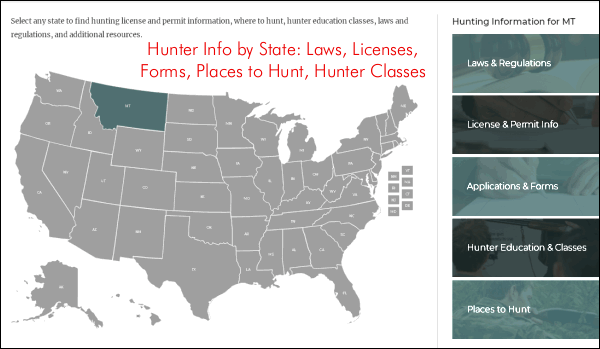
There’s a great online resource for hunters that will help you find game locations in your state and ensure you have all the proper permits and game tags. WheretoHunt.org features an interactive map of the country. For all 50 states, the NSSF has compiled information about hunting license and permits, where to hunt, hunter education classes, laws and regulations and more. For each state you’ll also find a link for required applications and license forms.
Product Review by F-Class John
Case preparation is critical for precision reloading. One must trim cases, debur/chamfer case mouths, clean necks, spruce up primer pockets and do other important tasks. Complete case prep can involve many separate processes, each requiring its own tools. With each of those tools comes additional cost as well as the need for more storage and bench space. To make case prep easier, faster, and more convenient Lyman created the Case Prep Xpress. The Case Prep Xpress, introduced a few years back, combines up to five prep stages into one well-built, stable, versatile unit. Watch this video to see the machine in action:
The Case Prep Xpress features five (5) independently-turning spindles all with the common 8/32 thread. This allows you to attach multiple tools supplied with the unit PLUS many other screw-on prep tools. For our testing we started out using a variety of the 12 included tools and found they cover the majority of case prep tasks. Lyman supplies deburr and chamfer tools, pocket uniformers, reamers and cleaners, as well as an assortment of neck brushes.
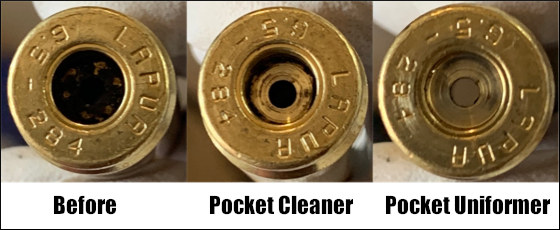
The deburr and chamfer tools worked really well, creating beautiful bevels all while leaving a nice flat edge across the top of the neck which is critical for accuracy and brass life. We found the primer pocket cleaning tool did a good job, but for truly clean pockets we recommend using the primer pocket uniforming tool, which very efficiently removes even hard residues.
The benefit of having interchangeable heads is that you can add your own accessories. We like to use a bore brush with bronze wool wrapped around it for use inside our necks. This worked perfectly once we screwed it in. In fact, we couldn’t think of any 8/32-threaded accessory that wouldn’t work well on this machine. Another great design feature is how all the accessories are oriented straight up. This allows for perfect visual alignment of your cases onto the tools which is critical — especially when performing cutting operations such as primer pocket uniforming.
Along with the five power stations there are six female-threaded storage spots on the sides where tools can be placed to ensure they don’t get lost. We like this feature since there will be more than five accessories you want to use and having them easily available is a great feature. You can keep 11 tools right on the machine (5 on top, 6 on the sides). That way you don’t have to dig through storage bins.
The Case Prep Xpress has a removable front bin to hold brass shavings, and there are two circular trays on either side of the bin. In front is a long tray that holds the provided brush. This makes it relatively easy to clean off brass shavings and other debris from case prep processes.
SUMMARY — Versatile Case Prep Xpress Is A Good Value
For the money, Lyman’s Case Prep Xpress is tough to beat. It performs multiple tasks well while being stable and easy-to-use. Yes there are some multi-spindle prep centers that offer variable or fast/slow RPM spindles while the Lyman’s spindles are all fixed RPM. (See, e.g. the RCBS Brass Boss). However those other systems don’t include all the convenient on-board storage of the Case Prep Xpress, and are more expensive. The Lyman Case Prep Xpress sells for $150-$170 “street price”. It’s currently on sale for $146.99 on Amazon. This makes the Lyman Case Prep Xpress a fine value — it offers great versatility while saving space and saving money compared to buying five or more separate, powered tools.
This Saturday, September 24, 2022, is National Hunting and Fishing Day.
There are over 9.2 million hunters in the United States. The fees paid by hunters are essential to support conservation efforts and to protect/maintain habitats.
These infographics explain the vital role that American hunters play in protecting wild species in North America. Currently 60% of state Fish & Wildlife Agency funding comes from excise taxes and licensee fees paid by hunters and anglers. The system has provided billions of dollars for conservation over the past nine decades. Since the late 1930s, hunters, target shooters and the firearms industry have been the nation’s largest contributors to conservation, paying for programs that benefit America’s wildlife.
The Pittman-Robertson Act generates $700 million annually, which is distributed by the U.S. Fish and Wildlife Service to state fish and game agencies across America.
A novice long-range competitor is now the first-ever USA King of 1 Mile. Clay Rhoden, the talented head honcho of Longshot (target cameras), won the match with a superb performance. Clay hit every single shot, without a miss, for the first five targets, all the way out to 1699 yards. There were two additional targets beyond one mile — Target 6 at 1909 yards and Target 7 at 2391 yards. Clay went 4 for 10 at these longer distances, but his perfect shooting out to 1699 yards still gave him a comfortable margin of victory.
Amazing FACT: Clay Won the 2022 USA Ko1M in only his sixth shooting match ever!
In winning the 2022 Ko1M match, Clay beat some living legends, including David Tubb, a 6-time NRA Nat’l Long Range Champion and 2019 NRA ELR HG Champ. Clay’s remarkable victory is doubly impressive if you consider that Clay had previously shot only five other rifle matches (at any distance) in his whole life. This was truly a stellar win for a new shooter. Huge congrats to Clay and his Global Precision Group (GPG) team. Clay’s GPG teammate Ray Gross took second overall.
Clay earned his one-mile Ko1M title shooting a very accurate 33XC rifle with BAT action, Bartlein barrel, Manners ELR Light stock, Bix’N Andy trigger, and a Nightforce ATACR 7-35x56mm scope. The ammo, which was developed and loaded by Paul Phillips, featured Berger 300gr Hybrid OTM bullets in Peterson brass pushed by Vihtavuori N565 powder and Federal 215 primers.
2022 King of 1 Mile USA Championship — The Winning Formula
Report by Clay Rhoden, Longshot Target Cameras
The 2022 (first ever) USA King of 1 Mile event is a match I will not soon forget! Before going any further, I want to thank Jay Monych and Alex Cordesman for putting this match together and for opening each day with prayer and the Pledge of Allegiance.
This was only my sixth match ever to shoot and boy was it a blast! I had no expectations going into the match and my focus was on trying to stay calm and collected. I didn’t shoot until the second day, but my teammate, Ray Gross, shot on the first day. I thought we did OK during his qualification run, but I felt that I let him down as a spotter by under-doping the wind calls on the first two targets. Regardless, it was enough to get him into the finals and gave him another shot at the win.
When it was my turn to shoot, I did my best to keep my heart rate down and keep from getting excited. I also prayed throughout the day and prior to shooting, asking the Lord to help me win if it was His will, and to help me gracefully accept the loss if it wasn’t. Additionally, I asked that If I won, He use the win to His glory, and He has and is! My wife and I are going through the beginning stages of the domestic adoption process and the first bit of real money will be due soon and what do you know, it just so happens to be $4,000, the exact amount of money that I won in the match!
The top 19 shooters advanced to the Ko1M FINAL (Targets 5,6,7). In 20th, Paul Phillips just missed out.
My prayers were answered, and I was the only shooter to pull off a flawless run during the qualifier, going 3 for 3 on Targets 1-4. That secured us the top spot going into the finals and after randomizing the list, I remained at the top as 1st shooter in the finals and Ray as the 3rd. Conditions during the finals were worse as it was later in the day and the mirage had really come out to play. I was able to continue my flawless run onto T5 going 5 for 5, then I got 1st, 3rd, and 5th round impacts on T6, and a 4th round on T7. Thankfully, that was enough to secure the win.
Rifle, Scope, and Ammo
I was shooting a brand new 33XC rifle that had about 30 rounds through the barrel from practicing before the match. The gun has a BAT Machine left-hand feed, right-hand eject action, Bartlein barrel, sitting in a Manners F-Class stock with a modified custom TCS weight-tuning butt system. On top was a Nightforce ATACR 7-35x56mm FFP MOAR scope with NF high rings. The BAT action was bedded by Alex Sitman with machine work by GA Precision. The stock allowed me to add a good bit of weight to the back of the gun. That combined with a Tubb 5-star muzzle brake created a smooth and predictable recoil that allowed me to stay on target and help spot my impacts.
Team GPG Captain Paul Phillips loaded all the Ammo for Clay Rhoden and other Team GPG members.
Equally important if not more important than the rifle is the ammunition, and I have to give credit where credit is due. Paul Phillips loaded all the ammunition for the whole team and it shot lights out. We used Peterson Brass, Federal 215M primers, Vihtavuori N565 powder, and Berger 300gr Hybrid OTM bullets. During the match we observed that the guns and ammo performed so consistently shot after shot, that if we got an impact, we just need to run the same hold because the gun is going to put the next round in the exact same spot as the last one.
I was asked “What did your wife and kids say when you put on your crown?” The first thing my wife said when I put it on was, “You look like a whitewalker from Game of Thrones.” I’m not sure what to think of that but she did have a point. My kids thought it was cool and I tried tell them that I was a King now and that they were going to have to listen better, but they saw straight through that.
Preparation for the King of 1 Mile Match
I received my rifle a few weeks before the match and shot it for the first time only a couple of days before the match during a team practice at the Kaian Vista Ranch, a central Texas ranch owned by GPG teammate James Devoglaer. Upon arriving at his ranch, we zeroed the guns, confirmed velocities, and checked to make sure that everything was level. After that, we practiced team communication and spotting on the KVR’s long-range hunter course with 6.5 Creedmoors and then did a couple simulated matches with our competition rifles on the KVR’s ELR course. This allowed us to practice communication between shooter and spotter, as well as verify the predictions from our Kestrels. This practice significantly boosted my confidence going into the match!
Wind Calls and Spotting
In ELR, this is where the team really comes into play, and thankfully, Team GPG just happens to have some of the best wind callers in the world. I shot on the second day of the match and while I was doing my best to stay calm before shooting, my teammates were discussing the wind and the anomalies they had experienced when they shot and factoring all of that into our starting wind calls. Once our time began, it was up to Ray and I to get it right and Ray was on top of it! We were able to make first-round impacts on Targets 1 (1263 yards) through Target 6 (1909 yards). On T7 (2391 yards) our assumption about what the wind was wrong and cost us a couple impacts but thankfully, we were able to parlay those learnings and capitalize on them when it was Ray’s turn to shoot. Ray and I were shooters 3rd and 1st respectively in the finals, which was good from the perspective of applying what we had just learned from when I shot, but bad for me because I was the wind guinea pig for everyone in the finals.
Becoming Part of Team GPG
I lucked into being part of Team GPG last year when I went to help Paul run our Longshot cameras during a team practice. After the practice Paul asked if I wanted to shoot his .416 Barrett and of course I couldn’t say no to that, so I got behind the gun and shot a 4″ group at 2000 yards. A few weeks later, Paul asked if I wanted to join the team and the rest is history. I was just fortunate enough, as a completely inexperienced shooter, to get on a team with some of the best shooters in the world!
Being part of a team and trusting your teammates is such a critical part of ELR and I couldn’t ask for a better team. Each one of us comes from a different background and has different specialties, and we do an excellent job of leveraging all of that to perform at the highest level. Paul and Ray have years of experience shooting competitively. James has years of experience with competitive shooting, hunting, and training, while I have experience with cameras and technology that helps to verify our impacts. Additionally, we are all shooting clone rifles and can instantly leverage what we learn during the match from one shooter to the rest of the team. Paul Phillips even also helped design the new Manners ELR Light stock we used.
Big Prize Table and Major Cash Awards
The sponsors really stepped up for this match and donated $65,000 – $70,000 worth of prizes plus $5,500 in cash! It was an awesome experience being called up first, getting a trophy, belt buckle, and giant check for first place. I also got to walk the prize table first and got an amazing custom lightweight hunting rifle in .30 Nosler from Alamo Precision Rifles (see photo). At this point, I think it’s definitely fair to say that I’m hooked!
Now it’s time to prepare for our next match, the King of 2 Miles. Hopefully, Lord willing, Team GPG will be able to pull off more podium finishes at the end of September.
Conclusion: Philippians 4:13 states “I can do all things through Christ, who gives me strength.” There is no way I could have done this without my faith in God and without my team! I am so blessed and grateful to be able to say that I won the King of 1 Mile!
Longshot Products — How They Are Employed for ELR
There is no way that I would have been in this sport or even aware of the sport if it weren’t for the products we make at Longshot. Originally, rather than buying a spotting scope or binoculars, I developed our long-range camera system to solve the problem of seeing my shots at 100 yards to help zero my first rifle. Shortly thereafter, I was introduced to the idea of 1000-yard shooting. Then, not too long after, I was introduced to Extreme Long Range (ELR) shooting.
For all these disciplines, our Longshot target cameras solve the problem of being able to see and confirm impacts, no matter the condition. And the “reach” of the system is great. The current Longshot LR-3 UHD camera has a guaranteed 2-mile range with open terrain.
As a relatively new shooter and novice long-range and extreme long-range shooter, Longshot cameras have played a critical role in my development as a shooter. With our cameras, I’m able to instantly and precisely associate environmental conditions or a breakdown in fundamentals to a specific result on the target. I truly believe that this along with the people that I have met while running this business have helped me to achieve so much so quickly.
Longshot Hawk Spotting Scope Cameras Used During Ko1M Match
While our long range UHD targets cameras can only be used for scoring during a match, Team GPG uses Longshot’s Hawk Spotting Scope Camera to take pictures of the targets prior to the match and create plot books for each shooter. We then use these to take notes and call corrections during the match. This process helped me get a fourth round impact on T7 during the match. We were able to see a super small poof of dust, plot it on our sheet and call a precise correction to bring us on target.
Click Arrow to Watch Hawk Spotting Scope Camera Video
Background Report from Paul Phillips, Team GPG Captain
Team GPG approached the 2022 inaugural USA King of 1 Mile event the same as we approached the 2019 King of 2 Miles where we finished 1st, 3rd, and 4th out of 80 shooters. This year, at the Ko1M in Texas, we had the same amazing results with first-place and second-place finishes out of 94 Ko1M competitors.
Our team GPG approach begins with making sure our rifles and ammunition are producing half-MOA or better accuracy along with single-digit SDs. We then make sure we have very accurate 100-yard zeros and our optics are plumb and level.
We then utilize a custom PDM (Personalized Drag Model) from Applied Ballistics and verify all of our ballistics with multiple Kestrels and Applied Ballistics analytics.
Once this all matches up, then we simply input all of the distances and environmentals and we are ready for competition. For wind calling we use the Kestrel for wind speed and direction and use analytics to get the values. Just before we shoot we register any last second pick-ups or let-offs to start shooting.
For team communications and team work we spent the day at the KVR ranch located in Lometa, TX owned by Team GPG member James Deboglaer. James put us through his hunter course and we used this as a way to communicate and make sure we were on the same page.
With good elevations and wind along with great team work and communications we were able to produce our first- and second-place results.
Paul Phillips Crafted All the Ammunition and Did Load Development
Paul told us: “I’m doing all of the load development, loading ammo, ballistics and initial wind estimations for my shooters. I also did all the ballistics solutions using AB Analytics.”
Rifle Specifications and Components
All the team’s guns and ammo were GPG spec 33XC builds, with ammunition loaded by Paul Phillips. Clay’s 33XC round has the 300gr Bergers running 3250 FPS MV. GPG team rifles feature these components:
BAT actions
Bartlein barrels
Bix’N Andy triggers
Manners ELR Light stock
Nightforce ATACR scopes
Accutac bipod
GA Precision Gunsmithing
Paul Phillips Load Dev
Alex Sitman bedding
Manson Reamers
Hollands level
Tubb brakes
Berger 300gr Hybrid OTM .338 Cal bullet
Peterson cartridge brass
Vihtavouri N565 powder
Fed 215 primer








 Being part of a team and trusting your teammates is such a critical part of ELR and I couldn’t ask for a better team. Each one of us comes from a different background and has different specialties, and we do an excellent job of leveraging all of that to perform at the highest level. Paul and Ray have years of experience shooting competitively. James has years of experience with competitive shooting, hunting, and training, while I have experience with cameras and technology that helps to verify our impacts. Additionally, we are all shooting clone rifles and can instantly leverage what we learn during the match from one shooter to the rest of the team. Paul Phillips even also helped design the new Manners ELR Light stock we used.


