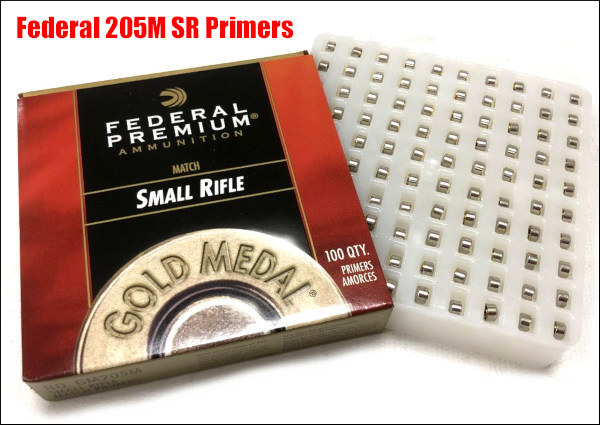
Do you know how gun primers are made — how the explosive elements are applied into those tiny cups? Find out by watching this video filmed at a Federal ammunition factory. It starts out with empty primer cups loaded, 1000 at a time, into trays using vibration (0:05 time-mark). While much of the process is automated, there is still a significant role played by production workers who apply a green, paste-like charging compound to the inside of hundreds of primer cups.
At the 0:17-second time-mark you can see the factory worker “charging” the primers with the priming compound. After the cups are filled, then the plate of cups “mates up with a plate of anvils” (0:40 time-mark). Then the primers are unloaded from trays and inspected.
Primer “Mysteries and Misconceptions” Article
There is an excellent article about primers on the Shooting Times website. This authoritative Shooting Times article explains the fine points of primer design and construction. The author reveals some little-known facts about primers and corrects common misconceptions. Here are some highlights:
Size Matters
Useful Trivia — even though Small Rifle and Small Pistol primer pockets share the same depth specification, Large Rifle and Large Pistol primers do not. The standard pocket for a Large Pistol primer is somewhat shallower than its Large Rifle counterpart, specifically, 0.008 to 0.009 inch less.
Magnum Primers
There are two ways to make a Magnum primer — either use more of the standard chemical mix to provide a longer-burning flame or change the mix to one with more aggressive burn characteristics. Prior to 1989, CCI used the first option in Magnum Rifle primers. After that, we switched to a mix optimized for spherical propellants that produced a 24% increase in flame temperature and a 16% boost in gas volume.
Foiled Again
Most component primers have a little disk of paper between the anvil and the priming mix. It is called “foil paper” not because it’s made of foil but because it replaces the true metal foil used to seal early percussion caps. The reason this little disk exists is strictly a manufacturing convenience. Wet primer pellets are smaller than the inside diameter of the cup when inserted and must be compacted to achieve their proper diameter and height. Without the foil paper, the wet mix would stick to the compaction pins and jam up the assembly process.
Many hunters and precision rifle competitors use muzzle brakes because these ported devices reduce felt recoil significantly. That makes a real difference getting back on target for quick follow-up shots. While many rifle owners appreciate the benefits of muzzle brakes, they may also neglect their brakes, allowing hard carbon and powder residue to build up. Not good. You should regularly clean your muzzle brake to remove fouling and carbon build-up.
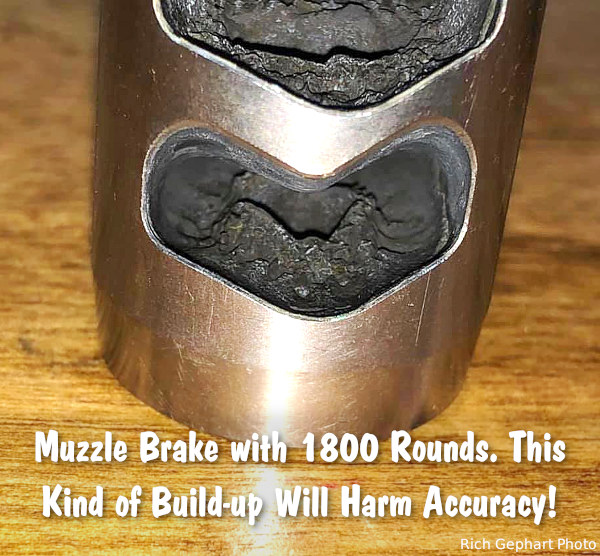
As Mark Edgreen posted: “Carbon build up on the crown and in the brake is a recipe for poor accuracy.” And another gunsmith reported that customers complained about guns that “shot out way too early” but they only needed to have the brakes cleaned.
Gunsmith and PRS/NRL competitor Jim See recently reminded his Facebook Fans about the importance of cleaning muzzle brakes: “How many times do I have to say it? You need to maintain your rifles. Clean your muzzle brakes people!”. Jim, who runs Elite Accuracy LLC, notes that hard carbon build-up in brakes can definitely harm accuracy. Look at this example:
Muzzle Brake Cleaning Methods
There are various methods for cleaning a brake, we list a variety of techniques, but we would start with NON-corrosive ultrasound. You’ll want to remove the muzzle device before doing these tasks.
1. Use Ultrasonic Cleaning Machine with cleaning solution. This may be the most efficient method: “I place my brake in the ultrasonic cleaner. Shiney as new.” (Jim Moseley).
2. Spray with commercial Carb Cleaner and brush. Then apply anti-corrosion coating.
3. Soak in half hydrogen peroxide and half vinegar. Suggestion: “Let sit over night and carbon melts off. Brush remaining carbon off, rinse and put the brake back on.” Apply anti-corrosive before mounting.
4. Soak in 50/50 solution of water and white vinegar and brush. (Be sure to apply anti-corrosion coating, such as Eezox, after soaking).
5. Tumble in liquid solution with stainless pins. Comment: “Comes out slightly faded, but perfectly clean on stainless, non-painted brakes though.” Warning — do NOT do this with threaded brakes — tumbling could affect threads of screw-on brakes. Also, tumbling can harm painted or Cerakote finishes.
Gunsmithing Tip: By fitting the muzzle brake so that the barrel crown is slightly forward, it is easier to wipe carbon fouling off the end of the barrel. See photo:
This custom war wagon hauls varmint hunters around the Longmeadow Game Resort in Colorado.
Will you be heading to the varmint fields this summer? Proper planning is key to a safe, satisfying, and productive varmint holiday. Of course you’ll be busy reloading, but you should make a check-list of all the gear and supplies you need. Bring a variety of rifles if possible — you’ll need to switch off as one barrel gets hot, and the chambering that works best for your close shots may not be ideal for those longer shots out past 400 yards. Here are some tips from our Forum members that can help you shoot more effectively, and avoid problems on your varmint hunt. Here’s one key tip: at your shooting station, put a strip of surveyor’s tape on a tall stake to show the wind direction. Then shoot in the direction the wind blows. This will minimize the effect of cross-winds.
Varmint Safari Planning, Equipment, and Shooting Advice
From PatchHound: “The gear you bring will make or break a trip out to Prairie Dog land. A lot has to do with where you going and how far you are from [civilization]. For starters, bring lots of water. It will be hot in Wyoming in a few more weeks but it don’t hurt to bring warm clothes in case it snows. It’s best to wear leather boots unless you’re real good at dodging cactus while walking around. Good sunscreen [and a wide-brimmed hat] will save the day too. [What you need to bring] really depends on whether you’re shooting on some friendly ranch or 100 miles in the middle of [a wilderness area]. Good survival gear is a good thing to have for the latter!”
This photo is from a Dan Eigen TV Show video featuring a P-Dog hunt.
From Stoner25mkiv: “I’d suggest an adjustable bipod if you are going to do any walking. A laser rangefinder is a huge asset. Have a fanny pack or backpack for extra ammo, water, bore-snake, etc. when you go on your walkabouts. We also take a couple pivoting benches, heavy movers’ pad/blanket, sandbags (Uncle Bud’s Bulls Bag) for shooting from near the vehicle. Boonie hat for blocking the sun, sun glasses, sunscreen. High leather boots.
Anyway, on to the rifles…consider bringing a 17 HMR, .223 Ackley bolt gun, .223 Ackley AR, and a 243 WSSM. Some years the 17 HMR isn’t removed from its case. We had a couple windless days and the 17 was lots of fun. I’d walk into the dogtown and then lay down and wait. After five minutes or so I’d have dogs within easy rimfire range, and out to as far as I’d care to stretch the rimfire. 275 yards was about it.”
From CTShooter: “The .204 [Ruger] is a laser beam and good to 400 yards easy. Forget the rimfire! Do you have a portable bench that pivots? Bring bipod, binocs. Bring a LOT of water. I have a milspec sniper shooter’s mat/drag bag with shoulder straps. It is good to carry everything when you want to wander off and shoot prone with bipod. Here’s a view through my 6BR in ND.”
From RJinTexas: “In most of the locations that we’ll be shooting we’ll usually set up a minimum of 200 yards from the edge of a major dog town. We’ll start by working over the close-in dogs and shooting our way out, some of these towns may run in excess of 500/600 yards deep. I believe that a rimfire will put you at a distinct disadvantage. The only rimfire that will somewhat work is the 17 HMR and you can reload for your 204s for close to the cost of HMR ammo and you’ll be less apt to be under-gunned. Your 204 will work well out to 300/400 yards unless the wind is blowing hard. We classify a 10-mph crosswind as a very calm day and what makes it a little more challenging is that it is usually also gusting.”
From Wes (P1ZombieKiller): “[For my first PD trip] there are so many things I was not ready for. The one thing that I did bring (that no one told me about) was a canopy. I’m glad I did. Even though the weather was [near perfect], I know that sun can humble you real fast. With my pop-up canopy, I could shoot all day without getting killed by the sun. You had to tie the canopy down real well or the wind would blow it across the pasture.
We sat on shooting benches that pivot 360°, and are fast and easy to set up. Most all shots were 175-250 yards. I just felt comfortable at that range. It was more fun for me to be able to film the hits, and the camcorder I was using just did not get good video past 350 yards. The digital zoom distorted the image too much. I knew I would only get this one chance to film my first P-dog outing, and I wanted to get it on film for [posterity].”
Bring Multiple Rifles on Your Varmint Adventures
On our P-Dog adventures, we like to have multiple rifles — a .17 HMR for close work, then maybe a .20 Practical AR for 150-250 yards, then a larger caliber such as 6BRA, 6 Dasher or 6XC for those long shots. The classic 22-250 is also a wickedly effective varmint cartridge.
.20 Practical (20-223 Rem) AR-Platform Varminter
Here is a .20 Practical built by Robert Whitley. Whitley’s Ultimate Prairie Dog Rifle (PDR) features a 24″ Bartlein 11-twist cut-rifled barrel, DPMS side-charging upper, and a Jewell trigger. It is chambered in 20 Practical, a cartridge popularized by Warren “Fireball” Brookman.
This .20 Practical cartridge is simply the .223 Remington necked down to .204. You can use your existing .223 Rem brass — no special case-forming required! The 20 Practical is accurate, flat-shooting, and has almost no recoil. The advantage over the standard .223 Remington is that, grain for grain, the bullets have a higher BC and travel at a higher velocity for more dramatic effect on a small varmint. The ultra-low recoil allows you to easily see your hits, even without a muzzle brake. The 20 Practical, launching 40-grainers at about 3750 fps, shoots flatter than a .223 Rem with 55gr hollowpoints.
.17 HMR Savage A17 Varmint Rifle
We also like to have a Rimfire for the closer shots, inside 150 yards. The .17 HMR or .17 WSM are good choices. With a rimfire you save on ammo costs and you don’t waste precious centerfire barrel life.
This video shows a successful Prairie Dog hunt with a .17 HMR. Watch and you’ll see hits out to 160 yards (00:50), proving the effective range of the .17 HMR cartridge. The host is shooting a Savage A17 semi-auto .17 HMR rifle in a Boyds laminated stock.
We are often asked “Can I get more velocity by switching primer types?” The answer is “maybe”. The important thing to know is that changing primer types can alter your load’s performance in many ways — velocity average, velocity variance (ES/SD), accuracy, and pressure. Because there are so many variables involved you can’t really predict whether one primer type is going to be better or worse than another. This will depend on your cartridge, your powder, your barrel, and even the mechanics of your firing pin system.
BE SAFE: Be cautious when changing primer types. Glen Zediker recommended decreasing your load ONE FULL GRAIN when changing to a different primer type, one that you haven’t used before.
Interestingly, however, a shooter on another forum did a test with his .308 Win semi-auto. Using Hodgdon Varget powder and Sierra 155gr MatchKing bullets, he found that Wolf Large Rifle primers gave slightly higher velocities than did CCI-BR2s. Interestingly, the amount of extra speed (provided by the Wolfs) increased as charge weight went up, though the middle value had the largest speed variance. The shooter observed: “The Wolf primers seemed to be obviously hotter and they had about the same or possibly better ES average.” See table:
Varget .308 load
45.5 grains
46.0 grains
46.5 grains
CCI BR2 Primers
2751 fps
2761 fps
2783 fps
Wolf LR Primers
2757 fps
2780 fps
2798 fps
Speed Delta
6 fps
19 fps
15 fps
You can’t extrapolate too much from the table above. This describes just one gun, one powder, and one bullet. Your Mileage May Vary (YMMV) as they say. However, this illustration does show that by substituting one component you may see significant changes. Provided it can be repeated in multiple chrono runs, an increase of 19 fps (with the 46.0 grain powder load) is meaningful. An extra 20 fps or so may yield a more optimal accuracy node or “sweet spot” that produces better groups. (Though faster is certainly NOT always better for accuracy — you have to test to find out.)
WARNING: When switching primers, you should exercise caution. More speed may be attractive, but you have to consider that the “speedier” primer choice may also produce more pressure. Therefore, you must carefully monitor pressure signs whenever changing ANY component in a load. In his books, the late Glen Zediker recommended decreasing your load ONE FULL GRAIN when changing to a different primer type, one that you haven’t used before.
Over the past 12 months, this article was one of the TOP 20 most-read Daily Bulletin features. We’re reprising it today for those who may have missed it the first time. The above diagram comes from a TiborasurasRex YouTube Video comparing G1 and G7 BC models. CLICK HERE to watch the video.
The better, up-to-date ballistics programs let you select either G1 or G7 Ballistic Coefficient (BC) values when calculating a trajectory. The ballistic coefficient (BC) of a body is a measure of its ability to overcome air resistance in flight. You’ve probably seen that G7 values are numerically lower than G1 values for the same bullet (typically). But that doesn’t mean you should select a G1 value simply because it is higher.
Some readers are not quite sure about the difference between G1 and G7 models. One forum member wrote us: “I went on the JBM Ballistics website to use the web-based Trajectory Calculator and when I got to the part that gives you a choice to choose between G1 and G7 BC, I was stumped. What determines how, or which one to use?”
The simple answer is the G1 value normally works better for shorter flat-based bullets, while the G7 value should work better for longer, boat-tailed bullets.
G1 vs. G7 Ballistic Coefficients — Which Is Right for You?
G1 and G7 refer both refer to aerodynamic drag models based on particular “standard projectile” shapes. The G1 shape looks like a flat-based bullet. The G7 shape is quite different, and better approximates the geometry of a modern long-range bullet. So, when choosing your drag model, G1 is preferable for flat-based bullets, while G7 is ordinarily a “better fit” for longer, boat-tailed bullets.
Drag Models — G7 is better than G1 for Long-Range Bullets
Many ballistics programs still offer only the default G1 drag model. Bryan Litz, author of Applied Ballistics for Long Range Shooting, believes the G7 standard is preferrable for long-range, low-drag bullets: “Part of the reason there is so much ‘slop’ in advertised BCs is because they’re referenced to the G1 standard which is very speed sensitive. The G7 standard is more appropriate for long range bullets. Here’s the results of my testing on two low-drag, long-range boat-tail bullets, so you can see how the G1 and G7 Ballistic coefficients compare:
G1 BCs, averaged between 1500 fps and 3000 fps:
Berger 180 VLD: 0.659 lb/in²
JLK 180: 0.645 lb/in²
The reason the BC for the JLK is less is mostly because the meplat was significantly larger on the particular lot that I tested (0.075″ vs 0.059″; see attached drawings).
For bullets like these, it’s much better to use the G7 standard. The following BCs are referenced to the G7 standard, and are constant for all speeds.
Many modern ballistics programs, including the free online JBM Ballistics Program, are able to use BCs referenced to G7 standards. When available, these BCs are more appropriate for long range bullets, according to Bryan.
[Editor’s NOTE: BCs are normally reported simply as an 0.XXX number. The lb/in² tag applies to all BCs, but is commonly left off for simplicity.]
This article is copyright 2026 AccurateShooter.com. No 3rd Party republication of this article is allowed without advance approval and payment of licensing fees.
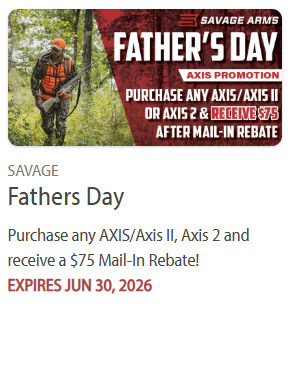
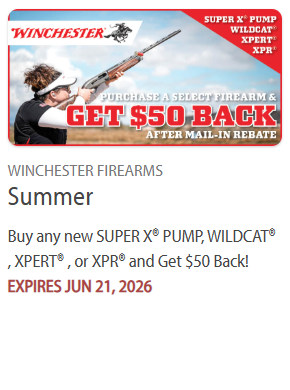
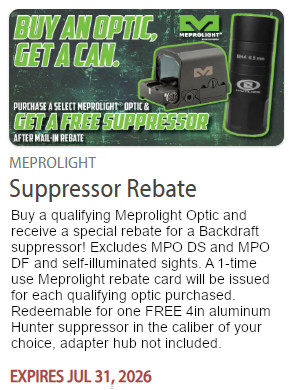
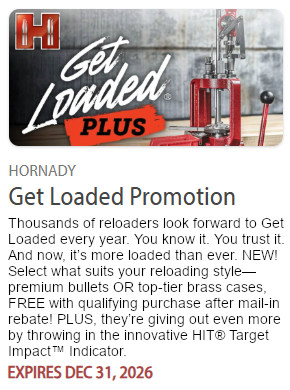
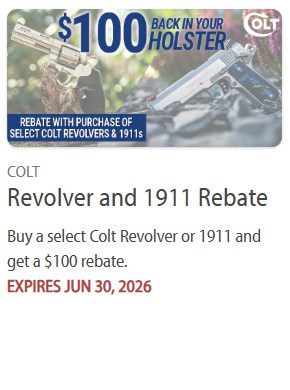
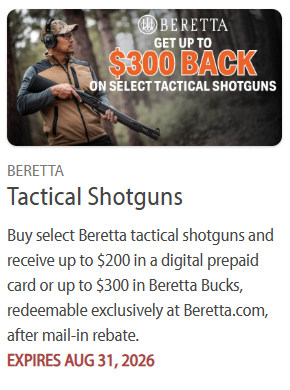
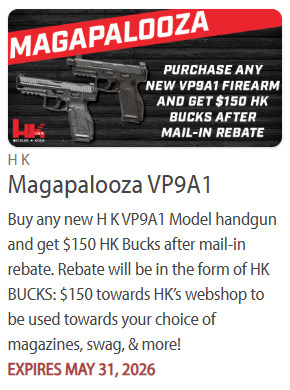
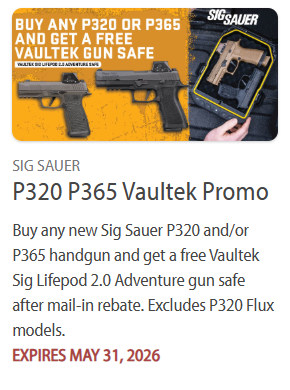
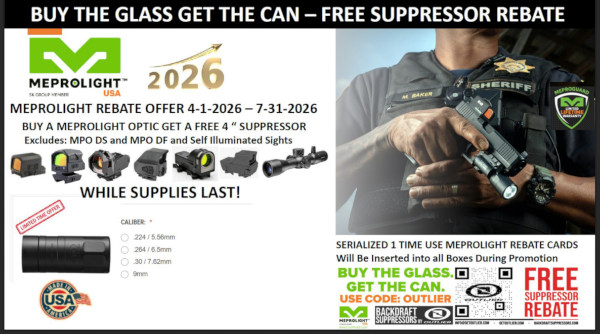
There a number of good rebate programs going on right now, but some conclude in just a few weeks. To take advantage of these deals you’ll need to start your shopping soon. Here are some current 2026 Rebate Programs for rifles, optics, ammunition, reloading gear, and shooting accessories. You can save up to $300.00 with these direct Rebate offers.
At the request of our readers, we provide select “Deals of the Week”. Every Sunday afternoon or Monday morning we offer our Best Bargain selections. Here are some of the best deals on firearms, hardware, reloading components, optics, and shooting accessories. Be aware that sale prices are subject to change, and once clearance inventory is sold, it’s gone for good. You snooze you lose.
NOTE: All listed products are for sale to persons 18 years of age or older. No products are intended for use by minors.
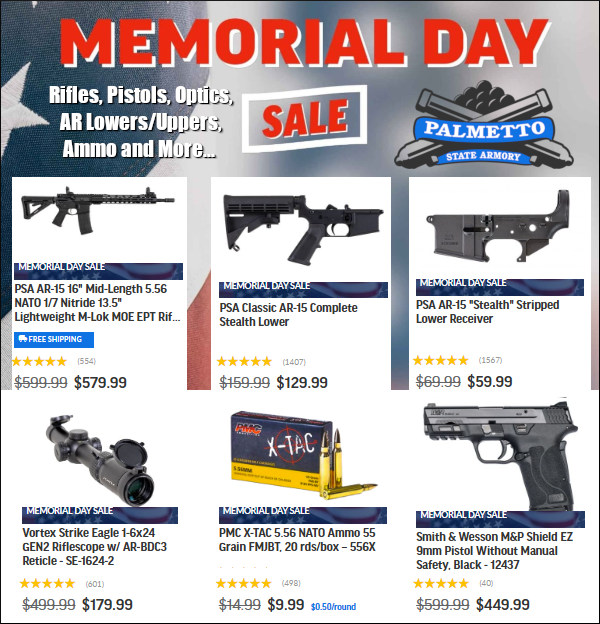
Palmetto SA — Memorial Day Sale
⏺️ » Great deals on rifles, AR components, ammo
Many leading vendors are running major Memorial Day Sales. Palmetto State Armory has hundreds of popular items on sale this week. Enjoy major discounts on AR components, complete rifles, handguns, optics and more.
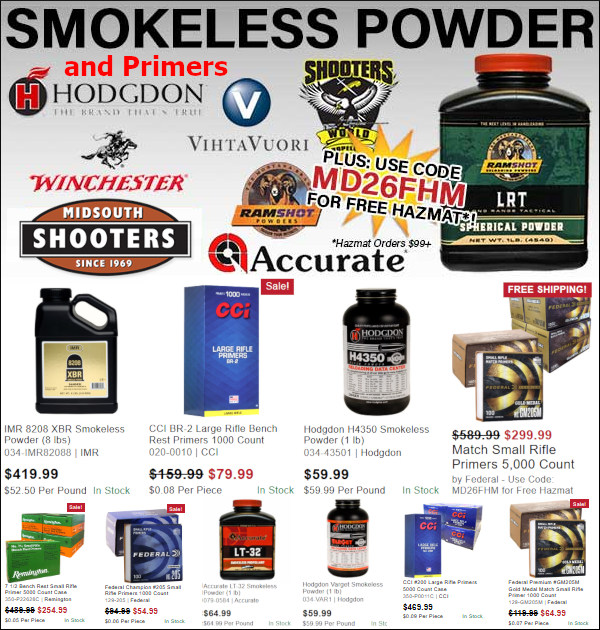
Midsouth — Primers Sale and Free Shipping or Free Hazmat
⏺️ » Primers SALE plus Free Shipping or Free Hazmat on powder/primers
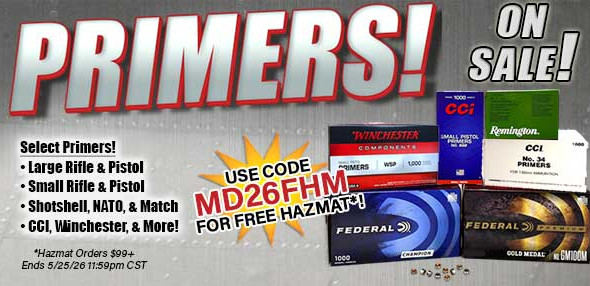
Midsouth is running notable promos right now with significant discounts on primers plus savings on powder shipping and hazmat. This sale includes major brands including Hodgdon, CCI, Winchester, Accurate, Remington, Ramshot and many others. Choose FREE Shipping or FREE Hazmat on orders over $99! Use Code MD26FS for Free Shipping on orders over $99 or use Code MD26FHM for Free Hazmat on orders over $99. Order Must Include $99 of In Stock Items – Up to 49lbs. NOTE: These codes expire Monday 05/25/26 at 11:59pm CST.
As an Amazon affiliate, this site can earn revenues through sales commissions.
RCBS, one of the biggest names in the reloading and gun maintenance world, changed ownership a couple years ago. Hodgdon Powder Company (Hodgdon) acquired RCBS from Revelyst, a division of of Vista Outdoor (VSTO). Most operations of RCBS have been continued, and the full product line remains in production — presses, dies, powder measures, case prep tools, priming tools, scales and more.
Today’s Saturday Showcase feature some of the most popular and noteworthy RCBS products including single-stage, turret, and progressive presses, plus powder dispensers and other tools.
RCBS ChargeMaster Link Scale/Dispenser with Bluetooth
Having a modern, electronic powder scale/dispenser makes the hand-loading process vastly more efficient. The latest generation of powder dispensers are very accurate, and they can store charge settings for multiple cartridge types. The latest RCBS ChargeMaster Link dispenser has a modern interface, plus Bluetooth technology that “talks” to a handy App on your mobile device. The popular ChargeMaster Link is available now for $299.99 at MidwayUSA.
RCBS Combo Kit — Good Choice for Getting Started in Reloading
You can definitely save money by buying multiple reloading gear items in one combo package. RCBS offers a variety of Reloading Combo Kits which feature reloading press, powder measure, scale, priming tool, and other items. These range in price from $265-$620 on Amazon. This video reviews an RCBS Rebel Master Kit. This is a very complete starter set-up, sold for $449.99 at Midsouth.
Along with the press, we like many of the components in the Rebel Master combo kit. The powder measure works well as does the trickler, and the hand primer tool is reliable, with good feeding and plenty of leverage.
RCBS Partner Press
We think all serious reloaders should have a small, secondary single-stage press for repetitive tasks such as decapping primers. In addition, a small, compact press can be transported easily to the range. Load development can be done more efficiently when loading at the range, as you can easily modify seating depth and other variables. The RCBS Partner Press (#ad) is a great choice for a secondary press. This UltimateReloader video shows the key features of the Partner Press.
RCBS 6-Station Turret Press — Operation Tips
This editor has owned and used an RCBS Turret Press for over two decades. While certainly not as versatile/sophisticated as the Area 419 XERO turret press, this six-station RCBS press does its job handily. It is a good choice if you load multiple pistol cartridges. With six stations, you can install both a sizing and a seating die for three different cartridge types, such as 9mm Luger, .357 Magnum, and .45 ACP. It is currently $406.99 at MidwayUSA.
RCBS Brass Boss Case Prep Center
The RCBS Boss is a powered case prep center that performs multiple tasks efficiently. Priced at $214.99 on Amazon (#ad), the RCBS Boss boasts six variable, high-speed rotating stations (four at <350 RPM; two at <550 RPM). This unit is great for initial case prep (chamfering/deburring) and regular brass maintenance.
RCBS Summit — Set-UP and Field installation on Vehicle
The RCBS Summit Press (#ad) is a very unique, small footprint press that operates differently than most reloading presses. The cast-iron Summit has a large-diameter center column and die moves up and down to meet the cartridge. With this small footprint, the Summit can be used in the field. As you can see in the second video, one of our testers actually mounted a Summit Press on his vehicle (with a special pedestal) so he could load anywhere.
RCBS Bench-mount Priming Tool (Two Short Videos)
If you need to prime large numbers of cases, the RCBS bench-mount Auto Priming Tool can do so efficiently at a modest cost (currently $135.84 on Amazon #ad). It attaches to your bench so it is secure and stable. A vertical tube holds dozens of primers that feed into the pusher as you can see in these videos. Older guys who experience pain when gripping hand primer tools have praised this bench-mounted RCBS unit.
Choosing a Case Cleaning System
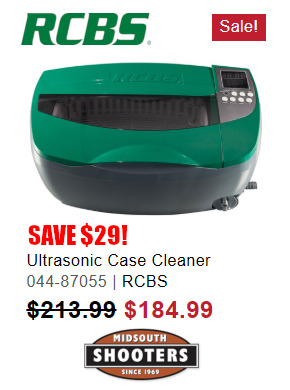
Here Kent Sakamoto of RCBS looks at the three main types of brass cleaning systems: Vibratory Tumbler, Wet Tumbler (with media), and Ultrasonic Cleaning Machine. Kent reviews the pros and cons of each system. Most gun owners can benefit by having an ultrasonic machine for parts cleaning as well as a tumbler for cleaning fired brass.
As an Amazon affiliate, this site can earn revenues through sales commissions.
Monday, May 25, 2026 is Memorial Day. Many leading shooting sports/outdoor gear vendors are running Memorial Day Sales over the next few days. You’ll find savings on guns, ammo, reloading supplies, brass, optics, hunting gear and more.
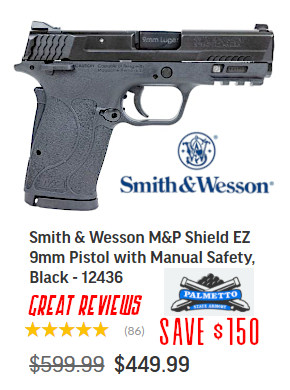
Memorial Day is one of the best times of the year to score deals on firearms, ammunition, and hunting gear. Major retailers are offering significant site-wide discounts, plus significant price cuts on top-tier brands like Vortex, Burris, Smith & Wesson, Tikka, and Walker’s.
Here Are Some Top Memorial Day Sale Opportunities:
MidwayUSA
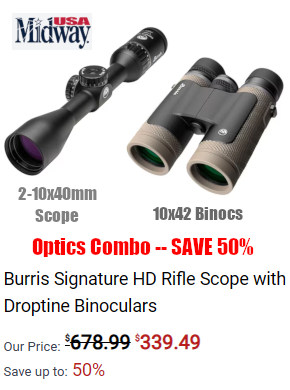
Prices are slashed on thousands of products with the MidwayUSA Memorial Day Sale. Enjoy major savings on optics, reloading tools, ammo, hunting gear and more. Many popular items are discounted 45% or more! For example the Vortex 4-12x40mm Vanquish hunting scope is now just $99.99, a 58% discount! In addition MidwayUSA is offering FREE Shipping with orders of $100 or more.
Brownells
Definitely visit Brownells.com this weekend. There are featured deals on gun parts, optics, and gear. In addition, Brownells is offering 12% Off a huge selection of products with Coupon Code MEM12.
Precision Reloading
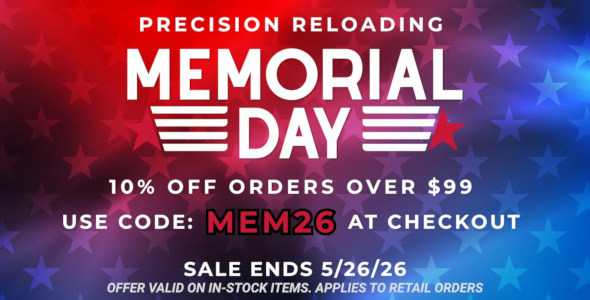
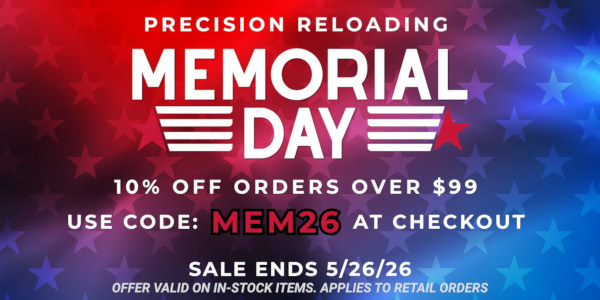
Save on a vast product selection with the Memorial Day Bargain Program at Precision Reloading. With Code MEM26 you save 10% (ten percent) on all purchases of $99 or more. This great 10% savings offer applies to virtually all in-stock products purchased from now through Tuesday, 5/26/26.
Palmetto State Armory
Palmetto State Armory is running a major Memorial Day Weekend sale right now, with significant discounts on ammo, optics, AR components and more. There are also major markdowns for complete firearms — pistols, rifles, and shotguns.
Sportsman’s Warehouse
Sportsman’s Warehouse: Save up to 25% on hunting, camping, and fishing gear. They are also offering an additional 10% off for veterans, active duty, and first responders. You can check out their deals on the Sportsman’s Warehouse Memorial Day Sale hub.
GrabAGun
The GrabAGun website offers a vast inventory of firearms. GrabAGun is now offering Daily Price Drops plus limited-time markdowns on leading firearms. Check out the inventory on the GrabAGun Sale page.
Guns.com: This large web vendor offers offers major warehouse clearance events on handguns, rifles, and shotguns. Browse the Memorial Day Weekend offers at the Guns.com Deals page.
Primary Arms: Find the full list of markdowns on the Primary Arms Memorial Day Sale page. For the next few days, you can get significant discounts on Optics, AR-15 parts, complete uppers, and triggers.
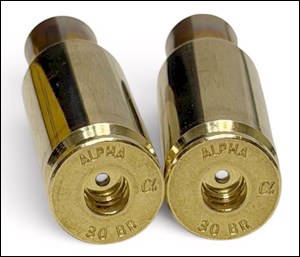
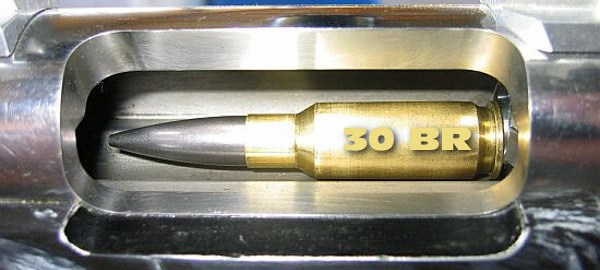
Here is great news for score benchrest shooters. For years 100/200 yard score competition has been dominated by the 30 BR cartridge, which offers outstanding accuracy and consistency with .30-caliber bullets. But creating a .30 BR cartridge took time and effort forming the brass from a parent typically using Lapua 6mm BR Norma brass or Peterson 7mm BR brass.
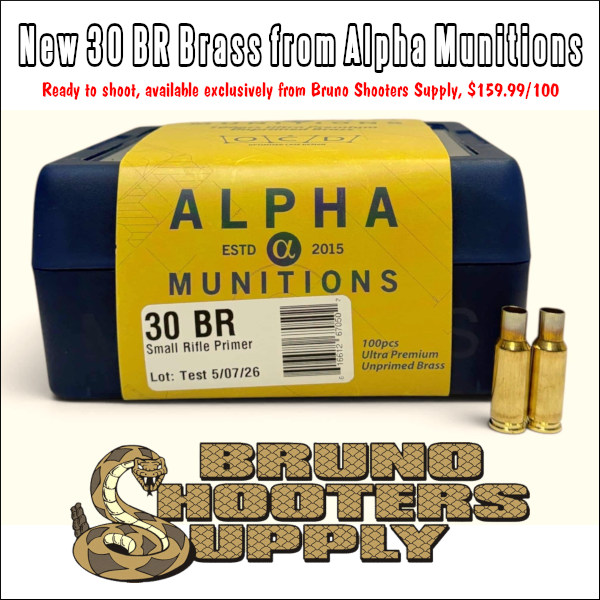
Now that has changed. Alpha Munitions now offers excellent, ready-to-shoot 30 BR brass. No separate fire-forming or hydro-forming is required. This Alpha 30 BR brass has shown excellent accuracy both with a no-turn neck and as turned for a tighter chamber. Case life is excellent as Alpha brass is strong with good longevity. This impressive new 30 BR brass is now available exclusively through Bruno Shooters Supply. It is IN STOCK now and priced at $159.99 for 100 pieces.
Ace benchrester and gunsmith Speedy Gonzales has praised this new Alpha 30 BR brass: “Well fellow score shooters, the days of expanding 6mm or 7mm brass up to make 30 BR brass are just about over. UPS just dropped off the test samples for me to test, and should be in full production soon. I will post a full video after testing and give you all the full report. 30 BR brass by Alpha will be sold exclusively through Bruno Shooters Supply and has an order list up and running[.]”


Size Matters



 From Wes (P1ZombieKiller): “[For my first PD trip] there are so many things I was not ready for. The one thing that I did bring (that no one told me about) was a canopy. I’m glad I did. Even though the weather was [near perfect], I know that sun can humble you real fast. With my pop-up canopy, I could shoot all day without getting killed by the sun. You had to tie the canopy down real well or the wind would blow it across the pasture.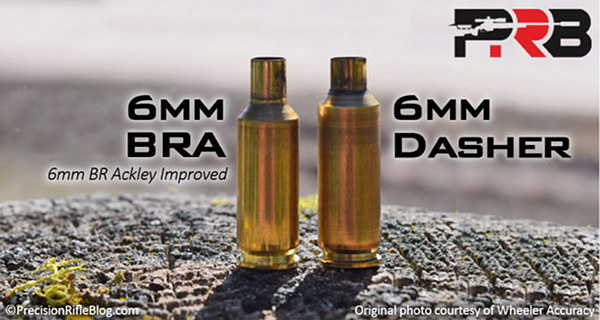


 The better, up-to-date ballistics programs let you select either G1 or G7 Ballistic Coefficient (BC) values when calculating a trajectory. The ballistic coefficient (BC) of a body is a measure of its ability to overcome air resistance in flight. You’ve probably seen that G7 values are numerically lower than G1 values for the same bullet (typically). But that doesn’t mean you should select a G1 value simply because it is higher.
 Drag Models — G7 is better than G1 for Long-Range Bullets