The USAMU has published a “how-to” article about bullet sorting. While many of us may sort bullets by base-to-ogive length (and/or weight), the USAMU story explores the “how and why” of sorting bullets by Overall Length (OAL). Read the article highlights below, and make your own decision as to whether OAL sorting is worth the time and effort. Bryan Litz of Applied Ballistics says that sorting by OAL is not a bad idea, but base-to-ogive bullet sorting probably represents a better investment of your time.
Bullet Sorting by Overall Length
We’d like to share a specialized handloading technique which we’ve long found beneficial to our long-range (600 yards and beyond) accuracy. Sorting of bullets for extreme long range (LR) accuracy is not difficult to do, but some background in theory is needed.
Here at USAMU’s Handloading Shop, we only sort individual bullets for the most demanding Long-Range applications and important competitions. Only the most accurate rifles and shooters can fully exploit the benefits of this technique. The basic sorting process involves measuring the Overall Length (OAL) of the bullets, and grouping them in 0.001″ increments. It’s not unusual to find lots of match bullets that vary as much as 0.015″-0.020″ in length throughout the lot, although lots with much less variation are seen as well. Even in bullet lots with 0.015″ OAL variation, the bullet base-to-ogive length will show much less variation. Hence, our basic sort is by bullet OAL. One obvious benefit of sorting is easily seen in the attached photo. The few bullets that are VERY different from the average are culled out, reducing probable fliers.
How does one know what OAL increments to use when sorting? The answer is simple. As each lot of bullets is unique in its OAL distribution, it’s best to sample your bullet lot and see how they are distributed. In the attached photo, you will see a set of loading trays with a strip of masking tape running along the bottom. Each vertical row of holes is numbered in 0.001″ increments corresponding to the bullets’ OAL. A digital caliper makes this task much easier. As each bullet is measured, it is placed in the line of holes for its’ OAL, and gradually, a roughly bell-shaped curve begins to form.
Note that near the center, bullets are much more plentiful than near the edges. At the extreme edges, there are a few that differ markedly from the average, and these make great chronograph or sighting-in fodder. We recommend using a sample of 200 bullets from your lot, and 300 is even better. Some bullet lots are very consistent, with a tall, narrow band of highly-uniform bullets clustered together over just a few thousandths spread. Other lots will show a long, relatively flat curve (less uniform), and you may also see curves with 2 or more “spikes” separated by several 0.001″ OAL increments.
Bullet Sorting — OAL vs. Base-to-Ogive vs. Weight
Expert advice from Bryan Litz, Applied Ballistics
I’m often asked what is a the best measure to sort bullets by, and the answer (to this and many other questions in ballistics) is: it depends.
Choosing to sort by overall length (OAL), base to ogive (BTO), bearing surface, weight, etc. can get overwhelming. Shooters typically look for something they can measure, which shows a variation and sort by that. It’s common for dimensional variations to correlate. For example, bullets which are longer in OAL are typically also shorter in BTO, and have longer noses. All these are symptoms of a bullet that was pushed a little further into the pointing die, or possibly had more than average lube while being swaged. So in essence, if you sort by BTO, you’re measuring one symptom which can indicate a pattern in the bullets shape.
So, the question still stands — what should you measure? You’ll always see more variation in OAL than BTO, so it’s easier to sort by OAL. But sometimes the bullet tips can be jagged and have small burrs which can be misleading. Measuring BTO will result in a lower spread, but is a more direct measure of bullet uniformity.
Then there’s the question of; how much variation is too much, or, how many bins should you sort into? Shooters who see 0.025” variation in BTO may choose to sort into 5 bins of 0.005”. But if you have only 0.005” variation in the box, you’ll still sort into 5 bins of 0.001”. What’s correct? You have to shoot to know. Live fire testing will answer more questions, and answer them more decisively than any amount of discussion on the subject. The test I recommend is to identify bullets on the extreme short end of the spectrum, and some on the extreme long end. Load at least 10 rounds of each, and take turns shooting 5-shot groups with them. If there is a difference, it will be evident. The results of the testing will answer your question of: should I sort based on X, Y, or Z?”
You can read more discussions on this and other similar subjects in our Accurateshooter.com Shooters’ Forum. Here’s a link to a thread discussing bullet sorting: Bullet Sorting Thread
At the request of our readers, we provide select “Deals of the Week”. Every Sunday afternoon or Monday morning we offer our Best Bargain selections. Here are some of the best deals on firearms, hardware, reloading components, optics, and shooting accessories. Be aware that sale prices are subject to change, and once clearance inventory is sold, it’s gone for good. You snooze you lose.
NOTE: All listed products are for sale to persons 18 years of age or older. No products are intended for use by minors.
1. Graf & Sons — Peterson Brass Sale
⏺️ » High-quality American-made cartridge brass with discounts
Peterson Cartridge produces very high-quality, competition-ready brass. And Peterson offers dozens of cartridge types — one of the widest selections of cartridge brass available. We’ve found Peterson brass to deliver good accuracy with excellent brass life. NOTE: As a bonus this week, if you order more than $150 worth of in-stock Peterson brass at Grafs.com, you get FREE ground shipping.
2. EuroOptic — Major Multi-Brand Optics Sale
⏺️ » Fantastic Deals on major brand optics
EuroOptic.com is running a major clearance sale this week on big name optics. You can save hundreds on quality scopes from Vortex, Leupold, Burris, Althon, Schmidt & Bender, and many other brands. This Limited Time Sale at EuroOptic offers huge savings up to 60% with specials and close-out deals. Click these links for sale listings by manufacturers: Vortex | Leupold | Burris | Athlon | Schmidt & Bender | Pulsar.
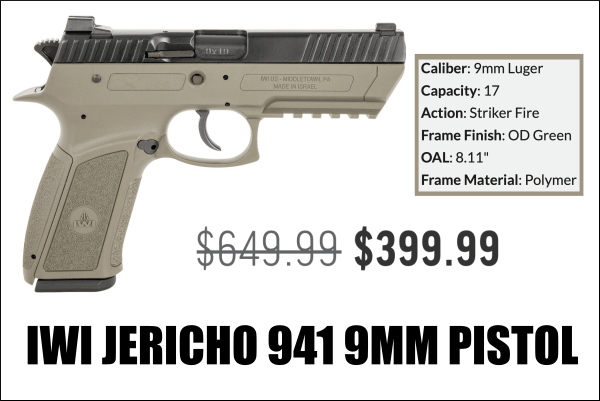
3. Palmetto State Armory — IWI Jericho 9mm Pistol, $399.99
⏺️ » High quality Israeli Weapons Industry (IWI) 9mm pistol
If you’re looking for a good, reliable 9mm handgun, consider the IWI Jericho 941 9mm pistol. This striker-fired pistol features a 4.4″ barrel and adjustable sights. The OD green polymer frame boasts interchangeable backstraps for good ergonomics. As part of PSA’s Veteran’s Day sale, this pistol is now just $399.99 — $250.00 off MSRP. The Jericho 941 combines notable CZ75-type features with IWI’s high standards for reliability, accuracy, and quality. User reviews have been very positive — 87% five-star.
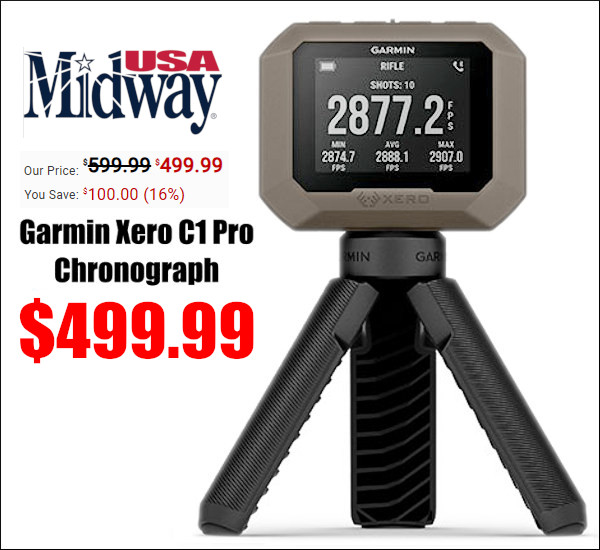
4. MidwayUSA — Garmin Xero C1 Pro Chronograph, $499.99
⏺️ » Superb, ultra-reliable compact radar chrono with $100 savings
Right now MidwayUSA has the excellent Garmin Xero C1 Pro Chronograph for $499.99, $100 off MSRP. These Garmin Radar chronos measure velocities from 100 to 5000 FPS, are easy to set up, and have up to 6 hours of battery life. In addition, if you want more savings, MidwayUSA has some newly overhauled (NOH) Garmin Xero C1 Pro Chronographs at $479.99, $120 off the normal price. All these Garmin Xero C1 Pro Chronos come boxed with all accessories, manuals, and a 1-Year Manufacturer Warranty.
5. Palmetto SA — Veterans Day Sale, UP to $500 off MSRP
⏺️ » Huge savings on wide variety of products including ARs and optics
This week Palmetto State Armory is running a major Veteran’s Day Sale through Friday. Popular products (with big discounts) include: Rifles, Pistols, Optics, Triggers, Ammunition, AR Uppers/Lowers, Magazines, Rifle Cases, knives and more. There are some incredible deals. For example the PSA PA-15 M4 Carbine is just $469.99 — that’s $480.00 off the regular price, a 50.5% discount.
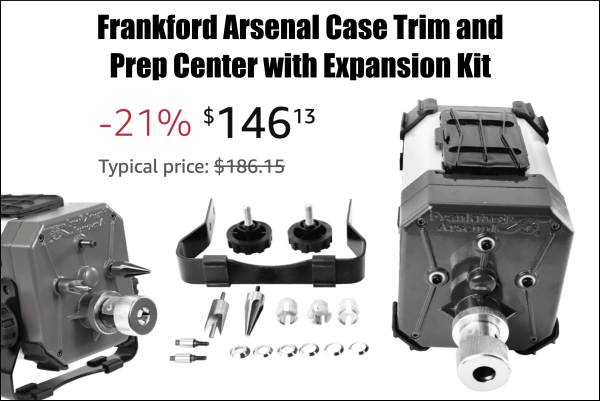
6. Amazon — Frankford Arsenal Case Prep & Trim Center, $146.13
⏺️ » Versatile powered tool center with good user reviews
The Frankford Arsenal Case Prep and Trim Center (#ad) can trim, chamfer, and deburr cartridge brass as well as clean primer pockets. The Case Prep Center boasts four power stations with case holder, VLD chamfering tool, outside chamfer tool, and primer pocket uniformers. The case holder features Adjustable Collet System (with bushing) for cases from .17 Rem to .460 Weatherby. This indexes the case shoulder and can be set to precisely trim brass to an exact length. This Frankford Case Prep Center is crafted from aluminum with a strong steel frame.
7. Amazon — Hornady LNL Sonic Cleaner, $137.95
⏺️ » Good, reliable, efficient unit for cleaning brass
Unlike traditional vibratory tumblers, Hornady’s LNL Sonic Cleaner (#ad) uses ultrasonic waves (with a ceramic heater) to quickly clean the inside and outise of cartridge brass. This can also help clean primer pockets. The large, 2-liter stainless steel tank holds up to 300 .223 Rem cases or 150 .308 Win cases. This Hornady machine is reliable and has good user reviews. For best results, use with Hornady One Shot Sonic Clean Solution (not included). The machine can also remove carbon residue from small metal equipment.
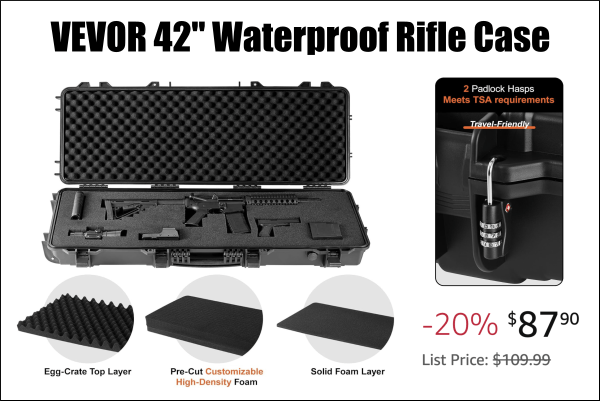
⏺️ » Major savings on rugged waterproof case; 50″ and 52″ models also
Protecting your firearms requires a good, tough transport case. The VEVOR 42″ Rifle Case (#ad) features three layers of protective foam, solid locking points, wheels, and a IP67 waterproof case. This VEVOR gun case meets TSA requirements, making it a good choice for rifle owners who travel by air. At just $87.90 this is a great deal — much cheaper than other wheeled rifle cases of similar size. NOTE: This design VEVOR case is available in larger sizes: 50″ long version for $108.99 and 52″ version for $132.99.
9. MidwayUSA — BOG Tripod Plus E-Max Pro Earmuffs, $149.99
⏺️ » Good combo set for Hunters and Varminters
Here’s a great combo for PRS/NRL shooters and/or hunters. You get the excellent BOG Deathgrip Tripod AND Caldwell E-Max Electronic Muffs for just $149.99 total at MidwayUSA (28% Off). And, for a few more days, this combo is just $129.99 at Palmetto SA during the PSA Veterans Day Sale. The BOG DeathGrip Tripod has rugged aluminum legs and a patented hands-free clamp that can quickly secure any rifle. The bipod head pans 360 degrees with cant adjustment. The 3-position leg angle lock allows bipod use in standing, kneeling, and prone positions. The comfortable, low-profile E-Max Pro electronic muffs have a 23dB noise reduction rating (NRR). NOTE: For a few days this week, this combo
10. Amazon — Lyman Case Prep Tool Kit, $70.69
⏺️ » Handy kit with 11 tools — all you need to prep cases
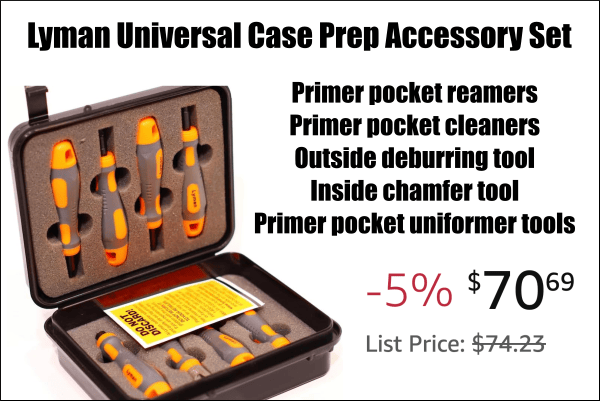
If you prefer to do your case prep by hand, we like the Lyman Universal Case Prep Accessory Set (#ad) which has ll good tools all in one handy case with fitted foam interior. The set includes both large and small primer pocket reamers, primer pocket cleaners, outside deburring tool, inside (VLD) chamfer tool and large and small primer pocket uniformer tools. All individual items have their own molded handle with rubber insert for sure grip. Includes custom zippered case for storage.
As an Amazon affiliate, this site can earn revenues through sales commissions.
The 6mm GT (aka 6GT) cartridge was conceived as a “bigger Dasher” for PRS and NRL competition. The 6mm GT’s creators wanted 6mm Dasher accuracy and moderate recoil delivered via a cartridge with a slightly longer case body for better mag-feeding, longer neck for seating flexibility, and more moderate pressures. So far the 6GT has performed very well in PRS competition. Today’s story is a bit different — this is about an experiment — running a 6mm GT in an F-TR type rifle. Understand that, under current NRA rules, you may only shoot .223 Rem (5.56×45) or .308 Win (7.62×51), in official, sanctioned F-TR competition, but the 6GT is fine for F-Open. Mike McCasland wanted to see the potential of the cartridge for long-range target shooting, so he put a 6mm GT-chambered Bartlein barrel on a nice custom rifle with McMillan XIT stock and Kelbly F-Class Panda action. The results were impressive.
6mm GT — New Cartridge with Multi-Discipline Potential
Story by Mike McCasland, Texas Precision
The 6mm GT began garnering attention within PRS circles in early 2019. It promised to shoot 105-110gr 6mm bullets at 2950-3000 FPS, yet not suffer from mag-feed issues sometimes found with 6mmBR variants such as the 6 Dasher, 6BRX, and 6BRA. Moreover, since it burned less powder, the 6mm GT promised increased barrel life compared to the 6mm Creedmoor or 6XC. The 6mm GT case size should still work with the accurate powders in the Varget burn-range. I found the 6GT also worked great with H4350.
As someone who aspired to building a repeater and jumping into the PRS game, and had a spare F-TR rifle sitting around, I thought it would be fun to build up a 6mm GT to see if there was any merit to the hype. My smith, Wes Ripley of RIP Precision in Texas, builds a lot of PRS rigs, and already had the reamer on hand (a 0.120″ freebore variant).
Whidden Gunworks had some 6mm GT FL bushing die kits in stock, so I figured why not see what all the fuss was about? At the very least I could play around with the 6mm GT in F-Open Class at local club matches to see how it compared to the 6BRA, 6 Dasher, and other popular 6mm cartridges.
Click image to see video comparison of multiple 6mm cartridges by Quarter Minute Magnums.
How the Project Got Started with Backup F-TR Rig
My 6mm GT build really started as a project spawned purely from COVID-19 Isolation boredom. This rifle primarily serves as a backup F-TR gun, and it had been relegated to performing some load development on .308 barrels, so I could spin new ones on my main match rifle. The only problem was, I had run out of .308 barrels that needed load development. So, I basically had an ideal test platform just collecting dust in the safe. All I needed was a 6mm GT-chambered barrel, since (like the 6mmBR) the 6mm GT works in a short action with a .308 Win-sized bolt-face.
6mm GT Rifle Specifications:
Action: Kelbly Panda F-Class SA RB/RP
Stock: McMillan XIT with RAD 2A
Barrel: 30″ 5R Bartlein 1:7.5″-Twist, HV Contour
Scope: Vortex Golden Eagle 15-60x52mm
Trigger: Jewell Benchrest, about 2 ounces
Bipod: Phoenix Precision
Mike McCasland reports: “I have used both Hornady and Alpha brass in this rifle and haven’t noticed much difference between the two. I will say that my batch of Alpha brass was slightly softer than Alpha brass I’ve used in other calibers; you could feel a difference when neck turning cases. I’m unsure if that’s a batch issue, or something specific to their 6mm GT brass as a whole. As far as performance, there was little discernable difference. Oddly enough, the Hornady brass seemed to have slightly less case capacity than the Alpha; with most other cartridges it’s the other way around.”
In this video, George Gardner of GA Precision talks about the 6mm GT cartridge which he helped develop.
POWDERS — The 6mm GT was designed with Hodgdon Varget in mind, and that popular powder works exceedingly well in this platform. That said, the 6mm GT can work with a wide variety of powders, some yielding better performance than Varget.
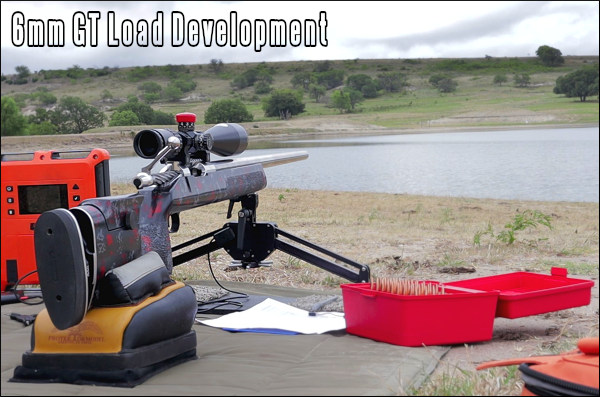
I’ve tried a multitude of powders during my initial 6mm GT load development: Varget, Shooters World Precision, RL16, VV N140, H4350, and RL-15 to name a few. In my barrel, Hodgdon H4350 seems to deliver the best velocity/accuracy combination. SD and ES also seemed to be the lowest with H4350.
Load Development for the 6mm GT — Many Powders Tested
BULLETS — The most common 0.120″ freebore chamber allows for the majority of high-BC 6mm projectiles found in both F-Class and PRS. I had good luck with the pointed 107gr Sierra Match Kings (SMK), as well as the 110gr Hornady A-Tips in my rifle. For those looking to run the heavier 112-115 grain 6mm offerings, I believe GAP designed a 0.160″ freebore reamer that gets those bullets out of the neck/shoulder junction. Shown below is the 0.120″ freebore JGS reamer print:
SUMMARY — Good Cartridge with Much Potential
Generally speaking, I think the 6mm GT is a good little round. Some may not subscribe to this theory, but I believe some cartridges are inherently easier to tune than others. I’m not sure the 6mm GT is as easy-to-tune as a 6mmBR, 6 Dasher, or 6 BRA, but I don’t think it lags that far behind.
With relatively little trouble, I was able to find loads with both Varget and H4350 that would consistently shoot very well — 0.2 to 0.3 MOA. Moreover, I found the 6GT cartridge lives up to the velocity claims made by G.A. Precision. I was easily able to push the 110gr A-Tips to 2950 FPS, and the 107gr SMKs to low 3000 FPS range without any pressure signs, or unnecessary wear and tear on the brass.
As a fun test, I ran my 6mm GT rifle in a local 1000-yard F-Class match with the 110gr A-Tips, just to see just how well they would perform. Although wind conditions of the day and some E-Target issues prevented my 6mm GT rig from getting the better of the larger 7mm and .30-Cal rifles, the 6mm GT proved itself an accurate little round at distance. Here is a 1000-yard ShotMarker target:
After putting several hundred rounds through my 6mm GT rifle, I anticipate building another 6GT on a repeater action to give PRS a try. I think if you are looking for a dual-purpose rifle that can run tactical matches (with 100% feeding reliability), and can also be used for mid-range, F-Open Class competition, the 6mm GT would be a very good option.
About the author, Mike McCasland:
Mike McCasland is an avid shooter who competes regularly in F-Class matches. Based in Texas, Mike is the creator of the Texas Precision YouTube Channel. There you’ll find many videos covering reloading, gun projects, and marksmanship. Mike has done some notable product reviews including a comparison test of Micrometer Competition Seating Dies. To access Mike’s YouTube Channel, CLICK HERE.
We have used NO-LEAD Cleaner in rimfire benchrest rifles similar to this modified Suhl 150-1. It helped restore accuracy with minimal brushing.
Made by the same smart folks that created Wipe-Out™, and Carb-Out™, NO-LEAD Brushless Lead Remover™ really works. Honest. If you are an active rimfire shooter, or if you shoot cast lead-alloy bullets in centerfire rifles and pistols, you should try this product. We now use NO-LEAD in our rimfire benchrest rifles, and in some centerfire guns that receive a steady diet of soft-alloy cast bullets (90%+ lead). (With rimfire guns, you don’t need to use NO-LEAD very often — maybe every 300-400 rounds unless you have a real fouler of a barrel.)
If you’ve got stubborn lead fouling in a rimfire barrel, or on a pistol’s muzzle brake/compensator, you should definitely give this stuff a try. We don’t know how but it does soften lead deposits. The manufacturer says you don’t need brushes, but we found that a bit of brushing (after NO-LEAD application) can help remove more serious lead build-up.
Yes we were surprised to find a lead remover that really works. We tried a half-dozen other lead “cleaners” that promised to dissolve lead and most of them, we discovered, are nearly useless. There’s a reason for that, as the lead alloys used in bullets don’t react to typical petrochemical-based solvents. It took the Wipe-Out chemists over five years to perfect this water-based solution that really does dissolve lead.
NO-LEAD Cleaning Procedure — Read Carefully NO-LEAD Lead Remover is a clear, red gel that is easy to apply. Just swab it in your bore (or on muzzle brakes) with wet patches or bore mop and let it sit for a few minutes. (The manufacturer says you can leave the NO-LEAD for up to 20 minutes, but that long of a dwell time does not seem necessary with our rimfire barrels.) When it contacts lead it will start to foam and you’ll see that the NO-LEAD solvent turns a pastel pink when it dissolves lead. The pink comes from the formation of lead oxide. After the recommended dwell time, simply patch out the dissolved lead deposits (you can also use a nylon brush for stubborn lead build-up).
NOTE: After cleaning, it is very important that you get all the NO-LEAD out of your barrel, and neutralize it. We recommend following the application of NO-Lead with Wipe-out or Patch-Out to neutralize the NO-LEAD, clear the bore, and remove residual carbon and copper fouling. If you don’t have Wipe-Out or Patch-out, flush the barrel thoroughly with Rubbing Alcohol or even a solution of Dawn dish detergent — then re-oil the bore.
Be Sure to Neutralize NO-LEAD After Use
Remember that N0-LEAD is a strong, slightly acidic chemical that needs to be neutralized after use. If you leave it on a nice, blued barrel for too long, it can harm the bluing. NO-LEAD will remove all the surface oils from the barrel bore. For this reason it is recommended that you neutralize NO-LEAD with Wipe-Out, or Patch-Out, which both contain effective corrosion inhibitors. If you don’t have those products, once you’ve flushed the NO-LEAD with something like rubbing alcohol, then follow with a gun oil. Caution: A petroleum-based gun oil will NOT, by itself, neutralize NO-LEAD. You need to neutralize first, then apply the corrosion inhibitor (or do it all in one step with Wipe-Out or Patch-Out).
Where to Buy NO-LEAD Lead Remover
NO-LEAD Lead Remover costs $18.55 for an 8 oz. squeeze bottle with a flip-top spout. This product is sold directly by Sharp Shoot-R Precision Products through Sharpshootr.com, or you can purchase NO-LEAD through many other online vendors. For more information, send an email via the Sharp Shoot-R Contact Form or or contact SharpShoot-R at (785) 883-4444. You can ask for Terry Paul, Sharp Shoot-R’s owner and the master chemist who developed the NO-LEAD formula.
If you are shopping for a new rimfire rifle, particularly a .22 LR, you may want to pick up a copy of Small-Bore Rifles: A Guide for Rimfire Users by C. Rodney James. This provides a detailed history of rimfire cartridges and provides a look at a variety of rimfire rifles for various applications — target, plinking, varminting. SSUSA.org explains this book covers “every aspect of rimfire shooting, from a detailed history of its calibers and platforms, to a discussion of proper maintenance and expected accuracy[.]” American Rifleman Editor-in-Chief, Mark Keefe, writes: “This little book is the most useful treatment of the [.22 Long Rifle] I have read, and it is highly recommended for anyone serious about being a rimfire rifleman.”
The 248-page book is available for $17.99 from Skyhorse Publishing in both paperback and ebook formats. You can view a 40-page sample of this book, including the index, on Amazon. CLICK HERE, then, when the page opens on Amazon.com, click the “READ SAMPLE” link below the book cover image. Amazon offers the book in Kindle format for $12.99.
This book focuses primarily on the .22 LR (Long Rifle) cartridge. However, it does include extensive information on other rimfire chamberings, including .17 PMC/Aguila, .17 HMR, and .22 WMR. Here’s part of the 22 WMR section:
Here are reviews by recent verified purchases of the book:
“Everything you could ever want to know about the development of the .22 round, the ballistics of the same and the history of early bolt-action .22 rifles are presented in an easy-read style by a very knowledgeable author. There are plenty of color photographs and a lot of useful maintenance information throughout the book. I do have one complaint… the book has almost no information on semi-automatics.” — K. Greene
“A must-read book for the rimfire enthusiast. Much accurate information presented in an enjoyable format. From the earliest rimfire rounds to the latest 17s [are] all are covered in this book. Bolt actions, semi-autos and single-shot rifles are covered with the pros and cons of each. What makes for accuracy from the rifle to the cartridge is well covered.” — Ken Cook
by Sierra Bullets Ballistic Technician Paul Box
All of us who have been in reloading and shooting for any period of time have read how sectional density has been regarded as a bullet’s ability to penetrate. Back before high velocity came along and modern bullet design, the easiest way to get more “power” and penetration was by increasing the diameter and mass. After all, a bowling ball will hurt more than a golf ball, right?
Let’s take a closer look at sectional density.
The formula for calculating sectional density is pretty simple and straight forward. Take the bullet weight and divide by 7000. This number is then divided by the bullet diameter squared Two bullets of equal weight and the same diameter will have equal sectional sectional density. No regard is given to the bullet construction. This is where the fly hits the soup in considering sectional density as far as penetration is concerned.
Section Density Formula: (Bullet Weight divided by 7000) divided by Bullet Diameter squared.
Bullet construction is the biggest factor in how it is able to penetrate. The best example I can think of here is to look at the Sierra .224 55 Gr. FMJBT GameKing #1355 compared to the 55 Gr. BlitzKing #1455. Both are .224 and weigh 55 grs. Both have a sectional density of .157. But there is a huge difference in their construction. The FMJ has a thick jacket and is designed to penetrate. The BlitzKing is designed for fast and rapid expansion with little concern for how deep they will penetrate.
The next time you’re choosing a bullet, look at the construction and less at the sectional density number. It’s all about the construction anyway. If you have any questions or would like to discuss sectional density or bullet penetration further, please give us a call at 800-223-8799 or shoot us an email at sierra@sierrabullets.com.
That’s custom paint on the stock, NOT a Hydro-dip coating. Impressive paintwork!
Our Sunday GunDay showcase rifle belongs to Shane Sivertsen (aka SoDakDasher in our Forum). This eye-catching tactical rig was smithed by Travis Stevens at TS Customs in Miller, South Dakota. Shane tells us that Travis is a “top-notch builder who builds tack-driving rifles that are still extremely shooter-friendly. Plus he is one of the friendliest guys you’ll meet.”
This rifle features a Lone Peak Fuzion Action with Trigger Tech Diamond trigger (flat shoe). Up front is a Benchmark 26″ MTU barrel chambered in 6mm BRA (a 40-degree 6mmBR Improved “BR Ackley”). It’s all nestled into a McMillan A5 stock with adjustable cheekpiece. Getting him on target is a Vortex Razor 4.5-27x56mm optic in Hawkins rings with a Vortex throw lever on the power ring for quick magnification changes. The Atlas PRS Bipod rides on an Area 419 ARCA rail up front. The barrel is finished off with a Piercision 5-Port Self-Timing Muscle Brake.
Custom Camo-Pattern Paint Job
All work on this rig was performed at TS Customs, including Cerakoting the action. The pattern on the McMillan A5 stock is NOT a hydro-dip! That is a custom Kryptek camo paint-job done in-house by a TS Customs employee. Shane liked the Kryptek pattern from day one: “It’s always a good thing to do something a little different to your equipment to stand apart from the rest of the pack.” Shane says the paint pattern is the first thing everyone notices about the rifle.
6mm BRA Chambering
Shane spent quite some time trying to decide which 6mm cartridge to choose. After much deliberation with Travis, he chose the 6mm BRA (aka “6BRA” or “6 BRA”), mainly due to the reputation this little cartridge has earned for accuracy and ease of tuning. This rifle is Shane’s second TS Customs-crafted rifle: “the [other] is basically the same action/barrel combo but set in an MPA chassis and chambered in 6mm Dasher.”
Excellent Accuracy with Varget and Berger 105gr Hybrids
Shane’s 6mm BRA is showing impressive accuracy: “Thanks to Mother Nature this spring (with cold, snowy weather), I have only been able to get 100 rounds fire-formed and the barrel broken-in. I started with 30.5 grains Varget in Lapua BR brass with CCI 450s and topped off with Berger 105gr Hybrids. Velocity averaged 2830 FPS with an SD of 4.7 from 10 rounds randomly picked from the lot.”
Shane knows there’s still more load development to do. But this rifle is grouping under one-half MOA and Shane says the gun can definitely out-shoot his abilities. He admits it’s still a work in progress but he is happy with the gun’s performance so far.
Shane praised his Piercision 5 port Muscle brake. Shane tells us: “While I am a suppressed shooter by preference, I wanted to give this brake a try. It works very well — the control and ability to stay on target for followups is remarkable. This brake works perfect on my 18-lb 6mm BRA and will be used indefinitely. Plus it will be a little payback to the other big-braked shooters on the line.”
While it’s still such a new toy, Shane doesn’t expect to make any modifications in the near future. However he says he might “upgrade to a Tangent Theta optic by the end of this season.”
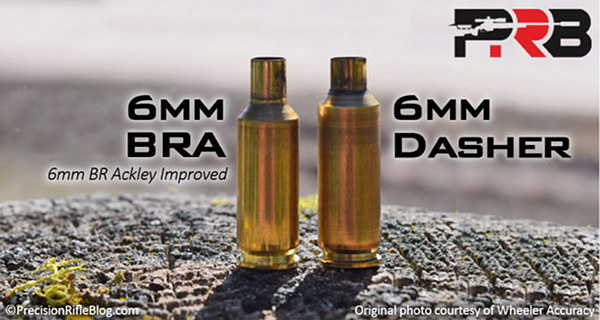
Below is a comparison between the 6mm BRA and the 6mm Dasher. The Dasher has slightly more capacity, but a much shorter neck. There is some evidence that barrel throat erosion may be slower with the 6mm BRA, and the 6mm BRA is easier to fire-form.
This is a grim tale. A man almost lost the use of his right hand, and did suffer terrible injuries to his fingers. All because he picked the wrong bottle of powder off the shelf. We have run this story before, and we will continue to run it every year, as a caution to our readers. This mistake is easy to make, but the consequences can be dire. Always, always double-check your powder labels before you start the hand-loading process. If you don’t, you may not have a hand to load with next time…
Similar Labels, Disasterous Consequences
The shooter, Denny K., was assembling some rounds for his brand new 7mm-08 Savage hunting rifle. He thought he was loading with Hodgdon Varget. Instead he had filled his powder measure with Hodgdon TiteGroup, a fast-burning pistol powder. The labels are similar, so the mistake is understandable. But the results were devastating. Here’s what 41 grains of TiteGroup can do in a 7mm-08:
Posting on the Firing Line, in a thread entitled “Lucky to Be Alive”, Denny writes:
“This is the hardest post to post. I know if I had read it a week ago my comment would have been: ‘You have no business reloading’. I had everything perfect, except pouring the wrong powder in the powder measure. I type this slowly with my left hand, embarrassed but … possibly saving someone else a tragedy or, like me, a long drive to the Emergency Room and surgery to save my finger.”
The Still-Sealed Bottle of Varget
Denny did not initially comprehend exactly why the kaboom happened. He thought maybe his new Savage rifle was at fault. Then, on his return home, he discovered something…
Denny wrote: “The seven-hour period it took to go to ER, transport to Trauma Center and surgery made me think it was a Savage rifle issue. Brand new rifle, new brass, triple-checked loading data. The next day I was humbled when I realized the Varget powder was still sealed.
I knew what powder to use. I thought [Varget] was what I used. Not until the following day did I realize the Varget was still sealed.”
At that point, Denny realized what caused the accident — “operator error”. He knew he had to warn others about using the wrong powder: “I knew I needed to share my mistake, even though it is embarrassing, just to remind people. I’ve been reloading for 30 years…”
Editor’s Comment: Denny was not a novice reloader. His experience demonstrates that this kind of mistake can be made by any hand-loader, even one with decades of experience. Be safe guys, take your time when you load your ammo. Remove powders from measures after your loading sessions (pistol powders can look very similar to rifle powders). And by all means CHECK the LABEL on the jug. As the TiteGroup label says: “A little goes a long way.”
It’s not a bad idea to separate your pistol powders from your rifle powders, or perhaps even load for pistol in a separate part of your workshop.
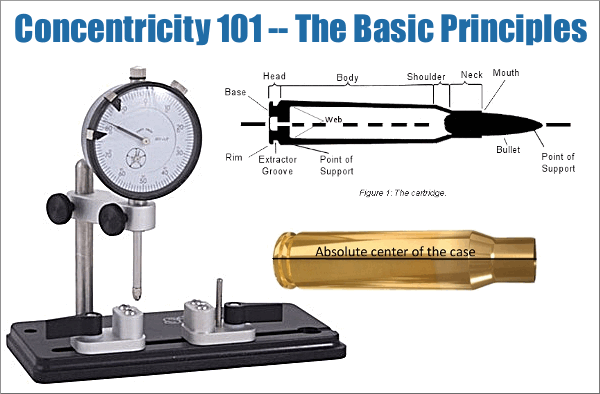
Sinclair Internationalhas released an interesting article about Case Concentricity* and bullet “run-out”. This instructional article by Bob Kohl explains the reasons brass can exhibit poor concentricity, and why high bullet run-out can be detrimental to accuracy.
Concentricity, Bullet Alignment, and Accuracyby Bob Kohl
The purpose of loading your own ammo is to minimize all the variables that can affect accuracy and can be controlled with proper and conscientious handloading. Concentricity and bullet run-out are important when you’re loading for accuracy. Ideally, it’s important to strive to make each round the same as the one before it and the one after it. It’s a simple issue of uniformity.
The reason shooters work with tools and gauges to measure and control concentricity is simple: to make sure the bullet starts down the bore consistently in line with the bore. If the case isn’t properly concentric and the bullet isn’t properly aligned down the center of the bore, the bullet will enter the rifling inconsistently. While the bore might force the bullet to align itself with the bore (but normally it doesn’t), the bullet may be damaged or overstressed in the process – if it even it corrects itself in transit. These are issues we strive to remedy by handloading, to maintain the best standard possible for accurate ammunition.
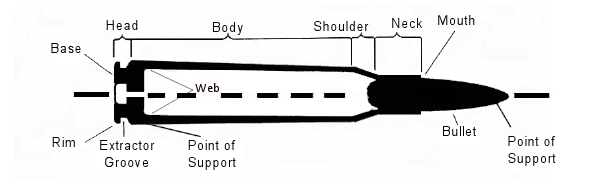
The term “concentricity” is derived from “concentric circle”. In simple terms it’s the issue of having the outside of the cartridge in a concentric circle around the center. That goes from case head and center of the flash hole, to the tip of the bullet.
Factors Affecting Concentricity
The point of using this term is to identify a series of issues that affect accurate ammunition. Ideally this would work best with a straight-walled case; but since most rifle cartridge cases are tapered, it equates to the smallest cross section that can be measured point by point to verify the concentric circle around the center. For the examples below, I’m working with .308 Winchester ammo.
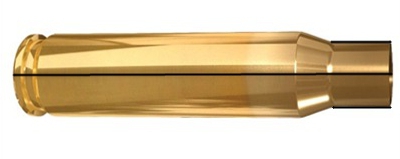
Figure 1: The cartridge.
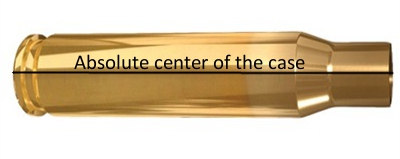
Figure 2: Centerline axis of the case, extending from flash hole to case mouth.
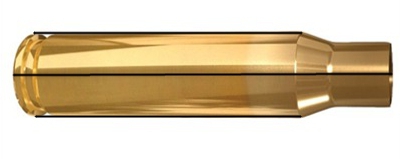
The case walls have to be in perfect alignment with the center, or axis, of that case, even if it’s measured at a thousandth of an inch per segment (in a tapered case).
Figure 3: Case body in alignment with its axis, or centerline, even in a tapered case.
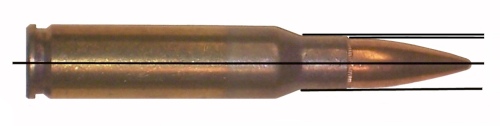
The case neck must also be in alignment with its axis. By not doing so you can have erratic bullet entry into the bore. The case neck wall itself should be as uniform as possible in alignment and in thickness (see the M80 7.62x51mm NATO cartridge in Figure 5) and brass can change its alignment and shape. It’s why we expand the case neck or while some folks ream the inside of the neck and then turn the outside for consistent thickness, which affects the tension on the bullet when seated.
Figure 4: Neck in alignment with center of the case axis.
Figure 5: Variations in case neck wall thickness, especially on some military brass, can cause an offset of the bullet in its alignment. This is an M80 ball round. Note the distinct difference of the neck walls.
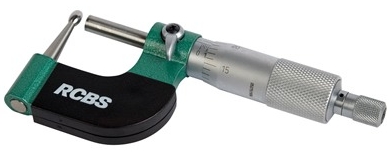
Having a ball micrometer on hand helps, especially with military brass like 7.62x51mm in a semi-auto rifle, where there are limits as to how thin you want the neck walls to be. In the case of 7.62 ball brass you want to keep the wall to .0145″.
Figure 6: A ball micrometer like this RCBS tool (#100-010-268) can measure case neck thickness.
Turning the outside of the neck wall is important with .308 military cases regardless of whether you expand or ream the neck walls. There are several outside neck turning tools from Forster, Hornady, Sinclair, and others. I’ve been using classic Forster case trimming (#100-203-301) and neck turning (#749-012-890) tools for 40 years.
Bullet Run-Out
The cartridge, after being loaded, still needs to be in alignment with the center of the case axis. Figure 7 shows a bad example of this, a round of M80 ball. A tilted bullet is measured for what’s known as bullet “run-out”.
Figure 7: An M80 round with the bullet tilted and not aligned with the axis. This will be a flyer!
Run-out can be affected by several things: (1) improperly indexing your case while sizing, which includes not using the proper shell holder, especially while using a normal expander ball on the sizing die (it also can stretch the brass). (2) The head of a turret press can flex; and (3) improper or sloppy bullet seating. This is also relevant when it comes to using a progressive press when trying to load accuracy ammo.
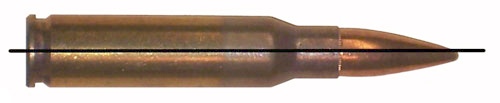
Mid Tompkins came up with a simple solution for better bullet seating years ago. Seat your bullet half way into the case, back off the seater die and rotate the case 180 degrees before you finish seating the bullet. It cuts down on run-out problems, especially with military brass. You also want to gently ream the inside of the neck mouth to keep from having any brass mar the surface of the bullet jacket and make proper seating easier. A tilted bullet often means a flyer.
Figure 8: Proper alignment from the center of the case head to the tip of the bullet.
(NOTE: This links to a Web Archive version of the original Sinclair Int’l article.)
*Actually some folks would say that if we are talking about things being off-center or out-of-round, we are actually talking about “eccentricity”. But the tools we use are called “Concentricity Gauges” and Concentricity is the term most commonly used when discussing this subject.
Fire-Form with Foulers
Here’s a tip for guys who shoot the 6 PPC, 6 Dasher, 6 BRA, .284 Shehane, or other wildcat cartridges that require fire-forming. Use your fouler shots to fire-form new cases. That way your fouler shots do “double-duty” and you get your brass fire-formed without putting extra rounds through your expensive barrel.
This procedure is recommended by Joel Kendrick, the 2004 IBS 600-yard Shooter of the Year. After he cleans his barrel, Joel knows it takes two or three shots to foul in the bore before accuracy returns. (YMMV — some barrels may need five or six foulers.) When shooting his PPC, Joel uses those fouler shots to fire-form his new brass. Joel explains: “I like to have relatively new brass always ready. By fire-forming a couple cases after each barrel-cleaning during a match, by the end of the weekend I’ve got a dozen or more freshly fire-formed cases to put into the rotation. If you do this with your fouler shots you get your fire-forming accomplished without using up any extra barrel life.”
This not only saves barrel wear, but it saves you trips to the range for the purpose of fire-forming. We thank Joel for this smart suggestion. For those who do not have a dedicated barrel for fire-forming, this should help keep your round-count down. Note: With this fouler fire-forming routine, you should ALWAYS do the fire-forming with the SAME POWDER you load for your match ammo. Joel currently works as the Supplier Quality Process Engineer for Parker TruTec — MMI Inc., a company that offers barrel surface coatings that can further extend your barrel life.








 As someone who aspired to building a repeater and jumping into the PRS game, and had a spare F-TR rifle sitting around, I thought it would be fun to build up a 6mm GT to see if there was any merit to the hype. My smith, Wes Ripley of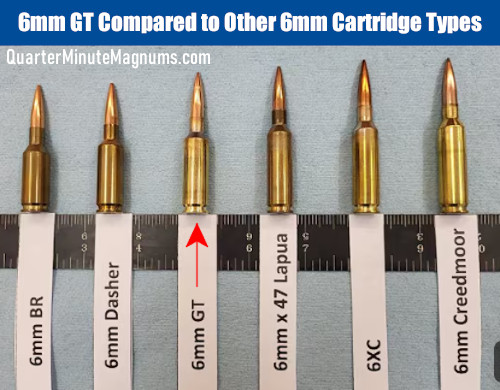


 BRASS — Editor’s Report: Lapua now offers excellent

 SUMMARY — Good Cartridge with Much Potential


 Made by the same smart folks that created Wipe-Out™, and Carb-Out™,
  Where to Buy NO-LEAD Lead Remover


 Custom Camo-Pattern Paint Job




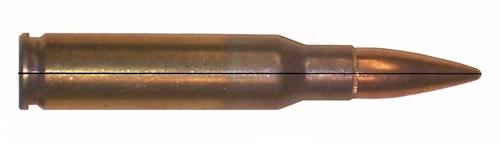

 Fire-Form with Foulers


