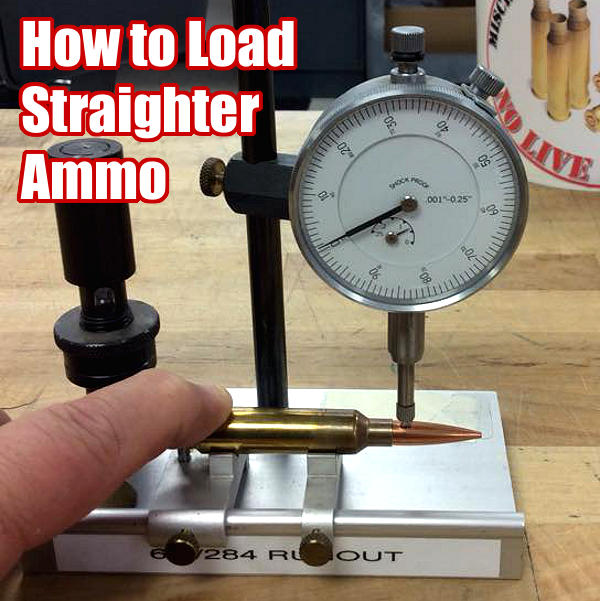
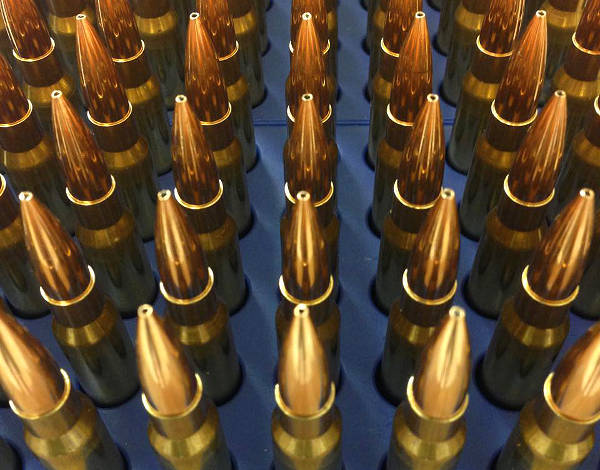
Each Wednesday, the U.S. Army Marksmanship Unit publishes a reloading “how-to” article on the USAMU Facebook page. A while back the USAMU’s reloading gurus looked at the subject of cartridge run-out and what can be done to produce straighter ammo. Tasked with producing thousands of rounds of ammo for team members, the USAMU’s reloading staff has developed smart methods for improving concentricity, even with budget=price dies. For other hand-loading tips, visit the USAMU Facebook page.
Minimizing Runout with Standard Seating Dies
This USAMU article explains how to set up standard bullet seating dies dies to minimize Total Indicated Run-out (TIR). The loading process is described using a single-stage press since most handloaders have one. A high-quality run-out gauge is essential for obtaining consistent, accurate results.
Having sized, primed, and charged our brass, the next step is bullet seating. Many approaches are possible; one that works well follows. When setting up a standard seating die, insert a sized, trimmed case into the shellholder and fully raise the press ram. Next, back the seating stem out and screw the die down until the internal crimping shoulder touches the case mouth.
Back the die out ¼ turn from this setting to prevent cartridge crimping. Next, lower the press ram and remove the case. Place a piece of flat steel (or window glass, which is quite flat) on the shellholder and carefully raise the ram.
Place tension on the die bottom with the flat steel on the shellholder. This helps center the die in the press threads. Check this by gently moving the die until it is well-centered. Keeping light tension on the die via the press ram, secure the die lock ring. If one were using a match style, micrometer-type seating die, the next step would be simple: run a charged case with bullet on top into the die and screw the seating stem down to obtain correct cartridge OAL.
However, with standard dies, an additional step can be helpful. When the die has a loosely-threaded seating stem, set the correct seating depth but don’t tighten the stem’s lock nut. Leave a loaded cartridge fully raised into the die to center the seating stem in the die. Then, secure the stem’s lock nut. Next, load sample cartridges and check them to verify good concentricity.
One can also experiment with variations such as letting the seating stem float slightly in the die to self-center, while keeping correct OAL. The run-out gauge will show any effects of changes upon concentricity. However, this method has produced excellent, practical results as evidenced by the experiment cited previously. These results (TIR Study 2) will reproduced below for the reader’s convenience.
First, however, let’s examine run-out figures of some factory-loaded match ammunition. This should give readers who are new to TIR gauges some perspective about the TIR ranges one might encounter.
TIR Study 1: 50 rounds Lake City M852 Match 7.62mm
(168 gr. Sierra MatchKings)
0.000” – 0.001” = 2%
0.001” – 0.002” = 30%
0.002” – 0.003” = 16%
0.003” – 0.004” = 22%
0.004” – 0.005” = 14%
0.005” – 0.006” = 14%
0.006” – 0.007” = 0%
0.007” – 0.008” = 2%
TIR Study 2: 50 rounds of .308 match ammo loaded using carefully-adjusted standard dies, vs. 50 using expensive “Match” dies from the same maker.
Standard dies, TIR:
0.000” — 0.001” = 52%;
0.001”– 0.002” = 40%;
0.002”– 0.003” = 8%.
None greater than 0.003”.
Note: both samples were loaded using the O-Ring method, i.e. with a rubber O-Ring placed under the locking ring of the Full-length sizing die to allow that die to float.
These tips are intended to help shooters obtain the best results from inexpensive, standard loading dies. Especially when using cases previously fired in a concentric chamber, as was done above, top-quality match dies and brass can easily yield ammo with virtually *no* runout, given careful handloading.
We’re told the 6.5 Creedmoor is now the best-selling chambering in new bolt-action rifles sold in the USA. Accurate, versatile, with moderate recoil, the 6.5 Creedmoor serves hunters, paper punchers, and PRS shooters equally well.
As part of its online Load Data Center, Nosler offers very complete load data for the popular 6.5 Creedmoor cartridge. This medium-sized cartridge has become one of the most popular chamberings for tactical and PRS shooters. The 6.5 Creedmoor combines excellent accuracy, good mag-feeding, good barrel life, moderate recoil, and reasonable component cost. That’s why this cartridge has caught on quickly. GET ALL 6.5 Creedmoor Load Data.
How does barrel length affect 6.5 Creedmoor Muzzle Velocity? CLICK HERE for RifleShooter.com barrel cut-down velocity test.
According to the Sierra Load Manual: “Developed in 2007 by Dennis DeMille and Dave Emary, the 6.5 Creedmoor is a shortened and improved 30 TC cartridge case that was inspired by the .308 Winchester design. This short action design was created to maximize case capacity and a wide range of loading lengths, while still fitting in standard short action magazines. With the correct twist barrel, the versatile 6.5 Creedmoor can take advantage of the wide range of bullet weights available in 6.5 mm (i.e. .264 caliber). Reloaders should keep in mind that the 6.5 Creedmoor works best with medium to medium-slow powders such as H4350, Varget, Win 760, and RE-17.”
Click Each Image to Load PDF File for Listed Bullet Weights
Our friend Bill Marr of Rifleshooter.com has done it again — conducted a fascinating 6mm Creedmoor barrel cut-down test that reveals how velocity changes with barrel length. This time Bill started with a 24″ Proof Research stainless steel barrel on a Howa action. Bill says this was a well-used barrel, with over 1800 rounds through it. So, the velocities might be a bit different than a new barrel of similar length. Bill cut the barrel down in one-inch increments. Here are some results from the test:
For this latest test, Rifleshooter cut the barrel in one-inch increments from 24″ to 16.1″ (just over legal minimum). Velocities were measured with a MagnetoSpeed V3 chronograph mounted on arm attached to the stock. This allowed the chrono to be adjusted inwards as the barrel was cut shorter, inch by inch.
For the 6mm Creedmoor cartridge, Bill loaded Hornady 108gr ELD Match bullets over 41.5 grains of Hodgdon H4350 with CCI 200 primers in new Starline brass.
The results were interesting to say the least. Bill reports: “Muzzle velocities ranged from 2,893 ft/sec at 24″ to 2,598 ft/sec at 16″ for a decrease in muzzle velocity of 295 ft/sec. Muzzle velocity changes per inch of barrel length ranged from 6 ft/sec per inch between 20 and 19 inches to 63 ft/sec per inch between 19 and 18 inches. Average velocity change per inch of barrel length was 37.9 ft/sec.”
Bill concludes: “An average drop of 37.9 ft/sec/inch of barrel is fairly significant and is what would be expected with a fast moving 6mm cartridge like the 6mm Creedmoor. While I’m used to seeing 6mm Creedmoors with slightly longer barrel lengths than 24″, when coupled with a sound suppressor the additional length can make moving the rifle quickly more difficult.
I’d suggest staying with longer barrel lengths wherever possible with this cartridge. At shorter lengths, it does give up more performance than its big brother the 6.5 Creedmoor.”
More 6mm Creedmoor Velocity Data from 2017 Cut-Down Test
If you’re curious about 6mm Creedmoor velocities at longer barrel lengths, back in 2017 Rifleshooter completed a 6mm Creedmoor barrel cut-down test from 31 inches all the way down to 17 inches. The test included four bullet types from 95 grains to 110 grains. With the 110gr Sierra MK, velocity at 31″ was an impressive 3110 fps. Surprisingly the velocity didn’t decrease that much for the first few inches. Even at 26″ (a five-inch reduction), measured velocity with the 110s was 3073 fps, a loss of 7.4 fps per inch on average. With a barrel shortened all the way to 20″ however, velocity had dropped down to 2949 fps, a significant (161 fps) loss. CLICK HERE for complete results from that 31″-17″ Barrel Cut-Down Test.
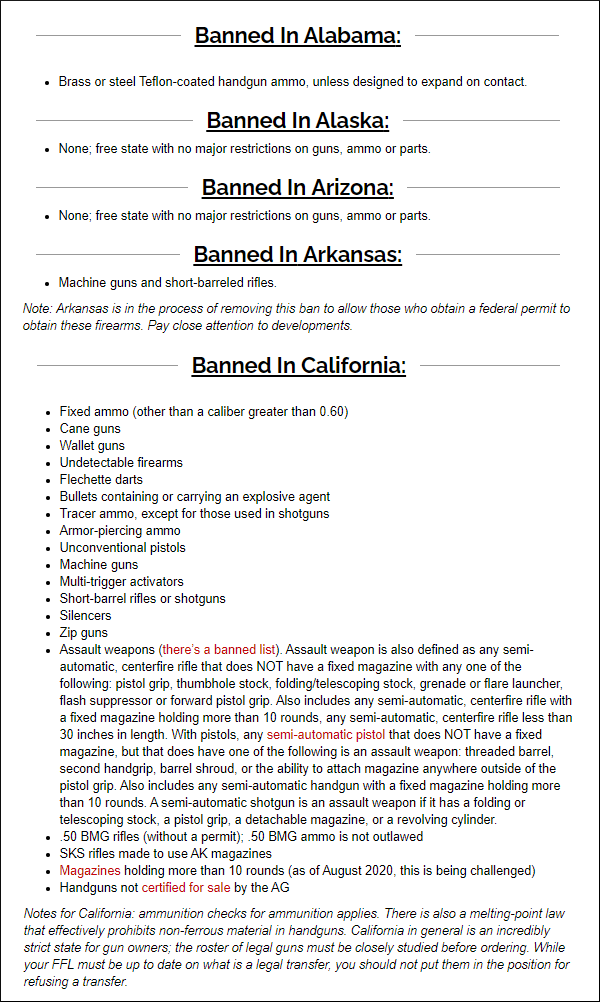
Cheaper Than Dirt (CTD), a Texas-based gun product retailer, has compiled a great resource that can benefit gun owners. CTD has created a “BANNED LIST” which catalogs firearms, ammo, and gun-related products (such as magazines) that are banned in particular states. This Overview of Restricted Guns, Ammo and Parts in Each State is searchable by state, so you can quickly identify the guns, ammo, and gun-related products banned in your location.
Wilburn Roberts, CTD Blog editor, explains: “You must be aware of local laws. I have authored more than 6,000 firearm-related articles, written 14 books on the topic of firearms and served as a peace officer and security professional for decades. I’m still learning new things related to laws every day.
Why read up on this topic? For starters, some things you would never have guessed are illegal. As an example, did you know that some states ban ‘wallet holsters?’ These are holsters that allow you to carry a handgun like a Beretta .25 ACP (or sometimes a small revolver) in the back pocket.
Be careful, as many things you are able to purchase easily online could be illegal in your home state. Some are patently illegal, others are illegal only if you carry them.
That being said, this is a report on certain items that are banned in one state or another. Feel free to use it as a reference for your own research. It contains pertinent gun laws nationwide and is separated on a state-by-state basis. It is ultimately your responsibility to study your own state laws and those of the states you travel in. Lawws might be … more complex than they first appear. Double-check the laws for your state. Also, remember that these laws are subject to change. At the end of the day, you should never order anything that is illegal in your state.”
DISCLAIMER: This is not intended to be a comprehensive or complete list of gun laws. The information provided is not intended as legal advice or a restatement of law. For any particular situation, it is highly recommended that a licensed local attorney be consulted for an accurate interpretation. The opinions and statements expressed in this article belong to the author and do not necessarily represent Cheaper Than Dirt, nor is the company at fault for any gun-related legal decisions you make.
At the request of our readers, we provide select “Deals of the Week”. Every Sunday afternoon or Monday morning we offer our Best Bargain selections. Here are some of the best deals on firearms, hardware, reloading components, optics, and shooting accessories. Be aware that sale prices are subject to change, and once clearance inventory is sold, it’s gone for good. You snooze you lose.
1. Krieger Barrels — Overstock Barrels in Inventory Now
⏺ Great Krieger barrels with no waiting — overstock inventory
Since Krieger barrels are so highly sought-after, there can be a long lead time to get a made-to-order Krieger barrel. Here’a little known secret, Krieger Barrels has an overstock barrels section on its website. There you’ll find a very wide selection of calibers, countours, and lengths. In stock are many of the most popular barrel types for hunting, PRS, Benchrest, and F-Class. Take a look, there just may be a barrel you need, and you’ll have your barrel in days, not months.
2. Annealing Made Perfect — AMP Annealer and Accessories
⏺ Most Advanced Annealing Machine and important accessories
Annealing Made Perfect (AMP) in the world leader in cartridge annealing technology. AMP has recently launched its own online store which features everything AMP sells, all in one place. Along with the AMP computer-controlled annealing machines, you’ll find case feeders, pilots, and software upgrades. You’ll also find a wide array of specialty parts which are not available anywhere else.
⏺ Peterson ammo made with great brass and top-tier bullets
Everyone knows Peterson makes some of the best brass on the market, but did you know Peterson produces some of the finest precision loaded ammunition as well? At Grafs.com you’ll find the outstanding Peterson specialty rifle ammunition. Graf’s carries favorites like .243 Win, .308 Win, and 6.5 Creedmoor, plus a wide selection of big magnum cartridge types, such as .300 Norma Mag, .375 and .408 Cheytac.
4. Amazon — MTM R-100 Deluxe 100-Round Ammo Box, $14.95
⏺ Best Ammo Carrier on the market — Mechanical Hinge, lockable
Here’s a great upgrade to the original MTM 100-rd ammo case, which had latches that could sometimes pop open and a folded plastic hinge that could break over time. That’s all changed with MTM’s new MTM R-100 Deluxe 100 Round Rifle Ammo Box. This features two strong snap closures and sturdy mechanical hinges for the lid. Yes the lid now lies flat when open! And there is now a locking hasp in the front. With these updates, we think this is, without question, the best 100-rd ammo carrier on the market.
⏺ Great Ruger 10/22 Deal with Veridian 3-9x40mm Scope
The Ruger 10/22 is a legendary American .22 LR rifle. It is fun to shoot, and a great first rifle for young marksmen. Sportsman’s Warehouse has just slashed the price on the Ruger 10/22 Carbine with scope. This carbine model features a black, synthetic stock and factory-mounted Viridian EON 3-9x40mm scope — all for just $299.99! This setup is ready to hit the range right out of the box.
6. Amazon — Kestrel 1000 Windmeter, $74.00
⏺ Basic Kestrel unit under $74.00 — reliable and accurate
Reading wind is critical for successful shooting and the Kestrel 1000 windmeter is probably the best way to do it for under $100. At only $74, this Kestrel 1000 features a 3-button control system and large LCD display. The unit measures current, average, and peak wind speed values fast and accurately in mph, km/h, feet/min, m/s, or knots.
7. Natchez — Primos Trail Camera Gen 2, $39.99
⏺ Great value — Use for game hunting and property security
If you need a simple, affordable trail camera, check out the Primos Proof Cam Gen 2 Low Glow Trail Camera. When you’re not using the camera for spotting game, these are great for general monitoring duties on your property. The manufacturer says the camera “is built for one purpose: To give hunters the most reliable, most simple-to-use camera money can buy with all the functions that really matter and none of the extras that don’t. Now Primos Proof Gen 2 line offers faster recovery, better detection distance, and best in class performance.” This unit features 12 megapixel resolution, 80-foot night range, 720P HD video with time-lapse, plus a 1-year battery life with 8 AA Batteries.
⏺ Performs as promised — saves mess at home or at range
When cleaning rifles, wet and dirty patches can make a real mess. Here’s a solution — the MTM Gun Cleaning Patch Catcher. Simply slip it over your barrel to contain all the patches pushed out the muzzle. No more mess and stains on your bench/table. When cleaning tasks are done, simply remove the Patch Catcher and dump the contents into the trash. Watch the video to see how the MTM Patch Catcher works.
9. Midsouth Shooters — Bulldog Rifle Case Sale
⏺ Good quality; 54″ case holds PRS and Match Rifles; Bargain Cases too
Midsouth is running a sale now on the Bulldog Rifle Cases. You’ll find a variety of cases at attractive prices. For F-Class and PRS rifles with long barrels, we like the big 54″ Long Range Rifle Case shown above. Bulldog also make great tactical cases for modern sporting rifles. And you’ll find affordable green/tan zippered cases for scoped hunting rifles (48″, $13.05) and long-barrel shotguns (52″, $13.24). These $13 Bulldog economy cases are a great bargain.
10. MidwayUSA — Lockdown 3-Gun Magnetic Barrel Rack, $15.99
⏺ Attach to outside of safe, or use in workshop or RV
This simple device is very handy when you’re loading multiple long guns into a safe. It’s also great for those multi-rifle cleaning sessions — just line up your rigs outside the safe securely. This “staging support” barrel rack attaches to the outside of a safe and holds your guns vertically with polymer-coated magnetic V-Blocks. You can also use this in your workshop or RV. For $15.99 this is worth every penny if it saves even one expensive stock from getting dropped and damaged.
In some areas of the country (California in particular), hunters are now forbidden to use bullets that contain lead. If you need a lead-free projectile for your deer rifle, consider Nosler’s E-Tip projectile. This has plenty of penetrating power and retained energy while complying with laws requiring “unleaded” ammunition. An “expansion chamber” behind the green polymer tip helps ensure reliable expansion with 95% weight retention. The video below shows a .30 Caliber 180gr lead-free E-Tip impressively power through TWO 12-inch blocks of Ballistics Gel at 100 yards. This was fired from a .308 Winchester.
Watch 180gr eTip Penetration and Expansion in Ballistic Gelatin:
Nosler claims the E-Tip bullet has advantages over other solid copper hunting bullets: “Unlike the competitor’s one-piece designs, Nosler E-Tip bullets will not blow the petals off at extreme velocities nor will the low end expansion ever be questioned, as the minimum impact velocity is set at 1800 fps for standard calibers.” One hunter, posting on Facebook, gave the E-Tip high marks: “I have had the opportunity to take a pig with a 130 gr E-Tip from my .270 and they work flawlessly. My son took two pigs with his .300 Win Mag and 165gr E-Tips and they worked flawlessly as well.”
This video illustrates the design and construction of the Nosler eTip Bullet:
We are often asked “Can I get more velocity by switching primer types?” The answer is “maybe”. The important thing to know is that changing primer types can alter your load’s performance in many ways — velocity average, velocity variance (ES/SD), accuracy, and pressure. Because there are so many variables involved you can’t really predict whether one primer type is going to be better or worse than another. This will depend on your cartridge, your powder, your barrel, and even the mechanics of your firing pin system.
BE SAFE: Glen Zediker recommends decreasing your load ONE FULL GRAIN when changing to a different primer type, one that you haven’t used before.
Interestingly, however, a shooter on another forum did a test with his .308 Win semi-auto. Using Hodgdon Varget powder and Sierra 155gr Palma MatchKing (item 2156) bullets, he found that Wolf Large Rifle primers gave slightly higher velocities than did CCI-BR2s. Interestingly, the amount of extra speed (provided by the Wolfs) increased as charge weight went up, though the middle value had the largest speed variance. The shooter observed: “The Wolf primers seemed to be obviously hotter and they had about the same or possibly better ES average.” See table:
Varget .308 load
45.5 grains
46.0 grains
46.5 grains
CCI BR2 Primers
2751 fps
2761 fps
2783 fps
Wolf LR Primers
2757 fps
2780 fps
2798 fps
Speed Delta
6 fps
19 fps
15 fps
You can’t extrapolate too much from the table above. This describes just one gun, one powder, and one bullet. Your Mileage May Vary (YMMV) as they say. However, this illustration does show that by substituting one component you may see significant changes. Provided it can be repeated in multiple chrono runs, an increase of 19 fps (with the 46.0 grain powder load) is meaningful. An extra 20 fps or so may yield a more optimal accuracy node or “sweet spot” that produces better groups. (Though faster is certainly NOT always better for accuracy — you have to test to find out.)
WARNING: When switching primers, you should exercise caution. More speed may be attractive, but you have to consider that the “speedier” primer choice may also produce more pressure. Therefore, you must carefully monitor pressure signs whenever changing ANY component in a load. Glen Zediker recommends decreasing your load ONE FULL GRAIN when changing to a different primer type, one that you haven’t used before.
To help celebrate National Shooting Sports Month (NSSM), rifle and gear manufacturers are offering big prize packages — the Gearbox Giveaways. Enter to win rifles, pistols, ammo, and other valuable prizes. Many of the Gearbox packages are worth over $3000 with the most valuable package worth over $4700! Enter as many of the Gearbox Giveaways as you choose. You can’t win if you don’t enter.
You’ll find all the Gearbox Giveaways on the NSSF website. Shown below are 12 current Gearbox Giveaways ranked in order of value — starting with the most valuable prize package. Below each photo is a link for the ENTRY PAGE for that gearbox item. Good luck!
Do you use factory ammo in your hunting rifles? Perhaps you buy bulk centerfire ammo for your AR15 or varmint rifle. Then this book is for you.
If you ever shoot factory ammo, you should consider getting Ammo & Ballistics 6. This resource book lists over 2,600 different loads for 200+ cartridge types from .17 Mach 2 up to .700 Nitro Express, including the most popular centerfire and rimfire cartridges (both rifle and handgun). In this updated-for-2020 Sixth Edition, there are over 3,000 tables covering virtually every caliber and every load for all commercially-loaded hunting ammunition sold in the USA. Tables include velocity, energy, wind drift, bullet drop, and ballistic coefficients up to 1,000 yards.
Ammo & Ballistics 6 helps you select ammo for a hunt — quickly compare the velocity and knock-down power of various commercial ammo. This book can help you choose a caliber/chambering for your next hunting rig.
Verified Book Purchaser Reviews
“Outstanding reference guide for shooters and ballistic enthusiasts alike. Has data on velocity, energy delivered, Taylor KO index, windage and elevation on numerous loadings for hundreds of [cartridge types]. Each cartridge has all dimensions labeled (i.e rim, case length, neck, etc.), and has an informative description of the cartridges history/relevance.” — S. Step, 2017
“Great heaps of data! This volume has pages and pages of new data for .22LR like the hot Velocitor, and also on the .22 WMR from 30 grains up into the 50s. Most importantly there is lots of range data, drop, windage, kinetic energy, etc. — Terrific reference guide….” — E. Svanoe
Ammo & Ballistics 6 contains data and illustrations on virtually every sporting cartridge sold in the USA. This 2020 Edition covers 200-plus cartridge types from .17 Mach 2 up to .700 Nitro Express.
At the request of our readers, we provide select “Deals of the Week”. Every Sunday afternoon or Monday morning we offer our Best Bargain selections. Here are some of the best deals on firearms, hardware, reloading components, optics, and shooting accessories. Be aware that sale prices are subject to change, and once clearance inventory is sold, it’s gone for good. You snooze you lose.
Cabela’s — Bergara B-14 HMR Rifle, $949.99
⏺ Good Ergonomics, Works for Hunting plus PRS Factory Class
Bergara rifles combine accuracy, good ergonomics, and smooth function at a lower costs than many other brands. If you’re looking for a new rifle that’s capable of hunting, PRS competition, or target shooting, check out the Bergara B-14 HMR now on sale. Available in 6.5 Creedmoor for $949.99, the B-14 HMR features a quality synthetic stock with adjustable cheek-piece (scope not included). The 24″ barrel has a threaded muzzle, so you can add a muzzle brake or suppressor. Order this online from Cabelas.com and it ships for free to your local Cabela’s store.
2. Precision Reloading — Lapua Brass and Scenar Bullets Rebate
⏺ SAVE 10% with Rebate Program for Lapua Brass and Bullets
Here is a great deal on great cartridge brass and bullets. Right now Lapua is offering a Lapua Summer Savings Rebate on cartridge brass and Scenar bullets. With this rebate, you can then save 10% on your purchases up to $200 max. Precision Reloading has a great selection of Lapua brass and bullets. Of course Lapua brass is the “choice of champions” and we have found the Scenars to be extremely consistent in weight and base-to-ogive measurements. The Lapua Rebate Program covers purchases through August 31, 2020. You can also buy from Midsouth Shooters and Grafs.com.
3. Palmetto State Armory — Rossi RS22 Rimfire Rifle, $109.99
⏺ Reliable, with very impressive accuracy — awesome deal under $110!
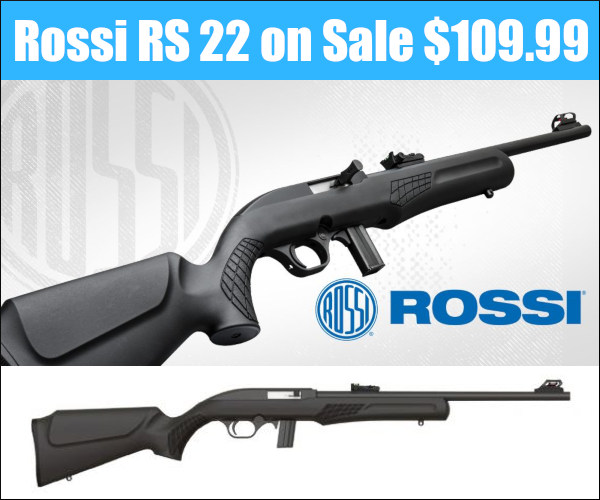
Looking for a very affordable first rifle for a young family member? Here’s one of the best low-cost options you can find among .22 LR rimfire rigs. The Rossi RS22 is a reliable, semi-auto rifle that comes equipped with barrel-mounted iron/fiber optic sights. There are also dovetails on the receiver for mounting scope rings. The RS22 also takes most Mossberg 702 magazines. The Rossi RS22 features an 18″ free-floating barrel, adjustable fiber optic sights and a synthetic Monte Carlo stock. For added accuracy, 3/8″ dovetail mounts allow the mounting of a scope or other optic. Overall weight, without scope, is 4.1 pounds.
⏺ Take advantage of Browning Bucks Rebates up to $100
Browning makes excellent rifles, shotguns, and pistols. The Browning Buckmark is one of our favorite .22 LR rimfire pistol, and Browning Citori shotguns are renown for their build quality and performance. Right now CDNN Sports is running special SALES on a wide selection of Browning Firearms. And now through the end of September, you can can Browning Bucks back — up to $100.00 on Citori shotguns. The rifle rebate is $50, while the pistol rebate is $25.00. Here’s a change to get major savings on quality guns.
5. Bruno Shooters Supply — Massive BAT Action Sale
⏺ Superb BAT custom actions, over 80 on sale at $100 Off
BAT actions have an amazing reputation and are available in more configurations that just about any other action on the market. Head over to Bruno Shooters Supply and choose from over 80 BAT Actions on sale. Many models are avaiable, all discounted $100 off Bruno’s normal pricing. This BAT promo gets you $100 closer to that elite custom rifle you’ve always wanted.
⏺ Fine new press and all you need to reload — just add dies and components
The RCBS Rebel Master Reloading Kit features the new Rebel Press plus Uniflow III powder measure, pocket digital scale, hand priming trickler, powder funnel, fold-up hex key set, deburring tool, brush set, case loading block, spray lube, and a Speer Loading Manual. Midsouth’s Rebel Kit sale price is $379.99. But note — this Kit qualifies for a $75.00 RCBS rebate, lowering your net cost to $304.99 — a killer deal. The RCBS Summer Rebate provides $50 back with $100-$249.99 purchase; $75 back with $250-$399.99 purchase; and $100 back with a purchase of $400 or more.
7. Midsouth Shooters — Norma .22 LR Match Ammo, $65.65/500
⏺ Great accuracy for the price; excellent for gun games and NRL22
Midsouth has 500-round bricks of Norma .22 LR 40gr Elite Match-22 ammo for $65.65 (just 13 cents a round). The Match-22 LR series is known to deliver great performance. Norma tests each lot of .22 LR ammunition and then when a particularly accurate batch is identified, Norma places them into the Match category. This Match-22 ammo was produced for biathlon and target competition. It also an excellent choice for NRL22 tactical rimfire matches. At just $6.56 for a 50-count box, this is a great deal.
If you’re looking for a decent, under-$300 spotting scope, check out this Athlon for $149.99 at MidwayUSA. That price, which includes a tripod, is 25% off the regular $199.99 price. No this won’t compete with a $1500 Kowa, but it offers solid performance for the price. A verified purchaser posted: “Great value for the money. For $150 I don’t think you can go wrong. I am also not going to be worried about dropping it or getting it dirty. I had looked at scopes in the $800 range and decided that for me, there just wasn’t another $700 of value with the other scopes”. Another owner posted: “A Swaro it ain’t. But for the price nothing I’ve ever seen even comes close to touching it. Good sharp optics and simple to use.”
Here’s a very good mat for just $27.99. This NcStar Vism shooting mat boast decent padding, and reinforced areas for elbows and knees. Full dimensions are: 69″ Long x 35″ Wide. This mat has straps for pre-loading your bipod. When you’re done simply fold in the edges, roll it up into a compact 19.50″ W x 8.50″ H package — the size of a sleeping bag. You can pay twice as much for a shooting mat and not get much more quality. This mat has earned 85% Five-Star buyer ratings on Amazon.





 For this latest test, Rifleshooter cut the barrel in one-inch increments from 24″ to 16.1″ (just over legal minimum). Velocities were measured with a