At the request of our readers, we provide select “Deals of the Week”. Every Sunday afternoon or Monday morning we offer our Best Bargain selections. Here are some of the best deals on firearms, hardware, reloading components, optics, and shooting accessories. Be aware that sale prices are subject to change, and once clearance inventory is sold, it’s gone for good. You snooze you lose.
NOTE: All listed products are for sale to persons 18 years of age or older. No products are intended for use by minors.
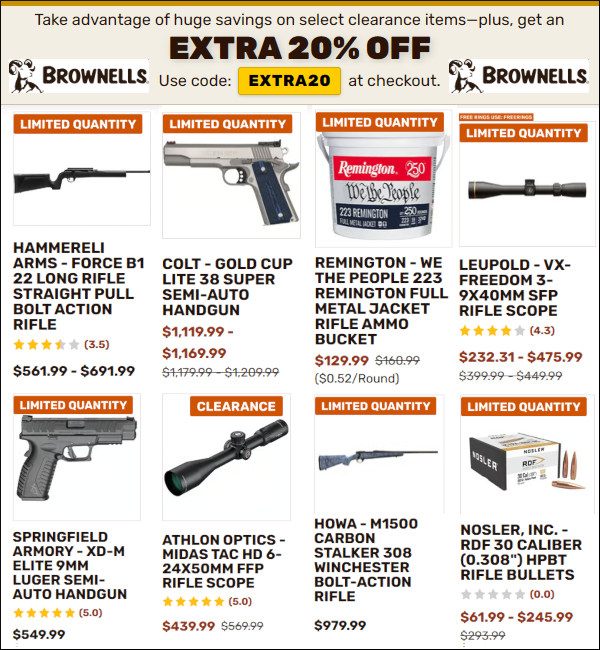
Brownells — Clearance Sale + 20% Off with Code EXTRA20
⏺️ » Deals on guns, ammo and gear plus save 20% with Code
Get big savings with the Brownells Clearance Sale. Along with the already discounted prices, on select clearance items you can save an additional 20% by using Code EXTRA20 during check-out. Sale items include including rifle scopes, rifles (Howa, Hammerli, Henry, Rossi, Mossberg), pistols (Colt, S&W, Sig Sauer, Walther, Springfield, Canik), tripods, ammunition (Federal, Remington, Winchester, Fiocchi), and Nosler brass. Definitely check out this Clearance Sale. There are exceptional deals PLUS 20% Off.
Bass Pro Shops and Cabela’s — Fall Hunting Classic Sale
⏺️ » Major discounts on hunting optics, accessories, gear, ammo and more…
Affiliated companies Bass Pro and Cabela’s are running a massive Fall Hunting Classic Sale right now with signficant discounts on rifles, shotguns, optics, ammo, hunting gear, rifle cases, gun safes and more. This is a great opportunity to get everything you need for an upcoming fall hunt. Plus the discounts on optics and rangefinders are great for all rifle shooters. And if you need sleeping bags, a tent, or camping accessories, this is a good time to buy.
As an Amazon affiliate, this site can earn revenues through sales commissions.
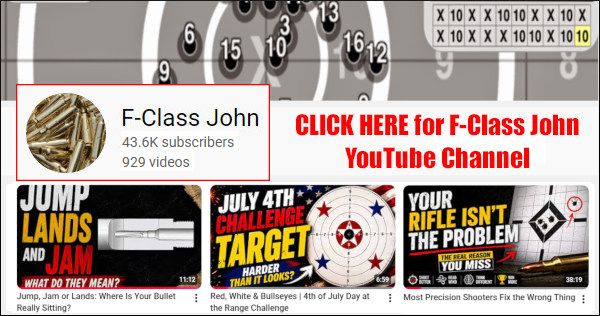
Today we showcase seven videos from video producer, skilled marksman, and Forum Member F-Class John. A talented F-Class competitor (and past Mid-Range National Champion), John analyzes product features with a smart, technically-focused mind. John has created hundreds of videos about reloading and precision tools, along with rifle and shooting accessories. And John also has created many videos showing how to improve your rifle handling and wind-calling. Many of John’s product review videos are very detailed and thorough. You’ll find over 920 informative videos on F-Class John’s popular YouTube Channel.
Many folks getting started in the cartridge reloading game are not fully familiar with seating depth options. They may only be looking to achieve a listed Overall Length (OAL) from base to bullet tip. But, for optimal accuracy and safe functionality, you need to look at the position of the bullet’s ogive relative to the start of the barrel’s rifling (i.e. the point where bullet jacket contacts the barrel rifling). Before you start reloading you want to measure the distance to the lands. Then, for most applications you want to start with the ogive’s contact point at least .010″ or more back away from the lands — that is called “jumping”.
For some benchrest applications you may want to actually have the bullets seated longer so the bullet actually contacts the lands. That is called “jam” seating. But there are variations in that. There is both a “mild” jam — a few thousands into the lands — as well as a full jam where the bullet is seated very long (and may even push back if case neck tension is light). Be very cautious with a full jam as this can significantly increase case pressure.
How to Improve Accuracy
In this video, F-Class John explains some key techniques on optimizing match ammo. He explains how to get very precise powder loads. In the video he respond to multiple questions from his Patreon subscribers. One topic is how to avoid the outliers in a 10-shot group. If those “flyers” are consistently coming at the end of a long string, John explains the problem is not likely the ammunition. Rather it could be a variety of factors such as “driver fatigue”, wind changes, barrel heating or other issues. For competitive shooters, this video is worth watching start to finish.
Patriotic July 4 Accuracy Target
The USA’s 250th birthday is behind us, having been celebrated on July 4, 2026. In this video F-Class John shows a fun 5-star red, white, and blue patriotic target and explains some of the challenges in getting an optimal score. There is a black bull inside the center star. Another feature of this target is that you can use the points on the stars to precisely aim your cross-hairs. This is a good target for centerfire at 100 yards, rimfire at 50 yards, and handguns at closer ranges.
Rear Bag Filling — Tips for Best Results
In benchrest and F-Class disciplines, you need a good rear bag to optimize accuracy and scores. A quality rear bag both supports and stabilizes the rifle and helps the rifle track properly during recoil. To get the best, most consistent performance from rear bags, you need to optimize the fill. In this video F-Class John discusses fill options and shows the process to fill your rear bag properly. He also talks about notable bag features including bag weight, footprint, and ear height/material.
Budget-Priced Arken EPL-4 Scope That Performs Well
Top competitors may spend $2500 or more on a top-quality, high-magnification rifle scope. But for those on a tighter budget, the Arken EPL-4 offers pretty impressive performance for under $350.00. In this video John tests this optic from the bench and shows that it has good glass and functions well. The EPL-4 combines Japanese ED glass with illuminated VPR or VHR FFP reticles. The Arken EPL-4 is offered in two sizes: 4-16x44mm ($299.99 at MidwayUSA) and 6-24x50mm ($329.99 at MidwayUSA).
Advanced AMP Press for Precision Bullet Seating
The AMP Electronic Bullet Seating Press is a state-of-the-art bullet seating press that tracks seating force round by round. The AMP Press combines a motor driven ram, a distance sensor, and a load cell to deliver extremely accurate and precise bullet seating measurements. It is designed for use with inline bullet seating dies. With this press you can quickly and easily change seating depths, which is useful during load development. In addition, the AMP press outputs data from the seating process to a linked computer. This allows you to see if there is an unusual seating value. You can mark those “outlyer” rounds and use them for fouling or warm-up shots.
F-Class Front Rests Reviewed
This is a great summary of multiple quality front rests. This is a must-watch video for all F-Open and Benchrest shooters! If you are shopping for a front rest, definitely watch this comprehensive 42-minute video from start to finish. This is probably the most informative video about premium shooting rests available on YouTube. Top F-Class shooter and video-maker F-Class John covers a wide selection of front rests, with some observations about coaxial bipods as well. John covers the impressive new SEB NEO-X, the easy-to-transport SEB Mini-X, the excellent Rodzilla Rest, the innovative 21st Century Hybrid Rest, the sleek Italian Lenzi Rest. At the end of the video John reviews the very affordable Caldwell Fire Control Rest ($289.99 at MidwayUSA), explaining how it can be a decent choice for shooters on a limited budget.
With our inflationary economy, ammo continues to go up in price every year. Smart shooters can benefit by price-shopping to get the best deals on factory-loaded ammunition, particularly for popular cartridge types such as .22 LR, 9x19mm (9mm Luger), .357 Mag, .223 Rem (5.56×45), and 6.5 Creedmoor. It this article we list 15 reliable online sources for factory-loaded ammo. You may want to bookmark this page so you can quickly scan and price-check multiple vendors. In addition, you can use a service such as AmmoSeek.com.
Why Should You Shop for Ammo Online?
By shopping online for ammo, you can save money, get a wider selection, and get bulk discounts. GunDeals.com explains: “Online purchases [can] save you a lot of money [and can] also save your time… one of the most important advantages is definitively the huge selection.” With online retailers you can quickly compare prices, and you will often get a discount on a large order (300 rounds or more) that is not available in local stores. Note, with some large vendors such as Cabela’s and Sportsman’s Warehouse you can order online then pick up in a local store.
Are There Restrictions on Online Ammo Purchasing?
In most (but not all) U.S. states is it legal to order ammunition online to be shipped to your residence. However, you MUST check your State and local laws and regulations. In some states and/or cities, it is ILLEGAL to purchase ammunition online for shipment across state lines with direct delivery. For example, in California, though there have been legal challenges, all ammo must still be purchased from a licensed ammo dealer/vendor with a state background check (so much for the Second Amendment)*. Likewise Washington DC, and Hawaii do not allow online ammunition purchases. And there are restrictions in New York City. In Alaska there are multiple shipping regulations that impact ammo deliveries from online sales so many vendors do not ship to Alaska.
*In some instances ammo can be purchased online from an out-of-state seller who will then ship to an authorized, in-state California vendor who may transfer the ammo for a fee with background checks as required by CA law.
For those who prefer to neck-size their brass (rather than full-length-size), the LEE Collet Die is a popular, inexpensive option. It works by having collet tangs or “fingers” press the neck against a central mandrel. The benefit is that you get a very straight neck, which is sized consistently from top to bottom. Canadian shooter Jerry Teo explains: “LEE Collet Dies produce sized cases with very low runout (measured runout is under .001″ using a Sinclair concentricity gauge). You also don’t get the build-up of brass at the base of the neck, as can happen with bushing neck dies. The neck-shoulder junction stays nice and crisp.”
NOTE: For most handloading, we recommend FULL-LENGTH sizing of cases. You should always have a good Full-length sizing die for your brass. But there are some situations where neck-sizing may be useful. This article explains how to neck-size effectively with a LEE Collet Die.
Here’s a good video that explains how to use a Lee Collet Die to Neck-Size .243 Win brass:
TIP ONE — Adjusting Tension
LEE Collet dies don’t have a specific mechanical adjustment for neck tension. But you CAN easily modify the die to provide more or less tension. If you want to adjust the neck tension using a Lee Collet die, you can simply chuck the mandrel in a drill and reduce the diameter with some sand-paper (to increase neck tension) or you can order a mandrel the next caliber larger and turn it to whatever diameter you want (the larger the mandrel diameter, the less the neck tension). You can also order custom mandrels from Lee sized to any diameter you want.
Regarding neck tension, Boyd Allen makes an important point: “The only way to properly get more neck tension with collet dies is to either reduce the diameter of the mandrel, or order a smaller-diameter mandrel from Lee. I remind folks that adjusting the die position to have more toggle at the top of the ram stroke (not the factory recommended method), or leaning on the press handle with more force than recommended will NOT increase neck tension.”
TIP TWO — Polish and Tune for Easy Case Removal
Some users have complained that their Collet Dies grab the case-neck too firmly, making the case hard to remove. There are solutions to this problem. First inspect the collet fingers and smooth the inner surface up a bit with polishing compound or an extra-fine sanding pad. Second, you can open up the fingers a little bit. LEE recommends that if your Collet Die is sticking, take a steel punch and tap the fingers apart a little bit so that the natural “unloaded” position is wider. Lastly, you should lightly lubricate the outside of the collet fingers (see arrows) before you re-assemble the die. This will ensure they slide smoothly. Also, to prevent the collet fingers from closing too tight, never load up the die with your press without putting a case in place first. Without a case neck between the collet fingers and the mandrel, the collet can clamp itself too tight as you raise the ram.
TIP THREE — Always Have a Case Inside When Operating Collet Die
Our friend Boyd Allen tells us that you need to follow directions and NEVER operate the die without a case inside. Boyd explains: “This is because doing so will spring the quadrants of the collet inward so that they interfere with the insertion of a case, and the user will have to figure out how to undo the damage if the die is to operate properly. This advice would not be needed if everyone read the instructions before using the die…. but many times, they don’t. Another thing that I tell new users is to take the die apart so that they will have a better chance of understanding how it works.”
TIP FOUR — Size Twice and Spin Your Case 1/8th Turn
After reaching fully “down” on your press handle, withdraw the case about an inch and manually rotate it about 1/8th (NOT 1/4 or 1/2) turn while still in the shell-holder, then size again. This will place the die’s collet petals on the four “high spots” of the case neck and will result in a rounder, more evenly-sized neck with slightly more bullet tension. This takes only about one second more per case and is well worth the slight extra effort. (We thank reader Stonecreek for this smart tip).
“A bullet launched at a higher altitude is able to fly slightly farther (in the thinner air) for every increment of downward movement. Effectively, the bullet behaves as if it has a higher ballistic coefficient.”
A few seasons back a good friend ventured to the high country of Colorado to pursue elk. He recently zeroed his rifle in California, at a range just a few hundred feet Above Mean Sea Level (AMSL). He wondered if the higher altitude in Colorado could alter his ballistics. The answer is a definite yes. However the good news is that free ballistics calculators can help you plot reliable drop charts for various shooting locations, high or low.
The question has been posed: “What effect does altitude have on the flight of a bullet?” The simplistic answer is that, at higher altitudes, the air is thinner (lower density), so there is less drag on the bullet. This means that the amount of bullet drop is less at any given flight distance from the muzzle. Since the force of gravity is essentially constant on the earth’s surface (for practical purposes), the bullet’s downward acceleration doesn’t change, but a bullet launched at a higher altitude is able to fly slightly farther (in the thinner air) for every increment of downward movement. Effectively, at higher altitudes, the bullet behaves as if it has a higher ballistic coefficient.
Forum member Milanuk explains that the key factor is not altitude, but rather air pressure. Milanuk writes:
“In basic terms, as your altitude increases, the density of the air the bullet must travel through decreases, thereby reducing the drag on the bullet. Generally, the higher the altitude, the less the bullet will drop. For example, I shoot at a couple ranges here in the Pacific Northwest. Both are at 1000′ AMSL (Above Mean Sea Level) or less. I’ll need about 29-30 MOA to get from 100 yards to 1000 yards with a Berger 155gr VLD at 2960 fps. By contrast, in Raton, NM, located at 6600′ AMSL, I’ll only need about 24-25 MOA to do the same. That’s a significant difference.
Note that it is the barometric pressure that really matters, not simply the nominal altitude. The barometric pressure will indicate the reduced pressure from a higher altitude, but it will also show you the pressure changes as a front moves in, etc. which can play havoc w/ your calculated come-ups. Most altimeters are simply barometers that read in feet instead of inches of mercury.”
As Milanuk states, it is NOT altitude per se, but the LOCAL barometric pressure (sometimes called “station pressure”) that is key. The two atmospheric conditions that most effect bullet flight are air temperature, and barometric pressure. Normally, humidity has a negligible effect. It’s important to remember that the barometric pressure reported on the radio (or internet) may be stated as a sea level equivalency. So in Denver (at 6,000 feet AMSL), if the local pressure is 24″, the radio will report the barometric pressure to be 30″. If you do high altitude shooting at long range, bring along a Kestrel, or remember to mentally correct the radio station’s pressure, by 1″ per 1,000 feet.
Trajectory of Bullet fired at Sea Level
Trajectory of Bullet fired at 20,000 feet
You can do your own experimental calculations using Berger Online Ballistics Calculator (free to use). Here is an extreme example, with two printouts (generated using Point Blank software), one showing bullet trajectory at sea level (0′ altitude) and one at 20,000 feet. For demonstration sake, we assigned a low 0.2 BC to the bullet, with a velocity of 3000 fps.
To learn more about all aspects of Exterior Ballistics, Hornady has a useful discussion of External Ballistics including the effects of altitude and temperature. There is also an online archive with detailed information from Sierra’s Exterior Ballistics Resource Page. This web archive features multiple sections from the Sierra Manual (4th and 5th Editions), including:
Section 3.0: Exterior Ballistic Effects on Bullet Flight
Section 3.1: Effects of Altitude and Atmospheric Conditions
Section 3.2: Effects of Wind
Section 3.3: Effects of Shooting Uphill or Downhill
Example from Section 3.0: “When a bullet flies through the air, two types of forces act on the bullet to determine its path (trajectory) through the air. The first is gravitational force; the other is aerodynamics. Several kinds of aerodynamic forces act on a bullet: drag, lift, side forces, Magnus force, spin damping force, pitch damping force, and Magnus cross force. The most important of these aerodynamic forces is drag. All the others are very small in comparison when the bullet is spin-stabilized.”
Here’a useful article by Sierra Bullets Media Relations Manager Carroll Pilant. This story, which originally appeared in the Sierra Bullets Blog, covers some of the more common ammo problems that afflict hand-loaders. Some of those issues are: excessive OAL, high primers, and improperly-sized cases. Here Mr. Pilant explains how to avoid these common problems that lead to “headaches at the range.
I had some gentlemen at my house last fall getting rifle zeros for an upcoming elk hunt. One was using one of the .300 short mags and every 3rd or 4th round would not chamber. Examination of the case showed a bulge right at the body/shoulder junction. These were new cases he had loaded for this trip. The seating die had been screwed down until it just touched the shoulder and then backed up just slightly. Some of the cases were apparently slightly longer from the base to the datum line and the shoulder was hitting inside the seating die and putting the bulge on the shoulder. I got to thinking about all the gun malfunctions that I see each week at matches and the biggest percentage stem from improper handloading techniques.
One: Check Your Cases with a Chamber Gage
Since I shoot a lot of 3-gun matches, I see a lot of AR problems which result in the shooter banging the butt stock on the ground or nearest solid object while pulling on the charging handle at the same time. I like my rifles too well to treat them that way (I cringe every time I see someone doing that). When I ask them if they ran the ammo through a chamber gage, I usually get the answer, “No, but I need to get one” or “I didn’t have time to do it” or other excuses. The few minutes it takes to check your ammo can mean the difference between a nightmare and a smooth running firearm.
A Chamber Gauge Quickly Reveals Long or Short Cases
Size Your Cases Properly
Another problem is caused sizing the case itself. If you will lube the inside of the neck, the expander ball will come out a lot easier. If you hear a squeak as the expander ball comes out of a case neck, that expander ball is trying to pull the case neck/shoulder up (sometimes several thousandths). That is enough that if you don’t put a bulge on the shoulder when seating the bullet … it can still jam into the chamber like a big cork. If the rifle is set up correctly, the gun will not go into battery and won’t fire but the round is jammed into the chamber where it won’t extract and they are back to banging it on the ground again (with a loaded round stuck in the chamber). A chamber gage would have caught this also.
Oversizing cases also causes problems because the firing pin doesn’t have the length to reach the primer solid enough to ignite it 100% of the time. When you have one that is oversized, you usually have a bunch, since you usually do several cases at a time on that die setting. If the die isn’t readjusted, the problem will continue on the next batch of cases also. They will either not fire at all or you will have a lot of misfires. In a bolt action, a lot of time the extractor will hold the case against the face of the breech enough that it will fire. The case gets driven forward and the thinner part of the brass expands, holding to the chamber wall and the thicker part of the case doesn’t expand as much and stretches back to the bolt face. If it doesn’t separate that time, it will the next time. When it does separate, it leaves the front portion of the case in the chamber and pulls the case head off. Then when it tries to chamber the next round, you have a nasty jam. Quite often range brass is the culprit of this because you never know how many times it has been fired/sized and in what firearm. Back to beating it on the ground again till you figure out that you have to get the forward part of the case out.
Just a quick tip — To extract the partial case, an oversized brush on a cleaning rod [inserted] and then pulled backward will often remove the case. The bristles when pushed forward and then pulled back act like barbs inside the case. If you have a bunch of oversized case that have been fired, I would dispose of them to keep from having future problems. There are a few tricks you can use to salvage them if they haven’t been fired though. Once again, a case gage would have helped.
Two: Double Check Your Primers
Another thing I see fairly often is a high primer, backwards primer, or no primer at all. The high primers are bad because you can have either a slam fire or a misfire from the firing pin seating the primer but using up its energy doing so. So, as a precaution to make sure my rifle ammo will work 100% of the time, I check it in a case gage, then put it in an ammo box with the primer up and when the box is full, I run my finger across all the primers to make sure they are all seated to the correct depth and you can visually check to make sure none are in backwards or missing.
Three: Check Your Overall Cartridge Length
Trying to load the ammo as long as possible can cause problems also. Be sure to leave yourself enough clearance between the tip of the bullet and the front of the magazine where the rounds will feed up 100%. Several times over the years, I have heard of hunters getting their rifle ready for a hunt. When they would go to the range to sight in, they loaded each round single shot without putting any ammo in the magazine. On getting to elk or deer camp, they find out the ammo is to long to fit in the magazine. At least they have a single shot, it could be worse. I have had hunters that their buddies loaded the ammo for them and then met them in hunting camp only to find out the ammo wouldn’t chamber from either the bullet seated to long or the case sized improperly, then they just have a club.
Four: Confirm All Cases Contain Powder
No powder in the case doesn’t seem to happen as much in rifle cartridges as in handgun cartridges. This is probably due to more handgun ammo being loaded on progressive presses and usually in larger quantities. There are probably more rifle cartridges that don’t have powder in them than you realize though. Since the pistol case is so much smaller internal capacity, when you try to fire it without powder, it usually dislodges the bullet just enough to stick in the barrel. On a rifle, you have more internal capacity and usually a better grip on the bullet, since it is smaller diameter and longer bearing surface. Like on a .223, often a case without powder won’t dislodge the bullet out of the case and just gets ejected from the rifle, thinking it was a bad primer or some little quirk.
For rifle cases loaded on a single stage press, I put them in a reloading block and always dump my powder in a certain order. Then I do a visual inspection and any case that the powder doesn’t look the same level as the rest, I pull it and the one I charged before and the one I charged after it. I inspect the one case to see if there is anything visual inside. Then I recharge all 3 cases. That way if a case had powder hang up and dump in the next case, you have corrected the problem.
On progressive presses, I try to use a powder that fills the case up to about the base of the bullet. That way you can usually see the powder as the shell rotates and if you might have dumped a partial or double charge, you will notice as you start to seat the bullet if not before. On a progressive, if I don’t load a cartridge in one smooth stroke (say a bullet tipped over sideways and I raised the ram slightly to reset it) Some presses actually back the charge back adding more powder if it has already dumped some so you have a full charge plus a partial charge. When I don’t complete the procedure with one stroke, I pull the case that just had powder dumped into it and check the powder charge or just dump the powder back into the measure and run the case through later.
At the request of our readers, we provide select “Deals of the Week”. Every Sunday afternoon or Monday morning we offer our Best Bargain selections. Here are some of the best deals on firearms, hardware, reloading components, optics, and shooting accessories. Be aware that sale prices are subject to change, and once clearance inventory is sold, it’s gone for good. You snooze you lose.
NOTE: All listed products are for sale to persons 18 years of age or older. No products are intended for use by minors.
MidwayUSA — Big Game Hunting Sale, Large Product Selection
⏺️ » Major discounts on hunting optics, accessories, gear, ammo and more…
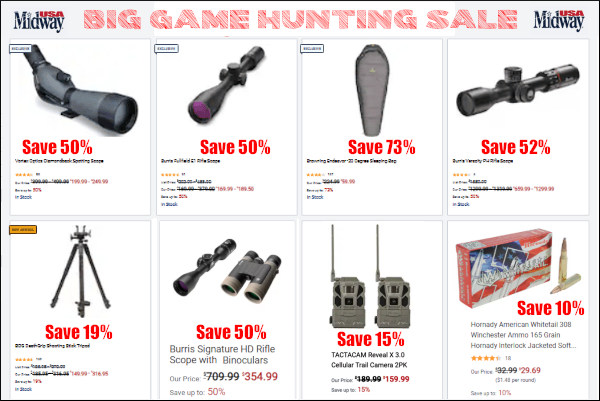
If you’re in the market for hunting gear and ammo, check out the Big Game Hunting Sale over at MidwayUSA. Here you’ll find deep discounts on everything you’ll need for your next hunt. You’ll find major savings on rifle scopes, spotting scopes, trail cams, field tripods, tree-stands, walkie-talkies, boots and other hunting gear. In addition, a huge selection of hunting ammunition from Barnes, Federal, Hornady, Nosler, Remington and Winchester is ON SALE.
Midsouth — Hornady Tool and Product Sale (Thru 8/31/2026)
⏺️ » Big Savings on presses, reloading tools, dies and more
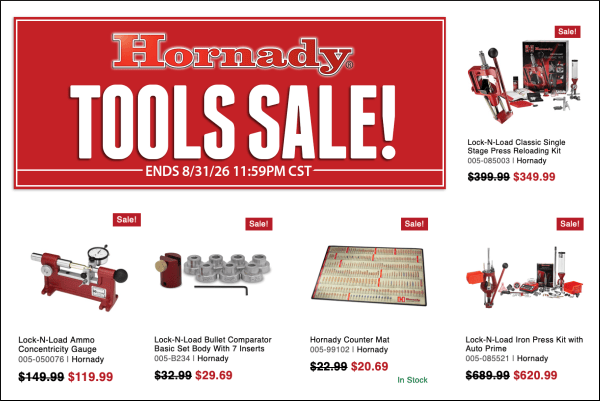
Midsouth is running a big Hornady Reloading Tool Sale right now. Get 10-15% off a huge range of Hornady products including Reloading Presses (and Press Combo Kits), Dies, Gauges, Case Prep Tools, Priming Tools, Trays and Cleaning supplies. In addition, many types or Hornady bullets, brass, and loaded ammo are on sale. Many of these Hornady items are available at some of the lowest prices we’ve seen in a while.
As an Amazon affiliate, this site can earn revenues through sales commissions.
For today’s Saturday Movie showcase we present six videos with .22 LR rimfire ammunition testing. Most of the videos include a wide variety of ammunition types, from bargain ammo, to high-end .22 LR match ammo. If you want to learn more about the properties of .22 LR rimfire ammo, you’ll find a good .22 LR ammo analysis on the Widener’s Blog. That article discusses .22 LR Bullet Design/Stability, Primer Ignition, Velocity Consistency, and Quality Control. In addition, 100-yard test results are provided for five (5) ammo types: Norma Xtreme LR-22, SK Rifle Match, ELEY Match, Lapua Long Range, and CCI Standard.
Big .22 LR Rimfire Ammo Comparison Test
This Backfire Channel Video features an accuracy comparison test of 13 .22 LR ammo types from multiple manufacturers. This includes low-priced ammo, such as Aquila, as well as more costly match ammo from ELEY, Lapua, and SK. Various types of ammo were tested in an outdoor range with three different NRL22-suitable rifles with slightly different chamber specs. Take note — this was NOT a benchrest rifle test conducted indoors. The most accurate ammunition overall was Lapua Center-X. NOTE: Different ammo may shoot better or worse in different rimfire guns. For example a round that works in an Anschutz rifle may not be the best choice for a .22 LR revolver. But this review can help you get started in ammo selection.
Testing Rimfire Ammo at New Whidden Gunworks Test Center
Whidden Gunworks operates an impressiv Rimfire Test Center in Nashville, Georgia. In this video, long-range champion John Whidden shows the Whidden Gunworks test range developed with ELEY Ammunition. The facility features two testing lanes — one for testing ELEY ammo and a second for testing other brands. On the second test lane, customers can test Lapua, SK, Norma, and RWS. Testing on this lane occurs at 50 meters and 100 meters simultaneously, registering results for BOTH distances. For more info, visit Whiddengunworks.com/ammunition-testing.
CLICK HERE to schedule a test at the Whidden facility.
.22 LR Ammo Buyers Guide
The Pursuit of Accuracy YouTube Channel has 420 videos, nearly all involving .22 LR rimfire rifles. The host tests different ammo in a variety of rimfire rifles. In this particular video, the host explains the key considerations in selecting .22 LR ammunition — how to choose the most cost-effective ammo for your rimfire rifle and discipline. You don’t need $14/box ammo to hit large steel plates at 20 yards. But you do need very consistent high-quality ammo for .22 LR Rimfire ELR Matches.
Testing Lapua Long Range Ammo at 400 Yards
With the emergence of long-range .22 LR rimfire matches, with targets at 100, 200, and 300 yards, the long-range capabilities of .22 LR have been pushed to the limits in recent years. In 2023 Lapua announced two new .22 LR rimfire ammo types — Long Range and Super Long Range. These are both specifically designed to optimize .22 LR performance past 100 yards. In this video, Gavin Gear of UltimateReloader.com tests the new Lapua ammo types on his range, with steel targets placed at 400 yards.
Subsonic vs. Supersonic .22 LR Ammunition
Here is another Pursuit of Accuracy Channel .22 LR ammo test. This specifically compares the performance of supersonic ammunition vs. subsonic ammo. What offers better accuracy? What is the best option for long range? The video addresses these questions.
Cheap .22 LR Ammo Tested with a $4000 Custom Rifle
Can relatively inexpensive ammo shoot well in $4000 rimfire rifle? This Midwest Long Range video seeks to answer that question. The results are interesting, with some surprisingly good results with CCI (8:03 time-mark) and Fiocchi (11:25 time-mark) Standard Velocity ammo. If you’re shooting NRL22 or PRS Rimfire matches on a tight budget, this video may steer you to some accurate yet affordable ammo options.
BONUS — Rimfire Ammunition Test with 31 Types
If watching today’s showcased videos has wet your appetite for .22 LR ammo comparison testing — here’s a “must-read” related article. The October 2018 issue of Shooting Sports USA (SSUSA) includes a great article with data on thirty-one (31) different types of popular .22 LR rimfire ammunition. The line-up includes low-speed, standard, and Hi-Velocity types, plus choices for plinking, varminting, and target applications. Brands tested include: Aguila, American Eagle, CCI, Federal, Fiocchi, Lapua, Remington, and Winchester. The ammo types ranged in speed from 727 FPS to 1735 FPS.
For each ammo type, SSUSA lists the bullet weight, velocity (FPS), and average of two, 5-shot groups at fifty yards. The most accurate ammo was Lapua Center-X LRN, with a 0.37″ average 50-yard group size. Second best was Lapua X-ACT LRN at 0.42″. Ammo was tested from a bench with a Cooper Model 57-M rifle fitted with 3-9x33mm Leupold VX-2 scope. The ammo offerings were grouped into three categories: (1) Varmints/Small Game; (2) Target; and (3) Plinking.
Here are two different bullet types, seated to the same CBTO length, but different COAL. Note the shiny scratches on the bullets made by the comparator tool which indicates a point on the bullet ogive near where the ogive will engage the rifling.
Effects Of Cartridge Over All Length (COAL) And Cartridge Base To Ogive (CBTO) – Part 2 by Bryan Litz forBerger Bullets. Part One of this series focused on the importance of COAL in terms of SAAMI standards, magazine lengths, seating depths, and pressure levels. Another measure of length for loaded ammunition is highly important to precision, namely Cartridge Base to Bullet Ogive Length (CBTO).
Figure 2. Chamber throat geometry showing the bullet jump to the rifling or lands.
Look at Figure 2. Suppose the bullet was seated out of the case to the point where the base of the bullet’s nose (ogive) just contacted the beginning of the riflings (the lands) when the bolt was closed. This bullet seating configuration is referred to as touching the lands, or touching the riflings and is a very important measurement to understand for precision hand-loading. Due to the complex dynamics of internal ballistics which happen in the blink of an eye, the distance a bullet moves out of the case before it engages the riflings is highly critical to precision potential. Therefore, in order to systematically optimize the precision of his handloads, it’s critically important that the precision hand-loader understands how to alter bullet seating depth in relation to the barrel rifling. Part of the required knowledge is understanding how to accurately and repeatably measure the Cartridge Base To Ogive (CBTO) dimension. This is explained in the FULL ARTICLE.
Bryan Litz offers an extended discussion on how to measure CBTO using different tools and methods, including the Hornady OAL gauge. You can read this discussion in the full article found on the Berger Bullets website. CLICK HERE to Read Full Article.
Why Not Use CBTO as a SAAMI Standard?
If CBTO is so important to rifle accuracy, you might ask, “Why is it not listed as the SAAMI spec standard in addition to COAL?” There is one primary reason why it is not listed in the standard. This is the lack of uniformity in bullet nose shapes and measuring devices used to determine CBTO.
Benefits of Having a Uniform CBTO
There is another aspect to knowing your CBTO when checking your COAL as it pertains to performance. With good bullets, tooling, and carefully-prepared cases you can easily achieve a CBTO that varies less than +/- .001″ but your COAL can vary as much as .025″ extreme spread (or more with other brands). This is not necessarily bad and it is much better than the other way around. If you have a CBTO dimension that varies but your COAL dimension is tight (within +/- .002″) then it is most likely that your bullet is bottoming out inside the seater cone on the bullet tip. This is very bad and is to be avoided. It is normal for bullets to have precisely the same nose shape and it is also normal for these same bullets to have nose lengths that can vary as much as .025″.
Summary of Cartridge Base To Ogive (CBTO) Discussion
Here are four important considerations regarding bullet seating depth as it relates to CBTO:
1. CBTO is a critical measurement to understand for handloaders because it’s directly related to precision potential, and you control it by simply setting bullet seating depth.
2. Tools and methods for measuring CBTO vary. Most of the measurement techniques have pitfalls (which may give rise to inconsistent results) that you should understand before starting out.
3. A CBTO that produces the best precision in your rifle may not produce the best precision in someone else’s rifle. Even if you have the same rifle, same bullets, same model of comparator gauges, etc. It’s possible that the gauges are not actually the same, and measurements from one don’t translate to the same dimension for another.
4. Once you find the CBTO that produces the best precision in your rifle, it’s important to allow minimal variation in that dimension when producing quality handloads. This is achieved by using quality bullets, tooling, and properly preparing case mouths and necks for consistent seating.
August is National Shooting Sports Month, a time when many new shooters are introduced to the fun of rifle, shotgun, and pistol shooting. To help serve America’s many new gun owners, Winchester offers an online information site for first-time ammunition and firearms buyers as well as those just getting started in the shooting sports and hunting. Winchester’s New Shooters Site has many helpful articles plus a series of informative videos.
Winchester’s New Shooters Site also links to the NSSF’s WHERE-To-SHOOT Resource, the internet’s most comprehensive listing of gun ranges. The Where-to-Shoot section makes finding a local range easy. Simply input your location and max desired distance, and the site will generate a list of nearby indoor and outdoor ranges with a Google map.










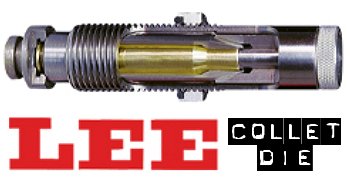 TIP ONE — Adjusting Tension
 TIP TWO — Polish and Tune for Easy Case Removal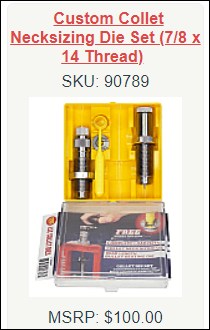

 The question has been posed: “What effect does altitude have on the flight of a bullet?” The simplistic answer is that, at higher altitudes, the air is thinner (lower density), so there is less drag on the bullet. This means that the amount of bullet drop is less at any given flight distance from the muzzle. Since the force of gravity is essentially constant on the earth’s surface (for practical purposes), the bullet’s downward acceleration doesn’t change, but a bullet launched at a higher altitude is able to fly slightly farther (in the thinner air) for every increment of downward movement. Effectively, at higher altitudes, the bullet behaves as if it has a higher ballistic coefficient.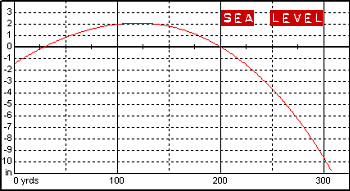


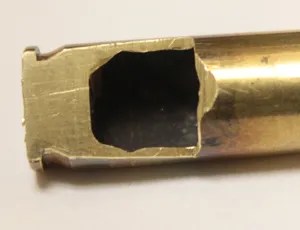 Oversizing cases also causes problems because the firing pin doesn’t have the length to reach the primer solid enough to ignite it 100% of the time. When you have one that is oversized, you usually have a bunch, since you usually do several cases at a time on that die setting. If the die isn’t readjusted, the problem will continue on the next batch of cases also. They will either not fire at all or you will have a lot of misfires. In a bolt action, a lot of time the extractor will hold the case against the face of the breech enough that it will fire. The case gets driven forward and the thinner part of the brass expands, holding to the chamber wall and the thicker part of the case doesn’t expand as much and stretches back to the bolt face. If it doesn’t separate that time, it will the next time. When it does separate, it leaves the front portion of the case in the chamber and pulls the case head off. Then when it tries to chamber the next round, you have a nasty jam. Quite often range brass is the culprit of this because you never know how many times it has been fired/sized and in what firearm. Back to beating it on the ground again till you figure out that you have to get the forward part of the case out.







 Effects Of Cartridge Over All Length (COAL) And Cartridge Base To Ogive (CBTO) – Part 2


