At the request of our readers, we provide select “Deals of the Week”. Every Sunday afternoon or Monday morning we offer our Best Bargain selections. Here are some of the best deals on firearms, hardware, reloading components, optics, and shooting accessories. Be aware that sale prices are subject to change, and once clearance inventory is sold, it’s gone for good. You snooze you lose.
NOTE: All listed products are for sale to persons 18 years of age or older. No products are intended for use by minors.
1. Midsouth — Blem Bullets Sale, 65+ Types Up to 50% Off
⏺ Big savings on rifle bullets .22 to .416 cal, match and hunting
Here’s a great Blem Bullet Sale at Midsouth. Save up to 50% on a wide range of bullets, from .22 Cal varmint projectiles up to massive 400+ grain hunting bullets. Chose among BTHP, Polymer Tip, Aluminum Tip, and even a few unleaded types. You’ll probably find something you’ll like, with huge savings. For example, PRS competitors can get 250 6mm 90gr bullets for just $59.99 — a mere 24 cents each (37% discount). And varminters can get 55gr BTHP bullets for just 13 cents each (price $32.99 for 250).
2. Midsouth — Lyman Gen 6 Powder Dispenser, $219.99
⏺ Save $40 (15%) on popular powder scale/dispenser
Optimal accuracy and low ES/SD demands very precise (and consistent) powder charges. You’ll want a quality powder scale/dispenser such as the Gen 6 Compact Digital Powder Dispenser System. Accurate to 0.10 grain, the Lyman Gen6 dispenses various types of smokeless powder at two grains per second. This machine has an auto repeat function that drops a precise charge each time the pan is reset.
3. Natchez — Primers and Ammunition Sale
⏺ Save on CCI, Fed, & Rem primers plus rimfire and centerfire ammo
The shortage of primers is easing, with prices dropping a bit. If you need primers, check out the current Primer and Ammo Sale at Natchez. A wide range of CCI, Federal, and Remington primers are on sale, with savings of $20-$35 per 1000. In addition there are significant discounts on rimfire and centerfire ammunition. Note: This sale concludes on Tuesday 4/23/24, so don’t delay.
⏺ Effective, compact hearing protection with ability to hear range commands
Protect your hearing and monitor range commands with the Radians Vertex Nano Electronic Earplugs now just $74.95 at Creedmoor Sports. The custom micro-circuitry has 2 mode levels for standard and enhanced amplification with < 0.02 second reaction time to protect against dangerous impulse noises. Dedicated right and left plugs are each powered by ultra-efficient batteries with 120 hours life. This is a great deal! These very same Radian electronic earplugs cost $119.99 elsewhere.
5. MidwayUSA — Vortex Gen I Diamondback Binoculars, $129.99
⏺ Great 10×42 binocs for the money — good choice for varminters
At the range or in the field, a good pair of binoculars is very useful. Right now the 10x42mm Vortex Optics Gen I Diamondback Binoculars are $100 off at MidwayUSA — a 43% savings. These lightweight (24 oz.) binoculars offer a wide field of view and a lifetime VIP Vortex warranty. These rubber-armored binocs are a good choice for hunters and backpackers. The Diamondback series are O-ring sealed and argon-purged for true 100% weatherproofing.
6. Graf’s — Competition Electronics Chron and Timer Sale
⏺ Big savings on chronos and timers
Every serious shooter needs a good chronograph. If you’re in the market for a chrono or timer check out the Competition Electronics sale at Graf & Sons. You can get a reliable Comp. Electronics chronograph for just $120 — hundreds less than a LabRadar or Garmin. And if you compete in timed, speed-based matches, a Comp. Electronics timer will help you train more effectively.
7. Amazon — Case Prep Multitool, $14.99
⏺ Great price on versatile tool with internal storage
Proper brass prep includes chamfering and deburring case-mouths as well as cleaning the primer pockets. For a modest $14.99 price, the TYRWEEY Case Prep Multitool (#ad) can perform all these key tasks. This tool will chamfer, deburr. and clean pockets. A very nice feature is that the tool heads can be stored INSIDE the handle when not in use. The tool has a non-slip, checkered exterior for secure handling.
8. Amazon — Tactical 4-Pistol Range Bag, $39.99
⏺ Good price on well-made, roomy Pistol bag.
The DSLEAF Tactical Gun Range Bag (#ad) is a good, sturdy bag that holds up to 4 full-size handguns. This DSLEAF bag has 3 inner removable dividers, 2 mesh pockets, and 6 mag-holders. It can hold up to 4 pistols as well as earmuffs and shooting eyewear. There are nice zippered pockets on the side and good, thick internal padding. If you’re not a pistol guy, you can also use this bag to haul your chronograph, target cam, and other accessories.
9. Amazon — Target Stand Dual Pack, $49.97
⏺ Good price on pair of adjustable target stand
The Knine Outdoor Shooting Target Stand kit (#ad) allows you to set up your own elevated target in any shooting area. This kit includes 2 metal target stands, 8 ground stakes, 8 butterfly screws, plus paper clips. The base units adjust for width from 13″ to 24″ horizontal spread. This kit includes ten printed 16″x12″ shooting paper targets. NOTE, you must supply your own wood risers and cardboard target backers.
10. Amazon — 6-Pack Stackable AkroBins, $15.00
⏺ Good option for tool and reloading components stackable storage
Parts, brass, and bullets all need to be kept safe on the bench when you’re reloading. Akro-Mils AkroBins (#ad) are a quality option that can be placed on wall racks, shelving, or on a benchtop. These can be stacked securely. These AkroBins are sold in packs of six for $15.00, and are available in four colors: red, yellow, blue, and white. Dimensions are 4-1/8″ Wide x 5-3/8″ Deep x 3″ High.
As an Amazon affiliate, this site can earn revenues through sales commissions.
Initial radar testing shows an interesting stability trend for slugs vs. pellets: drag is minimized for pellets in slower-twist barrels, while drag of slugs is minimized for a faster twist. Also, consistency of drag/BC is best when drag is minimized (BC maximized).
Show below are test data for .300 caliber 44.5 grain Slug and .300 caliber 44.8 grain Pellet, both shot from an air rifle around 800 FPS. Experienced air rifle shooters told us to expect this so it’s nice to see the measurements supporting this trend!
So why is fast twist good for slugs while bad for pellets and vice versa? Air rifle pellets with a skirt are mostly drag-stabilized, not spin-stabilized. So, they don’t need much if any spin at all to fly point forward; the skirt catches the air like the fins of a rocket. As such, spinning the pellets faster only becomes a problem of dynamic stability. If I had any suggestion after looking at this data, it would be to try an even slower twist for pellets, perhaps a 1:60″ (one turn in 5 feet) or even 1:120″.
Slugs are spin-stabilized so it reasons that more spin suppresses yaw and maximizes BC, to a point. Based on these results, it appears the slug is reaching max stability/BC with the 1:22″ and the 1:18″ provides no further benefit. Again, these are just initial findings, we’re eager to explore further in the coming weeks! To view our recent Air Rifle projectile testing, with full 8-minute video, CLICK HERE.
Photo 1: Three Near-Equal-Weight 7mm Bullets with Different Shapes
TECH TIP: Bullets of the same weight (and caliber) can generate very different pressure levels due to variances in Bearing Surface Length (BSL).
This article, from the USAMU Facebook Page, concerns reloading safety. In the relentless quest for more speed and flatter ballistics, some hand-loaders load way too hot, running charges that exceed safe pressure levels. Hint: If you need a mallet to open your bolt, chances are your load is too hot. Stay within safe margins — your equipment will last longer, and you won’t risk an injury caused by over-pressure. In this article, the USAMU explains that you need to account for bullet shape, diameter, and bearing surface when working up a load. Don’t assume that a load which is safe for one bullet will be safe for another even if both bullets are exactly the same weight.
How Bullet Profile and Bearing Surface Affect Pressure Levels
Today, we continue our handloading safety theme, focusing on not inadvertently exceeding the boundaries of known, safe data. Bullet manufacturers’ loading manuals often display three, four, or more similar-weight bullets grouped together with one set of load recipes. The manufacturer has tested these bullets and developed safe data for that group. However, seeing data in this format can tempt loaders — especially new ones — to think that ALL bullets of a given weight and caliber can interchangeably use the same load data. Actually, not so much.
However, bullet designs include many variables such as different bearing surface lengths, hardness, and even slight variations in diameter. In fact, diameters can occasionally range up to 0.001″ by design. Thus, choosing untested bullets of the same weight and caliber, and using them with data not developed for them can yield excess pressures.
This is only one of the countless reasons not to begin at or very near the highest pressure loads during load development. Always begin at the starting load and look for pressure signs as one increases powder charges.
Bullet Bearing Surface and Pressure
Bullet bearing surface length (BSL) is often overlooked when considering maximum safe powder charges and pressures. In Photo 1, note the differences in the bullets’ appearance. All three are 7 mm, and their maximum weight difference is just five grains. Yet, the traditional round nose, flat base design on the left appears to have much more BSL than the sleeker match bullets. All things being equal, based on appearance, the RN/FB bullet seems likely to reach maximum pressure with significantly less powder than the other two designs.
TECH TIP: Bullets of the same weight (and caliber) can generate very different pressure levels due to variances in Bearing Surface Length (BSL).
Bullet 1 (L-R), the RN/FB, has a very slight taper and only reaches its full diameter (0.284 inch) very near the cannelure. This taper is often seen on similar bullets; it helps reduce pressures with good accuracy. The calculated BSL of Bullet 1 was ~0.324″. The BSL of Bullet 2, in the center, was ~0.430″, and Bullet 3’s was ~ 0.463″. Obviously, bullets can be visually deceiving as to BSL!
Some might be tempted to use a bullet ogive comparator (or two) to measure bullets’ true BSL for comparison’s sake. Unfortunately, comparators don’t typically measure maximum bullet diameter and this approach can be deluding.
Note: Due to time constraints, the writer used an approximate, direct measurement approach to assess the bullets’ different BSLs. While fairly repeatable, the results were far from ballistics engineer-grade. Still, they are adequate for this example.
Photo 2: The Perils of Measuring Bearing Surface Length with Comparators
In Photo 2, two 7mm comparators have been installed on a dial caliper in an attempt to measure BSL. Using this approach, the BSLs differed sharply from the original [measurements]. The comparator-measured Bullet 1 BSL was 0.694” vs. 0.324” (original), Bullet 2 was 0.601” (comparator) vs. 0.430” (original), and Bullet 3 (shown in Photo 2) was 0.602” (comparator) vs. 0.463” (original). [Editor’s comment — Note the very large difference for Bullet 1, masking the fact that the true full diameter on this bullet starts very far back. You can use comparators on calipers, but be aware that this method may give you deceptive reading — we’ve seen variances just by reversing the comparators on the calipers, because the comparators, typically, are not perfectly round, nor are they machined to precision tolerances.]
Thanks to the U.S. Army Marksmanship Unit for allowing the reprint of this article.
Even with the very best cartridge brass, you can achieve the most consistent neck-wall thickness with precision case-neck turning. This can be done slowly with hand-tools (such as a K&M Tool), but powered neck turning can produce superb results in a fraction of the time. For today’s Saturday Showcase we feature the excellent 21st Century Power Neck-Turning Lathe and the state-of-the-art AUTODOD machine from F-Class Products. In addition, we show how neck turning can be done using a vertical milling machine fitted with a neck-turner. And to start off, we offer a Keith Glasscock video that analyzes when it makes sense to turn necks, considering the demands of your particular shooting disciplines.
To Turn or NOT to Turn — Wisdom from Keith Glasscock
In this video, top F-Class Shooter and Wind Coach Keith Glasscock discusses the process of turning case necks. Neck-turning may be mandatory if you have a chamber with reduced-diameter neck dimensions. With a standard chamber you may still want to do a minimal neck-turn to make your brass more consistent or to increase clearance. On the other hand, high-quality brass, such as Lapua, may perform exceptionally well right out of the box. Keith explains how to determine whether you need to turn your brass for your discipline, and explains procedures that help you achieve great results.
21st Century Innovation Powered Neck-Turning Lathe
The 21st Century Innovation Power Neck-Turning Lathe is a superb system for quickly and precisely uniforming the neckwall thickness of cartridge brass. With this powered system you can turn necks faster and more efficiently, with less effort. The cases feed very smoothly and the results are beautiful. Power is activated by the red button on the end of the blue, horizontal feed handle
The Powered Neck-Turning Lathe is a modular system. Swing the bar from right to left to feed the case. The power head (with case holder) glides on stainless steel rails for smooth movement. This allows very precise feed rate. Power is supplied via a button that is built into the end of the feed handle. Push the red button to make the case spin. It’s as simple as that. NOTE: The 21st Century Power Neck-Turning Lathe has been updated — the frame and motor are now flat black in color.
Here is another video that shows how the lathe system operates:
AUTODOD Power Neck-Turner from Black Machine
Bryan Blake of F-Class Products has created an ultra-precise and speedy neck-turning machine, the AUTODOD. This employs twin precision cutter tips to turn case necks inside and out quickly and efficiently, with superior precision. The advanced AUTODOD Neck Turning Machine holds cases securely in a precision-machined spindle attached to an electric motor. Twin blades move precisely during the cutting process, milling the necks inside and out. The turned necks come out perfect every time, with the shoulders trimmed exactly (with doughnut removed) as well. If you turn hundreds of cases during a shooting season, you may want to consider getting an AUTODOD from F-Class Products. Below is a video from F-Class John Showing the AUTODOD Machine in action.
Neck-Turning Cases with a Milling Machine
Our friend Erik Cortina figured out how to turn his match cartridge case-necks using his milling machine. Erik told us: “While in Raton [a while back], Mid Tompkins told me that he turns his brass on milling machine. He said he could do about 500 in two hours, so I decided to try it.” Erik fitted a Don Nielson “Pumpkin” neck-turner to the mill, and he used a modified 21st Century case holder to secure the brass. As you can see from this video, Erik was very successful with the process. The tool spins at 1500 rpm, turning Lapua 6.5-284 cases that have been necked up to 7mm.
It’s hard to argue with Erik’s results. Here are his turned Lapua cases, which have neck-wall thickness consistent to two ten-thousandths of an inch.
Neck-Turning Lubricants for Turner Mandrels
For Neck-Turning, Try STP Blend or Assembly Lube
For hand neck-turning, a variety of lubricants can work well on the outside of the necks. You will also want to lube the mandrel which runs inside the case. There are many options for lubing the neck-turning tool mandrel while turning case necks. Some folks use a blend of STP® Oil Treatment and Mobil 1 lube. Chuckw2 reports: “Try STP and Mobile 1 Synthetic oil in a 50/50 mixture. Very slick, you will need to tumble your cases after turning.” STP is a very thick lubricant, that flows and clings almost like honey. Jason reports the STP blend comes off easily in an ultra-sound bath, using a bit of detergent. At many retailers, STP is also available in a convenient 7-ounce tube, so you don’t have to buy a large bottle.
Another even cheaper option is assembly lubricant. For turning his case necks, RStreich uses assembly lube from an auto parts store. He notes: “The brand I have is reddish in color and kind of sticky like honey. It’s far better than the Imperial die wax I was using before.” There are a variety of types, both with and without moly additive, and you can select the viscosity you prefer if you sample a few brands. Be sure to clean out any lube residue from the inside of your necks when you have completed your neck-turning.
What you see above is what happens when you shoot the wrong powder in a muzzle-loader. Specifically, a charge of smokeless powder was used instead of black powder or black powder substitute. The difference in energy (by weight and volume) between black powder and modern smokeless powder is huge. You should never, ever run smokeless powder in a black powder recipe. The result can be catastrophic. In this case the hapless shooter lost a couple fingers. So he got a free twin-digit amputation, thanks to his reloading mistake. The lesson to learn here is to always double-check your propellant before loading. And never “re-bottle” smokeless powder into a different container with a different label (or worse yet, no label at all).
This incident happened in Indiana a couple years back. As reported by the Indiana Dept. of Natural Resources (DNR), this was a classic case of “user error”: “Corporal Eric Doane worked a firearm accident last night in Martin County that resulted in the shooter losing a couple fingers. This is what can happen when you shoot smokeless powder out of a muzzle-loader designed for black powder.”
A new Vortex video series, Cartridge Talks Comparisons, looks at multiple variables along with ballistics gel tests to determine the comparative performance of popular cartridge types. Each Month, Cartridge Talks will examine and test two popular cartridges, comparing their head to head performance. In Episode 1, Vortex Nation™ hosts Mark Boardman and Ryan Muckenhirn pit the 6.5 Creedmoor and .308 Winchester cartridges against each other, examining projectile performance. Mark and Ryan then make conclusions about the applications best suited to each cartridge type.
Cartridge Comparison 14-minute video, Highlighting Ballistic Gel Testing
This first Cartridge Talks Episode pits the 6.5 Creedmoor against the .308 Winchester in a head-to-head, ballistics gel-induced bullet battle. Ballistics (drop/drift), penetration ability, terminal performance and other variables are tested with a variety of tools and tests. Viewers are invited to check out Episode 1, and suggest future cartridge battles in the comments section.
Here is the full 67-minute 6.5 Creedmoor vs. .308 Win Cartridge comparison video:
“With the myriad of cartridges available to the big game hunter, picking which chambering is best for you and your application can be a daunting task,” says Muckenhirn. “In Cartridges Talks, we put our biases on the shelf and put as much scientific process to this as possible. From ‘shootability’ and accessibility, to terminal performance as observed in ballistics gel, Cartridge Talks wades through the numbers and figures with you, loads you up with the pertinent information, and helps you select the ideal cartridge for your next hunt!”
Here’s a “must-read” article for .22 LR rimfire shooters. The October 2018 issue of Shooting Sports USA (SSUSA) includes a great article with data on thirty-one (31) different types of popular .22 LR rimfire ammunition. The line-up includes low-speed, standard, and Hi-Velocity types, plus choices for plinking, varminting, and target applications. Brands tested include: Aguila, American Eagle, CCI, Federal, Fiocchi, Lapua, Remington, and Winchester. The slowest ammo, CCI Quiet-22 Lead RN, clocked 727 FPS. The fastest ammo, CCI Short-Range Green Lead-Free HP, ran 1735 FPS, 2.4 times the speed of the Quiet-22.
For each ammo type, SSUSA lists the bullet weight, velocity (FPS), and average of two, 5-shot groups at fifty yards. The most accurate ammo was Lapua Center-X LRN, with a 0.37″ average 50-yard group size. Second best was Lapua X-ACT LRN at 0.42″. Ammo was tested from a bench with a Cooper Model 57-M rifle fitted with 3-9x33mm Leupold VX-2 scope. The ammo offerings were grouped into three categories: (1) Varmints/Small Game; (2) Target; and (3) Plinking. (See ammo tables below.)
Click for larger page-view.
Different types of .22 LR (Long Rifle) rimfire ammo have different applications. Subsonic ammo, typically, is best for 25m to 50m target work with precision rimfire rigs. Hi-Velocity .22 LR ammo provides a flatter trajectory for longer ranges. SSUSA explains: “The array of .22 LR loads… turns a person’s head every which way. Subsonic target loads are the key to decisive accuracy on targets, while hyper-velocity cartridges provide striking bullet expansion on small varmints. In between, standard and high-velocity .22 LRs are loaded with a variety of bullet weights and styles for everything from small-game hunting to plinking[.]” READ Full SSUSA .22 LR Rimfire Ammo Story.
Soon after Lapua released the 6.5×47 cartridge, wildcatters recognized the potential of a necked-down 6mm version of the case. The 6-6.5×47 has emerged as a great, do-it-all cartridge that performs well in High Power competition, 600- and 1000-yard benchrest, and PRS tactical matches. But the 6-6.5×47 is not just for paper-punching. An efficient cartridge with great inherent accuracy, the 6-6.5×47 can be an excellent, flat-shooting, long-range varmint round. Here we feature Stan Stewart’s BAT-actioned 6-6.5×47 varminter. Fitted with a Krieger 1:10″ barrel, Stan’s rifle excels with a wide variety of varmint bullets. Whether driving 70-grainers at 3700 fps, or pushing the Berger 88gr High-BC FB bullet at 3400 fps, this 6-6.5×47 delivers half-MOA (or better) accuracy, in a well-balanced, easy-handling rifle.
The 6-6.5×47 for Precision Long-Range Varminting
The rifle carries a 12-42x56mm Nightforce NSX in Nightforce rings “hand-lapped for optimal fit/alignment”.
‘Seller’s Remorse’ Spurs 6mm Project Report by Stan Stewart
After selling my 6mm Remington Ackley Improved a couple of years ago and wishing I hadn’t, I begun to think about a new custom rifle for work on Prairie Dog towns and New York wood chucks at 600+ yards. I have a .223 AR and 22-250 for medium ranges but I missed my 6mm AI for long-range work so I started asking questions.
The 22-250 is a fine chambering, but it is hard on barrels, and I think the 6mms may have an accuracy edge out past 400 yards. Also, shooters today enjoy a vast collection of really great 6mm bullets. Barrel life and bullet options were two main reasons I decided to build a 6mm rather than another .224-caliber gun. But the question remained… what 6mm chambering to choose?
I started doing serious research on the 6-6.5×47. I received a lot of good advice from AccurateShooter.com and other websites on the pros and cons. I also talked to gunsmiths — quite a few recommended the new cartridge as well. Some of the cartridge attributes I liked was the small rifle primer, enough case capacity to efficiently reach 3700 fps with a 70gr bullet and 3400 fps with an 85-grainer without being terribly over-bore. Most important was the 6-6.5×47’s reputation for inherent accuracy without being finicky like my 6mm AI. So, having chosen my cartridge, I started asking for gunsmith recommendations. Again the folks on the AccurateShooter.com Forum were very helpful. After many conversations I settled on Dave Bruno in Dayton, Pennsylvania. He was a good choice.
Putting Together the New Rig with Premium Components
From the get-go, I knew I wanted a BAT action and Krieger barrel. BAT Machine and Krieger Barrels enjoy a great reputation in the shooting industry. BATs are beautifully-machined, smooth, and strong. Krieger cut-rifled barrels are known for dependable accuracy and long barrel life. While many 6-6.5×47 shooters choose an 8-twist barrel to shoot the 100-108gr bullets, I would be using smaller, varmint-weight bullets, so I selected a 1:10″ twist Krieger. This would allow me to shoot bullets from 60 grains up to 90 grains. Dave chambered the barrel with a .269″ neck and fluted the barrel to save weight. I also had Dave install a Vais muzzle brake. Dave fitted the BAT with a 2 oz. Jewell trigger, mounted a +20 MOA scope rail, then pillar-bedded the BAT into a McMillan Hunter-Class-style fiberglass stock.
Load Development for Varminting
I had selected a few powders and bullets recommended by other 6-6.5×47 shooters and started by seating all the bullets .005″ off the lands. The powders I selected were Varget, Vihtavuori N-550, and Reloder 15.
I was very pleased with the 88gr Bergers. In initial testing, they grouped well and I was able to drive them to 3400 fps easily. As I wanted a gun for long-range varmint work, I was hoping the 1:10″-twist barrel would provide enough stability for the heavier weight bullets. It did — the 10-twist worked great! I was able to shoot the lighter weight bullets and the 88s were superb. With a BC of 0.391, leaving the barrel at 3400, these bullets were still traveling at 2600 fps at 600 yards!
I did a lot of testing, recording group sizes for a variety of different bullets (see below) and powders. With group size/velocity data in a spreadsheet I was able to “crunch the numbers” and choose my preferred loads. The data drew a clear picture of what the rifle shot best. Here is a chart showing comparative group sizes, arranged by bullet type. On the last three lines, powders are listed by average for all bullets.
Choosing a Varmint Bullet for Precision and Performance
Stan Stewart didn’t just grab a box of bullets off the shelf and head off to the varmint fields. He researched a broad selection of varmint bullets suitable for a 10-twist barrel. He did extensive group testing with a wide range of bullets from 70 grains to 90 grains. Shown below is a “line-up” of some of the bullets Stan tested in his gun.
Stan logged all load data, velocities, and group sizes in a very detailed Excel spreadsheet. Stan’s testing revealed that the light bullets delivered superb accuracy, but they were less than ideal for long shots out past 400 yards. Stan tried the Bart’s 70, Sierra 70 BlitzKing, Berger 80, Hornady 87, Berger 88 Lo-Drag, and Berger 90. Among these choices the Berger 88-grainer was the clear winner for long range (see test targets at right). With an 0.391 BC, this unique “Match Varmint High-BC Flat-Base” offers good ballistics, and high velocities. Stan’s average group size with the 88s was 0.40 inches, bettered only by the Bart’s 70-grainer. Stan’s 6-6.5×47 can launch the Berger 88s at a healthy 3400 fps, providing a highly accurate, flat-shooting solution.
Initially, Stan had high hopes for the Hornady 87-grain V-Max. Stan told us “I also tried the 87 gr Hornady but they didn’t perform to expectations. I am a big Hornady fan but these bullets varied in weight and just didn’t want to group well.” [Editor’s Note: While many varmint shooters have had great luck with the Hornady 87gr V-Max, this is not the first report we’ve received of disappointing results with these bullets. In the Editor’s own 8-twist 6BR, the 87s never shot as well as Bergers, Lapuas, or Sierras in the 85-90 grain range.]
Final Thoughts on the 6-6.5×47 Lapua
I have owned three rifles chambered in 22-250 and will always own a rifle in this caliber because it is inherently accurate and drives a 50gr bullet at 3800 fps. No question the 22-250 can be deadly out to 500 yards. However, I’ve found that shooting past 400 yards with the light bullets is difficult if there is any wind at all. That’s why I liked my 6mm AI for those longer shots and why I decided on the 6-6.5×47 Lapua. I couldn’t be happier with my choice. The only thing that could make it better is if Lapua would produce the 6-6.5×47 as an “official” factory 6mm cartridge with 6mm necks right out of the box. But overall, I am very happy with the cartridge, and I thank Dave Bruno for producing a superbly accurate varmint rifle.
This report is from Bryan Litz and the ScienceofAccuracy.com website.
As long as there have been rifles, there has been a debate as to how much – if any – the rifle moves prior to the bullet exiting the bore. The first video below shows a Barrett MRAD chambered in .338 Lapua Magnum firing a 300gr Lapua Scenar bullet. Capturing projectiles at 100k+ frames per second allows us to visualize aspects of the firing sequence that are otherwise invisible to the human eye.
Click Video to see barrel with suppressor (on right) move with recoil before bullet exits.
What is clear from this video is that the rifle system is moving rearward while the bullet is traveling through barrel and subsequently through the suppressor. During the “in-bore” portion of bullet travel, any deviation of the muzzle orientation from the initial point of aim can cause a point of impact change. This is because the bullet will exit while the barrel is pointed somewhere different than when the shot was initially fired. Much of the shot’s point-of-aim orientation can be maintained through consistent marksmanship fundamentals and recoil management techniques. However, most shooters are not likely capable of managing it to less than 0.001″ for EVERY shot, especially given on lightweight magnum rifles.
Here’s another example with a 180gr bullet in a Rem 700 BDL .30-06 rifle. “Every time we watch a video like this it reminds us that guns like this, the majority of accuracy and precision come from the gun/sight/support system, not the ammo. When you consider that 0.005″ of muzzle deflection, (orthogonal to the bore) results in ~1.5 moa of dispersion (.75 in any direction) and you see this massive barrel movement prior to bullet exit, it’s clear that the vast majority of dispersion [for typical rifles] is coming from this movement”.
Precision rifle systems, such as benchrest, PRS, and F-Class rifles, tend to minimize the movement away from the bore axis prior to bullet exit to achieve the best possible precision. A common theme among the most precision systems is higher-weight rifles with lower-weight projectiles. This relates to basic physics: Newton’s Third of Motion “For every action, there is an equal and opposite reaction.” With all else held equal, if the rifle weighs more and the bullet weighs less, there is a lower magnitude of motion prior to the bullet leaving the barrel.
In our latest book, Modern Advancements in Long Range Shooting Volume III, Chapter 3 covers the Theory of Precision for Rifles which mathematically describes and estimates the precision potential of rifles based on rifle mass and kinetic energy of the bullet. The chapter includes all the live fire test data to support the theory and great discussion on the testing performed can be found on our podcast at the Science of Accuracy Academy website.
Hodgdon Powder Company (Hodgdon) offers a series of professionally-produced, “how-to” instructional videos on its online Reloading Data Center. These 3.5-minute videos present rifle, pistol, and shotshell reloading basics in an easy-to-understand, step-by-step format. These mobile-friendly, informative videos can also be viewed on a smart phone or tablet.
Along with these videos, you’ll find a ton of useful information on Hodgdon’s updated Reloading Data Center at hodgdon.com. From the landing page choose rifle, pistol, shotgun, or muzzle-loader, and then click “Get Details”. This will launch a page where you can find loads by selecting Cartridge, Bullet Weight, Powder Maker, and Powder Type (such as Varget or H4350).
Click to Watch Hodgdon Rifle Reloading Video:
Click to Watch Hodgdon Pistol Reloading Video:
In addition to these videos, Hodgdon’s Reloading Data Center (RDC) provides a wealth of information on Hodgdon®, IMR®, Accurate, Ramshot®, and Winchester® propellants. Along with reliable load data, you’ll find explanations of reloading basics, safety procedures, plus answers to frequently asked questions (FAQ).



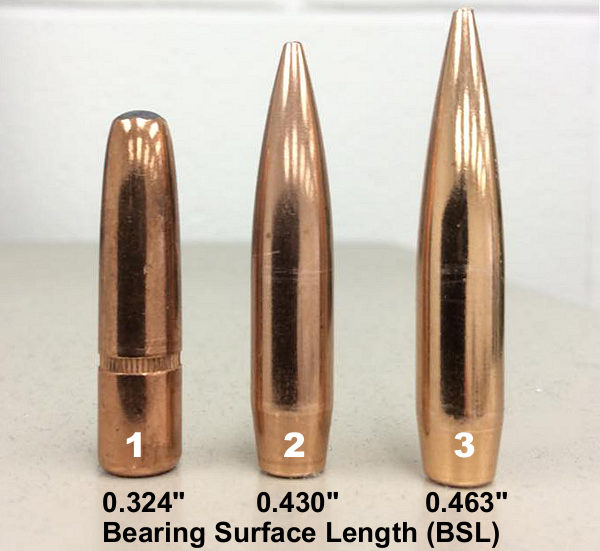 Bullet 1 (L-R), the RN/FB, has a very slight taper and only reaches its full diameter (0.284 inch) very near the cannelure. This taper is often seen on similar bullets; it helps reduce pressures with good accuracy. The calculated BSL of Bullet 1 was ~0.324″. The BSL of Bullet 2, in the center, was ~0.430″, and Bullet 3’s was ~ 0.463″. Obviously, bullets can be visually deceiving as to BSL!


 For Neck-Turning, Try STP Blend or Assembly Lube
 Another even cheaper option is assembly lubricant. For turning his case necks, RStreich uses assembly lube from an auto parts store. He notes: “The brand I have is reddish in color and kind of sticky like honey. It’s far better than the Imperial die wax I was using before.” There are a variety of types, both with and without moly additive, and you can select the viscosity you prefer if you sample a few brands. Be sure to clean out any lube residue from the inside of your necks when you have completed your neck-turning.


 ‘Seller’s Remorse’ Spurs 6mm Project


 Final Thoughts on the 6-6.5×47 Lapua


