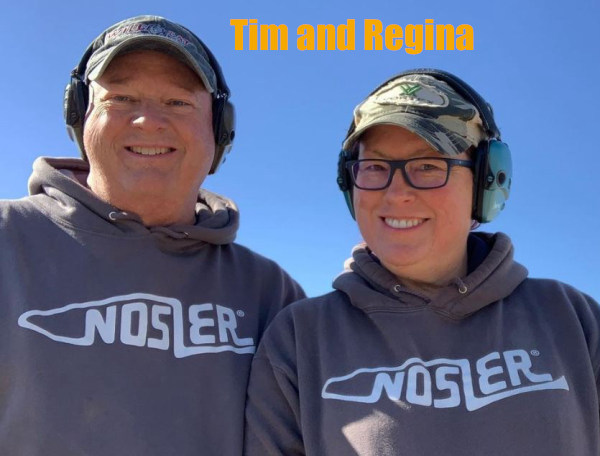
You’ve heard the adage — “The couple that plays together, stays together.” Here’s a story about a married couple that competes together in precision rifle matches. Shooters Tim and Regina Milkovich recently both placed in the Top 10 at the popular CowTown Accurized AR Match. Regina took third with a nearly-clean run, dropping only one shot on Stage 5 to end with 49 points and an overall time of 49.50. Tim followed closely behind, placing sixth with 48 points and a time of 37.95.
This match, held at the CowTown Range in Peoria, Arizona, is designed to test and build shooters’ long range skills. Shots are taken from normal PRS-style positions and supports. Each match consists of five stages with targets ranging from 100 to 700 yards. Each stage has a 20-round maximum, and the match typically requires 40 to 50 hits.
Tim and Regina, who are both sponsored by Nosler, can often be found competing together at individual and team matches. At this match, both shot ARs chambered in .223 Rem loaded with Nosler .22 caliber 77gr Custom Competition bullets.
This video is from a Cowtown Accurized AR match last October.
Regina is a Top Female PRS Shooter
Regina is one of the top female precision rifle competitors in the country. She is one of only two women to ever win a national-level Precision Rifle Series (PRS) match. Just a few years ago Regina was a novice in the PRS/NRL game. Now ranked as a Master Class shooter, today she is a respected, top-level competitor.
Time is a Veteran Who Shoots Many Disciplines
Tim is a military veteran with service in the U.S. Marine Corps, U.S. Army, and U.S. Air Force. He has been shooting competitively since 1986 in multiple disciplines including Pistol Silhouette, Bullseye Pistol, USPSA, IDPA, and 3 Gun. Tim has a Master Class ranking in most of the disciplines he shoots.
Tim also shoots bolt-action rifles. Below are his 6.5×47 Lapua cartridges loaded with Nosler 140gr RDF bullets and Varget powder. Photos from Tim Milkovich Facebook Page.
Jason Baney was one of the “founding fathers” of this website when we started out as 6mmBR.com 18 years ago. A few seasons back, Jason created an interesting wildcat, a mid-sized 7mm cartridge based on the 6.5×47 Lapua case. In this report, Jason (who now works at Eurooptic.com) talks about his 7×47 wildcat and his initial velocity (and feasibility) tests. To determine the 7×47’s velocity potential, Jason did a multi-stage test, cutting a barrel in two-inch increments. This process is illustrated in a video, embedded below.
You may be surprised that the little 7×47 cartridge could drive a 180gr Berger Hybrid at 2770+ FPS with a 32″ barrel and Reloder 17. Max Velocity with H4350 (and 32″ barrel) was roughly 70 FPS slower. With a 24″ barrel length, the 7×47 was still able to propel the 180gr Hybrids over 2600 FPS with H4350. That’s impressive performance for a mid-sized cartridge pushing a very big bullet.
7×47 Lapua Wildcat — Great Accuracy and Surprising Velocity
By Jason Baney, Eurooptic.com
The biggest enemy in long-range shooting is wind. This also happens to be the hardest to gauge and predict. The only way mere mortals can attempt to defeat the wind demons is to shoot a cartridge with the most ballistic efficiency, yet maintain a user-friendly combination of recoil and component consumption as well as performance on target.
The 7mm bullets tend to yield the best compromise of all of these aspects. Their BC-to-weight ratio is outstanding and 7mm bullets provide sufficient impact energy for most situations. In addition to that, the recoil of 7mm bullets can be more manageable than heavier/larger .30 and .338 caliber projectiles.
In cartridge design, of course you want the best case possible. Having used the 6.5×47 Lapua since its release in 2006, I felt this cartridge was the perfect choice to start with as I wanted a true short-action non-magnum round that gave the least possible wind drift to 1000 yards. The 6.5×47 parent case also allowed seating of the heavy 180gr class bullets completely out in the neck yet it maintained an overall length that would actually work in a factory Remington short action magazine.
The 6.5×47 brass from Lapua is as good as it gets and is a very efficient case. The small primer pocket has been a proven winner so no need to change anything. This combination has always given reliable precision and extremely tight velocity spreads.
So here I was, ready to expand a 6.5×47 Lapua to 7mm but a web search revealed no info on a 7×47 wildcat, so test loads would be based purely on an educated guess. My initial assessment/prediction was that heavier 180gr bullets in the larger 7mm caliber would end up at a max load very close to a 140gr bullet in the parent 6.5 caliber. This actually turned out to be a very accurate assumption.
The performance goal of this cartridge was to get a 180gr Berger Hybrid moving at 2720 FPS or faster to be able to shoot inside of a 6.5mm 140gr Berger Hybrid at 2900 FPS. (That 2900 speed is what I was able to achieve with the standard 6.5×47 Lapua). I also planned to try the 168gr VLD as well as the 180gr Lapua Scenar and 162gr Amax, but the specific goal was the beat the 6.5 140gr bullets at 2900 FPS. I believed the 180 Hybrid at 2720 FPS would be the easiest way to accomplish this.
Here are Summary Test Results for H4350 and Reloder 17 for 180s, and IMR 8208 for the 168s. Speeds were clocked by two chronographs at nine (9) barrel lengths, 32″ to 16.1″.
Since this cartridge was a complete unknown I thought it would be quite interesting to see what the 7×47 could achieve at various barrel lengths from very long to very short. We wanted to see which length would best suit the bullet/cartridge combination for max performance. Obviously testing 8-10 barrels at different lengths would be pointless due to natural performance variations between barrels, not to mention expensive and wasteful. I decided instead to attempt a fairly radical test and cut a barrel from 32″ down the 16.1” while chronographing the same loads along the way to see what each combination delivered at the different lengths.
Before I could get started of course a reamer and dies and a few other parts were needed. Dave Kiff at Pacific Tool and Gauge was excited to get going on the project so soon after our phone conversation my one of a kind reamer arrived. Since I had been using Forster dies in the 6mmx47 Lapua and 6.5×47 for all these years, I contacted my friend Bob Ruch at Forster and he was willing to make me a few sets of special dies for the project. Lapua of course provided some brass for the project and Rock Creek Barrels sent a beautiful 1:8.7″-twist 5R barrel blank as a sacrificial lamb. The gunsmith I chose for the chamber job on this project needed to be a tactical long range rifle shooter to appreciate the capability of the round all the way down to its 16.1” barrel length so I asked my good friend Wade Stuteville from Stuteville Precision to help me out.
The rifle I selected for the test was Accuracy International’s new AT rifle. This rifle is basically an overhauled and updated AI AW with a quick user-changeable barrel. I can literally change a barrel in 1 minute or less. The machining they have done to give this function was quite simple and brilliant in the way it retains the barrel yet allows the release quickly and with only a 4mm Allen wrench. This would make the test that I contrived go very smoothly as no major tools were needed.
My goal was to use as many different load combos for the test as I could without making it extremely cumbersome to complete. I wanted to test at least the 180 and 168 Berger as well as a couple different powders representing different burn rates to get an all-around feel for how the cartridge would behave at the different lengths. From previous experience with the 6.5×47, the best powder choices were Hodgdon H4350 and Alliant Reloder 17 (RL17) so these would be the main players. I also picked IMR 8208, Varget, and VV N550 to cover the spectrum of acceptable burn rates. Also, my standard CCI 450 primer was used as that has been successful for me in the 6mmBR and 6.5×47 since 2006 as they are incredibly consistent, however they are also better able to take high pressures without blanking. After picking the powders, I first ran ladder tests to assess max loads in the long 32” barrel.
Velocity Study — Chopping the Barrel from 32″ to 16.1″
Laying out the test actually took a bit of bit of mental gymnastics to provide randomness. The barrel was to be cut in 2” increments from 32” down to a final of 16.1”. Each length was actually pre-scored by Wade to make cutting easier to start and was actually 1/8” long at each mark so when I finally ended up at 16 1/8”, I was able to have the barrel re-crowned without going below legal length.
Six loads were assembled using the five powders mentioned above and two bullets (Berger 168gr VLD and 180gr Hybrid). Each set of rounds to be fired at each cut was predetermined and laid out so that the same load never preceded nor followed another more than once. Reloder 17 and H4350 loads were fired at each cut, while the four others were fired at every-other cut to keep the round count under 200. Twenty rounds (4 loads times 5 rounds each) were fired at each cut from 32” down to 18” and at the final 16.1” length each of the six loads was fired. That is a total of 190 test rounds. The barrel was cleaned before firing at the 24” length and before firing at the 16.1” length. After cleaning each time I fired two rounds of the next load as fouling shots to normalize velocities.
The rifle was fitted with a 3” fore-end attachment and fired from my 40-lb front rest for 1000-yard benchrest competition with a rear bunny-ear bag. Throughout the test, the rifle never changed its position — though the muzzle did retreat 2” with every cut. I used two chronographs for the test. An Oehler 35P was placed 10 feet from the original 32” muzzle and a Magnetospeed V3 was attached on the muzzle (at all barrel lengths down to 16.1 inches.)
After every round of firing, the barrel was removed and we poured cold water on the exterior only and wrapped a wet towel around it to speed cooling. While the barrel was cooling we used a couple C-clamps and a 2×4 to create an impromptu barrel vice to hold it while we were cutting. While it was clamped, we used a simple hacksaw to cut off two inches and crowned the barrel with an RCBS deburring tool for a nice finish. It took an average of two minutes to cut through the barrel at each length.
OBSERVATIONS:
Throughout the test, the rifle lost 3.2 lbs on its way to 16.1 inches. The recoil and muzzle blast increased dramatically from 32″ down to 16.1″. Groups on target were actually quite impressive given that we were not really trying for absolute precision and we had rough-cut crowns. Many groups formed one large hole and several were half-MOA or better – even at the final 16.1″ length.
Each load lost between 12.25-16.8 FPS per inch (loss per inch – LPI) over the entire test, though the rate of the loss varied by the burn rate of the powder and by barrel length. Generally below the 24” barrel length the LPI accelerated rapidly. Initial LPI at the longest lengths was 0-10 FPS, while the loss per inch at the shortest lengths were much higher at 30-55 FPS!
In general I did not quite achieve the velocity I was hoping for, but am very close and intend to test longer throats and different throat geometry to get where I want to be. Below I will break the attainable performance down into 3 barrel lengths for consideration in different disciplines.
APPLICATION ONE: 28-30” Barrel for 1000-Yard Benchrest:
Since I am close to or past my target velocity at the longer lengths (above 2720 FPS with the 180gr Berger Hybrid), I intend to barrel a 1000-yard Benchrest rifle in this caliber and give it an honest try in 1K benchrest. I feel that, with a 28-30″ barrel length, my goal will be attainable and it will pull away from 6.5mm class rounds in the wind drift department. While there will be a slight recoil increase, in a 17-lb rifle it is not a concern. There will also surely be a significant gain in useful barrel life as well.
With spring soon changing to summer, we are in peak varmint season in many parts of the country. In an area with a high number of critters, a semi-auto varmint rifle is a good choice. You get quick follow-up shots, with reliable 20-rd and 30-rd magazines.
For this Saturday at the Movies Showcase we feature a variety of semi-auto, AR-platform rifles chambered for efficient, high-velocity varmint ammo. Cartridges include: .17 WSM, .17 Remington, .20 Practical, .204 Ruger, .22 Grendel, .223 Rem, and 6mm ARC. We conclude with a video that reviews a variety of lead-free .223 Rem ammo types.
Rock Chuck Hunting in Eastern Oregon
This video has some great backcountry footage. The host nails a number of rockchucks with his .223 Rem-chambered AR-15. The shooter says that the default AR-15 cartridge works great for varmints: “The .223 Remington becomes a rockchuck hunter’s friend with the right load: Nosler 40gr Ballistic Tip loaded over a stuffed case of H335 powder. This achieves 3800 FPS with excellent accuracy.”
.17 Remington AR-15 — Small Bullet, Ultra-High Velocity
The .17 Remington wildcat is based on the .223 Remington case necked down to .172″, with the shoulder moved back. High muzzle velocity (4000+ FPS), flat trajectory, and very low recoil are the .17 Remington’s primary attributes. It has a maximum effective range of about 440 yards on prairie dog-sized animals, but the low BCs of the small .17-cal bullets makes them quite susceptible to crosswinds at such distances.
This Varminter.com video was created in spring 2022, just in time for Rockchuck and Thermal Coyote hunts. The host noted: “This was my first experience with the .17 Remington, but I was not unaware of its history and steady popularity among varmint and predator hunters. Although finding an available and affordable .17 Remington bolt-action rifle is nearly impossible nowadays, building one in an AR-15 was simple and straight-forward.” The video has full description of all the components for the build. The .17 Rem is fast — the 25gr bullet runs 3777 FPS from an 18″ barrel (see 01:42 time-mark). READ Full Story.
.17 WSM Rimfire in Franklin Armory F17-L
What’s the ultimate rimfire varmint rifle? An AR chambered for the .17 WSM could be the answer. Eric Mayer of Varminter.com states: “The Franklin Armory F17-L in .17 Winchester Super Magnum (WSM) has a lot of firsts. It is the first semi-automatic rifle in .17 WSM now available to the general public. It is the first gas-piston system, AR-15 rimfire rifle built in partnership between Franklin Armory and Osprey Defense.”
Eric has used the .17 WSM AR shooting ground squirrels, rock squirrels, prairie dogs, and rabbits. Eric notes: “The report of the .17 WSM is nowhere near as loud as most of the centerfire [varmint] cartridges. I found that when I shot the FA-17, it did not cause the other ground squirrels… to run for cover. The lack of recoil … allowed me to see right where I hit [and] if I happened to miss, [low recoil] made for quick corrections for wind, or distance.” READ Full Report
The .17 WSM is a much larger, more powerful round than the .17 HMR. See the size difference above.
Eric Mayer created his own custom .17 WSM AR-15 varmint rifle, built with a Franklin Armory F17-V4 Upper, Aero Precision Lower, and Magpul stock. This was used in California and Arizona. READ Full Story.
.20 Practical — Fast, Accurate, Easy to Form
The .20 Practical cartridge is simply a .223 Rem necked down to .20 caliber. This is a great choice for prairie dogs — and probably our favorite wildcat for the AR-15. Just neck down your .223 Rem brass, fit a .20-Cal barrel and you’re good to go. Robert Whitley notes the the .20 Practical “is a perfect cartridge for varmint hunting and general shooting — very accurate and fast! It functions 100% out of an AR-15.”
The .20 Practical offers some notable advantages for high-volume varmint shooters. The .20 Practical delivers very high velocity with very low recoil while still providing outstanding accuracy. The .20 Practical is great option for folks who favor “fast and light” — smaller, lower-mass bullets traveling at very high velocities. This little cartridge can launch 40-grainers at over 3900 FPS, and 32-grainers even faster. This makes the .20 Practical a great choice for an AR-based varmint rifle.
.20 Practical Ultimate AR Varminter
A decade ago AccurateShooter.com created a .20 Practical AR15 Ultimate Varminter with a custom 20-caliber upper from Robert Whitley of AR-X Enterprises, LLC. That project rifle was ultra-accurate — every 5-shot group out of the gun was less than the size of a dime. That gun was auctioned off, but Robert Whitley continues to produce custom 20 Practical AR-15 uppers.
You make .20 Practical cases by simply necking down .223 Rem brass to .20 caliber. You can start with standard .223 Rem brass and even load with standard .223 Rem dies. Just swap in a smaller expander and use smaller neck bushings.
Prairie Dog Hunt with .204 Ruger AR — Watch The P-Dogs Fly
The video was created during a 2018 prairie dog safari. It has stunning footage of hits on P-Dogs at multiple distances. You can see over FIFTY hits with some amazing P-Dog aerials. Watch the first flyin’ dog at 00:20 time-mark and there’s a truly spectacular gut-busting hit at 3:13. That shows the potency of a high-speed .20-cal projectile. The shooter was using a custom-built AR-15 chambered in a .204 Ruger. That cartridge was driving 35gr Berger hollow point bullets at a stunning 4050 FPS! The rifle was fitted with a Dakota silencer suppressor and many other custom components. If you’ve never tried prairie dog hunting, watch this video start to finish and you may be hooked.
6mm ARC AR-15 Varmint Rig
This Varminter.com video examines the 6mm ARC cartridge from a varmint hunter’s perspective. Created by Hornady, the 6mm ARC was designed for target shooting and medium-sized game both in bolt guns and Modern Sporting Rifles. Hornady states: “The 6mm ARC … fits in an AR-15-pattern action, functions reliably out of standard-capacity 24- or 17-round magazines. It delivers substantially better ballistics than the .223 Rem[.]” This video examines how the 6mm ARC performs in an AR-15 for varmint and predator hunting. The host reviews available factory varmint loads. The video also examines reloading components for the 6mm ARC — brass and bullets. CLICK HERE for full article.
Cottontail Rabbit Hunting with Suppressed .204 Ruger AR-15
As a varmint hunting tool, the .204 Ruger in an AR-15 is a versatile, worthy cartridge/rifle combo for the job. This video covers a cottontail rabbit hunt. The host states that “We were contacted by a farmer who was being slammed with cottontail rabbits eating out huge portions of his alfalfa fields.” This suppressed .204 Ruger AR-15 proved seriously effective on the rabbits, driving high-velocity rounds with impressive accuracy. See more details on the Varminter.com website.
The .22 Grendel is an extremely accurate and efficient cartridge based on the 6.5 Grendel necked down to .22 caliber. The case can drive 55gr varmint bullets at high velocities — over 3500 FPS. With a faster-twist barrel you can load up to 90gr bullets at 2500 FPS. The tester achieved velocities close to a 22-250. The short, fat case fits in AR-15 magazines, but may not feed as reliably during rapid fire. The tester did experience one double-feed.
Lead-Free Ammo Offerings Tested in .223 Rem AR-15
Some states — such as California — prohibit hunting with bullets that contain lead. If you plan to hunt in an area with such restrictions, you’ll need to find a lead-free substitute. Thankfully a number of manufacturers produce ammo with solid brass projectiles or other lead-free bullet designs. This Varminter.com video reviews .223 Remington no-lead ammunition from Cor-Bon, Hornady, Nosler and Winchester. These ammo types were tested in a AR-15 varmint rifle, used in a coyote hunt featured at the end of the video. SEE Full Story on Varminter.com.
At the request of our readers, we provide select “Deals of the Week”. Every Sunday afternoon or Monday morning we offer our Best Bargain selections. Here are some of the best deals on firearms, hardware, reloading components, optics, and shooting accessories. Be aware that sale prices are subject to change, and once clearance inventory is sold, it’s gone for good. You snooze you lose.
NOTE: All listed products are for sale to persons 18 years of age or older. No products are intended for use by minors.
1. Midsouth — Berger Bullets in Stock, Good Prices
⏺ Top-quality Berger bullets in stock now — order before they sell out
Berger bullets in popular calibers/weights have been in high demand. But Midsouth recently received a large shipment of .224, .243 (6mm), .257, .264 (6.5mm), .284 (7mm), .308 and .375-caliber Berger bullets. There are various weights in the popular calibers (e.g. 52gr, 73gr, 80gr, 85.5gr, and 90gr in .224). Over 40 Berger bullet types are in stock now, starting at $44.99 per 100. Grab these while you can.
⏺ Excellent precision reloading scale now $100 OFF
Need a high-quality reloading scale, but can’t afford an $800 A&D force restoration scale? Then you’re in luck. Right now you can get the excellent Creedmoor Sports TRX-925 scale for $249.95. This deal — a huge $100 savings off the regular $349.95 price — is for the first 249 customers only, so act soon. Note: The TRX-925 measures natively in GRAINS rather than grams, so it offers excellent precision.
3. Barnes Bullets — Barnes Match Burner Bullet Sale
⏺ Great prices on good match bullets, multiple calibers
If you’re looking for good target bullets at a good price, consider the Barnes Match Burners. On sale now direct from Barnes, these come in an assortment of calibers and bullet weights. Prices start at just $26.99 per hundred. For PRS/NRL we recommend the 6mm Match Burner 105gr HPBT, at $34.99 per hundred.
4. MidwayUSA — Vortex Optics on Sale, Save up to 40%
⏺ Huge discounts on popular Vortex scopes, spotters, binoculars
5. Graf & Sons — Ginex primers in Stock, $73/1000 for 5K
⏺ Reliable small rifle and small pistol primers at good prices
Primers are still hard to find and most are priced well over $100 per 1000. Give your wallet a break by picking up Ginex primers from Graf’s. Available in small rifle as well as small pistol sizes, these are quality primers offered in 5000-primer bulk packs, priced at $365.00 for 5K, which works out to $73.00 per thousand. User reports for these Ginex primers have been quite positive.
6. Midsouth — Triggertech Trigger Sale
⏺ Excellent triggers for competition and hunting rifles
Triggertech makes high-quality, reasonably-priced triggers that fit a wide selection of rifles. Right now Midsouth is running a Triggertech Sale with over 50 trigger types on sale — including triggers for Rem 700s (or clone) and ARs. Save 11% or more on a quality trigger and get FREE Shipping right now.
⏺ Unique design rechargeable muffs with behind-head strap
Ordinary electronic muffs can lose power at inopportune times. Save the aggravation and grab a pair of these Walker’s Rechargeable Firemax Ear Muffs. These Behind-the-Neck (BTN) muffs boast a 2000 mAH rechargeable lithium battery for over 200 hours of protection (way more than typical drop-in batteries). Simply charge your muffs before heading to the range. These Walker BTN muffs have a notable design — the primary padded strap runs BEHIND the ears, with a secondary, removable top strap. Many shooters will find this arrangement more handy and comfortable than conventional muffs with a bulky top strap.
8. EuroOptic — ZEISS Binoculars Sale, save $75-$150
⏺ Major discounts on high-quality ZEISS binoculars
ZEISS, the respected German optics maker, has launched a Spring into Savings event through participating ZEISS authorized retailers. This promotion runs through May 15, 2023, offering major instant savings on high quality ZEISS binoculars. And when you purchase ZEISS binoculars from EuroOptic.com, you get speedy RED Expedited Shipping. Here are the ZEISS Binoculars Spring Savings offers:
$150 Instant Rebate on ZEISS SFL 40 Binoculars
$100 Instant Rebate on ZEISS Conquest HD 42 and 22 Binoculars
$75 Instant Rebate on ZEISS Terra ED 42 and 32 Binoculars
9. Natchez — Ammo Sale (Multiple Brands)
⏺ Many popular ammo types at good prices
While it’s not one of the largest ammunition sales you’ll find on the web, this week’s Natchez Ammo Sale offers very significant discounts on a variety of popular cartridge types, with a good selection of manufacturers, including Hornady, Winchester, PMC, and Aguila.
10. Brownells — Ruger Max-9 FX Optics Ready 9mm, $349.99
⏺ Slim, smooth, 9mm Luger handgun with big discount
Ruger makes very reliable pistols and has excellent customer service. If you are looking for a very compact, easy-to-carry 9mm handgun, consider the Ruger Max-9 now $349.99 on sale at Brownells ($170 off MSRP). This particular pistol has a cool dark blue-gray optics-ready slide for easy mounting of small red dot sights. The MAX-9 also features a tritium fiber-optic day/night front sight.
11. Amazon — Splatter Stick-On Targets, $6.99/100ct Roll
⏺ 100 3″-diameter Adhesive Splatter Targets on roll
Splatter targets help you see bullet impacts clearly from a distance. Most splatter targets come in big sheets, but these handy 3″-diameter, stick-on splatter targets come on a convenient roll. Get a 100-count roll for just $6.99 on Amazon. These circular targets feature a black bullseye with red center and bright yellow rings. These targets are easy-to-peel and the roll can be stowed easily in a range bag.
Is factory 6.5 Creedmoor ammunition good enough to win a PRS or NRL competition? The answer is a resounding “YES” if we’re talking about Berger ammunition. Produced with Berger match bullets and premium Lapua brass, this Berger 6.5 Creedmoor ammunition demonstrated excellent accuracy, impressive velocity, and very good ES/SD numbers. When tested at 1000 yards with an MPA-stocked PRS rig with Rem 700 action, this ammo showed just half-MOA of vertical, and produced a group that would have been a 50-1X in F-Class competition. That’s quite impressive for a PRS rig.
This ammo test was performed by our friend Erik Cortina from Texas. The reigning SW Nationals F-Open champion, Erik is a top F-Class competitor who also shoots tactical matches (for fun and glory). A couple seasons back, Erik built a new 6.5 Creedmoor with a Remington 700 action. Though this rifle sports a top-shelf MPA chassis and premium Kahles scope, Erik calls this his “budget build” because it has a plain Rem 700 factory action rather than the elite Borden actions he normally runs. Erik’s actions of choice are the Borden Mountaineer for PRS and Borden BRM-XD for F-Class.
Erik posted: “Shot my budget 6.5 Creedmoor … with Berger Bullets factory ammo. I shot five rounds over the chrono to get speed. I used BC info from the box and it all lined up properly. I adjusted my ECTuner to tune load and it took just 15 shots to get it shooting well. It’s simple with good components.”
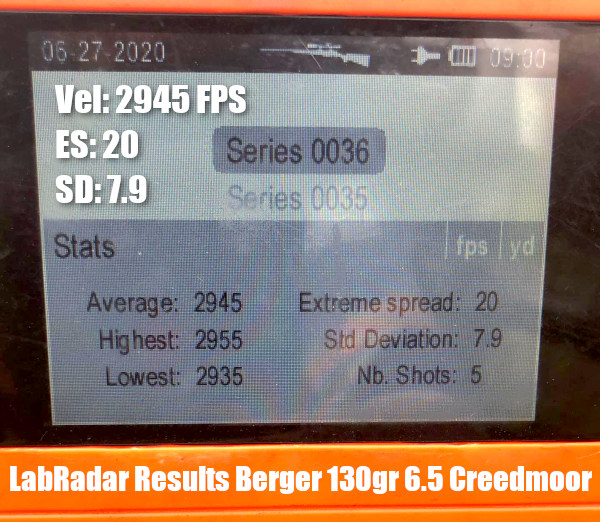
This Berger factory ammo features Berger 130gr Hybrid OTM Tactical bullets. The Lapua 6.5 Creedmoor cases have a large rifle primer. You can see this ammo displays good velocity with Extreme Spread and Standard Deviation rivaling good hand-loads.
Cortina says the very accurate Brux barrel and razor-sharp 6-24x56mm Kahles scope help achieve this kind of outstanding performance at 1000 yards. Here are the key components for Erik’s latest PRS rig:
Barrel Tuner by Erik Cortina — Fits Behind Muzzle Brake
This rifle features a barrel tuner designed and crafted by Erik Cortina. You can the EC Barrel Tuner alone, or, as you can see, the EC Tuner can be fitted BEHIND a muzzle brake. Erik tells us: “The EC Tuner allowed me to tune the barrel to my ammo rather than tuning the ammo for barrel as is done when reloading. With the tuner, there is no need to try different brands of ammo as they can all be tuned to shoot as good as possible in my rifle.”
Erik Cortina is one of the world’s top F-Class shooters. Erik won the 2023 Southwest Nationals in F-Open Division, and he was a member of Team USA which won the F-Open World Championship in South Africa. And Erik also won the individual F-Open title at the South African National Championship which preceded the 2023 F-Class Worlds. Erik also has competed successfully in Long-Range and Precision Rifle matches. Along with his shooting skills, Erik is a respected video host. His Erik Cortina Video Channel now boasts nearly 500 videos, covering a wide range of shooting disciplines, along with reloading, load tuning, and other gun tech topics.
This Saturday we are featuring nine of Erik’s informative videos. These cover reloading techniques, marksmanship tips, and more. We start with two vertical-format “shorts”, both worth watching. In the first video you can see Erik nail five straight targets at 500 yards, with the last one a tiny square.
Two “Shorts” — Precision Steel and Advanced Reloading
500-Yard “Know Your Limits”
Cortina with 6mmBR Nails ‘Em All
Loading Cartridge with
SuperTrickler and AMP Press
Barrel Break-in — Don’t Waste Barrel Life
A factory barrel can benefit from a break-in regimen. Some custom barrels shoot great from the get-go and don’t require elaborate break-in rituals. In this popular video, Erik explains how he determines the appropriate break-in procedure for his barrels: “Deciding if you need to break-in a barrel is not as easy as many think. In this video, I discuss the thought process I go through in deciding if I need to break in a barrel or not.”
Smallest 1000-yard Group Ever Caught on Camera
This 1000-yard group was NOT shot in a match, so it is not a record. But Erik shot a truly spectacular group during practice. This shows what modern F-class rifles can do with ideal conditions. Erik drilled five shots in 1.3″ inches, with 4 shots in under 1/2″ (see 1:15 – 2:20 time). And the first 3 shots landed right on top of each other (about 1/4″). Erik notes: “While shooting, I decided to set up my camera and record the screen on my phone so I could see the shots on my Electronic Target. To my surprise, the shots kept stacking up on top of each other. I had a 3-shot group under 1/4 inch! Most shooters would be happy with that at 100 yards, but this is at 1,000 yards!”
Common Sense Reloading
All novice reloaders should watch this video. Erik explains the three key items when reloading for accurate rifles. Erik explains: “We as humans have a tendency to complicate things, and reloading is no different. For some reason, we think that the more complicated it is, the better the end product will be. It doesn’t have to be that way, today I explain the three different things that must be in check to ensure you have a consistent and efficient load. Once you get these three things corrected, you’ll always have a good load.”
Team USA F-Open World Champions
The 2023 F-Class World Championships were recently held in South Africa. There were talented teams from many countries. With a strong, come-from-behind performance on the last day of the team match, The U.S.A. F-Open Team topped South Africa to win the F-Open Team Championship with a 3540-366V score (South Africa finished with 3535-374V — a “V” is like an “X” in the USA). Congratulations to the 2023 USA F-Open team, the new World Champions! Erik Cortina was a member of Team USA.
Stop Neck-Sizing Brass
With over 400,000 views, this is one of Erik’s most popular videos. Erik explains why it is NOT smart to neck-size only. For almost all rifle applications, you’ll get better case life and more consistent loads if you full-length size your cases. Full-length sizing also provides vital shoulder bumping, which is essential for proper case-feeding and smooth bolt closure. Proper full-length sizing will also help optimize ES and SD.
Precision Reloading Class at PRS Expo 2022
This 8-minute video records a seminar Erik conducted at the 2022 PRS Expo. In this segment, Erik explains the key elements of accuracy. He advises that the bullets are the most expensive element of each cartridge, and are critical to accuracy, so competitors should always buy the best — never attempt to cut costs on projectiles. CLICK HERE for PART TWO of Erik’s presentatiion.
About Erik Cortina Precision Products Cortina Precision makes some of the best barrel tuners on the market. The EC Tuner was developed over a decade ago and has many championships under its belt. The EC Tuner was recently revamped and released as the EC Tuner V2. The V2 model employs a spring to maintain load on the tuner at all times and eliminate backlash. That helps with consistency. The EC Tuner V2 works well for centerfire, rimfire, and even air rifles.
Cortina Precision also offers the EC Tuner Brake. The Tuner Brake combines a barrel tuner with a muzzle brake. The EC Tuner brake greatly reduces recoil and allows you to tune your rifle to your load. These Tuner Brakes are a good choice for hunters and PRS/NRL competitors, as they work equally well with handloads and factory loads. For more information, visit ShootSmallGroups.com. – Erik Cortina
The total economic impact of the firearm and ammunition industry in the United States increased to $80.73 billion in 2022 from $19.1 billion in 2008, a 322% increase, while the total number of full-time equivalent jobs rose to over 393,696 from approximately 166,000, a 136% increase in that same period, according to a report released by the NSSF, The Firearm Industry Trade Association. READ Full REPORT.
The Firearms and Shooting Sports Industry Now Generates 393,696 Jobs in America
On a year-over-year basis, the industry’s economic impact rose to $80.73 billion in 2022 from $70.52 billion in 2021. Total jobs increased by over 17,877 in the same period, to 396,696 from 375,819. The firearm industry has broader impacts throughout the American economy. The gun industry also generates business for firms not directly related to firearms — creating jobs in industries such as banking, retail, accounting, metalworking, and printing.
Gun Manufacturers and Ammo Makers Now Pay over $7.48 Billion in Taxes
The firearm and ammunition industry paid over $7.48 billion in business taxes, including property, income, and sales-based levies. An additional $1.15 billion was paid in federal excise taxes, which directly contributes to wildlife conservation.
“Our industry’s economic input is undeniably contributing to every state and every community. This milestone achievement of over $80 billion in economic impact proves that the American firearm and ammunition industry is strong,” said Joe Bartozzi, NSSF President and CEO. “Over 4.2 million Americans from all walks of life, for the first time, discovered and exercised their right to lawful firearm owners and safely participate in the recreational shooting sports last year. This growth equals more jobs that add to our local economies, averaging $65,000 in wages and benefits, up from $56,900 reported last year. Since 2008, federal tax payments increased by 266%, Pittman-Robertson excise taxes that support wildlife conservation by 226% and state business taxes by 46%.”
The annual Firearm and Ammunition Industry Economic Impact Report provides a state-by-state breakdown of job numbers, wages and output, as well as federal excise taxes paid. CLICK HERE for Full Report (Printable PDF).
Every gun enthusiast can use a large supply of .22 LR rimfire ammunition for fun plinking and steel target work at the range. Yes, rimfire ammo has increased in price over the past decade, but there are still some exceptional deals. Here’s a great .22 LR rimfire ammo deal we found at SportsmansGuide.com.*
Right now, for just $109.99, you can get a bucket of 1400 Remington rounds with 36gr plated Hollow Point (PHP) bullets. That works out to just 8 cents per round ($0.078). Compare that to $0.20/rd for 9mm Luger ammo, and $0.50/rd or more for bulk .223 Rem centerfire ammo. That’s why this ammo is a good choice for high-volume plinking and plate owrk. The claimed velocity for the Remington ammo is 1280 FPS — a pretty fast speed for the .22 LR cartridge.
Range Test of Remington Bucket of Bullets .22 LR Ammunition
Here is a range test of the 36gr .22 LR rimfire cartridges in Remington’s Bucket of Bullets. The ammo was fired through a Ruger 10/22 with iron sights. The tester did observe one round that seemed weak (03:07 time), and this showed a 967 FPS velocity. That’s 313 FPS slower than the rated velocity. The tester produced about a 1.2″ group at 25 yards. He concludes he would not use this ammo for competition, but it is plenty good for “plinking, having fun… and poppin’ squirrels.”
* The price for regular customers is $109.99 for the 1400-rd bucket. However Sportsman’s Guide Buyers’ Club members pay $104.49, saving nearly 5%. And club members get FREE Shipping on orders over $49.00. This ammunition cannot be shipped to California.
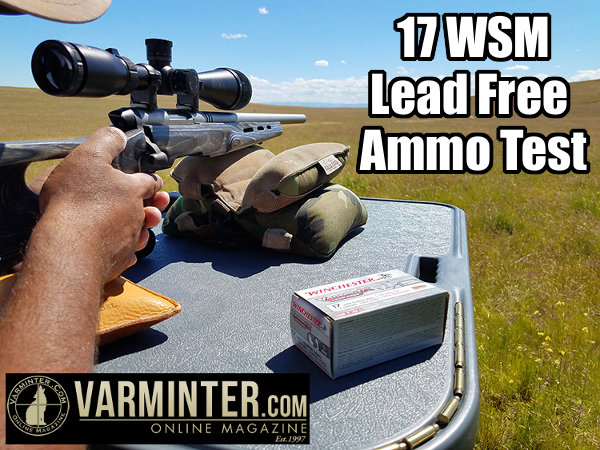
Some “progressive” states, such as California, are imposing broad new restrictions on the use of ammunition that contains lead. This is problematic for rimfire varmint shooters. Thankfully, Winchester now offers LEAD FREE 17 WSM ammunition. In this ammunition, zinc replaces lead in the bullet cores.
The team at Varminter.com has conducted an extensive test of Winchester’s new lead-free ammo. Over the course of multiple sessions, Varminter.com shot the ammo using no less than nine different rifles. Four, 5-shot groups were shot with each rifle from the bench at 100 yards.
Results were impressive. Average group size for a 1:9″-twist heavy barrel Savage B-Mag was a remarkable 0.5005 inches. Group size averages for seven of the eight other 17-cal rifles* ranged from 0.755 to 1.03 inches at 100 yards — pretty impressive for factory rimfire rigs. A LOT of time was invested in this test, and we recommend you read the full report on Varminter.com.
Fastest Rimfire Cartridge Ever
If you’re not familiar with this cartridge, the 17 WSM is the fastest, flattest-shooting rimfire round you can buy. It stomps the .22 LR, and even offers significantly better ballistics than the popular 17 HMR. This lead- free version is impressively flat-shooting. With a 100-yard zero, it drops only 4.3 inches at 200 yards. Compare that with a .22 LR which can drop 18 inches or more from 100 to 200 yards (based on 1150 fps MV).
Zinc Replaces Lead in Winchester’s Eco-Friendly 17 WSM
For folks who live in areas where lead ammo is restricted, such as California, the arrival of this Lead Free 17 WSM is good news. Winchester’s new 17 WSM ammunition features a Zinc-cored, polymer-tipped 15-grain bullet with 0.118 G1 BC. The ammo is rated at a speedy 3300 FPS velocity. Winchester says that the zinc core and “thin alloy jacket with engineered sidewall profile” deliver “explosive fragmentation.”
*The ninth rifle, a Savage BMAG with original thin-contour barrel, was the “odd man out”. Accuracy was mediocre, averaging 1.763 inches.
Rifleshooter.com does some great original research — providing “hard data” you can’t find anywhere else. Here are the eye-opening results of Rifleshooter.com’s 6.5 Creedmoor barrel cut-down test. You may be surprised at the results. Read on…
What do you get when you cut a 6.5 Creedmoor-chambered barrel down to just over 16 inches? A lot more velocity than you might think. Our friends at Rifleshooter.com conducted a remarkable barrel cut-down test with 6.5 Creedmoor test rifle, shortening the barrel from 27 to 16.1 inches in one-inch increments. Surprisingly, with a 142gr Sierra MK, the total velocity loss (as measured with a Magnetospeed) was just 158 FPS, an average of 14.4 FPS per inch of barrel length. With the lighter 120gr A-Max bullet, the total velocity loss was 233 FPS, or 21.8 FPS average loss per inch of barrel.
Test Procedure
Five (5) rounds of each type of cartridge were fired at each barrel length and the velocity data was recorded with a MagnetoSpeed V3 barrel-mounted chronograph. The rifle was then cleared and the barrel was cut back one inch at a time from 27″ to just over 16″. NOTE: During this winter test, the air temperature was a very chilly 23° F. One would expect higher velocities across the board had the outside temperature been higher.
The photo below shows how the barrel was cut down, inch-by-inch, using a rotary saw. The barrel was pre-scored at inch intervals. As the main purpose of the test was to measure velocity (not accuracy) the testers did not attempt to create perfect crowns.
6.5 Creedmoor vs. Other Mid-Sized 6.5mm Cartridges
The 6.5 Creedmoor is a very popular cartridge with the tactical and PRS crowd. This mid-size cartridge offers good ballistics, with less recoil than a .308 Winchester. There’s an excellent selection of 6.5mm bullets, and many good powder choices for this cartridge. When compared to the very accurate 6.5×47 Lapua cartridge, the 6.5 Creedmoor offers similar performance with less expensive brass. For a tactical shooter who must sometimes leave brass on the ground, brass cost is a factor to consider. Here’s a selection of various 6.5mm mid-sized cartridges. Left to right are: 6.5 Grendel, 6.5×47 Lapua, 6.5 Creedmoor with 120gr A-Max, 6.5 Creedmoor with 142gr Sierra MK, and .260 Remington.
When asked to compare the 6.5 Creedmoor to the 6.5×47 Lapua, Rifleshooter.com’s editor stated: “If you don’t hand load, or are new to precision rifle shooting, get a 6.5 Creedmoor. If you shoot a lot, reload, have more disposable income, and like more esoteric cartridges, get a 6.5×47 Lapua. I am a big fan of the 6.5×47 Lapua. In my personal experience, the 6.5×47 Lapua seems to be slightly more accurate than the 6.5 Creedmoor. I attribute this to the quality of Lapua brass.” Now that Lapua offers 6.5 Creedmoor brass with small primer pockets, the 6.5 Creedmoor is even more attractive.
The creator of Rifleshooter.com also operates a Custom Rifle Building enterprise and gun shop in Long Island, New York: 782 Custom Guns Ltd.. He tells us: “We offer an unparalleled level of gunsmith machine shop services in the Long Island region. From precision rifles (USMC M40A3/A5/A6 XM3 clones) to customized Remington 870 and Mossberg 590 shotguns, and customized 1911s, chances are if you can dream it, we can build it!”




 .20 Practical Ultimate AR Varminter




 Cortina says the very accurate Brux barrel and razor-sharp 6-24x56mm Kahles scope help achieve this kind of outstanding performance at 1000 yards. Here are the key components for Erik’s latest PRS rig: