Shown are funnel with ultra-long drop tube (which helps get more kernels in the cases), RCBS Chargemaster (in wood box), and Hood Press (similar to Harrell’s Combo press).
Loading at the range remains important in the Benchrest for Group discipline. In a Special Report below, past IBS President Jeff Stover explains how loading methods (and hardware) have evolved over the years. The advent of accurate, affordable electronic powder dispensers, such as the RCBS ChargeMaster and Frankford’s new Intellidropper, have changed the game and made it easier to load efficiently at the range. And quality manual powder measures are fast and can be very consistent, with a little practice. Loading at the range permits competitors to tune their load to the conditions, change seating depths, or even choose different bullets to suit the barrel’s preferences on any given day.
Although pre-loading is not uncommon, most 100/200-yard group shooters usually load at the match, often between relays. The goal is to shoot smaller groups by staying “in tune”. In a game where 5-shot groups “in the 1s and Zeros” is the goal, tuning loads for the conditions helps deliver match-winning accuracy. Nearly all competitors in this short-range discipline shoot the 6mm PPC cartridge, or a PPC variant.
Loading at the Range — Then and Now
In benchrest shooting for group, loading at the range has been de rigueur for decades. In the Score discipline, preloading is usually the custom. The main reason is that, in Score competition, only one Aggregate (warm-up match and five record targets) per day is usually shot. That would be less than 50 shots, assuming a few sighter shots. Also, the 30BR, the dominant Benchrest-for-Score cartridge, is very amenable to pre-loading.
By contrast, the Group discipline includes 21 targets (two warm-ups and twenty record targets) over a weekend, usually shot with 6PPC-chambered rifles. Many times, the 6PPC shooters may tweak their loads through the day given changing atmospheric conditions or simply trying to find the correct tune to “dot up”. This term, “Dot up”, means the shots are essentially going through the same hole, or closely so.
Loading at the range was a bit different when benchrest competition was in its infancy. The 1951 book, Modern Accuracy by Bob Wallack, is the best of the early benchrest books. Copies can be found, from time to time, on eBay or Alibris. It is a fascinating survey of benchrest as it existed more than six decades ago. There’s even coverage of a controversial target that was argued over at the time. In it, there is a photo of Wallack using the rear bumper of a car at the bench to clamp his reloading tools. Things have come a long way compared to the range loading set-ups of modern shooters. Here you can see Bob Wallack way back in 1950:
Modern loading bench set-ups shown in this Special Report belong to top shooters Howie Levy, Bob Hamister, and Kent Harshman.
Posting on the 6.5 Creedmoor Group Facebook Page, Russel T. complained that his AR magazine doesn’t like to feed that last few rounds. Russell asked: “Full magazine, no problem cycling. But with five (5) or less in the magazine… this happens. What can cause this?”
It sure looks like he could use a new magazine spring, but there may be buffer-related problems as well. Or maybe a gas system issue. What’s your call? Here are some responses posted by Facebook folks:
“Weak mag spring.” — Josh N.
“Weak mag spring or too heavy of a buffer spring.” — Justin G.
“Try a different mag, if it still jams it’s probably a gas problem, if not chuck the bad mag.” — Otto G.
“Weak mag spring or literally anything that would cause the Bolt Carrier Group to short cycle.” — Reggie W.
“I’ve had the same issue with my 300 BLK when my buffer tube came apart. It would still cycle cheap rounds fine but [not] the Hornadys. Took it apart and found the buffer tube was in pieces.” — Hunter R.
“Could be a weak mag spring or buffer spring, both at the same time.” — John S.
“As mentioned it could be a list of things. However, bolt velocity is too fast/hard and the usual (but not always) culprit is over-gassing.” — Bill F.
“Short cycle — clean and LUBRICATE the weapon.” — Mark H.
“Look to see where the brass is ejecting. That will tell if it’s an over or under gas issue. If that’s ok then look at the mag spring. See Diagram” — Teddy G.
“Weak magazine spring, I tossed four brand new ‘bargain mags’ [due to] that very problem.” — John V.E.
“May not be a weak spring or bad mag. Check out a Tubb Precision flatware spring. I swapped mine in a new rifle and solved the problem of short stroking and double feeds.” — Anthony T.
“It might be the follower as well, some designs will dip in the front/rear as rounds are expended. It’s the reason why we didn’t use some service mags with the green followers.” — Chris J.
“Weak spring… time for a new magazine…or add a 5-round block and make it a 25-round magazine. But I’m positive it’s a weak spring, which means it’s just a matter of time for failure.” — Steve M.
“Without the weapon in hand I would hate to guess….
Start with the simple stuff and go from there. Trying to diagnose a problem from a photo is just like when your wife or girlfriend tells you the car won’t start. LOL.” — Mark T.
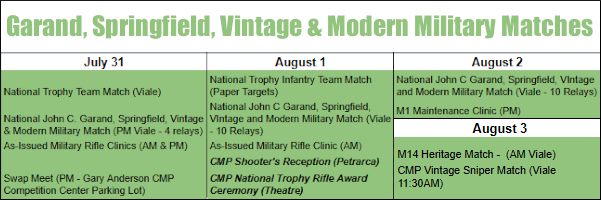
For the next four days — July 31 through August 3, 2025 — the .30-06 M1 Garands and classic military rifles will fill the firing lines at Camp Perry. The National John C. Garand, Springfield, Vintage and Modern Military Match (GSMM) concludes Saturday, August 2, 2025, followed by an M14 Heritage Match and Vintage Sniper Match on Sunday, August 3rd. SEE CMP National Matches 2025 Calendar.
Some participants will shoot just one rifle type, but there is also a combined GSMM 4-Gun Aggregate. This GSSM Agg encompasses a series of position shooting matches on NRA SR targets at the CMP Nationals. Match scores will be posted on the CMP National Matches Results Page.
This video shows the Garand Match at Camp Perry. The rifles are still the same a decade later…
The annual GSMM event is one of the most popular events at Camp Perry, drawing participants from around the nation. One of America’s top GSSM shooters is Brian Williams, who was profiled in our Daily Bulletin. The 4-gun Aggregate includes M1 Garand, 1903 Springfield/1917 Enfield (or similar bolt rifle), M1 Carbine, and AR-type rifle for “Modern Military”.
GSMM matches attract new shooters as well as older competitors. You don’t need to make a huge investment in rifles or optics. We have friends who have done well with a “box stock” 1903 A3 Springfield they acquired from the CMP decades ago. On the firing line are a mix of seasoned competitors and novice shooters. They all come together to share common interests in marksmanship and historic firearms.
During CMP GSMM matches, CMP staff members are always on hand to ensure safety on the firing line and answer questions. This match is fun and efficient. The electronic targets, with monitors at each station, show shot location/score instantly. And there is no pit duty. Competitors never have to venture downrange to change or retrieve targets.
E-Targets at 2025 CMP National Matches
After years of testing, the Civilian Marksmanship Program (CMP) will make full use of eTargets at the 2025 National Rifle Matches at Camp Perry, which run July 20 through August 9, 2025. The advanced Kongsberg eTargets will be used at all Highpower rifle matches, National Trophy Rifle competitions, and Rifle Games events. In addition the eTargets will be used for the Rimfire Sporter Match on July 20 and the National Mid/Long Range Matches in August. The use of eTargets eliminates the need for pit duty, drastically cutting down the duration of each match. CLICK HERE to learn more about Camp Perry eTargets.
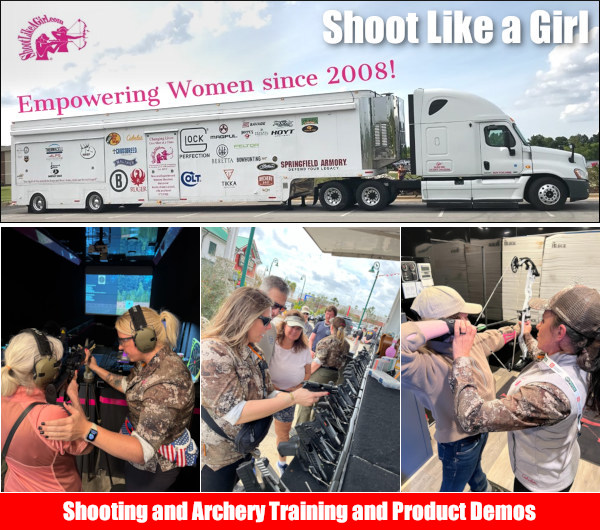
Shoot Like A Girl is a group that helps introduce women to the shooting sports. The organization offers training clinics and tours the country with a unique semi-trailer rig mobile range.
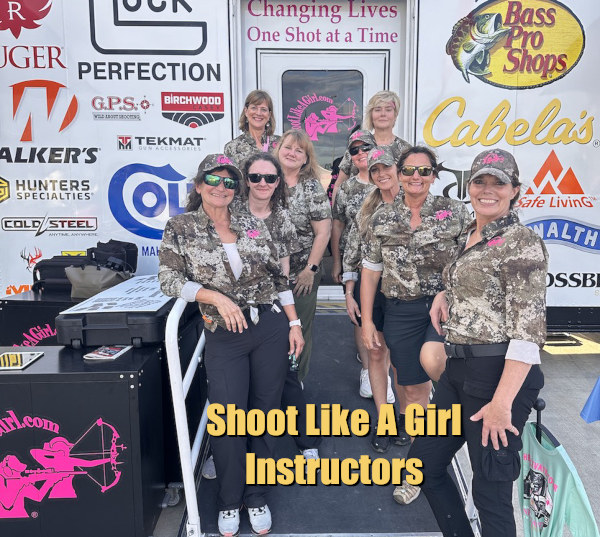
After a successful trip to Thornton, CO, the Shoot Like A Girl Mobile Range will be at the Bass Pro Shops in Memphis, TN, August 1-3, 2025 (Friday through Sunday). The state-of-the-art mobile range allows participants 18 and older to experience shooting under the guidance of certified female instructors. These instructors will offer a comprehensive intro to firearm safety/handling using a Firearms Training Systems (FATS) by InVeris. This military-grade simulator provides immediate sound, recoil, and impact feedback. Shoot Like A Girl instructors also offer safety talks for youths under 18.
The Shoot Like A Girl experience will be stationed in front of Bass Pro Shops in Memphis, Tennessee on Friday, August 1, Saturday, August 2 and Sunday August 3, from 11 a.m. to 4 p.m. Women and men of all experience levels are welcome for this free event. All necessary equipment will be provided to guests.
August 29-31, 2025 Professional Bull Riding, Ridgedale, MO
September 27-28, 2025: Bass Pro Shops, Huntsville, AL
October 11-12, 2025: Bass Pro Shops, Mesa, AZ
TBD (5 Days): Bass Pro Shops, Grand Opening, Odessa, TX
Shoot Like A Girl (SLG2 Inc.) was established in 2008 with a mission to grow the number of women who participate in archery and shooting sports. The first five years focused on archery, but in 2013, SLG2 added Firearms Test Shots™ where women can shoot a 9mm pistol, .223 rifle with the use of a military-grade firearms simulation system.
New and experienced shooters are invited to attend this free event. At the range, women gain experience in handling and shooting handguns, long guns and compound bows using state-of-the-art technology.
The Shoot Like A Girl semi-tractor trailer travels to cities all across the USA, giving attendees an opportunity to shoot pistols, rifles, and bows in a fun, safe and comfortable atmosphere. These events utilize the InVeris military grade firearm simulator. The event is free to each guest thanks to Shoot Like A Girl’s generous corporate partners.
Check the ShootLikeAGirl.com Website for Mobile Range 2025 Travel Schedule.
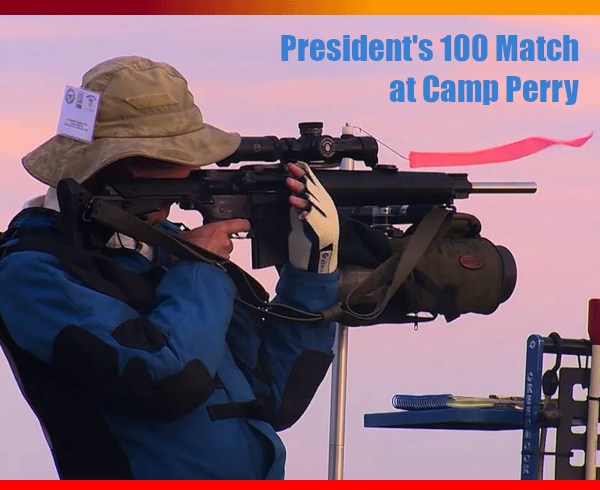
The National President’s 100 Match is a famous competition held at Camp Perry every summer. This year’s President’s 100 Match takes place today, July 28, 2025. SEE 2025 Camp Perry NM Calendar.
This is a huge event. in recent years, there have been over 1000 ranked competitors from throughout the nation, making this one of the biggest rifle events of the year. Credit our friend Dennis Santiago for this report. Dennis has competed in the President’s 100 in recent years.
Image from Shooting USA TV which has broadcast highlights from President’s 100 match.
The President’s 100 Rifle Match is richly steeped in history. This unique match was first held in 1878. Above is the view from the line at 600 yards. The top 100 competitors overall in the President’s Rifle Match are designated as the President’s 100. They receive President’s 100 medallions and certificates.
Looking downrange at the 600-yard targets. Camp Perry photos courtesy Dennis Santiago.
President’s 100 Shoot Off — The Top 20 shooters compete in the Shoot-Off.
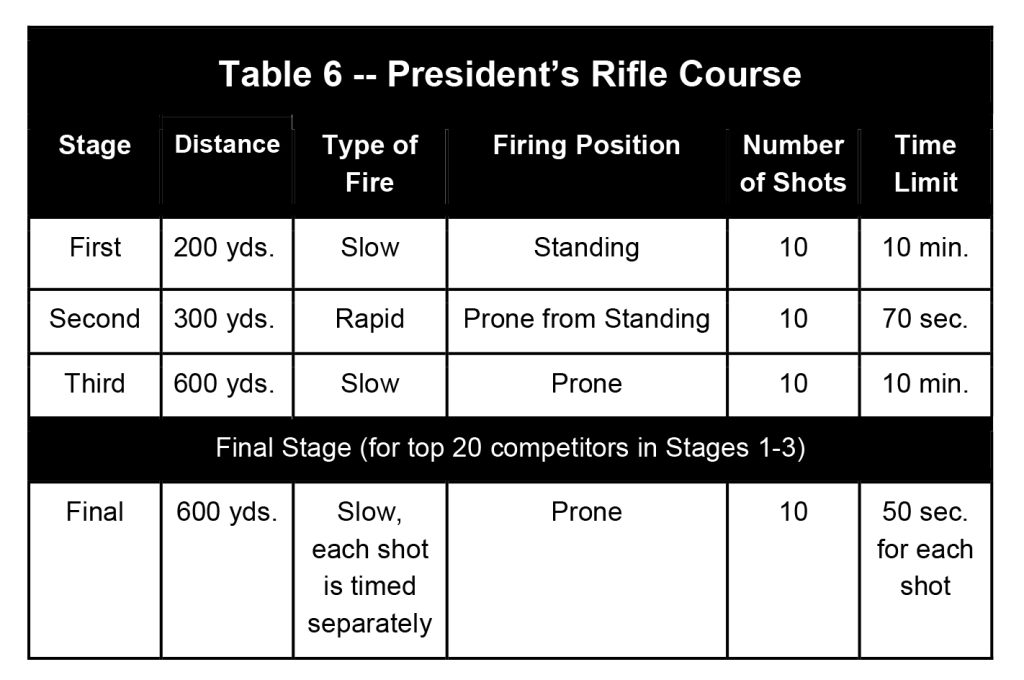
President’s 100 Course of Fire
There is a three-yardage, four-stage Course of Fire for the President’s Rifle Match Course of Fire. Firing is done on the SR target at 200 and 300 yards and the MR target at 600 yards. Scores in stages 1-3 determine the President’s 100 and the final rankings of competitors in 21st place and below. Scores in stages 1-4 determine the match winner and the final rankings in places 1-20. If there is a tie for first place (equal total and X-count), the tied shooters will continue to fire one-shot-at-a-time until the tie is broken. No sighters are permitted in National Trophy Rifle Matches.
Origins of the President’s Match The National Rifle Association’s President’s Match was instituted in 1878, as the American Military Rifle Championship Match. In 1884, the name was changed to the President’s Match for the Military Rifle Championship of the United States. It was fired at Creedmoor, New York until 1891. In 1895, it was reintroduced at Sea Girt, New Jersey. Today, the match is held at Camp Perry, Ohio.
The President’s Match was patterned after the Queen’s Match for British Volunteers. That British competition was started in 1860 by Queen Victoria and the NRA of Great Britain to increase the ability of Britain’s marksmen following the Crimean War.
The tradition of making a letter from the President of the United States the first prize began in 1904 when President Theodore Roosevelt personally wrote a letter of congratulations to the winner, Private Howard Gensch of the New Jersey National Guard.
After a hiatus in the 1930s and 1940s, The President’s Match was reinstated in 1957 at the National Matches as “The President’s Hundred.” The 100 top-scoring competitors in the President’s Match were singled out for special recognition.
E-Targets at 2025 National Matches — Rimfire and Centerfire
After years of testing, the Civilian Marksmanship Program (CMP) will make full use of eTargets at the 2025 National Rifle Matches at Camp Perry, which run July 20 through August 9, 2025. The advanced Kongsberg eTargets will be used at all Highpower rifle matches, National Trophy Rifle competitions, and Rifle Games events. In addition the eTargets will be used for the Rimfire Sporter Match on July 20 and the National Mid/Long Range Matches in August. The use of eTargets eliminates the need for pit duty, drastically cutting down the duration of each match. CLICK HERE to learn more about Camp Perry eTargets.
These matches are conducted by the CMP and Ohio National Guard. Since their inception, the National Matches have become a huge, national shooting sports event with over 4,500 annual participants.
Today’s Sunday GunDay article features modern magnum cartridge types favored by F-Open competitors. These cartridges will soon be in the hands of top F-Open shooters. The 2025 F-Class National Championships commence next week at the Winnequah Gun Club in Lodi, Wisconsin. The Mid-Range Championships run August 2-5, 2025, while the Long Range F-Class Championships start on the 6th and run through August 9, 2025. At the Nationals top F-Open and F-TR shooters are aiming their rifles at 600-yard targets. VIEW 2025 F-Class Nationals Match Program HERE.
2025 NRA F-CLASS NATIONAL CHAMPIONSHIPS
NRA F-CLASS MID-RANGE NATIONAL CHAMPIONSHIP AUGUST 2-5, 2025
NRA F-CLASS LONG RANGE NATIONAL CHAMPIONSHIP AUGUST 6-9, 2025
Event hosted by Winnequah Gun Club and sponsored by Brux Barrels, Criterion Barrels, Krieger Barrels, and Silver Mountain Target.
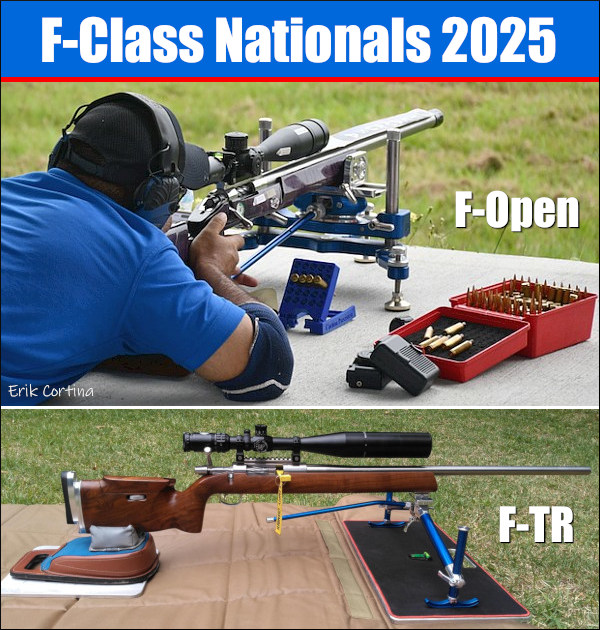
There will be two divisions at The F-Class National Championships: F-Open and F-TR. In F-Open the rifles can shoot any cartridge type (up to .35 caliber) and have a 22-lb (10kg) weight limit. A front rest is allowed, and most shooters favor a rest with a joystick control.
In F-TR, two cartridge types are allowed: .223 Remington (5.56×45) or .308 Winchester (7.62×51 NATO), with no restrictions on bullet weight. F-TR rifles are fired off a bipod attached to the rifle’s fore-end. The F-TR weight limit is 8.25 kilograms, or about 18 pounds. This includes the weight of the rifle, scope, and bipod. A sandbag can be used under the rear of the stock. Because of the lower weight limit, which includes the bipod, F-TR stocks tend to be much slimmer and lighter than F-Open stocks which have wide fore-arms to work with the front rests.
F-Open Cartridge Options — Modern Magnum Options
For Today’s Sunday Gunday Story we feature an article about F-Open chamberings by respected rifle builder and past F-Open National Champion Emil Kovan. In this article, Emil reviews some of the new magnum cartridge options that are being employed by F-Open competitors. Many shooters are still using the .284 Winchester (or variants), but an increasing number are shooting 7mm and .30-caliber cartridges based on magnum cartridge types. The 7mm is probably still the favored caliber for F-Open because 7mm bullets offer great ballistics with less recoil than heavier .30-caliber projectiles.
Cartridges for F-Class Part II — Rise of the Magnums
A few seasons back, I wrote an article on cartridge choices for F-Class shooters. CLICK HERE to READ ARTICLE. Since the first article I wrote, F-Class has continued to grow, and push the limits of precision and accuracy. While the .284 Win and its variants are still the most common F-Open cartridges, more and more top F-Open shooters are using magnum cartridge types to win competitions and set new records. In this article, I will list some of the advantages and disadvantages of the most commonly used magnums, and will cover the strengths and weaknesses of each one of them.
Performance factors we will consider for magnum F-Open cartridges include:
1. Equal or better accuracy than standard chambers
2. Better ballistic performance
3. Enhanced case life
4. Barrel life
Accuracy Potential of Magnum Cartridges for F-0pen Competition
John Meyrs has won four National Mid-Range Championships using the .300 WSM. Tim Vought used the same cartridge to win two Mid-Range Nationals and used a 7-6.5 PRC to win the long range Nationals. Standard .437″ case head (.308 Win head size) cartridges still have more Nationals wins overall, but the magnums are quickly catching up, and my prediction is that magnums will dominate soon.
The accuracy and precision potential of magnums used in F-Class (.300 WSM, 7-270 WSM, 7mm RSAUM or “7 SAUM”, 7-6.5 PRC) is better than non-magnum cartridges because their shapes are closer to the ideal “fat/short” body associated with wider nodes and extreme precision. For example a .300 WSM is proportionally much closer to the 6 PPC, 6 Dasher, and 6 BRA than is the .284 Winchester.
Stunning F-Open rifle with SEB Mini front rest with Blake Machine accessories.
The first thing that comes to mind when magnums are discussed is power and speed. In my humble opinion most shooters are missing out on accuracy because they push their magnums right past the most stable and accurate nodes. Recently I met my good friend from the Army Marksmanship Unit, SFC Brandon Green, at a shooting competition. We discussed the latest and greatest in long-range shooting. I knew that the USAMU had switched from 6.5-284 Norma to 7mm RSAUM several years back, but didn’t know what load they are currently using. Brandon told me that the load featured Berger 180gr hybrids in Nosler cases at 2820 fps. We all know that the 7 SAUM is capable of much higher speeds, “but at around 2820 fps the load/rifle combo will hammer the X-Ring anywhere under any conditions” SFC Green said.
F-Open rifles on the firing line at the Ben Avery Shooting Facility in Phoenix, Arizona.
Most shooters jump right into magnum territory velocities when testing, missing out on better precision at standard chamber speeds. For example, my 30 KMR can easily reach 2880 fps with 230gr Hybrids, and it actually shoots pretty good. But the same rifle at around 2770 fps will absolutely hammer the X-Ring in any condition anywhere. When it’s all said and done, F-Class is a long-range shooting competition at a known distance which requires extreme precision and accuracy. It is not a speed race.
IMPORTANT — Case-Head Dimensions Do Make a Difference
Magnums, when shot within reasonable velocities, on average will give better case life due to the bigger case + lower pressure and “more meat” in the case-head area. For example a 7 SAUM case will outlast a .284 Win case when both are loaded to around 2900 fps.
Disadvantages of Magnum F-Open Cartridges
Perhaps the biggest disadvantage linked to magnums is recoil. Some people complain about developing the “gun shy” syndrome after shooting a magnum for a while. Muzzle blast and recoil are significantly more pronounced in magnums, but that can be easily managed with a properly-built rifle equipped with appropriate recoil mitigation hardware such as RAD and the various butt plates.
F-Open rifle equipped with recoil reduction buttpad system.
Barrel Life — “Barrels are Expendable Components”
It is true that certain magnums can torch a barrel in just a few hundred rounds. But the same is true when improving a 6BR to 6 Dasher for example — barrel life might be reduced significantly. More powder = more heat = diminished accuracy after a certain round count. In my experience, a F-Open magnum’s barrel life is very close to high-performance standard cartridges such as the .284 Shehane or .284 KMR. I “retire” my barrels around 1200 rounds regardless of the cartridge being a magnum or not. After that many rounds most barrels will still shoot OK but will copper up, and you will start seeing those unexplained vertical 9s. The bottom line is this, barrels are expendable components very much like brass. You can’t get the performance of .300 WSM and the barrel life of the .308 Win at the same time. If you want to race in NASCAR, fuel mileage should not be the top priority!
Top Magnum Cartridge Types Used in F-Class Open Division
.300 Winchester Short Magnum
The .300 WSM (Winchester Short Magnum) tops the popularity chart in F-Class Open division. It has been used to win numerous National championships and has set many National records. The .300 WSM’s short/fat case shape, with minimal body taper and 35-degree shoulder, contribute greatly to its outstanding performance at long range. Components are readily available as well. Best brass remains to be Norma, although ADG is just as good and some would even say better, but it is more expensive and harder to get at this time.
The .300 WSM has been described as a “super-sized Dasher”.
For the .30-cal magnums, in my opinion, the best bullets by far are made by Berger. If your rifle does not shoot 215gr, 230gr hybrids, or 210gr VLDs well, you likely have a rifle problem, NOT a bullet issue. My “go to” bullet is the Berger 230gr Hybrid. The 215-grainer is a close second, followed by Berger’s accurate but ballistically inferior 210gr VLD, which I use in calm and steady conditions.
Top powders for the .300 WSM are Hodgdon H4831SC and H4350. I know there are many more powders suitable for the .300 WSM cartridge, but none I have used can match Hodgdon’s consistency when shot in different geographical locations and weather conditions.
7mm Remington Short Action Ultra Magnum
The 7mm RSAUM (aka 7 SAUM) used to be the darling of F-Open. Its case capacity and shape are about perfect for launching 180gr pills with great ballistics and precision. Its popularity faded a little, due to the lack of good brass, and the rise of the improved versions of the .284 Win which can almost match the RSAUM performance. Norma still makes 7 RSAUM brass which is pretty good but little on the soft side and hard to find. ADG is arguably producing the best RSAUM brass right now. It is very uniform, reasonably priced, and seems to hold up very well even when pushed hard. The best bullets are again made by Berger, and those are the 180gr hybrid, 184gr hybrid, and 180gr VLD. Best powders are H4831sc, H4350, and Alliant Reloder 16 and Reloder 23.
7-270 WSM, 7-300 WSM, and 7 WSM
The first two are pretty much identical, the only difference being that the 7-270 WSM is necked up .270 WSM while the 7-300 WSM is a .300 WSM necked down to 7mm. I personally prefer the first one since necking-up is easier than necking-down (with fewer doughnut issues).
The WSM case-based 7mms will give you great velocity flexibility as well as superb precision when tuned well. In the 2013 world championship in Raton NM, I was scoring for a gentleman from Canada who was shooting 7-270 WSM. The wind was blowing pretty hard that day. On one of his shots, just before he pulled the trigger the wind gusted. I remember thinking that’s going to be an 8 for sure. The target came up a line 10! I asked him after the match what he was shooting, and he replied 180s at 3100fps. Although capable of such speeds, I think that potentially better and more consistent accuracy can be achieved at much slower speeds. The best powders and bullets are again Hodgdon and Berger respectively. Best cases are made by Norma and ADG, with Winchester being a third option.
7-6.5 PRC — Popular Wildcat
Last but not least on our chart is the 7-6.5 PRC. This particular cartridge is actually a wildcat. It is a 6.5 PRC necked up to 7mm. It is pretty much identical to the 7 RSAUM with the only differences being a shorter neck and .01″-narrower body. Currently the 7-6.5 PRC is the most requested cartridge that I offer when building new rifles. It seems to fill the gap between the .284 Win and the larger magnums very nicely. It is capable of reaching 3000fps but most shooters are getting their best results around 2920-2950 fps. The biggest advantage of this wildcat is brass. Lapua makes super high-quality, readily-available 6.5 PRC brass. Best powders are H4831sc, H4350, Reloder 16, and Vihtavuori VV 555. The best bullet in my opinion is the 180gr Berger. I am yet to hear about a better-performing bullet in this chamber.
Conclusion In conclusion, magnums are not perfect but their performance advantages should be very seriously considered when building a rifle for long-range F-Class. In part three, I will list the most common wildcat magnums, and present the KMR magnums which will make you (if you haven’t already) buy a magnum action and get a magnum build for sure!
– 2014 F-Class Open National Champion
– 2015 F-Class Open National Championship, Silver Medal
– F-Class Open National Championship Teams, 2015, 2014, 2013, Shooting Team Member
– Over 15 wins in Regional and State Championships in Palma, F-TR, F-Open
– 2013 U.S. National Team Member
– 2023 F-Open Gold Medal Team USA Member, 2023 World Championship in South Africa
In the archives of The First Shot (the CMP’s Online Magazine), SGT Walter E. Craig of the USAMU discusses physical conditioning for competitive shooters, particularly High Power competitors. Fitness training is an important subject that, curiously, is rarely featured in the shooting sports media. We seem to focus on hardware, or esoteric details of cartridge reloading. Yet physical fitness also matters, particularly for High Power shooters. In his article, Craig advocates: 1) weight training to strengthen the Skeletal Muscle System; 2) exercises to build endurance and stamina; and 3) cardiovascular conditioning programs to allow the shooter to remain relaxed with a controlled heart beat.
SGT Craig explains: “An individual would not enter a long distance race without first spending many hours conditioning his/her body. One should apply the same conditioning philosophy to [shooting]. Physical conditioning to improve shooting skills will result in better shooting performance[.] The objective of an individual physical training program is to condition the muscles, heart, and lungs thereby increasing the shooter’s capability of controlling the body and rifle for sustained periods.”
In addition to weight training and cardio workouts (which can be done in a gym), SGT Craig advocates “some kind of holding drill… to develop the muscles necessary for holding a rifle for extended periods.”
For those with range access, Craig recommends a blind standing exercise: “This exercise consists of dry-firing one round, then live-firing one round, at a 200-yard standard SR target. For those who have access only to a 100-yard range, reduced targets will work as well. Begin the exercise with a timer set for 50 minutes. Dry-fire one round, then fire one live round and without looking at the actual impact, plot a call in a data book. Continue the dry fire/live fire sequence for 20 rounds, plotting after each round. After firing is complete, compare the data book to the target. If your zero and position are solid, the plots should resemble the target. As the training days add up and your zero is refined, the groups will shrink and move to the center.”
Fitness training and holding drills help position shooters reach their full potential. Here is 6-Time U.S. National Long Range Champion John Whidden.
Training for Older Shooters
Tom Alves has written an excellent article A Suggested Training Approach for Older Shooters. This article discusses appropriate low-impact training methods for older shooters. Tom explains: “Many of the articles you will read in books about position shooting and the one mentioned above are directed more toward the younger generation of shooters in their 20s. If you look down the line at a typical high power match these days you are likely to see quite a few folks who are in their middle 30s and up. Many people in that age range have had broken bones and wear and tear on their joints so a training program needs to take that into account. For instance, while jogging for an extended period for heart and lung conditioning may be the recommended approach for younger folks, it may be totally inappropriate for older people.”
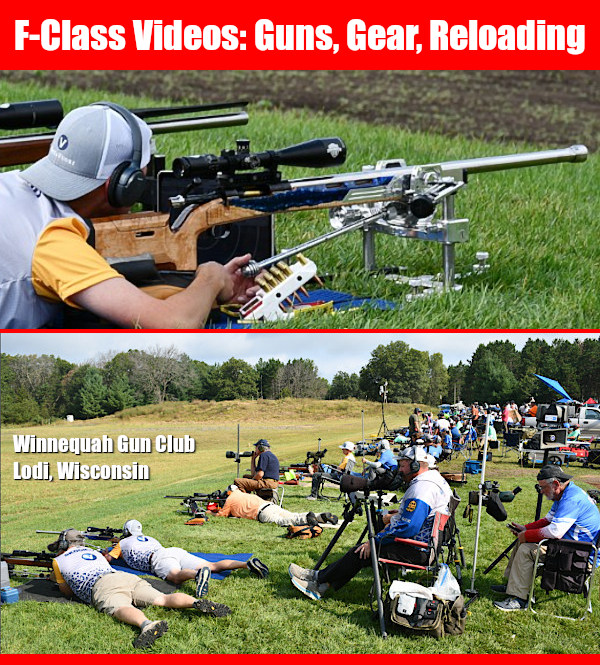
Today’s Saturday movie showcase features eight videos about F-Class marksmanship, gear selection, and reloading methods. The 2025 NRA F-Class National Championships take place next week at the Winnequah Gun Club range in Lodi, Wisconsin. The F-Class Nationals start on August 2nd and run through August 9th. There are two divisions: F-Open and F-TR. The F-Class Championships have two segments, Mid-Range and Long Range. The Mid-Range competition runs August 2-5, while the Long Range competition is scheduled for August 6-9. Competitors can register for the 2025 F-Class Nationals through the NRA Shooters Portal. Learn more about the range at Winnequahgunclub.org.
WICKED WINDS — At Ben Avery with 18-30 mph Winds
Long-range F-Class shooters will tell you that the winds can be the biggest challenge in a match. And things can get pretty wild at times as the Ben Avery range in Phoenix, site of the 2022 NRA F-Class National Championships. In this video, shooters fight through extremely strong 18-30 mph winds at 600 yards. In these kind of extreme conditions, a major unexpected gust can send your bullet off-target.
Wind-Reading for Long-Range Competition
In this excellent video Keith Glasscock, who has finished second overall at multiple F-Class Nationals, explains how to read the wind and even predict wind changes in cycling conditions. Keith notes that you should look at environmental features and mirage, not just wind flags. Keith is one of America’s best wind gurus — he was a team wind coach and he has finished second three times in F-Open division at the F-Class National Championships.
F-0pen rifle at the Berger SW Nationals at the Ben Avery Shooting Facility in Phoenix, AZ.
Load Development Procedures for F-Class — Seating Depth
In this video, 2023 NRA Mid-Range National Champion John Masek (aka “F-Class John”) explains how he does load development in an efficient and reliable manner. He specifically focuses on testing for optimal seating depth. With 318,000 views, this is the most-watched video on F-Class John’s popular YouTube channel. Viewers have praised this video: “This was a great video, really appreciate the explanation about how you bracketed the jump and why you chose the closest.”
Front Rest Options for F-Open (and Benchrest) Competition
If you are shopping for a front rest, definitely watch this comprehensive 42-minute video from start to finish. This is probably the most informative video about premium shooting rests available on YouTube. Top F-Class shooter and video-maker F-Class John covers a wide selection of front rests, with some observations about coaxial bipods as well. John covers the impressive new SEB NEO-X, the easy-to-transport SEB Mini-X, the excellent Rodzilla Rest, the innovative 21st Century Hybrid Rest, the sleek Italian Lenzi Rest. At the end of the video John reviews the very affordable Caldwell Fire Control Rest ($269.99 on Amazon), explaining how it can be a decent choice for shooters on a limited budget.
Reloading for F-Class — Interview with Erik Cortina
In this Precision Rifle Network video, Erik Cortina of Team Lapua-Brux-Borden covers the reloading process for his F-Class rifle. All phases of reloading are noted — brass prep, annealing, primer seating, precision powder measuring (to the kernel), and bullet seating. Erik also talk about load testing and use of barrel tuners. Erik produces the EC Barrel Tuner which is used by many top competitors.
Trigger Trio — Evaluation of Three Trigger Types for F-Class Rifles
In this video, F-Class John evaluates three triggers that are popular with F-Class competitors: Bix’N Andy, Flavio, and TriggerTech Diamond. John talks about the pros and cons of each trigger type and offers advice for mounting and pull-weight adjustment. The Italian Flavio triggers are sold by Bruno Shooters Supply, Bix’N Andy triggers can be purchased from Bullet Central, and the TriggerTechs are offers by MidwayUSA and Area 419.
F-Class Shooting at Bisley Range in the United Kingdom
F-Class competition is popular around the world, and the UK is a major center of F-Class shooting in Europe. The Bisley range is justly famous, with a long heritage of shooting competitions. This video features the European F-Class Championship held at Bisley in 2015.
Building a Modern F-Open Stock for Competition
In this video, our friend F-Class John explains the process for building two custom laminated stocks for his F-Open rifles. John selected handsome, highly-figured African hardwoods, which were then laminated into layers with purple-tinted heart-wood and dark Wenge wood stringers in the middle. The stock-maker then sliced the wood into layers (1:02) and then glued the layers together (1:40). After final cutting, the stocks are shown at 2:00, and then the video shows how the stocks received their final finish. Both stocks are fitted with the R.A.D. recoil-reduction system. See the bedding at 19:00 and the fully finished rifles at 19:12 with barreled actions fitted.
Here is another beautiful F-Open stock, on the firing line at Ben Avery, Arizona with a SEB Mini front rest. Note the metal side-bars on the front of the forearm. These metal fittings extend the stock’s “wheelbase” while also lowering the rifle’s center of gravity.
Are you looking to get started in PRS and NRL practical precision rifle competition? Or perhaps you’d like to advance your skill set so you can place higher in big matches (and get your hands on those prize table items)? Of course there is no substitute for trigger time in the field, but there ARE some great print resources. These four books can help you select the right equipment, improve your shooting skills, make better wind calls, increase your fitness, and develop a more efficient between-match training program.
1. Precision Rifle Marksmanship: The Fundamentals
Frank Galli, $21.13 Paperback, $20.07 Kindle
Frank Galli (aka “LowLight”) is the founder/head honcho of SnipersHide.com, the most active tactical community on the internet. Galli is also a retired USMC scout-sniper. Practical Precision Rifle shooting is one of the hottest trends in competitive shooting today. PRS and NRL matches draw big turn-outs and boast impressive prize tables. Galli’s Precision Rifle Marksmanship (#ad) book covers the fundamentals of precision marksmanship with easy-to-understand methodology. The book uses the same instruction process that Galli uses in his live marksmanship classes.
As Sniper’s Hide guru Frank Galli explains, there is no voodoo when it comes to precision rifle marksmanship, but there are techniques that, when practiced, make the difference between good marksmanship and great marksmanship. Understanding the reasons that a bullet hits or doesn’t hit its intended target at ultra-long distances is a crucial element to learning. Galli’s explanations of how to understand and compensate for wind speed and direction are excellent — great wind-reading advice.
Published in 2020, this 272-page well-illustrated book covers the latest equipment (scopes, LRFs, chassis systems, mags, bags, bipods, tripods) favored by tactical competitors in PRS/NRL type matches.
2. Long Range Shooting Handbook
Ryan Cleckner, $24.95 Paperback, $9.99 Kindle
Ryan Cleckner’s Long Range Shooting Handbook (#ad) is the best-selling modern book on practical rifle skills. A former U.S. Army sniper instructor, Cleckner is knowledgeable, and his text is well-organized and chock full of good information. You can view Sample Chapters on Amazon.com.
Ryan Cleckner’s highly-regarded Long Range Shooting Handbook is designed as an intro to important fundamental concepts such as MOA vs. Mils, External Ballistics, and Environmental Effects. Included are personal tips and advice based on Cleckner’s years of experience as a sniper instructor.
The Long Range Shooting Handbook is divided into three main categories: What It Is/How It Works, Fundamentals, and How to Use It. “What It Is/How It Works” covers equipment, terminology, and basic principles. “Fundamentals” covers the theory of long range shooting. “How to Use It” gives practical advice on implementing what you’ve learned, so you can progress as a skilled, long range shooter. This book will benefit any long-range shooter, not just PRS/NRL competitors.
3. IMPACT! — Training and Preparing for Precision Rifle Matches
Rodney Maze, $14.99 Paperback, $4.99 Kindle
Impact!, by PRS competitor Rodney Maze, is an entry/intermediate level guide to preparing yourself and your equipment to compete in precision rifle type matches. It will also benefit anyone looking to learn about practical-style long range and precision shooting. We recommend you check it out for yourself — there are 20 Pages of free sample content (#ad) on Amazon. Topics covered include:
— Rifle, optic, and equipment selection
— Setting up your rifle, bags, tripods for PRS/NRL matches
— Understanding ballistics and how to record and use ballistic data
— Techniques for using holdovers for multi-target stages
— Gun skills, rapid fire techniques, clearing malfunctions
— Shooting off of barricades, and specialty stages
— Effects of wind and how to improve your wind calls
— Tips for live fire and dry fire practice
— Preparing yourself and your equipment for a match
— Mental strategies and techniques
Impact! is illustrated with plenty of photographs. Topics are divided logically, and concepts are explained in clear language. Also included is an extensive glossary of terms used in precision shooting and a list of additional resources you can use to further pursue your precision shooting knowledge. This book also includes a handy Appendix with formatted pages for recording data about your rifle, scope, and ammunition. There is also a Wind table for recording your rifle “dope” and wind hold-offs. Lastly, Impact! has a useful table of unit conversions.
4. Practical Shooter’s Guide
Marcus Blanchard, $19.98 Paperback, $9.99 Kindle
Thinking of getting started in the Practical/Tactical shooting game? Looking for ways to be more stable when shooting from unconventional positions? Then you may want to read Marcus Blanchard’s Practical Shooter’s Guide (A How-To Approach for Unconventional Firing Positions and Training) (#ad). Unlike almost every “how to shoot” book on the market, Blanchard’s work focuses on the shooting skills and positions you need to succeed in PRS matches and similar tactical competitions. Blanchard provides clear advice on shooting from barricades, from roof-tops, from steep angles. Blanchard says you need to train for these types of challenges: “I believe the largest factor in the improvement of the average shooter isn’t necessarily the gear; it’s the way the shooter approaches obstacles and how they properly train for them.”
As an Amazon affiliate, this site can earn revenues through sales commissions.
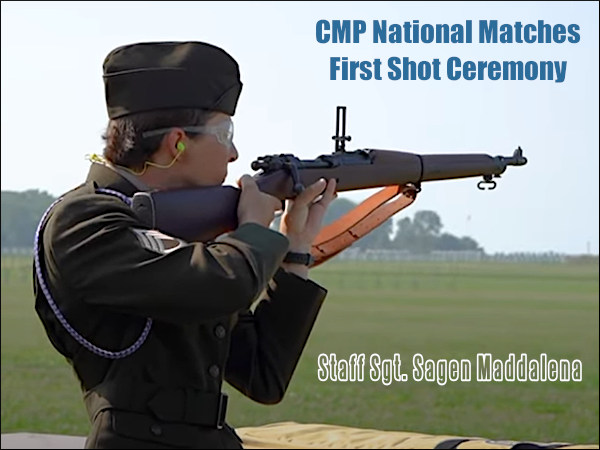
SSG Sagen Maddalena fired the ceremonial first shot with a 1903 Springfield rifle, officially opening the CMP National Matches for the 2025 season.
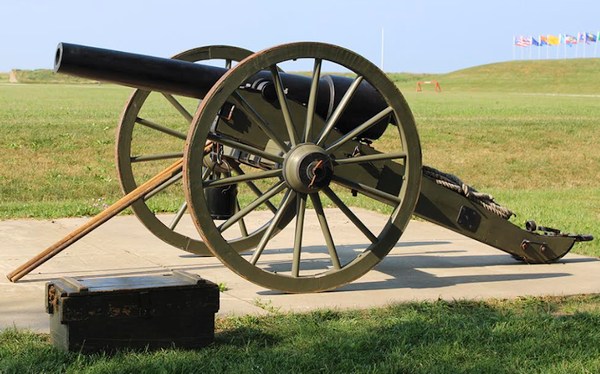
On July 14, 2025 the Civilian Marksmanship Program (CMP) hosted the annual First Shot Ceremony, the traditional start to the CMP National Matches. The CMP welcomed back an accomplished USAMU shooter who earned the Silver Medal at the Olympics. As visitors arrived, the 122nd Army Band played in the plaza. Then a wheeled cannon gave multiple blasts. Above the crowd, a U.S. Army Air Corps Mitchell B-25 bomber and a U.S. Navy Grumman TBM Avenger fighter-bomber flew overhead.
Emcee Christie Sewell, CMP Chief Programs Officer, introduced notables including CMP Director of Civilian Marksmanship Emeritus, Gary Anderson. After brief remarks from CMP’s Board Chair/CEO, Jerry O’Keefe, Sewell introduced the 2025 honorary First Shot Speaker, Staff Sgt. (SSG) Sagen Maddalena of the U.S. Army Marksmanship Unit.
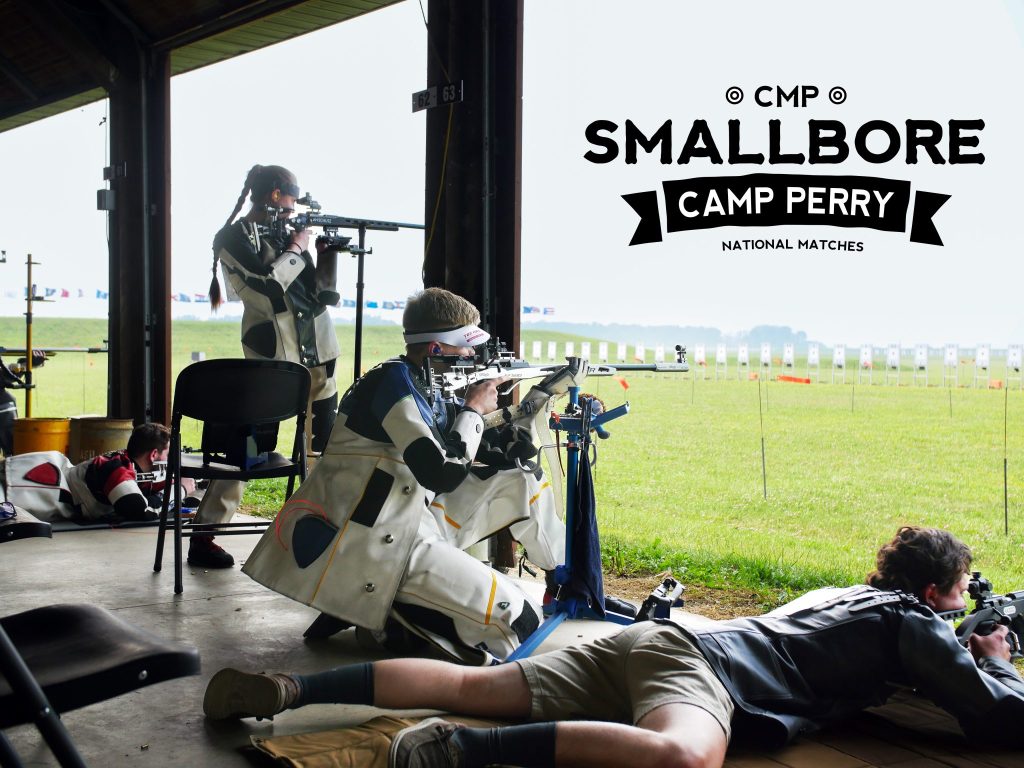
SSG Maddalena — currently the number-one-ranked 50-meter smallbore athlete in the world — had some of her earliest successes at Camp Perry as a junior before earning a Silver medal at the 2024 Paris Olympic Games in the women’s 50-meter 3P rifle event. She began as a junior in a California 4-H .22 rifle program and moved on to the California Grizzlies service rifle team. As a teen with the Grizzlies she earned a Distinguished Rifleman badge in 2011.
Then she became a member of the Alaska Fairbanks rifle team. She went on to become an eight-time All-American. In 2019, she enlisted in the U.S. Army and was assigned to the U.S. Army Marksmanship Unit.
In 2023, she earned a gold medal and set a new world record in the women’s team 50-meter rifle three-position event at the 2023 ISSF World Championships. She went on to add another two gold medals in the women’s 50-meter smallbore rifle and 10-meter air rifle events at the 2024 CAT Games in Argentina. That performance secured her place on the 2025 U.S. Olympic Team.
At the First Shot ceremony, Sagen thanked the community and all those who helped to make the National Matches a success: “Let us give it our best in competition and treat each day as a new opportunity to challenge ourselves and to excel.”
CMP National Matches Schedule and Details
The 2025 CMP National matches at Camp Perry commmenced on July 6th and run through August 9, 2025. The National Matches are open to the public and have offered a wide range of events and matches since 1907. Held annually at Camp Perry, the National Matches include a wide range of events for rimfire rifles, centerfire rifles, and pistols. Listed below are event by category. Click on each discipline below for registration information, detailed match program, and schedule.
These matches are conducted by a partnership of the CMP and Ohio National Guard. Since their inception, the National Matches have become a huge national shooting sports festival with over 4,500 annual participants including many of the world’s best marksmen.









 The National Rifle Association’s President’s Match was instituted in 1878, as the American Military Rifle Championship Match. In 1884, the name was changed to the President’s Match for the Military Rifle Championship of the United States. It was fired at Creedmoor, New York until 1891. In 1895, it was reintroduced at Sea Girt, New Jersey. Today, the match is held at Camp Perry, Ohio.

 There will be two divisions at The F-Class National Championships: F-Open and F-TR. In F-Open the rifles can shoot any cartridge type (up to .35 caliber) and have a 22-lb (10kg) weight limit. A front rest is allowed, and most shooters favor a rest with a joystick control.


 In conclusion, magnums are not perfect but their performance advantages should be very seriously considered when building a rifle for long-range F-Class. In part three, I will list the most common wildcat magnums, and present the KMR magnums which will make you (if you haven’t already) buy a magnum action and get a magnum build for sure!
 In the archives of