There’s a good episode of Shooting USA TV this week, featuring the Rimfire Challenge World Championships. This major match attracts hundreds of competitors from around the nation. It’s fast and fun with instant feedback from ringing plates indicating hits. The Rimfire Challenge Championships is family-friendly event that’s great for all skill and experience levels. This week Shooting USA will also feature two dozen new-for-2020 products, including new pistols, rifles, shotguns, optics, holsters, and more.
Shooting USA airs Wednesday 9:00 PM Eastern and Pacific, 8:00 PM Central on Outdoor Channel. You can also watch Shooting USA any time online via Vimeo.com.
The Rimfire Challenge World Championships
The Rimfire Challenge is just about the most fun you can have with .22 LR pistols and rifles. The Rimfire Challenge Championship drew 250 competitors to the Old Fort Gun Club in Arkansas. The competition is similar to the Steel Challenge, but a lower cost, family-friendly rimfire only event. And the steel target set up is different each time, with competitors only knowing how many targets to shoot, and in what order, when they step to the shooting box.
This Rimfire Challenge Championship featured 16 stages — 8 for pistol, 8 for rifle. On each stage, shooters engage 5, 6, or 7 targets, in five separate strings of fire, with the best four runs counting for record.
NSSF Rimfire Challenge Basics
The Rimfire Challenge is a two-gun event so you need a rifle and a handgun (either a semi-auto pistol, or revolver). There are two divisions: 1) Open — Any firearm (pistol or revolver in handgun class) with scopes, optical sights, light gathering scopes, battery powered optics or lasers; and 2) Limited — Pistols and rifles with iron sights, adjustable metallic sights, and/or fiber optic. Bolt-action rifles and lever-action rifles are allowed, but self-loading (semi-auto) rifles are most popular because they can shoot quickly.
Many different stage designs can be employed at Rimfire Challenge matches. Shown above are two examples from the Rimfire Challenge Suggested Courses of Fire.
New-for-2020 Products Also Featured this Week
Shooting USA has assembled many of the new products which were to be unveiled at the NRA Annual Meetings in Nashville, Tennessee. Unfortunately that Nashville NRA event was cancelled due to the pandemic (there will be a smaller NRA Annual Meeting in Tucson, Arizona, October 24, 2020). Jim and John Scoutten review two dozen products that were going to be showcased at the NRA event in Nashville. Here are four of the new products reviewed in this episode:
Shooting USA is available On Demand via Vimeo.com. Watch a single episode for $0.99, or get a full-month subscription for $3.99 and watch as many shows as you like with limited commercial interruptions.
This SunDay GunDay story features a stunning rifle constructed as a raffle prize to benefit Team USA members who will be traveling to South Africa in 2021 for the upcoming F-Class World Championships. Raffle tickets purchased for this F-Open rig, as well as two other rifles, will help defray expenses for Team USA members, both adults and juniors. Along with the stunning F-Open rifle featured here, there are two other great prizes: A KW Precision-built .308 Winchester F-TR rifle with Borden Rimrock action, and a Kelbly Koda Rifle in 6.5 Creedmoor with Nightforce scope.
.284 Shehane F-Open Prize Rifle with Superb Components
Report by Katie Blankenship
This eye-catching F-Open rifle was crafted by Blake Barrel and Rifle in Arizona. This prize rifle features all top-of-the-line components: Borden BRMXD Action, Cerus multi-laminate stock with forearm extension, R.A.D. recoil reduction system (hydraulic-damped buttpad), Bix ‘N Andy trigger, and Nightforce Competition scope. The stainless Blake barrel is chambered for the .284 Shehane wildcat, and sports an F-Class Products tuner on the end.
If you like this rifle, you can participate in a Team USA Contest with a chance to win this beauty. Team USA is running a raffle that supports all three divisions of the United States F-Class Team: F-Open, F-TR, and Under-25. After each member sells $250 dollars worth of tickets, the proceeds go into individual accounts to pay for trip expenses such as air travel, hotel, food, entry fees, uniforms, ammunition, and other costs.
The prize drawings will be held at Ben Avery Range in Phoenix, AZ in November 2020. All winners must comply with all Federal and State laws in order to take possession of firearms. $2,500 may be awarded in place of firearm. Entrants do not need to be present to win. Winners will be announced after confirmation of legal eligibility and with consent of the winner. Raffle tickets cost $10.00 each or you can get three tickets for $25.00. CLICK HERE for prize raffle details.
About the Under-25 F-Class U.S. Rifle Team
My sister Kaycie and I are both on the Under-25 United States F-Class Team. We both started out shooting F-Class on the Wickenburg High School Rifle team. I started in 2012 while Kaycie started in 2015. We went from using loaner guns with Wickenburg to shoot the F-Class sport, to now having a couple generous sponsors and making the Under-25 United States Team.
The raffle is for three different rifles. The one featured here is the sponsored F-Open rifle built by Blake Barrel and Rifle. For this special rifle, I was actually involved in the build process at Blake Machine in Phoenix, Arizona, where I work.
How Sisters Katie and Kaycie Got Involved in Rifle Competition
Kaycie and I grew up in a family that spent a lot of quality time together in the outdoors — hunting, shooting, and fishing. With my passion for hunting (inspired by my Dad), I wanted to further my shooting skills. So, I decided to join Wickenburg High School’s Rifle Team coached by Rex Powers. Upon joining, since I was a small, 90-lb girl, some people thought I would never be a top competitor on the team — not able to compete with the bigger boys on the team. But within my freshman year of high school I was the team’s top shooter and held that spot all 4 years of high school. I developed a passion for F-Class shooting. After graduating from HS, I continued to assistant-coach the team and compete in local matches. My sister Kaycie accompanied me in 2015 and also found a love for the sport. Now a senior in high school, Kaycie is still shooting with the high school team, while earning a sport on the Under-25 U.S. F-Class Rifle Team.
What Katie Likes about F-Class Competition
F-Class shooting has given me the opportunity to meet many influential people, to travel, and to work in a specialized job that I love. This sport has taught me patience, attention to detail, and discipline. And that, in turn, has had a positive impact on many other areas in my life. Kaycie and I’ve have also met many other junior shooters who have become great friends. It’s great to have that camaraderie at matches. The community behind this sport includes many very generous people with tons of knowledge — there is such a healthy competitive atmosphere at the range.
How Young Shooters Can Get Started in F-Class
If you are interested in F-Class we highly suggest going to your local range and watching an F-Class match being held. There are so many people willing to provide knowledge and guidance to help you get started in the sport and join the fun!
The Bryan Blake Connection — How He Helps Young Shooters
I met Bryan Blake (Blake Barrel and Rifle) in early 2018 at a local mid-range Championship. At the time I was shooting a 6.5×47 Lapua with a shot-out barrel and was just there for fun, knowing my scores would be low. Bryan loaned me one of his rifles for a string and offered to loan me a gun for the upcoming October State 600-yard championships. Since then I now have my own F-Class rifle build by Blake Barrel and Rifle and now work for Bryan’s family-owned business. Bryan has helped raise my shooting to the next level with his knowledge of the sport and his dedication to encouraging young competitors.
Get Rifle Prize Raffle Tickets to Support Team USA
Team USA Raffle Prize Drawing will take place in November 2020.
Kaycie and I are proud to represent our country in the 2021 F-Class World Championships. We appreciate your support for F-Class Team USA by purchasing raffle tickets. You can purchase tickets on the webpage linked above. NOTE: When tickets are purchased through that page, the funds will go directly towards travel expenses Kaycie and I will incur going to the 2021 World F-Class Championships.
The photo shows John Whidden, 5-time National Long Range HP Champion (2007, 2008, 2010, 2016, 2017). John exemplifies the traits of a great competitor — he is always positive, he knows how to handle pressure, and he always looks for ways to improve.
In the archives of On The Mark magazine, DCM Emeritus Gary Anderson, an Olympic Gold medal-winning shooter in his younger years, offers sage advice for competitive shooters.
In his article Ten Lessons I Wished I Had Learned as a Young Shooter, Anderson provides ten important guidelines for everyone involved in competitive shooting. Here are the Ten Lessons, but you should read the full article. Anderson provides detailed explanations of each topic with examples from his shooting career.
LESSON 1 – NATURAL ABILITY WILL NOT MAKE YOU A SHOOTING CHAMPION.
(You also need hard work, training effort and perseverance.)
LESSON 2 – ANGER IS THE ENEMY OF GOOD SHOOTING.
(The key to recovering from a bad shot is to stay cool, no matter what happens.)
LESSON 3 – BAD SHOTS CAN TEACH YOU MORE THAN GOOD SHOTS.
(Today, error analysis is one of the most powerful tools for improving scores.)
LESSON 4 – NEVER GO WITHOUT A SHOT PLAN.
(A shot plan is a detailed breakdown of each of the steps involved in firing a shot.)
LESSON 5 – PRACTICE IN BAD CONDITIONS AS WELL AS GOOD CONDITIONS.
(Most competitions are fired in windy conditions or where there are plenty of distractions.)
LESSON 6 – CHAMPIONS ARE POSITIVE, OPTIMISTIC PEOPLE.
(Negative shooters expect bad results; positive shooters expect to train hard to change bad results.)
LESSON 7 – IT’S NOT ABOUT WHETHER YOU WIN OR LOSE.
(It’s about how hard you try to win.)
LESSON 8 – YOUR DOG WON’T BITE YOU AFTER SHOOTING A BAD SCORE.
(Hopefully your coach, parents and friends won’t bite you either.)
LESSON 9 – YOUR PRESS CLIPPINGS CAN HURT YOU OR HELP YOU.
(Winning can go to our heads. We start thinking we are so good we don’t have to work hard any more.)
LESSON 10 — YOU NEVER SHOT YOUR BEST SCORE.
(Great champions are always looking for ways to improve.)
USAMU shooters on the firing line at the Wa-Ke’-De outdoor range in Bristol, IN. Photo courtesy USAMU.
About Gary Anderson Gary Anderson served as the Director of the Civilian Marksmanship Program (CMP) from 1999-2009, and is now DCM Emeritus. As a Nebraska farmboy, Gary grew up hunting and shooting. Dreams of winning an Olympic Gold Medal in shooting led Gary to the U.S. Army. In 1959, he joined the elite U.S. Army Marksmanship Unit. Just two years later, he won his first national championship.
At the 1962 World Shooting Championships in Egypt, Anderson stunned the shooting world by winning four individual titles and setting three new world records. At the 1964 Tokyo Olympics, Gary won the 300m free-rifle Gold Medal, setting a new world record in the process. At the 1966 World Shooting Championships in Germany, Anderson won three additional world titles. At the 1968 Olympics, Gary won a second gold medal in the 300m free-rifle event.
After his “retirement” from international competition, Gary competed in the National High Power Championships, winning the President’s National Trophy in 1973, 1975 and 1976. Over his competitive career, Anderson won two Olympic Gold Medals, seven World Championships, and sixteen National Championships. He is unquestionably one of the greatest American marksmen ever.
The Civilian Marksmanship Program has announced the cancellation of the Oklahoma CMP HP Rifle & CMP Games Matches due to considerations brought on by the COVID-19 virus. The event was scheduled for 12-18 October at the Oklahoma City Gun Club in Arcadia.
All OK Games Events Will Be Cancelled
The CMP had planned a full slate of events in Oklahoma, including CMP Games rifle, EIC service rifle, multiple pistol matches, M1 Garand, vintage sniper rifle, rimfire sporter rifle, and testing of a new benchrest M1 Garand rifle discipline.
“In seeking a sense of normalcy in its marksmanship event schedule for the balance of 2020, the CMP was looking forward to conducting match activities in Oklahoma,” said Judy Legerski, CMP Board Chairman. “Unfortunately, recent flare-ups of the COVID-19 virus have prompted us to cancel the event in the best interest of our competitors, Oklahoma City Gun Club staff and CMP personnel,” she said.
“We look forward to renewing our Oklahoma rifle and pistol match series in brighter times in 2021,” Mrs. Legerski said. The next scheduled CMP highpower, pistol and games event, the Talladega 600 conducted at the CMP’s marksmanship park near Talladega, Alabama, is planned for 16-22 November.
The CMP continues to follow prudent health practices and is monitoring conditions of all future event locations. Event cancellations will be announced by the CMP on www.TheCMP.org and through social media.
2020 IBS 1K Nationals at Vapor Trail Range in Missouri
Report by Jim Bauer
“COVID Nationals” — That’s an unusual description for the IBS 1000-Yard Nationals, but it has been a very unusual year. On September 5th and 6th, 2020, Vapor Trail Valley Range held the IBS 1000-Yard National Benchrest competition. This year 63 shooters attended the event. While down from last year, that’s a good number considering the last-minute venue change. The IBS has worked hard this year to secure ranges where members can shoot and compete.
Vapor Trail Steps Up to Host 1K Nationals
When it appeared that holding the IBS 1K National event in North Carolina wasn’t going to be possible due to COVID-19 restrictions, Tom Jacobs, owner/operator of the Vapor Trail Valley Range in Spickard, Missouri stepped up. Along with Sara and Rory Jacobs, the Vapor Trail team accept the challenge of running a major National event. With only two months to prepare, the Jacobs hosted an outstanding event.
The precision with which this event was handled was impressive. Vapor Trail installed additional target frames to accommodate the larger attendance. A large TV screen streamed the scores, groups, relay winners and shooter positions as targets were measured. The Target Crew, managed by Sary and Rory Jacobs, had complete relay target changes done in less than five minutes. Tom Jacobs orchestrated the match from his newly constructed “Command Center” in the middle of the Firing Line and not once was there any confusion or time lost due to Shooter or Management Issues. Vapor Trail also supplied a BBQ lunch for all on Saturday and a ribeye steak lunch on Sunday. Nobody worried about going hungry.
This monitor showed immediate updates as the relays were scored. Jim Bauer notes: “it was really nice to see the scoring as it happened”.
Impressive Line-Up of 1000-Yard Competitors
The competition at this match was as tough as it gets. Competitors included IBS Long Range record-holders Mike Wilson, Tom Mousel, Bart Sauter, and Andy Ferguson. Past National Champions on hand included Glen Sterling Jr., Richard Schatz, Jason Walker, Glenn Hiett, and Carrol Lance. If you won a championship this year, you earned it. New IBS National 2-Gun 1000-Yard Champion Allan Carmichael can be very proud of his accomplishment this year.
Match Started with Good Conditions, But Then Got Tough on Day 2
Day one started off with good weather and mild wind conditions, allowing some impressive groups and scores. Then, in typical Vapor Trail fashion, the wind started to shape the results. At the end of Day One, two of the three Light Gun (LG) relays had been shot and one of three Heavy Gun (HG) relays were completed. The second day menu was to start with a HG relay, finish the Light, followed by the third and final Heavy Gun relay.
30 to 40 MPH winds at End of Day 2
On Day Two, the first HG session had relatively nice conditions, but then things got interesting. The south wind, a head wind at Vapor Trail, had a steady increase all day. By the time the Light Guns started to shoot again the wind was 15 mph plus with a switch from head on to a quarter in from the southwest. Groups and Scores opened up and the leader board had many unpredictable changes.
After the Light Guns were done, the Heavies stepped up for the final Relay sequence. The wind started to howl with peak velocities in the 30-40 mph range. If you were one of the unlucky Heavy Gun shooters in that final HG Relay on Day Two, it was tough. Over half of the shooters on the line DQ’d in a couple of target sequences (sub-sets of final relay). The shooters watched the wind flip over clay targets, laying on the berm, used in the sighter period. When all was said and done, due to the high winds, approximately 40% of the competitors DQ’d during the match at some point.
Top Competitors, left to right: Jason Boersma (HG Score + Overall), Glenn Hiett (HG Group), Allan Carmichael (2-Gun Champion), Jim Bauer (LG Group, Score, + Overall), and two of Jim’s grandsons.
When the match was over and the wind quit blowing us around, the winners were announced. For the prestigious 2-Gun title Allan Carmichael is our new IBS 1K Champion. Allan is from Carter Lake, Iowa. Allan has been an active shooter at Vapor Trail for years but wasn’t able to compete last year due to the Midwest flooding that happened last year. Not bad shooting for a guy that hasn’t been able to compete for almost 2 years. Allan used the same gun in both Light and Heavy classes. Allan campaigned a 6 Dasher built with a BAT SV action, Krieger barrel, and Jewell trigger in a stock that Alex Wheeler trued for him. Allan was shooting Berger 105gr VLDs with Varget and CCI 450s. Allan deserves credit — h did some great shooting under tough conditions for sure.
The Heavy Gun Overall Champion and HG Score winner was Jason Boersma from Sioux Falls, SD. Jason is a fierce competitor who has been winning since 2010. Jason is currently leading the IBS 1K Shooter of the Year race. Jason’s Heavy Gun is a .300 WSM with a Defiance action, 8″-wide forearm stock similar to a Maxi-Tracker, Krieger barrel, and Jewell trigger. He was shooting 215gr Berger Hybrids in Hornady .300 WSM brass filled with H4350 and Federal 210Ms.
Jason told us: “My Heavy Gun choice was pretty lucky, I brought both my HGs with me and on Thursday I shot them both and the WSM shot much better than my 6.5 Outlaw HG, so I decided to go with it. That’s why on the equipment list it has my 6.5 written down. I just finished my .300 WSM one week before the match and wasn’t even sure about bringing it along, but I’m glad I did. In Light Gun I was just trying to focus on not making a mistake and hope the conditions held each time. On Sunday the winds got pretty bad and strong gusts and I was just trying to get all the shots off quickly and hope they stayed on paper. The strong winds caused many DQs, but overall it was a great Nationals and a great time spent shooting with friends. You are only as good as the people you shoot against and the best were there that weekend.”
Jason’s Light Gun features a Borden action, Bix ‘N Andy trigger, and a stock he crafted himself. His LG cartridge was a wildcat, the 6.5 Outlaw. Jason said the case is essentially a 6.5×47 Lapua AI. The velocity is 2850 fps using 140gr Berger Hybrids, H4350, and CCI BR4 primers.
Jim Bauer was was Light Gun Score, Group, and Overall champion [Editor: Mighty impressive trifecta Jim!] Jim’s rifle featured a BAT B action, Krieger barrel, Bix ‘N Andy trigger. The stock is a modified ST-1000 with truing and modifications by Gordy Gritters who has been Jim and Sally’s gunsmith for 15+ years. Jim’s cartridge is the 6 Dasher loaded with Varget powder and 103gr Vapor Trail bullets. Notably Jim was using CCI 550 Magnum PISTOL primers (yes FIVE-Fifty). Jim says some of the Deep Creek, Montana 1K shooters have also tried these CCI 550 pistol primers with success.
Glen Hiett was the Heavy Gun Group champion this year. A great competitor, Glen was the 2-Gun champion at Hawk’s Ridge last year AND he was also the 2019 IBS 1K Shooter of the Year. Remarkably, Hiett earned those major achievements in his rookie year. I think we are going to be seeing a lot more of Glenn in the winner’s circle. Glenn ran the 6 BRA cartridge (6mm BR improved). His rifle featured a BAT B action, Jewell trigger, Brux barrel, and Alex Sitman stock. He was using Vapor Trail 103gr bullets with Alliant Reloder 15 powder and CCI 450s.
Ladies Champion Donna Matthews with Vapor Trail Range Owner Tom Jacobs (left).
The 2020 Ladies Champion is Donna Matthews from North Carolina. Donna was the Ladies Champion in 2019 as well. Along with her husband David, they are the IBS goodwill ambassadors.
Praise and Thanks for Vapor Trail Range and IBS Sponsors
There are lots of stories to be told from this year’s 1K Nationals. As confirmed in AccurateShooter Forum threads, the match ran flawlessly. Everyone was thankful that we had a place to shoot a game that we love. The food, the friendships, the camaraderie, all made for a fun, inviting environment. We thank the Jacobs family clan for hosting us. Give credit also to Mike McBride for the scoring program that he created for the 600-yard discipline and the modified version he built for this event. Thanks to all within the IBS who worked hard so that we could still hold this event in this Pandemic year.
We want to thank all of our sponsors that made the match and ample Prize Table possible. We certainly realize that 2020 has been a challenging year. We thank the guys from Hornady — Craig Anderson, John Potratz, Justin Morrow, Trampas Kluender, and Chad Donscheski. They have supported Vapor Trail Range for years and their contributions are appreciated. We also want to thank AMP annealing, Bench Source, 21st Century Shooting, Krieger Barrels, Hawkhill, Bart’s Bullets, and SEB Rests.
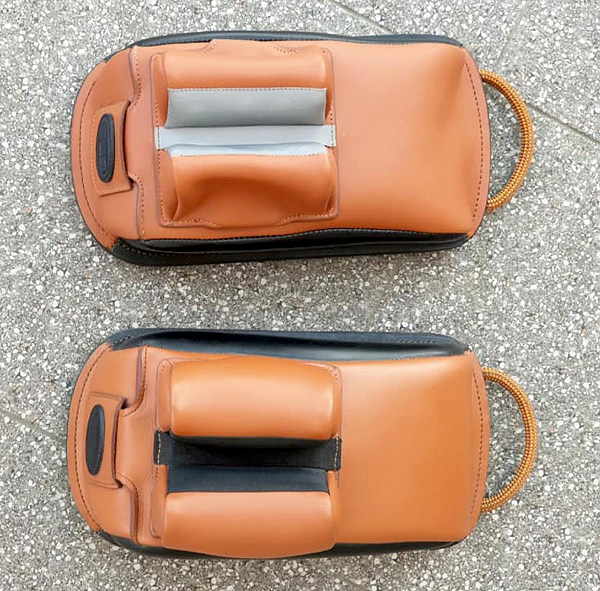
Benchrest and F-Class shooters know that you need a very good rear bag to achieve optimal (and repeatable) accuracy with your rifle. The rear sandbag does more than just support the weight of the rifle in the rear. It also aligns the stock with the front rest, absorbs vibration/shock, and perhaps most importantly, guides the rearward travel of the stock during the recoil cycle.
A premium bag will be stable from shot to shot, not move on recoil, and also be a good match to the angles and width of the keel (bottom) of your stock. Modern rear sandbags also employ various types of synthetics on the contact surfaces. The idea is to reduce friction which still providing a stable “grip” on the stock.
We’ve learned that our friend Sebastian Lambang, inventor of SEB coaxial rests, has come up with an improved, second-generation Bigfoot Rear bag. The design looks very well thought-out and the craftsmanship is excellent. Seb welcomes comments on his Facebook Page. These will be available soon from SEB dealers worldwide.
Seb explains: “Here is the new/premium SEB Bigfoot Rear Bag. The photos show our Prototype bag model shown with nylon seat belt material on the ears.” Note that the bags sit perfectly flat — there is no bulge on the bottom even though the bags are “packed to the brim with sand”.
Dimensions: Standard spacings between ears: 3/8″, 1/2″, 5/8″, 3/4″, and 1″; standard height: 4″.
Customizing: Other spacing, bag height, for right- or left-handed available on request.
Accessories: The SEB doughnut (bag base/surround unit) is also available (sold separately).
Here is gunsmith Richard King, with his updated Martini Mark III smallbore rifle.
This is the kind of family-friendly, “feel-good” story we like. A few years back, Texan Richard King created a rimfire benchrest rifle using a classic Martini Mark III smallbore action. He fitted the gun with a new flat, wide forearm and a new buttstock, allowing the gun to sit steady on the bags and track smoothly. The narrow action was also fitted with a cantilevered top rail to hold a high-magnification scope.
Here is Vicki King, with Martini Mark III and her trophy.
But here’s the best part. Back in 2014, Richard provided this updated classic to his wife Vicki, who proceeded to win a rimfire benchrest match (Vintage class) with the old Martini. Richard reports: “Here is my lovely wife with her High Overall Vintage trophy. That is a Martini Mark III that I re-stocked in walnut for 50-yard, .22-caliber benchrest matches. It’s great to have her shooting with me again.”
Bravo Richard — kudos to you AND to your lovely bride. It’s great to see a couple shooting together. It’s also great to see a classic rifle brought back to the winner’s circle with some inspired stock-work, new optics mount, and other smart upgrades. Old rifles never die… at least if they find their way to a great smith like Richard King.
2020 has been a pretty rotten year so far — with the Pandemic, shutdowns, riots, and, yes, cancellation of major shooting tournaments, including the big summer National Matches at Camp Perry.
But, not daunted, the CMP organized a series of shooting matches around the country, called the Home Range Appreciation Series. Over 1200 Rifle and pistol competitors shot Home Range matches in 32 states this year. In total, 11 smallbore events, 33 air rifle, 9 GSMM rifle, 13 Highpower Rifle Aggregate, 2 pistol and 4 Rimfire Sporter rifle events were fired in 32 states. Nearly 1,500 entries were recorded throughout the events, with competitors from 43 states.
Open to both adult and junior athletes, the Home Range Appreciation Series events were fired in local club matches and scored by the CMP to be compared against overall scores from participating marksmen around the nation. Matches included the White Oak 1600 Rifle Aggregate, a 200-Yard Reduced Course 800 Rifle Aggregate, a Garand/Springfield/Vintage/Modern Military Rifle Match, Rimfire Sporter Rifle, CMP Pistol 2700 (featuring .22 Rimfire, Center Fire and 45 Caliber pistols), Smallbore 3×20, Smallbore Prone 3200, and air rifle 3×20 and 60-Shot matches.
The CMP conducted a Virtual Awards Ceremony on Friday, October 2, 2020, to honor the top competitors in various discpline. A drawing for all sponsor-donated items also took place during the Virtual Awards Ceremony. You can watch this virtual awards ceremony on YouTube:
The CMP thanks all participants, volunteers, clubs and others who helped to make this inaugural event a true success. To see the top performers, CLICK HERE for full list of Home Range Match Results.
Considered the biggest PRS-type rifle match in the world, the 2020 GAP Grind/Bushnell Pro/Am kicks off today. The big GAP Grind runs for three days, October 2-4, at the K&M Shooting Complex in Finger, Tennessee. In association with the Precision Rifle Series (PRS), the format will again be a professional-amateur, individual and team match to promote sportsmanship and welcome new shooters to the competition scene. Competitors ranging from top professionals to those seeking their first taste of the sport are invited to attend.
The GAP Grind is held at the impressive K&M Shooting Complex in Tennessee:
Lots of Action, with 20+ Stages
The GAP Grind is a challenging, “high tempo” match with minimal down-time between stages. Over the course of 20+ stages, competitors will fire 200+ shots at a variety of steel, paper, moving, and reactive targets out to 1,200 yards. Targets vary in size/difficulty based on the shooter’s position, distance, and time allotted. Most stages include “stressors” — i.e. time limits or required movement(s).
Ramia Whitecotton Facebook photo.
The GAP Grind typically attracts over 300 competitors — half experienced shooters and the other half newcomers to the sport. The key to growing the shooting sports is attracting new shooters. The best way to bring in “new blood” seems to be the Pro-Am type format. At the GAP Grind, experienced shooters share their knowledge and guide the new shooters through the competition.
Bushnell Side Match on October 2, 2020
On Friday, October 2, Bushnell will sponsor a side match featuring the RXS-250, a new red dot optic. This is an impressive impact-resistant design, with 10 user-adjustable brightness and True Tone coatings for a sharp, distortion free image. Bushnell will provide prizes to competitors — a lucky amateur will receive a new Bushnell Elite Tactical optic. Plus range officers will receive product prizes to thank them for dedicating time to the event.
Editor’s NOTE: Shelley Davidson passed away in 2008 after a courageous battle with cancer. He was one of the great innovators in benchrest rifle design. This article, written before Shelley died, showcases Shelley’s creative talents at their best. His “Tinker Toy” design will always be a tribute to Shelley’s fabricating skills and imagination.
Shelley Davidson — a brilliant innovator. R.I.P. Shelley — you will not be forgotten.
Shelley Davidson’s peers called his radical rifle the “Tinker Toy” gun. We call it revolutionary. Even now, 14 years after its creation, there’s nothing quite like it. This innovative, skeleton design threw conventional wisdom to the winds. Shelley readily concedes he “broke the rules” of benchrest rifle building. But this was inspired rule-breaking, because Davidson’s rifle shot like a house on fire. The Tinker Toy gun won its first matches, both for Score AND for Group. And this rifle also delivered many “zero groups” in Gene Begg’s Texas Tunnel. Hats off to Shelley for conceiving and building a truly radical rifle that was also wicked accurate and successful in competition.
Tinker Toy 30 BR — Radical As It Gets
Report by Shelley Davidson
Although I’m not big on naming rifles, my shooting buddies have christened the gun “Tinker Toy.” I can live with that as it does kind of look as if it was made with a Tinker Toy set.
Origins of the Project
This project began with some wild ideas I had in the fall of 2006 about using magnets to tune a barrel. My idea was to use one magnet on the barrel and another on the stock so they pushed against each other to counter gravity-induced barrel sag (and possibly) tame barrel vibration in a beneficial manner. The only way to test these ideas was to build the device and mount it on a gun. That meant I had to build a new rifle because there was no place to mount a magnet on the stock of a conventional benchrest rig. I had a Kelbly-stocked heavy varmint stock with a Michael Kavanaugh paint job on it. I didn’t think Kav would ever forgive me if I started drilling holes in one of his works of art. My light varmint was in a carbon fiber Scoville stock that costs about a grand. Drilling into the Scoville for an experiment just smacked of bad judgment. So, the magnet thing was my first motivation for designing a new stock. As long as I was building from scratch I decided to offset the barrel and action 0.75″ to the right to counteract the spin/torque from the bullet.
Although there’s nothing new here, my second motivation was to build a 30BR that could shoot in the 10.5 lb light varmint class in NBRSA. The magnetic tuner will automatically make this gun illegal in the IBS. The IBS has declared all barrel attachments un-safe and have outlawed them. I personally feel that the IBS really outlawed all barrel attachments to prevent experimentation and innovation. But at least we have NBRSA matches.
Designing the New Gun — Thinking “Outside the Box”
Once I’d decided to build a lightweight stock that could support experimental devices out near the muzzle, I started drawing up some rough plans. I also took a trip to Jerry Stiller’s shop in Wylie, Texas for a brainstorming session with Jerry, the maker of Viper and other Benchrest actions. Jerry is a school-trained mechanical engineer and thinks differently than I do. I came away from Stiller’s shop with my design roughed out and sketched on paper. The design violated several covenants of conventional wisdom for building competition BR rifles. For instance, two-piece stocks stress the action. Stress reduction is why most BR rifles are glued into the stock. Another myth is that metal stocks vibrate too much so wood or foam-filled fiberglass or carbon fiber are used.
Tinker Toy Rifle DESIGN FEATURES
Shelly Davidson’s Rifle was so innovative, that almost every feature, except the bare action, is very different than you’ll find on most Benchrest rigs. Accordingly we felt it would be useful to isolate and describe the key design features, from stem to stern. Click thumbnails to view FULL-SIZE PHOTOS.
Front Bracket with Magnetic Tuner
The tuner consists of one rare earth magnet attached to the stock and another attached to a barrel sleeve with the magnets oriented so as to make the magnetic force repel each other. The purpose is to counter “barrel droop” and, hopefully, dampen barrel vibration. The lower magnet is carried on a threaded shaft (with lock ring), allowing the magnet to be raised up and down to adjust the “up push” on the barrel.
Tubular Fore-Arm Supported by Brackets
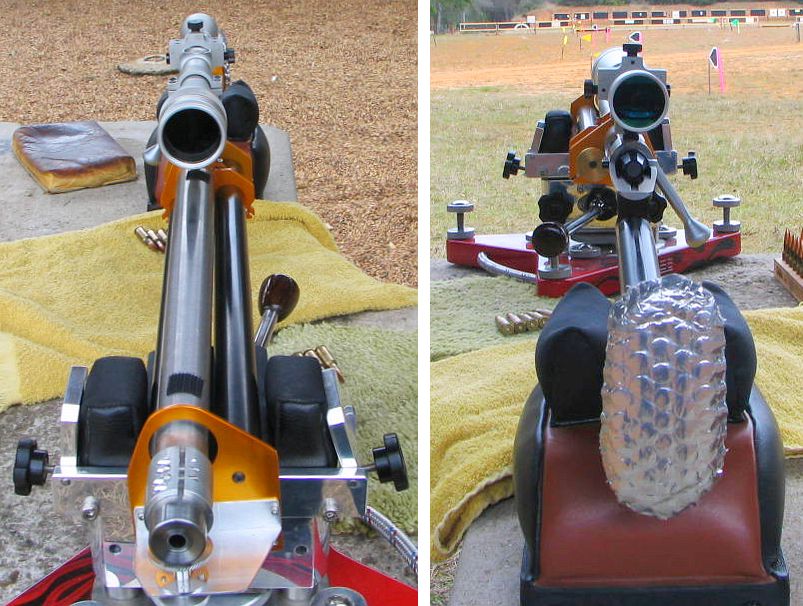
Three brackets support two tubes, one on either side of the barrel. The rear-most bracket is sandwiched between the barrel and the action. Four inches forward (max distance allowed for barrel blocks) a second bracket grips the barrel. Near the muzzle a third bracket secures the ends of the tubes and holds the magnetic tuner. To allow barrel offset, the left tube is 1″ diameter tube while the right tube is 5/8″ diameter.
Offset Barrel The rifle rests on a 3″ wide plate attached to the underside of the two fore-end tubes. With the plate centered in the front sandbag, the barreled action is actually offset 0.75″ to the right (looking forward from the breech). The purpose of this offset is to keep more weight on the right side to counter the tendency of the rifle to torque counter-clockwise. Two different diameter tubes allow for the built-in offset.
Floating Action without Sub-Support or Bedding
On the Tinker Toy gun, the action serves as a load-bearing assembly, holding the barrel in the front, and the skeleton buttstock (or “keel”) in the rear. Shelley was told that accuracy would suffer if you stressed a benchrest action in this manner but that proved untrue. It is a very simple solution to building a rifle, and it eliminates the need to bed the action. The forearm attaches to the action via a bracket installed like a recoil lug.
Skeleton Rear “Keel” Affixed Directly to Action
Davidson’s Tinker Toy does not have a conventional rear buttstock. Instead there is low-profile, v-shaped metal “keel”, as Davidson calls it, that rides the rear bag. The keel is supported by a tubular backbone that attaches at the rear of the Diamondback action. At the butt end is an aluminum plate covered with bubble wrap that serves as a butt pad. The skeletonized rear section helps the rifle maintain a very low center of gravity.
Locked Scope with External Windage and Elevation Adjustment
Shelley ran an older Leupold 36X Benchrest Scope with front-adjusting objective. To eliminate slop or loose tolerances in the erector mechanism that could cause changes in point of impact, the internals have been locked up by Jackie Schmidt. To move the cross-hairs relative to the bore axis, Shelley has a special Jewell/Foster rear ring that allows a limited amount of lateral and vertical movement of the entire scope body.
TINKER TOY SPECIFICATIONS
Action: Stiller SS Diamondback Drop-Port (1/2″ short), with .308 Bolt Face.
Barrel: Shilen .308 caliber, 17-twist, HV.
Chambering: 30BR, .330″ neck, Pacific Tool & Gauge Robinett Reamer.
Stock: Davidson Custom Tubular Stock with 0.75″ Offset Barreled Action.
Tube Construction: 6061 Aluminum, 1″ diameter (left), 5/8″ diameter (right).
Load: H4198 powder and 118gr Ronnie Cheek bullets. Loaded to 2980 fps.
Trigger: Jewell, 2 ounce BR.
Tuner: Custom, Adjustable with Opposing Magnets.
Optics: Leupold 36X (locked by J. Schmidt).
Rings: Jewell Foster External Adjusting Rings.
Stiller Diamondback Action and Shilen 17-Twist Barrel
I had wanted to use an aluminum Stiller Cobra drop port with a 6mmBR bolt face but Jerry had none in stock and he estimated it would be a year before one was available. Although I’ve waited for up to a year for an action in the past, I wanted to build this rifle during the fall of 2006 while the weather was pleasant enough to work in my unheated and un-air-conditioned garage shop. Jerry did have a 1/2″ short stainless steel Diamondback in stock so I purchased it even though it would add 3 ounces to the gun compared to the aluminum Cobra. Three ounces is a lot of weight when you’re working with a 10.5-lb limit. I had a heavy varmint contour Shilen 17-twist barrel that would work nicely and I had a Jewell trigger on a rifle that I wasn’t using at the time. I also decided to use my Leupold 36X (locked-up by Jackie Schmidt) with the Jewell/Foster adjustable rings.
Building the Tube Fore-Arm and Brackets
I took a wild guess as to tubing thickness and settled on .035″ for the 1″ left fore-arm tube and .058″ for the 5/8″ right fore-arm tube. All of the flat stock and tubes are 6061 Aluminum. I did the lathe work and the mill work and every evening I’d put the parts together and think about the proper way to proceed.
When the parts were mostly made, I started thinking that this was a truly ugly rifle. I thought about painting it but that wasn’t a good option as many of the parts are designed to slide over others and glue together. Anodizing was the best answer so while looking on the Internet for local anodizing shops I Googled “Home Anodizing”. Sure enough there were a few sites that told about how to anodize at home. I picked up some battery acid from NAPA Auto Supply, some Rit Clothes Dye from Wal-Mart, and a bunch of distilled water from the grocery store. Using an old battery charger as my dc power supply I started anodizing and dying the eighteen parts that went into the stock. Although I had to strip and re-anodize some of the parts, the work turned out acceptable.
Putting it All Together–Lug-Mounting the Fore-Arm and Lots of Epoxy
The barrel contour had to be modified to work with the stock which attaches by way of a rear plate which mounts like a recoil lug and a plate that ties the barrel and the stock tubes together 4″ forward of the bolt face. The four-inch maximum distance is a NBRSA rule concerning barrel blocks.
The recoil lug-style stock mount is probably the only truly innovative thing I did other than the opposing-magnet tuner. Basically, the rear bracket is sandwiched between the receiver face and the barrel shoulder–positioned where a conventional recoil lug would go. I also added a brass ring (visible in photo) between the anodized bracket and the barrel. This was done to distribute loads over a wider surface area. (I was concerned that the bracket material was fairly soft and I didn’t want to crush it as I torqued the barrel in place.) After fitting the barrel and plates I glued the entire gun together using epoxy and various LocTite adhesives. The rest of the parts were assembled but I did not Loctite the scope bases since I thought I’d be disassembling the rifle for re-work after the first trials. That came back to bite me during later testing when the gun started shooting erratically and I went down a couple of blind alleys before finding the loose bases.
Range Testing–Results Are Very Positive
The first range session was a real shocker. Even though the wind was up to 10mph and twitchy, the rifle showed promise from the very first shot. I really didn’t expect that kind of performance without, at least, some rework. After sighting in, I shot five, 5-shot groups that, when averaged together, measured .223″. That’s good enough to win some benchrest group matches. But I wasn’t finished with the gun yet–I still wanted to try out my magnetic tuner concept.
The Magnetic Tuner
Next, I built the magnetic tuner. The tuner consists of one rare earth magnet attached to the stock and another attached to a barrel sleeve with the magnets oriented so the magnetic forces repel each other. In order to test the magnets and to determine if the rifle really shot as well as it seemed to, I took it to Gene Beggs’s shooting tunnel in Odessa, Texas. I spent two days at the tunnel testing loads and then installed the magnetic tuner. The gun shoots well with the magnets and shoots well without them. I suppose I can’t make any claims as to how much, if any, improvement the magnets make. Gene said that my gun was the most accurate rifle to be tested at his one-year-old shooting facility: “Shelley Davidson brought one of the most unusual rifles I had ever seen; he called it his ‘Tube Gun.’ And boy, did it ever shoot! It still holds the record in the tunnel as the rifle that shot more zeros than any other to date.” I definitely recommend Gene’s facility for testing and refining shooting techniques and loads.
Competition — Tinker Toy Won Both Score and Group Matches
Finally the big day arrived when I’d shoot the first match with my new gun. The North Texas Shooters Association was holding its first club match of the 2007 season. At the Denton, Texas matches we shoot a Score Match in the morning and a Group Match in the afternoon. The March event was at 100 yards and the April match will be at 200 yards and so on alternating throughout the benchrest season.
Match One–Tinker Toy Wins Score with a 250 – 17X
Since the gun is chambered in 30BR and that chambering is almost immune to tuning woes, I preloaded 130 rounds with H4198 powder and 118gr Cheek bullets. I used my SEB front rest and rear bag which are made by Sebastian Lambang in Indonesia. Everything came together, and Tinker Toy demonstrated that the accuracy it showed in the tunnel was no fluke. The gun shot great and I won the morning match with a 250, 17X. The day was quite windy and the next best shooter scored a 250, 15X. So I’d chalked up my first win.
Match Two–Tinker Toy Wins Group with a .2282″ Agg Tinker Toy won the afternoon group match I entered with a five-group Aggregate of .2282″. (The second place score was .2568″.) My groups were .149″, .197″, .243″, .302″ (oops), and .250″. You know how some folks say a 30BR can’t be competitive with a PPC? Well that .2282″ Agg won’t break any records, but it is good enough to win some regional registered BR matches. So this rifle has demonstrated an ability to win in both Score and Group matches. Obviously I have a very good Shilen barrel, great Cheek bullets and the rest of the components are doing their jobs as well. But, the stock is also working well.
Score Shooting vs. Group Shooting–The Rules
In a score match, the shooter shoots one bullet at each of five record targets, which are clustered on one target sheet. The Aggregate score of five of these targets determines the winner. If the shooter touches the 10 ring on all of his 25 targets he can score a “clean” 250 score. Usually there will be more than one shooter who scores a 250 so the winner is determined by the X-count. The 1/2″ 10-point ring has a 1/16″ dot in its center. Touching the X dot adds to the shooters X count. In short-range group matches, the shooter must try to put five bullets through the same hole. At each distance (100 or 200), five, 5-shot matches are scored, the group sizes are added together (MOA equivalent at 200) and the total is divided by five to arrive at an Aggregate score.


 In the archives of
 Gary Anderson served as the Director of the Civilian Marksmanship Program (CMP) from 1999-2009, and is now DCM Emeritus. As a Nebraska farmboy, Gary grew up hunting and shooting. Dreams of winning an Olympic Gold Medal in shooting led Gary to the U.S. Army. In 1959, he joined the elite U.S. Army Marksmanship Unit. Just two years later, he won his first national championship.
 All OK Games Events Will Be Cancelled






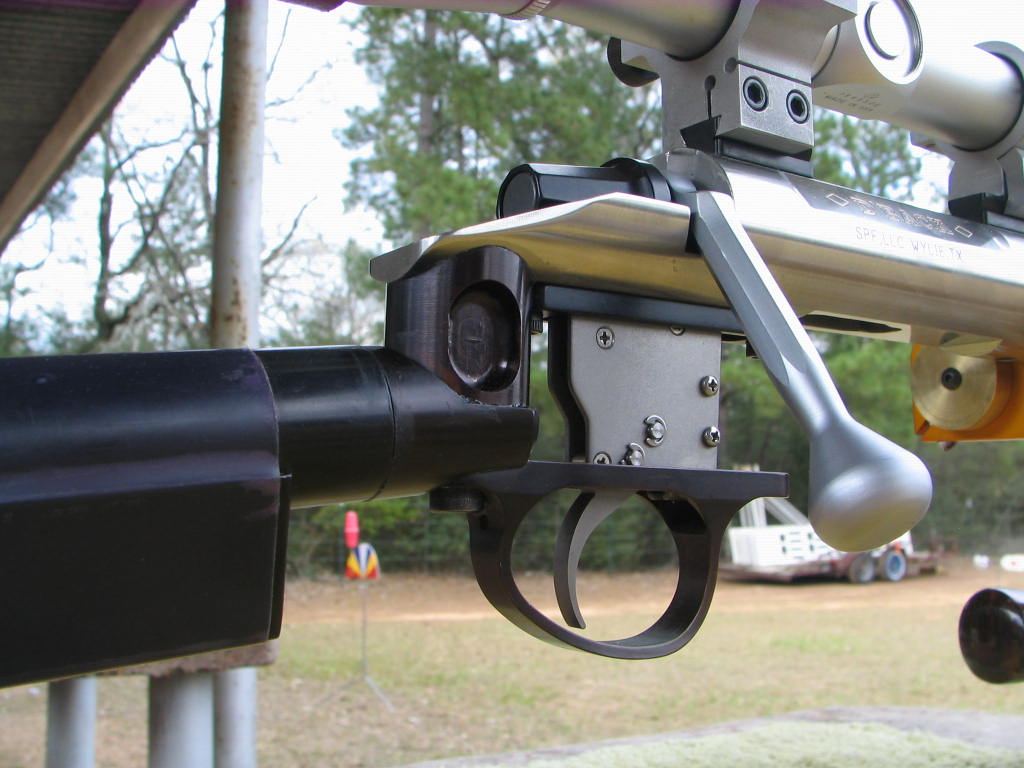


 The recoil lug-style stock mount is probably the only truly innovative thing I did other than the opposing-magnet tuner. Basically, the rear bracket is sandwiched between the receiver face and the barrel shoulder–positioned where a conventional recoil lug would go. I also added a brass ring (visible in photo) between the anodized bracket and the barrel. This was done to distribute loads over a wider surface area. (I was concerned that the bracket material was fairly soft and I didn’t want to crush it as I torqued the barrel in place.) After fitting the barrel and plates I glued the entire gun together using epoxy and various LocTite adhesives. The rest of the parts were assembled but I did not Loctite the scope bases since I thought I’d be disassembling the rifle for re-work after the first trials. That came back to bite me during later testing when the gun started shooting erratically and I went down a couple of blind alleys before finding the loose bases.

 Match One–Tinker Toy Wins Score with a 250 – 17X


