Introducing the Hybrid-X Shooting Rest
The new, patent-pending Hybrid-X front rest from 21st Century Shooting is a true hybrid between a joystick and a traditional “wheel” rest. Windage (left/right point of aim) changes are made via a control stick that extends back to the shooter. This control stick travels on a horizontal plane. Elevation is controlled through a knob on the end of the control stick, OR a large, traditional wheel on the post. So you have TWO elevation control options — the Big Wheel or the smaller knob on the end of the control rod.
The entire central assembly of the rest is mounted on a circular plate that is mounted in the base plate. This central assembly and plate is called the Target Acquisition System or “T.A.S”. This allows the user to easily self-align the rifle and rear bag by simply loosening a few levers. Self-alignment will help minimize set-up time and improve repeatability by eliminating binding of the rifle in the shooting bags. In addition, this will allow for rapid windage adjustment if needed to acquire a target. This really is an important advancement — you can simply place the rest on bench or ground, and then use the T.A.S. function to get perfect target alignment. No more trial and error placing the rest multiple times to get the correct orientation to the target.
The Hybrid-X design team tells us: “Smooth operation and ease of control are what this rest represents. The utilization of a ball screw plus bearing block provides glass-smooth elevation adjustment. And the elevation is stable.” Guys, this is important. Unlike some joystick rests which move when you release the joystick, on the Hybrid-X, the cradle holding your rifle does not “droop” when you release the Hybrid-X control stick. Repeatability from shot to shot is provided by the rock-solid platform and the fact that elevation does NOT change when you let go of the control stick.
The entire center section of the rest rotates as one unit for fast, perfect alignment to target.
Key Features of New Hybrid-X Shooting Rest
1. Weight of rifle is not a factor in ease of controls due to the use of ball screws/bearing blocks in the post.
2. Windage range is more than you would ever need — more than other rests on the market.
3. Elevation is not lost from shot to shot even if you release control stick.
4. Total weight of Hybrid-X prototype is 28 pounds.
5. Designed, machined and built in the USA!
How does it work? Very well indeed! The folks at 21st Century report: “Everyone that has shot off this rest so far is blown away with the repeatability, smoothness, and the ease of the controls.” The innovative Hybrid-X rest is Patent Pending, and is 100% made in the USA. Priced at $1950.00, the Hybrid-X is in production now. You won’t see it (yet) on the 21st Century website, but you can email or call (260) 273-9909 to order. Currently, expect a 60-day wait from time of order to delivery. The rest includes a front bag.
Field Test of New 21st Century Rest in Competition
Report from F-Class Competitor Bret Solomon
I would like to first start out by saying “Thank You” to all the persons involved at 21st Century Shooting for getting me this new rest. I used the new rest for the first time on Friday, August 7, 2020 for a team match in The Michigan State Long Range Team Match Championship. My team took first in the F-Open Division and I had a very quick learning curve with the rest. Saturday, I again used the rest for the Michigan Long Range/F-Class Regional individual matches. We shot one match and called the rest of the day due to weather concerns. Sunday we came back for three matches.
As the day progressed, the winds came up and starting switching considerably more and I put the new rest to work. I was able to concentrate on wind switches, feeling very confident that the gun was staying where I put it in the rest and on target. Adjustments were very smooth and I was able to shoot multiple shots with no elevation changes. The controls are in a position where you can get behind the gun and not have to reach out for changes. Yes the rest performed great — I was able to come from behind to take a one-point win in the F-Open Division. I believe the new rest from 21st Century Shooting made a significant difference for me. In the future, I hope the Hybrid-X rest will help advance my shooting game.
Once again, thank you to 21st Century Shooting for a great addition of technology, innovation, craftsmanship, and customer service to the shooting community. — Bret Solomon
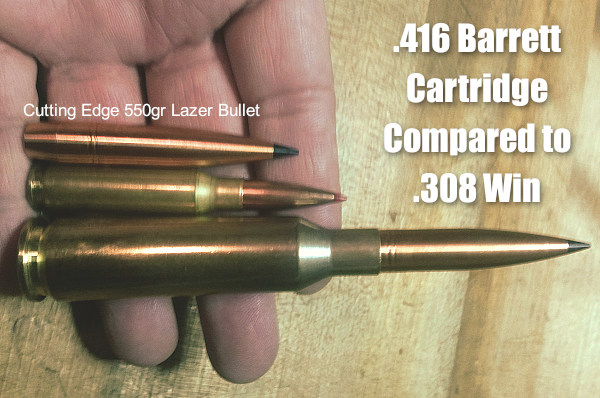
In the ELR game, particularly the King of 2 Miles (KO2M), it’s “go big or go home”. The top shooters run large-capacity cartridges that push large-caliber, ultra-high BC bullets at very high velocities. Bullets launched by cartridges such as the .416 Barrett can sustain supersonic velocities at Extreme Long Ranges — and that’s what it takes to win. The .416 Barrett can launch a 550-grain solid bullet at 3000+ FPS.
Photo from ELR Competitor Corbin Shell.
2018 and 2019 Kings of 2 Miles Loaded on RCBS Presses
So how do you load jumbo cartridges such as the .416 Barrett? It takes a big, heavy, super-strong reloading press. We’ve learned that the last two Kings of 2 Miles, Paul Phillips (2019) and Robert Brantley (2019) both loaded their KO2M ammo on RCBS AmmoMaster .50 BMG presses. Phillips loaded .416 Barrett ammo, while Brantley loaded custom .416 MCS rounds.
In 2018, Robert Brantley topped the field using his custom .416 MCS loads perfected on the AmmoMaster .50 BMG Press. This year, Brantley took a close second to 2019 KO2M winner Paul Phillips. Both Phillips and Brantley use the AmmoMaster .50 BMG single stage press kit and RCBS .416 Barrett dies to hand-load for extreme long-range. “My ammo has been much more consistent after switching to the RCBS press and dies,” remarked Phillips, who runs the Global Precision Group. Brantley said he uses RCBS products for most of his reloading needs — from the dies and AmmoMaster, to the ChargeMaster and Brass Boss. His custom .416 MCS loads launch a 550-grain bullet more than 3,100 fps.
Loading with RCBS AmmoMaster .50 BMG Press
This video shows reloading with the RCBS AmmoMaster .50 BMG press. While this video shows .50 BMG cases being loaded, the principles are the same for loading the .416 Barrett used by both Brantley and Phillips. Big cases need big presses!
Derek Rodgers Shooting the .375 CheyTac at K02M in 2017
Another ELR ace, 2017 King of 2 Miles champion Derek Rodgers, favored the .375 CheyTac cartridge. For his successful K02M quest, Derek ran Cutting Edge Bullets in Peterson brass with Hodgdon H50BMG powder. The video below shows Derek in action at the 2017 KO2M event.
The KO2M competition is a two-day extreme long-range (ELR) match held at the NRA Whittington Center outside Raton, New Mexico. Teams consist of one shooter and up to two wind coaches/spotters, who fire on steel targets ranging from about 1,500 to 3,500 yards.
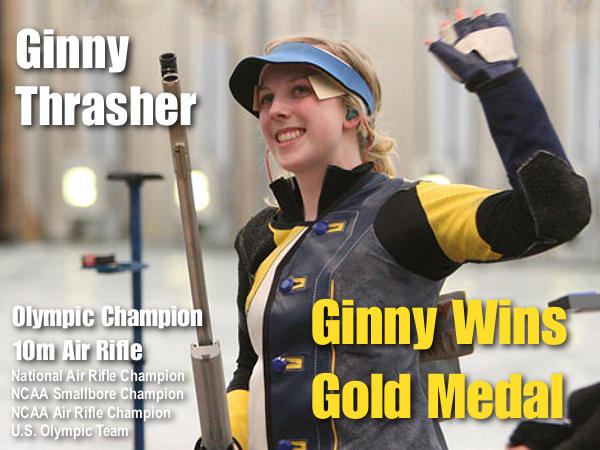
Ginny Thrasher won the very first Gold Medal of the Rio 2016 Olympic Games in Brazil. And now she has her sights set on another strong performance in the next Olympics, slated for Japan in 2021. Ginny Thrasher’s marksmanship success story started a decade ago at the age of 14 when she went on a hunting trip with her grandfather. From there she rose to stardom in collegiate shooting and then the Olympics.
In 2016 when Ginny earned Gold in Rio for Team USA she was the youngest American female to ever win a shooting Gold Medal. In first Olympic showing, she led the Women’s 10-meter air rifle and set a new Olympic record with a finals score of 208.0!
“There are so many feelings associated with 2016 for me … I didn’t realize it at the time, but that was the year that all athletes dream of”, the now 23-year-old said. “Going to the Olympics was one of the most amazing and singular once-in-a-lifetime experiences that not everyone gets … It was amazing,”
Returning to the United States after the Olympics in 2016 presented a swirling new world for Ginny. As a collegiate athlete on the West Virginia University (WVU) rifle team, she suddenly found herself the most famous person on campus — often stopped while walking to class or shopping for groceries, being asked for a picture or an autograph.
The overwhelming response of the country, from strangers to national media, turned attention to the sport of rifle shooting. That gave Ginny a sense of pride in the impact she had made for the entire marksmanship community: “That’s something that athletes in other sports experience all the time, but it’s not something rifle shooters typically experience,” she said. “I was very, very grateful to have the community support, and it was a lot of fun to go and be invited to different events and speak to different media outlets and truly represent my sport.”
She went on, “It was getting a lot of attention at a time when our sport is not very common, not a lot of people know what it is … So the more I could answer people’s questions to advocate and to educate, to me, that was a huge opportunity.”
With her medal carefully tucked away in a bank lockbox for safekeeping, Ginny has done her best to become accustomed to her new reality. As she went back to competing with her WVU teammates in 2016, she found herself sometimes distracted by the attention.
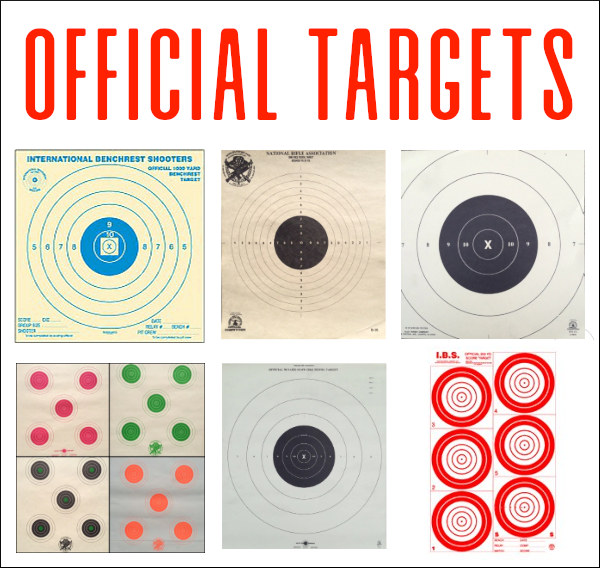
Need targets — not just any old targets, but the correctly-sized targets for specific shooting disciplines (such as NRA Smallbore, F-Class, and 1K Benchrest)? Well you won’t find them at your neighborhood gun store. Precise, dimensionally-correct competition targets are produced by a half-dozen specialty printers. In this article we provide links to the leading target sellers, with a chart showing “who’s got what”. Look for your particular discipline and the vendors will be specified.
Sources for Official Shooting Competition Targets:
AccurateShooter.com offers dozens of FREE, printable targets for target practice, load development, and fun shooting. We also offer a few of the most popular NRA Bullseye targets. One or more of these printable targets should work for most training purposes. However, some readers have asked: “Where can we get the real targets… exactly like the ones used in NRA, IBS, and NBRSA shooting matches?”
All these vendors carry nearly all the NRA High Power and Smallbore targets, including the smaller F-Class targets. National Target has the F-Class and High Power targets, including 100-yard reductions of the 200, 300, and 600-yard military targets.
Germany’s Kruger Targets sells all the important NRA targets, and international (ISSF) air rifle and smallbore targets too.
Orrville Printing currently sells IBS targets for rimfire (50 yard) benchrest, short-range centerfire Benchrest (100, 200, 300 yards), Hunter BR Rifle (100, 200, 300 yards), plus the official 600-yard and 1000-yard IBS targets. National Target Company also has most of the IBS targets. NBRSA short-range, 600-yard, and 1000-yard benchrest targets are available directly from the NBRSA Business Office. Send an email to nbrsa@icloud.com or call (434) 993-9201.
Need Steel, Cardboard Silhouettes or specialty targets? ALCO Target Company in Duarte, California is the USA’s leading producer of the full spectrum of shooting targets including paper targets, cardboard targets, steel targets, and target stands.
British rimfire ammo-maker ELEY has created a new global match series. Shooters compete at there local ranges, and then scores are compared to other shooters around the world. There will be five Precision Club Masters competitions: Benchrest, Prone, 3-Position, Practical, and Pistol. At the end of the season, the top competitors will receive glory, and, yes, valuable prizes from ELEY.
ELEY is excited to launch its brand new ELEY Precision Club, allowing competitors from all over the world to compete against each other from their local shooting clubs. Scores will be tallied online through an exciting Masters series of events. Winners can be recognized as a World Champion. In addition, top shooters compete for valuable cash, ammunition, and clothing prizes.
ELEY states: “We love… to connect with shooters across the globe. With an uncertain future, and the current global situation restricting travel, the ELEY Precision Club hopes to provide shooters with a fun, safe alternative for competing. The fun must go on!” The ELEY Precision Club will provide shooters of all ages and abilities from a range of disciplines to compete on a global stage against other shooters internationally.
Here is our friend Joe Friedrich. Joe has set many benchrest records with ELEY .22 LR ammunition.
First Precision Club Event Will Be ELEY Benchrest Masters
The first competition to be hosted on the myELEY.com platform is the ELEY benchrest masters. Competitors will shoot six (6) 25-bull targets at a distance of 50 meters. Scores must be uploaded to the myELEY.com dashboard by 11:59 pm on November 1, 2020 (GMT). That’s just before midnight in the United Kingdom.
Image from National Rimfire Benchrest Association of Ireland (NRBAI).
How to Enter ELEY Precision Club Events
To participate, you first need to register on the ELEY Precision Club homepage. Once you register, ELEY will create a personalised myELEY.com competition dashboard for you and send you login details by email.
To get started: Complete the registration form. Once your competition dashboard is created you will have instant access to any future ELEY online competitions. The myELEY.com personalised dashboard compiles statistics and results and tracks your world ranking. Once your personal dashboard is created, you’ll get instant access to all future ELEY Precision Club online competitions.
To learn more about the 5-discipline ELEY Masters series, or to enter the first benchrest match, go to Eley.co.uk/precisionclub.
William “Tom” Collins earned the CMP’s Distinguished Rifleman Badge #2500 this July. Collins earned his final EIC points at the Washtenaw Sportsman’s Club in Michigan.
One of the highest honors in competitive shooting is earning the Distinguished Rifleman Badge. This Badge was created by the War Department in 1884 to recognize members of the U.S. Army for Excellence-in-Competition (EIC) with the Army’s service rifle. Other U.S. Armed Forces soon adopted a similar program and in 1926 civilians were authorized to participate. This story is about William “Tom” Collins, 50, of Maumee, Ohio, who earned his badge in July 2020. His achievement was a landmark — Civilian Distinguished Rifleman Badge number 2500.
Collins Earns Distinguished Rifleman Badge Number 2500
Story based on Report by Ashley Brugnone, CMP Staff Writer
For over 20 years, the Civilian Marksmanship Program (CMP) has issued Distinguished Badges to competitors who collect at least 30 Excellence-In-Competition (EIC) “leg” points — earned by placing in the top 10% of an EIC match. This story is about Ohio shooter William “Tom” Collins, who recently earned Distinguished Rifleman Badge number 2500. [Editor: To learn more about the history of the Distinguished Rifleman Badge and what is takes to earn it, read Distinguished Rifleman — the Chase for Excellence by Jonathan Ocab.]
For Collins, this fulfilled a dream to join generations of elite marksmen before him. “The Distinguished Rifleman Badge has been a goal of mine since I learned about it,” Collins said. “I like to think back on the history of the badge … It makes me proud to be a part of that.”
Collins earned Distinguished Rifleman Badge #2500 in July. “Shooting is almost like meditation to me”, Collins said. “You really can’t think about anything other than the current shot. It’s very relaxing.”
He gives simple advice to other competitors hoping to one day earn a Distinguished Badge of their own: “Anyone working on it – quit thinking about it. Just shoot.”
Collins is congratulated by his friend Jamie Root after “going Distinguished”.
Collins has been shooting most of his life. Growing up in rural Ohio, he received his first BB gun around seven years old and his first .22 at age 11. It wasn’t until he joined the Army Reserves in 1987 that he received any formal marksmanship training. After he left the Reserves nine years later, he started looking toward organized shooting sports.
One day, back in 2014, he picked up his rifle and took the 45-minute drive to Fremont, Ohio, to fire in his first GSM (Garand-Springfield-Modern/Vintage Military) Match at the Sandusky County Sportsmen’s Club. It was there that he met Jesse Bragg, who was running the event.
Jesse Bragg, a retired staff sergeant from the Marine Corps Reserve Rifle Team, took Collins under his wing and showed him the ropes. Collins says Bragg seemed to want to teach more than run the match. In fact, Bragg was the one who introduced Collins to the idea of pursuing a Distinguished Badge. Collins admits that he had no clue what “going distinguished” meant. Bragg went over the terms – legging out, finishing “first leather” and other related expressions.
In 2015, Collins went to the National Matches at nearby Camp Perry, Ohio, and fired in his first President’s Rifle Match. Watching the elite shooters take their final shots inspired Collins: “Learning about the Distinguished Badge, learning about the President’s Match — I just knew that I had to get this Distinguished Badge on my way to, hopefully, getting into the President’s 100 or even the Top 20.” So Collins began traveling to GSMM competitions with his match rifle in tow, just to get in a little extra practice. It became his main focus. In June 2019, he earned his first set of six leg points at the CMP Viale Range 800 Aggregate and EIC Service Rifle Match at Camp Perry. It was a breakthrough.
When I first started, I was shooting the Garand and the M1A. [But] once I realized I wanted to get my Distinguished Badge, I said, “None of the wood guns. It’s all my match rifle until I go Distinguished”.
He went on to earn eight points at his next match in July, followed by eight more in August. With one more match left in 2019 and only seven points away from the required 30 to earn a badge, his goal was within sight. But it wasn’t until the EIC match at the Washtenaw Sportsman’s Club in Ypsilanti, Michigan, in July 2020 that he was able to conquer his nerves and earn his final points: “The most rewarding thing – it’s when you get there. When you finally earn it, everybody knows it. Everybody at the range celebrates with you. All of your friends are there with you. It’s just rewarding in itself. You’re part of that tradition that spans three centuries.”
Friendships Made on the Road to Distinguished
More so than the time, effort, and skill it took to earn the badge, the journey to become Distinguished was almost as rewarding as the badge itself for Collins, given the relationships he’s made along the way:
“These guys I’ve met and hung out with — we’ve given jobs to each other, we celebrate each other’s birthdays, we know each other’s families. It’s just been a great group of guys. You always are rooting for your friends, regardless of how well you’re doing. If you’re doing bad, you root for them even more.”
Distinguished Badge-Earning Marksmen Will Be Honored in 2021 at Camp Perry
Part of the tradition of earning a Distinguished Badge is walking across the stage at Camp Perry during the National Matches award ceremony. There, badge winners are formally pinned by their peers on a stage that has felt the footsteps of prominent marksmen for over a century.
“Last year, when I got the first points, I told myself, ‘I’m going to walk this stage at Perry next year'”. Collins and all others who earned a Distinguished Badge in 2019 or 2020 will still have the opportunity to take the stage next year at the 2021 National Matches — and that’s just what Collins plans to do.
On the Shooting Sports USA website, there’s a great profile of Kevin Nevius, one of America’s leading competitive marksmen. Kevin is best known for his smallbore success — Kevin won smallbore National Championships in 2008, 2010, and 2014. Kevin also has also an impressive record in long-range centerfire competition. He won the NRA 2018 Long Range Championship, while in 2005 and 2006 he won the Sierra Trophy at Camp Perry in 1000-yard competition. This story, penned by gunwriter Hap Rocketto, covers Kevin’s career, which has included multiple championships and many records.
“My brother got me into long range varmint hunting and I started building my own guns very early,” Nevius told Dan Holmes in a Pronematch.com interview. “I had a hunting friend who shot indoor smallbore who started me in three position and I was hooked.”
At the 2018 NRA Long Range Championships, Kevin Nevius went head to head against the nation’s top long-range aces this past week, and emerged on top. Besting the likes of past multi-time Long Range Champions David Tubb and John Whidden, Kevin Nevius shot superbly at Camp Atterbury to win his first NRA National Long Range Championship.Kevin built his own rifles for the match, using Kelbly centerfire actions in a Grunig & Elmiger smallbore stock. Here is Kevin’s first-hand report of his 2018 LR Championship victory.
Smallbore shooting is where I learned to build a good position, and so much of that carries forward to Long Range High Power. It was a huge shock though, the first time I looked at a 44” aiming black through aperture sights at 1000 yards! Smallbore aiming blacks are twice as big, at one tenth the distance — the fact that we can hit something at 1000 yards with that sight picture still amazes me!
Here are highlights from Hap Rocketto’s Profile of Kevin Nevius:
Champion shooter Kevin Nevius grew up in a household that did not allow firearms, an unlikely beginning for one of the United States’ premier prone rifleman and gunsmiths. Once out on his own he fell in with his brother who enjoyed long-range varmint hunting. His natural bent for things mechanical (he is a professional structural engineer) soon had him tinkering with rifles, which eventually led him to building his own.
Everything fell into line for him in smallbore during the 2008 season. After shooting a series of training matches in which he was most successful, he arrived at Camp Perry at the peak of performance and won his first National Smallbore Rifle Conventional Prone Championship. Kevin came back strong in 2010, winning the inaugural individual National Smallbore Rifle Metric Prone Championship, as well as the team title at Bristol, IN. [Kevin then won the Smallbore Conventional Prone Championship in 2014 with a practically perfect score of 4799-390X (LINK).]
Along the way, Nevius has won some impressive national records. In conventional competition he co-holds the 1200-shot metallic sight aggregate record of 1200-102X. He was just one shot short of perfection in the 480 aggregate, where he holds the civilian record of 4799-412X, just one point behind, and 11 Xs ahead of, Joe Hein’s 4800-401X open record.
Kevin Nevius hopes to build a smallbore rig capable of 3/8-MOA at 100 yards.
Building the Ultimate Rimfire Prone Rifle
Kevin is not just a great trigger-puller. He also smiths his own rifles. His current goal as a gunsmith is to build a rimfire rifle that will shoot 3/8″ groups at 100 yards. That’s a big challenge — 3/8-MOA represents very good accuracy for a centerfire rifle with handloaded ammo. But if any rimfire smith can build a rifle that will shoot that well at 100, it’s probably Kevin.
2020 has been a challenging year for the shooting sports. The CMP National Matches at Camp Perry and NRA National Championships at Camp Atterbury were cancelled due to Pandemic health concerns. Other major matches have been dropped from the calendar due to COVID-19. That’s why we are pleased to report that the IBS was able to conduct the 2020 Benchrest for Score 100/200 Meter National Championships. Attendance was solid, and competitors had a good time. Here is the match report from IBS member Todd Payseur.
IBS 100/200 Score Nationals at Mid-Carolina Gun Club
Report from Todd Payseur
The morning light breaks and shooters begin to set the final touches on their wind flags. Yes, it’s time for the Nationals! For what has been a crazy COVID-impacted year with a lot of cancelled matches, dates being changed, and some states still not able to hold matches, many shooters had cabin fever for the Nationals.
Several people had concerns beforehand with even having a match in August at the Mid-Carolina Gun Club because of how brutal our summers can be, but Mother Nature really blessed us with a calm weekend. Saturday started with overcast skies and projected highs around 87 degrees, which for August is almost unheard of. A few showers during the day, but nothing that really amounted to much or effected any of the relays. The winds stayed calm and 20 VFS shooters stayed clean and 2 Hunter guns went for 250-10X with Peter Hills creedmooring Ronnie Milford for the top 6-power at 100 meters. In VFS a familiar face, Wayne France shot a great 250-21X edging out rookie shooter Will Till at 250-20X.
Lisa Moore, grandmother of Gage and Remy Logsdon, prepares for the next relay with bolt removed.
This is Will’s second season in VFS and he has steadily improved. His second place finish at 100 meters is the start of many great finishes ahead for this young man. Speaking of young people, I’m pleased to say we had a great showing of Junior shooters this year and they all deserve to be mentioned. Defending rookie of the year Tori Allen (below right) was the top junior, followed by first-year rookie Remy Logsdon. Gage Logsdon rounded out the top three junior shooters. With such young talents coming into the benchrest game, we are very optimistic about the future of our sport.
Wayne France (Left) with 100-yard 1st Place Agg patch. Tori Allen (Right) was the top Junior shooter.
Sunday at 200 meters was the Lin Smith show! Lin shot both a Heavy and a Light Varmint rifle and turned in a very impressive 500-17X for the day. This fine work led him to two of the top three places at 200 meters and a first and fourth in the Grand Agg. I can’t say enough about how happy everyone is for Lin. He is one good man that those of us in the southeast region are honored to compete with and call a friend.
Grand Agg winner Lin Smith really put on a display of fine shooting this weekend.
In the 6-power Hunter Rifle class, Jim Cline turned in an impressive 249-5X at 200 meters for the win and that led him to his first place finish in the Grand Agg followed by a solid 245-4X by Ronnie Milford who took second-place in the Grand Agg.
Here are all the winners with their wood. Left to Right: Will Till, Gage Logsdon, Lee Martin, Tori Allen, John Bosley, Lin Smith, Peter Hills, John Ridgeway, Remy Logsdon, Wayne France, Jim Cline and Ronnie Milford.
CLICK Chart for Full Spreadsheet with Results for ALL Shooters
View back to the benches from the 100-meter targets at Mid-Carolina Gun Club. the Orangeburg swirl is lurking in those trees… just waiting to push bullets where they just shouldn’t go!
Great Competition, Great Food, Great Location
Overall we had a good turnout with 35 VFS guns and 8 V/VH guns on Saturday and 34 and 7 on Sunday. Competitors came from as far away as Maine and Michigan and everywhere in between. The food was outstanding with meals available both Friday and Saturday evenings at the range along with lunches Saturday and Sunday. One thing is for certain, if you enjoy great food and great company, then the IBS VFS circuit is something you should come check out, I’m sure you won’t be disappointed!
About the Mid-Carolina Gun Glub in South Carolina CLICK HERE for more information on the Mid-Carolina Gun Club in Orangeburg, South Carolina. This club boasts a great facility with plenty of room for cleaning/loading, plus a large, covered eating area with serving line. There is also parking for campers on the club property. I would like to personally thank Jim Cline and the whole Mid-Carolina Crew for another great weekend and cherished memory!
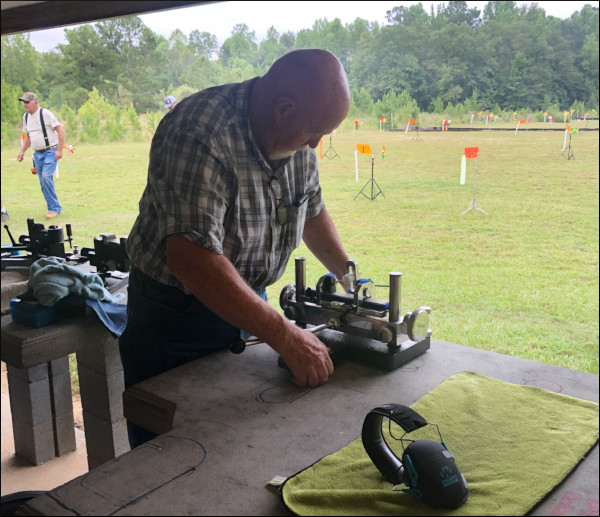
Jerry Powers from the Ashe County gang setting up a SEB MAX. SEB rests, both MAX and NEO, are very popular with score BR shooters.
This feature story comes from 5-time NRA National Long-Range Champion John Whidden. In this article John, who runs Whidden Gunworks, talks about the Palma rifle he has used at the Camp Perry and Camp Atterbury National Matches and other major competitions. This unique .308 Win prone rifle features a Barnard “P” action in a converted aluminum Anschutz “Precise” smallbore (rimfire) stock. The combo of Barnard action and Anschutz ergonomics is hard to beat, says John, who told us: “this is easily the best Palma rifle I’ve ever had.”
As a bonus, the Barnard “drop-in” required no modification of the Anschutz Precise stock. This means John can actually swap in his rimfire barreled action and shoot smallbore with the same stock.
Whidden’s Perfect Palma Match
Whidden secured his 2017 NRA Long Range National Championship title by shooting “clean” (not dropping a point) in the tough Palma competition. In the NRA Palma match, rifles must be .223 Rem or .308 Winchester, with metallic sights (no scopes). The match is conducted at three yardages, 15 shots at each distance of 800/900/1000 yards, with unlimited sighters at 800 and two sighters at 900 and 1000.
Whidden’s Championship-Winning Rifle
Since John captured his fifth Long Range crown with a superb performance in the Palma match, we thought we’d give readers a look at John’s very special Palma rifle. This unique .308 Win prone rifle features a Barnard “P” action in a converted aluminum Anschutz “Precise” smallbore (rimfire) stock. John told us this gun handles like no other: “After recoil, with this Anschutz stock, the sights fall right back on target — better than any other prone rifle I’ve shot”.
As a bonus, the Barnard “drop-in” required no modification of the Anschutz Precise stock. This means John can actually swap in his rimfire barreled action and shoot smallbore with the same stock.
Sling Rifle Evolved: The Ultra-Accurate Hybrid Palma Rifle
by John Whidden
The mental component of Long Range competitive shooting is always challenging but having tremendous confidence in the accuracy of your equipment is a huge benefit. There’s nothing to start your Palma match off well like knowing that you are shooting the most accurate Palma rifle you’ve ever owned.
After winning an NRA Long Range National Championship at Camp Perry, there are always plenty of questions about the equipment used by those at the top. Shooters are always looking to learn what is the best equipment at any given time so that when the time comes to spend our own hard earned dollars we can make the best choices. Even if you shoot an entirely different discipline knowing which manufacturers are making winning gear is very valuable.
Whidden .308 Winchester Palma Rifle
Action: Barnard “P” (three lugs, 60° bolt lift)
Barrel: Bartlein 32″, Light Palma contour, cryo-treated by 300 Below
Stock: Anschutz Precise aluminum smallbore stock, set up for centerfire barreled action
Trigger: Barnard Two-Stage adjustable
Whidden’s Wonder-Gun: German Stock, New Zealand Action, American Barrel
The Palma rifle I shot this year at Camp Perry is one that I have been super pleased with. I built the rifle early this year and the major components are a Barnard P action, Anschutz Precise smallbore stock, and Bartlein barrel. The caliber is .308 Win, as dictated by the Palma rules. Palma matches are fired from 800, 900, and 1000 yards utilizing iron sights only. No optical sights are allowed.
The Anchutz Precise stock is so well-designed that once I finished adjusting the details, I realized that my hold was about 1/3 smaller than with the stocks I shot previously. While in recoil the gun will track vertically and fall back down right on my own target just as it should. In the past, with my other Palma rifles, it was frankly sometimes a struggle to get them to settle back on target after a shot.
Whidden Gunworks has installed a variety of different actions in the Anschutz Precise stocks. Though the stocks are designed for the .22 LR caliber 2013 action rifles, we’ve successfully installed Barnard, Kelbly, Bat, Nesika, and Remington clone actions into them. The Barnard Model P makes a particularly simple installation because there is no modification necessary to the stock at all. A competitor can then shoot both his centerfire rifle as well as his smallbore gun in the exact same stock. The location of the trigger and bolt handle on the Barnard are positioned just right to make this work. Other actions do require at least some amount of modification to the stock, and we have found the Barnard works the best.
Barnard manufactures several models of actions as part of their lineup. All of the actions in the lineup use three lug bolts which give a shorter 60-degree bolt lift when opening and closing. All of the critical surfaces are machined after heat treating. This means that they are exceptionally true and square, more so than other actions. The Model P action is most familiar to Palma and F-Class shooters and are commonly seen on the firing line. The fact that Model P actions include an excellent two-stage trigger makes also the pricing very attractive.
Based on my previous excellent experiences, I selected Bartlein barrels for this rifle. When shooting internationally in the Palma matches we are restricted to 155 grain .308 bullets, but I made the unusual choice of a 1-10″ twist for these bullets. I’ve shot this fast twist for some years with the 155s with good success and it’s pleasing to know that Bryan Litz is finding benefits in some cartridges to shooting faster twist rates than we previously thought we needed. The chamber is the 2011 Palma and the barrel is a Light Palma contour finished at 32” length. The barrel was cryo-treated by 300 Below. The point of impact isn’t changed at all by barrel heating and the accuracy is incredible regardless of the temperature of the barrel. This can’t be said of all the barrels I’ve owned.
Get Your Own Wonder-Gun from Whidden Gunsworks
Like what you see? Whidden Gunworks can build you a rig like this, fitting a centerfire barreled action in the Anschutz Precise stock. John tells us: “Call us to find the current all-up price for a special rifle like this with Barnard or other suitable custom action, and Anschutz stock. We attempt to keep all of the parts except the stock in inventory, so lead time should be under eight (8) weeks.”
Stock Offers Great Adjustability One thing that is quickly noticed about the Anschutz Precise stock is its adjustability. The engineers did a very good job of allowing many of these adjustments to be made while in the shooting position, most notably the cheekpiece adjustments. When a shooter picks up a Precise stock for the first time they also notice how narrow the fore-end is. This really contributes to reducing the pain in the forward hand in prone when shooting with a sling. This stock is, by far, the most comfortable sling stock I’ve ever handled.
This rifle was very accurate right away and very comfortable to shoot. I’ve built some really good shooting Palma rifles but this is easily the best Palma rifle I’ve ever had. The Barnard action with its superb quality and excellent two-stage trigger has been the best choice I could have made. When you can go to the firing line knowing that you have the very best, the foundation for success has been set.
The inaugural Hornady Precision Hunter Steel Challenge took place in Colorado August 8 and 9. This unique competition involved lots of hiking with various shooting positions in challenging natural terrain. The unique match was hosted at the Cameo Shooting Complex near Grand Junction, CO.
There were 135 registered competitors — quite a turn-out for a physically demanding match in a fairly remote location. Congrats to Heavy Class and Overall Winner Brian Black who topped the field with 140 Match points (100% of possible). Brian shot a 6.5×47 Lapua with Berger 6.5mm 140gr Hybrids. Brian’s winning rig featured a Lone Peak Arms Fuzion action, Benchmark barrel, and XLR Element chassis. Behind Brian was Serger Ducourneau in second with 134 points (95.71%). Eric Anderson finished third overall with 129 points (92.14%).
Overall and Heavy Class winner Brian Black (center) with trophy.
The Hornady Precision Hunter Steel Challenge tests a rifleman’s fitness and skills as marksman and hunter. The stages were blind with a 4-minute time limit to move to the shooting area, locate, range, and engage targets. Shooters could choose between two rifle weight classes (light or heavy) and had to meet a minimum power factor cartridge requirement that helped even the playing field. The match featured a diverse course of fire with a good mix of prone and natural terrain shooting positions. Look at the images — this was no ordinary shooting match, and natural terrain features were employed much more than at any PRS match.
Hornady wanted to thank Match Director, Scott Satterlee, the Cameo Shooting Complex and all of the volunteers and sponsors that made this match possible.







 ELEY is excited to launch its brand new ELEY Precision Club, allowing competitors from all over the world to compete against each other from their local shooting clubs. Scores will be tallied online through an exciting Masters series of events. Winners can be recognized as a World Champion. In addition, top shooters compete for valuable cash, ammunition, and clothing prizes.


 Champion shooter Kevin Nevius grew up in a household that did not allow firearms, an unlikely beginning for one of the United States’ premier prone rifleman and gunsmiths. Once out on his own he fell in with his brother who enjoyed long-range varmint hunting. His natural bent for things mechanical (he is a professional structural engineer) soon had him tinkering with rifles, which eventually led him to building his own.




 One thing that is quickly noticed about the Anschutz Precise stock is its adjustability. The engineers did a very good job of allowing many of these adjustments to be made while in the shooting position, most notably the cheekpiece adjustments. When a shooter picks up a Precise stock for the first time they also notice how narrow the fore-end is. This really contributes to reducing the pain in the forward hand in prone when shooting with a sling. This stock is, by far, the most comfortable sling stock I’ve ever handled.


