In July and August we should be talking about the CMP Games at Camp Perry (Ohio) and the National Matches at Camp Atterbury (Indiana). Instead, all these events have been cancelled due to the COVID-19 Pandemic. Thankfully, the CMP is organizing a local match series that can provide some competitive fun in summer 2020.
To fill the void of the unfortunate withdrawal of the 2020 National Matches from the annual schedule, the Civilian Marksmanship Program (CMP) have prepared a solution that will allow competitors to compete with one another during the summer months at their local ranges.
The CMP has created special series of matches for Summer 2020 — the “Home Range Appreciation Series”, a collection of High Power rifle, pistol, smallbore rifle, air rifle and pistol competitions, shot at local facilities, and open to both adult and junior athletes. Scores from all the CMP-sanction home range matches will be complied together, and all participants will receive a commemorative t-shirt and coin. In addition, sponsors will provide awards such as gift certificates, memorabilia, and ammunition.
Home Range Shooting Matches are Underway
Since early June, scores have been pouring in weekly for the CMP’s (CMP) Home Range Appreciation Series of events. Introduced to supplement the cancelled 2020 National Matches in Ohio and Indiana, clubs from Texas, Mississippi, Wyoming, New York and several other states have conducted an assortment of rifle, pistol, smallbore and air rifle competitions at their local ranges.
One Home Range event was held at Hornell Sportsman’s Club in New York. “Thanks, CMP, for opening the Home Series,” said the Club’s CMP match coordinator, Joe Menichino. “We are all disappointed that the Perry matches were cancelled, and this series gives us a chance to shoot and compete.”
GENERAL INFORMATION
Each local match will be sanctioned by a CMP Affiliated club. All matches MUST be fired by September 8 and results received by September 14, 2020. All results will be final on October 1, 2020. A list of matches will be posted on the CMP website. Participants may fire in more than one event of the same discipline, but only the scores of the first event will be recorded, with the exception of the White Oak 1600 Aggregate which is two 800 Aggregate matches. This event maybe fired at different locations for competitors to complete their two 800 Aggregate matches.
SAFETY and HEALTH CONSIDERATIONS
The CMP reminds clubs to follow all state and local health guidelines and health advisories. Recommended range health practices include: limiting/spacing the number of participants who congregate for safety briefings, spacing out firing points, leaving empty firing points between shooters, ensuring participants wear masks, washing hands frequently, providing disinfectant wipes, and continuously cleaning common surfaces such as shooting benches and equipment.
For questions on Rifle, Pistol or Games Matches, contact Christina Roguski at croguski [at] thecmp.org or (419) 635-2141, ext. 714. For questions about Smallbore Matches, contact Brad Donoho at bdonoho [at] thecmp.org or (419) 635-2141, ext. 730. For Air Rifle match questions, contact Katie Harrington at kharrington [at] thecmp.org or (419) 635-2141, ext. 731.
The sound of bullets ringing steel were heard all over the country over a three week period in July, during the 2020 Scholastic Action Shooting Program (SASP) National Virtual Championship. Over 248,000 rounds were sent down range as SASP athletes competed from their home ranges around the country. Photo and match results were posted on social media. Scores were then tallied and compared among hundreds of entrants. The ability to compete at Nationals from their home range gave teams all over the country the opportunity to finish the season as a team, competing for the national title.
Just last year, the SASP National Championship surpassed the Glock Shooting Sports Foundation (GSSF), to become the largest Action Shooting Match in history. Despite a heavily altered 2020 season, the SASP community continued to break records for participation with 1,656 event entries for the 2020 SASP National Championship.
“Virtual” Championship Held at Multiple Locations throughout the USA
Traditionally held at the Cardinal Shooting Center in Marengo, Ohio, the 2020 SASP Nationals were instead conducted in a multi-location “virtual” format. This arrangement was made “in order to protect the safety of our athletes, coaches, and familie” according to SASP National Director, Rick Leach. “The nature of our sport puts athletes and range officers in close proximity, which we could not in good conscious do with thousands of athletes in Ohio this year. We received hundreds of photos and videos from teams competing in Nationals from their home range.”
You can see SASP 2020 National Championships Results online. Just select the firearm category and class of shooters. For example, here are Centerfire Pistol Men’s results for all categories. Click image to zoom.
“This year we saw participation grow to states that are not always able to make the journey to Ohio each year for Nationals,” said SASP Director of Development, Kelvin Walton. “Although the spectacle of teams converging on the Cardinal Center to compete is part of the Nationals experience, the SASP community made the most out of an unusual season.”
What happens when a round goes off unsafely in an AR? Watch this video and see. At about the 00:40 time-mark the shooter has a malfunction (click no bang), with a round. He then removes the magazine, and clears the chamber (we think). On the next round, at 00:53 you hear a “Bang” and see a big puff of smoke coming out of the upper receiver (see photo at right). This has been called a “detonation” by the video-maker, but we’re not 100% sure what happened. What do you guys think? Watch the video carefully, and state your conclusions in the comment section if you wish.
What Caused this Malfunction? Watch Video…
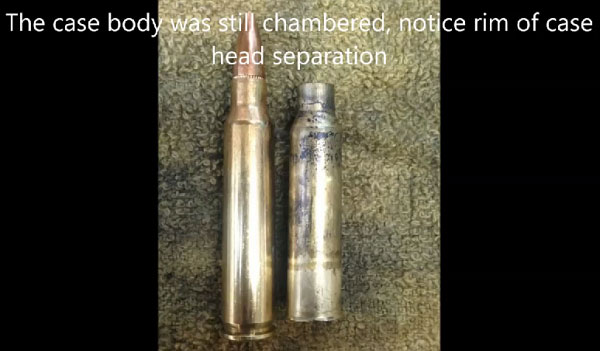
In any event, the shooter is fortunate his upper did not completely fracture, launching shrapnel into his face or other body parts. This could have turned out much worse. Here are screen-shots from the video, showing details of the gun after the accident, along with the recovered brass case, which separated near the case-head.
The Sniper’s Hide Cup competition went forward this year, despite challenges presented by the COVID-19 pandemic. The event took place June 20-21, 2020 in Colville, WA. This was a backcountry match, set in beautiful green mountain scenery. Here are images from the 2020 SH Cup as posted on the Sniper’s Hide Facebook Page. Congrats to Frank Galli (aka “Lowlight”), founder of Sniper’s Hide, and all the participants in the event. Looks like a great two days of shooting.
The Everyday Sniper Episode 260: Sniper’s Hide Cup 2020
After the 2020 SH Cup event, Frank Galli hosted an informative podcast:
Topics include: Stages, Targets, Equipment, Mindset, First-Time Competitors
Frank: “I’m back from the Sniper’s Hide Cup in Colville, Washington. I’ll be breaking down some lessons learned and give you my observations from the field and competitors with whom I spoke. [We cover] the experience of attending a match and helping new shooters — the juniors, the first time competitors, and how you work with them. Thanks for listening, sharing, and commenting on the Everyday Sniper Podcast.”
With the COVID-19 Pandemic, many shooting ranges remain closed or severely restricted. And in some cities there are still stay-at-home orders in place. If you’re an avid rifleman who enjoys shooting regularly, the Pandemic lock-down can bring withdrawal pains. The closure of outdoor ranges can mean months of forced inactivity, unless you have indoor shooting solution — such as this indoor airgun target backer system from Creedmoor Sports.
If you cannot practice at a nearby public range, Creedmoor Sports offers a great solution for those who want to shoot indoors — even in your own basement or garage.
Creedmoor’s patented 10m Air Gun Range provides a target holder and a curtain-type backstop capable of stopping pellets with a muzzle velocity up to 600 fps. The target boxes can be positioned at various heights for prone, kneeling, and standing. Creedmoor says the hardened steel target boxes provide 100% containment for any pellet passing through the target.
Creedmoor’s Air Gun Range is a proven, heavy duty product — the only Air Rifle target system ever tested and approved by the U.S. Military. This system is now being used in more than 800 schools nationwide, as well as the CMP shooting facility in Alabama. The 3-station range easily dis-assembles for transport and storage, fitting inside a 34″ x 10″ x 8″ carry duffle. The one-station range measures 84″ high x 30″ wide when assembled.
The Portable Air Gun Range comes with a durable curtain/ backstop that sets up quickly and easily. Velcro edging allows multiple curtains to be joined together. The curtain provides ample stopping power for air pellets. However, this is NEVER to be used with rimfire or centerfire rounds, or even high-energy pneumatic hunting rifles. This is for standard airguns only. That could be a $100 Crosman, or a $3600.00 Model 9003 S2 Anschutz:
Important news for 1000-yard benchrest competitors! The 2020 IBS 1000-yard National Championships will be held September 5 and 6, 2020 at the Vapor Trail Valley Range in Missouri. Take note — the IBS 1K Nationals were originally going to be held at the Hawks Ridge Range in North Carolina. So the event has moved from NC to Missouri, and will be held later in the year. This change was done because of uncertainties over COVID-19 public health policies/retrictions in North Carolina. Also, moving the Nationals to early fall gives more time to organizers to plan the event.
Forum member David 0306 from North Carolina observed: “As many of you have probably already heard, the 2020 1000-yard IBS Nationals has been cancelled for Hawks Ridge Gun Club in North Carolina. [Due to] uncertainty of what phase the NC Governor will have the state in, and the possibilities of going back into a stay-at-home order, the board at Hawks Ridge decided it was in the best interest of the shooters to cancel and allow another club to host the Nationals if possible. This will also help with travel plans, and getting time off from work. What I do know is Vapor Trail Valley has stepped up to the plate and has agreed to host the Nationals. Thank You Vapor Trail Valley and IBS shooters for your help and support through these difficult times.”
This site is for and about accurate shooters. So today we feature the short-range group Benchrest game, where it’s all about shooting tiny groups in the ones and even “zeros”. Seeing the tiny groups 6 PPC aces produce, it’s easy to think the precision is all about the equipment. But there is a lot more involved. A talented human still has to watch the flags, run the gun properly, and tune his loads for the conditions. Here are some tips from one of the world’s best benchresters, Charles Huckeba.
Texan Charles Huckeba was the top individual shooter at the 2013 World Benchrest Championships (WBC) held near Sydney Australia in October 2013. In this video, 2013 WBC Two-Gun Overall winner Charles shoots a 1/8th MOA group at 200 yards — “a little bitty dot” as a fellow Team USA shooter observes. That’s impressive. If you can describe Huckeba’s style in a nutshell it would be “smooth, consistent, and rapid but not hurried”.
Charles also employed some unusual hardware. In the video, take a close look at the joystick on the Farley Coaxial front rest. There’s no knob at the end. In its place is a small, wood ammo caddy. Charles removed the standard knob from the handle of his Farley rest and replaced it with a home-made wood block that holds cartridges for the record target. The 10.5-lb Light Varmint rifle is chambered in 6PPC with a BAT Machine Action and a composite wood and carbon-fiber stock.
Watch Charles Huckeba Shoot 1/8 MOA, 200-yard group at World Benchrest Championships
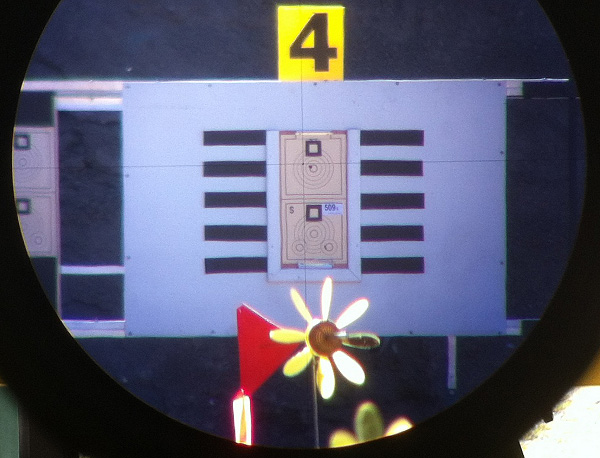
Here is the actual 200-yard, 5-shot group Charles shot in the video. Photo (by Stuart Elliot) taken through the lens of Huckeba’s 50X March scope (reticle has 1/16th MOA Dot).
Analyzing the Fine Points — What Makes Huckeba So Good
Short-range benchrest shooter Boyd Allen saw some interesting things in Huckeba’s WBC performance, as captured on video. Boyd noticed Huckeba’s smooth gun-handling and efficient loading. But Boyd also spied some interesting equipment, including an innovative joystick “handle-caddy”.
1. Low Friction Bags — When Huckeba slid his rifle, there was very little apparent friction. The front bag features the new 3M material (ScotchLite) on the sliding surfaces. The rear Protektor bag has ears of the same low-friction material.
2. Pause Before Chambering — While he was watching the flags and deciding when to start firing, Charles kept his first round in the action, but out of the barrel’s chamber, probably so as not to heat the cartridge and change the round’s point of impact.
3. Ammo Caddy on Joystick Arm – Charles shoots a Right Bolt/Left Port action, so he pulls his rounds with his left hand. Note that Huckeba’s record rounds rest in a small, wood ammo caddy attached to the end of the joystick shaft. Look carefully, you’ll see the wood ammo block in place of the normal black ball at the end of the joystick. That allows Charles to pull shots with the absolute minimum of hand movement. Ingenious! Huckeba is very fast, with a great economy of motion. I believe that because his ammo was literally at hand, Charles was better able to keep his focus on aiming and the flags.
4. Smooth-Cycling BAT Action — Note how smoothly Huckeba’s action operates. When Charles lifts the bolt handle (to extract a round and cock the firing pin), this does not disturb the rifle. Likewise, as he closes the bolt, the gun doesn’t wobble. The smooth action allows Charles to hold point of aim even when shooting relatively quickly. Huckeba’s BAT action is chrome-moly steel. Some shooters believe this metal makes for a smoother action than stainless steel or aluminum.
5. Long-Wheelbase Stock — The wood and carbon fiber stock is light, long, and stiff. Yet, importantly, the stock is also well-damped. The longer-than-average stock length (with extended forearm) seems to help the gun track well without jumping or rocking. The longer forearm allows a longer “wheelbase”, effectively shifting the weight distribution rearward (less weight on the front, more weight on the rear). This places a greater share of the gun’s weight on the rear bag, as compared to a more conventional benchrest stock. Huckeba’s stock, built by Bob Scoville, is at the cutting edge of short-range benchrest design. Its light-weight balsa wood and carbon fiber construction provides a combination of stiffness and vibration damping that allows its relatively long fore-end to be fully utilized to increase the weight on the rear bag (always an issue with 10.5-pound rifles).
To learn more about this benchrest stock design, read the comments by stock-builder Bob Scoville in our PPC with Pedigree story in our Gun of the Week Archives. Bob observed:
“There is a lot more to the structure of the stocks than meets the eye. The carbon fiber skin with which I cover the stocks creates a light, tough exterior surface. However, this contributes very little to the overall performance of the stocks. The real strength and stiffness is the result of an internal beam utilizing balsa core/carbon fiber technology.
This type construction can be found in aircraft, race cars, powerboats, and sailboats. It is interesting to note, balsa has the highest strength to weight ratio of all woods and carbon fiber is one of the lowest stretch (modulus of elasticity) relative to weight of all materials. The marriage of these two materials is common in the high-performance world. Additionally, balsa is used commercially for vibration dampening and sound reduction.”
Video find by Boyd Allen. Video by Stuart Elliot of BRT Shooters Supply, Brisbane, Australia.
Kirsten Weiss knows a thing about accuracy. She won the 2012 NRA Three-Position Women’s Smallbore Championship, while finishing as the National Overall Woman Champion. She used to shoot with the American team in top-level World Cup competition. Kirsten started shooting fairly late — at age 16. Despite her relatively late start, she earned a place on the University of Nebraska shooting team. That literally opened up a new world for Kirsten: “During the course of my career, I’ve had a lot of success. I’ve gone to World Cups… in Zagreb, Croatia, in Munich, Germany. I’ve won National Championships, and got on to the U.S. Olympic short list, so it’s been a good career.”
In these three videos, Kirsten offers key tips on accurate shooting. In the first video she explains how to get and maintain the proper cheek weld on your rifle. In the second, Kirsten talks about canting error — how having inconsistent side-to-side tilt on your rifle. In the third video, Kirsten explains the importance of proper trigger placement.
Proper Cheek Weld
No matter what your discipline — smallbore, silhouette, High Power, F-Class, or even PRS — it’s vital to have a consistent cheek weld for every shot. You want your head to be in the same position on the stock each time.
In this video, Kirsten explains how to find the best position for your head on the stock, which may require adjusting the cheekpiece and/or length of pull. Then Kirsten demonstrates how to maintain consistent cheek weld shot after shot.
Consistent Rifle Cant (Tilt from Centerline)
Kirsten says most training manuals don’t explain rifle cant: “You won’t find this shooting technique just anywhere. Most shooters don’t even think about it — and they’re missing out. Proper Rifle Cant or Gun Cant (also known as cant error or even scope cant) is a complicated topic, but I’ll explain it simply — and how to simply avoid cant error.”
Want to know how to actually aim a gun right? This accuracy tip covers a crucial aspect of marksmanship. If you cant your rifle inconsistently from shot to shot, the point of impact will change, even with “perfect aim”. This is another episode in Kirsten’s How to Shoot Awesomely video series.
Proper Trigger Finger Technique
Kirsten tells us: “Finger placement on the trigger might not seem like a big deal, but it actually is. The reason for this is because, depending on where your index finger is placed on the trigger, [this] translates to different muscle interactions with the gun.” Watch this video to see Kirsten demonstrate proper finger placement (and explain problems caused by improper finger positioning).
When you pull the trigger, you only want to engage the last section of your finger, in order to avoid unwanted muscle engagement and to achieve a smooth shot. Remember there is a “sweet spot” between the crease (first joint) and the tip of the finger. If you position the trigger in that “sweet spot”, you should see an increase in your accuracy. Don’t make the mistake of putting the trigger in the crease of your finger, as shown below.
Modern F-Class and Palma Rifles are long. With barrels up to 32″ in length these big rigs won’t fit in your average gun case — either fabric covered or hard shell. Likewise, it seems like PRS rifle are getting longer each season, as competitors find longer barrels provide greater velocity and heavier rifles have more stability, allowing shooters to see hits better.
So, if you have a rifle that measures over 48″ in length, you have two options for transport — first separate the stock from the barreled action, or get a very large carry case that allows extended length rifles to be transported. This article reviews hard and soft rifle cases options for long-barreled rifles.
Large Hard Shell Rifle Cases (at least 50″ Interior)
What to Look For in Hard Rifle Carry Cases
When you are considering a large rifle case you, first measure your rifle and make sure it will fit within the INTERIOR dimensions. With some rifles you can make more clearance by removing or adjusting the buttplate system. Then consider the duties. If you will be traveling by commercial airline, you definitely need a hard case — no way around that. Will you be carrying one rifle or two — that will dictate the case you buy. For max flexibility you’ll want foam like the SKB so you can have various rifles. For max security during transport, however, it makes sense to have dense foam that is customized to fit your rifle.
SKB Double Rifle Case, 56″
Expensive but built like a tank — that describes SKB Cases. These high-quality hard sided cases are ideal for airline transport, with very tough exteriors, great padding, and strong hinges. The SKB model 2SKB5009 Double Rifle Case is an excellent choice for carrying two rifles long distances. This has a very tough exterior with a metal middle frame for extra strength. Priced at $304.99, this case has exterior dimensions: 56″ L x 16.5″ W x 9.5″ H. This photo shows the case carrying both an M1A and an M1 Garand. NOTE: The foam is not really customizable. This is not the best choice if you plan to carry a single rifle and a spotting scope and a second barrel.
Pelican Vault Series Rifle Cases
Pelican Products, known for premium hard-shell transport cases also offers a more affordable VAULT series of cases. Pelican’s VAULT cases offer durability and security at a lower price point. VAULT cases range in price from $39.99 to $199.95 and are backed by a 1-year guarantee. The VAULT rifle cases all feature wheels, easy-to-use push-button latches, and four stainless steel lock hasps for security. There is also a brightly colored Hi-Viz strip on the front of Pelican’s VAULT cases. This will make it easier to spot your case at airport baggage areas. At around $200.00, the model V800 double-rifle case features a 53″ x 16″ x 6″ interior. That’s long enough for F-Class rifles and tactical rigs with brakes. The model V770 single-rifle case is 50″ × 10″ × 6″ inside. That’s still big enough for most hunting, varmint, and benchrest rifles.
Plano Two-Gun Tactical Case
This Plano two-gun case is Amazon’s #1 Best Seller in wheeled, heavy-duty firearms cases. This is offered in three sizes: 36″, 42″, and 52″. We like the biggest 52″ version, ($115.99 on Amazon), as it is long enough inside to fit most scoped match rifles. Alternatively, if you have a really long F-Class, ELR, or Palma rig, you can detach the barreled action from the stock, and run the two sections in the shorter 42″ case. The big case lets you easily carry TWO scoped hunting rifles. That’s great because this case is strong enough for airline travel, meeting FAA requirements for checked baggage. This Plano case offers a good balance between strength and weight, all for a reasonable cost.
Large Soft Rifle Cases (at Least 50″ Interior)
What to Look For in Soft Rifle Carry Cases
With soft cases, look at the quality of zippers, slings, and shoulder straps. It’s nice to have pockets, but remember most of your accessories (spotting scopes, stands, bipods, rear bags etc.) will be carried separately, so the pockets may not really be that critical. Consider the fabric — is it waterproof? That’s important if you live in a wet region such as Oregon or Washington.
Champions Choice Deluxe 58″ Rifle Case, $72.00
Many of our readers shoot Palma, F-Class, and ELR rifles with long barrels (up to 35″). It’s difficult to find high-quality, well-padded cases that fit very long rifles. Champion’s Choice offers just such a product, the 58″ Deluxe Soft Rifle Case. With thick 1″ padding on each side, big pockets, and backpack straps, this black/blue/white gun case has earned rave reviews from our Forum members. There’s plenty of room for big scopes, and it even comes with an internal tube to hold your cleaning rod.
Bulldog 54″ Long Range Rifle Case, $106.99
Highly rated by buyers, Bulldog Long Range Rifle Case fits rifles up to 52.5″ long. Priced at $106.99 at Guncases.com, the Bulldog LR has many impressive features, and is one of the best soft cases you can buy for long match rifles. This versatile case boasts a tough 600-dernier water-resistent outer shell, plus quilted inner lining with Velcro tie downs. There are two zippered center pockets plus an external zippered pocket at front for suppressor storage. The main compartment zippers are lockable.
Creedmoor Sports 52″ Nylon Case for Match Rifles, $76.95
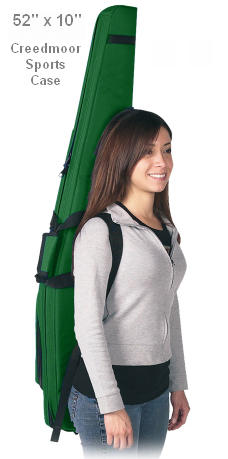
52″ Creedmoor Sports Soft Case
At the request of many High Power shooters, Creedmoor Sports has created a high-grade 52″x10″ softcase. That’s tall and long enough to fit a Tubb 2000, or AR-based spacegun with long barrel. The Creedmoor case is one quality offering, with nice 1″ thick close-cell foam padding plus tough Cordura nylon on the outside and nylon pack cloth on the inside. Both materials are urethane-coated for water proofing. Another nice feature are the integral backpack straps (see photo left). These free your hands to carry rests, spotting scopes or other gear.
Savior double rifle cases come in sizes from 36″ to 55″ in an assortment of colors. A great choice for long PRS and match rifles, the biggest Savior Gun Case (55″ model) can hold two rifles up to about 53.5″ OAL. Multiple colors and five lengths are available: 36″, 42″, 46″, 51″, 55″. The big 55″ case is $96.99 at Amazon while the 51″ version is $91.99. With comfortable shoulder straps, these cases can hold TWO rifles and just about all the accessories you’d want to pack.
Extreme 52″ Midsouth Gun Case (Budget Option)
For those on a tight budget, Midsouth Shooters Supply offers an Extreme 52″ padded gun case for just $30.16. This thickly-padded case is high enough in the center to fit most scoped rifles — even with big Nightforce scopes. Made by Bulldog Cases, the all-black Extreme 52″ case features a soft faux-fur inner lining, an external accessory pocket, and a removable shoulder strap.
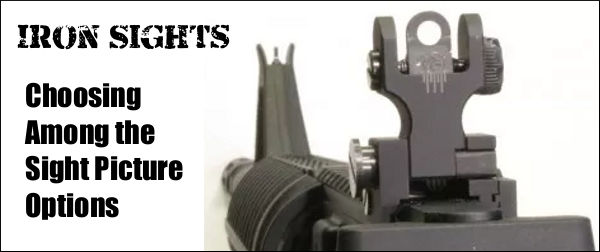
In an article for the CMP Online Magazine, SSG Tobie Tomlinson of the USAMU Service Rifle Team explains the various sight alignments employed by iron sights shooters. Tobie writes: “There are a myriad of sight picture options that shooters have used to great effect over the years. The sight picture that allows you to consistently shoot the smallest group, with a minimal shift in zeros, is the correct one. Remember, for any shooter to be successful, consistent sight picture must be complemented by front sight focus and sight alignment.” CLICK HERE to read FULL ARTICLE
Center Hold
The front sight is placed directly in the center of the target. A center hold is great in different light conditions. On a bright day the target appears small. On a dark day the target appears large. In [any] light conditions the center of the target is always in the center. A shooter who has problems with elevation shots in various light conditions may benefit from a center hold.
6 O’Clock Hold
With the 6 O’Clock hold the front sight is placed at the bottom of the aiming black. For many shooters, this hold allows precision placement of the front sight. The ability to accurately call your shots will come with time and experience. Light changes, which alter the appearance of the target, may affect shooters who utilize the 6 O’Clock hold.
Sub 6 Hold
The sub 6 is just like the 6 O’Clock hold, only there is a small line of white between the front sight and the aiming black. Many shooters have a problem determining the exact 6 O’Clock position with their front sight, but by using a sub 6 or line of white they may be able to better estimate their hold.
Frame Hold
With the frame hold, just like with the other holds, the front sight is in the center of the rear sight. The front sight can then be placed at the 6 or 12 O’Clock position on the frame when there is no visible aiming point. This hold is typically reserved for foul weather and poor light conditions. By placing the front sight at the top or bottom of the frame, a shooter may hold better when there is little target to see. It can be difficult to hold a tight group this way, but it may add more hits in bad conditions. This technique is normally applied when shooting longer ranges such 600 or 1000 yards.




 With the COVID-19 Pandemic, many shooting ranges remain closed or severely restricted. And in some cities there are still stay-at-home orders in place. If you’re an avid rifleman who enjoys shooting regularly, the Pandemic lock-down can bring withdrawal pains. The closure of outdoor ranges can mean months of forced inactivity, unless you have indoor shooting solution — such as this indoor airgun target backer system from Creedmoor Sports.



 3. Ammo Caddy on Joystick Arm – Charles shoots a Right Bolt/Left Port action, so he pulls his rounds with his left hand. Note that Huckeba’s record rounds rest in a small, wood ammo caddy attached to the end of the joystick shaft. Look carefully, you’ll see the wood ammo block in place of the normal black ball at the end of the joystick. That allows Charles to pull shots with the absolute minimum of hand movement. Ingenious! Huckeba is very fast, with a great economy of motion. I believe that because his ammo was literally at hand, Charles was better able to keep his focus on aiming and the flags.


 52″ Creedmoor Sports Soft Case

 In an article for the
  Center Hold
 6 O’Clock Hold
 Sub 6 Hold
 Frame Hold


