Video Podcast about Rimfire Testing June 10, 2020
Lapua’s Rimfire Performance Center East (Ohio) Manager Luke Johnson talks about rimfire ammunition testing on “The Shooter’s Mindset” Podcast this week. During this hour-long episode, Luke explains how rimfire ammo is tested in Lapua’s test tunnel facilities.
During this June 2020 podcast (see video below), The Shooter’s Mindset (TSM) hosts covered all aspects of rimfire performance testing with Johnson. Johnson explained the testing process, the importance of ammo testing, how to best identify good groups, and the benefit of having multiple lots of ammunition while shooting competitively.
“Many shooters are familiar with Lapua’s Rimfire Performance Centers, but have yet to take advantage of the service. Both of our facilities offer shooters the opportunity to test various styles and lots of Lapua ammunition under tightly controlled conditions”, stated Johnson. “Our goal is to help shooters match the perfect lot of ammunition with their rifle so they may hit the range with confidence knowing their ammunition will perform.”
About Luke Johnson — Smallbore Silhouette Champion
Luke Johnson is the manager of the Lapua Rimfire Performance Center housed at the Cardinal Shooting Range near Columbus, Ohio. Luke, a native of Marysville, PA, has a long background of competitive shooting and hunting.
Johnson was a four year letterman for the Univ. of Alaska-Fairbanks D1 Rifle Team. In addition to his 3P/Prone shooting pedigree, Luke is a High Master rifle silhouette competitor and past National Smallbore Silhouette champion.
NRA Smallbore Rifle Silhouette Champion
USA Junior National Champion (50 meter rifle)
NCAA – CRCA All-American
Patriot Conference – All-Conference
About Lapua
Lapua produces the highest-quality small caliber cartridges and components for civilian and professional use. Lapua is a part of the Capstone Precision Group, exclusive U.S. distributor for Berger, Lapua, Vihtavuori and SK-Rimfire products. For more information, visit Lapua.com.
Today’s Sunday GunDay story features a beautiful F-Open rifle from Ireland. This was crafted a few years back, but it’s still one of our favorites. It has a handsome thumbhole custom stock, and it boasts an unusual chambering — the .300 Blaser Magnum. This impressive rig carries its barreled action in a massive barrel block — not often found in F-Class rigs.
Here’s a very impressive F-Class project from Enda Walsh of Custom & Precision Rifles in Ireland. This rifle features a free-floated BAT Machines ‘M’ action with a Benchmark barrel chambered in .300 Blaser Magnum (300 BM). The barreled action is secured with a large barrel block. This handsome, long-wheelbase F-Class rig demonstrated some stunning accuracy at 1000 yards when it was brand new. Enda tells us: “I couldn’t wait until the rifle was fully polished before testing. I went to MNSCI (Midlands National Shooting Centre of Ireland) to shoot my new barrel block rifle. I came home with a huge smile on my face after shooting a five-shot group with 1.5″ vertical and 3″ horizontal at 1000 yards in an 8 mph wind.”
Click Photo for full-screen version
AUDIO FILE: Enda Walsh Talks about his New .300 BM Barrel Block F-Open Rifle.
Below you can see the barrel block in the handsome Padouk wood and carbon fiber stock. Enda uses high-spec epoxy layered between the barrel and the aluminum barrel block. Yes, those three “super-sized” cartridges are .300 Blaser Magnums loaded with with 230gr Berger Hybrids. The smaller cartridge is a .308 Win (with 150gr bullet), provided for comparison. This .300 BM drives the 230s at 3140 FPS.
.300 BM Runs 230-grainers at 3140 FPS!
Enda tells us: “I wanted something to beat the 300 WSM. After studying the .300 Blaser Magnum, I decided this was the [chambering] that could deliver high accuracy consistently and be able to shoot the 230gr Bergers at 3140 FPS. Using H1000 powder, they do very well but the case life is short at these speeds. We have backed them off a little and retained the accuracy and extended case life considerably.”
Enda says the 230gr Hybrids at 3140 fps drift much less in the wind than do 7mm 180gr Hybrids launched from a 7mm WSM. A quick run through JBM Ballistics for a 10 mph, full-value crosswind at 1000 yards (sea-level) tells the tale. JBM predicts 4.2 MOA horizontal deflection for the .30-caliber 230s at 3140 fps vs. 5.0 MOA for the 7mm 180s at 3050 fps. That 0.8 MOA difference represents more than 8 inches at 1000 yards. When you consider the small size of the F-Open X-Ring, you can see how the enhanced ballistics could be a game-changer in the wind.
Note the metal bag-rider “keel” on the underside of the buttstock.
Barrel Block Acts as Heat Sink
Enda needed a way to beat the heat, with this big case. He explains: “Because of the large case volume (roughly 82 grains of usable capacity) there are two issues. Firstly, throat wear, and secondly heat. To combat this I have a new reamer on order with slight alterations which will help the throat wear. To combat the heat affecting a 34″ barrel I decided to build a barrel block rifle. It was previously mounted in a standard stock, and when the barrel got too hot accuracy was an issue. The barrel block acts as a heat sink and also shortens the overhanging barrel considerably, which has greatly improved accuracy over a complete string. The block is made from aircraft grade aluminium.” As a final note, Enda wanted to thank Pacific Tool & Gauge for the special-order reamers.
More .300 Blaser Magnum F-Classers from Enda Walsh in Ireland
Here are three more .300 Blaser Magnum F-Class rifles Enda built for the 2014 European Championships at the Bisley Range in the UK. The color scheme comes from the Irish Flag.
And here is Enda Walsh himself shooting of of these rifles in Ireland:
A decade-and-a-half ago, our friend Robert Whitley created the 6mmAR, a wildcat based on the 6.5 Grendel necked down to 6mm. The great thing about the 6mmAR cartridge is that is offers superb accuracy with high-BC 6mm bullets, while working in AR15-platform rifles. The 6mmAR feeds and functions using 6.8 SPC or 6.5 Grendel AR magazines. We provided a full report on the 6mmAR way back in 2006.
Hornady Introduces the 6mm ARC Cartridge for AR15 Platform
Now Hornady, with no apparent credit to Whitley’s 6mmAR, has announced a copycat cartridge, which it calls the 6mm ARC (Advanced Rifle Cartridge). Hornady will offer loaded 6mm ARC ammunition and also cartridge brass. In addition Hornady will produce reloading dies, shell plates, modified case, and other accessories. SEE 6mm ARC SAAMI Specification.
Hornady states: “Hornady® is proud to introduce the new 6mm ARC (Advanced Rifle Cartridge). Recently tested, selected and fielded by a specialized group within the U.S. Department of Defense for its multipurpose combat rifle program, the 6mm ARC is a truly versatile cartridge that maximizes the potential of the AR-15 platform.” Hornady Ballistician Jayden Quinlan adds: “We subsequently modeled and tested a variety of designs in different calibers until we were able to produce the most flexible cartridge possible within the limits of the AR-15 system. The 6mm ARC does much of what larger cartridges can and everything that smaller cartridges can’t.”
NOTE: The rim diameter (0.441) and thickness of the 6mm ARC appear to be identical to the 6.5 Grendel as illustrated on page 40 of the SAAMI Industry Standards. From all we can tell, in other dimensions as well, this is a very close copy of Robert Whitley’s 6mmAR, a 6-6.5 Grendel wildcat. For example, 6mm ARC case length is 1.49″ vs. 1.51″ for 6mmAR. The Guns&Ammo report on the 6mm ARC states: “The 6mm ARC is based on the 6.5 Grendel. Hornady started by necking down the cartridge to 6mm and then pulled the shoulder back closer to the case head .030-inch. … Hornady also set maximum chamber pressure low at 52,000 pounds PSI. This slows extraction and makes it much less violent, prolonging the bolt’s life.”
There is an extensive discussion of the 6mm ARC on the Gun University website. You’ll find dimensions and performance numbers for the new cartridge along with videos showing the 6mm ARC cartridge tested in a Barrett AR-type REC7 DI rifle. Read Gun University Story HERE.
More Velocity Than a .223 Rem, Less Weight and Recoil Than a .308 Win
Hornady says the 6mm ARC “delivers substantially better ballistics than the [.223 Rem] and offers a much lighter gun/ammo system with 30% less weight than the AR-10/308 Win system. This new cartridge delivers less felt recoil than larger short-action-based cartridges, yet takes full advantage of modern, heavy-for-caliber 6mm bullets that provide excellent accuracy and ballistic performance at extended range.”
You can see a ballistic comparison between 6mm ARC, .223 Remington, and .308 Winchester in this Hornady chart:
Notably, a large number of AR gun-makers have committed to producing rifles or uppers chambered for the 6mm ARC. Some of these are: Adams Arms, Barrett, Brownells, Christensen Arms, GAP, Howa, Mossberg, Noveske, Odin Works, Radical Firearms, and Wilson Combat. In addition Geissele and CMC Triggers are listed as suppliers on Hornady’s 6mm ARC webpage.
The Proven Lapua Brass Alternative — 6mmAR and 6mmAR Turbo
If you want 6mm ARC performance in your AR15 with superior case life and consistency, consider doing the 6mmAR or 6mmAR Turbo instead. These are proven designs with winning records in high power competition. Redding produces dies, and complete uppers (with proper Grendel-sized bolt face) are available from 6mmAR.com.
Superior Accuracy with Impressive Ballistics
Robert explained to us: “Lapua’s Grendel brass is of exceptional quality, very hard at the back, with a well-annealed neck area, and it has a small primer pocket and small flash hole. When you start with this kind of brass, you have all the ingredients of great accuracy. Necked down to 6mm, it is like a long-bodied 6 PPC, that feeds and shoots well out of an AR-15. This gives you a case that can handle high pressures, with the accuracy pedigree of the 6PPC. It doesn’t get much better than that.”
To create the 6mmAR simply neck-down parent Lapua 6.5 Grendel brass, which has small primer pocket and small flash hole. Case capacity is 36.0 grains of water, filled to over-flowing. (For comparison the 6mm PPC holds about 32.5 grains). To prepare cases, simply run the 6.5 Grendel brass through a Redding 6mmAR full-length sizing die. The FL die’s internal neck diameter (0.267″) is spec’d to deliver about .004″ tension on the bullet–just right for a gas gun. Redding’s 6mmAR dies were built to Whitley’s specs and closely match the actual dimensions of the Lapua brass. This video from Robert Whitley shows how to form 6mmAR cases from Lapua 6.5 Grendel brass.
Velocities: With the recommended medium-burn-rate powders, bullets in the 85- to 90-grain range can be pushed to the 2800 to 2850 fps range. In most 6mmAR rifles, the 105- to 107-grain bullets can be driven to velocities of 2700 to 2750 fps in a 24″ or longer barrel. More speed is possible, but don’t count on it with the average barrel. If you want more speed the 6mmAR Turbo offers additional case capacity. This allows the 6mmAR Turbo to drive the heavier 6mm bullets at velocities close to 6mmBR Norma cartridge levels.
Magazines: The correct magazines are the key to a reliable, competition-worthy system. For best results with the 6mmAR or 6mmAR Turbo, use special 6.8 SPC mags or Alexander Arms Grendel mags. Those specialized mags will provide better reliability than standard .223 Rem/5.56 mags for the AR15.
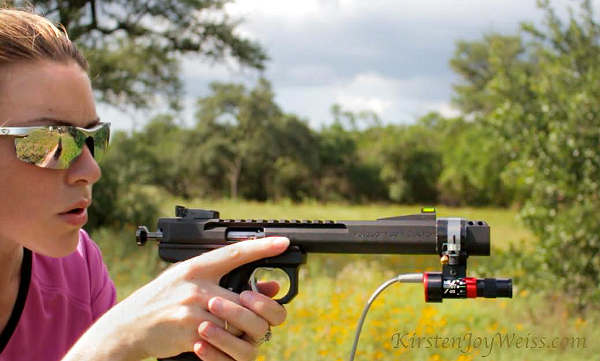
“SCATT” — if you’re an Olympic Class air rifle or smallbore competitor you know what SCATT means. The Russian-made SCATT is a marksmanship training system with an electro-optical sensor that fits on the end of a barrel. The sensor “sees” the target and then tracks your muzzle movement relative to the center of the target, recording a “trace” that can be displayed on a computer. The SCATT MX-02 unit works for live-fire training as well as dry-fire training. There is also a newer SCATT MX-W2 wireless system that works for dry-fire AND live-fire training. To learn more about the SCATT electronic trainers, visit SCATTUSA.com.
Pro shooter Kirsten Joy Weiss demonstrates the SCATT MX-02 electronic training system:
The system traces and records valuable information such as hold pattern, shot hold duration, follow-through, recoil pattern, and much more. The latest SCATT MX-02 systems can be used both indoors and outdoors up to 300 meters (and possibly more). READ FULL SCATT MX-02 TEST HERE.
SCATT traces reveal muzzle movements during the aiming process.
Kirsten Joy Weiss, a top-level competitive position shooter, has tested the latest SCATT MX-02 training systtem. She put the MX-02 through its paces, and then produced an informative video that shows how it works. Click on the video above to see Kirsten use the MX-02 with her Anschütz rifle and other guns.
Kirsten was impressed with the SCATT MX-02 she tested:
“We live with tech woven into our every day, so if you had the chance to work with a computer to make you a better shooter — would you? Can a computer train you as well as your favorite coach or, dare to say, better than a human?”
Weiss says it’s like having a little coach with you recording your every move. “If R2D2 had a cousin who knew how to shoot,” Weiss quips, “his name would be the MX-02″.
The SCATT MX-02 can also be used with target pistols.
The Civilian Marksmanship Program (CMP) now offers a discount program for Affiliated Clubs and individuals. This program allows discounted purchase of airguns and rimfire match rifles. This can help jump-start programs for schools, junior clubs, teams, and camps. The discounts will be significant. For example a Savage Mark I-FVT .22 LR Rifle can be purchased for just $257.00, a 46% savings over the $480.00 regular price!
To place an order or to learn more, visit the CMP website at thecmp.org/clubs/cmp-affiliate-rifle-purchase/. Or contact the CMP Club Sales Department at (419) 635-2141 x753 or email clubrifle@thecmp.org.
The CMP Affiliate Purchase Program currently offers .22 LR caliber smallbore rifles, .177 caliber sporter air rifles, and a few air pistols. The products are intended for junior athletes in target training and competition preparation at beginning and intermediate levels. Equipment now available includes:
.22 LR Target Rifles
Savage Mark I-FVT, single shot, RH or LH $257.00 each (reg. price $480.00)
Savage Mark II-FVT, 5-round magazine, RH or LH $257.00 each (reg. price $479.00)
(These rifles may be purchased by clubs only, not individuals.)
Anschutz 1903 .22 LR RH rifle in .22 for $1595.00. No discount for CMP clubs or individuals.
Precision .177 Air Rifles
FEINWERKBAU 500 10-meter .177 air rifle – Club and individual price $1275.00 (reg. price $1295.95) from Pyramyd Air.
Air Arms MPR .177 Air Rifle – Club and individual price $850.00 (reg. price $999.49) from Pyramyd Air’
Anschutz 9015 Club Rifle – Club and individual price $1895.95 (reg. price $2199.99) from Pyramyd Air.
Hammerli AR20 Air Rifle – Club sales only $840.00 (reg. price $969.99) from UMAREX/Hammerli.
Sporter .177 Air Rifles
Daisy 599 10 meter competition air rifle, $595.00 (no club or individual discount)
Daisy M887 Gold Medalist CO2 air rifle – Club and individual price, $305.00 (reg. price $499.99)
Daisy Elite 753W pump air rifle, wood stock – Club and individual price $257.00 (reg. price $449.99)
Daisy Elite 753S pump air rifle, black synth. stock. Club and individual price $194.00 (reg. price 449.99)
Air Arms T200, .177 air rifle, for clubs and individuals for $525.00 (regular price $579.99) Pyramyd Air.
.177 Air Pistols
Pyramyd Air offers two air pistols:
Alfa Proj Competition PCP Pistol, .177 for $749.99 (reg. price $799.99)
Air Venturi V10 Match Air Pistol, .177 for $239.99 (reg. price $264.99)
Long-Term Payment Plans Available
Delayed payment plans (with the exception of the Savage Mark I-FVT and the Savage Mark II-FVT) are available that allow payments for clubs over a two-year span (not open to individuals). Purchaser must have ordered over $500 worth of items in order to qualify for the delayed payment program.
We know that many of our readers have never personally participated in a short-range (100/200 yard) benchrest match. That’s understandable — moving backers are required in registered 100/200 benchrest (for group) matches, yet only a small percentage of ranges have that equipment. If you’re curious about the “point-blank” benchrest game, but haven’t had the chance to see it first-hand, check out this video created by youtuber “Taofledermaus”. On his YouTube Channel, you’ll find many other interesting shooting videos, including slow-motion target impact clips. This video shows the LV and HV guns, the flags, the gun-handling, the reloading set-ups, and of course, tiny little groups on targets.
Registered 100/200 Benchrest Match
Viewer Comments on the Video:
“There is a lot more to this game than just pulling the trigger. Record targets are 5-shot groups, 5 averaged together for an Aggregate. Most times the winning Agg is under .250″ for 25 shots at 100 yards. Rifles weigh 10.5 pounds for LV class. Used rifles can be had for about $1500. Then add in another $1000 for rest, bags, loading tools, bullets, powder, not to mention windflags.” — Vmhtr
“Benchrest shooting is sort of an ‘academy of shooting’. Lots of academic thought and measurements, handloading made with anal attention at detail. It’s much more thought than action. Most of those people made their tools themselves. [There are] It’s plenty of seniors because it takes patience, lots of patience. Sure a teenager ain’t gonna bother it.” — THP
“I was surprised they did all their hand loading right there on the spot. — I think you nailed it. It’s a super-precise sport. It’s expensive, it’s slow, and it requires a lot of travel, so it’s well-suited for retired folks. It’s gotta beat golfing!” — Tao
“I used to shoot 6mm PPC in a BR rifle. I spent so much time at the reloading bench that I just gave up on it all and switched to 22 rimfire gallery matches. Saved a lot of my sanity doing that….” — Walt
Magnified 8X view looking down-range at buffalo target.
Could You Hit a Steel Buffalo at 2240 Yards (1.27 miles) … with Iron Sights?
Impossible as that may seem, that’s exactly what Ernie Jimenez did some years back at the North Springs Shooting Range in Price, Utah (elevation 5,627′). Shooting a milsurp Swiss K31 rifle chambered for the 7.5×55 Swiss round, Jimenez placed four hits on a three-foot-high, bison-shaped steel target placed a staggering 2240 yards from the firing line. Not bad for a rifle which Jimenez acquired many years ago for just $99.00. Of course he did have plenty of misses along the way (and Ernie even managed to hit the plate shielding his camera).
This video is set to start half-way through, when the shooter starts making hits:
The whole process was recorded on video and posted on YouTube. The Long-Range Shooters of Utah say this is an official Guinness World Record for longest shot with iron sights. We can’t confirm that, but it still is an impressive feat. Jimenez had to compensate for a huge amount of bullet drop. His K31’s long-range military sights helped but he still had to aim well over the pink bison. To see how far that target is, watch the video at 14:30 — a camera at the firing line zooms all the way back until the bison is nothing but a tiny dot. The photo below show the target at 8X magnification, but it’s still barely visible.
Here’s the unmagnified, “naked-eye” view from the firing line. Can you see a pink buffalo at all?
Bullet Dropped Over 400 Feet along its Trajectory
To roughly gauge the bullet drop, we took a 7.5x55mm Swiss load from the Hodgdon Reloading Center. With max “book” load of H4350, a 168gr Sierra HPBT has a muzzle velocity of 2524 FPS. According to JBM Ballistics, that bullet will drop over 400 feet during its flight. That’s lot of hold-over! Assuming a 100-yard zero, 59° temp, and 5,600′ altitude, JBM calculates that the drop to 2250 yards is a stunning 210.9 MOA — that’s 4969.9 inches, or 414.15 feet!
In the first part of the video, shooter Ernie Jimenez talks about his hand-loads and his K31 rifle. Here is an example of the distinctive straight-pull K31 (Karabiner Model 1931). Image courtesy AIM Surplus.
Many of our Forum members have expressed interest in a recoil-reduction system for prone F-Open competition rifles shooting heavy bullets from powerful cartridges. A .300 WSM shooing 200+ grain bullets can definitely take its toll over the course of a match. One system that has been used with considerable success is the hydraulic “Bump Buster” recoil system. This definitely reduces the pounding your shoulder gets during a long match. To illustrate this system, we’ve reprised an article on Bret Soloman’s F-Open rifle from a couple years back. Watch the Videos to see the Bump Buster in action.
On his Facebook page, Hall-of-Fame shooter and ace gunsmith Thomas “Speedy” Gonzalez unveiled an impressive new F-Open rifle built for Bret Solomon. The rifle features Speedy’s new low-profile F-Class stock.
Bret’s gun is chambered for his 300 Solomon wildcat, shooting heavy 210gr bullets, so it can can be a real shoulder-buster, without some kind of buffer. The stock is fitted with a Ken Rucker’s Bump Buster hydraulic recoil reduction system to tame the recoil. The Bump Buster was originally designed for shotguns and hard-hitting, big game rifles. It is interesting to see this hydraulic buffer adapted to an F-Open rig.
Here you can see Bret shooting the gun, coached by Nancy Tompkins and Michele Gallagher:
Bret’s gun features a stainless Viper (Stiller) action, barrel tuner, and an innovative Speedy-crafted wood stock. Speedy says this stock design is all-new: “It is a true, low Center-of-Gravity F-Class stock, not a morphed Palma stock merely cut out on the bottom”. See all the details in this short video:
Stock Features: Glue-in or Bolt-In and Optional Carbon Pillars and Cooling Ports
Speedy explained the features of the new stock design: “Terry Leonard and I started working on an F-Class version of his stocks last year during the F-Class Nationals and came up with what he and I consider the first true low-CG stock in the sport. As you can see by the videos, there is very little torquing of the stock during recoil. I add the carbon fiber tunnel underneath the forearms to save Terry some time. This bonds very well to his carbon fiber skeleton within the stock adding addition stiffness to the forearm to support the heavy barrels found on the F-Class rigs.
We are playing with both glue-ins like we benchresters use and bolt-ins as well. The rifles on the videos are glue-ins. Bret just took delivery today of his first bolt-in employing carbon fiber pillars and the first Leonard stock ever to have cooling ports.”
Need for Recoil Reduction Follows F-Class Trend to Bigger Calibers and Heavier Bullets
In recent years we have seen F-Open competitors move to bigger calibers and heavier bullets in pursuit of higher BC. There is no free lunch however. Shooting a 210gr .30-caliber bullet is going to produce much more recoil than a 140gr 6.5mm projectile (when they are shot at similar velocities). Does this mean that more F-Open shooters will add hydraulic buffers to their rigs? Will a recoil-reduction system become “de rigueur” on F-Open rifles shooting heavy bullets?
Our friend Boyd Allen observes: “You may imagine that shooting a short magnum, or even a .284 Win with heavy bullets, involves a fair amount of recoil, and in the prone position this can be more than a little wearing. It can in fact beat you up over the course of a match. Some time back, Lou Murdica told me about having a hydraulic recoil absorbing device installed on one of his F-Class rifles, chambered in .300 WSM. Lou is shooting heavy (210-215gr) bullets so the recoil is stout. According to Lou, the hydraulic recoil-reduction system made all the difference.”
Story tip from Boyd Allen. We welcome reader submissions.
The prone position demonstrated by two talented Service Rifle shooters. At top is SFC Brandon Green, multi-time High Power National Champion. Below is Tony Chow, a gifted match shooter. NOTE: Current Service Rifle rules allow the use of optics up to 4.5X.
Jay Christopherson, 2020 Berger SW Nationals F-Open Champion, is one of the nation’s best F-Class shooters. When shooting F-Class, Jay uses a Seb Mini front rest and a large rear sandbag to support his big 22-lb F-Open rifle. Though he loves F-Class, Jay is also interested in Service Rifle competition where no external supports are allowed. You hold the rifle with your arms and a sling. Some Service Rifle competitions involve three position (Standing, kneeling/sitting, and prone), while others are prone only. Even in the prone position, the sling is a vital accessory.
Jay dramatically improved his Service Rifle “hard-holding” technique by enlisting the help of Emil Praslick III, former USAMU rifle coach. Emil’s guidance and advice resulted in an immediate increase in Jay’s scores on target, as recorded by his ShotMarker electronic target system. Jay noted: “These targets show the difference between hacking it on your own, and spending an hour with someone who knows what they are doing and can tell you that you are doing it wrong.” These targets show Jay’s “before and after” Service Rifle results shooting slung up prone at 600 yards:
Service Rifle, Prone with Sling at 600 Yards
Here is Jay’s target BEFORE training with Emil Praslick — a 194-3X with lots of vertical.
And here is Jay’s improved target AFTER putting Praslick’s advice to work — impressive 199-8X with significantly less vertical.
You can see on this second target much improved vertical. All 20 shots were in a vertical range much smaller than the vertical height of the 10-Ring. Had shot 16 not gone wide left, this would have been a 200. Shot 16 was OUT of the 10-Ring to the left, but note that vertically it has almost perfect elevation.
Jay stated: “I was pretty amazed at not only the difference on the target, but how much difference the changes Emil suggested made to how my hold felt. The entire feel was different and a ton less stress in my neck and arms compared to what I was feeling before. I was actually feeling pretty good about that 194 yesterday, because I hadn’t slung up in two years and that was my highest score (by one point) after doing some load fixing. But having someone explain what you are doing wrong and why makes a world of difference.
At a time when most major shooting championships have been cancelled, it’s great to see an event still taking place. The High Desert 3-Gun Championship in Idaho will be going forward June 12-14, 2020. Set at the Parma Rod & Gun Club in Idaho, it great to see an outdoor shooting competition going forward even as much of America still rankles under Pandemic stay-at-home orders. Match Registration is still open.
GunsAmerica Digest Editor True Pierce will be shooting the event, and he’s excited about the chance to compete in a beautiful location. He recently authored a story: Top 10 Reasons to Shoot the Aero Precision 3-Gun Championship. Pierce explains the appeal of the match — big prize table, excellent stages, and even a bit of PRS — there are long-range bonus stages with rifle targets out to 1000 yards.
GunsAmerica Digest Editor True Pierce at 2019 High Desert 3-Gun Championship. Note the Pistol, Rifle, and Shotgun (on wood benchtop).
Among True Pierce’s reasons for attending the match, here are the most compelling:
1. Great Prize Payout — This year there is over $50,000 worth of prizes. Every one of the 200+ competitors should receive something. Prizes include guns, triggers, optics, ammo, gear, tools and more.
2. Great Stages — This is a true 3-gun match where you shoot ALL your firearms (Rifle, Pistol, Shotgun) on ALL 10 stages. There are even bonus long-range targets out to 1000 yards. Bring an optional precision rifle for these long-range segments.
3. Great Location — The match is held in Idaho in a scenic outdoor setting at the Parma Rod & Gun Club Range, located an hour from Boise. There is outdoor camping at the range for just $10/night.
4. Great Experience — True Pierce reports: “It’s fun! Really fun! You’ll be shooting in bays, shoot houses, towers, natural terrain, and using cool props. The average shooter will spend four minutes shooting each stage and will shoot about 300 rounds of rifle, 300 rounds of pistol, 200 rounds of birdshot, 40 slugs, and 30 rounds of long-range.”


 Here’s a very impressive F-Class project from Enda Walsh of


 .300 BM Runs 230-grainers at 3140 FPS!




 On his


