Today is Day One of the Berger Southwest Nationals, at the Ben Avery Range outside Phoenix, AZ. There will be a 600-yard mid-range match. Many of the nation’s most talented F-Class and sling shooters will be there. But no matter what your skill level, it is still possible to make major mistakes, that can spoil the day and/or put you out of the running for the entire match.
Photo by Sherri Jo Gallagher.
In any shooting competition, you must try to avoid major screw-ups that can ruin your day (or your match). In this article, past F-TR National Mid-Range and Long Range Champion Bryan Litz talks about “Train Wrecks”, i.e. those big disasters (such as equipment failures) that can ruin a whole match. Bryan illustrates the types of “train wrecks” that commonly befall competitors, and he explains how to avoid these “unmitigated disasters”.
Urban Dictionary “Train Wreck” Definition: “A total @#$&! disaster … the kind that makes you want to shake your head.”
Success in long range competition depends on many things. Those who aspire to be competitive are usually detail-oriented, and focused on all the small things that might give them an edge. Unfortunately it’s common for shooters lose sight of the big picture — missing the forest for the trees, so to speak.
Consistency is one of the universal principles of successful shooting. The tournament champion is the shooter with the highest average performance over several days, often times not winning a single match. While you can win tournaments without an isolated stellar performance, you cannot win tournaments if you have a single train wreck performance. And this is why it’s important for the detail-oriented shooter to keep an eye out for potential “big picture” problems that can derail the train of success!
Train wrecks can be defined differently by shooters of various skill levels and categories. Anything from problems causing a miss, to problems causing a 3/4-MOA shift in wind zero can manifest as a train wreck, depending on the kind of shooting you’re doing.
Photo by Sherri Jo Gallagher.
Below is a list of common Shooting Match Train Wrecks, and suggestions for avoiding them.
1. Cross-Firing. The fastest and most common way to destroy your score (and any hopes of winning a tournament) is to cross-fire. The cure is obviously basic awareness of your target number on each shot, but you can stack the odds in your favor if you’re smart. For sling shooters, establish your Natural Point of Aim (NPA) and monitor that it doesn’t shift during your course of fire. If you’re doing this right, you’ll always come back on your target naturally, without deliberately checking each time. You should be doing this anyway, but avoiding cross-fires is another incentive for monitoring this important fundamental. In F-Class shooting, pay attention to how the rifle recoils, and where the crosshairs settle. If the crosshairs always settle to the right, either make an adjustment to your bipod, hold, or simply make sure to move back each shot. Also consider your scope. Running super high magnification can leave the number board out of the scope’s field view. That can really increase the risk of cross-firing.
2. Equipment Failure. There are a wide variety of equipment failures you may encounter at a match, from loose sight fasteners, to broken bipods, to high-round-count barrels that that suddenly “go south” (just to mention a few possibilities). Mechanical components can and do fail. The best policy is to put some thought into what the critical failure points are, monitor wear of these parts, and have spares ready. This is where an ounce of prevention can prevent a ton of train wreck. On this note, if you like running hot loads, consider whether that extra 20 fps is worth blowing up a bullet (10 points), sticking a bolt (DNF), or worse yet, causing injury to yourself or someone nearby.
[Editor’s Note: The 2016 F-Class Nationals will employ electronic targets so conventional pit duties won’t be required. However, the following advice does apply for matches with conventional targets.]
3. Scoring/Pit Malfunction. Although not related to your shooting technique, doing things to insure you get at least fair treatment from your scorer and pit puller is a good idea. Try to meet the others on your target so they can associate a face with the shooter for whom they’re pulling. If you learn your scorer is a Democrat, it’s probably best not to tell Obama jokes before you go for record. If your pit puller is elderly, it may be unwise to shoot very rapidly and risk a shot being missed (by the pit worker), or having to call for a mark. Slowing down a second or two between shots might prevent a 5-minute delay and possibly an undeserved miss.
4. Wind Issues. Tricky winds derail many trains. A lot can be written about wind strategies, but here’s a simple tip about how to take the edge off a worse case scenario. You don’t have to start blazing away on the command of “Commence fire”. If the wind is blowing like a bastard when your time starts, just wait! You’re allotted 30 minutes to fire your string in long range slow fire. With average pit service, it might take you 10 minutes if you hustle, less in F-Class. Point being, you have about three times longer than you need. So let everyone else shoot through the storm and look for a window (or windows) of time which are not so adverse. Of course this is a risk, conditions might get worse if you wait. This is where judgment comes in. Just know you have options for managing time and keep an eye on the clock. Saving rounds in a slow fire match is a costly and embarrassing train wreck.
5. Mind Your Physical Health. While traveling for shooting matches, most shooters break their normal patterns of diet, sleep, alcohol consumption, etc. These disruptions to the norm can have detrimental effects on your body and your ability to shoot and even think clearly. If you’re used to an indoor job and eating salads in air-conditioned break rooms and you travel to a week-long rifle match which keeps you on your feet all day in 90-degree heat and high humidity, while eating greasy restaurant food, drinking beer and getting little sleep, then you might as well plan on daily train wrecks. If the match is four hours away, rather than leaving at 3:00 am and drinking five cups of coffee on the morning drive, arrive the night before and get a good night’s sleep.”
Keep focused on the important stuff. You never want to lose sight of the big picture. Keep the important, common sense things in mind as well as the minutia of meplat trimming, weighing powder to the kernel, and cleaning your barrel ’til it’s squeaky clean. Remember, all the little enhancements can’t make up for one big train wreck!
The 2019 Berger Southwest Nationals, one of the biggest (and best) rifle competitions of the year, kicks off Wednesday, February 13, 2019 at the Ben Avery Range outside Phoenix, Arizona. The big match continues through Sunday, February 17th. This match attracts the top F-Class and sling shooters in the country, along with many talented foreign competitors.
Talk to the competitors and many will tell your that the SWN is their favorite match of the year. For those in Northern states, the chance to enjoy some Arizona sunshine is a big draw, along with the quality of the competition, and the camaraderie.
The Berger SW Nationals are made possible through the principal support of Berger Bullets and Lapua, both part of the Capstone Precision Group, which also distributes Vihtavuori powder and SK Ammunition in the USA. Berger and Lapua both generously donated product prizes for 2019 SWN competitors.
Here’s a cool video from the 2016 Berger SW Nationals. This includes drone footage of the range:
Event Schedule for 2019 Berger SWN
Wednesday, 13 February 2019, 9:00 AM
Mid-Range Match – Three 20-shot matches at 600 yards. (Divisions – Palma, Any Rifle-Any Sight, F-Open, F-TR)
Thursday, 14 February 2019, 9:00 AM
4-Man Palma Team Match – 15 shots for record at 800, 900, and 1000 yards. (Divisions – Palma, F-Open, F-TR)
Friday, 15 February 2019, 8:30 AM – Start of Grand Agg
Individual Palma Match – 15 shots for record at 800, 900, and 1000 yards. (Divisions – Palma, F-Open, F-TR)
Swap Meet at 1000 Yard Line after conclusion of Day’s Match
Saturday, 16 February 2019, 8:30 AM
Individual 1000 Yard Matches – Two 20-shot matches at 1000 yards. Any Rifle-Iron Sight (Any sight for F-Class shooters). (Divisions – Palma, Any Rifle-Iron Sight, F-Open, F-TR)
4 Man Team Match – 20 shots at 1000 yards. Any Rifle-Iron Sight (Any sight for F-Class shooters). (Divisions – Palma, Any Rifle-Iron Sight, F-Open, F-TR)
Banquet Dinner – Approximately 5:00 pm at Indoor Range.
Sunday, 17 February 2019, 8:30 AM
Individual 1000 Yard Matches – Two 20-shot matches at 1000 yards. Any Rifle-Any Sight (Any sight for F-Class shooters). (Divisions – Palma, Any Rifle-Any Sight, F-Open, F-TR)
Awards Ceremony at the Indoor Range.
Sling Shooters in Palma Division
There will be many Eliseo tubeguns in the hands of the sling shooters. For the Palma division, the cartridge of choice is the .308 Winchester (7.62.x51). This versatile cartridge is still capable of extreme accuracy. Never underestimate a skilled sling shooter with a good Palma rifle.
Forum member David Christian will be attending the Berger SW Nationals this week. He has an impressive new F-Open rig and a top-flight SEB rest to bring. David’s Open-class rifle features a beautiful laminated stock, with Borden action and Kahles optic. With rest, and spotting scope, you’re looking at $6K easy, so David has packed his gear very carefully:
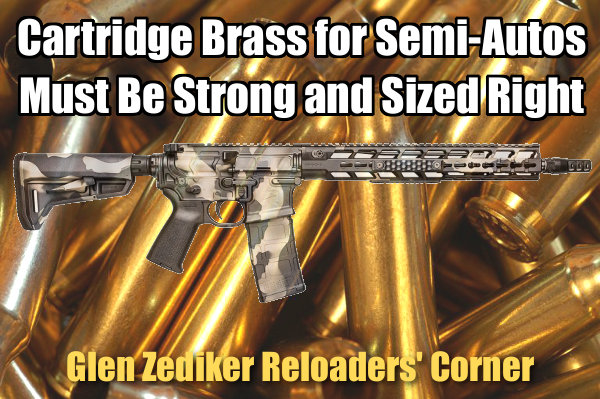
Here are highlights from an article Glen Zediker wrote for the Midsouth Blog. In this article Glen focuses on cartridge brass for semi-auto rifles, AR-platform guns in particular. Glen notes that semi-autos are tougher on brass than bolt-action rifles, so you need strong, durable brass, that has been full-length sized. And you need to be careful about neck tension, and primers. The article starts with Glen’s recommendations for tough, hard brass, and then includes the points outlined below.
ONE: Full Length-Size Cases with Adequate Shoulder Set-Back
This is a huge source of debate… amongst my readers, but, since now I’m strictly speaking of semi-auto needs I doubt there will be much dissent: full-length resize all cases! Most cases from most semi-autos will emerge with a pretty well-blown case shoulder [taming down an excessively functioning gas system can reduce this]. Make double-sure you’re sizing the cases down to at least 0.003 clearance. If you don’t there are safety and function problems ahead.
TWO: USE Sufficient Neck Tension
The case neck [must be] reduced an adequate amount to retain the bullet. There should be a minimum net difference of 0.003 inches (three-thousandths) between sized outside case neck diameter and loaded round outside case neck diameter. [Editor — that means at least three thou of “grip”.] Reason: don’t take a chance of inadvertent bullet movement during the recoil and feeding cycles. That movement can be back or forward! It’s easily possible for a bullet to jump ahead when the inertia from the bolt carrier assembly chambers the next round.
THREE: Use Tough Primers
Choose a tough primer! There’s a floating firing pin on an AR15 (M1A also) that is supposed to be held in check but that system doesn’t always work! If you load and extract a round and see a little dimple in the primer, that’s from the firing pin tapping off of it (again, created by inertia of bolt closing). A combination of a high primer and a sensitive primer cup assembly can create a “slam-fire”. Brands? CCI has some mil-spec primers that work well, and I’ve had great success with Remington 7-1/2. Some of the well-respected “match” primers are a little thin. The CCI and Remington also hold up well to the (sometimes) greater firing forces working on the primer (again, from the quick unlocking).
And, finally, make double-sure that each and every primer is seated to below flush with the case head! That’s true for any firearm (because it also means that the primer is fully seated) but imperative for safety in a semi-auto. This is especially an issue for those who use a progressive-type loading press.
The Berger SW Nationals is coming up in a couple weeks. At that match, the sling shooters and F-Class competitors need to haul lots of gear from parking lot to the firing line, and then move from yardage to yardage. Along with their rifles, shooters need to bring mats, front rests or bipods, spotting scopes (with stands), rear bags, ammo boxes, log sheets, tool kits, and heavy coats (for the sling shooters).
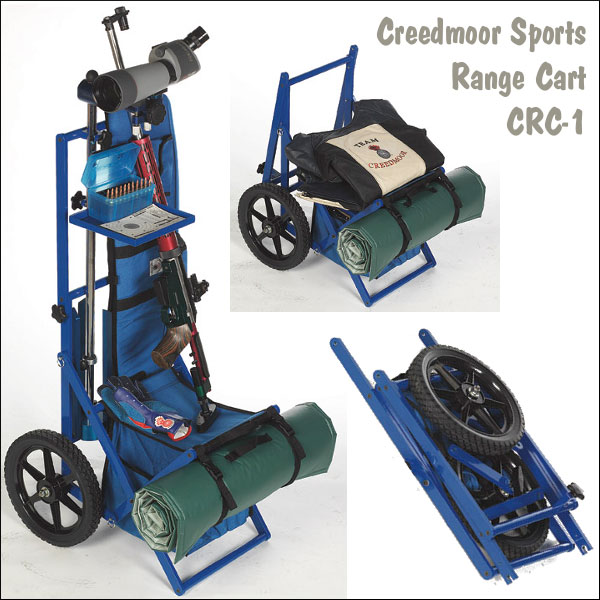
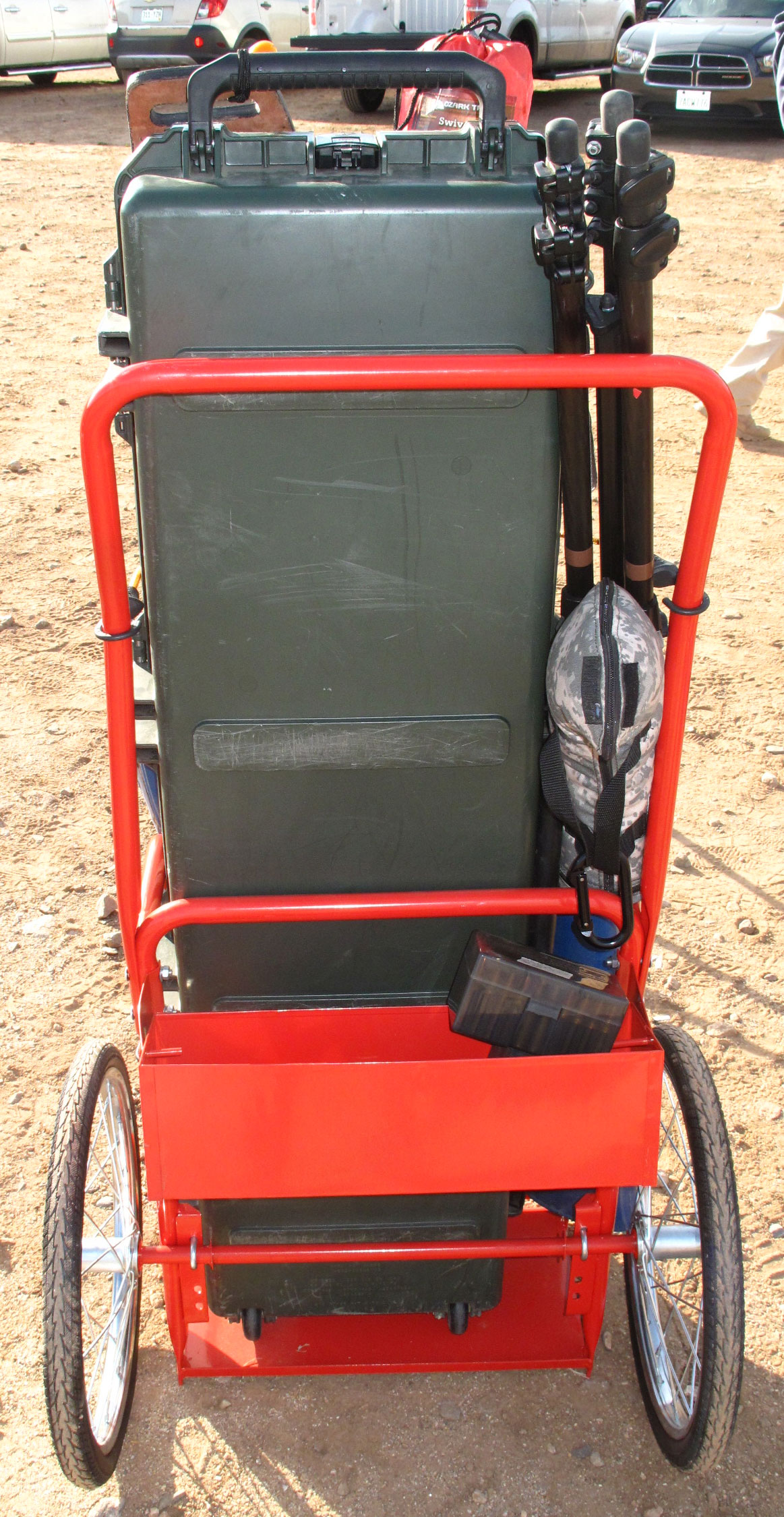
To do the hauling, you can certainly purchase a factory-made, purpose-built cart that folds up and has all the bells and whistles. The Creedmoor Sports CRC-1 (photo right) is a proven, quality product that works great. You’ll find these used by top shooters at Camp Perry. But the Creedmoor CRC-1 cart costs $499.95. For a fraction of that price ($55.99), plus a few dollars more for do-it-yourself enhancements, you can have a heavy-duty cart that will haul all your gear just fine, though it doesn’t fold up. In the top photo is a Harbor Freight Welding Cart we saw at the Berger Southwest Nationals. This rig is carrying a rifle in hard gun case, bipod, folding chair, shooting mat, tripod, spotting scope, rear sand-bag, and ammo box — that’s a lot of gear!
Check out the Harbor Freight Welding Cart, item #65939. This cart is ON SALE right now for just $59.99. Overall size is 29-1/2″ L x 20″ W x 49″ H, and width between side rails is 18″. The wheels (with tires) are 20 3/4″ in diameter for smooth rolling. Consider that, if you made your own cart from scratch you could easily pay $30.00 or more just for the large-diameter wheels and axle. Do note — this cart has air-filled tires. Be sure to inflate before you go to the Range!
This Cart is now on sale for just $55.99 — GREAT DEAL!
As sold, the Harbor Freight Welding Cart can benefit from upgrades for range use. But with a few bungee cords (and some creativity), the cart can be adapted pretty easily to hauling your gun gear. If you want to enhance the basic cart, it’s easy to add plastic side-panels on the bottom unit, and fit a barrel-holding system on the cross-tube. This ensures rifles and gear won’t flop forward. (A small piece of wood under the bottom panel provides a bit of extra lift that will keep the bottom plate out of the dirt and gravel.)
Three-Position (3P) Air Rifle Shooting is the most popular and fastest-growing form of shooting sports competition for junior shooters (High School age and younger). The Civilian Marksmanship Program (CMP) conducts two different 3P Air Rifle events. Precision Air Rifle is modeled after Olympic-style shooting and allows the use of specialized target rifles and equipment. Sporter Air Rifle is designed for new competitors or those who desire to compete with a minimum of equipment and expense.
In both types of shooting, competitors fire at targets at a distance of 10 meters in three different positions, prone, standing and kneeling. Three-Position Air Rifle provides young competitors with competitive shooting sports opportunities that can be offered on a wide variety of easily accessible or easily constructed ranges, with equipment that is commonly available at affordable costs.
The CMP actively promotes Three-Position Air Rifle shooting as a premier youth marksmanship competition by providing low-cost equipment and pellets as well as training materials and competition activities. In addition, other air gun events for juniors and adults are hosted by CMP throughout the year. CMP facilities have Open Public Shooting evenings, and matches for air rifle and air pistol take place at the CMP Marksmanship Centers.
Want to learn long-range benchrest skills from the best in the business? Then head to Williamsport, PA this June. The registration period for the 2019 PA 1000 Yard Benchrest School is now open. This year’s session will be held Saturday and Sunday, June 8-9, 2019, with a “Meet and Greet” on Friday night, June 7. Classes, taught by top 1K shooters, are held at the Original Pennsylvania 1000-Yard Benchrest Club Range, one of the best 1000-yard ranges in the country. The school will be limited to 24-30 students with one instructor for every two students.
Praise from a 1K Benchrest School Grad
Here’s a testimonial from a recent graduate: “I can attest to the knowledge that you gain. I went last year and loved it. Have renewed my membership in the Club and would love to go this year. I would love to take the course again. In the photo above I am in the back row, fourth from the right — sunglasses and blue shirt.” — Bob, Class of 2016
Participants will learn all aspects of long-range benchrest shooting from some of the most skilled marksmen in the country. Much time is spent at the loading bench and on the firing line. Classes cover load development, precision reloading, bench skills, and target analysis. You don’t even need guns and ammo — all equipment and ammunition will be provided.
School instructors tell us: “This year’s benchrest school will be a 2-day weekend event. (There is also an optional ‘Meet and Greet’ gathering Friday evening). The school is a beginner class designed to teach the fundamental skills needed to be competitive at at 600 and 1000 yards. Saturday will be spent in class covering a range of topics including reloading ‘dos and don’ts’, load development and equipment handling. Sunday we will shoot an actual match to see what you’ve learned.”
After taking this class, you might be the guy who shoots an amazing 100-8X at 1000 yards like this:
Cost for the class is $475.00 including lunches on Sat/Sun and dinner on Saturday. Act soon if you want to attend the 2019 school — the program fills quickly. The classroom is limited to only 24 (possibly 30) students and instruction is one instructor per two students. A one year membership is included with the cost of the school.
If you have any questions regarding the school send email to: amurtagh6mm [at] gmail.com.
Andy Murtagh
Vice President and Public Relations Officer
Original PA 1000 Yard Benchrest Club
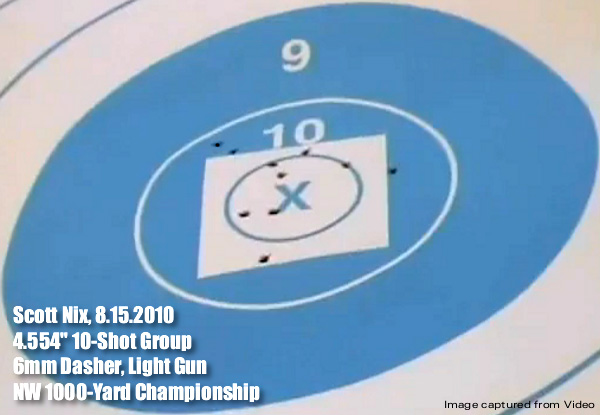
How well can the little 6mm Dasher perform at 1000 yards when the conditions are good, and the shooter is riding a hot streak? Well here’s a shot-by-shot record of Scott Nix’s 4.554″ ten-shot group shot at Missoula, Montana at the Northwest 1000-yard Championship a few years back. All 10 shots were centered for a 100-6X score. That’s about as good as it gets. If Scott had stopped after 5 shots, his group would have been under three inches.
Video Demonstrates Amazing 1000-Yard Accuracy
Watch the video. You can see the group form up, shot by shot. It’s pretty amazing. Scott’s first shot (at the 45-second mark of the video) was right in the X-Ring, and four of Scott’s first five shots were Xs. That’s drilling them! This video was recorded from the pits at the 1000-yard line, during record fire.
There’s a formidable new option for PRS Production Class. MasterPiece Arms (MPA) is bringing out a new tactical/practicalcompetition rig, officially called the MPA BA PMR Competition Rifle. This new rifle has a $1999.99 price tag, making it suitable for Production Class. It will be offered with Curtis Action fitted to an X-Caliber, hand-lapped 26″ match barrel. Three chamberings will be available: 6mm Creedmoor, 6.5 Creedmoor and .308 Winchester.
This rifle is designed specifically for the Production Class requirements of the Precision Rifle Series (PRS) and has been approved for use within this division. It includes many competition-related features while staying under the $2,000 price limit for this class. It is available in either a Black or Tungsten Cerakote® finish. Accuracy is helped with a very good barrel — an X-Caliber, hand-lapped 416R Stainless premium barrel with a polished finish. The chamber is indicated within 0.0001” or less to the bore of the rifle.
The MPA BA PMR Competition Rifle utilizes the MPA BA Ultra Lite Chassis, CNC-machined from 6061 aluminum. The V-bedding system provides additional clearance for glass bedding action and straight section of the barrel. The chassis also includes a built-in inclinometer, thumb notch, lower mounted Picatinny Rail, 20 MOA Scope Rail, A2 Style Pistol Grip and is R.A.T. System compatible. The MPA Buttstock comes with an adjustable cheek riser and length of pull that are locked in position with a series of set screws that are embedded into the buttstock body. This is the same system MPA uses on its Standard BA Chassis, but without the thumb wheels.
CMP Competition Rulebooks that will govern all CMP sponsored and sanctioned competitions in 2019 have now been approved by the CMP Board’s Rules Committee and posted on the CMP website. Significant changes in this year’s rulebooks include dividing the former Service Rifle and Pistol Rulebook into two separate rulebooks, the establishment of a new program to give persons with disabilities an opportunity to earn Distinguished Badges, and the creation of separate unlimited classes for Modern Military Rifles and Rimfire Sporter Rifles. 2019 CMP Competition Rulebooks are effective immediately and can be downloaded from the CMP website by using the following links:
CMP Games Competition Rules, governs As-Issued Military Rifle, Modern Military Rifle, Vintage Sniper Rifle Team Match, Rimfire Sporter Rifle and As-Issued Pistol
LINK: http://thecmp.org/wp-content/uploads/CMPGamesRules.pdf
Here are key 2019 CMP Rule Change Highlights. For a more complete list of important changes, read the official CMP 2019 Rule Change Summary.
New Distinguished Marksman Program For Shooters with Disabilities
A major new CMP program being introduced in 2019 is the Distinguished Marksman Badge Program for competitors with medical or physical limitations or disabilities. To implement this program, the CMP is establishing a new Distinguished Badge called the Distinguished Marksman Badge. Any rifle or pistol competitor with a disability or limitation that previously prevented them from fully meeting rules requirements for earning EIC credit points is invited to apply to the CMP for a “Distinguished Marksman Authorization” (contact acantu@thecmp.org or phone 419-635-2141, ext. 602).
Electronic Scoring Target Rules
New electronic target (EST) installations at the Talladega Marksmanship Park and CMP Travel Games necessitated special rules to govern irregular shot entries that may appear on electronic targets. CMP EST rules were updated this year, based on EST experiences. CMP Rules now define EST complaint resolution processes for: 1) a protested shot value; 2) a missing slow-fire shot; 3) a missing rapid-fire shot; 4) an extra slow-fire shot and 5) an extra rapid-fire shot.
Highpower Rifle Rule Changes
Separate Highpower Rifle Rulebook
Until this year Service Rifle and Pistol events all had the same rulebook. As a result, rules frequently skipped from rifle to pistol and back and this often caused confusion. Now there are two separate rulebooks, one for Highpower Rifle and a separate rulebook for Pistol.
Long Range Rifle Classification System
The CMP brought Long Range Rifle competitions at 800, 900 and 1000 years back to Camp Perry and the National Matches in 2018. This successful new program attracted 182 competitors who made 454 event entries. This year’s change features the introduction of a Long Range Rifle classification system that will expand the CMP Highpower Rifle classification system implemented in 2018 (HP Rule 3.11.4).
National Matches Program
The 2018 National Matches Program that introduced CMP Cup Matches, Long Range Rifle Matches and the Roosevelt Match (for U.S. Krag and M1903 rifles) will be unchanged in 2019. All of the highpower rifle events that were on the 2018 National Matches Program are already in this year’s National Matches Schedule. If you have not done so already, download the 2019 National Matches Calendar.
In 2019, the “Standard Modern Military Rifle” will return to its original rules for AR-type rifles that featured a 7.5 lbs maximum weight and metallic sights only. In 2019, AR-type rifles that weigh more than 7.5 lbs or that have optical sights will compete in a separate Unlimited Class. In addition, Modern Military Rifles with optical sights will now all be in the Unlimited Modern Military Rifle Class. Free-floating handguards will be allowed in both the Unlimited and Standard Modern Military Rifle Classes.
CMP Games Rule Changes
The CMP Games Rulebook that governs As-Issued Military Rifle and Pistol events as well as Rimfire Sporter Matches has some of the most significant 2019 rule changes. These include the establishment of an Unlimited Modern Military Rifle Class and the expansion of the Rimfire Sporter Tactical Class to become a combined Tactical and Unlimited Class (TU-Class). Changes in this rulebook are.
Modern Military Rifle
For 2019, after much debate and inputs from many, the CMP decided to return the first Modern Military Rifle Class to its original rules as a Standard Modern Military Rifle and to establish a separate Unlimited Modern Military Rifle Class. The Standard Modern Military Rifle will go back to its original 7.5 lbs. weight limit for AR-type rifles and 9.0 lbs. for M1As. Standard Modern Military Rifles will be restricted to metallic sights only. Rifles that weigh more than 7.5 lbs. or 9.0 lbs. or that have optical sights will now be in the Unlimited Modern Military Rifle Class. Restrictions against float tubes or metallic sights with finer adjustments were removed for both classes.
As-Issued Military Rifle Events
The core of the CMP As-Issued Military Rifle program is the ever-popular Garand-Springfield-Vintage Military Rifle triad. Those events and the Carbine Match, which accompanies them on many match programs, remain unchanged.
At long range, small bullet holes are much easier to see “in the white” than in the black center of the normal High Power target. When you’re practicing at long range using a scoped rifle, one way to enhance your ability to see your bullet holes is to print a “negative” version of the regulation bullseye target so that your black center is now white.
How do you create a “negative” of a target image? Many image programs, including the FREE Irfanview software, have a “Negative” function in the pull-down menu. If you don’t see a “Negative” menu option in your program, look for a “substitute colors” option. Many printers also have a “reverse colors” function. If you can’t find a solution with your computer or printer, just take a normal bullseye target to a copy shop, and the staff can easily print you a set of targets with white centers in black fields.
Forum member Watercam has a Pentax PF-80ED spotting scope that allows him to see 6mm bullet holes in the white at 600 yards. However, 6mm holes in the black are only visible out to 400 yards or so. Accordingly, Watercam uses a modified “reversed” black-to-white target for 600-yard practice. Watercam explains: “[Using the Pentax] With my 6mm and limited mirage I see defined, 6mm holes in the white out to 600. In the black, however, I can see bullets holes at about 400. I now use reverse-color targets for training without a pit partner at the 600-yard line.”
The Hi-Viz Solution — Day-Glo Pasters
If you’re not concerned with official scoring rings, you can use an all-white target with a bright, fluorescent target dot in the middle. A 2″- or 3″-diameter stick-on target dot is highly visible at 600 yards. Birchwood Casey Target Spots® assortment #33928-TSA offers neon orange target dots in 1″, 2″, and 3″ diameters.
TARGET TIP — Use Chart Paper
For practice backers for the Day-GLo pasters at long distance, use Flip Chart Paper (aka Easel Pads) marked with graph lines at 1″ intervals. Available either regular or self-stick, one sheet can hold 4-8 pasters and the white paper allows for easy spotting of the holes and quick estimation of group size. Get Flip Chart Paper at Amazon.com, Staples, or Office Depot.
Brits Use White-Field Target for F-Class
In the UK, some ranges are now using a “reverse-style” target with a mostly white area. Laurie Holland says this allows shooters to see shots much more easily. Laurie reports: “Here’s a photo of the 500/600 yard F-Class match target we use in PSSA comps at Diggle Ranges with club members Chris Hull (L) and Terry Mann (R). We now use this target form at all ranges up to 1K for F-Class, and, yes you can often see your hits at 600 yards on the target before the markers pull it. Regards from England — Laurie”.


 Train Wrecks (and How to Avoid Them)

 4. Wind Issues. Tricky winds derail many trains. A lot can be written about wind strategies, but here’s a simple tip about how to take the edge off a worse case scenario. You don’t have to start blazing away on the command of “Commence fire”. If the wind is blowing like a bastard when your time starts, just wait! You’re allotted 30 minutes to fire your string in long range slow fire. With average pit service, it might take you 10 minutes if you hustle, less in F-Class. Point being, you have about three times longer than you need. So let everyone else shoot through the storm and look for a window (or windows) of time which are not so adverse. Of course this is a risk, conditions might get worse if you wait. This is where judgment comes in. Just know you have options for managing time and keep an eye on the clock. Saving rounds in a slow fire match is a costly and embarrassing train wreck.




 The Berger SW Nationals is coming up in a couple weeks. At that match, the sling shooters and F-Class competitors need to haul lots of gear from parking lot to the firing line, and then move from yardage to yardage. Along with their rifles, shooters need to bring mats, front rests or bipods, spotting scopes (with stands), rear bags, ammo boxes, log sheets, tool kits, and heavy coats (for the sling shooters).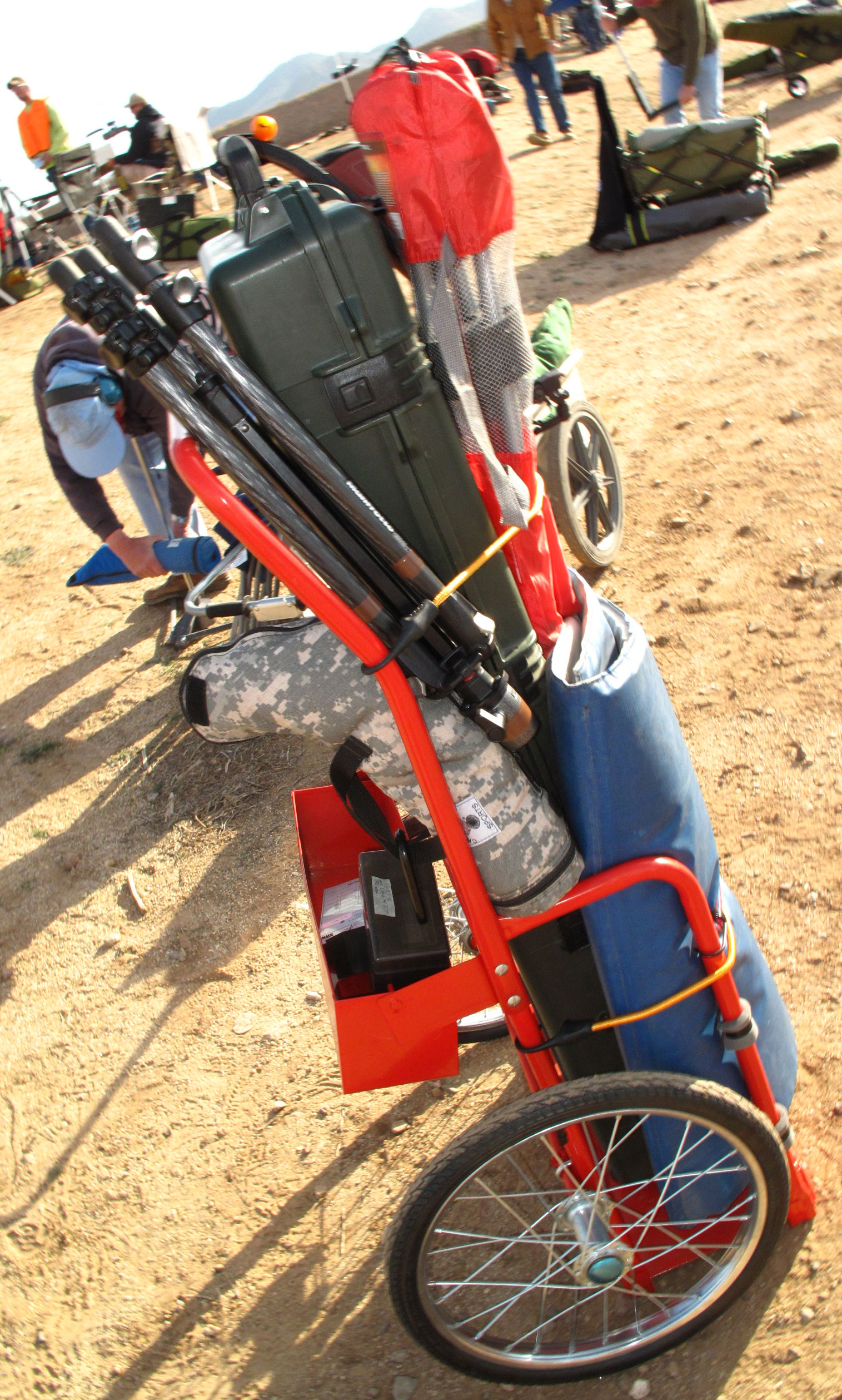


 Three-Position (3P) Air Rifle Shooting is the most popular and fastest-growing form of shooting sports competition for junior shooters (High School age and younger). The Civilian Marksmanship Program (CMP) conducts two different 3P Air Rifle events. Precision Air Rifle is modeled after Olympic-style shooting and allows the use of specialized target rifles and equipment. Sporter Air Rifle is designed for new competitors or those who desire to compete with a minimum of equipment and expense.

 Want to learn long-range benchrest skills from the best in the business? Then head to Williamsport, PA this June. The registration period for the 2019 PA 1000 Yard Benchrest School is now open. This year’s session will be held Saturday and Sunday, June 8-9, 2019, with a “Meet and Greet” on Friday night, June 7. Classes, taught by top 1K shooters, are held at the Original Pennsylvania 1000-Yard Benchrest Club Range, one of the best 1000-yard ranges in the country. The school will be limited to 24-30 students with one instructor for every two students.


 How well can the little 6mm Dasher perform at 1000 yards when the conditions are good, and the shooter is riding a hot streak? Well here’s a shot-by-shot record of Scott Nix’s 4.554″ ten-shot group shot at Missoula, Montana at the Northwest 1000-yard Championship a few years back. All 10 shots were centered for a 100-6X score. That’s about as good as it gets. If Scott had stopped after 5 shots, his group would have been under three inches.


 Forum member Watercam has a Pentax PF-80ED spotting scope that allows him to see 6mm bullet holes in the white at 600 yards. However, 6mm holes in the black are only visible out to 400 yards or so. Accordingly, Watercam uses a modified “reversed” black-to-white target for 600-yard practice. Watercam explains: “[Using the Pentax] With my 6mm and limited mirage I see defined, 6mm holes in the white out to 600. In the black, however, I can see bullets holes at about 400. I now use reverse-color targets for training without a pit partner at the 600-yard line.”


