A new video series featuring NFL legend Brett Favre and USA Shooting competitors is now available on GetZone.com. This series showcases the best aspects of our sport — the dedication and hard work of young shooters, including paralympian marksmen. Host Brett Favre talks with Olympic and Paralympic competitors about their challenges and achievements. In each episode, Favre and the featured athletes conduct shooting drills and share tips and tactics.
Episode 1 — Brett Favre talks with two-time Olympic shotgun bronze medalist Corey Cogdell-Unrein. She explains that more financial support is needed: “I’ve watched so many of my teammates struggle, and scratch, and fight to pay just their training expenses, and go in debt financially to pursue this sport. I’ve thought, how good could we be if we had the funding that we needed?”
Episode 2 — In the second episode, Marco De La Rosa details his journey from service in the U.S. Marine Corps to competing for the USA as a Paralympian pistol shooter: “I traveled everywhere to find myself — then I found this — I found shooting,” said De La Rosa. “I didn’t get into this for myself. I’m representing the Corps, and the Army guys, and everybody at the VA. That’s what I’m about, I represent America,” he added.
Episode 3 — In the third episode, Brett Favre interviews Paralympic Rifle shooter McKenna Dahl, who explained: “Shooting gives me a purpose and a passion for life that I don’t think I ever would have found if it weren’t for the sport. It’s an honor to be able to go out and wear the American Flag on your shoulder. I wouldn’t be where I am in life today if it weren’t for the sport and… this country, and I’m really thankful for that.” [Editor: Compare this young woman’s ethics and dedication to a certain ex-NFL quarterback who is now being glorified by Nike for kneeling during the National Anthem. She honors the country, while he dishonors it. Yet he gets paid millions by Nike.]
NOTE: We’re proud to report that McMillan Firearms stepped up as one of the first major sponsors for the series, and will be featured in an upcoming episode of “USA Shooting Presented by 4Outdoors”.
One recent trend in F-TR competition is the use of low-profile, benchrest-type stocks shot with a light hand-hold and little or no face contact. For this method of F-TR shooting to work, you need the right equipment, and practice a “minimalist” shooting technique. One of the pioneers in this style of F-TR shooting is action-maker John Pierce of Pierce Engineering. Above you can see John shooting one of his F-TR rifles at the 2015 Canadian F-Class Championships. Note the straight-line stock and see how the adjustable bipod is set quite low to the ground (in fact the bipod’s arms are almost straight out).
Members of the Michigan F-TR Team, including Bryan Litz, have used similar rigs with success. Bryan said it took a while to adapt his shooting technique to this kind of rig, but there is a pay-off. Armed with a Pierce-built F-TR rifle, Bryan won his first-ever F-TR Match. Bryan explains the technique he uses when shooting this kind of rifle:
“Coming over from sling shooting, I knew there would be unique challenges to F-TR which I wanted to learn prior to (not during) a major tournament. I learned a new shooting position which doesn’t involve drawing the right knee up. For F-TR I get more straight behind the gun rather than at an angle. I found that the rifle shoots best with very light cheek, shoulder and grip pressure, approaching free recoil. This is how Eric Stecker shot his similar rifle into second place in the SW Nationals [with high X-Count by a large margin]. I learned the rifle’s sensitivity to different bipod and rear bag supports, and found the best buttplate position to allow the rifle to track and stay on target after recoil. This set-up shot best with a mostly free-recoil approach, that means ‘hovering’ over the comb, rather than resting your head on the stock. This took some ‘getting used to’ in terms of neck and back muscle tone. These are the kind of details I think it’s important to focus on when entering a new discipline.”
Bryan’s Pierce-built F-TR rig is a tack-driver: “I can certainly vouch for this set-up! In [a 2015] mid-range State Championship in Midland, MI, I shot my Pierce rifle into first place with a 598-44X (20 shots at 300, 500 and 600). Once you get used to the positioning and way of shooting these rifles, they just pour shots through the center of the target.”
Pierce F-TR Rifles with Scoville Stocks
Shown below are three complete Pierce F-TR rifles, along with a barreled action for comparison. The carbon-fiber/composite stocks are built by Bob Scoville. These Scoville stocks are very light, yet very strong and very stiff.
Show Me the Money, Baby! The biggest money match of the year, NRA World Shooting Championship (WSC), runs September 20-22 at the Peacemaker National Training Center in Glengary, WV. This event offers over $250,000 in cash awards and product prizes, making the WSC the richest combined shooting event in the USA (if not the world).
This unique 3-day multi-gun match tests competitors’ skills across twelve challenging stages involving nearly every major shooting discipline for rifles, shotguns, and pistols. All guns and ammo are supplied, but entry fees are steep.
WSC Highlight Video with Competitor Interviews:
All the Equipment is Supplied
“What makes this event very unique, especially to a professional shooter, is all the equipment is supplied. You have to leave your ego at home and just try to adapt as best you can to the equipment that you have supplied.” — Jerry Miculek
This major match attracts both sponsored Pros and “regular Joes”. Shooters will be split into two groups: a Professional Division for sponsored shooters, and the Amateur Division for non-sponsored competitors. All firearms, optics, and ammo will be provided by match sponsors for both divisions.
Video Shows Stages at 2017 World Shooting Championship
Cash Awards, Huge Prize Table, and Random Drawings
The NRA World Shooting Championship will offer $250,000 in cash and prizes. Along with the $25,000 winner’s pay-out, there will be fat cash prizes for second and third place overall, High Lady, and High Amateur Junior. Then there are the rich prize tables. In 2017, the Amateur prize table held $100,000 worth of prizes. And last year the WSC added Ten (10) Random Drawings worth $400 each. These drawings, held during the WSC Awards Banquet, gave every competitor a chance to win cash, no matter what their event ranking.
Seen at the WSC: VuDoo Gunworks Tactical .22 LR Rimfire Rifles
The 2017 WSC included a side-match featuring Vudoo Gunworks .22 LR rimfire tactical rigs. Shooters were impressed with the V-22 rifle, which looks and feels like a centerfire rig, but with a rimfire repeater action running full-size mags.
Vudoo states: “Our V-22 also runs a full-size short action bottom metal (DBM) and our V-2210 magazine has a [full-size] AICS form factor. The V-22 is the only controlled-round-feed .22 LR receiver out there. The bolt has full capture control of the cartridge from the time it leaves the magazine until it ejects the spent round out the ejection port.” That means the round never touches anything during feed travel so the bullets won’t be nicked/dented during rapid cycling. Sean Murphy of Nightforce enjoyed shooting the Vudoo Gun Works .22s: “I’ll probably end up with one of their rimfires as it is a sweet setup.”
Report by Boyd Allen, IBS Vice President Photos by Gordie Gritters and Alex Wheeler
The 2018 IBS 1000-Yard Nationals event was hosted by the Montana NW 1000 Yard BR Club, which has an active and well-run 1K benchrest shooting program. Over eighty shooters from as far away as Indonesia participated, 82 in Light Gun, and 85 in Heavy Gun. By all accounts it was a very well-run match, that was enjoyed by all who attended.
The Deep Creek Range is a beautiful place to shoot, with normally favorable conditions. But the winds were challenging at the 2018 IBS 1000-yard Nationals.
One man, Carroll Lance, dominated the match, taking the 2-Gun Overall Aggregate, while also winning HG Score Agg, HG Group Agg, and HG Overall Agg. It was a masterful performance — Carroll shot his Light Gun in both classes, beating dozens of bigger, heavier, and much more expensive rifles. Carroll’s name will be placed on four IBS perpetual trophies. Here’s Carroll with his line-up of trophies.
Winning Form — Carroll Lance Talks Technique
When asked for his advice to a new shooter, Big Winner Carroll Lance said: “Shooters should concentrate on being smooth, so as not to disturb the rifle in the bags. Speed will come naturally. The common mistake is to try to run the shots faster than can be done smoothly.”
Aerial Drone Video Shows Deep Creek Range outside Missoula, Montana. Worth Watching!
Challenging Conditions at Match
While Deep Creek is renown for often having good, “readable” conditions, this was a tough year according to Deep Creek veterans. As proof, there were five DQs on a single relay.
Tom Mosul (who ran the firing line for most of the event) noted that conditions were not extreme but could be tricky, with max wind speed s10-15 mph. It varied enough that being on some relays could effectively put a competitor out of the tournament. Tom also mentioned that indicators that he normally could depend on were not reliable this year.
Leo Anderson, who has been present at nearly all the 1000-yard matches ever held at Deep Creek, said this 2018 match had some of the trickiest conditions he has seen in 20 years of competition. Leo said you could not see the conditions causing POI changes. Alex Wheeler agreed, and added that although it was pretty calm at the benches, that the scorer who was running targets (from the pits to the firing line) said there was a strong cross wind half way down range that could not be felt at the pits or firing line…typical for Deep Creek, tough to read when it does decide to be nasty.
Summary of IBS 1000-Yard Nationals Match Results
For those who are unfamiliar with long range benchrest results, there are seven categories of winners, with seven corresponding traveling trophies (the big ones that bear the names of each year’s winners). For each of the two rifle classes (Light Gun and Heavy Guun) there are group, score, and overall aggregate winners (every target is both measured for group size and scored.) Finally, there is a 2-Gun winner for both rifle classes combined, based on group AND score.
With over eighty competitors, the PDF of the complete results, including those of every relay plus a very detailed list of the equipment used by every competitor for both classes, is a whopping 52 pages long. Links Below:
Equipment List Light Gun and Heavy Gun Classes
The seven travelling trophies went to just three shooters. Cody Finch won the LG Group aggregate. Tim Gonnerman won the LG Score aggregate and LG Overall aggregate. Carroll Lance won everything else — HG Score aggregate, HG Group aggregate, HG Overall aggregate, and the 2-Gun Overall.
Big winner Carroll Lance shot his 6mm Dasher Light Gun for both classes. The rifle, smithed by Jay Cutright, features a Borden BRM drop port action, Krieger barrel, Wheeler LRB stock, and Nightforce scope. Carroll’s match-winning load consisted of Vapor Trail bullets, in front of H4895 powder and CCI primers.
Cody Finch’s Light Gun was a 6BR Ackley (6BRA) with Lederer barrel, BAT action, Nightforce scope, and a DCT stock. His load consisted of Vapor Trail bullets, Hodgdon powder, and CCI primers. Alex Wheeler smithed the rifle.
Tim Gonnerman’s Light Gun, smithed by Mike Bigelow, featured a Krieger barrel (6mm Dasher), BAT action, Nightforce scope, and McMillan stock. The load consists of Vapor Trail bullets, H4895 powder, and CCI 450 primers.
Equipment List by Class Based on Two-Gun Overall Agg Rankings Light Gun Equipment List (click to zoom):
I called the major Aggregate winners (Carroll Lance, Cody Finch, and Tim Gonnerman), and asked them about the 1K Nationals. My questions fell into five major categories: 1) how the wind compared to other matches (including other locations); 2) how each handles his rifle and equipment; 3) how they shot the match; 4) how they clean their barrels (and what their barrel accuracy life is); and 5) How they reload.
They all described the conditions as challenging. This was not a match to use for spotting small differences in accuracy between similar calibers. Even with the rotations of relays and benches, there was an inescapable luck factor, with some relays having significantly more challenging conditions than others. Changes could be rapid, with reversals that could be extreme.
Gun-Handling: On the subject of how the rifle is handled, Cody Finch shoots with only trigger contact, while Tim Gonnerman and Carroll Lance have light stock contact. Tim said that he is so focused on shooting that he is really not aware of the details of how he handles the rifle. Carroll said that he makes light contact with his trigger hand and has the butt touching his shoulder so lightly that he can barely feel it, but solidly enough that it only recoils about a quarter inch.
Shooting Strategies: Cody uses his sighter period to investigate how differences in mirage affect bullet impact location and then holds off shot by shot during his record string. Tim and Carroll do not, they adjust their scopes using the last sighter shot (which they can see because there is target service like an high power match with spotter disks) and then hold center for their record, trying to do as little with their rest adjustments as possible. Carroll mentioned that he only made one adjustment for the whole weekend and that his usual practice is to make small corrections with hand pressure.
Barrel Cleaning: Tim shot the whole weekend, without cleaning. When he does clean he uses Pro Shot Copper Solvent, patches, a nylon brush, and does a lot of soaking. Periodically he uses IOSSO with a patch on a nylon brush. He breaks in his barrels with the common one-shot-and-clean progressing to three and then five, and, sees a velocity increase at about 120 rounds from new. Tim cleans with patches and bronze brushes. I smiled when he told me what he cleans with, CLR, ThorroClean (Bullet Central) and IOSSO. CLR has been the topic of some discussion on the internet, and a friend found that it did a good job on carbon. It has been a controversial topic. Of note, Tim shot the smallest group for the tournament.
Barrel Life: All three Top Guns said that accurate barrel life varied from barrel to barrel. I got the general impression that most were done or close to done by 1,500 rounds, at least for the Dasher, with the BRA being too new to tell if it would stretch that far, but that it might.
Reloading Methods: On the reloading side, none of them anneal regularly, if at all. Carroll’s cases had 15-20 firings on them, and had only been annealed once, early on, but they still felt good when he was seating bullets. Last year he tried to anneal after every event.
Most of his competition has been at 600 yards, where Varget did a good job, with bullets seated .010 to .012 into the lands, but it did not perform well at 1K so he switched to H4895, which likes its bullets .005 into the lands. The chamber has a .268 neck. Case necks were turned to .0105 for a loaded round clearance of about .003. He used a .263 bushing.
Starting with a fired case, he sizes in a FL bushing die, tumbles in corn cob media to remove the lube, and just before seating bullets applies graphite to the insides of case necks with a Q-Tip.
Course of Fire at 1K Nationals (as explained by Tom Mosul):
“Relays were rotated along with bench assignment within each relay. The match is a three-target Aggregate, so what we did was divide the total number of relays and benches by 3, and then rounded down. Due to the number of benches (13) and shooters there were seven relays per target. Saturday morning started with LG target #1, followed by HG target #1, finishing the day with LG target #2. Sunday morning began with HG target #2, then LG target #3, and finished with HG target #3. For each relay six minutes are allowed for sighter shots, followed by a cease fire, and within a minute after that, a ten-minute record period.”
True Treasure Trove of Prizes at Deep Creek
There was a very rich prize table, including BAT, Borden, Curtis Custom, and Defiance actions; McMillan, McMillan/Wheeler and Shehane stocks; Kahles, Nightforce, Swarovski, and Vortex Scopes; SEB NEO Rest; Benchsource Annealing machine; Bartlein, Brux, Lilja, Krieger, and Rock Creek barrels; Zeiss Binoculars; many gift certificates (incl. Kelbly’s and McMillan) and much more.
The Top Guns got the pick of the prizes. Carroll Lance chose a Kahles 10-50 rifle scope, Tim Gonnerman chose a BAT Neuvo action, and Cody Finch chose a Borden BRM action.
NOTE: Prizes that manufacturers and vendors contribute are an important part of any successful match. I am sure that everyone who was connected with this event is grateful to all the generous sponsors who donated prizes and gift certificates. Sebastian Lambang (shown below), creator of SEB Rests, shot the match and donated a SEB NEO rest.
More Photos — Hundreds of Photos
Here are links to ALL pictures that Gordy Gritters and Alex Wheeler were kind enough to take at the 2018 IBS 1000-Yard Nationals. There are 359 images altogether:
This shows Tom Jacobs of Vapor Trail Bullets holding his match rifle while Gordy Gritters drills a couple of ounces out of the butt. We’re told Tom knew he was an ounce heavy when he got there.
From the late ’70s through 1983, a huge, concrete-walled warehouse in Houston was used for benchrest testing. Virgil King and Bob Fisher set up a bullet-catching backstop at the end of a 30-yard-wide, 325-yard-long fire lane that remained unobstructed even when the warehouse was in use. This allowed accuracy tests in virtually perfect “no wind” conditions. Over a six-year period, about 30 shooters were invited to test their rifles. The results were amazing, with numerous “zero groups” being shot in the facility. Many of the lessons learned in the legendary Houston Warehouse still help benchresters achieve better accuracy today.
Dave Scott explains why the Warehouse was so unique:
“Over a period of six years, the levels of accuracy achieved in the Houston Warehouse went beyond what many precision shooters thought possible for lightweight rifles shot from sandbags and aimed shot-to-shot by human eye. For the first time, a handful of gifted, serious experimenters — armed with the very best performing rifles (with notable exceptions) — could boldly venture into the final frontiers of rifle accuracy, a journey made possible by eliminating the baffling uncertainties of conditions arising from wind and mirage. Under these steel skies, a shooter could, without question, confirm the absolute limits of accuracy of his rifle, or isolate the source of a problem. In the flawlessly stable containment of the Houston Warehouse … a very few exceptional rifles would display the real stuff, drilling repeated groups measuring well below the unbelievably tiny .100″ barrier. The bulk of rifles, however, embarrassed their owners.”
Scott’s article also reveals some interesting technical points: “One thing that IS important is that the bullet be precisely seated against the lands. T.J. Jackson reported this fact in the May 1987 issue of Precision Shooting. In a letter to the Editor, T.J. wrote, ‘…in all our testing in that Houston warehouse… and the dozens and dozens of groups that Virgil King shot in there ‘in the zeroes’… he NEVER fired a single official screamer group when he was ‘jumping’ bullets. All his best groups were always seated into the lands, or at the very least… touching the lands. Virgil said his practice was to seat the bullets so the engraving was half as long as the width of the lands. He noticed an interesting phenomenon with rifles that could really shoot: if the bullets were seated a little short and the powder charge was a bit on the light side, the groups formed vertically. As he seated the bullets farther out and increased the powder charge, the groups finally became horizontal. If he went still farther, the groups formed big globs. He said the trick is to find the midway point between vertical and horizontal. That point should be a small hole.”
You should definitely read the complete article, as it provides many more fascinating insights, including shooting technique, barrel cleaning, neck-turning, and case prep.
The Int’l Shooting Sport Federation (ISSF) World Shooting Championship commences next Friday in South Korea. Along with pistol and shotgun aces, the world’s top air rifle, smallbore rifle, and 300m centerfire shooters will vie for glory and Olympic placements. Twenty Olympic quotas will be up for grabs in the rifle events and Team USA should secure some spots, along with some trophies in South Korea. The 52nd World Championship run August 31 through September 15 in Changwon, South Korea.
Top USA Rifle Competitors at the ISSF World Championship
Three-time Olympic medalist Matt Emmons will make his sixth World Championship appearance in Changwon where he will shoot Men’s Three-Position Rifle and Prone Rifle. Emmons will also shoot the Men’s Prone Rifle event in which he won gold in 2002, bronze in 2010 and bronze as a Junior in 1998.
Emmons’ two-time Olympic teammate Michael McPhail of the USAMU will also shoot Men’s 50m Prone Rifle. In addition he will compete in Three-Position events. Notably, McPhail will also shoot centerfire at 300 meters. At the 2014 World Championship, McPhail won bronze in Men’s 300m Prone Rifle, which he will once again compete in Changwon.
For Sarah Beard, Changwon marks her third World Championship appearance. She’ll have lots of chances at medals as she’ll be shooting 3P rifle, Air Rifle Mixed Team event, Prone, 300m Three-Position and 300m Prone Rifle. Beard won silver in 2010 in Junior Women’s Prone Rifle in Munich, Germany.
Mindy Miles was the top finisher in Women’s Air Rifle selection for this World Championship. Mindy recently finished a superb collegiate career at TCU that included four of the 10-best Air Rifle scores in the 2017-2018 NCAA season, including a perfect 600 score.
With the recent IBS 100/200 Group Nationals in Pennsylvania, we thought our readers might like to learn more about the short-range Benchrest game. Seeing the tiny groups 6 PPC aces produce, it’s easy to think the precision is all about the equipment. But there is a lot more involved. A talented human still has to watch the flags, run the gun properly, and tune his loads for the conditions. Here are some tips from one of the world’s best benchresters, Charles Huckeba.
Texan Charles Huckeba was the top individual shooter at the 2013 World Benchrest Championships (WBC) held near Sydney Australia in October 2013. In this video, 2013 WBC Two-Gun Overall winner Charles shoots a 1/8th MOA group at 200 yards — “a little bitty dot” as a fellow Team USA shooter observes. That’s impressive. If you can describe Huckeba’s style in a nutshell it would be “smooth, consistent, and rapid but not hurried”.
Charles also employed some unusual hardware. In the video, take a close look at the joystick on the Farley Coaxial front rest. There’s no knob at the end. In its place is a small, wood ammo caddy. Charles removed the standard knob from the handle of his Farley rest and replaced it with a home-made wood block that holds cartridges for the record target. The 10.5-lb Light Varmint rifle is chambered in 6PPC with a BAT Machine Action and a composite wood and carbon-fiber stock.
Watch Charles Huckeba Shoot 1/8 MOA, 200-yard group at World Benchrest Championships
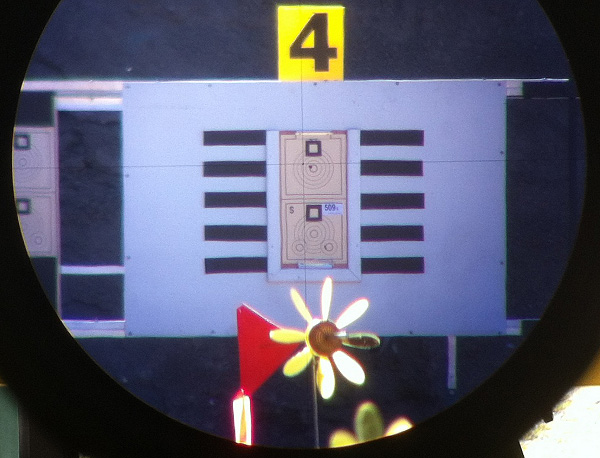
Here is the actual 200-yard, 5-shot group Charles shot in the video. Photo (by Stuart Elliot) taken through the lens of Huckeba’s 50X March scope (reticle has 1/16th MOA Dot).
Analyzing the Fine Points — What Makes Huckeba So Good
Short-range benchrest shooter Boyd Allen saw some interesting things in Huckeba’s WBC performance, as captured on video. Boyd noticed Huckeba’s smooth gun-handling and efficient loading. But Boyd also spied some interesting equipment, including an innovative joystick “handle-caddy”.
1. Low Friction Bags — When Huckeba slid his rifle, there was very little apparent friction. The front bag features the new 3M material (ScotchLite) on the sliding surfaces. The rear Protektor bag has ears of the same low-friction material.
2. Pause Before Chambering — While he was watching the flags and deciding when to start firing, Charles kept his first round in the action, but out of the barrel’s chamber, probably so as not to heat the cartridge and change the round’s point of impact.
3. Ammo Caddy on Joystick Arm – Charles shoots a Right Bolt/Left Port action, so he pulls his rounds with his left hand. Note that Huckeba’s record rounds rest in a small, wood ammo caddy attached to the end of the joystick shaft. Look carefully, you’ll see the wood ammo block in place of the normal black ball at the end of the joystick. That allows Charles to pull shots with the absolute minimum of hand movement. Ingenious! Huckeba is very fast, with a great economy of motion. I believe that because his ammo was literally at hand, Charles was better able to keep his focus on aiming and the flags.
4. Smooth-Cycling BAT Action — Note how smoothly Huckeba’s action operates. When Charles lifts the bolt handle (to extract a round and cock the firing pin), this does not disturb the rifle. Likewise, as he closes the bolt, the gun doesn’t wobble. The smooth action allows Charles to hold point of aim even when shooting relatively quickly. Huckeba’s BAT action is chrome-moly steel. Some shooters believe this metal makes for a smoother action than stainless steel or aluminum.
5. Long-Wheelbase Stock — The wood and carbon fiber stock is light, long, and stiff. Yet, importantly, the stock is also well-damped. The longer-than-average stock length (with extended forearm) seems to help the gun track well without jumping or rocking. The longer forearm allows a longer “wheelbase”, effectively shifting the weight distribution rearward (less weight on the front, more weight on the rear). This places a greater share of the gun’s weight on the rear bag, as compared to a more conventional benchrest stock. Huckeba’s stock, built by Bob Scoville, is at the cutting edge of short-range benchrest design. Its light-weight balsa wood and carbon fiber construction provides a combination of stiffness and vibration damping that allows its relatively long fore-end to be fully utilized to increase the weight on the rear bag (always an issue with 10.5-pound rifles).
To learn more about this benchrest stock design, read the comments by stock-builder Bob Scoville in our PPC with Pedigree story in our Gun of the Week Archives. Bob observed:
“There is a lot more to the structure of the stocks than meets the eye. The carbon fiber skin with which I cover the stocks creates a light, tough exterior surface. However, this contributes very little to the overall performance of the stocks. The real strength and stiffness is the result of an internal beam utilizing balsa core/carbon fiber technology.
This type construction can be found in aircraft, race cars, powerboats, and sailboats. It is interesting to note, balsa has the highest strength to weight ratio of all woods and carbon fiber is one of the lowest stretch (modulus of elasticity) relative to weight of all materials. The marriage of these two materials is common in the high-performance world. Additionally, balsa is used commercially for vibration dampening and sound reduction.”
Video find by Boyd Allen. Video by Stuart Elliot of BRT Shooters Supply, Brisbane, Australia.
Many of the nation’s top 100/200-yard Benchrest Shooters came to central Pennsylvania this month for the IBS Group Nationals, held August 13-18 at the Union County Sportsmen’s Club. This major event encompassed six days of shooting, making this one of the lengthiest benchrest matches of the year. There were nearly 90 registered competitors, plus competitors’ spouses and kids were able to shoot in a fun match on Wednesday afternoon. This is a prestigious match — with National titles up for grabs in four classes: Sporter, Light Varmint, Heavy Varmint, and Heavy Bench. CLICK HERE for Full Results.
IBS Group Benchrest Nationals 2018
Report by Jeff Stover, IBS President The Range and Conditions
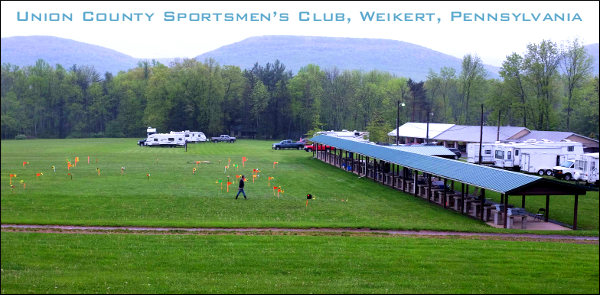
This year’s venue was a return to one of the premier benchrest rifle ranges in the country. Union County Sportsmen’s Club is located near the center of Pennsylvania. It gets its name from the nearby village of Weikert. The range faces east, not ideal, but that is what the topography dealt the club. This week of competition had the usual prevailing conditions: mostly from the west, meaning from 4 o’clock to 8 o’clock. A switch green to orange and back again, with changing velocities. Sometimes readable. Many times, however, conditions are confounding.
The Course of Fire
The IBS Group Nationals event is a bit of an endurance test as it spans six days for those shooting. The sequence of competition groups has 100-yard targets shot the first three days followed by three days at 200 yards. It is done this way to require only one change of wind flags. Nationals competition requires “full rotation”. That means that every time a shooter goes to the line for the next match target, he or she must move a requisite number of benches to the right. At the end of the day a shooter will shoot across the full width of the line. Some ranges offer unique properties that render some parts of the range harder or easier to shoot small groups. Bench rotation is important to even out those factors.
Hall of Famer Jeff Gaidos taking aim. Note both eyes are open. Jeff picked up two more HOF points at Weikert this year.
Light Varmint, Heavy Varmint, Sporter, and Heavy Bench Equipment
It takes thirty targets of five shots each and ten targets of 10-shot groups to win a “4 Gun Nationals”. That would be the classes of Light Varmint, Heavy Varmint, Sporter, and Heavy Bench. For all practical purposes, the first three are known as “bag guns” while the Heavy Bench rifles are “rail guns”. In fact, most competitors shooting a bag gun opt for a single rifle, which has been the benchrest standard for decades: a 10.5-pound rifle chambered in 6 PPC.
Peinhardt Wins 2-Gun & 3-Gun, Costa Wins 4-Gun, and Mitchell Smashes HB Record
Jeff Peinhardt won the 2-Gun and 3-Gun to dominate the “bag guns” (Light Varmint, Heavy Varmint, and Sporter). Larry Costa won the 4-Gun, with the top combined Agg for all four classes. Paul Mitchell turned in the notable railgun performance in the Heavy Bench division. Mitchell posted a 200-yard Agg of 0.1687 MOA. That should smash the old record of .2224 MOA set by Ed Watson way back in 1990! Note those figures are for MOA at 200 yards. Mitchell’s average 10-shot group size was 0.3374” (MOA x 2). That is only slightly larger than the Aggregate record for 5-shot groups with a rail gun. Mitchell said his rail has a superb Krieger barrel: “My rail gun was originally built by Bud Welch in the early ’90s. I took about ten years off from shooting from the late ’90s until 2008. When I got back I had Bruce LaChapelle take the action out of a sleeve and clamp the barrel in a Delrin sleeve. Dwight Scott chambered this Krieger barrel in January of 2017 and let me know that he thought it could be one of the hummers we all dream of and don’t waste it. This is the fourth 10-Shot teen Agg I have shot with it. It will be a sad day when it’s shot out!”
Click links below for Day-by-Day Results. Complete results may be found at the IBS Match Report Page.
Multi-Gun Results:
There are awards for combined results in multiple classes. Jeff Peinhardt won the both the 2-Gun (HV-LV) and 3-Gun (LV-HV-SP). Long time top shooter Larry Costa won the overall 4-Gun. Both Costa and Wayne Campbell (4-gun runner-up) are Hall of Famers. 4-Gun 3rd-place finisher Hugh Williamson, a Canadian, is also a barrel-maker.
The 3-Gun Top Three (from left): Jeff Peinhardt, Larry Costa, and Ronald Burdick:
IBS Score Benchrest Nationals Multi-Gun Results
2-Gun Top Three
3-Gun Top Three
4-Gun Top Three
1. Jeff Peinhardt
2. Ronald Burdick
3. Larry Costa
.2104
.2138
.2148
1. Jeff Peinhardt
2. Larry Costa
3. Ronald Burdick
.2035
.2040
.2164
1. Larry Costa
2. Wayne Campbell
3. Hugh Williamson
.2191
.2238
.2331
On Wednesday Afternoon first timers/novices (including spouses and children) were allowed to shot a group with the assistance of a coach. Here is PowderPuff winner Dena Wise with Coach David Halblom. Note Dena’s impressive 0.148 group. Dena is sister to Dale and Russ Boop.
Benchrest State of the Art — Equipment
Want to know what the Top Guns were shooting at Weikert? Here is a complete Top Ten Equipment list for all four classes: Sporter, LV, HV, and Heavy Bench (Railgun):
Thanks to the Hard Working Team at Weikert
The IBS is indebted to Nancy Scarbrough who did a fabulous job as match director. Mark Trutt, once again, devoted a full week as range officer and getting the range and grounds ready. The target crew was very efficient under the experienced direction of Steve Dodge.
Target Analysis from the “Wailing Wall”
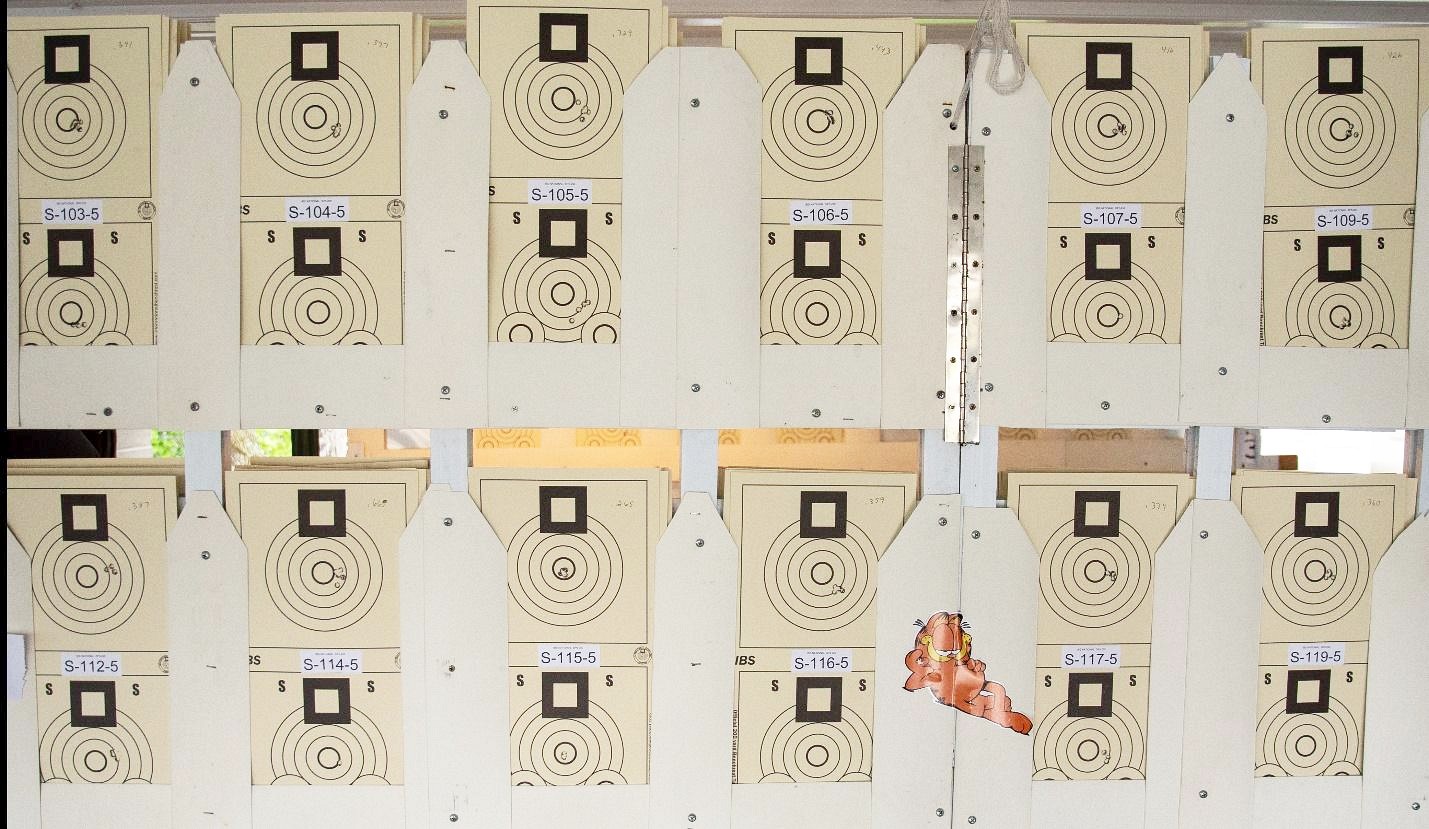
This photo shows 200-yard targets for one of the relays in the Sporter Class (10.5-lb riles, all 6 PPC). At the match, the scored, 5-shot targets are put up on a board, euphemistically called the “Wailing Wall”. These groups are revealing. Note that almost all the groups are located below and to the right of the moth ball (the 10 Ring in the center). The second set of target rings denoted by an “S” are for sighters, and are not scored.
Click photo to view large image
These targets were shot in a left to right drift (flags showing GREEN due to convention) drift. The targets show that most of the shooters sighted in during dead calm with point of impact at or below the 10 ring (mothball) for easier holding. So in a “green” condition the groups will move to the right of dead calm. These targets also demonstrate what modern benchrest bag guns can do at 200 yards! Some of those would be 100-yard ‘wallet groups’ for non-benchrest shooters. Remember these are 10.5-lb rifles, not heavy, “unlimited” rail guns. Mighty impressive precision.
IBS Shooter Profile — Bill Brawand
by Jeff Stover There are few “characters” left in the benchrest world, but Bill Brawand is one of them. He is still competing at age 84. He started in the game way back in 1973 and has been a stalwart on both the IBS and NBRSA circuits ever since.
He grew up on a dairy farm in north central PA near the town Wilcox. In the early days he earned $100 per week. That was not near enough to support a family and a competitive benchrest habit. That was one reason he got into bullet making. If he wanted to attend a match he had to do extra farm and dairy work to justify being gone for a weekend. Those chores were in addition to making bullets to both shoot and sell. He has worked hard his entire life and earned everything he has achieved.
Some time ago, oil and gas were discovered on the large Brawand farm. With production underway, many years ago the dairy was closed so Bill could focus on real estate and managing his wells. The oil/gas boom resulted in a dramatic change in his economic fortunes but Bill did not change at all. Before he finally got a small RV, he was known to sleep on a clubhouse couch.
Benchrest is now a family affair for Bill. One of Bill’s daughters, Sam, usually meets him at the shoots to assist him as needed. His knee problems keep him in a motorized scooter to get around the range. Sam memorialized Bill’s shooting accomplishments by sewing his many patches earned in shooting onto both a quilt and his shooting jacket (above). Check it out — that represents many decades of trigger pulling!
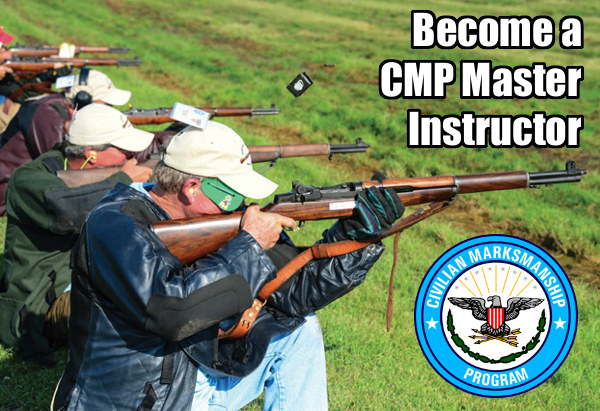
We all enjoy shooting rifles, but it’s also fulfilling to share your knowledge as a mentor. Serving as a rifle instructor can be very rewarding. Now the CMP offers a program to certify Master Instructors for the CMP’s most popular rifle programs — Vintage Military and Rimfire Sporter.
CMP Master Instructor Training Workshops
As a CMP Instructor you can help novices learn to safely shoot the M1 Garand, M1903 Springfield, and other vintage military rifles. You can also help with the very popular Rimfire Sporter program. Later this year, the CMP is offering an excellent program to help train new Master Instructors.
Experienced rifle marksmanship instructors and shooters who wish to receive advanced training and be certified as “Master Instructors” to teach CMP-sanctioned Clinics are invited to apply to attend a CMP Master Instructor Training Workshop. These workshops will train instructors to conduct Garand, Springfield, and Vintage Military Rifle Clinics and/or Rimfire Sporter Clinics. There will be two (2) instructor training workshops this year, one at Camp Perry in October and the second in Talladega in December. Dates and locations are:
M1903 Springfield shooter at Camp Perry. From GarandThumbBlog’s 2015 CMP Games Video.
CMP Master Instructor Class — In the Beginning
Our friend Dennis Santiago has been a CMP instructor for many years. He reports this has been a great experience and the CMP is a great organization. Dennis earned his “teaching credentials” at the first-ever GSM (Garand/Springfield/Vintage Military) Master Instructor Class.
CMP Director Gary Anderson is top row far left, with Dennis in front row center.
My Decade as a CMP Master Instructorby Dennis Santiago
I was in the first GSM Master Instructor class. It was taught at Camp Pendleton (CA) in November 2006 as part of the CMP Western Games. It was a three-day class by then-head of the Civilian Marksmanship Program, Gary Anderson.
We were the guinea pigs for an experiment. Our mission would be to take what we learned back to our clubs and create programs to teach the sport of High Power riflery to Americans, most of whom, were unfamiliar with shooting, let alone the details of serious competition. It was one of the most rewarding shared experiences of my life and it began a 10-year journey that helped build my love for the sport.
Gary spent lots of time not only teaching his prepared material but working with us on feedback about how to improve the curriculum. I took what I learned back to the Burbank Rifle and Revolver Club (BRRC) and, working with Wayne Fenner (left in photo), my friend and fellow sponsor of the California Grizzlies Junior Rifle Team, adapted BRRC’s training match program to the CMP’s approach.
Over the course of almost a decade, I taught a battalion of Americans from every walk of life and every political and ethnic background how to operate and compete with the U.S. Rifle M-1 Garand. It defined one weekend of every month of my life. We experimented with every CMP match format that came out, often discussing concepts with Gary and the CMP team.
Many of the students I taught went on to become accomplished competitors in their own right. I’ve watched them win medals, major tournaments, become distinguished riflemen. Some set national records. One made it to the Olympic Trials. The true reward was to hear from all of them again and again over the years. I’m from the old school that says you pass on what you have learned because you pay forward in gratitude to those who taught you. And so it was the decade I was BRRC’s GSM Master Instructor of record.
If you want to make a difference to the growth of our sport, consider taking the time to become a GSM Master Instructor. Teach another battalion of Americans what it means to be the caretakers of our heritage from behind every blade of grass.
DCM Emeritus Gary Anderson Teaches Clinic at Camp Perry, Ohio:
Here a Springfield M1903 shooter (in period-authentic uniform) competes in CMP Legacy Match.
In today’s feature, Emil Praslick III of Team Applied Ballistics explains how to determine wind direction down range. Praslick, now retired from the U.S. Army, was an 18-time National and 2-time World Champion coach with the USAMU. Emil is consider by many to be one of America’s greatest wind readers — a master when is comes to identifying wind value and direction, and predicting wind cycles.
Video ONE: Determining the Direction of the Wind
Key Point in Video — Find the Boil
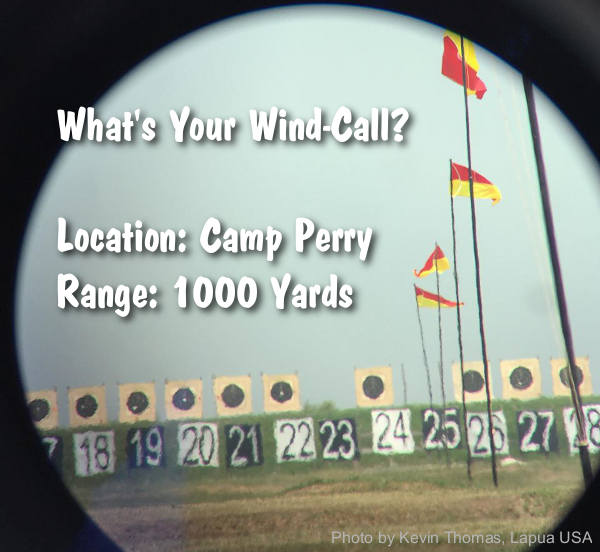
Emil explains how to determine wind direction using optic. The method is to use spotting scope, riflescope, or binoculars to look for the “Boil” — the condition in mirage when the light waves rising straight up. The wind will generate that straight-up, vertical boil in your optics when it is blowing directly at you, or directly from your rear. To identify this, traverse your scope or optics until you see the boil running straight up. When you see that vertical boil, the direction your optic is pointing is aligned with the wind flow (either blowing towards you or from directly behind you).
Video TWO: The No Wind Zero Setting
In this second video, Emil defines the “No-Wind Zero”, and explains why competitive shooters must understand the no-wind zero and have their sights or optics set for a no-wind zero starting point before heading to a match. In order to hit your target, after determining wind speed and direction, says Emil, “you have to have your scope setting dialed to ‘no wind zero’ first.”
Coach of Champions — Emil Praslick III
SFC Emil Praslick III, (U.S. Army, retired) works with Berger Bullets and Applied Ballistics. Emil served as the Head Coach of the U.S. National Long Range Rifle Team and Head Coach of the USAMU for several years. Teams coached by Emil have won 33 Inter-Service Rifle Championships. On top of that, teams he coached set 18 National records and 2 World Records. Overall, in the role of coach, Praslick can be credited with the most team wins of any coach in U.S. Military history.


 Dave Scott explains why the Warehouse was so unique:




 3. Ammo Caddy on Joystick Arm – Charles shoots a Right Bolt/Left Port action, so he pulls his rounds with his left hand. Note that Huckeba’s record rounds rest in a small, wood ammo caddy attached to the end of the joystick shaft. Look carefully, you’ll see the wood ammo block in place of the normal black ball at the end of the joystick. That allows Charles to pull shots with the absolute minimum of hand movement. Ingenious! Huckeba is very fast, with a great economy of motion. I believe that because his ammo was literally at hand, Charles was better able to keep his focus on aiming and the flags.


 There are few “characters” left in the benchrest world, but Bill Brawand is one of them. He is still competing at age 84. He started in the game way back in 1973 and has been a stalwart on both the IBS and NBRSA circuits ever since.


 We were the guinea pigs for an experiment. Our mission would be to take what we learned back to our clubs and create programs to teach the sport of High Power riflery to Americans, most of whom, were unfamiliar with shooting, let alone the details of serious competition. It was one of the most rewarding shared experiences of my life and it began a 10-year journey that helped build my love for the sport.