Report by Boyd Allen, IBS Vice President Photos by Hillary Martinez
Many of the nation’s best Score Benchrest shooters came to Maryland last month for the IBS 200/300-Yard Score Nationals. This is a one-shot-per-bullseye discipline dominated by accurate 30-caliber cartridges such as the 30 BR. Over the weekend of the 4th and 5th of August, 42 shooters participated in the 2018 IBS 200/300-Yard Score Nationals, held at the Thurmont Conservaton & Sportsman’s Club, in Thurmont, Maryland. Forty-one competitors shot Varmint for Score (VFS). Between the two 6X disciplines there were six competitors, equally divided between Hunter (H) and Varmint Hunter (VH). Dewey Hancock was “Top Gun” for the match, winning the VFS 200/300 Grand Agg with 500-23X, a possible new record.
There are six bullseyes on an IBS Score target. Competitors take one shot per bull for five scored shots. The sixth (bottom right) bullseye is reserved for sighter shots.
Rising River After Rain
This match had some unique challenges — caused by a river that overflowed after a rain. Thankfully, the match proceeded without major problems once needed equipment was moved. It rained nearly half an inch the Friday night before the match, as it had for several days. Given the flooding, there was a slight delay Saturday morning. The scoring trailer had to be moved because it been parked (before the rain) in a low area adjacent to where Big Hunter Creek empties into the Monocacy River. (In the satellite view, the firing line cover is in the middle, about one-third up from the bottom.)
Hot and Humid in Maryland — The match director described the weather as very hot and humid. On Saturday, the temperature varied from 66 to 81 degrees, the humidity from 62 to 100 %, and the wind speed from 0 to 9 mph. On Sunday, things warmed up a bit, the humidity was reported as a little lower, as was the wind speed.
The Green Fields of Thurmont — With recent rains at Thurmont, lush green grass stretched from firing line to targets. This elicits envy from a shooter who has spent all of his time on ranges that do not have a single blade of green anywhere, except for a few weeks during a short rainy season. To my eyes, this range is beautiful.
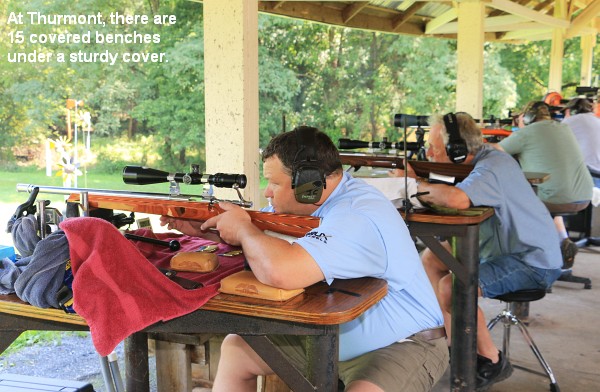
Thurmont shooters are blessed with a truly outstanding facility that serves all types of shooting. There are fifteen covered benches of mixed construction under a sturdy cover, with plenty of parking both for vehicles and RVs. Learn more about the Thurmont Club at TCandSC.org.
TOP TEN Match Results, and Equipment List
Can anyone identify that big gold-tone coaxial rest on the right?
The VFS Grand Aggregate Top Five were: Dewey Hancock (1st Place), John Bosley (2nd), Ronnie Milford (3rd), Brian Fitch (4th), and Jim Cline (5th). VFS winner Dewey Hancock shot a possible new 200/300 yard record with a 500-23X.
Top shooters left to right: Dewey Hancock, Nick Breeden, Brian Fitch, Glen Olenick, Robert Brooks, Steve Cameron, Dean Breeden (arms raised), KL Miller, Jim Cline, Ronnie Milford, John Bosley.
Wayne France — with the “I just won a Nightforce” smile!
Steve Eller smiling — BIB Bullets from Randy Robinette are always a good choice.
Dean Breeden, Match Director and Competitor
Match directors do not get the appreciation they deserve. The match calendar would be blank without them. Score Nationals Match director Dean Breeden ran a great show here. In addition to rescuing a trailer from flood waters, and running the 200/300 Score Nationals, Dean also himself competed at the Nationals, shooting two rifles. He did well, with Top Ten finishes at both distances, in both VFS and Hunter classes (3rd in Hunter at 300 yards).
While Dean may be under-appreciated as a match director, Dean is widely recognized as one of the best IBS score shooters out there. Dean holds six (6) current IBS Score Shooting records.
In his Match Report, Dean acknowledged and thanked the generous match sponsors:
BIB Bullets
Brunos Shooter Supply
Brux Barrels
Dave Short Customs
Eddie Harren
Krieger Barrels
Nightforce
PMA Tool
Redding Reloading
ShadeTree Engineering
Wilson Dies
Dennis DeMille shows a young competitor at the CMP Western Games how to adjust his leather sling.
Setting-Up a Leather Service Rifle Sling for Competition
So you made the mistake of disassembling your leather service rifle sling, or are intimidated about how to use one? In this Creedmoor Sports InfoZone video, Creedmoor G.M. Dennis DeMille explains how to set up and use a sling. The covers the basics — Dennis starts with a totally disassembled leather service rifle sling and shows you how to set it up properly.
Tip: “Many shooters shy away from using a leather sling because they have never been taught how to use one. That’s unfortunate. In my opinion a leather sling offers more support than a web sling, which is important when competiting with the heavier than normal rifles.”
Configuring the Sling for the Standing (Offhand) Position
In this second in a series of Creedmoor InfoZone videos on the setup and use of the leather service rifle sling, Dennis DeMille details how to configure and best utilize the leather service rifle sling while shooting from the standing position.
Tip: “Putting the Frogs in different hole will change the amount of added elevation a sling provides.”
Looking at Sling Types — Comparing the Features
In this video Dennis showcases a large variety of shooting slings. He explains the strong points of each type so you can choose the sling best suited to your discipline and shooting style.
The Benefits of Dry-Fire Training
Once you know how to set up your sling properly, you’ll want to practice. Dennis DeMille stresses the importance of dry-fire practice with sling and shooting coat. Dry-Fire training is essential to the sling disciplines. Dennis DeMille, a national Service Rifle Champion, told us that, for every minute he spent in actual competition, he would spend hours practicing without ammunition. While in the USMC, Dennis would practice in the barracks, working on his hold and dry-firing:
“The most important thing is to spend time off the range practicing. Most of what I learned as a High Power shooter I learned without ammunition — just spending time dry firing and doing holding exercises. Holding exercises will really identify the weak parts of your position. The primary purpose of dry firing is to get you used to shooting an empty rifle. If you can shoot a loaded rifle the same way you shoot an empty rifle then eventually you will become a High Master.”
The 2018 Western CMP Cup and CMP Games Event will be held October 16-22 at the Ben Avery Range in Phoenix, Arizona. For 2018 the CMP takes over what were the Creedmoor Cup Matches, and all matches will now follow CMP High Power Rifle Competition Rules. Notably, this year the Cup and Games matches on the High Power range will be fired on the CMP’s electronic targets. That means less time in the pits, and faster cyeling of relay. Also new this year, the CMP will be adding more smallbore events at Ben Avery. Click HERE for full schedule of events.
The CMP Cup Matches include two CMP 1000 Aggregate Matches followed by a 4-Man Team Match and an EIC Service Rifle Match. Following the CMP Cup Matches will be the CMP Games Matches, which will include Small Arms Firing School (SAFS), Garand/Springfield/Vintage/Modern Military Matches, Carbine Match, Rimfire Sporter match and Vintage Sniper Team Match.
All Competitors firing on the High Power range will be firing on Kongsberg Electronic Targets (KTS). The KTS system registers each shot and relays the location and score value to a monitor beside each shooter on the firing line. CLICK HERE for Electronic Target Scoring Rules.
M1 Carbine Match is always very popular.
There will be shade for the Rimfire Sporter Match, at least during the prone stage.
Eye, Ear, and Cranial (Sun) Protection
Vintage Sniper Rifle Match competitors try to keep cool
A Small Arms Firing School (SAFS) will be held on Friday, October 19, 2018.
In 2014, two competitors sported vintage U.S. Marine Corps uniforms. Semper Fi!
Readers often ask us: “Is there an inexpensive way I can get started in position shooting?” The answer is “yes” — across the country CMP-affiliated clubs host Rimfire Sporter matches. You can use a wide variety of .22 LR rimfire rifles — manual actions (such as a Winchester model 52) or semi-automatics (such as a Ruger 10/22). There are prone, sitting/kneeling, and standing stages. CMP rules provide separate classifications for scoped rifles, open-sighted rifles, and aperature-sighted rifles. The matches are fun, the ammo is inexpensive, and everyone has a good time while improving their marksmanship.
The rapid-fire sitting or kneeling stage of a CMP-sanctioned .22 Sporter Match consists of two, 5-shot strings. A manually-operated or semi-automatic rifle may be used for this match.
The video shows the sitting/kneeling rapid-fire stage of a Rimfire Sporter match.
Our friend Dennis Santiago helps run CMP Rimfire Sporter Matches in Southern California. Dennis observes: “You want something challenging? Well that X-Ring 50 yards away is the diameter of a 50 cent piece, and there are people out there that can womp that thing with iron sights.”
Dennis notes: “There are six (6) stages of fire on a tough little target. Notice the rifles that can be used run the gamut from pump and bolt actions to variations on the semi-auto theme. All still require a good eye and a steady hold to earn one’s bragging rights for the day. A match takes about an hour and a half per relay. The slowest part of the match is initial sighting in. It’ll take longer than the allocated 5 minutes for the typical first timer coming to a club match.”
At Dennis’s Burbank Rifle & Revolver Club (BRRC), procedures are modified a little bit: “What we typically do at BRRC is run two relays. Experienced competitors shoot per the full rulebook. New shooters are afforded a bit more relaxed environment to make the experience more fun and inviting. We do the same thing in our M-1 Garand Clinic/Match series.”
Rimfire Sporter Match Basics
The CMP Rimfire Sporter Rifle Match is an inexpensive, fun-oriented competition using .22 caliber sporter rifles (plinking and small game rifles) commonly owned by most gun enthusiasts. To compete, all you need is a basic rifle, safety gear, and ammunition. No fancy, high-dollar rifles are required.
The event is shot with standard sporter-type, rimfire rifles weighing no more than 7 ½ lbs, with sights and sling. Rifles may be manually-operated or semi-automatic. Shooters with manually-operated actions are given extra time in the rapid-fire stage to compensate for the difference. (See Video).
There are three classes of competition — the standard “O Class” for open-sighted rifles, “T-Class” for telescope-sighted and rear aperture-sighted rifles and “Tactical Rimfire” class, which is a .22 caliber A4 or AR15 style rifle. Firing for all classes is done at 50 and 25 yards on a target with a 1.78″ ten-ring and an 18″ outer one-ring. Even new shooters can get hits on this target, but it’s still tough enough that no one yet has fired a perfect 600×600 score.
The Civilian Marksmanship Program (CMP) has a CMP Guide to Rimfire Sporter Shooting. This FREE, 50-page digital publication covers equipment, positions, course of fire, rules, scoring and much more. You’ll find helpful “how-to” sections on aiming, sight picture, hold control, and trigger control. Reading these instructional sections can benefit any prone or three-position competitive shooter.
IBS 100/200 Yard Score Nationals Will Be Rescheduled due to Impending Hurricane
Due to the impending landfall of Hurricane Florence, the IBS 100/200 yard Score Nationals event has been rescheduled from this coming weekend (September 15-16) to the weekend of October 27-28, 2018, at the same location — the Ashe County Wildlife Club (ACWLC), in Laurel Springs, North Carolina.
The same Ashe County club hosted the 200/300 Score Nationals in 2015, and it was a huge success. Given the popularity of this fine North Carolina shooting facility, we expect the turn-out in October (as rescheduled) will be high. CLICK HERE for Forum thread.
The ACWLC range is located in the mountainous northwest point of the state with Virginia to the north and Tennessee to the west. The Club also hosted the 100 and 200 Yard National Championship in 2014, utilizing its 30 benches protected by an overhang.
Ashe County Wildlife Club maintains a website, www.acwlc.org and a public Facebook page. The Club hosts rifle, pistol, and shotgun sports (skeet, trap, sporting clays) events at its range facility located about 15 miles east of West Jefferson at 3220 Big Peek Creek Road, Laurel Springs, NC (turn north off NC Highway 88). Visit www.acwlc.org to learn more about the club or obtain Membership applications.
A new video series featuring NFL legend Brett Favre and USA Shooting competitors is now available on GetZone.com. This series showcases the best aspects of our sport — the dedication and hard work of young shooters, including paralympian marksmen. Host Brett Favre talks with Olympic and Paralympic competitors about their challenges and achievements. In each episode, Favre and the featured athletes conduct shooting drills and share tips and tactics.
Episode 1 — Brett Favre talks with two-time Olympic shotgun bronze medalist Corey Cogdell-Unrein. She explains that more financial support is needed: “I’ve watched so many of my teammates struggle, and scratch, and fight to pay just their training expenses, and go in debt financially to pursue this sport. I’ve thought, how good could we be if we had the funding that we needed?”
Episode 2 — In the second episode, Marco De La Rosa details his journey from service in the U.S. Marine Corps to competing for the USA as a Paralympian pistol shooter: “I traveled everywhere to find myself — then I found this — I found shooting,” said De La Rosa. “I didn’t get into this for myself. I’m representing the Corps, and the Army guys, and everybody at the VA. That’s what I’m about, I represent America,” he added.
Episode 3 — In the third episode, Brett Favre interviews Paralympic Rifle shooter McKenna Dahl, who explained: “Shooting gives me a purpose and a passion for life that I don’t think I ever would have found if it weren’t for the sport. It’s an honor to be able to go out and wear the American Flag on your shoulder. I wouldn’t be where I am in life today if it weren’t for the sport and… this country, and I’m really thankful for that.” [Editor: Compare this young woman’s ethics and dedication to a certain ex-NFL quarterback who is now being glorified by Nike for kneeling during the National Anthem. She honors the country, while he dishonors it. Yet he gets paid millions by Nike.]
NOTE: We’re proud to report that McMillan Firearms stepped up as one of the first major sponsors for the series, and will be featured in an upcoming episode of “USA Shooting Presented by 4Outdoors”.
One recent trend in F-TR competition is the use of low-profile, benchrest-type stocks shot with a light hand-hold and little or no face contact. For this method of F-TR shooting to work, you need the right equipment, and practice a “minimalist” shooting technique. One of the pioneers in this style of F-TR shooting is action-maker John Pierce of Pierce Engineering. Above you can see John shooting one of his F-TR rifles at the 2015 Canadian F-Class Championships. Note the straight-line stock and see how the adjustable bipod is set quite low to the ground (in fact the bipod’s arms are almost straight out).
Members of the Michigan F-TR Team, including Bryan Litz, have used similar rigs with success. Bryan said it took a while to adapt his shooting technique to this kind of rig, but there is a pay-off. Armed with a Pierce-built F-TR rifle, Bryan won his first-ever F-TR Match. Bryan explains the technique he uses when shooting this kind of rifle:
“Coming over from sling shooting, I knew there would be unique challenges to F-TR which I wanted to learn prior to (not during) a major tournament. I learned a new shooting position which doesn’t involve drawing the right knee up. For F-TR I get more straight behind the gun rather than at an angle. I found that the rifle shoots best with very light cheek, shoulder and grip pressure, approaching free recoil. This is how Eric Stecker shot his similar rifle into second place in the SW Nationals [with high X-Count by a large margin]. I learned the rifle’s sensitivity to different bipod and rear bag supports, and found the best buttplate position to allow the rifle to track and stay on target after recoil. This set-up shot best with a mostly free-recoil approach, that means ‘hovering’ over the comb, rather than resting your head on the stock. This took some ‘getting used to’ in terms of neck and back muscle tone. These are the kind of details I think it’s important to focus on when entering a new discipline.”
Bryan’s Pierce-built F-TR rig is a tack-driver: “I can certainly vouch for this set-up! In [a 2015] mid-range State Championship in Midland, MI, I shot my Pierce rifle into first place with a 598-44X (20 shots at 300, 500 and 600). Once you get used to the positioning and way of shooting these rifles, they just pour shots through the center of the target.”
Pierce F-TR Rifles with Scoville Stocks
Shown below are three complete Pierce F-TR rifles, along with a barreled action for comparison. The carbon-fiber/composite stocks are built by Bob Scoville. These Scoville stocks are very light, yet very strong and very stiff.
Show Me the Money, Baby! The biggest money match of the year, NRA World Shooting Championship (WSC), runs September 20-22 at the Peacemaker National Training Center in Glengary, WV. This event offers over $250,000 in cash awards and product prizes, making the WSC the richest combined shooting event in the USA (if not the world).
This unique 3-day multi-gun match tests competitors’ skills across twelve challenging stages involving nearly every major shooting discipline for rifles, shotguns, and pistols. All guns and ammo are supplied, but entry fees are steep.
WSC Highlight Video with Competitor Interviews:
All the Equipment is Supplied
“What makes this event very unique, especially to a professional shooter, is all the equipment is supplied. You have to leave your ego at home and just try to adapt as best you can to the equipment that you have supplied.” — Jerry Miculek
This major match attracts both sponsored Pros and “regular Joes”. Shooters will be split into two groups: a Professional Division for sponsored shooters, and the Amateur Division for non-sponsored competitors. All firearms, optics, and ammo will be provided by match sponsors for both divisions.
Video Shows Stages at 2017 World Shooting Championship
Cash Awards, Huge Prize Table, and Random Drawings
The NRA World Shooting Championship will offer $250,000 in cash and prizes. Along with the $25,000 winner’s pay-out, there will be fat cash prizes for second and third place overall, High Lady, and High Amateur Junior. Then there are the rich prize tables. In 2017, the Amateur prize table held $100,000 worth of prizes. And last year the WSC added Ten (10) Random Drawings worth $400 each. These drawings, held during the WSC Awards Banquet, gave every competitor a chance to win cash, no matter what their event ranking.
Seen at the WSC: VuDoo Gunworks Tactical .22 LR Rimfire Rifles
The 2017 WSC included a side-match featuring Vudoo Gunworks .22 LR rimfire tactical rigs. Shooters were impressed with the V-22 rifle, which looks and feels like a centerfire rig, but with a rimfire repeater action running full-size mags.
Vudoo states: “Our V-22 also runs a full-size short action bottom metal (DBM) and our V-2210 magazine has a [full-size] AICS form factor. The V-22 is the only controlled-round-feed .22 LR receiver out there. The bolt has full capture control of the cartridge from the time it leaves the magazine until it ejects the spent round out the ejection port.” That means the round never touches anything during feed travel so the bullets won’t be nicked/dented during rapid cycling. Sean Murphy of Nightforce enjoyed shooting the Vudoo Gun Works .22s: “I’ll probably end up with one of their rimfires as it is a sweet setup.”
Report by Boyd Allen, IBS Vice President Photos by Gordie Gritters and Alex Wheeler
The 2018 IBS 1000-Yard Nationals event was hosted by the Montana NW 1000 Yard BR Club, which has an active and well-run 1K benchrest shooting program. Over eighty shooters from as far away as Indonesia participated, 82 in Light Gun, and 85 in Heavy Gun. By all accounts it was a very well-run match, that was enjoyed by all who attended.
The Deep Creek Range is a beautiful place to shoot, with normally favorable conditions. But the winds were challenging at the 2018 IBS 1000-yard Nationals.
One man, Carroll Lance, dominated the match, taking the 2-Gun Overall Aggregate, while also winning HG Score Agg, HG Group Agg, and HG Overall Agg. It was a masterful performance — Carroll shot his Light Gun in both classes, beating dozens of bigger, heavier, and much more expensive rifles. Carroll’s name will be placed on four IBS perpetual trophies. Here’s Carroll with his line-up of trophies.
Winning Form — Carroll Lance Talks Technique
When asked for his advice to a new shooter, Big Winner Carroll Lance said: “Shooters should concentrate on being smooth, so as not to disturb the rifle in the bags. Speed will come naturally. The common mistake is to try to run the shots faster than can be done smoothly.”
Aerial Drone Video Shows Deep Creek Range outside Missoula, Montana. Worth Watching!
Challenging Conditions at Match
While Deep Creek is renown for often having good, “readable” conditions, this was a tough year according to Deep Creek veterans. As proof, there were five DQs on a single relay.
Tom Mosul (who ran the firing line for most of the event) noted that conditions were not extreme but could be tricky, with max wind speed s10-15 mph. It varied enough that being on some relays could effectively put a competitor out of the tournament. Tom also mentioned that indicators that he normally could depend on were not reliable this year.
Leo Anderson, who has been present at nearly all the 1000-yard matches ever held at Deep Creek, said this 2018 match had some of the trickiest conditions he has seen in 20 years of competition. Leo said you could not see the conditions causing POI changes. Alex Wheeler agreed, and added that although it was pretty calm at the benches, that the scorer who was running targets (from the pits to the firing line) said there was a strong cross wind half way down range that could not be felt at the pits or firing line…typical for Deep Creek, tough to read when it does decide to be nasty.
Summary of IBS 1000-Yard Nationals Match Results
For those who are unfamiliar with long range benchrest results, there are seven categories of winners, with seven corresponding traveling trophies (the big ones that bear the names of each year’s winners). For each of the two rifle classes (Light Gun and Heavy Guun) there are group, score, and overall aggregate winners (every target is both measured for group size and scored.) Finally, there is a 2-Gun winner for both rifle classes combined, based on group AND score.
With over eighty competitors, the PDF of the complete results, including those of every relay plus a very detailed list of the equipment used by every competitor for both classes, is a whopping 52 pages long. Links Below:
Equipment List Light Gun and Heavy Gun Classes
The seven travelling trophies went to just three shooters. Cody Finch won the LG Group aggregate. Tim Gonnerman won the LG Score aggregate and LG Overall aggregate. Carroll Lance won everything else — HG Score aggregate, HG Group aggregate, HG Overall aggregate, and the 2-Gun Overall.
Big winner Carroll Lance shot his 6mm Dasher Light Gun for both classes. The rifle, smithed by Jay Cutright, features a Borden BRM drop port action, Krieger barrel, Wheeler LRB stock, and Nightforce scope. Carroll’s match-winning load consisted of Vapor Trail bullets, in front of H4895 powder and CCI primers.
Cody Finch’s Light Gun was a 6BR Ackley (6BRA) with Lederer barrel, BAT action, Nightforce scope, and a DCT stock. His load consisted of Vapor Trail bullets, Hodgdon powder, and CCI primers. Alex Wheeler smithed the rifle.
Tim Gonnerman’s Light Gun, smithed by Mike Bigelow, featured a Krieger barrel (6mm Dasher), BAT action, Nightforce scope, and McMillan stock. The load consists of Vapor Trail bullets, H4895 powder, and CCI 450 primers.
Equipment List by Class Based on Two-Gun Overall Agg Rankings Light Gun Equipment List (click to zoom):
I called the major Aggregate winners (Carroll Lance, Cody Finch, and Tim Gonnerman), and asked them about the 1K Nationals. My questions fell into five major categories: 1) how the wind compared to other matches (including other locations); 2) how each handles his rifle and equipment; 3) how they shot the match; 4) how they clean their barrels (and what their barrel accuracy life is); and 5) How they reload.
They all described the conditions as challenging. This was not a match to use for spotting small differences in accuracy between similar calibers. Even with the rotations of relays and benches, there was an inescapable luck factor, with some relays having significantly more challenging conditions than others. Changes could be rapid, with reversals that could be extreme.
Gun-Handling: On the subject of how the rifle is handled, Cody Finch shoots with only trigger contact, while Tim Gonnerman and Carroll Lance have light stock contact. Tim said that he is so focused on shooting that he is really not aware of the details of how he handles the rifle. Carroll said that he makes light contact with his trigger hand and has the butt touching his shoulder so lightly that he can barely feel it, but solidly enough that it only recoils about a quarter inch.
Shooting Strategies: Cody uses his sighter period to investigate how differences in mirage affect bullet impact location and then holds off shot by shot during his record string. Tim and Carroll do not, they adjust their scopes using the last sighter shot (which they can see because there is target service like an high power match with spotter disks) and then hold center for their record, trying to do as little with their rest adjustments as possible. Carroll mentioned that he only made one adjustment for the whole weekend and that his usual practice is to make small corrections with hand pressure.
Barrel Cleaning: Tim shot the whole weekend, without cleaning. When he does clean he uses Pro Shot Copper Solvent, patches, a nylon brush, and does a lot of soaking. Periodically he uses IOSSO with a patch on a nylon brush. He breaks in his barrels with the common one-shot-and-clean progressing to three and then five, and, sees a velocity increase at about 120 rounds from new. Tim cleans with patches and bronze brushes. I smiled when he told me what he cleans with, CLR, ThorroClean (Bullet Central) and IOSSO. CLR has been the topic of some discussion on the internet, and a friend found that it did a good job on carbon. It has been a controversial topic. Of note, Tim shot the smallest group for the tournament.
Barrel Life: All three Top Guns said that accurate barrel life varied from barrel to barrel. I got the general impression that most were done or close to done by 1,500 rounds, at least for the Dasher, with the BRA being too new to tell if it would stretch that far, but that it might.
Reloading Methods: On the reloading side, none of them anneal regularly, if at all. Carroll’s cases had 15-20 firings on them, and had only been annealed once, early on, but they still felt good when he was seating bullets. Last year he tried to anneal after every event.
Most of his competition has been at 600 yards, where Varget did a good job, with bullets seated .010 to .012 into the lands, but it did not perform well at 1K so he switched to H4895, which likes its bullets .005 into the lands. The chamber has a .268 neck. Case necks were turned to .0105 for a loaded round clearance of about .003. He used a .263 bushing.
Starting with a fired case, he sizes in a FL bushing die, tumbles in corn cob media to remove the lube, and just before seating bullets applies graphite to the insides of case necks with a Q-Tip.
Course of Fire at 1K Nationals (as explained by Tom Mosul):
“Relays were rotated along with bench assignment within each relay. The match is a three-target Aggregate, so what we did was divide the total number of relays and benches by 3, and then rounded down. Due to the number of benches (13) and shooters there were seven relays per target. Saturday morning started with LG target #1, followed by HG target #1, finishing the day with LG target #2. Sunday morning began with HG target #2, then LG target #3, and finished with HG target #3. For each relay six minutes are allowed for sighter shots, followed by a cease fire, and within a minute after that, a ten-minute record period.”
True Treasure Trove of Prizes at Deep Creek
There was a very rich prize table, including BAT, Borden, Curtis Custom, and Defiance actions; McMillan, McMillan/Wheeler and Shehane stocks; Kahles, Nightforce, Swarovski, and Vortex Scopes; SEB NEO Rest; Benchsource Annealing machine; Bartlein, Brux, Lilja, Krieger, and Rock Creek barrels; Zeiss Binoculars; many gift certificates (incl. Kelbly’s and McMillan) and much more.
The Top Guns got the pick of the prizes. Carroll Lance chose a Kahles 10-50 rifle scope, Tim Gonnerman chose a BAT Neuvo action, and Cody Finch chose a Borden BRM action.
NOTE: Prizes that manufacturers and vendors contribute are an important part of any successful match. I am sure that everyone who was connected with this event is grateful to all the generous sponsors who donated prizes and gift certificates. Sebastian Lambang (shown below), creator of SEB Rests, shot the match and donated a SEB NEO rest.
More Photos — Hundreds of Photos
Here are links to ALL pictures that Gordy Gritters and Alex Wheeler were kind enough to take at the 2018 IBS 1000-Yard Nationals. There are 359 images altogether:
This shows Tom Jacobs of Vapor Trail Bullets holding his match rifle while Gordy Gritters drills a couple of ounces out of the butt. We’re told Tom knew he was an ounce heavy when he got there.
From the late ’70s through 1983, a huge, concrete-walled warehouse in Houston was used for benchrest testing. Virgil King and Bob Fisher set up a bullet-catching backstop at the end of a 30-yard-wide, 325-yard-long fire lane that remained unobstructed even when the warehouse was in use. This allowed accuracy tests in virtually perfect “no wind” conditions. Over a six-year period, about 30 shooters were invited to test their rifles. The results were amazing, with numerous “zero groups” being shot in the facility. Many of the lessons learned in the legendary Houston Warehouse still help benchresters achieve better accuracy today.
Dave Scott explains why the Warehouse was so unique:
“Over a period of six years, the levels of accuracy achieved in the Houston Warehouse went beyond what many precision shooters thought possible for lightweight rifles shot from sandbags and aimed shot-to-shot by human eye. For the first time, a handful of gifted, serious experimenters — armed with the very best performing rifles (with notable exceptions) — could boldly venture into the final frontiers of rifle accuracy, a journey made possible by eliminating the baffling uncertainties of conditions arising from wind and mirage. Under these steel skies, a shooter could, without question, confirm the absolute limits of accuracy of his rifle, or isolate the source of a problem. In the flawlessly stable containment of the Houston Warehouse … a very few exceptional rifles would display the real stuff, drilling repeated groups measuring well below the unbelievably tiny .100″ barrier. The bulk of rifles, however, embarrassed their owners.”
Scott’s article also reveals some interesting technical points: “One thing that IS important is that the bullet be precisely seated against the lands. T.J. Jackson reported this fact in the May 1987 issue of Precision Shooting. In a letter to the Editor, T.J. wrote, ‘…in all our testing in that Houston warehouse… and the dozens and dozens of groups that Virgil King shot in there ‘in the zeroes’… he NEVER fired a single official screamer group when he was ‘jumping’ bullets. All his best groups were always seated into the lands, or at the very least… touching the lands. Virgil said his practice was to seat the bullets so the engraving was half as long as the width of the lands. He noticed an interesting phenomenon with rifles that could really shoot: if the bullets were seated a little short and the powder charge was a bit on the light side, the groups formed vertically. As he seated the bullets farther out and increased the powder charge, the groups finally became horizontal. If he went still farther, the groups formed big globs. He said the trick is to find the midway point between vertical and horizontal. That point should be a small hole.”
You should definitely read the complete article, as it provides many more fascinating insights, including shooting technique, barrel cleaning, neck-turning, and case prep.




 The VFS Grand Aggregate Top Five were: Dewey Hancock (1st Place), John Bosley (2nd), Ronnie Milford (3rd), Brian Fitch (4th), and Jim Cline (5th). VFS winner Dewey Hancock shot a possible new 200/300 yard record with a 500-23X.


 The Benefits of Dry-Fire Training


 Dave Scott explains why the Warehouse was so unique:


