23rd Annual Bud Pryor Memorial Match, June 10-11, 2017 Match Report by Josh Shrum
For 23 years now, Benchrest Score shooters have flocked to the Thurmont Conservation & Sportsman’s Club outside of Frederick, Maryland for “The Bud”. This year, competitors from as far south as Georgia and as far north as Vermont came to try their hand against the always-challenging conditions of “The Bud”. Traditionally held in mid-June’s tricky conditions, the Bud Pryor Memorial is an event to challenge even the most skilled Benchrest competitor.
Day One started with the 100-Yard Aggregate, which pretty much set the tone for what was to come all weekend long. Of the 33 shooters competing in the Varmint For Score (VFS) class, thirteen shooters dropped at least one point at 100 yards. “The Bud” had begun.
100-Yard Winner Wayne France
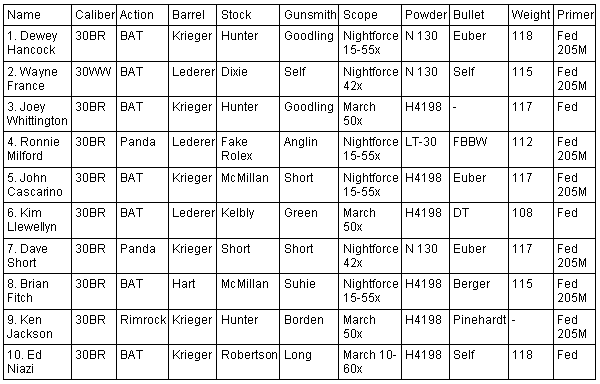
By the end of the 100-Yard Agg, five competitors finished with top scores of 250-21X, with Wayne France taking the win under Creedmoor tie-breaker rules. Wayne would continue to shoot well for the entire weekend, finishing in the Top 10 at 200 and taking second (by Creedmoor) at 300, shooting his Lederer-barreled BAT in a Dixie stock. Wayne does his own gunsmithing, makes his own bullets, and shoots his own cartridge design. He is truly a “Do-It-Yourselfer”.
200-Yard winner Ronnie Milford checking conditions…
Ronnie Rocks at 200, with an Impressive X-Count
Georgia shooter Ronnie Milford won the 200-Yard Agg with an impressive 250-13X. Ronnie was one of only six shooters to finish “clean” at 200, as traditional Bud weather was punishing even the smallest errors in judgment by shooters. Built by gunsmith Doyle Anglin, Ronnie’s Lederer-barreled Panda beat the field at 200 yards by three Xs, a significant margin. The next three shooters (places 2-4 at 200 yards) all shot 250-10X. Interestingly, Ronnie was shooting Accurate LT-30 powder, not the more widely used Hodgdon H4198 or Vihtavuori N130.
Of special note, Mrs. Carol Grosbier came on Saturday to visit during the match. Nearly every single shooter there stopped by to visit and offer their condolences on the passing of her husband Dick Grosbier, former IBS Vice President and Webmaster. It was great to see Carol and everyone’s actions showed just how great of a community of shooters the sport of Benchrest has.
The longest challenge, the 300-Yard Agg, was shot on Day Two. While conditions were not quite as “tough” as the previous day, they were anything but forgiving. High heat and gusting winds kept shooters on their toes as they strove for victory at 300 yards. A mere seven shooters would manage to stay clean through the first match, and only Maryland shooter Dewey Hancock managed to stay clean through Match Two. Dewey would go on to win the 300-Yard Agg shooting a 248-3X, beating 100-Yard winner Wayne France by Creedmoor and edging out Joey Whittington’s score of 248-2X. Dewey’s Goodling-built rifle uses a BAT action, Krieger barrel, and sits in a beautiful Roy Hunter stock.
Dewey Hancock Wins with Strong Performances at 100, 200, and 300
Dewey Hancock’s excellent performance at 300, coupled with his second-place finish at 200 and his Top Ten finish at 100 put him on the throne. Hancock won the Grand Aggregate for the 23rd Annual Bud Pryor with a score of 748-31X. Just one point behind, Wayne France took second with a score of 747-31X. Joey Whittington took third with 746-35X.
Hunter Class was contested by both K.L Miller and Brian Fitch (Brian competed in both VFS and Hunter) with K.L Miller taking the Grand Aggregate in Hunter with a 723-11X while Brian posted a 717-11X. Mark Ukishima shot the events only Factory Class gun. It was great to have so many different classes contested at this year’s Bud Pryor.
TOP 10 EQUIPMENT LIST:
About the Bud Pryor Memorial Match Bud Pryor was a fine gentleman who started shooting IBS matches in 1983. He was a machinest turned gunsmith who made friends and got many people started in shooting IBS registered matches over the next few years. Bud and Dick Grosbier ran the first IBS match at the Thurmont range in April 1983. CLICK HERE to see vintage photos of the 1983 match.
After Bud’s untimely passing a few years later, the club decided to put on a big match and dedicate it to him. As Thurmont is one of the few ranges around with 100/200/300 yard capabilities, we decided to put on a 3-yardage Grand Aggregate match. This was not as simple as it seems, since the three-yardage 100/200/300 was not an IBS-recognized Aggregate. After an agenda item was approved at an IBS winter meeting, 100/200/300 records were set at Thurmont. Over the years, most records have stayed at this scenic range. There are a total of four IBS ranges now holding 100/200/300 yard matches.
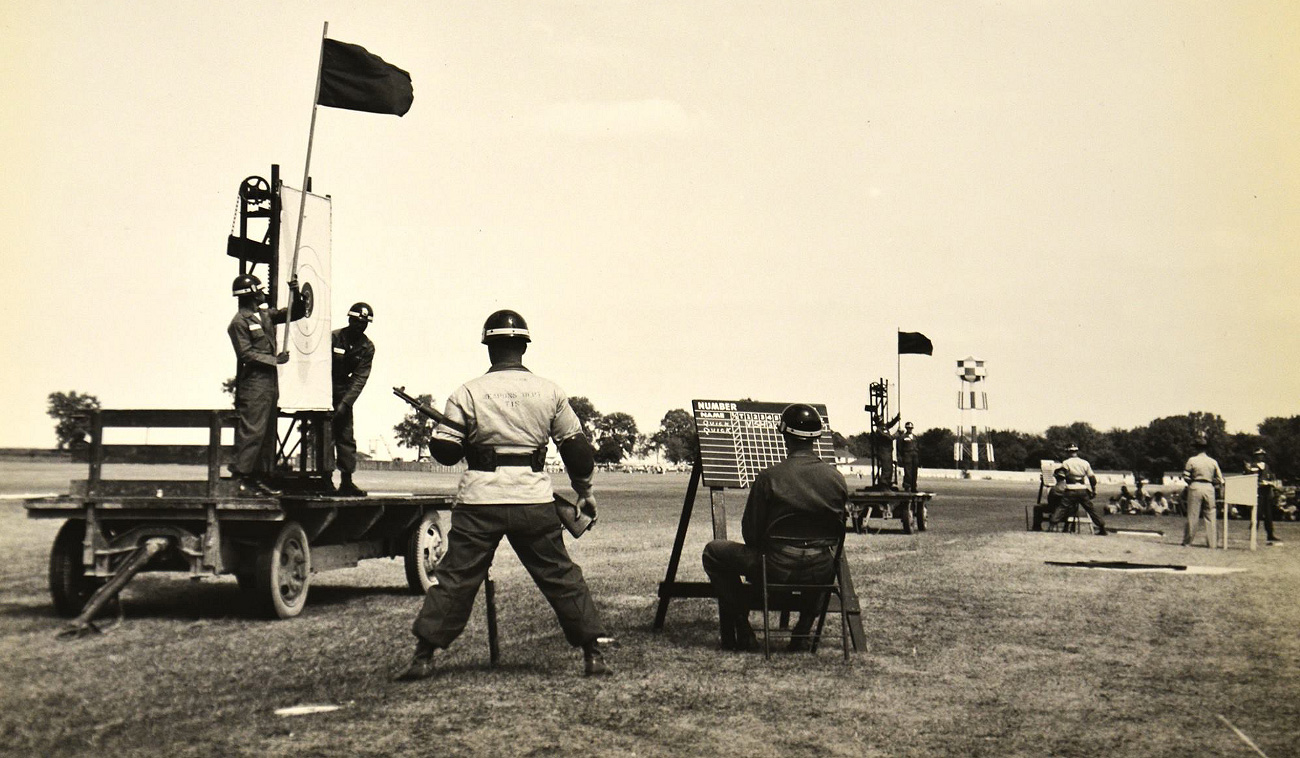
Ever wonder what “Maggie’s Drawers” means? Well, in the shooting community it means a complete miss on the target, as originally indicated by a large red flag. In this 1957 photo, the U.S. Army brought the targets to the students at the annual Small Arms Firing School. Wheeled carts with “demo” targets were positioned at the firing line, between shooting stations, so trainees could better see the procedures. Soldiers demonstrated firing a shot, scoring the target and scorecard on the Camp Perry firing line. Targets in use at the time were the “V” type. In this demonstration shot, the pit worker waves a red flag, known as “Maggie’s Drawers”, signifying a miss. This old photo comes from the Civilian Marksmanship Program (CMP) Archives.
If you click the gray tab to view the photo full-screen, you can see something extra. Look carefully at the horizon below the muzzle of the M1 Garand held by the shooter in the foreground. If you look carefully, you can see a crane being used to erect the beach tower that now watches over Lake Erie and the ranges when they are “hot”.
Origin of ‘Maggie’s Drawers’ Term Hap Rocketto, noted shooting historian, has explained the etymology of “Maggie’s Drawers”. This term “refers to the red flag waved vigorously across the face of the target to signify a complete miss of the target during practice”. The term came in use in the early 20th Century (prior to WWI) when flags were used to signal shot locations on long-range rifle targets.
Hap writes: “Since [the early 20th Century] the target has changed to the decimal bull and the marking system has been revised several times. Flags are no longer used, being replaced by value panels and chalk boards. However, one term from the flag days has held on with a tenacity that is indicative of the strong traditions of the high power community. If a shooter had the misfortune of firing a miss a red flag was waved across the front of the target. The flag is commonly known as ‘Maggie’s Drawers’ giving us the term now generally used to refer to a miss. The term ‘Maggie’s Drawers’ seems to be based on, as many things are in the military, a bawdy song. Prior to The Great War there was an old music hall song entitled The Old Red Flannel Drawers That Maggie Wore which [was creatively altered], as things tend to be by the troops, into something less delicate than might have been sung in vaudeville in the United States or in British music halls of the day.”
Report by Corbin Shell
Not long ago, I learned of the King of 2 Miles (KO2M) shoot held in Raton, NM and was fortunate enough to get an entry slot. I will be shooting with David Tubb, multi-time High Power and Long Range National Champion, on a team we call the “Second Amendment Cowboys”. Given such short notice, I scrambled to find the necessary components to build a suitable rifle for the event. I turned to longtime friend and owner of X-Treme Shooting Products (XTSP), Tom Myers, to see if he might have a suitable action. XTSP is known for its premium titanium rifle receivers, however XTSP also manufactures stainless actions. As luck would have it, Tom was completing a small run of .338 Lapua Magnum-sized stainless steel single-shot actions. Other components were sourced as quickly as possible and the building began in earnest.
Before acquiring the first component for this build I already knew who was going to perform the work, Doyle Anglin at Dixie Guns, inc.. Doyle’s attention to detail and rifle building knowledge is second to none! I came to Doyle with the idea of building a rifle to shoot in the King of 2 Miles match and his ears perked up. Once all the components were in hand Doyle began construction. Doyle was given free liberty to build whatever he felt best for the job given the time constraints and components that were readily available on such short notice. I cannot thank Doyle Anglin enough for the stellar job he did!
KO2M .338 Lapua Magnum Improved — Rifle Components
— Custom laminated stock Doyle Anglin designed and created from scratch
— 10″-long aluminum barrel block designed and made by Doyle Anglin
— XTSP (X-Treme Shooting Products) PH420 stainless single shot receiver 1.450” diameter. PVD-coated receiver body. FNC-coated one piece bolt.
— XTSP +35 MOA and +60 MOA tapered Picatinny rails, PH420 stainless, PVD-coated
— XTSP two-stage trigger with safety
— Krieger 1:9.3″-twist barrel. 1.450” for 6.5” tapering to 1.100” at the muzzle. 33.5″ finished length
— Piercision Rifles 3/4×24 slab-sided, 5-port muzzle brake
— BAT stainless trigger guard
— Masterclass cheek piece with extended rods
— Masterclass butt plate hardware
— Duplin Bipod
— Spuhr +20.6 MOA one piece scope mount
— Ivey +175 MOA adjustable scope mount
— Sightron SIII 6-24x50mm MOA-value scope (100 MOA of total travel)
— Geier & Bluhm 10 minute precision bubble level mounted to barrel block via extension rod
— Manson .338 Lapua Magnum Improved 30-degree reamer, .375” neck diameter
Load Information
— Sierra 300 grain MatchKing, meplats trimmed and pointed, seated .010″ into lands*
— Hodgdon Retumbo Powder, 101 grains
— Peterson .338 Lapua Magnum brass
— Federal 215 primers
— Jim Carstenson custom reloading dies: inline seater, full-length bushing, neck bushing and threaded micrometer seating die
This load has achieved 3050fps with low single-digit SDs
Given the 12-pound barrel weight, Doyle strongly suggested a barrel block to offer additional support and increase rigidity. Doyle created a split ten-inch aluminum barrel block and mating steel plate that is inletted into the forend of the custom laminated stock. The 1:9.3″-twist Krieger barrel is epoxied into the barrel block as well as being held in place by the ten socket head cap screws. Two hardened and ground pins locate and index the barrel block onto the steel mating plate. The steel mating plate acts as the recoil lug which mates up to the cut on the reward section of the barrel block. The Krieger barrel is chambered with a 30-degree Lapua Magnum Improved reamer and throated accordingly, yielding a loaded round of approximately 4.000 inches.
The barrel is capped with a very effective Piercision Rifles 3/4×24 slab-sided, five port muzzle brake. The size proportions of the muzzle brake work well with the 1.100” muzzle diameter, however it will work on barrels up to 1.450″ in diameter.
Doyle Anglin worked his creative magic and constructed the multi-color laminated stock from a blank. The five inch fore-end allows the rifle to be utilized in a dual role — either benchrest or prone with bipod. The cheek piece hardware is from Master Class Stocks and is adjustable for cast on/off with preset elevation settings via half-moon shaped clips. The two-way adjustable butt plate hardware also comes from Alex Sitman at Master Class Stocks. The multi-colored laminate stock is clear-coated with special marine UV inhibitor paint. The glass smooth finish makes the wood appear wet and is extremely smooth to the touch.
Lots of Elevation on Tap with Angled Rails, Spuhr and Ivey Mounts
Topping off the rifle is either a +35 or +60 MOA X-Treme Shooting Products Picatinny scope rail. The receiver and scope rails are pinned for accurate repeatability when interchanging. Five 8×40 socket head cap screws firmly hold the scope rail in place. A SPUHR +20.6 MOA tapered, one-piece scope mount securely grasps the Sightron SIII 6-24x50mm MOA scope. I cannot say enough good things about the quality of the SPUHR scope mount! This is the only fixed scope mount that I will use going forward and a special thanks goes out to Ulf at SPUHR! The 35 MOA rail and 20.6 MOA SPUHR mount setup allows full utilization of the Sightron’s 100 MOA of internal travel. The second scope setup is comprised of an Ivey +175 MOA adjustable scope base and Sightron SIII 6-24x50mm optic.
Scope in SPUHR mount shown below:
Scope in IVEY Mount with barrel block-mounted precision bubble level:
When shooting extended long range (ELR) it is important that the scope’s crosshairs remains level. Should the crosshairs be canted it will induce impact shift which increases with the angle of cant and distance. The decision was made not to use any of the lesser quality/precision bubble levels that currently flood the market. These levels have poor resolution usually between one and two and a half (1-2.5) degrees. It must be noted that not all levels are created equal. The fine folks at Geier & Bluhm offered up a solution with a precision glass vial horizontal level with an accuracy of ten minutes. As a refresher, one degree is comprised of 60 minutes of angle. The level setup we chose for this rifle is, at minimum, six times more accurate than the best scope or picatinny level on the market. The 10 MOA bubble level sensitivity is just about perfect and does not create a situation of having to “chase” the bubble left and right when in position.
A portable 150 MOA tall target was created to test both scope tracking and crosshair alignment. When testing at the local 100-yard range I got a lot of strange looks and a few inquiries as to why in the world was I shooting thirteen FEET above the aiming bullseye.
As the F-TR shooters have learned, it is very important that the rifle travel freely and repeatable under recoil. I turned to Ray Gross who custom made a rubber and Cordura shooting mat which the bipod rides on. This mat is of the same material and construction that most of the F-TR team is utilizing. The rubber durometer is correct so the rifle does not bounce or hop when fired. The bipod skis slide very easy on the Cordura-topped mat. A big thanks goes to Ray Gross for assisting with the mat setup. In addition, high molecular weight polyethylene (HMWPE) tape was applied to the butt stock of the rifle. The HMWPE tape allows for extremely low friction between the butt stock and rear sand bag. This configuration tracks very well and slides rearward like it is on rails.
As load development progressed I tested three different brands of projectiles. A ladder test was performed at 300 yards to determine where the node was with my barrel and powder combination. The rifle liked between 99-101 grains of Hodgdon Retumbo. I then proceeded to shooting ten shot groups at 1000 yards. In this rifle the Sierra 300gr Matchking was hands down the winner for smallest groups and the best elevation at 1000 yards. The load settled on is 101 grains of Retumbo and 300 grain Sierra Matchking. 500 Sierra bullets were measured base to ogive and the spread over the entire 500pc measured .003” with 490pc varying by .001”. Keep up the good work Sierra Bullets! A special thank you goes to John Whidden for generously allowing me to come to his shop and repoint the Sierra .338 projectiles and allowing me to test at his 1000 yard range.
Preparation for the King of 2 Miles match has been a great learning experience and a lot of fun! Next year’s rifle design is already in the works and should be an over the top build. Stay tuned to AccurateShooter.com for further details!
* The Sierra 300gr MatchKings were meplat-trimmed and pointed using the original pointing system made by Ferris Pendell for Jim Hardy. A big thank you goes out to John Whidden for allowing me to come to his shop and use the original bullet pointing system.
While the majority of competitive shooters are male, some of the very best shooters are female. Competitive shooting is one sport where men and women do compete head-to-head at the highest level. You won’t see that in tennis, or cycling, or basketball, but in shooting, it’s not unusual to see a talented lady on top of the podium. There still are gender-based classifications in some shooting disciplines, but in F-Class, NRA High Power, and Benchrest women can and do compete on a par with men. These talented ladies have proven themselves capable of winning National and International Championships against all comers.
To celebrate the skills and talent of lady shooters, Shooting Sports USA recently created a great article showcasing 50 of the most talented female shooters in the USA. This list includes Olympic gold medalists (in shotgun and air rifle), Pistol champions, Palma rifle shooters, PRS competitors, and 3-gun specialists. Here are some of the 50 notables from the list. CLICK HERE to see the whole list.
Kim Rhode: One of a few household names on this list, Kim Rhode and her Olympic bronze medal performance in Rio last year made her a six-time Olympic medal recipient. Kim has won an Olympic medal on five continents. Additionally she won the Women’s Skeet Final at the 2016 ISSF Shotgun World Cup Final in Rome, Italy. She plans to “definitely [go] for Tokyo in 2020. If Los Angeles gets the bid for the next one, (even if they don’t) I’ll probably go to the 2024 Olympic Games. There’s no reason for me to stop at this point.” Kim was recently elected to the NRA Board of Directors. Editor: Kim is a once-in-a-generation shooter; we support her work with the NRA.
Ginny Thrasher: This Olympic gold medalist needs little introduction. Quietly arriving on the scene after years racking up smallbore and air rifle victories, Ginny Thrasher arrived at West Virginia University and made history. Not only did she win the smallbore championship at NCAA in 2016, but her performance at the Rio 2016 Olympics started a media frenzy. Winning the first U.S. Gold Medal of the Games will do that. Prior to glory on the international stage, Ginny was winning NRA smallbore championships as a member of Northern Virginia’s own Junior Acorns team.
Lena Miculek: The daughter of master shooter Jerry Miculek, Lena burst onto the competitive shooting scene in 2005 with five consecutive Sportsman’s Team Challenge Junior national titles. Moving on to 3-gun, by 2015 she had an astonishing 89 percent win rate. Lena was the 2016 NRA World Shooting Ladies Champion. Recently, she traveled to Russia to compete at the inaugural IPSC World Rifle Championship, along with her mother Kay Miculek, Ashley Rheuark, and Maggie Reese. Lena and Team USA’s women’s team won Gold in the women’s Open division, and Lena won a second Gold Medal as the Ladies Open Division Individual Champion.
Lanny and Tracey Barnes: Both highly decorated Olympic biathletes, the identical Barnes twins have been on the World Cup circuit for over a decade. At the age of 18, they made their first World Junior Championship team and medaled in the World Junior Championships the next year. Lanny competed in the 2006 and 2010 Olympics, and Tracy competed in the 2006 and was an alternate in 2010. Lanny posted the best U.S. finish in 16 years in 2010 with perfect shooting. These days, the twins compete in 3-gun and Sportsman’s Team Challenge—and also are serious hunters.
Kirsten Joy Weiss: Before making great trick-shot videos on YouTube, Kirsten Weiss was a smallbore rifle champion, winning high lady and second place overall at the NRA 3-position smallbore nationals in 2012. Remarkably, Kristen shot the any sight match with iron sights, while many of her fellow shooters were using scopes. For those new to rimfire, Weiss says, “It is almost always better to start with iron sights rather than a scope. Scopes can be a crutch, but interestingly enough they can also help in developing bad habits if your fundamental marksmanship skills aren’t developed yet.”
Nancy, Sherri, and Michelle — The Tompkins/Gallager Clan
There are three more ladies, champions all, who should be included in the Top 50 list. We would definitely add Nancy Tompkins, and daughters Sherri Gallagher and Michelle Gallagher to this list. Nancy and Sherri are the only two women in history to have won the National High Power championship. Michelle Gallagher has won the Long Range National championship and she also serves as the coach of the U.S.A. F-Open team at the 2017 F-Class World Championships. Nancy Tompkins has rightly been called the “First Lady of American Shooting” and rightly so. You won’t find a nicer person, or a more talented shooter. Sherri, currently with the U.S. Army Golden Knights parachute Team, was an ace shooter with the USAMU squad who earned U.S. Army’s Soldier of the Year honors in 2010.
Here’s something we’d like to see gun manufacturers do more often — provide firearms for shooting matches. That can attract new shooters and grow the sport. Providing guns to competitors also helps “level the playing field”, at least when it comes to a “factory class” competition.
In order to encourage participation and promote competitive shooting, GLOCK will bring extra pistols for the inaugural GSSF Camp Perry National Challenge Match. These Glock-supplied handguns can be used by those who don’t own a Glock but who want to compete at Perry. Participants may sign up to fire in multiple relays. Entry fee is $20 for adults and $15 for Juniors.
The guns are free to use, but those who borrow pistols will still need to purchase their own 9×19 mm ammo to fire in the GSSF National Challenge match. Ammo is offered for $15/box from the CMP Store at Camp Perry.
The GSSF Camp Perry National Challenge is not an old-fashioned bullseye pistol match. Notably this match is shot two-handed, similar to an IDPA match. The relays are also “on the clock” — targets are set at distances of 5, 7, 10, 15 and 25 yards — with 10 rounds each in a time limit of 15 seconds. There will be two pistol classes, Stock and Unlimited. The Stock Class is for GLOCK firearms with only those components available from the manufacture (though some modifications are permitted). The Unlimited Class is for Glock firearms with major modifications such as aftermarket barrels, mag funnels, recoil springs, and firing pins. Standard, Fiber optic and express sights are approved in Stock Class, while Unlimited Class allows “any non-post and notch sights including but not limited to, ghost ring or laser, electronic or optical sights”.
IBS 31st Annual Memorial Match at Union County Sportsmen’s Club, Weikert, PA Reported by Jeff Stover, IBS President
The “Boop Shoot” is traditionally held on Mother’s Day in May, but this year it was moved to June due to a club conflict. No matter, as 63 shooters showed up on June 10th and 11th, 2017 to compete at one of the best benchrest ranges in the country. “Weikert” is nestled in a narrow valley in pastoral central Pennsylvania and has a wide following since the IBS Nationals have been held there a number of times.
The 2-Gun Aggregate represents “all the marbles” — the overall win for a weekend of Short Range Group shooting. Accuracy gunsmith Dave Bruno won the 2-Gun with a .2606 Agg shooting his 6PPC built on a Borden action in a Roy Hunter stock. On Dave’s heels was Al Auman, shooting a Goodling-built 6PPC BAT. In third place was Paul Mitchell with his BAT 3-Lug in a Scarborough stock built by Dwight Scott. The 2-Gun Aggregate is the combined average group size for 20 targets total, 10 each for both the Light Varmint (10.5-lb) and Heavy Varmint (13.5-lb) classes, with shooting at both 100 and 200 yards. Despite the class distinctions based solely on rifle weight, a vast majority of shooters opt for a 10.5-lb rifle for the entire course of fire. You get a lot of shooting at an IBS Registered Group match.
Two-Gun Overall Winner Dave Bruno (center) flanked by second place Al Auman (right) and third place Paul Mitchell (left).
The Tailwind from Hell
The real story of this match was the shooting conditions. For the entire weekend, there was a tail wind. When the wind blows hard, a pure tailwind is favored by many veteran shooters as velocity changes are less apparent on the target compared to a pure crosswind where pickups and letups can be mapped on the record target of a less-than-observant trigger puller. At this match, it was a tailwind from hell. The over-the-shoulder wind veered from red (right to left) to green (left to right) as quickly as it took you to read this sentence. The point of impact in the extremes could cause groups of 1.5 inches at 200 yards. It was one of those shoots where posting a .824” 200-yard group could move you up in the standings. Normally shooting an “eight” would assure a “bottom of the pile” finish.
Sunday morning saw that nefarious tailwind doing its dirty work once again, but it was not quite as bad as the afternoon would turn out to be. The tailwind’s impact, however, could be seen in the fact that the Heavy Varmint 200-yard winner was upstate NY shooter, Jim Miller with a .2817 (200-yard Aggregates are recorded in MOA, so Jim’s average group at 200 yards was .563”). He was the only competitor in the “twos”. Bob White shot well but his .3012 was not enough.
Scott Miller ready to pull the trigger on the firing line…
Dave Bruno Dominates Light Varmint 200
Light Varmint 200 was shot after lunch on Sunday. The winds had picked up while the shooters were enjoying burgers and hot dogs from the range house. This last Aggregate was the climax of the entire weekend. Two-gun winner Dave Bruno set the stage for his overall win by shooting as if he were from another planet. He was on fire with a .2388 Aggregate. Next was Bob Brushingham with a .3024. That is a difference of .0636” in average group size, or about 1/16th of an inch. A sixteenth is not much in most things, but in short range benchrest it is a chasm that Evel Knievel would not dare to test. Most Aggregates in benchrest are won and lost by a few thousands, or even ten-thousands of an inch. Dave blew out the field with his singular performance. When asked what condition he shot, Dave said “the tailwind” — go figure.
Yes, 100-yard was also contested. Back in the day, a “Teen Agg” (an aggregate of targets under .200”) was usually shot in perfect, or mild, readable conditions. The level of shooting in recent years, however, has seen Teen Aggs shot in tough conditions. The aforementioned tailwind prevailed on Saturday too, but was just a bit less nasty.
Loading at the range remains important in the Benchrest for Group discipline. In a Special Report below, IBS President Jeff Stover explains how loading methods (and hardware) have evolved over the years.
Pat Hurley checking his aim (notice bolt is out).
Two Gun Overall
1. Dave Bruno: .2604
2. Al Auman: .2727
3. Paul Mitchell: .2776
4. Bob Brushingham: .2851
5. Kent Harshman: .2969
Heavy Varmint Grand
1. Jim Miller: .2582
2. Bob White: .2622
3. Allen Arnette: .2706
Light Varmint Grand
1. Dave Bruno: .2375
2. Al Auman: .2717
3. Paul Mitchell: .2770
Light Varmint 100 was won by veteran Howie Levy (he started shooting in 1968!) with a .1794. He was not alone below .2, as Dale Boop was close at .1848. He was shooting Norma 201 to boot. This powder was the ticket to small 6PPC groups in the 1980s, but has been little seen for many years.
More Teen Aggs were shot in the Heavy Varmint relays. Benchrest Hall of Fame shooter Allen Arnette recorded a tiny .1686. On the podium with Allen were Howie Levy with a .1808 and Willie Bauer who shot a .1980.
Light Varmint Trophy Winners (L to R): Hensley, Boop, Auman, Brushingham, Francis, and Bruno.
Memorial Shoot Is a Family Affair
The 2017 Annual Boop Memorial Shoot ran like clockwork, as usual, and once again the success of this annual shoot can be attributed to the Trutt and Boop families. Mark Trutt serves as range officer extraordinaire. Dale Boop is match director while his mother, Linda, handles the administrative and scoring chores. Target crew honcho Steve Dodge, once again, ensured a rapid and accurate changing of the target.
NOTE: It has yet to be determined whether 2018 Memorial Match will be on Mother’s Day or in June.
Loading at the Range — Then and Now
In benchrest shooting for group, loading at the range has been de rigueur for decades. In the Score discipline, preloading is usually the custom. The main reason is that, in Score competition, only one Aggregate (warm-up match and five record targets) per day is usually shot. That would be less than 50 shots, assuming a few sighter shots. Also, the 30BR, the dominant Score cartridge, is amenable to pre-loading.
By contrast, the Group discipline includes 21 targets (two warm-ups and twenty record targets) over a weekend, usually shot with 6PPC-chambered rifles. Many times, the 6PPC shooters may tweak their loads through the day given changing atmospheric conditions or simply trying to find the correct tune to “dot up”. This term, “Dot up”, means the shots are essentially going through the same hole, or closely so.
Loading at the range was a bit different when benchrest competition was in its infancy. The 1951 book, Modern Accuracy by Bob Wallack, is the best of the early benchrest books. Copies can be found, from time to time, on eBay or Alibris. It is a fascinating survey of benchrest as it existed more than six decades ago. There’s even coverage of a controversial target that was argued over at the time. In it, there is a photo of Wallack using the rear bumper of a car at the bench to clamp his reloading tools. Things have come a long way compared to the range loading set-ups of modern shooters. Here you can see Bob Wallack way back in 1950:
Modern loading bench set-ups shown in this Boop Memorial Match Report belong to top shooters Howie Levy, Bob Hamister, and Kent Harshman.
By Steve Cooper, CMP North General Manager & Ashley Brugnone, CMP Writer
In disappointing fashion to all involved, the CMP [cancelled] its June 17 Excellence-In-Competition match when significant damage was done to the target system following the successful completion of standing and rapid-fire sitting stages at 200 yards by nearly 100 competitors.
Nearly 100 competitors took to the firing line on Viale Range for Saturday’s EIC Rifle Match.
The CMP EIC match was the historic debut of the latest in scoring technology on the “big” ranges at the 101-year-old Ohio National Guard training site near Port Clinton. The match fired on Viale Range was a fill-in for a previously cancelled Ohio Rifle & Pistol Association event. CMP is in its second year of operating 10 electronic target lanes at 100 yards for rifle and five lanes for pistol at Camp Perry’s Petrarca Range. CMP also operates two 80-point electronic indoor airgun ranges at Camp Perry and Anniston, AL, respectively.
During the changeover from 200 to 300 yards at the Saturday event, multiple targets were damaged when newly-trained CMP target workers accidentally strained or tore several interconnecting cables on the target line while raising and lowering target carriers. Diagnostics showed several targets were showing errors, but CMP technicians believed many targets could be salvaged and some were repaired.
The loss cut the range from 35 to 19 serviceable targets. CMP staff and competitors agreed to shrink the size of the range, re-squadding shooters into more relays on the remaining working targets. After repairs were made, firing continued with the prone rapid-fire stage at 300 yards. When firing was complete, a handful of shooters received inconsistent information on their monitors. A re-fire was conducted for that group and many of the re-fire group still reported target errors.
Members of CMP staff convene to discuss abnormalities during the 300-yard prone rapid-fire stage of the EIC Rifle Match. Moments later, the match was called off after it was determined too many targets were compromised by damaged cables in the Viale Range pits.
It became clear that the initial damage to the target communication system was worse than originally thought. Christie Sewell, CMP Programs Chief, explained to competitors that it was impractical to go any further and had no choice but to cancel the match. CMP offered refunds to all competitors or the option of crediting their entry fees to a future match. The match did not count toward the competitors’ EIC match total for 2017.
The Takeaway from this Experience – CMP is a Pioneer in the Electronic Target World
They say it’s easy to recognize pioneers — they’re the ones with arrows in their backs. It feels that way sometimes at the Civilian Marksmanship Program as we roll out the most sophisticated electronically-scored targets in the world to America’s bullseye rifle and pistol shooters. Sometimes we make mistakes and they cost us time, money and aggravation.
Cables carry power + communications from target to target the length of the line. Many places between targets can trap and catch cables. The loss of 1 cable can take out 5 adjacent targets.
But we press on. And the competitors who understand our goals press on with us. We pull the arrows out of each other’s backs, cover shot holes with thick-skin pasters, learn from our mistakes and press on with our mission. That mission includes safety instruction, youth marksmanship fundamentals, growing the sport of bullseye target shooting and providing our competitors the best opportunity to maximize participation in this sport.
What Actually Went Wrong on Saturday
Those familiar with the KTS targets at the CMP Talladega Marksmanship Park know they are hard-wired and mounted to actuators that tilt the targets up and down for use on three different target lines. Shooters fire from a common covered firing line and fire distances of 200, 300 or 600 yards during open public sessions and matches without moving. Those targets are semi-permanent and fit into frames that are bolted to iron brackets mounted on a concrete deck.
Are you a tactical competitor, or are you considering getting started in the PRS series or other practical shooting competition? Then here are three videos you’ll definitely want to watch. Ed Mobley and Steve Lawrence, aka the 6.5 Guys, interview PRS Director Shawn Wiseman, as well as the founders of the New National Rifle League. In addition, the 6.5 Guys catch up with Frank Galli, founder of Sniper’s Hide. These three interviews cover important developments in the tactical/practical disciplines, such as the new PRS Gas Gun Series.
Precision Rifle Series — Shawn Wiseman
6.5 Guys: We sat down with Shawn Wiseman of the Precision Rifle Series (PRS). We discussed the new divisions (gas gun and tactical) as well as the club series. We got authoritative answers in response to the many questions that have been floating around. Shawn discussed the challenges the PRS has faced with its rapid growth and how these challenges have been addressed.
National Rifle League — Tyler Frehner and Travis Ishida
6.5 Guys: We met with Tyler Frehner and Travis Ishida of the new National Rifle League (NRL). The NRL is 501(c)3 non-profit organization that conducts a series of practical/tactical style matches around the country and promotes a range of outdoors-related public interest activities. The interview covers the formation of the National Rifle League, the goals of the program, and the match schedule for 2017.
Snipers Hide — Frank Galli
6.5 Guys: Frank Galli shared his observations from SHOT Show as well as the future of Sniper’s Hide. Frank has been a terrific mentor and supporter of the 6.5 Guys. Frank talks about important developments for the Sniper’s Hide Forum. In addition, Frank discusses the evolution of the tactical disciplines and precision rifle hardware.
Story based on report by Ashley Brugnone, CMP Writer
Headed to Camp Perry this summer? Then consider doing some airgunning while you’re there. More shooting equals more fun right? Camp Perry centerfire competitors can participate in air rifle/air pistol events throughout the month of July. The air gun matches are held inside the modern air-conditioned Gary Anderson CMP Competition Center. This facility has modern electronic targets with monitors at each shooting station. Large LED view screens show scores to spectators.
The Gary Anderson Competition Center range consists of 80 firing points – each equipped with new electronic targets, installed in November 2016. The high-tech Kongsberg Target System (KTS) targets are powered by OpticScore technology, which are scored optically by internal LED lights. Monitors at each firing point instantly display scores, and button functions with an LED lighted screen allow ease of use for individuals of all ages and experience levels.
Events at the CMP air range include 30 and 60 Shot Air Pistol, 30 and 60 Shot Air Rifle, 20 Shot Standing and 20 Shot Novice Prone. For an extra challenge and maybe even a little spending money, Top Center Shot cash prizes will be awarded during the 20 Shot Standing, 30 Shot Air Pistol and 30 Shot Air Rifle competitions. Additionally, an AiR-15 Challenge and Top 20 Shoulder-to-Shoulder competition with CMP National Match AR-15 style air rifles will be held.
AiR-15 Match Rifle Based on Anschütz 8001 Creedmoor Sports offers an AR-style air rifle built around an Anschütz 8001 barreled action. This rifle was designed in conjunction with the development of the CMP’s National Match Air Rifle shooting discipline.
Air Gun Range Open to Public Between Scheduled Matches
The Air Gun Range will be open for public “fun shooting” this July, between scheduled matches. Camp Perry visitors are invited to visit the Competition Center and “give it a shot”. Loaner air rifles and air pistols will be available, along with help from trained CMP staff members.
CMP staff members are also on hand to answer questions. The facility also has a CMP store where guests may purchase shirts, mugs, and other items. CLICK HERE for more information about the National Match Air Gun events
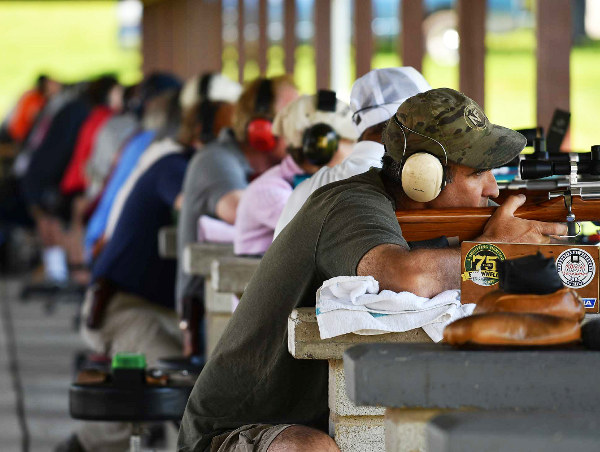
There are hundreds of cartridge types capable of winning in F-Open. For F-TR you can shoot either the .223 Rem or .308 Win, but you have many load options. This article will focus on proven choices, currently used by the top F-Class shooters in the world. Our discussion will analyze cartridge selection based on the four different F-Class sub-disciplines: Open Mid-Range, Open Long-Range, F-TR Mid-Range, and F-TR Long Range.
Click image to view full-screen photo.
Mid-Range F-Open Cartridges
For starters, a .300 WSM is certainly capable of winning mid-range matches but it is not ideal. So what is ideal, and why? F-Class Mid-Range matches usually are usually shot at 300, 500, or 600 yards — or all three. At those distances the 6mm and 6.5mm cartridges rule. In moderate conditions, the 6mm Dasher is unbeatable. Its low recoil along with its super grouping ability and good ballistics make it my number one choice for Mid-Range.
Best bullets for the 6mm Dasher are: Vapor Trail 103gr, Berger 105 Hybrid, 108 BT, and 105 VLD (hunting). Best powders are: Varget, H4895, and Reloder 15.
Choices for Mid-Range in Tougher Conditions:
We all know that conditions are not always “moderate” that’s why something a little bit bigger will save you a “Nine” or two. The 6.5X47 Lapua was designed for 300-meter competition, but as soon as it was released, it was adopted by F-Class, benchrest, and tactical shooters. It offers great ballistics with very low recoil and big “accuracy window”. Lapua makes great brass for it (no surprise there) and Berger makes great bullets: 130gr VLD, 140gr VLD, 140gr Hybrids. Best powders in most barrels are Varget and H4350, I don’t use double-based powders such as Reloder 17 and the Vihtavuori N500 series because of their unpredictable performance day to day (greater temp sensitivity).
The 6.5X47 Lapua necked down to 6mm is also a great option for mid range matches. I was able to easily get 3200 fps with 105 hybrids and H4350.
Choice for Long-Range F-Open Competition
In Long-Range F-Open Class (out to 1000 yards), the big, high-BC bullets rule. If I had to pick one cartridge for F-Class (both mid- and long-range) I would pick the .284 Winchester or one of its variants. The .284 Win is currently dominating in F-Open competition. It offers great barrel life, it is super-easy to tune and its recoil is very manageable. The best bullets for it by far (in my opinion), are the Berger 180 Hybrids. But Sierra’s new 183gr MK bullet (with factory-uniformed meplats) seems to perform very well as does the Berger 180 VLD. Best powders for the .284 Win are H4350 and H4831SC.
Long-Range Only F-Open Cartridge
As much as I like the .284 Win, for long-range competitions I like the .300 WSM even more. If you look at a .300 WSM and a 6mm Dasher side by side, they appear almost identical in geometry — the .300 WSM looks like an “super-sized” Dasher. Both cartridges are currently the “darlings” of long-range benchrest due to their extraordinary grouping ability and huge “node’’ windows. Big accuracy windows allow loads to perform well in different conditions and geographical locations. That’s obviously very important if you travel to compete. The .300 WSM loaded with Berger 215gr or 230gr Hybrids is very tough to beat at long range, and it is currently my number one choice.
The 7mm RSAUM is another outstanding long-range round. It resembles a 6BR on steroids and it is almost as easy to tune. Best bullets for it are Berger 180gr Hybrids, 195gr EOLs, and Sierra’s 183gr MatchKing. Best powders for the 7mm RSAUM are: H4350, H4831SC, and VV N160.
Top Caliber/Bullet Combos for F-TR
In F-TR competition, the choice is clear — a .308 Win throated for Berger 185gr BTLRs and 200gr Hybrids will win in mid-range AND long-range comps. Many championships have been won, and many records set with those two bullets in the .308 Win. To quote Danny Biggs (a two times FTR National Champion) “The 185 BTLR is the best bullet for .308 Win ever made”.
The Berger 215gr Hybrids have been used to win many competitions including recently the 2015 F-Class Nationals. Bryan Litz won both the Mid-Range and Long-Range 2015 Championships using 215s. Bryan’s rifle is shown below:
I recommend chambers throated for the 185/200 grain projectiles over the 215/230 grain bullets. The reason is that if you have your barrel throated out for the 215s or the 230s, you could have a “slow” barrel and max out on pressure before the desired velocity is reached. Optimum freebore for the 230s is too long for the 185/200s, so you would be limited to using only 215/230gr bullets in that barrel.Furthermore, the recoil increase with heavier bullets is substantial, causing the rifle to be more difficult to shoot.
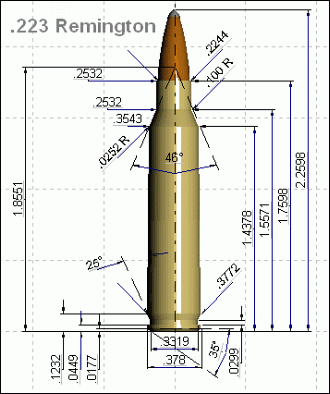
.223 Rem — Not A Competitive Option
I would stay away from the .223 Remington. On paper the 90gr VLD will shoot inside most .308 Win loads even at a 1000 yards. But in reality, on average, the .223 Rem, regardless of what powder/bullet combo is used, cannot compete with the .308 Win. [Editor: The equipment lists at major F-TR matches will confirm Kovan’s conclusion here.]
Conclusion (and Other Options)
This article covers only the (currently) most popular cartridge/bullet combos for F-Class (F-Open and F-TR). As I said in the beginning, many cartridge types are capable of winning but are not listed due to their low popularity, case design, or lack of quality components. All of the above information is based on my personal experience and it is meant to help new shooters choose the right cartridges for F-Class matches. Thanks for reading and good luck — Emil Kovan
Emil Kovan Competition History:
– 2014 F-Class Open National Champion
– 2015 F-Class Open National Championship, Silver Medal
– F-Class Open National Championship Teams, 2015, 2014, 2013, Shooting Team Member
– Over 15 wins in Regional and State Championships in Palma, F-TR, F-Open




 Bud Pryor was a fine gentleman who started shooting IBS matches in 1983. He was a machinest turned gunsmith who made friends and got many people started in shooting IBS registered matches over the next few years. Bud and Dick Grosbier ran the first IBS match at the Thurmont range in April 1983. CLICK HERE to see vintage photos of the 1983 match.
 Hap Rocketto, noted shooting historian, has explained the etymology of “Maggie’s Drawers”. This term “refers to the red flag waved vigorously across the face of the target to signify a complete miss of the target during practice”. The term came in use in the early 20th Century (prior to WWI) when flags were used to signal shot locations on long-range rifle targets.


 Kim Rhode: One of a few household names on this list,
  Ginny Thrasher: This Olympic gold medalist needs little introduction. Quietly arriving on the scene after years racking up smallbore and air rifle victories, Ginny Thrasher arrived at West Virginia University and made history. Not only did she win the smallbore championship at NCAA in 2016, but her performance at the Rio 2016 Olympics started a media frenzy. Winning the
  Lena Miculek: The daughter of master shooter Jerry Miculek, Lena burst onto the competitive shooting scene in 2005 with five consecutive Sportsman’s Team Challenge Junior national titles. Moving on to 3-gun, by 2015 she had an astonishing 89 percent win rate. Lena was the
 Kirsten Joy Weiss: Before making great trick-shot videos on YouTube, Kirsten Weiss was a smallbore rifle champion, winning




 .223 Rem — Not A Competitive Option
 Emil Kovan Competition History:


