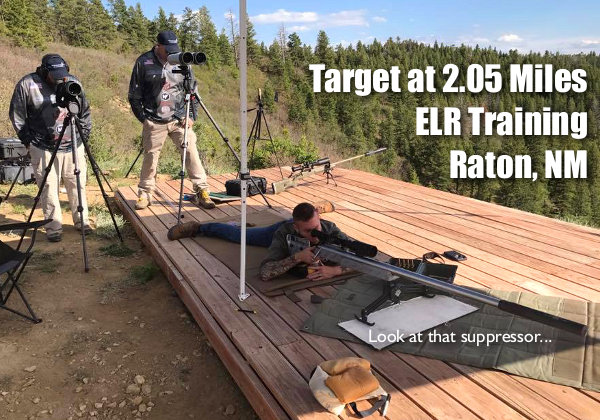
Shooter behind the .375 Lethal Magnum. Check out the size of that suppressor!
Two-Mile ELR Training The Applied Ballistics ELR Team spent the weekend at the NRA Whittington Center in New Mexico training for the upcoming King of 2 Miles event. Former USAMU coach Emil Praslick III was on hand to help with wind calls. The results were impressive — all team members had confirmed hits at 2.05 miles on a 36″x36″ steel target. Bryan Litz even had a 3-shot group that measured 17.5″ x 22″. That’s under 0.6 MOA!
Most guys would be happy with 0.6 MOA at 300 yards. Bryan did it at 3611 yards, shooting Paul Phillips’s .375 Lethal Magnum. When you consider all the variables involved (bullet BC variance, shot velocity variance, wind changes during flight, Coriolis effect etc.), that’s phenomenal.
Report by Paul Phillips
Just got done shooting two days in New Mexico with Recoil Magazine and the Applied Ballistics ELR team. We learned a lot and had great success. Every team member made impacts on target at 2 miles. The best 3-shot group at 3611 yards (2.05 miles) was shot by Bryan Litz with my 375 Lethal Mag. The group measured 17.5 inches tall by 22 inches wide with Cutting Edge bullets. We also had Recoil’s David Merrill shoot at two miles and was laying them in there like a true pro. We had three team members make impacts on the 36-inch plate at two miles within just three attempts in a mock competition. I also increased my personal longest shot by hitting only 15 inches right of center at 3611 yards. 2.05 miles. I did it with a GSL Technology Copperhead Silencer.
Report by Emil Praslick
I participated in the Extreme Long Range training with the Applied Ballistics team at the Whittington Center in Raton, NM. All team members had confirmed hits at 2.1 miles. Components and hardware suppliers included: Berger Bullets, Cutting Edge Bullets, Nightforce Optics, Kestrel, FLIR Systems.
Q: At that distance (2.1 miles), how much do spin drift and the Coriolis effect impact bullet trajectories?
Praslick: At 3613 yards we had to adjust about 1.5 MOA/56″ of Coriolis (up), and 5 MOA/~190″ of right spin drift adjustment. You’d have to come down if facing East. The planet rotates counter-clockwise (from above), so your target would be falling away from you.
Here is a 3-round group at 1898 yards (1.08 Miles) shot with factory ABM Ammo .338 Lapua Magnum loaded with 300 grain Berger Bullets Hybrids. That’s sub-MOA elevation. (The guy calling wind didn’t do too bad, either.)
Report by Bryan Litz
Learning is my favorite part of new ventures and we learned a LOT this weekend shooting extreme range in New Mexico. I connected on a second round hit on a 3-foot square target at 2 miles in simulated match conditions under coaches Emil Praslick and Paul Phillips. In fact all five of our team shooters got on at 2 miles. The Applied Ballistics Extreme Long Range team is in good shape for the King of 2 Miles match later this month, and there is still so much to LEARN!
You need serious equipment for shooting beyond two miles. Who can identify this high-tech hardware?
Gunsmith/stockmaker Alex Wheeler is a very smart guy. Among his many clever innovations is an adjustable bag-rider that fits on the underside of the buttstock at the rear. Alex calls this a “Rudder” because it allows the shooter to align the tracking perfectly. The rudder assembly can swing left and right using an adjustment bolt. You can also adjust the Rudder’s vertical “angle of attack” with simple shims. Some guys like the Rudder’s 3/4″-wide bottom perfectly parallel with the bore axis. Others prefer a slight angle so the stock slides down a bit during recoil.
Adjustable Rudders Now For Sale
Alex has fitted these innovative, adjustable Rudders in the stocks and complete rifles he sells.And now owners of other stocks can benefit from Wheeler’s invention. Alex is offering the Rudders for sale: “I have made my adjustable Rudders for sale. Price including mounting hardware is $125 shipped. These are the same rudders I install in most ever stock I build. They’re the only way to achieve perfect tracking every time.”
Watch how the Wheeler Rudder works in this video. Alex explains: “If you pull your rifle back in the bags and the cross-hair moves, your stock is not straight. The easiest fix is to use an adjustable Rudder. They come standard on all my stocks. The white box on the 1000-yard target is 4″. With a properly-adjusted rudder it’s easy to obtain less than 1″ of cross-hair movement at 1000 yards.”
Rudder-Equipped Stock In Action (with 1000-Yard Champ Tom Mousel)
This second video shows how well a Rudder-equipped stock performs. This shows IBS 1000-yard Champ Tom Mousel running five (5) shots with his 17-lb Light Gun chambered in 6BR Ackley Improved. Note how perfectly the stock tracks. It runs smoothly straight back then comes right back on target when pushed forward by Mousel. Check it out — this is impressive.
It’s relatively easy to install these rudders on most wood and wood laminate stocks. Alex says: “Just notch the stock, and install the anchors for the adjustment bolts.” In addition, McMillan will soon be offering fiberglass stocks with a notch designed to fit the Wheeler rudder. Based on Alex’s Deep Creek Tracker stock design, these new McMillan stocks with have metals rails in the front also.
New Rudder-Equipped McMillan LRB Stock
Alex explains: “The new McMillan Rudder-equipped stock will be a version of the Deep Creek Tracker, most likely called a Wheeler LRB (Long Range Benchrest). It will feature factory installed 1/2″ wide aluminum rails in the 4″ fore-arm. It will come with the rear notch molded in for the Rudders which I will install on each stock. I will be exclusive dealer on these and hope to see the first one in June. I also have got with Edgewood to make 4″ wide front bags that will fit a standard rest top and will cost the same as their standard 3″ bag. I will have some in stock but anyone can order them direct and not have to pay the $125 price for a custom bag.”
In response to many requests from Forum members who shoot F-Class, we are republishing this informative interview, which first appeared last summer. You’ll find many “solid good” tips that can help any long-range rifle competitor.
Dan Pohlabel is a member of the all-conquering Team Sinclair F-TR squad. This talented group of shooters hasn’t lost a team match in years. What’s the secret of Team Sinclair’s success? Well there is not one single factor. These guys have very accurate rifles, they work hard on load development, and they practice in all conditions. In this interview, Dan Pohlabel talks about F-TR competition, reviewing the hardware (and skill set) it takes to win. He offers some great tips on developing loads. You’ll find a longer version of this interview on the Sinclair Int’l website. CLICK HERE to Read Full Interview.
Q: What do you find most challenging in F-TR Shooting?
It has to be keeping up with the competition, our sport has grown so quickly with new talented shooters. Staying at the top requires having a laser of a rifle, perfect loads, near perfect wind reading, and, of course, breaking good shots.
Q: How can novice shooters improve their game?
Seek out the local F-TR shooters and go to matches with them, listen and learn. Attend team matches and offer to score for one of the teams. As a scorer, you will sit close enough to hear the coach make wind calls and see the results on the target. Through the spotting scope you will see changes in mirage and it’s the quickest way to learn the basics of wind reading. Choosing and buying equipment is relatively easy, learning to read the wind is a journey.
Q: What’s in your range bag for match days?
Rear bag, towel, shooting glasses, canned air, ear protection, data book, pen, rifle rain cover, hat, rifle tools, timer, ammo, and bug spray.
Q: What specialized gear can you not live without?
1. A good set of elbow pads. It’s hard to keep concentrating on shooting when your elbows are rubbed raw from days of competing on them.
2. Good bug spray. We shoot from the ground but our shooting mats aren’t that big. It’s hard to concentrate with bugs crawling or chewing on you.
Q: Load Development — How do you work up a load?
First, I call Derek Rodgers and get his load data, he is the best load development shooter I know! Otherwise, here is the procedure I recommend. Measure throat length with bullet of your choice, to determine how much room is left in the case. The above measurement determines what powders you can use. We use only Hodgdon Extreme powders. Shoot a ladder test, five rounds each in 0.2 grain increments, to find the accuracy node for that bullet/powder combination. Take the best two loads and do a jump test with five rounds each, test at .005″, .025″, .060″ jump. One of these groups will be significantly better than the rest, now you can tweak that measurement +/- .002” or .005” to get the best accuracy.
Test at least three different primers to determine which offers a little better ignition for your load, a 5-shot test will usually tell you which is the best. Go back and test the two best combinations in a 10-shot test at least twice, pick a cool overcast day and also a hot sunny day and compare results. Take your final “best load” back and do a “simulated match”, 20 shots, waiting at least 20 seconds between shots. If you like those results it’s probably a reliable and accurate load.
Q: What rear bag do you use?
I use a two-bag system, large bag on bottom with a smaller bag on top. I had the bags made of marine canvas, zippered and filled with plastic beads. I can adjust the amount of fill to make them a perfect height for my shooting position. Teammate Jeff Rorer uses a similar system and mine is nearly a copy of his rear bags.
Q: How often do you practice and how many rounds do you shoot per year?
In good weather I practice a couple times a week at the local range, a couple more dry-firing practices/week at home. I typically shoot between 2,000-2,500 rounds per year.
Q: How do you prepare mentally before a match?
[I do] lots of visualization — run the video in my head of what I expect to see and of my performance. I think about the correct strategy for the conditions, staying disciplined to the strategy.
Q: What do you avoid before a shoot?
No late nights or excessive alcohol. Very little caffeine in the morning. Leave your cell turned off. Avoid emotional people.
Q: What’s your procedure on a Match day?
I arrive early, get squadding card, move gear, watch wind speed/direction, check over rifle and gear, sit and relax, visualize and focus on the most important goal of the day. Most days we shoot three relays of 20 shots. It’s important to eat and hydrate continually all day. My focus and concentration are better when I snack all day with fruit and energy bars, and lots of water. While taking my turn in the pits, I try to relax and only focus on what is ahead of me and [not] what’s already happened.
Q: What is your favorite reloading product?
My favorite reloading product is the Sinclair Premium Neck Turning Tool with Handle, I also use the expander mandrels provided by Sinclair for sizing the brass in preparation for the turning process. Correct and repeatable neck tension begins with turning necks to a uniform thickness. Sinclair also has mandrels to size the necks after neck turning that accurately size the necks for a specific neck tension.
Q: What is your preferred scope?
The scope I find the most useful is the Nightforce Competition Scope. This scope is very light-weight, has 15-55X magnification, world-class quality glass, 10 MOA per revolution on the turrets, 1/8 moa adjustments. It’s perfect for F-Class competition.
Q: What advice do you have for someone wanting to get into the sport?
Find a local club with some F-TR shooters and ask for their help. Most shooters will be happy to take you with them to a match, listen and learn while you’re there. You may find out it’s not what you thought, or you may be hooked. If you decide to jump in, start with an inexpensive rifle. This sport is expensive and you don’t need a $5000 rifle to learn good wind-reading skills. Start with a used Savage F-TR rifle and learn the basics, shoot for a year at least before making a larger investment. The money you saved buying a used Savage rifle will help pay for your divorce lawyer, LOL.
Q: What training drills do you use?
Dry-firing the rifle at home is a good way to practice when you can’t get to the range and shoot. It allows me to practice set-up, rifle handling, and position. When I can practice at a local range, I also dry-fire between shots to increase the amount of repetitions and increase the time spent in position.
Q: Who has been your biggest influence in shooting?
Eric Bair, 2006 F-Open National Champion helped me get started and gave me great advice. Most of the shooters on Team USA and Team Sinclair help each other, nobody knows all the answers but we share what we have learned. Danny Biggs, 2008 and 2009 F-TR National Champion also helped me when I was struggling to learn some of the ranges. I learned a lot from Danny.
Jessie Duff won her 8th Ladies Class Title at the 2017 U.S. Steel Nationals in Daytona, Florida.
It’s drag racing with guns! Draw your gun then shoot five steel targets as fast as humanly possible. The U.S. Steel Nationals is the fastest action pistol sport on the planet. Splits are blazing fast — in the top tier of shooters, standings are settled by hundredths of a second. The Steel Nationals has recently has also expanded to include rimfire firearms, and that’s lowered the cost of competing. In this week’s episode of Shooting USA, John Scoutten and Tony Pignato have the highlights of the final round of the 2016 U.S. Steel Nationals, held in Daytona, Florida.
Watch Full Episode of Shooting USA
Air Times by Time Zone
Eastern Time: Tuesday 3:00 PM; Wednesday 9:30PM, 1:00 AM
Central Time: Tuesday 2:00 PM; Wednesday 8:30 PM, Midnight
Mountain Time: Tuesday 1:00 PM; Wednesday 7:30 PM, 11:00 PM
Pacific Time: Tuesday Noon; Wednesday 6:30 PM, 10:00 PM
The show airs tonight on the Outdoor Channel on cable TV. If your cable service doesn’t include the Outdoor Channel, you can watch the entire episode on your computer or mobile device right here. Just click the above video to start the 47-minute show.
Pro Shooter Experience in Las Vegas
Along with the U.S. Steel Nationals Coverage, this week’s episode features the Pro Shooter Experience (PSE) in Las Vegas (starting at 32:22 in video above). Participants enjoy three days of training with three world Champions: Max Michel, JJ Racaza, and Travis Tomasie.
Max explains: “The whole premise was to get three world champion shooters together [who are] great ambassadors of the game, and really give back…” Max and Travis are both former USAMU shooters with multiple championship wins. JJ is one of the fastest pistoleros on the planet. The PSE features 1-on-1 training sessions, shooting competitions, speed drills, and some very impressive shooting by the pros.
“Koenig” means “king” in the German language. Well, Doug Koenig certainly proved to be King of the Bianchi Cup this past week at the Green Valley Rifle & Pistol Club in Hallsville, Missouri. Coming into the event as the reigning champion, Koenig added an 18th Bianchi Cup Open Championship title to his resume, remaining the winningest shooter in Bianchi Cup history. The win earned Koenig a $10,000 check to go with his trophy.
Report by NRABlog.com
Koenig posted strong scores in all four Colt Championship Final events, including perfect 480-48 scores in the Barricade and Plates runs. While perennial contender and five-time Bianchi Cup champ Bruce Piatt bested Koenig in the opening Practical event and kept it close, Koenig narrowly edged out his longtime friend and rival, finishing the Colt final event with a 1920-184 over Piatt’s 1920-181.
Here are the top four women shooting the Practical Event during the Colt Championship Final. From top: 2017 Bianchi Women’s Champion Cherie Blake, third place SFC Katie Bahten, second place Anita Mackiewicz, and fourth place Jessie Duff. Shooting Sports USA Photo
SFC Sokolowski Shoots First-Ever Perfect Score in Metallic Class
There were some other great performances. The USAMU’s SFC Adam Sokolowski made history of his own in Hallsville, shooting the first-ever perfect score of 1920 in the Metallic Division. Last year’s Production Champ, Adam switched to Metallic this year — it seems like it was a good choice. Cherie Blake was the Women’s Champion, and noted shooter Rob Leatham won the Production Division. In the Junior Division, it was a family affair — Tim Yackley was a repeat winner, while younger brother Sean Yackley finished second.
Not to be outdone by the youngsters, 80-year-old John Sanders won the Grand Senior Championship with a score of 1908-135X. Impressive — we hope we’ll still be competing in our 80s!
For more complete coverage of the 2017 NRA Bianchi Cup, see John Parker’s Shooting Sports USA 2017 Match Report. Shooting Sports USA will publish the full results of the 2017 NRA Bianchi Cup National Action Pistol Championship in a future edition of the digital magazine.
According to a Precision Rifle Blog survey, the MasterPiece Arms (MPA) chassis system is the second most popular stock in the PRS game, and it’s gaining ground fast. MPA was second only to Manners Stocks in popularity among the top 100 PRS shooters. Remarkably, the MPA chassis experienced a nine-fold increase in use in 2016 over the previous year. This thing is really catching on.
Here MPA President Phil Cashin Shows How to Set Up the MPA BA Chassis:
2015 PRS Champion David Preston (who is currently ranked #1 in Precision Rifle Series standings) favors MPA Chassis systems: “I chose the MPA BA Chassis because of its adjustability, versatility, and company’s willingness to adapt to shooters needs and suggestions. It’s the most comfortable and reliable stock on the market.”
One reason the MPA Chassis works so well is that MPA’s president, Phil Cashin, is an active PRS shooter who regularly tests out features in competition. He also gets feedback from other PRS competitors: “We’re always implementing feedback and suggestions from shooters into our products. In fact, the idea for our EVG grip, which has a rest on it to better support your trigger finger, came directly from a suggestion that David Preston, 2015 PRS Champion, gave me at a match.”
New MPA BA Competition Chassis
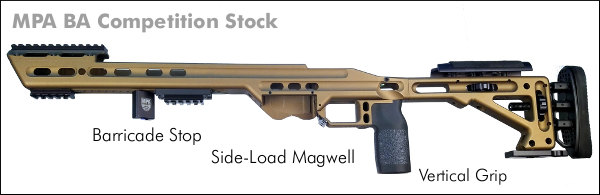
The “latest and greatest” MPA stock system is the MPA BA Competition Chassis. This offers the best features of the original MPA BA Chassis system plus some new, notable enhancements. With the elimination of the monopod, weight is reduced. A movable barricade stop comes standard. The buttstock offers full adjustability for length-of-pull, cheek height, and buttpad height/cant.
Rotating, Multi-Position Barricade Stop — Aids stability when shooting on a variety of barricades. Trinity Rail System — Allows closer bipod when shooting off oil drums or similar props. Modified Magazine Well — This “Ryan Castle” magwell allows fast side-loading of mags into chassis. Rear Bag-rider Attachment — Improves tracking/stability in rear sandbag.
MPA Production Class Rifle with Savage Action
Along with its chassis systems, MPA offers a complete rifle for the PRS Production Division:
To fit PRS Production Class Rules (PCR), MPA has developed the new $1999.99 BA Lite PCR Competition Rifle built around a Savage Model 12 short action. The Savage action is upgraded with a Rifle Basix 2-lb trigger, and the adjustable, MPA BA Lite Chassis offers a bag rider, barricade stop, and even a built-in bubble level. Bipods can be attached up front to a rail, with optional spigot mount. MPA PCR Rifles come with stainless Bergara barrels, 22-26 inches in length, fitted with MPA muzzle brakes. Chamberings offered are: 6mm Creedmoor, 6.5 Creedmoor, 6-6.5×47 Lapua, 6.5×47 Lapua, .243 Win, and .308 Win. The PCR rifle includes a 10-round AICS-type magazine.
On the Shooting Sports USA website, there’s a great profile of Kevin Nevius, one of America’s leading competitive marksmen. Kevin is best known for his smallbore success but he has also an impressive record in long-range centerfire competition — In 2005 and 2006 he won the Sierra Trophy at Camp Perry in 1000-yard competition. This was followed by smallbore National Championships in 2008, 2010, and 2014. This story, penned by gunwriter Hap Rocketto, covers Kevin’s career, which has included multiple championships and many records.
“My brother got me into long range varmint hunting and I started building my own guns very early,” Nevius told Dan Holmes in a Pronematch.com interview. “I had a hunting friend who shot indoor smallbore who started me in three position and I was hooked.”
Here are highlights from Hap Rocketto’s Profile of Kevin Nevius:
Champion shooter Kevin Nevius grew up in a household that did not allow firearms, an unlikely beginning for one of the United States’ premier prone rifleman and gunsmiths. Once out on his own he fell in with his brother who enjoyed long-range varmint hunting. His natural bent for things mechanical (he is a professional structural engineer) soon had him tinkering with rifles, which eventually led him to building his own.
Everything fell into line for him in smallbore during the 2008 season. After shooting a series of training matches in which he was most successful, he arrived at Camp Perry at the peak of performance and won his first National Smallbore Rifle Conventional Prone Championship. Kevin came back strong in 2010, winning the inaugural individual National Smallbore Rifle Metric Prone Championship, as well as the team title at Bristol, IN. [Kevin then won the Smallbore Conventional Prone Championship in 2014 with a practically perfect score of 4799-390X (LINK).]
Along the way, Nevius has won some impressive national records. In conventional competition he co-holds the 1200-shot metallic sight aggregate record of 1200-102X. He was just one shot short of perfection in the 480 aggregate, where he holds the civilian record of 4799-412X, just one point behind, and 11 Xs ahead of, Joe Hein’s 4800-401X open record.
Kevin Nevius hopes to build a smallbore rig capable of 3/8-MOA at 100 yards.
Building the Ultimate Rimfire Prone Rifle
Kevin is not just a great trigger-puller. He also smiths his own rifles. His current goal as a gunsmith is to build a rimfire rifle that will shoot 3/8″ groups at 100 yards. That’s a big challenge — 3/8-MOA represents very good accuracy for a centerfire rifle with handloaded ammo. But if any rimfire smith can build a rifle that will shoot that well at 100, it’s probably Kevin.
The CMP Eastern Games were a huge success, thanks in no small part to the mobile electronic target system. The event, which drew 360+ competitors, took place April 28 – May 2 at Camp Butner in North Carolina*. The Kongsberg electronic targets allowed the CMP to run relays more efficiently, and the targets eliminate the need for competitors to do pit duty. GSM Matches, which typically run four relays each day, saw days with a total of nine and 10 relays during its scheduled times, while the Vintage Sniper and other matches finished in record time.
“The electronic targets are phenomenal,” said brothers Richard and Jonathan Mast, who attended the Eastern Games along with other family members. Jonathan added, “It was the best shooting experience I’ve ever seen as far as immediately finding out where you’re shooting – best I’ve ever had.”
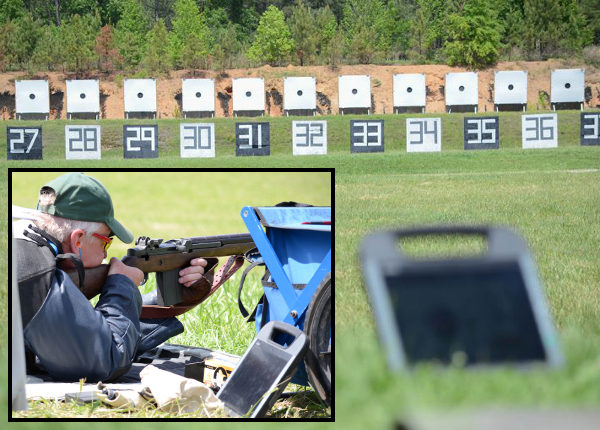
Throughout the event at Camp Butner, competitors had the opportunity to fire on CMP’s mobile electronic highpower target range. The Kongsberg targets contain internal microphones that locate shot position. The scores are instantly calculated by computer and then wirelessly transmitted to portable, tablet monitors on each firing point.
The new targets were well received. Competitors observed that the targets simplify the process for the shooter and provide immediate feedback and scoring. Shooter Caleb Mast noted: “This makes it easier for people who don’t have equipment, like a scope, to get in. All you pay is the registration fee, and I just brought what I’m wearing and was still able to score well enough to get my feedback on the monitor.”
*The Eastern Games ran April 28 through May 2, 2017. The Creedmoor Cup Marches were held May 3-7, 2017, following the Eastern Games. SEE Match Schedule.
We are sad to announce that Richard (Dick) Grosbier, who served as IBS Vice President and webmaster, has passed away. He died unexpectedly at his home last Friday, May 12, while recovering from neck fusion surgery. He was 72. A memorial service was held on May 16th. We offer condolences to Carol, his wife of 38 years, and to his family members.
Dick Grosbier was one of the stalwarts of the International Benchrest Shooters (IBS) who gave countless hours to our sport. Jeff Stover, IBS President, notes: “Dick was serving as the 1st VP of IBS and was the Match Chairman. Dick worked tirelessly on behalf of our sport. Dick was very well known in benchrest, especially in the Score discipline. He has been the IBS webmaster from Day One. He was a central figure in the IBS and Benchrest as a whole.” Jeff adds that Dick’s passing leaves “a pronounced void in the world of Benchrest. He was a good man. We shall miss him.”
Many benchrest competitors have expressed their sadness at Dick’s passing:
“He was one of the most helpful and concerned people I have met in benchrest, an enthusiastic and helpful shooter with as big a heart as anyone I have ever met. I thoroughly enjoyed my numerous phone conversations with him over the years. He will be sadly missed by all his Maine friends.”– Greg P.
“Dick did a lot for the sport. It’s going to be hard to replace a man like him.” — Dick Wright
“We are truly diminished. He will be missed. My condolences to family and friends.” — James Mock
“I had met Dick several times as I traveled around in my shooting career. Dick gave freely of his talents and time to support the sport he dearly loved. Dick made a difference in the World. It’s a better place for him having been here.” — Al Nyhus
Honoring Dick Grosbier at the White Horse Range in West Virginia
The day after he died, Dick’s friends and fellow shooters honored him. On May 13th, at the 1000-yard match held at the White Horse Range in West Virginia, Stanley Taylor, David Matthew and the other competitors all took one shot at a special target placed at 1000 yards, which they all signed. The group then said a prayer and held a moment of silence for Dick. It was a thoughtful and fitting tribute to a fellow shooter. The match directors are planning a Memorial match for Grosbier later this year.
R.I.P. Richard Roland Grosbier
Dick Grosbier was a man of many talents and interests. Here is a quote from his Obituary in the Frederick (MD) News-Post:
After high school Dick joined the Air Force, from 1965-1967 serving as an Aircraft Electronics Navigational Equipment repairman. This training enabled him to begin his life’s work in the electronics field, first with Heathkit Electronics in Rockville, and later with Industrial Photo of Silver Spring.
Dick enjoyed many varied activities. He met [his wife] Carol at a sports car club, and they participated in many car rallies. He was very interested in computers[.] He was Vice-President of the International Benchrest Shooters and enjoyed benchrest target shooting at many rifle ranges up and down the east coast. He was also very involved in model railroading[.] Dick loved to travel and with his wife made several coast-to-coast trips across the U.S., visiting almost all the lower 48 states, and Hawaii.
How’d you like to score a check for $25,000? That’s the winner’s pay-out for the 2017 World Shooting Championship (WSC), which runs September 14-16 at the Peacemaker National Training Center in Glengary, WV. This event offers over $250,000 in cash awards and product prizes, making the WSC the richest combined shooting event in the USA (if not the world). This unique 3-day multi-gun match tests competitors’ skills across twelve challenging stages involving nearly every major shooting discipline for rifles, shotguns, and pistols.
This major match attracts both sponsored Pros and “regular Joes”. For 2017, shooters will be split into two groups: a Professional Division for sponsored shooters, and the Amateur Division for non-sponsored competitors. All firearms, optics, and ammo will be provided by match sponsors for both divisions. “This year the NRA is going back to basics and returning the match to the original format of two divisions for professionals and amateurs, putting everyone on an even playing field”, said Cole McCulloch, NRA Competitive Shooting Director.
WSC Highlight Video with Competitor Interviews:
What the Competitors Have to Say:
“We’ve been waiting all our lives for a match like this, so we can come over (from the UK) [and] shoot guns that we can’t even own in the UK, because of the laws. What the NRA has done is really great — this is a ground-breaking type of match.” John C., Amateur Competitor (UK)
“The main reason I signed up is just the ease of it… I don’t have to have thousands of dollars worth of guns. It’s a good way to try out all the different events.” — M.J., Amateur Competitor
“What makes this event very unique, especially to a professional shooter, is all the equipment is supplied. You have to leave your ego at home and just try to adapt as best you can to the equipment that you have supplied.” — Jerry Miculek
Video Shows 2014 World Shooting Champion SFC Daniel Horner in 3-Gun Stage
Cash Awards, Huge Prize Table, and New Random Drawings
The NRA World Shooting Championship will offer $250,000 in cash and prizes. Along with the $25,000 winner’s pay-out, there will be fat cash prizes for second and third place overall, High Lady, and High Amateur Junior. Then there are the prize tables — a real treasure trove. The designated Amateur prize table by itself will offer products and certificates topping $100,000 in value.
NEW Random Drawings — The WSC has added a new type of prize for 2017. Ten (10) Random Draw Prize Winners of $400 will be chosen during the WSC Awards Banquet. These random drawings give every competitor a chance to win cash, no matter what their event ranking.
Match entry fees are $395 for Professionals, $325 for Amateurs and Juniors. All firearms and ammunition are provided, and entry fees include one awards banquet ticket. For more information, visit WSC.NRA.org, call 703-267-1479, or email NRAhighpower@nrahq.org.
How to Win the World Shooting Championship
As first published in the NRA Blog, here are competition tips from 2015 NRA World Shooting Champion Bruce Piatt, and Dianna Muller, the top female competitor at the 2015 WSC:
“The format at the NRA World Shooting Championship is unique in that you don’t know what you have to shoot until you show up, so training for the event is a little difficult. My advice is to pack some good eye and ear protection, bring an open mind, be prepared to listen to the stage descriptions, figure out the best way you can take the guns they provide, and post the best score you can. When the match supplies all the guns and ammo, all you have to do is deal with ‘the performance’. This is the most level playing field in the shooting sports — anyone from around the world can come and play.” — Bruce Piatt
“The [WSC] is such a different breed — it’s really a difficult match for which to prepare! You are tackling disciplines outside your expertise and using guns you aren’t familiar with, and that can really rattle your nerves if you don’t prepare for that mental challenge. But you can use this match design to your advantage. Remove all expectations, because, who is great at ALL the disciplines (besides Jerry Miculek)?! Give yourself some room to be ‘not so great’, focus on the fundamentals and try to enjoy the match. It is kind of liberating throwing everything to the wind and seeing how you stack up against all kinds of shooters!” — Dianna Muller


 The Applied Ballistics ELR Team spent the weekend at the NRA Whittington Center in New Mexico training for the upcoming King of 2 Miles event. Former USAMU coach Emil Praslick III was on hand to help with wind calls. The results were impressive — all team members had confirmed hits at 2.05 miles on a 36″x36″ steel target. Bryan Litz even had a 3-shot group that measured 17.5″ x 22″. That’s under 0.6 MOA!


 “Koenig” means “king” in the German language. Well, Doug Koenig certainly proved to be King of the Bianchi Cup this past week at the Green Valley Rifle & Pistol Club in Hallsville, Missouri. Coming into the event as the reigning champion, Koenig added an 18th Bianchi Cup Open Championship title to his resume, remaining the winningest shooter in Bianchi Cup history. The win earned Koenig a $10,000 check to go with his trophy.




 Champion shooter Kevin Nevius grew up in a household that did not allow firearms, an unlikely beginning for one of the United States’ premier prone rifleman and gunsmiths. Once out on his own he fell in with his brother who enjoyed long-range varmint hunting. His natural bent for things mechanical (he is a professional structural engineer) soon had him tinkering with rifles, which eventually led him to building his own.




 We are sad to announce that Richard (Dick) Grosbier, who served as IBS Vice President and webmaster, has passed away. He died unexpectedly at his home last Friday, May 12, while recovering from neck fusion surgery. He was 72. A memorial service was held on May 16th. We offer condolences to Carol, his wife of 38 years, and to his family members.