There’s a talented new team getting ready for the 2017 King of 2 Miles (KO2M) Competition in Raton, NM next month. The team features ace F-Class shooters Ian Klemm and Dan Pohlabel. Here’s a build report from X-Treme Shooting Products, which supplied the impressive XTSP action and two-stage trigger.
Big Gun for King of 2 Miles Event at Raton
XTSP: “It’s exciting — we’re getting closer to the 2017 King of 2 Miles match next month. Here are a few pictures of one of the rifles we will be shooting. Owned and built by Dan Pohlabel, it’s a .338 Lapua Magnum Improved. It has a 40° shoulder and we plan on shooting .338 Caliber 300 grain Berger OTM projectiles at around 3,100 fps.”
“We started off with an XTSP .338 Magnum receiver, custom-built as a single shot with a solid bottom for stiffness. We built +60 MOA rails for each of the rifles. Of course we’re using the XTSP two-stage trigger! We added a 34″-long Bartlein gain-twist barrel which is 1.450″ at the shank tapering to 1.2″ at the muzzle. At the end we added Piercision Rifles’ 3/4 x 24 slabbed 5-Port ‘Muscle Brake’. The action is bedded in a McMillan Super Magnum stock. On top sits a Vortex Optics HD Razor in Vortex 35mm rings. We’ll have another rifle just like it shortly with the machine work by Dan Pohlabel again. That second rifle will be finished up and shot by Ian Klemm of Vortex Optics.”
Here’s a file photo of a .338 Lapua Magnum Improved, alongside a standard .338 Lapua Magnum. We’re not sure about the shoulder angle on this particular example. For the XTSP project, the angle is 40 degrees (40°). Photo Courtesy LongRangeHunting.com.
The great shooting coat controversy has been quelled — at least for the next few months. The CMP will not be banning any brands of commonly-used jackets for now. On Monday, May 15th, the CMP announced that it would halt “strict enforcement” of shooting jacket rules for the remainder of 2017, until new, clear standards can be adopted. Here is the CMP’s statement:
Moratorium on Strict Enforcement of Shooting Jacket Rules
The Civilian Marksmanship Program has declared a moratorium on strict enforcement of rules on design and construction of shooting jackets for 2017 until specific procedures and measurement tools are developed to determine the maximum amount of support coats may provide to competitors.
“The CMP 2018 Rules will contain further clarifications concerning jacket design and construction specifics going forward,” said Mark Johnson, CMP’s Chief Operating Officer. “The CMP strives to institute rules that promote true marksmanship skill and those that resist the equipment race (gamesmanship) facets of our sport.”
“The CMP’s matches are being developed to enhance competitor learning and increasing their own personal marksmanship skill set, not who can buy the best gadget for means of additional support or easier access to higher point totals,” Johnson said.
In 2017, the primary emphasis of the shooting jacket rule, 6.6.1 in the CMP Highpower Rifle and Pistol Competition Rules, 21st Edition – 2017, still applies. The rule states, in part, “Shooting jackets made of flexible material may be worn in CMP Rifle events. Shooting jackets may have shoulder, sling and elbow pads providing those pads are not constructed so as to provide rigid artificial support. Jacket constructions that use back braces (…) or other non-flexible materials are prohibited.”
For 2018, it is the CMP’s intent to provide a clear and concise definition of “flexibility” as it relates to support materials used in shooting jackets and a simple measurement process capable of passing or failing jackets across the entire spectrum of highpower rifle jackets in the marketplace.”
Jacket Rules Not Abandoned Completely
We commend readers to look at the second-to-last paragraph in the CMP statement above. The CMP says Rule 6.6.1 still applies, requiring shooting jackets to be made of “flexible materials” without “rigid, artificial support”. Keep that in mind. While the CMP is halting “strict enforcement” of jacket rules, you still can’t show up with a bionic exo-skeleton.
There’s a new home on the web for Extreme Long Range (ELR) shooters. Bryan Litz and Applied Ballistics recently launched ELR Central, a new website dedicated to ultra-long-range shooting*. This new site will offer a wide variety of information. Bryan Litz explains: “The most visible element of ELR Central will be a website which will serve to publish and promote all ELR shooting events going on across the country. Although owned and operated by Applied Ballistics, ELR Central will rely heavily on input from the community in order to best serve the sport as a whole.” Along with the ELR Central website, Applied Ballistics has launched a new ELR Central Facebook page.
Content Available on ELR Central
The ELR Central website will eventually offer a comprehensive library of information and activity reports. Bryan and his team plans to build out the website to include all the following:
1. Map of ELR ranges across the USA.
2. List of ELR events with links to the Match Directors’ pages.
3. Technical information and articles for the ELR community.
4. Match results/reports, including equipment lists where available.
5. Analysis of what equipment and shooters are doing well in ELR.
6. Links to other ELR shooting resources such as forums and websites.
On 5/13/17, the Applied Ballistics ELR Team had a successful practice at 3161 Yards (1.8 miles). Bryan Litz reports: “The main goal … was to test how the Berger and Cutting Edge bullets traveled through transonic and subsonic speeds. We all made several hits on target and several within 1 MOA of center.”
Standardized ELR Targets
Another goal of ELR Central is to develop standardized ELR targetry. Bryan explains: “In competitive rifle shooting, standardization of targetry is important. Applied Ballistics, through ELR Central, will provide steel targets to organizations wishing to run ELR matches and/or record-setting events. No one would be required to use these standard targets, we’re simply providing resources to help promote promote some consistency.” The initial standard target, produced by MGM Targets, will be a steel square, 3 feet (36″) per side.
ELR Central is Not A Rule-Making Entity
Bryan was quick to explain that ELR Central is not a governing body, but rather it was created to help advance the sport (and science) of shooting at very long distances, one mile and beyond: “The concept of ELR Central is a result of the ongoing discussions about standardizing ELR matches, records, targets, and more. Although ELR Central will not be enforcing these details, there is a measure of organization which we feel is appropriate, would benefit the sport, and that we are willing to provide. ELR Central is NOT a governing or sanctioning body. We do not have nor seek the authority to dictate how matches are run. For anyone who asks, we can advise on best practices, and what’s generally working, but we’re not here to tell anyone what to do nor how to do it.”
More Information on ELR Competition, per ELR Researcher:
(1) By consensus of the parties involved in the ELR meetings held at SHOT this year, and notwithstanding the names and descriptions of certain “ELR” web sub-forums, “ELR” has been defined as “beyond 1500 yards”.
(2) ELR Central-recognized “ELR” events require that more than one-half of targets must be beyond 1500 yards. Where all criteria are not met an event may be promoted as having “ELR components”.
(3) “ELR Central has published a set of guidelines and standards by which official world records can be established.” CLICK HERE for guidelines/standards.
Story tip from EdLongrange. We welcome reader submissions.
The nation’s top pistoleros are headed to Missouri this month to compete in the 2017 NRA Bianchi Cup, the most prestigious action pistol match of the year. The 2017 Bianchi Cup event, also known as the National Action Pistol Championship, will be held May 24-27, 2017 in Columbia, Missouri at the Green Valley Rifle & Pistol Club.
The format will be changed slightly for the 2017 NRA Bianchi Cup. The Multi-Gun Aggregate has been reinstated on Tuesday, May 23; signup for the Aggregate will be online only, capped at 44 competitors. The Championship consists of a “Match X” and the “Championship Final”. Each round is the aggregate of the four (4) following fired events: Practical, Barricade, Falling Plate and Moving Target Events. Match X will be conducted over 3 days, Wednesday, 24 May through Friday, 26 May 2017. CLICK HERE for official Program Guide. Send questions to bianchicup@nrahq.org or call 703-267-1452 for the NRA Bianchi Cup Coordinator.
Check out this “Sizzle Reel” from the 2013 NRA Bianchi Cup:
About the Bianchi Cup
The Bianchi Cup is the NRA National Action Pistol Championship, a major tournament held every May in Columbia, Missouri. The premier action pistol championship, the Bianchi Cup boasts the largest purse of any tournament on the action pistol calendar. The Bianchi Cup is the only major shooting tournament that has retained its original Course of Fire since its inception. The Course of Fire consists of four separate matches:
The Practical Event: From the appropriate shooting line, the shooter fires at distances from 10 yards to 50 yards under varying time limits.
The Barricade Event: From within shooting boxes and behind barricades, a shooter fires at targets on either side of the barricade at different distances and under varying time limits.
The Falling Plate Event: From the appropriate shooting line, the shooter fires at 8 inch round steel plates arranged in banks of six at distances from 10 to 25 yards under varying time limits.
The Moving Target Event: From within shooting boxes at distances ranging from 10 to 25 yards, the shooter fires at a target moving from left to right with the target being exposed for only 6 seconds.
Due to the high accuracy required in each stage of the Bianchi Cup, the tournament is widely considered one of the most difficult handgun championships on the planet.
Report by Kristina Holden
Even with a bit of snow left on the ground, some great long range shooting took place up in Montana recently. March 25th, 2017 was opening day for the first 1000-yard IBS match of the year at Montana’s Deep Creek Shooting Range, just outside of Missoula, Montana. With temperatures during both matches at a consistent low to mid 40s and winds blowing at a slight 2-4 mph from the south, the weekend was sure to produce some excellent results.
Framed by forested hills, the Deep Creek Range is a beautiful place to shoot.
Fifteen (15) shooters braved the cool Montana spring weather for what would turn out to be a very competitive match. On Saturday, both Richard Schatz and David Torgerson made the first Light Gun (LG) shoot-off, posting two-inch groups, with Richard taking the win (check out his targets above). David and Richard made it into the Heavy Gun (HG) shoot-off as well, this time with David taking the win. Leo Anderson took the LG score crown with a 47, while Shawn Williams took the HG title with a perfect 100.
Here Scott Stanko sets up his Light Gun. Scott won Sunday’s LG shoot-off.
Sunday’s conditions were even better and the shooters took advantage of them. Once again, some truly excellent groups were shot by Tom Mousel and Scott Stanko, both making the LG shoot-off with 2 inch groups. Scott, shown above, prevailed in the shoot-off. Richard Schatz, once again, made his way into the shoot-offs and took the HG win from Tom Mousel with a 4.889″. Jeff Reed took the HG score win over Leo Anderson with a 96. In the LG Score shoot-off, Jim Williams nailed a real stunner of a group, taking the Score win with a 2.018” – 49. Check out the group below. That sure would have helped his Aggs if it happened in the relay!
Jim Williams with his 2.018″- 49 group. That works out to 0.19 MOA — amazing accuracy at 1000 yards.
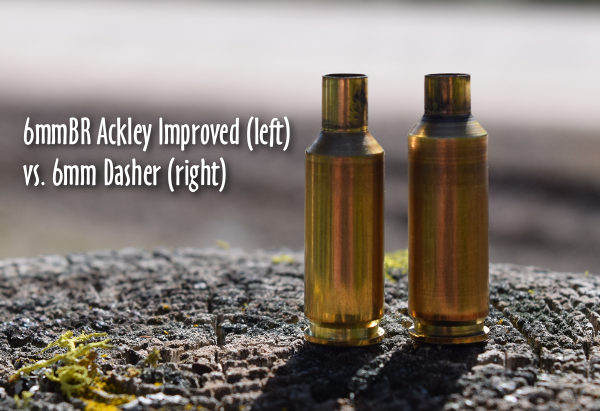
New Cartridge Debuts — the 6mmBR Ackley Improved (6mm BRA)
The 2017 season has brought some new gear/cartridge developments and many shooters were able to put them to good use in the first match of the year at Deep Creek. Leo Anderson and Tom Mousel were both shooting the new 6mm BRA (6mmBR AI), a 6mmBR Norma with a reduced body taper and a 40 degree (40°) shoulder. Fire-forming is as simple as turning the necks and shooting, as the factory 6mmBR case will headspace in the AI chamber. Sizing with a 6mm Dasher die with .080″ turned off the bottom is the ticket. Tom Mousel, reigning IBS 1K Champ, “believes this case to have a little wider tune window and far less throat wear”. That means this case might be easier on barrels. For Tom’s 6mm BRA with 28” Krieger barrel, the accuracy node is about 2980-2990 fps, so this gives up only 30-50 fps compared to typical Dasher velocities. Both of Tom’s HG groups held in the 3s for vertical, proving the 6mmBR Ackley’s accuracy potential.
Vapor Trail Bullets and Deep Creek Tracker Stock
Tom Jacobs at Vapor Trail Bullets has been working with a new die for his excellent 6mm 103gr Vapor Trail bullet. Four of the weekend’s competitors were shooting bullets off the new Vapor Trail die. The new die seems to be producing a bullet every bit as good as the old die, maybe even better. Several groups in the 2s (two inch) were shot this weekend. As well as Richard Shatz’s impressive 3.671″ 10-shot group in Heavy Gun (see top of this article).
Finally, the new Deep Creek Tracker 4″-wide stock is becoming a favored option, with half of the competitors at the match shooting these stocks from Wheeler Accuracy. That extra inch in the stock’s fore-end seems to be provide more stability and less rocking on the front rest when opening and closing the bolt. Also, the adjustable tracking rudder makes for perfectly parallel tracking surfaces, an absolute “must have”.
The weekend ended with the sun finally breaking through the clouds. Competitors enjoyed some great grilled Polish dogs with all the fixings prepared by Mark and Angie Candau; who also shot in the match. There were plenty of smiling shooters with awards/prizes for their efforts. It was a great opening match of the season!
Here are the Top Guns at the match: Dave Torgeson, Jim Williams, Jeff Read, Shawn Williams, Richard Schatz, Leo Anderson, Lonnie Anderson, and Tom Mousel.
Deep Creek is one of America’s best 1000-yard shooting centers — many records have been set here.
On Ammoland.com, there’s an interesting article about the NSSF’s recent 3-Gun Fantasy Camp in Las Vegas. Author Duncan Johnson attended the Camp last month and wrote an “after action report”. He said the Camp was a great experience, and his shooting improved greatly with the expert tutoring from top pros: “If you have ever wanted to try a 3-Gun competition, just go do it, you will quickly find out why this is the fastest-growing shooting sport today. If you are new to shooting and or just getting started in 3-Gun, I 100% recommend you attend the NSSF Fantasy Camp.”
Here are Four Tips/Observations Duncan learned during the 3-Gun Fantasy Camp:
1. Use a Zoom Rifle Optic – “The LWRC 3-Gun ready rifle [provided for the Camp] was topped with a Leupold Mark 6 1-6x20mm riflescope, which made distance shooting much easier than the AimPoint optic [on my own AR]. 3-Gun competitions have rifle stages that can involve distance shooting out to ranges of 500 yards or more. For that reason, most shooters in the 3-Gun TacOps and Practical divisions use magnified riflescopes like the Leupold Mark 6 or the Vortex Strike Eagle.”
2. Use Your Quads and Core Muscles — “There are also a lot of little things that the pros teach you… For instance, some shooters instinctively bend their knees to enter their stance, but once they start firing they tend to follow the recoil with their shoulders and end up leaning back. In order to avoid that, use your quad muscles in your legs to get a solid stance that will absorb more recoil. Also use your core muscles to maintain a strong stance, especially in shotgun stages. The combination of strong quad and core muscles will contribute to controlling muzzle flip and moving onto your next target more easily.”
3. Vision-Based Target Transitions — “Another pro tip from Randi Rodgers on transitioning from target to target with a pistol was using your eyes rather than your sights to switch targets. So imagine it as pull the trigger, the slide starts to come back, using your eyes find the next target, then point with the front sight, find the sight picture, fire, and repeat.”
Editor’s Note: A few seasons back, I attended an action shooting seminar taught by Randi, and she explained the “move your eyes” technique. For multi-target stages, this really works. Move your eyes from target to target, and you’ll find your arms automatically “pull” the handgun into position. You still need to get the sights on target, but this method yields create smoother, faster stage runs.
4. Trigger Control and Use of Support Hand — If you don’t have good trigger control and pull straight back, you can move your sights during the shot. This is a common problem with novice pistol shooters. The solution is lots of dry fire training. Duncan found out he needed work: “In my case, the biggest area where I need improvement was shooting my pistol. There were two different things I was doing that will guarantee a missed shot every time with a handgun. When I pull/squeeze/depress my trigger I have a tendency to also pull the gun off target, resulting in a miss to the low left of a target. I [also] over-apply pressure with my shooting hand. According to the pros, pistol grip should be 40% shooting hand, and 60% supporting hand.”
This article originally appears on Ammoland.com, reprinted here under Creative Commons License.
Pat Reagin of PMA Tool took some cool new products to the range this past weekend. Look carefully at the photo above. That’s not a standard bag-holder on the SEB NEO rest, and that stylish black rear bag doesn’t look anything like an Edgewood or Protektor. The rifle is also sporting the new-generation Weaver 46x48mm T-Series XR Side-Focus Scope.
Lenzi Rear Sand Bag
Pat tells us: “We are now carrying rear bags made by Italian benchrester Alberto Lenzi. Made in Italy, these Lenzi bags are AWESOME! They are available for short range and one that is slighty taller for long range.” The Lenzi rear bags feature a big, 8″x6″ footprint with a thick, slightly concave base that sits very flat on the bench top. Lenzi bags are very stable with a reassuring “dead” feel on the bench. Guys who have tried this bag really like it. Pat says: “I can’t explain it, but the bag seems to absorb energy/recoil better than other bags — the gun tracks a little better and I get back on target really well.” CLICK HERE for more information: Lenzi Long Range Rear Bag | Lenzi Standard Rear Bag.
– Black leather with Cordura at stock contact points with blue stitching.
– 1/2″ flat between medium ears.
– Heavy 8″x6″ base with built-in “donut”.
– Weight about 15.5 lbs filled with heavy sand in bottom & white sand in ears.
Lenzi Replacement Top for SEB NEO Front Rest
A common complaint about the SEB NEO rest is the rest top, specifically the three-piece bag. This rest top made by Alberto Lenzi (an Italian benchrest shooter) addresses the issue by replacing the entire rest top. The rest top features a more conventional design and includes a traditional style front bag that conforms to IBS and NBRSA rules.
The Lenzi Top with Super-Slick Bag is $269.95, while the bag alone is $79.95. You can also get the Lenzi NEO Replacement Top with an Edgewood bag for $275.95. Finally there is a new Lenzi Cordura style bag that fits this system — you can special request that.
Weaver 46x48mm T-Series XR Benchrest Scope
Weaver’s new 46-power T-Series XR scope features a 30mm main tube with side parallax adjustment. Clicks are 1/8 MOA, with 44 MOA windage and elevation travel. Pat Reagin reports: “It’s clear enough. The clicks are a little mushy, but positive. Eye relief is great.”
Available reticles are Fine Crosshair (FCH) and 1/16 MOA Target Dot. Current “street price” is around $900. Amazon currently has the Target Dot Version for $898.99 with free shipping.
It’s great to see two important businessmen give back to the shooting sports. Kelly McMillan and Jim Borden are working together on a project — creating an F-Class Open rifle that can be loaned out to young shooters to help them get started with the sport. Great idea — we need to get more young folks involved in precision shooting. In F-Class (as well as benchrest) it seems we have an “aging population”. Engaging the next generation of shooters is vitally important.
“Big shout out to Jim Borden. He heard I want to build a mid-range/entry level F-Class rifle to be loaned out to new junior shooters interested in finding out whether they like competing in F-Class Open. He contacted me a couple of weeks ago and said he would like to be involved in this project and wanted to send an action on which to build this rifle. Oh boy, it has arrived. Borden’s [operation] has always been synonymous with quality firearms and components but this action is an example of quality craftsmanship in every aspect. Thanks Jim for doing what you do. Hope I can do this thing justice.”
We’d like to see the looks on the faces of the juniors who’ll get to shoot this new rifle Kelly will be building. That’s like a Driver Training student getting to pilot a Ferrari. When this Editor got started in shooting, it was with very well-worn, hand-me-down 22 LRs at a local Boy Scout summer camp. We think it’s great that juniors will be able to sample something built with all-top-quality components.
Every Friday at 11:00 am, Kelly McMillan hosts the Talking Stock Radio Show on the Voice America Network. This week’s show features guest Robbie Barrkman, founder of The Robar Companies and CTI (Coating Technologies Inc.). If you have used any firearm product coated in NP3, you have Robbie to thank for it. Kelly will also interview Extreme Long Range (ELR) shooter Randy Powell from Thunder Ammo & Arms in Oklahoma.
The National Benchrest Shooters Association (NBRSA) held its 600-Yard and 1000-Yard Benchrest Championships in April. Both events were held at the Sacramento Valley Shooting Center facility in Northern California. With significant rainfall in Spring 2017, the range was unusually green and pretty as you can see.
1000-Yard NBRSA Nationals, April 22-23, 2017
The 2017 NBRSA 1000-Yard National Championship was held at the Sacramento Valley Shooting Center last weekend. Congratulations to Richard Schatz, the 2017 NBRSA 1000 Yard National Champion. Richard, a past NBRSA Champ, also won Light Gun Score and Heavy Gun Group. Bill Johnston finished Second Overall, while Louie Tamagni secured Third Overall. Recently-crowned 600-Yard Champ Robert Hoppe won Heavy Gun Score at 1000, showing his ability at the longer distance. Congrats also to Dan Roberson who set a new Light Gun 3-Target Group National Record: 3.395. That’s 1/3 MOA at 1000 yards for three targets. That would be impressive at 300 yards. At 1000 yards, it is stunning.
CLICK HERE for a MS Word file with full 1000-Yard Match Results.
600-Yard NBRSA Nationals, April 19-20, 2017
The 2017 NBRSA 600-Yard National Championship was held at the Sacramento Valley Shooting Center April 19-20. Robert Hoppe shot superbly to win the 2017 Mid-Range Championship. Along with his overall title, Hoppe won Two-Gun Group, Two-Gun Score, Light Gun Group, and Heavy Gun Score. Mighty impressive shooting — Congrats Robert. Finishing Second Overall was Jamie Cardena, while Bert Croy took Third Overall. Jason Peterson had the Top Light Gun Score, while Richard Duncan won Heavy Gun Group. Terry Nunemaker shot the smallest group, a 1.087″ 5-shot, 50-1X. That was a stunning target, all shots centered. Congrats to 2017 Champ Robert Hoppe and all the “Top Guns”.
CLICK HERE for a MS Word file with full 600-Yard Match Results.
Photos courtesy Tanner Furniss and Canada Cummins.CLICK HERE for Match Gallery.
There’s a great interview with Bryan Litz of Applied Ballistics on Mia Rhode’s Life Of A Shooter’s Wife Blog. We recommend you read the full interview. Bryan offers many important insights that can benefit any precision shooter. It’s fascinating to learn about Bryan’s background and how he progressed in competitive shooting, starting with very basic equipment. As a “broke high school kid”, he got started on the cheap, paying for gear with wages from McDonald’s. Now he’s a globally-recognized expert in Ballistics and Long Range precision. You’ll enjoy reading the Full Interview. Here are some highlights…
LOASW: When did you first become interested in shooting?
Bryan: My first memories of shooting were at the age of about 9 or 10. Pellet rifle in the back yard. My Dad taught me to shoot, stressing the importance of accuracy. I was driven to hit targets, mostly small targets at long distance. My grandfather was on the All-Army shooting team back in the ‘50s, and was distinguished in both rifle and pistol. Shooting is part of my family’s DNA and I benefited from that from a young age.
LOASW: What sparked your interest in Competitive Shooting and how old were you when you started competing?
Bryan: Hunting groundhogs in the farm-fields of Pennsylvania through high school is where I truly connected with long-range shooting. My Dad heard of a competition range (The Original Pennsylvania 1000 Yard Benchrest Club in Williamsport, PA). So we visited there one summer and I immediately found my trusty 22-250 inadequate for the job of 1000-yard benchrest shooting. So I saved my McDonald’s wages until I could afford a 7mm Remington Magnum and began competing in my first matches at the age of 15.
Learning with Limited Resources…
… It was a huge mis-match to my situation because benchrest is a highly gear-driven sport, and the winners typically have many $1000s of dollars wrapped up in equipment. I was a broke high school kid who needed my parents to drive me to the range my first year, and my second year, I had to rely on fellow competitors to jump start my old pick-up truck that was always breaking down. Nevertheless I enjoyed the hell out of shooting 1000 yards. I can honestly say that I don’t have any more FUN shooting these days with all the best equipment as compared to those bad ‘ol days when I had maybe $900 total wrapped up in all my gear. Those who remember me from those early days might recall the home-made shooting rest and McDonalds French fry box that I carried all my gear in. Later when I picked up prone/sling shooting, my shooting mat was a piece of carpet (pink, no less), and my shooting coat was a military field jacket with belts sewn in it.
Money was probably my biggest challenge when I started out. I had plenty of fun with my budget kit, but was certainly constrained by lack of access to quality gear. I overcame this with hard work and making the most of what I had. Learning how to mitigate the deficiencies of my equipment was an important stepping stone which has been highly valuable even now when I’ve got better stuff. It’s a good skill to have, to be able to spot something about to come unraveled.
LOASW: What advice would you give to someone new to competitive shooting?
Bryan: Find a mentor, someone who lives near you who has experience and is willing to share it. You will cut years off your learning curve if you can get someone to share their experience with you who’s “been there done that”.


 Standardized ELR Targets




 LOASW: When did you first become interested in shooting?


