|
|
October 18th, 2016
Here’s an example of world-class benchrest shooting. Charles Huckeba of Texas was the top individual shooter at the 2013 World Benchrest Championships (WBC) held near Sydney Australia in October 2013. In this video, 2013 WBC Two-Gun Overall winner Charles shoots a 1/8th MOA group at 200 yards — “a little bitty dot” as a fellow Team USA shooter observes. That’s impressive. If you can describe Huckeba’s style in a nutshell it would be “smooth, consistent, and rapid but not hurried”.
Charles also employed some unusual hardware. In the video, take a close look at the joystick on the Farley Coaxial front rest. There’s no knob at the end. In its place is a small, wood ammo caddy. Charles removed the standard knob from the handle of his Farley rest and replaced it with a home-made wood block that holds cartridges for the record target. The 10.5-lb Light Varmint rifle is chambered in 6PPC with a BAT Machine Action and a composite wood and carbon-fiber stock.
Watch Charles Huckeba Shoot 1/8 MOA, 200-yard group at World Benchrest Championships
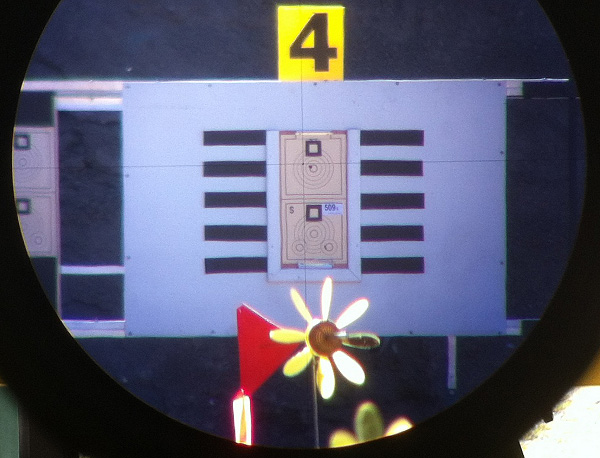
Here is the actual 200-yard, 5-shot group Charles shot in the video. Photo (by Stuart Elliot) taken through the lens of Huckeba’s 50X March scope (reticle has 1/16th MOA Dot).

Analyzing the Fine Points — What Makes Huckeba So Good
Short-range benchrest shooter Boyd Allen saw some interesting things in Huckeba’s WBC performance, as captured on video. Boyd noticed Huckeba’s smooth gun-handling and efficient loading. But Boyd also spied some interesting equipment, including an innovative joystick “handle-caddy”.
1. Low Friction Bags — When Huckeba slid his rifle, there was very little apparent friction. The front bag features the new 3M material (ScotchLite) on the sliding surfaces. The rear Protektor bag has ears of the same low-friction material.
2. Pause Before Chambering — While he was watching the flags and deciding when to start firing, Charles kept his first round in the action, but out of the barrel’s chamber, probably so as not to heat the cartridge and change the round’s point of impact.
 3. Ammo Caddy on Joystick Arm – Charles shoots a Right Bolt/Left Port action, so he pulls his rounds with his left hand. Note that Huckeba’s record rounds rest in a small, wood ammo caddy attached to the end of the joystick shaft. Look carefully, you’ll see the wood ammo block in place of the normal black ball at the end of the joystick. That allows Charles to pull shots with the absolute minimum of hand movement. Ingenious! Huckeba is very fast, with a great economy of motion. I believe that because his ammo was literally at hand, Charles was better able to keep his focus on aiming and the flags. 3. Ammo Caddy on Joystick Arm – Charles shoots a Right Bolt/Left Port action, so he pulls his rounds with his left hand. Note that Huckeba’s record rounds rest in a small, wood ammo caddy attached to the end of the joystick shaft. Look carefully, you’ll see the wood ammo block in place of the normal black ball at the end of the joystick. That allows Charles to pull shots with the absolute minimum of hand movement. Ingenious! Huckeba is very fast, with a great economy of motion. I believe that because his ammo was literally at hand, Charles was better able to keep his focus on aiming and the flags.
4. Smooth-Cycling BAT Action — Note how smoothly Huckeba’s action operates. When Charles lifts the bolt handle (to extract a round and cock the firing pin), this does not disturb the rifle. Likewise, as he closes the bolt, the gun doesn’t wobble. The smooth action allows Charles to hold point of aim even when shooting relatively quickly. Huckeba’s BAT action is chrome-moly steel. Some shooters believe this metal makes for a smoother action than stainless steel or aluminum.
5. Long-Wheelbase Stock — The wood and carbon fiber stock is light, long, and stiff. Yet, importantly, the stock is also well-damped. The longer-than-average stock length (with extended forearm) seems to help the gun track well without jumping or rocking. The longer forearm allows a longer “wheelbase”, effectively shifting the weight distribution rearward (less weight on the front, more weight on the rear). This places a greater share of the gun’s weight on the rear bag, as compared to a more conventional benchrest stock. Huckeba’s stock, built by Bob Scoville, is at the cutting edge of short-range benchrest design. Its light-weight balsa wood and carbon fiber construction provides a combination of stiffness and vibration damping that allows its relatively long fore-end to be fully utilized to increase the weight on the rear bag (always an issue with 10.5-pound rifles).
To learn more about this benchrest stock design, read the comments by stock-builder Bob Scoville in our PPC with Pedigree story in our Gun of the Week Archives. Bob observed:
“There is a lot more to the structure of the stocks than meets the eye. The carbon fiber skin with which I cover the stocks creates a light, tough exterior surface. However, this contributes very little to the overall performance of the stocks. The real strength and stiffness is the result of an internal beam utilizing balsa core/carbon fiber technology.
This type construction can be found in aircraft, race cars, powerboats, and sailboats. It is interesting to note, balsa has the highest strength to weight ratio of all woods and carbon fiber is one of the lowest stretch (modulus of elasticity) relative to weight of all materials. The marriage of these two materials is common in the high-performance world. Additionally, balsa is used commercially for vibration dampening and sound reduction.”
Video find by Boyd Allen. Video by Stuart Elliot of BRT Shooters Supply, Brisbane, Australia.
October 15th, 2016

Jeffrey Block has created a great FREE software program, OnTarget, that measures shot groups quickly and precisely. All you need is a photo or scan of your target. The program allows you to set your target distance, and provides caliber-specific tools to precisely mark the center of each shot. Once you’ve marked each bullet hole, Jeff’s OnTarget program automatically calculates group center, maximum group spread (CTC), average distance to center, group width and height, and group offset from point of aim. The program will even measure multiple groups on the same target.
CLICK HERE to Download OnTarget Group-Measuring Software (v1.10 FREE; v2.10 $11.99)
Video Tutorial Shows How OnTarget Software Works
Jeff created an excellent Animated Tutorial demonstrating OnTarget’s functions. It shows how to import a target image or scan, how to set target distance and scale, how to set bullet size, how to circle each bullet hole, and how to save the marked and measured target. VIEW OnTarget TUTORIAL.
 After just a few minutes spent learning the program’s tool buttons, we were able to plot shot groups on a variety of targets with ease. Once you select the target distance and bullet diameter, figuring group size is a simple matter of centering a circle tool over each bullet hole. Then the program “connects the dots” and provides all the info you could want automatically. After just a few minutes spent learning the program’s tool buttons, we were able to plot shot groups on a variety of targets with ease. Once you select the target distance and bullet diameter, figuring group size is a simple matter of centering a circle tool over each bullet hole. Then the program “connects the dots” and provides all the info you could want automatically.
The program worked with bullet holes as small as 17 caliber and as large as 50 caliber. It is very precise, but remember that if your target photo was taken at an angle, distorted perspective can cause slight errors in measurement. Therefore, for the ultimate precision, you want to start with a flat scan of the target.
OnTarget Compared to Measuring Manually
We found OnTarget to be especially useful for groups with widely dispersed bullet holes, or very small bullet holes, such as 17 caliber holes. We’ve found that it’s difficult to measure 17-cal group sizes with a standard caliper, because the tool itself obscures the tiny holes. With OnTarget, the program can zoom up your target view, making it much easier to plot the center of each shot. And with a widely dispersed group of shots, the program automatically finds the two most distant shots. You can’t mistakenly pick the wrong pair of shots to measure.
| MEASURING REAL TARGETS — Actual Examples |
Here are examples we created with OnTarget. The first photo shows a 17 Mach 2 target. These tiny 17-cal holes are notoriously hard to measure. With OnTarget, it’s a snap. You just load the target image into the program, zoom in with the controls, and then click on the center of the holes. The program automatically calculates group size, displaying measurements in both inches and minutes of angle (MOA)
Original Target (with ruler for scale)

Target Captured and Displayed in Program

Detail of Group, Enlarged by Program

10-shot Groups? — No Problem
Here’s another target, showing 6mm bullet holes at 600 yards. The first image shows the target image loaded into the program with the ten holes circled in red.
Target Displayed in Program

For this target we have used the Aiming Point option. The Aim Point was set at the center of the “X” and the program calculates average distance from the Aim Point. Very cool.
Detail of 10-Shot Group, Enlarged by Program

No Scanner Needed
The OnTarget program grabs target scans directly from a flatbed scanner using Microsoft’s Windows Image Acquisition system. But don’t worry if you don’t have a scanner. You can just take a digital photo of your target and OnTarget will import it quickly and easily. To set target scale, a simple tool allows you to mark a known length on the target (such as the diameter of the “X” Ring), and the program will then size the target accordingly. Is OnTarget precise and accurate? Here’s what Forum Member Steve W. says: “I used the extreme spread measurement of a group on one of my 600-yard match targets… as it was officially scored at the match. By clicking the +—+ icon, then clicked the cursor in the centers of the two extreme spread holes, I then entered that value in the reference window. After that it was simple because the bullet placement cursor’s circle was the same size as the black outline of the actual bullet holes on the picture of the target. OnTarget’s measurement came up within .006″ of the official 2.772 inch measurement of the group. That’s pretty darned close; well inside the human judgment of aligning the tips of a micrometer on the bullet holes.”
Bottom Line — Great Program — Download It Today
Jeffrey Block has done a great service for shooters by creating the FREE OnTarget program. It is easy to learn, it functions great, and it can save you time and effort measuring targets. It also lets you easily archive and compare multiple targets produced during load development or rifle testing. You can record ammo type, date, location, weather etc. in note fields accessed by “Group Info” and “Target Info” tabs.
Keep in mind that OnTarget was NOT created to replace existing methods for scoring competition targets. But for all other target measuring purposes it does a great job. Visit Jeff’s website, OnTargetShooting.com, view the tutorial, and check out OnTarget for yourselves.
To learn more about OnTarget, see more measuring samples, and read advanced Power-User Tips, visit our full OnTarget Product Review.
October 12th, 2016

Paul Phillips Reports:
“Here is a sneak peak of my new barreled action for ELR. Compliments of Lethal Precision Arms. This Bartlein barrel is chambered in .375 Lethal Magnum. This massive cartridge will be launching the 405 grain Berger solids with a BC of 1.09 @ 3200+ FPS. The 38″ barrel is screwed on to a two-inch round .50 Cal Action from BAT Machine. This barreled action weighs 35 pounds and is approximately 48 inches long as shown in the photo. Yes that’s 35 pounds NOT counting stock, scope, muzzle brake, and bipod.
This barreled action is now being sent to McMillan Group International for custom in-letting and a custom Big Mac Stock optimized for Extreme Long Range. Stay tuned for more progress on this new ELR Beast for the next King of 2 Miles competition.”
Our buddy Paul Phillips is an outstanding shooter who has competed with the U.S. National Team and is currently a member of the U.S. Rifle Team F-TR. Paul has been interested in extreme long-range (ELR) shooting for quite some time, but the King of 2 Miles (KO2M) event this fall at Raton, NM really brought things into focus for Paul. A member of the K02M-winning Applied Ballistics squad, Paul now knows exactly what kind of hardware (and cartridge) it takes to win at two miles (and beyond). Now he’s ready for more, and he’s building a very special (and very big) rifle.
After his experience at the King of 2 Miles event, Paul decided he needed his own world-class rifle for the ultra-long-range game. For this rifle, Paul acquired a massive BAT action and a ginormous Bartlein barrel, finished at 38 inches. The .375 Lethal Magnum chambering is wildcat that starts with the 585 Hubel Express (HE) case, adapted for a Cheytac boltface. This jumbo cartridge can propel 405gr Berger solids at 3200+ FPS. The G1 BC of these prototype solids is a stunning 1.09. Note: Berger has no current plans to market this .375-caliber solid bullet — it is still in the prototype stage.

October 9th, 2016

Bryan Litz, 2016 F-TR National Mid-Range Champion, tried his hand at a new discipline recently — tactical shooting. Bryan competed in the Guardian Match, a PRS-type competition hosted by the Marksmanship Training Center in Lake City, Michigan. Though the course of fire was new to Bryan, he did very well indeed, finishing second overall in his first-ever Tactical Match.
Bryan said PRS-type tactical shooting is “totally different” than F-TR competition: “I think the biggest difference (from F-TR) are the time constraints. The time pressure’s totally different. We had just 25 seconds to do one short-range stage, and other stages are 90 seconds, 120 seconds….”
Bryan added: “You’ve got to know your dope for the first shot — no sighters. F-TR is more deliberate, precision-based. This [tactical game] is about accuracy to be sure, but there’s even athleticism — if you’re not flexible, you’re just straight up not going to be able to aim at some of these targets.”
Bryan, who first achieved great success in sling-shooting disciplines, said that tactical matches, with their multiple “on the clock” stages, offer new challenges: “This was a way different experience than I’m used to, mostly due to time pressure and awkward shooting positions. But I enjoyed the problem- solving element. Fellow shooters were very helpful and generous with advice.” Posting on Facebook, former USAMU coach Emil Praslick offered this sarcastic advice: “You need more Velcro and camouflage. That is what is preventing you from winning.”

During his match Brian shot in multiple locations, with a variety of target types, including steel and IPSC movers. There were some unusual challenges including a “Tree-Stand Hunter” stage, and a stage that required moving “Around, Over, and Under a Vehicle” as you can see…

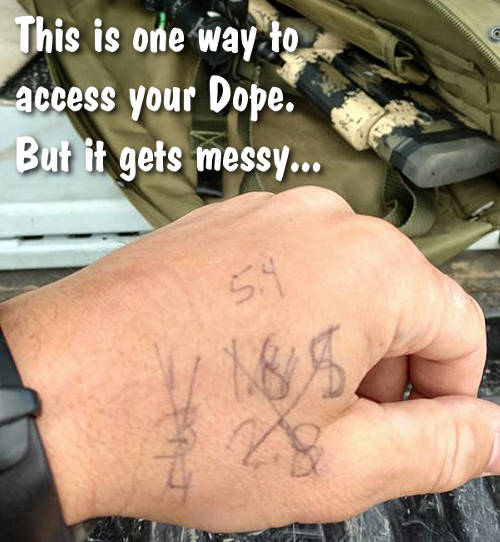
Before the match, Bryan practiced from a tripod, but he wasn’t sure about the best technique: “Seriously, what kind of groups are considered ‘good’ from a position like this? Does 2 MOA suck?” Here’s the recommended technique (from Gunny N.): “Anchor the sling to the front of the rifle but not the back. Wrap sling around leg or center post of the tripod. Place your off hand on the wrap and twist it to tighten up. That will apply down pressure on the forearm. Your shoulder will apply down pressure on butt stock. You’ll tighten groups 25-50%.”

Parting Shot…
October 7th, 2016

If you look at that 5-round group you might think it was shot with a 6 PPC or maybe a 6mmBR. But no, this was done with heavy 180gr Berger Hybrid bullets and the .284 Shehane, an improved version of the .284 Winchester. In fact, this impressive sub-quarter MOA group was shot while fire-forming with a very well-worn barrel!
Gun builder Ryan Pierce of Piercision Rifles explains:
Here’s a 5-shot 0.191″ group at 100 yards with my .284 Shehane fireforming loads. This barrel has 2200 rounds through it. It had 2000 as a straight .284 Win and then I set it back to .284 Shehane to form brass with. This was the first five rounds through it after I cleaned it after the last match. [The load was] 180 Hybrids with 54.0 grains of H4831 SC.
Ya, I figured why not I had some old barrels laying around so I just chopped 2″ off the back and 1″ off the front and chambered it up as a Shehane. Had 1000 pieces to fireform and didn’t want to do all that on a brand new barrel.
My fireform loads are going 2765 FPS. I have a 29″ barrel also though since it’s a setback. Once you get it formed I would push it faster than that or I wouldn’t even bother with the Shehane. My old straight .284 load at 2890 fps had ES spread in single digits for 10 shots. I figured if I get it up to 2935-2950 fps that will be a point or two saved in a several day match.
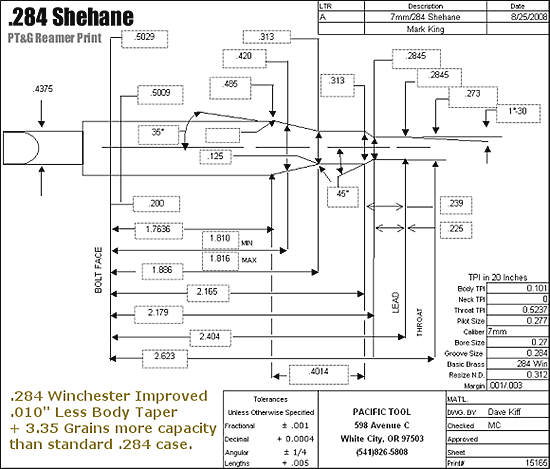
Fellow .284 Shehane shooter Erik Cortina notes that the .284 Shehane has a velocity edge over the straight .284 Win because it holds more powder: “The Shehane has more capacity than the .284 Winchester. Ryan is using 54.0 grains simply as a fire-forming load. Typical load for a Shehane is around 57.0 grains of Hodgdon H4831 SC.” By blowing the sidewalls out 0.010″, the .284 Shehane picks up about 3.3 grains of extra case capacity. That enhancement makes a BIG difference. The extra boiler room is enough to drive the 180s at 2900-2950 fps with H4831sc, with long barrels.
October 6th, 2016

The first-ever New England CMP Games were held at the Camp Ethan Allen Training Site (CEATS) in Vermont, on September 14-18, 2016. This proved to be a great event at a stunningly scenic facility — a paradise for marksmen. Over 150 rifle and pistol competitors ventured to Vermont to enjoy the CMP’s inaugural New England Games, the latest in the CMP’s popular series of major, regional matches.

Here’s the view from the berm, looking back to the firing line…

The 2016 New England CMP Games included a Small Arms Firing School with expert instruction. Both novice shooters and experienced competitors benefitted from the training sessions.

Also featured at the New England Games was a preview of CMP’s electronic outdoor targets that are able to be transported and assembled across the country. For many shooters, this was the first time they were able to try electronic targets.

Competitors were mightily impressed by the breathtaking natural surroundings at the New England Games. “I was blown away by the facilities at Camp Ethan Allen,” said Steve Cooper, CMP North general manger. “The grounds were neatly manicured, our offices for registration and sales were very convenient and the classrooms were perfect for our clinics.”
He went on to say, “As beautiful as the surroundings were, the people were even better. They truly wanted us there and they enjoyed the matches, clinics, and other activities. It will be a pleasure to return next year for an even bigger and better event.”
Many awards were earned at the 2016 New England Games…

Of course, it wouldn’t be a true CMP Games event without a Rimfire Sporter Match.

The CEATS Pistol Range hosted both centerfire and rimfire matches in a lovely, tree-lined setting.

CLICK HERE for a complete list of New England CMP Games match results. Photos from the event are posted on the CMP’s Zenfolio website. Mark your calendars! Next year’s New England CMP Games are scheduled for September 20-24, 2017.

October 4th, 2016

Forum member Keith W. (aka “Cigarcop”) is a talented riflesmith whose projects display outstanding finish work and attention to detail. Keith does some of the best bedding work we’ve ever seen. Recently Keith completed a rifle for tool-maker John Perkins, owner of 21st Century Shooting. John, who recently competed at the F-Class Nationals in Lodi, WI, wanted a new F-Open rifle with top-of-the-line hardware and a sweet-tracking stock. We think John will be impressed with this gun — and we bet it proves to be an tack-driving “hammer”. John will use the 21.5-lb rifle for F-Open competition and some mid-range and long-range benchrest competition in HG class.
This stock sports 12 coats of Urethane, wet-sanded between each coat.

This competition rifle features a melonited BAT “M” action (with Bix’N Andy trigger), a pair of 7mm Brux barrels chambered in .284 Win, and a Precision Rifle & Tool (PRT) Low-Boy stock. As you can see from these photos Keith posted in our Shooters’ Forum, this is a beautifully-finished rifle. If you have questions about this project, direct them to Cigarcop in this FORUM Thread.
Build Details for a Beautiful F-Open Rig
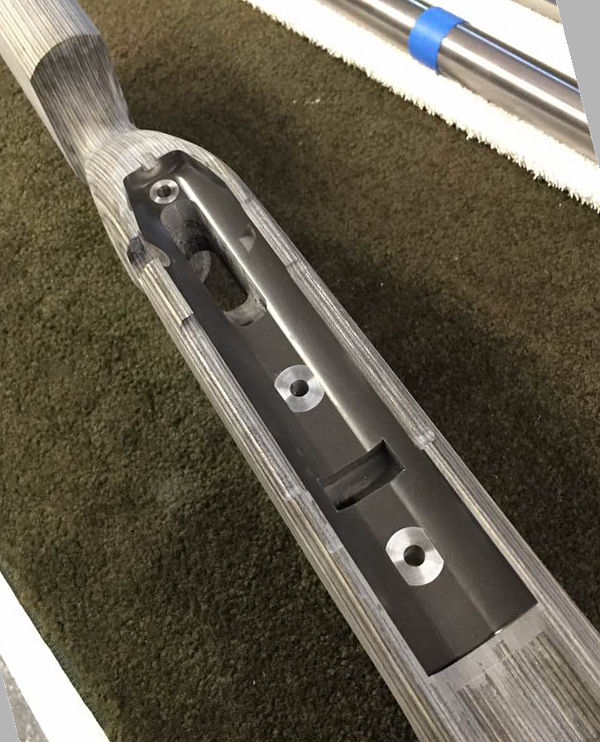
Keith reports: “The rifle is built on a PRT Laminated Low-Boy F-Class Stock with a Bat M Melonited Action, +20 MOA rail, Pillar bedded in Devcon 10110. After bedding and inletting I clear-coated the stock with 12 Coats of a 3-part Urethane finish which was wet-sanded between each coat and sanded out to 2000 before final polishing. John Perkins provided two Brux 1:9″-twist, 1.250″-contour barrels. They are both finished at 31″ and chambered in straight .284 Win with .313″ neck and .213″ freebore to shoot the 180gr Berger Hybrids.
Cigarcop does superb bedding work, as you can see…
John chose the Bix’N Andy trigger after sampling one of Erik Cortina’s rifles at the Berger SW Nationals. “I tried the BNA trigger on Erik’s gun and I was so impressed. It is very light but 100% consistent. After an injury I’ve lost some feel in my trigger finger and the BNA helps because it is so smooth. I would never go back to anything else.”

New Seating Die from 21st Century
While talking about his new rifle, John Perkins revealed that he has developed a very sophisticated new micrometer seating die: “This is something very new, and unlike anything else on the market. Each die is tailored to the dimensions and ogive curve of your particular bullet which we measure with an optical comparator. The customer provides fired, sized brass and sample bullets and we can produce a perfect match.”
John says his new seating dies produce ultra-consistent base-to-ogive load lengths along with exceptionally low run-out. “This new die produces incredibly straight ammo — there are some special features inside the die that help straighten the bullet during the seating process”. That delivers “truly superior concentricity” according to John. 21st Century Shooting will be taking orders soon for the new seating die. Call (260) 273-9909 for more information.
October 3rd, 2016

If you like 3-Gun shooting, definitely check out this video, a complete 22-minute episode of the Hot Shots TV series. This Hot Shots Season Three episode features three of the greatest action shooters in the world: Max Michel, Jerry Miculek, and Clint Upchurch. This superstar trio demonstrate their skills with a variety of rifles, pistols, and shotguns. You’ll see the latest “full-race” ARs, ultra-high-capacity scatterguns, and high-end pistols.
Click to Watch Full 22-Minute Episode from Hot Shots Season Three:
In this game it’s all about speed on target — matches are decided by fractions of a second. You’ll see Max Michel training with a pistol — and his speed is truly amazing. He gets six shots on target in under 4 seconds including draw. This season-opening episode of Hot Shots finds Max in Arizona tuning up against his fiercest rival, Jerry Miculek and family. You’ll also see competition footage from the West Coast Steel Championship and Clint playing host to a hometown 3-Gun match.

September 30th, 2016

This feature story is the third (and final) installment of a three-part series by 2016 National Long-Range Champion John Whidden. In this article John, who runs Whidden Gunworks, talks about the Palma rifle he used at the 2016 Camp Perry National Matches. This unique .308 Win prone rifle features a Barnard “P” action in a converted aluminum Anschutz “Precise” smallbore (rimfire) stock. The combo of Barnard action and Anchutz ergonomics is hard to beat, says John, who told us: “this is easily the best Palma rifle I’ve ever had.”
As a bonus, the Barnard “drop-in” required no modification of the Anschutz Precise stock. This means John can actually swap in his rimfire barreled action and shoot smallbore with the same stock.
Sling Rifle Evolved: The Ultra-Accurate Hybrid Palma Rifle
by John Whidden
The mental component of Long Range competitive shooting is always challenging but having tremendous confidence in the accuracy of your equipment is a huge benefit. There’s nothing to start your Palma match off well like knowing that you are shooting the most accurate Palma rifle you’ve ever owned.

After winning the 2016 NRA Long Range National Championships at Camp Perry, there are always plenty of questions about the equipment used by those at the top. Shooters are always looking to learn what is the best equipment at any given time so that when the time comes to spend our own hard earned dollars we can make the best choices. Even if you shoot an entirely different discipline knowing which manufacturers are making winning gear is very valuable.
Whidden 2016 Palma Rifle
Action: Barnard “P” (three lugs, 60° bolt lift)
Barrel: Bartlein 32″, Light Palma contour, cryo-treated by 300 Below.
Stock: Anschutz Precise aluminum smallbore stock, set up for centerfire barreled action.
Trigger: Barnard Two-Stage adjustable

Whidden’s Wonder-Gun: German Stock, New Zealand Action, American Barrel
The Palma rifle I shot this year at Camp Perry is one that I have been super pleased with. I built the rifle early this year and the major components are a Barnard P action, Anschutz Precise smallbore stock, and Bartlein barrel. The caliber is .308 Win, as dictated by the Palma rules. Palma matches are fired from 800, 900, and 1000 yards utilizing iron sights only. No optical sights are allowed.
The Anchutz Precise stock is so well-designed that once I finished adjusting the details, I realized that my hold was about 1/3 smaller than with the stocks I shot previously. While in recoil the gun will track vertically and fall back down right on my own target just as it should. In the past, with my other Palma rifles, it was frankly sometimes a struggle to get them to settle back on target after a shot.
Whidden Gunworks has installed a variety of different actions in the Anschutz Precise stocks. Though the stocks are designed for the .22 LR caliber 2013 action rifles, we’ve successfully installed Barnard, Kelbly, Bat, Nesika, and Remington clone actions into them. The Barnard Model P makes a particularly simple installation because there is no modification necessary to the stock at all. A competitor can then shoot both his centerfire rifle as well as his smallbore gun in the exact same stock. The location of the trigger and bolt handle on the Barnard are positioned just right to make this work. Other actions do require at least some amount of modification to the stock, and we have found the Barnard works the best.
Barnard manufactures several models of actions as part of their lineup. All of the actions in the lineup use three lug bolts which give a shorter 60-degree bolt lift when opening and closing. All of the critical surfaces are machined after heat treating. This means that they are exceptionally true and square, more so than other actions. The Model P action is most familiar to Palma and F-Class shooters and are commonly seen on the firing line. The fact that Model P actions include an excellent two-stage trigger makes also the pricing very attractive.
Based on my previous excellent experiences, I selected Bartlein barrels for this rifle. When shooting internationally in the Palma matches we are restricted to 155 grain .308 bullets, but I made the unusual choice of a 1-10″ twist for these bullets. I’ve shot this fast twist for some years with the 155s with good success and it’s pleasing to know that Bryan Litz is finding benefits in some cartridges to shooting faster twist rates than we previously thought we needed. The chamber is the 2011 Palma and the barrel is a Light Palma contour finished at 32” length. The barrel was cryo-treated by 300 Below. The point of impact isn’t changed at all by barrel heating and the accuracy is incredible regardless of the temperature of the barrel. This can’t be said of all the barrels I’ve owned.

Get Your Own Whidden Wonder-Gun for $4500.00
Like what you see — but wonder how much it will cost? Whidden Gunworks can build you a rig like this, fitting a centerfire barreled action in the Anschutz Precise stock. John tells us: “The price of a rifle like this one but without sights or mounts would be just under $4500.00. We attempt to keep all of the parts except the stock in inventory, so lead time should be under eight (8) weeks.”
Stock Offers Great Adjustability
 One thing that is quickly noticed about the Anschutz Precise stock is its adjustability. The engineers did a very good job of allowing many of these adjustments to be made while in the shooting position, most notably the cheekpiece adjustments. When a shooter picks up a Precise stock for the first time they also notice how narrow the fore-end is. This really contributes to reducing the pain in the forward hand in prone when shooting with a sling. This stock is, by far, the most comfortable sling stock I’ve ever handled. One thing that is quickly noticed about the Anschutz Precise stock is its adjustability. The engineers did a very good job of allowing many of these adjustments to be made while in the shooting position, most notably the cheekpiece adjustments. When a shooter picks up a Precise stock for the first time they also notice how narrow the fore-end is. This really contributes to reducing the pain in the forward hand in prone when shooting with a sling. This stock is, by far, the most comfortable sling stock I’ve ever handled.
This rifle was very accurate right away and very comfortable to shoot. I’ve built some really good shooting Palma rifles but this is easily the best Palma rifle I’ve ever had. The Barnard action with its superb quality and excellent two-stage trigger has been the best choice I could have made. When you can go to the firing line knowing that you have the very best, the foundation for success has been set.
September 29th, 2016

Ballistics Guru Bryan Litz needed all of his wind-reading skills in Lodi, WI. Conditions were challenging!
Bryan Litz of Applied Ballistics won his second straight Mid-Range F-TR National Championship this past weekend. Likewise the Michigan F-TR Team won its second Championship in a row. So it was a heck of a showing by the Michiganders overall. With a strong individual performance, Phil Kelley finished second with his fellow X-Men teammate James Crofts in third. The X-Men Team also garnered second-place in the F-TR Team event. Kelley told us: “It sure is fun to compete with the best in the business — to share the individual overall podium with Bryan Litz and James Crofts is an exciting honor.”
It was a bit cold in Lodi, Wisconsin, photo by K. McSparron.

F-Class Goes High-Tech with Electronic Targets
This was the first-ever F-Class National Championship that used electronic Targets. Litz offers his perspective on the new E-Targets in the Q&A section below — Bryan is mostly positive about the E-Targets but he says there are still some minor bugs to be worked out.
Bryan, a sling-shooter at heart, has really taken to this F-TR game. He won both the Mid-Range and Long Range F-TR National Championships in 2015 and now he has one 2016 title in the bag. Bryan tells us: “Many thanks go out to all those who’ve supported me in winning my second F-TR Mid-Range National Championship. My serious pursuit of F-TR shooting began the day I called John Pierce and requested: ‘John, build me one like yours’. That rifle and others built by Pierce Engineering are at the top of the game. Thanks also to my many great team-mates on the Michigan and U.S. Rifle Teams who have taught me a lot about this sport. As always the competition was stiff and mother nature gave us some drastically different looks. The challenging weather, combined with the introduction of electronic targets to this sport at the national level, required shooters to be highly adaptable. Thanks to the match organizers and technical staff who did a great job.”
John Pierce (left) and Bryan Litz with his Championship-winning Pierce-built F-TR rifle (2014 photo).

Litz Loads Vihtavuori N140 with 215gr Berger Hybrids in his .308 Win
Bryan told us: “Load data is always a common question and I keep no secrets –I’m running the same basic load I shot the past few years with the exception that I’m now burning 43.0 grains of Vihtavuori N140 instead of Hodgdon Varget in new Lapua brass with Fed 210M primers and 215 Berger Hybrids seated about 0.005″ off the riflings. This gets 2520 fps in a 28-inch barrel. I use this same load for both mid-range and long range.”
Team Competition — Michigan Wins F-TR Division with X-Men in Second
Michigan F-TR Team won its second consecutive Mid-Range National Championship. Congratulations to team-mates Al Barnhart, Doug Boyer, Bryan Litz, and John Roethlisberger. Al and Doug are experienced veterans but this is John’s first experience in a national-level event. Michigan actually fielded two teams in this event and the second squad also won a medal in one of the matches. Byran Litz noted that the Michigan F-TR Team “has been working hard to develop our shooters and many have made it onto the U.S. Rifle Team. We have many great sponsors including: Applied Ballistics, Berger Bullets, Bartlein Barrels, Marksmanship Training Center, Nightforce Optics, Pierce Engineering, and Vihtavuori Powder.” Bryan added: “I also thank Team X-Men for the spirited competition. You guys (James Crofts, Tracy Hogg, Phil Kelly, Ian Klemm, and Ken Klemm) are great and make these team matches very fun.”
Bryan Litz with Michigan F-TR team-mates Al Barnhart, John Roethlisberger, and Doug Boyer.

Q & A with the Champ — Litz Talks Targets and Match Strategies
We asked Bryan how the new Electronic Target technology used in Lodi alters the F-Class game. As the Long Range Nationals are underway now, we also asked Bryan to comment on Mid-Range vs. Long Range strategies — what does he do different at 1000 yards vs. 600 yards.
1. How did you like the electronic targets? Did this require/allow a change in your shooting style or rhythm (e.g. can competitors shoot faster now with less wait time between shots)?
LITZ: I really like the E-Targets for many reasons. Not pulling pits is the biggest one but the E-Targets also bring a level of fairness that human pullers could never achieve in the sense that everyone gets the same speed ‘service’.
For the 2016 FCNC in Lodi, WI, all the targets are programmed with a 7-second delay which is equivalent to “very good” target service. The system actually shows your shot value immediately, but doesn’t plot the location of the shot for 7 seconds. So if you want to “machine gun” a shot following an X with the same hold, you can take your chances without knowing where the X was.
The E-Targets require some adaptation from regular pit service. For those with many years of experience on traditional targets, it’s just WEIRD that the target doesn’t go up and down or have a spotter in it. All the information you need is on the tablet. This isn’t better or worse, just different. Occasionally the tablets lose signal for a few seconds and it can be frustrating, but this is not different than when a puller missed a shot and you had to “call for a mark”. I think that very soon the connectivity issues will be fully resolved and the systems will operate flawlessly. I know it would be impossible to get all the shooters through on such a small range any other way. The E-Targets have enabled a medium-sized range like Lodi to host a National Championship.
Q: How is the mid-range F-TR game different than long-range F-TR competition?
LITZ: Usually Mid-Range is about consistent precision — not having any fliers and not dropping any points. Mid-Range matches are usually decided by a narrower point spread than long range. Conditions aren’t typically big enough to move you out of the 10 ring very much at mid-range. The first couple days of the 2016 Mid-Range Nationals was just like this. I won the first two days, dropping only 3 points in total. But then the wind picked up on Day 3 and it was totally different! It became more like a Long Range match with all the points falling like rain and [conditions] very difficult to read. Many more 8s and 7s appeared at 600 yards and the field really spread out. In the end I was able to hold onto my lead and win the tournament.
Q. Why the change to Vihtavuori N140 powder? Was it more available or were you seeing lower ES/SD?
LITZ: I’m seeing the same ES/SDs with VV N140 as what I was using before (Varget) and N140 may burn a little cleaner. Also availability has been improving on the Vihtavuori powders in recent years. We (the Michigan F-TR Rifle Team) are very fortunate to have Vihtavuori as a sponsor and look forward to winning many matches with Vihtavuori products.
Editor’s Note: If any readers have results for the F-Open Mid-Range Nationals, please post in the comments section below and we will update this story.
|


