Yes, F-Classers, it’s time for the Nationals. Is your ammo loaded? Scope zeroed? The 2016 NRA F-Class Nationals will be held in Lodi, Wisconsin at the Winnequah Gun Club from September 23 through October 1, 2016. This will be a combined Mid-Range and Long Range event, with the Mid-Range activities running September 23-27, followed immediately by the Long-Range Nationals which conclude October 1, 2016. F-TR and F-Open shooters will compete for both individual and team honors. Here is the schedule:
Electronic Scoring at F-Class Championships This is big news. For the first time ever in the USA, electronic (sonic-sensor) targets will be used for both the Mid-Range and Long Range F-Class National Championships. NOTE: These are NOT like the self-contained Kongsberg target systems at the CMP’s Talladega Marksmanship Park.
At Lodi, Competitors will still aim at conventional paper target faces but sonic sensors on the target frames will allow instant shot plotting and scoring. This target system was developed by Silver Mountain Targets of Canada. The Silver Mountain system uses sonic sensors (essentially high-tech microphones) to triangulate shots with great precision. Monitors will be positioned at each firing station. The Silver Mountain system has been extensively tested and the match directors have hard-wired the target “brains” back to the scoring center to ensure reliable communications. Before the championship, match officials will be conducting a mandatory class on the operation of the electronic target monitors.
Looking downrange at Winnequah Gun Club in Lodi, WI:
2016 NRA F-Class National Championships FEE Schedule:
Mid-Range – Individual entries all individual matches – $230
Mid-Range – Each Team match (pay at range) – $80
Long Range – Individual entries all individual matches – $230
Long Range – Each Team match (pay at range) – $80
Combined Individual entry Mid-Range and Long Range – $400
STATE of the ART — F-TR and F-OPEN
Here is the sleek .308 Win rig Bryan Litz used to win the 2015 Mid-Range AND Long-Range F-TR Championship at the Ben Avery Range in Phoenix.
And here is the 7mm RSAUM F-Open rifle belonging to Kenny Adams. The reigning F-Open World Champion, Kenny will be one of the favorites in Lodi…
Kenny’s World-Beating 7mm RSAUM Load
For his 7mm RSAUMs Kenny loads Hodgdon H4350 powder and Federal 215m primers into Nosler or Norma RSAUM brass. In the RSAUM he runs Berger 180gr Hybrid bullets seated “just touching” the lands. Kenny is very precise with his charge weights. Using a Sartorius Magnetic Force Restoration scale, Kenny tries to hold his powder charges to within 1-2 kernels charge-weight consistency.
The National Shooting Sports Foundation and Cavern Cove Rimfire welcomes everyone to join us October 14 – 16, 2016 for the 2016 NSSF Rimfire Challenge World Championship! The event will be hosted at the Cavern Cove Rimfire facility in Woodville, Alabama.
Competitors will be challenged with both rimfire pistol and rifle stages. As with all NSSF Rimfire Challenge events, both novice and experienced shooters are encouraged to participate. This event is designed to be fun and enjoyable for all skill levels. For many shooters, a Rimfire Challenge represents their first competitive shooting experience.
Rimfire Challenge events are intended to be entertaining for the entire family. Whether you’re coming as a spectator or a competitor, side shooting activities are in the works so that everyone in attendance will have the opportunity to enjoy some trigger time. Come one come all to what will be a very exciting and fun weekend!
Are you a died-in-the-wool .50 BMG fan? Got a hankerin’ for heavy artillery? Then visit the FCSA Photo Gallery page. There you’ll find hundreds of photos from Fifty Caliber Shooting Association (FCSA) matches and 50 Cal fun shoots in eleven states plus Australia, Switzerland, and the United Kingdom. To access the photos from the Gallery Page, start by selecting a state/country and then click on the colored buttons for the event date (e.g. 2015-04).
Photo sets go all the way back to 2002, so you can see the evolution of the hardware over the years. Sample multiple archives to see the differences in terrain from one range to another — from Raton’s alpine setting to the hot, dry Nevada desert. This Gallery is really a treasure-trove of .50-Cal history. Here are a few sample images.
Story Tip from EdLongrange. We welcome reader submissions.
U.S. Rifle Team (F-TR) Selects New Berger 200.20X Bullet for 2017 World Championships
Berger Bullets has released new .30 caliber bullet that could be a game changer for the F-TR discipline — a bullet with exceptional accuracy and very high BC. Berger’s NEW 200.20X Hybrid Target Bullet is the result of extensive research and development in partnership with the U.S. Rifle Team (F-TR), world champion shooters, and accuracy enthusiasts within the long range shooting community.
The new 200.20X has a 0.640 G1/0.328 G7 BC compared to 0.616 G1/0.316 G7 for the older 200 grain .30 caliber Hybrid. That’s a significant reduction in drag. Recommended twist for the new bullet is 1:10″, same as with the earlier 200-grainer.
Berger Chief Ballistician and U.S. Rifle Team (F-TR) member Bryan Litz said, “This is the ideal bullet for F-TR and similar long-range disciplines. The 200.20X has a longer boat tail and nose, with shorter bearing surface which equates to less drag, a higher ballistic coefficient, and fewer points lost to the wind. The BC of the new 200.20X is 4% higher than the existing 200 grain Target Hybrid (G7 BC of 0.328 vs. 0.316). The shorter bearing surface also makes the 200.20X easy to load and shoot in standard chambers. New shooters won’t need special reamers or costly gunsmithing to make this bullet perform.” Bryan himself is switching to the new 200.20X: “After winning the 2015 National Mid-Range and Long Range F-TR Championships with the Berger 215 grain Target Hybrid, I’m switching to the 200.20X because it’s an even better option.”
Bryan tells us that new 200-20X bullet requires a 1:10″ twist to achieve full stability and performance (BC) in most conditions, but you can shoot it out of a 1:11″ twist with a minor decrease in BC. For a stability analysis, enter this bullet in the Berger Stability Calculator with a weight of 200.2 grains, and a length of 1.508″ to get stability results for your particular rifle and atmospheric conditions.
After extensive field testing, this new 200.20X bullet has been adopted as the official .30 caliber match projectile for the U.S. Rifle Team (F-TR). The team verified that this new bullet offers very impressive performance — the higher BC equates to less wind drift, and this bullet has shown exceptional ability to “hold waterline”. Check out this 1000-yard group by Team member Dan Pohlabel, as shown on an electronic target monitor.
To learn more about the new .30 caliber 200.20X Hybrid Target Bullet and its development, visit the Berger Bullets Blog for details. These 200.20X bullets are available right now through your favorite authorized Berger Bullets vendors.
About the U.S. Rifle Team (F-TR)
The two- time World Champion, U.S. Rifle Team (F-TR) is comprised of 30 shooters and coaches who have dedicated themselves to four years of training and preparation to represent the United States at the 2017 World Championships to be held in Canada. They compete all over the world at various ranges out to 1,000 yards.
Buy Bullets and Support U.S. Rifle Team (F-TR)
Eric Stecker, President of Berger Bullets said, “We are proud to be the Official Bullet of the U.S. Rifle Team (F-TR). To support our team, Berger Bullets will donate $1.00 for every box of 200.20X bullets sold towards U.S. Team expenses for the upcoming 2017 F-TR World Championships, which will be held at the Connaught Ranges in Ottawa, Canada.”
Grizzly Industrial and Bullets.com President Shiraz Balolia pulled off a stunning feat of marksmanship recently, winning his third straight F-Open title at the Canadian F-Class National Championships. It wasn’t easy — conditions were tough, as was the competition — there were top shooters from around the world, including many past U.S. Champions. Shiraz had a slim, one-point lead after Day 2, but Balolia ended up tied on total points (and V-Count) with Emil Kovan at the end of the third and final day. But when the cards were compared, a string of Vs on Day 3 secured Shiraz the win via tie-breaker. Thus Shiraz achieved the memorable “three-peat”, winning Canada’s 2016 F-Open National Championship to complement his 2015 and 2014 victories.
Three-Peat at Connaught — 2016 F-Open Canadian Championship
by Shiraz Balolia This trip to Ottawa for the Canadian National Championship was a specially important one. The U.S. Team tryout process and practice was to take place for two days prior to the National Championship as the next F-Class World Championship is going to be held in Ottawa in August of 2017.
Connaught Range is a fantastic range that is very well run. Pullers are provided as part of your entry fee and matches are run at different times of the day, even into the evening. The flags are heavier than the ones we use in USA and are notorious for lying to the shooter. Matches are shot in pair firing mode which means one shooter takes a shot and the other scores. You cannot simply rattle off a shot as soon as the target comes up.
Crazy Hot Conditions at the Connaught Range
The first day the winds were mild, but tricky and the temperature was 102° F. I had never shot in such weather and ended up in the 6th place for the day. The second day had several matches at 900 meters and the wind picked up, with a 105° F recorded temperature, causing havoc with everyone. In one of my matches at 900 meters I took my two sighters and my first shot for record was a 3 (equivalent to an 8 in USA). To top it off I shot another 3 a few shots later. Liar, Liar, flags on fire! Anyway, I dropped 7 points in that match only to find out some very good shooters had dropped over 10! I moved to top position for the two-day Aggregate.
The third and final day was one string of 20 shots with shooters squadded by their two-day Aggregate ranking. So I was paired with Emil Kovan, while the third position shooter was paired with the fourth-ranking shooter et cetera. We all shot in identical conditions.
Après Moi, le Déluge — Not Your Gentle Drizzle
Then came a vicious rainstorm. We waited out the storm for two hours before we shot. The rain was really, really nasty and coming down really hard. We were all huddled under the U.S. Open Team’s tent.
Shiraz and Emil Battle to the End…
Finally, after the long delay, we got back to the firing line. And it went down to the wire. Emil shot a 100 with 3 Vs and I shot a 99 with 12 Vs. When the dust settled, we ended up with the same score and total V-Count (611-61V). The tie would be resolved by a “count-back” procedure. I had a stack of Vs at the end of my string and that won the match. What a fight!
Shiraz told us that this third championship was the toughest: “A while back, I had rotator cuff surgery on my shooting arm and had not shot a match in 9 months. I barely was able to test loads for three weeks before I shipped my ammo and did not know what to expect.” He says that winning “did not even sink in for a few days and looking back, I think this will be something I will cherish forever.”
Shiraz’s win came against very tough competition. Shiraz notes: “The whole U.S. Team, the whole Canadian Team, many South Africans, Germans, British, Ukrainians and others were present. We had several past US National Champions present as well and it was a great honor to shoot with all of them.”
Note: This is a photo from 2013, there may be slight changes in the rifle.
The rifle features a BAT Machine ‘M’ action, with a 31″, 1:10″-twist Bartlein barrel. The scope is a March 10-60x52mm, which sits on a +20 MOA angled rail. The primary stockwork, including fitting of the adjustable cheek-piece and buttplate, was done by Alex Sitman of Master Class Stocks. Shiraz customized the stock with finger grooves, fore-end channel, and a bottom rear slide. Shiraz did the final stock finishing as well.
Gun Components
BAT Machine Action
Master Class Stock, modified by Shiraz
Bartlein Barrel, 1:10″ Twist, 31 inches long
Fitted Barrel Harmonic Tuner
March 10-60x Scope with fine crosshair and 3/32″ dot
Caliber & Load
.300 Winchester Short Magnum (WSM)
215gr Berger Hybrid bullets, 2870 FPS
Norma .300 WSM Cases
H4831SC Powder
Tula (Russian) Primers
NOTE: Shiraz was not running anywhere near max: “I chose a light load for Ottawa due to the range limits as my other accurate node is 100 FPS faster and almost at the range limit.”
Clear skies and calm winds welcomed 85 of the nation’s best Precision Rifle Series (PRS) shooters to the PRSID Shootout at the Snake River Sportsmen range in Vale, Oregon. Held on August 27-28, this sold-out event was hosted by the Precision Rifle Shooters of Idaho (PRSID). Finishing first was Jake Vibbert of Washington state with a 163.500 score, followed by Oregonian Jon Pynch with 156.500. In third place was Ben Cleland of Georgia with 152.500.
Over the two-day event, competitors shot 20 challenging stages such as ‘MGM Spin Cycle’, ‘Run through the Rocks’, and ‘MGM Spinner Chicken Dinner’. The course of fire featured many reactive targets. The “instant feedback” offered by reactive targets is a major “fun factor” contributing to the rapid growth of PRS shooting. Shooters engaged MGM targets on 19 of the 20 stages at distances from 300 yards to 1160 yards with MGM Flash Targets on all engagements past 300 yards. The Flash Target Systems made impacts easy to see for both shooters and spotters.
Light React LED Hit Sensors were also used to help confirm hits on the two long-range stages with engagements out to 1160 yards. In the past couple of years the PRS has emerged as a very popular competitive shooting discipline. PRS specializes in tactical-style target shooting “on the clock” with challenging scenarios and targets placed at distances out to 1200 yards. More typical, however, are PRS stages with targets placed from 200 to 500 yards.
Event organizers commented afterward: “A big thanks to Travis Gibson and MGM Targets for backing our club and for making targets that show clear impacts, it made it easy on the spotters. [The] Max light react system ran flawlessly on the long range in combination with MGM flashers. There was never any guessing whether you had an impact or not.”
The ability to read the wind is what separates good shooters from great shooters. If you want to learn wind-doping from one of the best, watch this video with 2010 National High Power Champion (and U.S. Army 2010 Soldier of the Year) Sherri Gallagher. Part of the USAMU’s Pro Tips Video Series, this video covers the basics of wind reading including: Determining wind direction and speed, Bracketing Wind, Reading Mirage, and Adjusting to cross-winds using both sight/scope adjustments and hold-off methods. Correctly determining wind angle is vital, Sheri explains, because a wind at a 90-degree angle has much more of an effect on bullet lateral movement than a headwind or tailwind. Wind speed, of course, is just as important as wind angle. To calculate wind speed, Sherri recommends “Wind Bracketing”: [This] is where you take the estimate of the highest possible condition and the lowest possible condition and [then] take the average of the two.”
It is also important to understand mirage. Sheri explains that “Mirage is the reflection of light through layers of air, based off the temperature of the ground. These layers … are blown by the wind, and can be monitored through a spotting scope to detect direction and speed. You can see what appears to be waves running across the range — this is mirage.” To best evaluate mirage, you need to set your spotting scope correctly. First get the target in sharp focus, then (on most scopes), Sheri advises that you turn your adjustment knob “a quarter-turn counter-clockwise. That will make the mirage your primary focus.”
The 2016 World Speed Shooting Championships (WSSC) were held August 25-27 at the Hogue Action Pistol Range in San Luis Obispo, California. This prestigious U.S. Practical Shooting Association (USPSA) match attracted 125 competitors from around the world, who competed in eight precisely-configured Steel Challenge stages. At the WSSC, it’s all about speed — getting hits on steel in the shortest possible time. And no one on the planet is better at that than Max Michel Jr., King of the Steel Challenge.
This year, Max Michel captured another World Championship title, finishing 0.85 seconds ahead of second place K.C. Eusebio, with B.J. Norris placing third. This was Max’s fourth straight WSSC title and his seventh overall. We’d call that dominance. At this year’s competition, Max logged a best-ever overall score of 74.84, while setting a new world record on the final stage (Outer Limits). Max now owns the overall course world record and seven (of eight) stage world records.
Not to be outdone by Max, Taurus® Team Captain Jessie Duff took her sixth consecutive Ladies Open WSSC Title, and Duff won the Overall Single Stack World Speed Shooting Championship as well. As in years past, Jessie dominated the Women’s Division, but she was most proud of her Single Stack Overall Victory: “To win an overall championship title has been a dream of mine since I started shooting, something I’ve spent all my time working towards. I couldn’t be more proud to win the overall Single Stack title with my Taurus, allowing them to share in this victory with me!”
With a 30-year heritage, the WSSC Steel Challenge Match draws the world’s top speed shooters — both men and women. The three-day match is unique in that competitors shoot different guns each day: Rimfire on Thursday, Iron Sights on Friday, and the full-boogie Open guns on Saturday. The stages are precisely set up with exact Steel Challenge target spacing and distances. That creates an equal playing field at all WSSC events so stage record times can be set at any WSSC venue.
Ruger has created a series of videos showcasing competitive shooting competitions including: Rimfire Challenge, Metallic Silhouette, Biathlon, IDPA, SCSA (Steel Challenge), USPSA, and Cowboy Action shooting events. Log on to Ruger’s Beginner’s Guide to Shooting Competitions webpage to see informative videos for these sports. Rimfire Competition is affordable and fun, Silhouette is a great family sport, and the Steel Challenge is the ultimate pistol speed-shooting event.
INTRO to RUGER RIMFIRE CHALLENGE Matches
INTRO to STEEL CHALLENGE Pistol Competition
Ruger also offers many other cool videos, both on its Video Webpage and on Ruger’s YouTube Channel. On YouTube, you’ll find a great four-part Tactical Carbine video series, hosted by Dave Spaulding, winner of the 2010 Trainer of the Year award by Law Officer Magazine. There are also a number of videos featuring the Ruger Precision Rifle (RPR) a popular (and affordable) rig for Tactical/Practical shooting competitions. The video below explains the RPR’s adjustments:
Emil Kovan is one of the top F-Class shooters in the world. He won the 2014 United States F-Open Championship. Earlier this month Emil finished second in F-Open Division at the 2016 Canadian National F-Class Championship in Ontario. Emil actually tied Open-class winner Shiraz Balolia for overall score AND “V”-count, but Emil was awarded second on the tie-breaker.
“What are the best components for an F-Open class rifle, and why?” That’s a question that I get asked all the time and will try to answer in this article. Two months ago, I was contacted by Duane, a gentleman I met at the 2015 F-Class Nationals. He was interested in building a rifle with the new Master Class Low Profile F-Open Stock, created by Carl Bernosky and Alex Sitman of Master Class Stocks.
I have known Alex Sitman for many years, and use his stocks exclusively, but was not very familiar with his new Low Profile F-Open stock. After a brief conversation with Alex, I placed an order, and had the stock inletted and bedded at my shop in a month. My first impression was “Wow that’s a long stock” — the forearm is significantly longer than on the original Master Class F-Class prone stock. I bolted the barreled action in, and squeezed the end of the forearm and barrel together, the stock flexed a little bit, but not as much as other designs that I have tested. I think that’s due to having “more meat” in the receiver area. The full stock depth continues farther forward that on some other “low profile” designs. That makes the stock stiffer in the vertical plane, reducing the hinging effect forward of the action. The stock was finished in gloss black per the customer’s request. Interestingly, I found that the multiple layers of paint and clearcoat stiffened the stock up quite a bit.
CLICK IMAGE below for full-screen version
Low Center of Gravity Tames Torque
Compared to the original Master Class F-Open stock, the barrel sits about an inch lower. Lower center of gravity equals less torque, and that is very important when shooting heavy bullets in fast twist barrels. Another significant improvement is that the toe of the stock is flat and parallel to the forearm. I added a 3/4″ track rail in the rear, and milled the underside of the fore-end to create two parallel “rails” in the front to help the stock track better.
One of the biggest reasons why I like Master Class stocks, is the pistol grip. I don’t shoot “free recoil” and a comfortable pistol grip is super important to me when selecting a stock. The new Master Class Low Profile stock shares the same grip as the old model. This allows the stock to accommodate either a “hard hold” style or a more free-recoil style of shooting — whatever the rifle’s owner prefers. This design versatility is one reason I recommend Master Class stocks. Shooters may experiment with either shooting style to find what suits them best.
Cartridge Choice — A 40° .284 Win Improved
Duane decided to have the barrel chambered for my 284 KMR IMP (Improved) wildcat. What is .284 KMR IMP and why choose it over the straight .284 Winchester? Improved by definition means “made better”, I took a great cartridge, and modified it to increase capacity, reduce pressure, and increase brass life.
There are many “improved” variants of the original .284 Winchester: 7mm Walker, .284 Shehane, .284 Ackley and so on. My version, the 284 KMR IMP, shares the .010″ blown-out sidewalls of the .284 Shehane, but I have further increased the case capacity by changing the shoulder angle from 35 to 40 degrees. The 284 KMR IMP allows you to almost match magnum cartridge velocity in a standard-bolt-face action. If you want to run 180gr-class 7mm bullets over 2900 FPS, it is cheaper and more convenient to have a barrel chambered in 284 KMR IMP than to spend $650 for a magnum bolt.
Tuning Loads for the .284 Win Improved Cartridges
The 284 KMR IMP seems to have two nodes, one around 2820 fps and other at 2940 fps. My match load clocks at 2935 fps with single-digit ES. Note –I selected that load based on accuracy, NOT raw speed. A lot of novice (or hard-headed) shooters make the mistake to push their cartridges to the max, and disregard more accurate loads at lower velocity.
The sport of F-Class is rapidly growing, and the equipment used is improving constantly. I remember that only few years ago, an F-Open rifle that could shoot sub-one-inch of vertical at 300 yards was considered competitive. Now, we are pursuing sub-one-inch vertical at 600 yards! It takes a great rifle to approach that goal, but it is also up to the shooter to learn and experiment as much as possible in order to achieve success.
Dies for an Improved .284 Win Cartridge
One of the biggest challenges in campaigning a wildcat cartridge has been obtaining great dies. When searching for custom dies, it almost seems like that the odds are stacked against us. The most common problem is wait-time — custom die orders can take months to be completed. Also, most custom die makers want you to send them two or three cases, each fire-formed three times. I find that funny because if could somehow properly size the cases for three fire-forming cycles, I would not need a sizing die.
Custom-made dies should size the case just right, but sometimes the die’s internal dimensions are slightly off, and this leads to problem number two: dies sizing too much (or even worse) too little. I had a one “custom” die that would not size the bottom of the case enough. This made the extraction of fired cases very difficult. I feel that the best option (if available) for shooters interested in wildcat chambers is to have their gunsmiths make the dies. I offer that die-making service in addition to barrel chambering.
BAT Machine “M” Action
Duane decided to use a BAT M action for this rifle, and I think that he could not have made a better choice. We are blessed with many good match-quality receivers: Barnard, BAT, Borden, Kelbly, Nesika, and Stiller just to mention a few. These are all very well-made and suitable for F-Class. Among BAT Machine Co.actions, I like BAT models M, MB, and 3LL best. I prefer these because because of their size (large bedding footprint) smoothness, timing, options available, and last but not least visual appearance.
Trigger: I recommend and use Jewell triggers. Other good options are: Kelbly, CG Jackson (good 2-Stage) Anschutz (best 2-Stage for Bat and Kelbly actions), Bix’N Andy, and David Tubb.
Barrel: Duane made another good choice here. He decided to go with a Brux 1:8.5″-twist, 4-groove cut-rifled barrel. If you look at the F-Class and Long Range benchrest equipment lists, you will see that cut-rifled barrels are currently dominating. Many records have been shot with both button-rifled, and cut-rifled barrels. I have shot both, and prefer cut-rifled barrels. I am not saying that button-rifled barrels are not capable of shooting as well as cut-rifled barrels, but on average, in my experience, four out of five cut-rifled barrels (from top makers) will shoot well, vs. three out of five buttoned barrels. YMMV, but this is what I’ve observed.
Scope: Duane’s rifle was fitted with a Nightforce 15-55x52mm Competition scope with DDR-2 reticle. This optic is ultra clear, reasonably lightweight (28 oz.), super reliable, and has 1/8 MOA clicks — what you want for long range F-Class competition. In this 15-55X NF model, I like the DDR-2 reticle best, because fine cross hairs (FCH) are hard to see in heavy mirage. The DDR-2 has a heavier horizontal line, with a center dot. March scopes are also very popular and very well-made.
Thanks for reading, and keep ‘em in the middle…
Emil Kovan Competition History:
– 2014 F-Class Open National Champion
– 2016 F-Class Open Canadian Championship, Silver Medal (tied for first on score)
– 2015 F-Class Open National Championship, Silver Medal
– F-Class Open National Championship Teams, 2015, 2014, 2013, Shooting Team Member
– Over 15 wins in Regional and State Championships in Palma, F-TR, F-Open


 This is big news. For the first time ever in the USA, electronic (sonic-sensor) targets will be used for both the Mid-Range and Long Range F-Class National Championships. NOTE: These are NOT like the self-contained Kongsberg target systems at the CMP’s Talladega Marksmanship Park.


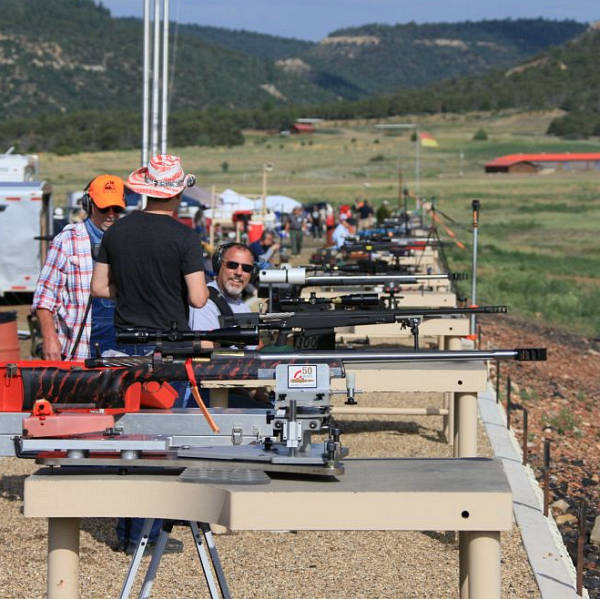


 This trip to Ottawa for the Canadian National Championship was a specially important one. The U.S. Team tryout process and practice was to take place for two days prior to the National Championship as the next F-Class World Championship is going to be held in Ottawa in August of 2017.


 The ability to read the wind is what separates good shooters from great shooters. If you want to learn wind-doping from one of the best, watch this video with 2010 National High Power Champion (and U.S. Army 2010 Soldier of the Year) Sherri Gallagher. Part of the USAMU’s Pro Tips Video Series, this video covers the basics of wind reading including: Determining wind direction and speed, Bracketing Wind, Reading Mirage, and Adjusting to cross-winds using both sight/scope adjustments and hold-off methods. Correctly determining wind angle is vital, Sheri explains, because a wind at a 90-degree angle has much more of an effect on bullet lateral movement than a headwind or tailwind. Wind speed, of course, is just as important as wind angle. To calculate wind speed, Sherri recommends “Wind Bracketing”: [This] is where you take the estimate of the highest possible condition and the lowest possible condition and [then] take the average of the two.”


 Emil Kovan Competition History:


