It’s almost time for the Berger SW Nationals. Phil Kelley says he’s ready for this view…
February in Phoenix… For many of us February is all about the Berger Southwest Nationals, which kicks off Tuesday, February 10th with a Shooting Clinic and runs through Sunday, February 15th. This prestigious match, hosted at the Ben Avery Shooting Facility, draws top F-Class and sling shooters from around the country. One of those F-Class shooters, Phil Kelley, posted the above photo, saying he’s ready to make the trek from his North Carolina home to Arizona. Good luck to Phil and all the competitors. A record number of shooters should be on the firing line this year.
Tuesday, 10 February 2015, 9:00 AM
Shooting Clinic: Instruction in both classroom and live-fire settings. Lunch provided.
Wednesday, 11 February 2015, 9:00 AM
Mid-Range Match: Three 20-shot matches at 600 yards.
Thursday, 12 February 2015, 9:00 AM
4-Man Palma Team Match: 15 shots for record at 800, 900 and 1000 yards.
Note – Practice available for those not shooting with a team.
Friday, 13 February 2015, 9:00 AM – Start of Long-Range Grand Agg
Individual Palma Match: 15 shots for record at 800, 900, and 1000 yards. Swap Meet at 1000-yard line after conclusion of match.
Saturday, 14 February 2015, 8:30 AM
Individual 1000-Yard Matches: Two 20-shot matches at 1000 yards. Banquet Dinner at Indoor Range, at approximately 5:00 pm.
Sunday, 15 February 2015, 9:00 AM
Individual 1000 Yard Matches: Two 20-shot matches at 1000 yards. Awards Ceremony at the Indoor Range.
Low-BC bullets launched from a .22 LR gun are easily blown around by the wind. That’s why it’s a smallbore shooter’s dream to shoot indoors, where fickle wind currents are less likely to spoil your shots. Not many folks have the opportunity to shoot indoors at all, must less compete in an indoor match. However, a crew from Ashbury Precision Ordnance recently got the chance to try out their rimfire rifles in a indoor setting, a converted poultry barn to be precise. And today they’ll be competing in a smallbore “Barn Benchrest” match at that same barn. Looks like fun!
Could this be the beginning of a new “Barn Benchrest” league? The folks at Ashbury tell us: “Rube, Gary, and Matt headed over the mountains to Luray, Virginia, to get in some practice for [Saturday’s] .22 Cal Benchrest Rifle Match. It’s colder than a well diggers’ butt outdoors, but shooting a match indoors, in a converted poultry barn, is nice. As always, we’re shooting great RUAG/RWS ammo!”
Poultry Barn aka Piney Hill Benchrest Facility
The official name of this converted barn is the Piney Hill Benchrest facility. Virginia State 3-Gun Rimfire BR Championships will be held there February 20-21, 2015, while the IR50/50 Indoor Sporter Nationals are scheduled for Piney Hill in March. If you’re curious, the benches are made from cement blocks with wood tops, so they’re very solid. Here’s a panorama photo of the Piney Hill Barn.
Springfield Armory has taken the M1A into the 21st Century with an adjustable modular stock that makes this classic semi-auto rifle more versatile than ever. The adjustable stock on this Loaded M1A (MP9826, MSRP $2,021) offers many cool features. You can raise/lower the cheek-piece with a handy rotary knob. Likewise the buttplate can be moved in and out with a quick-adjusting knob, allowing length-of-pull adjustment up to 1.3 inches. The toe of the stock features a bag-rider section, making the gun more stable on a sandbag. Up front you’ll find an accessory rail plus a forward-angled swivel stud allowing easy bipod mounting. The included iron sights feature half-minute adjustments for windage and 1-MOA adjustments for elevation. The 22″ stainless steel barrel has a 1:11″ twist. Rifle weight with an empty magazine is 11.25 lbs.
At the 2015 SHOT Show, Rob Leatham runs through Springfield Armory’s new Loaded M1A Series rifle with an adjustable stock (MP9826, MSRP $2,021).
Click Image to See Full-Size Photo
MIA Match at Camp Perry is Popular
In 1974, Springfield Armory began offering a civilian-legal, semi-automatic version of the M14 known as the M1A™. M1As have enjoyed some success in Service Rifle and High Power Competition but today most Service Rifle shooters use the lighter-recoiling AR-platform black rifles. Nonetheless the M1A remains popular with American shooters and the annual M1A Match at Camp Perry offers serious, big-time prize money, thanks to Springfield Armory. In 2014 over $25,000 worth of cash and gear was awarded to Camp Perry M1A competitors, making the M1A Match the richest single rifle event at the NRA National Championships.
Nick Till in 2009 M1A Match. Nick was the 2007 Service Rifle Nat’l Champion. Photo courtesy NRA Blog.
Shooting reactive targets is fun, especially when you get to use ultra-accurate benchrest rifles. To see how the “Varmint Silhouette” game is played, tune in to Shooting USA tonight on the Outdoor Channel. Tonight’s episode features a long-range varmint benchrest silhouette match at the Ridgway Rifle Club in Pennsylvania. This is silhouette like you’ve never seen it, with targets placed from 850 to 1,000 yards, and shooters using precision rifles, high-end optics, and advanced rests. This new sport combines the knock-down fun of silhouette with the high-tech precision of benchrest shooting. At Ridgway’s first Bench Rest Silhouette match 28 shooters participated. Five years later, nearly 120 shooters attend regular monthly matches. CLICK HERE for Match Info.
Varmint Benchrest Silhouette Basics
In 2010, the Ridgway Rifle Club combined Metallic Silhouette and 1000-yard Bench Rest into one exciting new discipline. Steel targets are arrayed in banks of five at four distances. The targets are set up as follows: Crows at 850 yards, Ground Hogs at 900 yards, Bobcats at 950 yards, and Coyotes at 1000 yards. Just dinging a target is not enough — to count as a “hit”, the target must fall down.
Ridgeway allows two classes of guns, Heavy Class with a maximum weight of 17 pounds, and Standard Class with a maximum weight of 12 pounts. Both classes must otherwise conform to the Light Gun rules for the Original 1000-Yard Bench Rest Club in Williamsport, PA.
Varmint Silhouette West of the Mississipi
Clubs in other states also host Varmint Silhouette matches (or some variant thereof). One of the longest-running and most popular Varmint Silhouette matches is held the first weekend of every month at the Pala Range, in San Diego County, California. At Pala, competitors shoot at “critter” targets placed at five yardages: 200 Meters – Field Mice (“pikas”); 300 meters – Crows; 385 meters – Ground Squirrels; 500 meters – Jack Rabbits; 600 yards – Prairie Dogs
Fun Weekend for the Whole Family At Pala, there’s a deluxe Indian Casino/Spa nearby. So don’t hesitate to bring the wife. If she’s not a shooter, she can enjoy a fancy brunch or spa treatment while you’re having fun mowing down metal critters. Pala is a 30 minutes from the Pacific Ocean and beautiful beaches, so you can make this a weekend holiday for the whole family — kids love sand and surf.
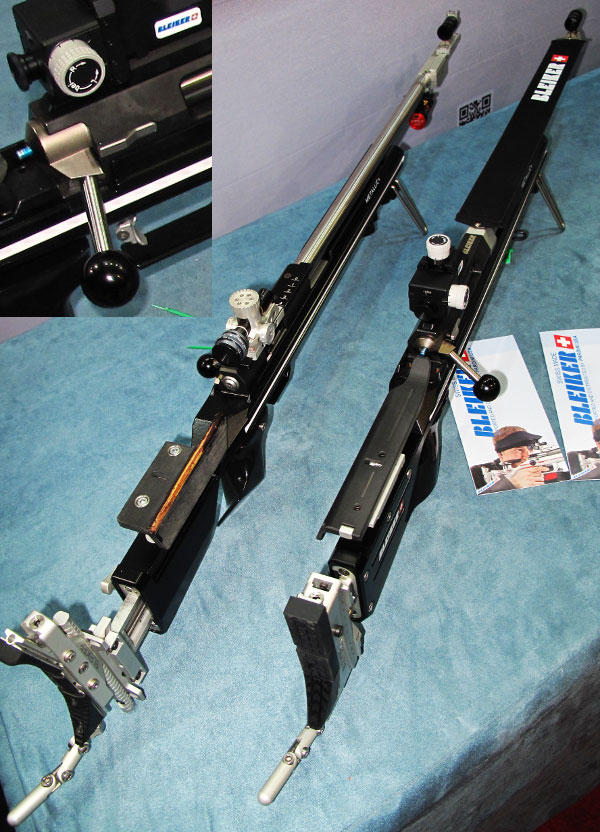
You don’t want to inquire about the price of a Bleiker competition rifle. As the expression goes, “If you have to ask, you can’t afford it”. At the Pardini USA booth at SHOT Show we saw a pair of black beauties — two “full-race” Bleikers, one a smallbore match rifle (.22 LR) and the other a 300m position rifle chambered in 6mmBR Norma. The combined price for the two rifles was a jaw-dropping $20,100.00. Yep, over $20K for the two. The 6mmBR rig was $10,200 while the smallbore rifle was $9,900.00.
Bleikers command such high prices because they win. At recent ISSF 300m and Smallbore Championships, Bleikers have been used by many of the medal winners. A gun is worth $10K if it can really put you on the podium or, better yet, deliver a world championship.
You are looking at $20,100 of Competition Rifles here. (Click Image for full-screen version.)
Take a look at this slick feature on the 300m gun. The adjustable cheek-pad automatically tilts up (for clearance) when you retract the bolt. That’s clever Swiss Engineering.
Our friend Dennis Santiago found two interesting rifles at SHOT Show. At first glance, these look just like the legendary M1 Garand and the M1A (civilian version of the M14). The size is right and the stocks look authentic. But take a closer look and you see these are NOT chambered for .30-06 (Garand) or 7.62×51 (M1A) cartridges. Rather, these Baby Battle Rifles are rimfire clones, chambered for the .22 LR. We like the concept — this gives Garand Match and M1A Match competitors the ability to cross-train with low-cost rimfire ammo. Plus, who wouldn’t want a rimfire Garand for a little low-recoil plinking fun? We bet these will produce smiles when folks at the range see them for the first time. And a .22 LR Garand is definitely going to be softer on the ears (and your shoulder)!
Dennis tells us: “These were kind of neat. The form factors and ergonomics are accurate. The weight is a pound or two lighter than the real deal. Trigger is Ruger’ish. It might be fun to show up with one of these at a CMP .22 Sporter match.”
The two Baby Battle Rifles are sold by Kingston Armory. You can visit KingstonArmory.com, but there’s really nothing to see yet — Kingston’s website is still “under construction. If you have questions you can call Kingston at 845-292-3222.
ELEY .22 LR ammunition has certainly been the choice of champions in high-level international smallbore competition. But ELEY is not resting on its laurels. ELEY’s engineers have worked hard to develop two new types of rimfire ammo — one fast (“force” high-velocity), one slow (“contact” subsonic). ELEY force and ELEY contact, the latest additions to ELEY’s product line, will be officially launched at SHOT Show in Las Vegas next week.
Black Casings — Not Just for Looks
Designed for power, ELEY force is a new, high-velocity .22LR round that delivers both superior energy AND accuracy. ELEY force features a new propellant with a distributed pressure curve. This provides more energy during the in-barrel “burn time”, accelerating the bullet to a high velocity. Force is optimized for semi-auto rimfire rifles.
The cartridge brass for ELEY force is matte black, the result of a patented oxidisation process, first used with Eley edge (introduced in 2013). ELEY force is now the second type of ammo with black cases, which are dark for a good reason. According to ELEY’s engineers: “The black oxidized case finish increases friction between the case and projectile. This regulates and controls the force required to release the bullet, stabilizing the projectile and increasing ballistic consistency and accuracy.”
ELEY Contact — The Subsonic Solution
ELEY contact is a subsonic semi-automatic .22LR round designed for extreme accuracy, reduced noise, and minimal recoil. The reduced recoil allows the shooter to recover his sight picture more quickly. This is especially important for rapid-fire shooting with semi-automatic rimfire rifles.
Both ELEY force and ELEY contact are engineered with a heavier 42 grain bullet for high energy and are coated in a specially-formulated paraffin wax to minimize build-up in actions and magazines.
ELEY’s History — A Success Story Spanning Two Centuries
A company with a rich heritage, ELEY has been making ammunition for 187 years. The company was first established in 1828 in London and was later moved to Birmingham, beginning a long and proud tradition. (Learn about ELEY’s history.) Over the years, ELEY has pioneered many technical innovations. ELEY now specializes in .22 LR caliber cartridges, and ELEY’s match ammo has a remarkable track record in competition. At the 2012 Olympics, 14 out of 18 smallbore shooting medals were won by shooters using ELEY ammunition.
ELEY Test Facilities in USA, UK, and Germany
ELEY tells us the “every current ISSF Smallbore World Champion uses ELEY Tenex ammo”. That success can be attributed (at least in part) to ELEY’s technical testing facilities in the UK, Germany, and the USA. At these test centers, competitive shooters can test ammo lots in their particular match rifle to ensure the best match of barrel and ammunition. To learn more about the ammunition testing facilities and ELEY products, visit www.Eley.co.uk.
It may be cold and wintry in Camp Perry, Ohio. But it’s warm inside — inside the Gary Anderson CMP Competition Center that is. And dozens of competitors will be there for the next three days (Jan. 16-18) at the Ninth Annual Camp Perry Open Air Gun Tournament.
The Camp Perry Open is one of the biggest mid-winter air gun events in the nation. This year’s match will include a three-position air rifle competition, a 60-shot standing air rifle event, a 60-shot Air Pistol event as well as a Clinic. The 3X20 plus final three-position air rifle competition will take place on Friday, 16 January 2015. A clinic for interested junior shooters will be held on Saturday afternoon. The 60-shot international events will be fired on Saturday and Sunday (January 17th and 18th).
Electronic Targets with Results Streamed Online
The Gary Anderson Center boasts state-of-the-art electronic targets that record scores the instant each shot is fired. Shot-by-shot feeds are then displayed online through as Live Target Images that can be viewed anywhere there is an Internet connection. CLICK HERE to See Live Target Feeds
How Electronic Targets Work
Each electronic target is equipped with four microphones — one in each corner of the target. As the pellet strikes the target, it generates a sound wave that propagates to the microphones. The sound waves are used to determine the shot location by calculating the amount of time it takes for the sound to reach the microphones. That’s physics so the results are precise — machine-calculated shot locations are accurate to one hundredth of a millimeter.
Mark your calendars for the “Mother of all Airgun Matches”. The 33rd Annual Canadian Airgun Grand Prix, the largest airgun competition in North America, will be held in Toronto on February 6 – 8, 2015. Competitors from several countries will be in attendance. All events will take place in the International Plaza Hotel conveniently located only 5 kms from the Toronto Pearson airport.
70-Position Shooting Range with Electronic Targets for Finals
The main shooting range for the Canadian Airgun Grand Prix features 70 positions for air rifle and air pistol, including positions designated for access by adaptive athletes, with electric target carriers on all positions. This will provide state-of-the-art hardware for the competitors.
See How Electronic Targets Work:
The Grand Prix Finals will be shot on SIUS electronic targets and will follow the new ISSF format. The top 8 in each of the Men’s and the Women’s events, including International Juniors and Sub-juniors will compete in Finals to determine the “Open” winners. For more info and updates, visit the Canadian Airgun Grand Prix Facebook Page. Competitors can register at: http://nfap.ca/cagp/cagp.nsf.
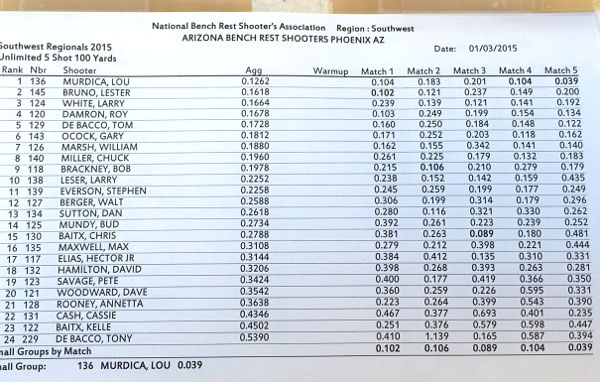
Sometimes superlatives really aren’t necessary. Just look at that target. Yes that is FIVE shots (although it truly appears like one hole). And it is centered! This remarkable group, measured at 0.039″, was shot by Lou Murdica in Phoenix on January 3, 2015. Lou drilled this group with his 6 PPC railgun. Rounds were loaded with Accurate LT-32 powder and Berger 65gr BT bullets. The target will be submitted to the NBRSA as a potential new 100-yard Benchrest record in the Unlimited (Railgun) Class. The current NBRSA record small group (Unlimited) is a 0.049 shot by Hall-of-Famer Gary Ocock in 2009.
This is a file photo with a different railgun.
This wasn’t the only tiny group shot by Lou over the weekend. Murdica shot a sizzling 0.1262 five-target 100-yard Unlimited Aggregate. That 0.1262 Agg will also be submitted for consideration as a possible record. Here are the individual group sizes: 0.104, 0.183, 0.201, 0.104, 0.039. At this match Lou won both the Unlimited and Sporter class. “It was a great weekend” Lou reported.
About the Gun
What kind of rifle can put five shots in one hole? Lou was shooting an Unlimited-class railgun. This return-to-battery rig (a Kensler railgun) allows the shooter to focus on firing at the perfect time for the conditions. Lou’s Kensler railgun (see below) features a Kelbly top-loader Grizzly action, Shilen 6-groove barrel, and March 10-60X scope. The Shilen is chambered for the 6 PPC cartridge. But there’s something special about this particular 6 PPC — read on….
Click photo for larger version:
Radical New Reamer Design from PT&G
Lou used a new chamber reamer from Pacific Tool & Gauge (PT&G) with special geometry in the leade/throat section. Called a “Bore Rider” (or sometimes “bore-runner”), this new reamer design cuts a staged, variable taper in the leade/throat area that is quite different than the taper in a typical throat. It’s a little hard to explain, so we’ve included the 6 PPC Bore Rider reamer print below. (Download the PDF file for a better view.) Experts should look at the leade angle(s), freebore, and throat dimensions. You may be surprised. Dave Kiff of PT&G says this Bore Rider design has worked successfully for other cartridge types/calibers as well. Apparently this design helps the bullet center up smoothly in the bore before the bullet engages “hard” in the rifling — or so we’ve been told.




 At Pala, there’s a deluxe Indian Casino/Spa nearby. So don’t hesitate to bring the wife. If she’s not a shooter, she can enjoy a fancy brunch or spa treatment while you’re having fun mowing down metal critters. Pala is a 30 minutes from the Pacific Ocean and beautiful beaches, so you can make this a weekend holiday for the whole family — kids love sand and surf.