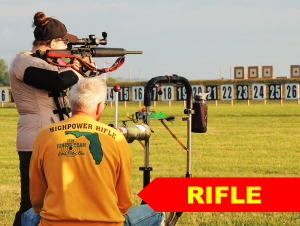
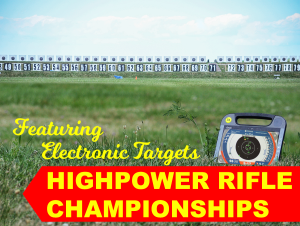
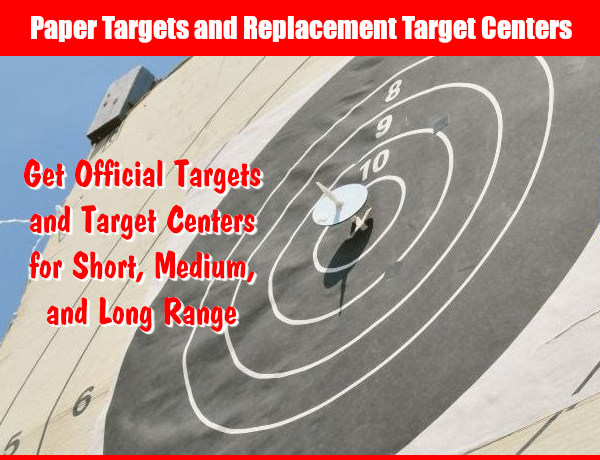
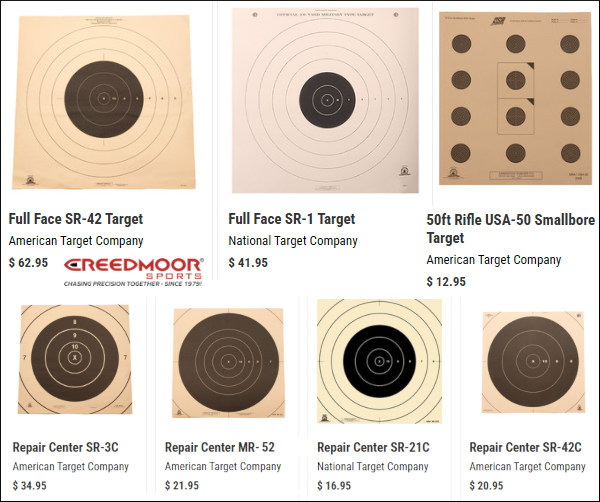
Are you a High Power or Smallbore marksman looking for bullseye paper targets? Here are bulk sets of 25, 50 and 100 targets from Creedmoor Sports. All these can can be used for general practice, fun matches, or official sanctioned events. Choose the 200-yard SR-1 target with seven scoring rings (X,10,9,8,7,6,5), priced at $41.95 for 100. For smallbore, you can get the USA-50 Smallbore Target $12.95 for 100. Creedmoor also offers a variety of Repair Centers, including the 300-Yard SR-3C Target Repair Center ($34.95), or the SR-21C Target Repair Center ($16.95). These target centers can be used on top of full targets, or by themselves for practice on smaller target frames.
Creedmoor Sports also offers match-grade shot spotter discs. These are used to mark shot locations. They are offered in three diameters: 1.5″, 3.0″, and 5.0″. In addition, you can purchase the spindles used with spotter discs along with range Golf Tees also employed to mark shots. These are placed in the shot holes by pit workers.
Frankly for practice, we recommend a target cam, or ShotMarker system.
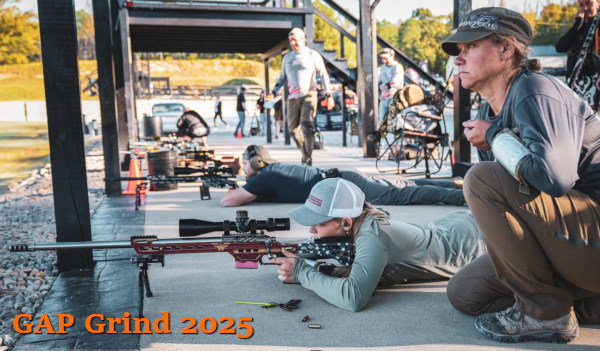
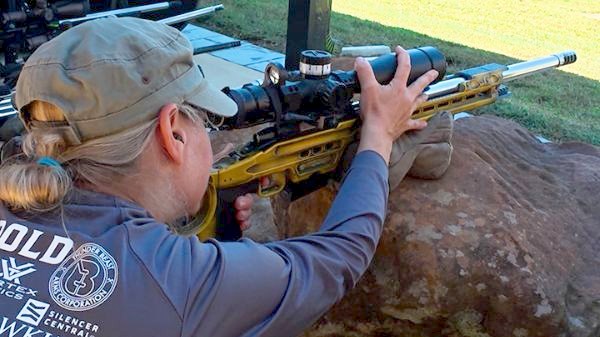
This week, Shooting USA TV spotlights the 2025 GAP Grind, America’s largest PRS Pro-Am Tactical match. The 14th Annual Bushnell Tactical GAP Grind Pro/Am shooting match was held from October 3 to October 5, 2025. The event took place at the K&M Precision Rifle Training Complex in Finger, Tennessee. The GAP Grind, the largest PRS match in the world, drew nearly 400 amateur and pro shooters. Recognized as the premier PRO-AM precision rifle match with both individual and team competition, the GAP Grind has introduced many new shooters to the sport. The next GAP Grind match will be held October 3–4, 2026 at the K&M Complex in Tennessee.
SHOW TIMES: This Shooting USA Episode airs Wednesday, July 8, 2026 at 9:00 PM Eastern and Pacific; 8:00 PM Central. If you miss the regular broadcast, you can stream on Vimeo for $0.99 per episode. You can also see hundreds of shooting videos for free on Shooting USA’s YouTube channel.
In this video Eagle Eye Shooting Shares Highlights from the 2022 GAP Grind
Big Prize Table at 10th Annual GAP Grind Event
The year’s largest PRS match drew hundreds of attendees, and more than 80,000 rounds were fired throughout the three-day event. Bushnell provided thousands of dollars worth of prizes to the top competitors. Trophies were awarded to the top 5 teams, top 5 professionals, and to the top 5 amateurs.
Lots of Action, with 20+ Stages
The GAP Grind is a challenging, “high tempo” match with minimal down-time between stages. Over the course of 20+ stages, competitors will fire 200+ shots at a variety of steel, paper, moving, and reactive targets out to 1,200 yards. Targets vary in size/difficulty based on the shooter’s position, distance, and time allotted. Most stages include “stressors” — i.e. time limits or required movement(s).
GAP Grind Pro-Am Format — Seasoned Shooters Help Newcomers
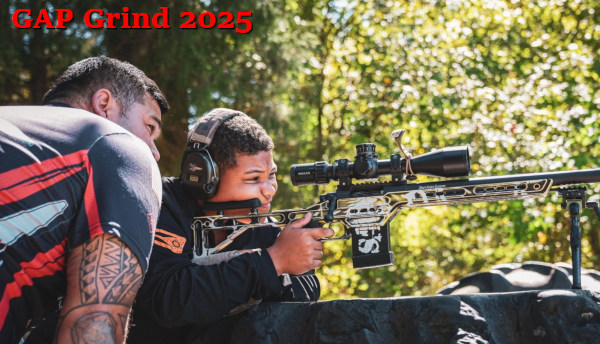
The GAP Grind typically attracts nearly 400 competitors — half experienced shooters and the other half newcomers to the sport. The key to growing the shooting sports is attracting new shooters. The best way to bring in “new blood” seems to be the Pro-Am type format. At the GAP Grind, experienced shooters share their knowledge and guide the new shooters through the competition.
GAP Grind Hardware
You’ll find the latest and greatest PRS/NRL hardware at the GAP Grind. Over the past few seasons, most top competitors have “stepped down” from the 6.5/6mm Creedmoor to the smaller, more efficient 6mm Dasher, 6BRA, 6 GT and other 6mm cartridges. These 6mm cartridges offer excellent accuracy with less recoil than the 6.5 Creedmoor.
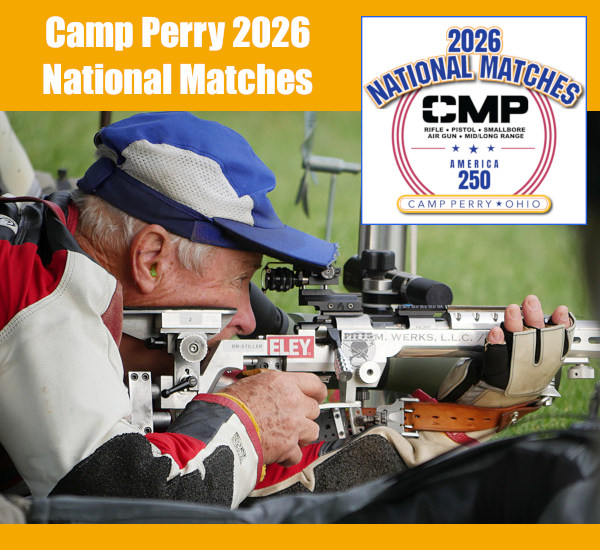
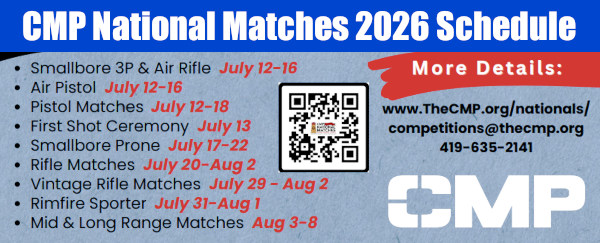
The CMP 2026 National Matches at Camp Perry, Ohio start in six days. The 2026 CMP National Matches will take place at Camp Perry from July 12 through August 8, 2026, with the First Shot Ceremony on Monday, July 13, 2026.
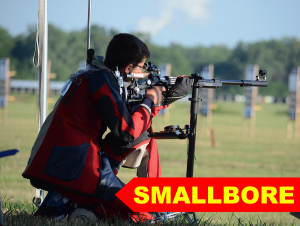
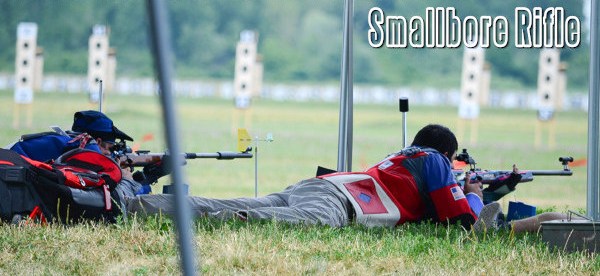
The rifle segments of the CMP National Matches commence next week at Camp Perry. First there will be smallbore competition July 12-22, with centerfire rifle matches commencing on July 20, and running through August 8, concluding with the Mid-Range and Long Range Matches.
To help those who will be competing this year, we offer Ten Lessons from Gary Anderson, DCM Emeritus.
TEN WAYS to Win — Competition Advice from Gary Anderson
In the archives of On The Mark magazine, Gary Anderson, an Olympic Gold medal-winning shooter, offers sage advice for competitive shooters.
In his article Ten Lessons I Wished I Had Learned as a Young Shooter, Anderson provides ten important guidelines for everyone involved in competitive shooting. Here are the Ten Lessons, but you should read the full article. Anderson provides detailed explanations of each topic with examples from his shooting career.
LESSON 1 – NATURAL ABILITY WILL NOT MAKE YOU A SHOOTING CHAMPION.
(You also need hard work, training effort and perseverance.)
LESSON 2 – ANGER IS THE ENEMY OF GOOD SHOOTING.
(The key to recovering from a bad shot is to stay cool, no matter what happens.)
LESSON 3 – BAD SHOTS CAN TEACH YOU MORE THAN GOOD SHOTS.
(Today, error analysis is one of the most powerful tools for improving scores.)
LESSON 4 – NEVER GO WITHOUT A SHOT PLAN.
(A shot plan is a detailed breakdown of each of the steps involved in firing a shot.)
LESSON 5 – PRACTICE IN BAD CONDITIONS AS WELL AS GOOD CONDITIONS.
(Most competitions are fired in windy conditions or where there are plenty of distractions.)
LESSON 6 – CHAMPIONS ARE POSITIVE, OPTIMISTIC PEOPLE.
(Negative shooters expect bad results; positive shooters expect to train hard to change bad results.)
LESSON 7 – IT’S NOT ABOUT WHETHER YOU WIN OR LOSE.
(It’s about how hard you try to win.)
LESSON 8 – YOUR DOG WON’T BITE YOU AFTER SHOOTING A BAD SCORE.
(Hopefully your coach, parents and friends won’t bite you either.)
LESSON 9 – YOUR PRESS CLIPPINGS CAN HURT YOU OR HELP YOU.
(Winning can go to our heads. We start thinking we are so good we don’t have to work hard any more.)
LESSON 10 — YOU NEVER SHOT YOUR BEST SCORE.
(Great champions are always looking for ways to improve.)
About Gary Anderson Gary Anderson served as the Director of the Civilian Marksmanship Program (CMP) from 1999-2009, and is now DCM Emeritus. In 1959, he joined the elite U.S. Army Marksmanship Unit. Just two years later, he won his first national championship. Over his competitive career, Anderson won two Olympic Gold Medals, seven World Championships, and sixteen National Championships. He is unquestionably one of the greatest American marksmen ever.
At the 1962 World Shooting Championships in Egypt, Anderson won four individual titles and set three new world records. At the 1964 Tokyo Olympics, Gary won the 300m free-rifle Gold Medal, setting a new world record. At the 1966 World Shooting Championships in Germany, Anderson won three additional world titles. At the 1968 Olympics, Gary won a second gold medal in the 300m free-rifle event. After his “retirement” from international competition, Gary competed in the National High Power Championships, winning the President’s National Trophy in 1973, 1975 and 1976.
G. David Tubb, America’s greatest competitive marksman, sadly passed away on July 2, 2026 from serious heart and blood oxygen complications following a lower leg amputation surgery. America’s shooting world has lost one of its true superstars, a man whose records at the range will likely never be surpassed.
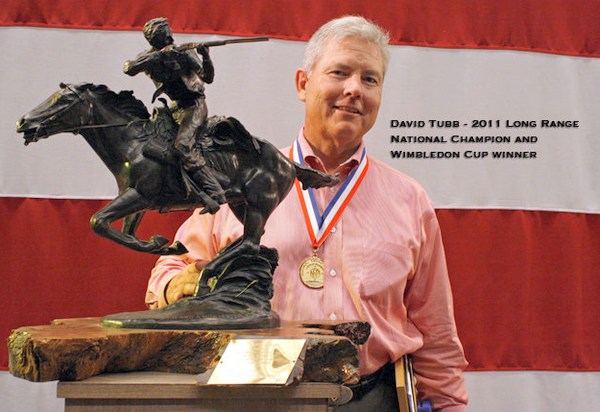
If you have ever competed in NRA High Power, Silhouette, or Long Range disciplines, you know the name David Tubb. Arguably the greatest rifle marksman in American history, David has recorded 11 High Power Rifle Championships, 6 Long Range National Championships, and 7 High Power Silhouette National Championships. Over his career David has won 130 NRA trophies for various competitions. No one has even come close to that number of Championships and honors in rifle competition.
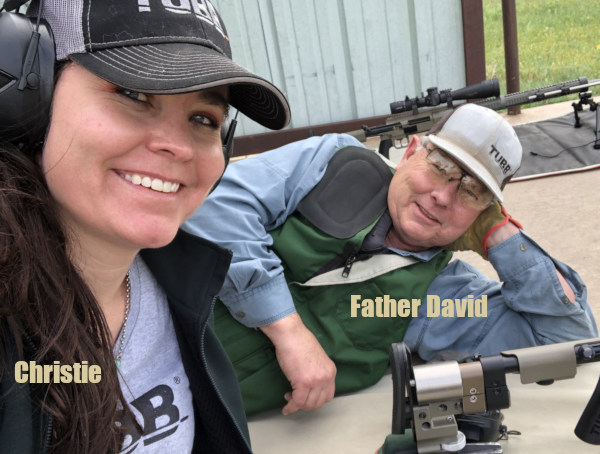
After David passed we communicated with his daughter, Christie Tubb Stallter. She was deeply saddened but wanted to help us understand David’s skills and achievements both as a marksman and a father.
G. David Tubb — Great Marksman and Great Father
by Christie Tubb Stallter
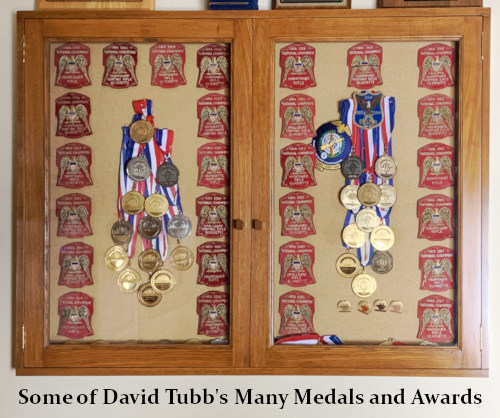
Editor: Over his many decades of shooting, David Tubb amassed more major medals, trophies, and awards than any other American marksman in history. Here his daughter lists some of the most important awards. Then Christie explains the qualities David had that made him a great marksman and a great father.
Summary of David Tubb’s Awards
Dad had so many individual match awards that we did not keep records of them all. There are trophies and plaques in stacks up high in storage in a few places at my parents’ house and business office. He had over 130 NRA national trophies over his shooting career.
Dad was most proud of the perfect score he shot to win the 2004 NRA Long-Range Highpower Rifle National Championship in Camp Perry, Ohio. He did not drop a single point over the course of the match, making this his proudest accomplishment.
David Tubb Major Marksmanship Awards
11-time National Highpower Rifle Champion
6 National Highpower Long Range Championships
Several Highpower National Records
7 National Highpower Rifle Silhouette Championships
8 National Highpower Hunting Rifle Silhouette Championships
2-time Wimbleton Cup winner
National Smallbore Rifle Silhouette Champion
4 National Smallbore Hunting Rifle Silhouette Championships
7 Sportsmen Team Challenge Championships
Rifle Masters tournament champion
1998 NSSF Shooter of the year
Int’l Confed. of Fullbore Rifle Assoc. (ICFRA) Palma Individual World Champion
ELR 3-shot cold bore World Record Holder recognized by 50 Cal. Shooters Association
2019 NRA ELR Heavy Gun National Champion
Over 130 NRA Championship Event Trophies (Individual Match Winner)
Memories of Time Spent Together At the Range
Some of my fondest memories with my dad were spent traveling to rifle matches and competing together. We took many road trips to places such as Arcadia OK, Raton NM, and Camp Perry Ohio to compete. I fell off my shooting stool in Arcadia while spotting and he thought that was quite funny. I can remember shooting at Camp Perry and qualifying for a shoot off in one of the 1000-yard matches with iron sights. Dad had not shot well on the same relay and literally came running when he found out I had shot a 200 with 10Xs about 40 targets away from him on the firing line. He was my score keeper for the shoot off which was one of my fondest memories. He was so proud of me.
Dad was constantly testing shooting components. I can remember opening the refrigerator in the garage at home and seeing a rifle sitting in there along with ammo in the refrigerator and freezer. He was testing to see how the rifle and ammo were going to react in colder temps. He was constantly trying to improve shooting products and loved the challenge. Sometimes it drove me crazy because he wouldn’t settle on a load until the very last minute before a match. I guess that is what made him David Tubb. He never accepted “good” and always strived for “excellence”.
Lessons My Father Taught Me about Family, Life, and Achieving Goals
My dad taught us to listen to each other even if we did not agree with one another. My husband always found it fascinating that we could argue at the dinner table with one another and be totally fine with each-other five minutes later. My dad taught me how to have a very strong work ethic which is now something I realize many young adults and teenagers are missing these days. I grew up constantly working outdoors on our ranch doing activities such as farming, building corrals, cleaning out stock tanks, working cattle, building fences. He would always say, don’t do a half-way job or you’re going to have to redo it and boy did I have to redo some projects over the years.
By the time I was 18, I realized I had stronger work ethic that most kids my age. He taught me to work harder, think smarter, and never quit. Why accept a 10 when you can shoot an X on the firing line. This mentality carried into adulthood and is one of the reasons why I have a doctorate. I couldn’t just settle. I had to get to the top in my field.
He taught me to never quit. There is always a way to reach your goals and overcoming the mental aspect is usually more than half of the battle. He will be greatly missed but his lessons instilled in me are being passed on to my children. Dad was not only a world-class shooter, but he was a very generous person. He always answered phone calls and was willing to help, discuss, and problem solve whatever the issue was. This was a very rare attribute for such a successful person. He was always willing to share his knowledge and experience to grow the shooting sports.
David Tubb Biography Video
Click the video above to view an excellent documentary which covers David Tubb’s career in competitive shooting. Called America’s Rifleman, this fine documentary by filmmaker Sheldon Charron takes you inside the life and mind of legendary shooting champion David Tubb.
Learn how David evolved into the most successful rifleman in the history of competitive shooting, the challenges he faced, and how he overcame them on his road to success, both at the range and in his business, Superior Shooting Systems.
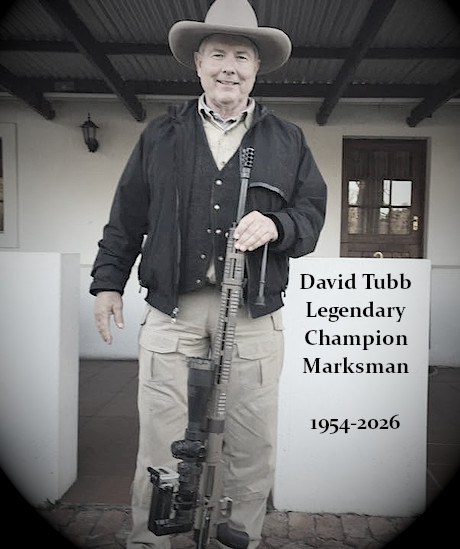
David Tubb with the ELR Adaptive Target Rifle (ATR) he designed which has set ELR records. You can see David shoot this rig in the video below:
David Tubb Shoots ELR Adaptive Target Rifle at KO2M
For the Extreme Long Range discipline, David Tubb developed a .375-caliber, long-barreled ELR version of his famous Tubb rifle, called the Adaptive Target Rifle (ATR). A version of this rifle, piloted by David’s son-in-law Nate Stallter, set the current ELR World Record in January 2018.
The TUBB 2000 — Innovative Modular Bolt Gun
David Tubb is arguably the greatest High-Power Across-the-Course rifle competitor in American history. He won many of his championships shooting a modular rifle of his own design — the Tubb 2000, aka T2K. In this video, David shows the features of the Tubb 2000 rifle which makes it adaptable to multiple shooting positions — prone, sitting/kneeling, and standing.
David Tubb Talks about KO2M and Extreme Long Range Shooting
David Tubb’s long-range rifles have performed well in Extreme Long Range shooting. AT the 2019 NRA Extreme Long Range Championship, David Tubb won the Heavy Gun Division. In this video, created during the King of 2 Miles (K02M) competition at the Whittington Center in New Mexico, David talks about the challenges of ELR shooting, and cartridge selection. Big, heavy, large-caliber bullets with ultra-high BCs are favored for the ELR game, but recoil and cost must also be considered.
“America’s Rifleman” Movie Credits:
Production Company: Enter360 Media
Producer/Director/Editor: Sheldon Charron
Production Assistant: Christie Tubb
This site is for and about accurate shooters. So today we feature the short-range group Benchrest game, where it’s all about shooting tiny groups in the ones and even “zeros”. Seeing the tiny groups 6 PPC aces produce, it’s easy to think the precision is all about the equipment. But there is a lot more involved. A talented human still has to watch the flags, run the gun properly, and tune his loads for the conditions. Here are some tips from one of the world’s best benchresters, Charles Huckeba.
Texan Charles Huckeba was the top individual shooter at the 2013 World Benchrest Championships (WBC) held near Sydney Australia in October 2013. In this video, 2013 WBC Two-Gun Overall winner Charles shoots a 1/8th MOA group at 200 yards — “a little bitty dot” as a fellow Team USA shooter observes. That’s impressive. If you can describe Huckeba’s style in a nutshell it would be “smooth, consistent, and rapid but not hurried”.
Charles also employed some unusual hardware. In the video, take a close look at the joystick on the Farley Coaxial front rest. There’s no knob at the end. In its place is a small, wood ammo caddy. Charles removed the standard knob from the handle of his Farley rest and replaced it with a home-made wood block that holds cartridges for the record target. The 10.5-lb Light Varmint rifle is chambered in 6PPC with a BAT Machine Action and a composite wood and carbon-fiber stock.
Watch Charles Huckeba Shoot 1/8 MOA, 200-yard group at World Benchrest Championships
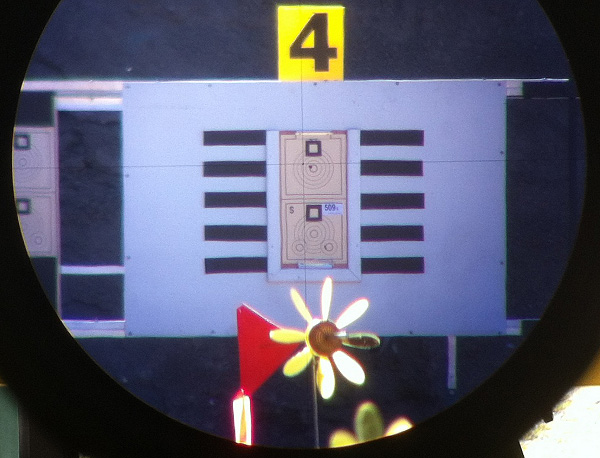
Here is the actual 200-yard, 5-shot group Charles shot in the video. Photo (by Stuart Elliot) taken through the lens of Huckeba’s 50X March scope (reticle has 1/16th MOA Dot).
Analyzing the Fine Points — What Makes Huckeba So Good
Short-range benchrest shooter Boyd Allen saw some interesting things in Huckeba’s WBC performance, as captured on video. Boyd noticed Huckeba’s smooth gun-handling and efficient loading. But Boyd also spied some interesting equipment, including an innovative joystick “handle-caddy”.
1. Low Friction Bags — When Huckeba slid his rifle, there was very little apparent friction. The front bag features the new 3M material (ScotchLite) on the sliding surfaces. The rear Protektor bag has ears of the same low-friction material.
2. Pause Before Chambering — While he was watching the flags and deciding when to start firing, Charles kept his first round in the action, but out of the barrel’s chamber, probably so as not to heat the cartridge and change the round’s point of impact.
3. Ammo Caddy on Joystick Arm – Charles shoots a Right Bolt/Left Port action, so he pulls his rounds with his left hand. Note that Huckeba’s record rounds rest in a small, wood ammo caddy attached to the end of the joystick shaft. Look carefully, you’ll see the wood ammo block in place of the normal black ball at the end of the joystick. That allows Charles to pull shots with the absolute minimum of hand movement. Ingenious! Huckeba is very fast, with a great economy of motion. I believe that because his ammo was literally at hand, Charles was better able to keep his focus on aiming and the flags.
4. Smooth-Cycling BAT Action — Note how smoothly Huckeba’s action operates. When Charles lifts the bolt handle (to extract a round and cock the firing pin), this does not disturb the rifle. Likewise, as he closes the bolt, the gun doesn’t wobble. The smooth action allows Charles to hold point of aim even when shooting relatively quickly. Huckeba’s BAT action is chrome-moly steel. Some shooters believe this metal makes for a smoother action than stainless steel or aluminum.
5. Long-Wheelbase Stock — The wood and carbon fiber stock is light, long, and stiff. Yet, importantly, the stock is also well-damped. The longer-than-average stock length (with extended forearm) seems to help the gun track well without jumping or rocking. The longer forearm allows a longer “wheelbase”, effectively shifting the weight distribution rearward (less weight on the front, more weight on the rear). This places a greater share of the gun’s weight on the rear bag, as compared to a more conventional benchrest stock. Huckeba’s stock, built by Bob Scoville, is at the cutting edge of short-range benchrest design. Its light-weight balsa wood and carbon fiber construction provides a combination of stiffness and vibration damping that allows its relatively long fore-end to be fully utilized to increase the weight on the rear bag (always an issue with 10.5-pound rifles).
To learn more about this benchrest stock design, read the comments by stock-builder Bob Scoville in our PPC with Pedigree story in our Gun of the Week Archives. Bob observed:
“There is a lot more to the structure of the stocks than meets the eye. The carbon fiber skin with which I cover the stocks creates a light, tough exterior surface. However, this contributes very little to the overall performance of the stocks. The real strength and stiffness is the result of an internal beam utilizing balsa core/carbon fiber technology.
This type construction can be found in aircraft, race cars, powerboats, and sailboats. It is interesting to note, balsa has the highest strength to weight ratio of all woods and carbon fiber is one of the lowest stretch (modulus of elasticity) relative to weight of all materials. The marriage of these two materials is common in the high-performance world. Additionally, balsa is used commercially for vibration dampening and sound reduction.”
Video find by Boyd Allen. Video by Stuart Elliot of BRT Shooters Supply, Brisbane, Australia.
More and more folks are using Burris Signature Rings these days. These unique rings feature polymer inserts. That allows you to pre-load some elevation in your scope set-up, or you can center-up the windage. Additionally, the polymer inserts hold your scope securely without leaving marks on the tube. Lastly, some folks believe that Signature rings may offer advantages for benchrest competition. Rodney Wagner shot a world-record 600-yard group using Burris Signature Zee Rings (“Zee” denotes the Weaver-rail model). James O’Hara set multiple IBS 1000-yard records using Burris Signature Zee Rings. James will tell you he thinks “all his guns seem to shoot best with these rings”.
IBS World Record Set with Signature Zee Rings
Are Signature Zees good enough for competition? Absolutely. Some folks scoff at these Burris rings, given their modest price. A set of 1″-diameter Sig Zees cost $43.10 at Midsouth. But consider this, in 2013 Rodney Wagner shot the then-smallest 600-yard group in history, a 0.336″ 5-shot stunner, using Signature Zee Rings on his IBS Light Gun. It took five years for a smaller 600-yard group to be shot, a 0.311″ by bullet-maker Bart Sauter, using his IBS Heavy Gun. (See IBS 600-yard Records.) Here’s Rodney with his record-setting rifle, fitted with affordable Signature Zee 30mm rings.
Vendors Have Burris Signature Rings in Stock Now
Various models of Burris Signature Rings are available from many online vendors. NOTE: You may have to check with more than one seller to get the exact size, height, and model you prefer. But right now these vendors have pretty good selections of Signature Zees in stock now, including the popular 30mm High and 30mm Extra High models (each currently $59.37 at Midsouth). If you check all three sellers, you’ll probably find what you need.
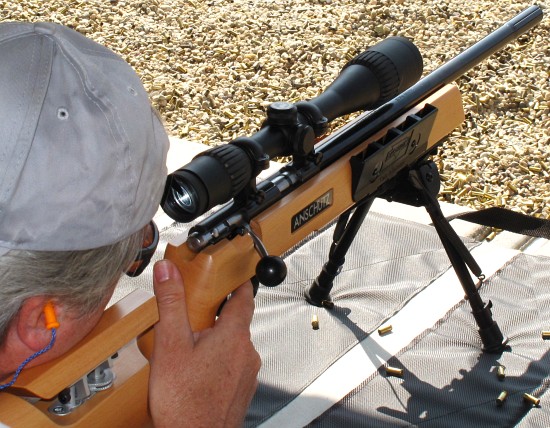
AccurateShooter’s Editor trains with .22 LR Anschutz model 64R back in 2008.
Rimfire Tactical Matches Aren’t Really New
NRL22 and PRS 22 rimfire shooting disciplines are fun, affordable forms of competition. We’re pleased to see the rapid growth of NRL22 and PRS rimfire. However, the concept of a rimfire tactical/practical match is not new — at least on the West Coast. Way before anyone every heard of PRS, California shooting clubs conducted “Rimfire Tactical” matches. These matches were first fired nearly two decades ago. CLICK HERE to read our comprehensive Rimfire Tactical report from way back in 2008. That article includes free targets, ballistics charts, and a complete run-down on suitable rimfire rifles.
The Concept Behind the Rimfire Tactical Match by Bill Erwin
Many guys who shoot long-range tactical matches practice with .22 LR rifles of similar configuration. Rimfire ammo is way more affordable than centerfire, you do not need a big range facility, and shooting rimfire saves wear and tear on your centerfire rifle. Further, for learning how to read the wind, there really is no better training tool than a 22 LR, even as close as 50 yards. Check out this table showing how a .22 LR ballistics compare to .308 Win:
.22 LR vs. .308, Distances for Equal 10 MPH Wind Drift
This table shows the corresponding distances at which a 10 mph full-value crosswind pushes a .22 LR bullet and .308 projectile the same amount. Values are based on 0.130 BC for a 40gr .22 LR bullet, and 0.496 BC for 175gr .308 bullet.
22 LR 40gr 1050 fps
50 yd Wind 1.0″
75 yd Wind 2.2″
100 yd Wind 3.8″
125 yd Wind 5.8″
150 yd Wind 8.2″
175 yd Wind 11.0″
200 yd Wind 14.3″
.308 Win 175gr 2650 fps
130 yd Wind 1.07″
180 yd Wind 2.15″
230 yd Wind 3.68″
280 yd Wind 5.63″
330 yd Wind 7.98″
380 yd Wind 10.71″
440 yd Wind 14.56″
This table shows how the .22 LR can be an effective substitute for a .308 Win during training. Because the smaller bullet drifts more in the wind, a .22 LR rimfire shooter will experience roughly the same crosswind effects as if he was shooting a 175gr .308 Win twice as far out. So, rimfire work can teach you to dope the wind like a .308 Win, but at less than half the distance. Shooting a .22 LR at 100 yards is like shooting a .308 Win (with 175gr SMK) at 230 yards.
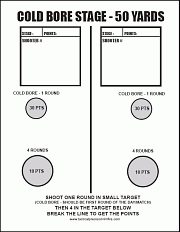
SPECIAL BONUS–Rimfire Tactical Precision Targets
These FREE targets by DesertFrog are offered in Adobe Acrobat format for easy printing. CLICK HERE to download all six targets as a .ZIP archive.
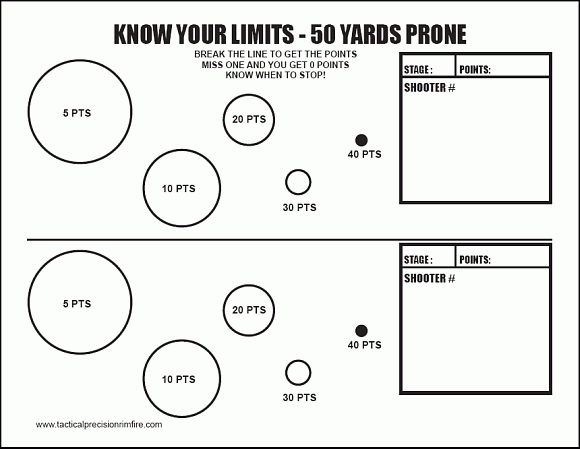
Rimfire Training Target for Fun Matches
Here’s a rimfire training target with “big to small” target circles. Start with the largest circles, then move to the smaller ones in sequence. This systematic drill provides increasing challenge shot-by-shot. Novices often are quite surprised to see their accuracy improve as they move from bigger to smaller aiming points. That provides positive feedback — always a good thing.
Right Click and “Save as” to download printable PDF versions of target.
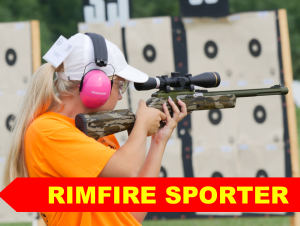
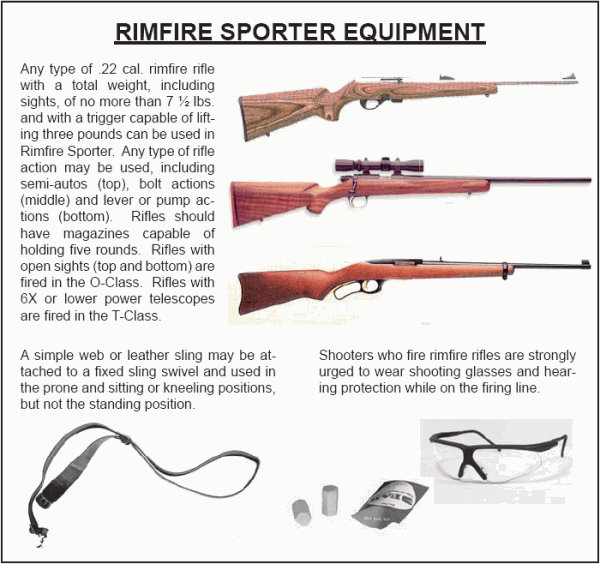
The CMP Rimfire Sporter discipline is for smallbore rifles that weigh 7 1/2 pounds or less with sights. Firing is done at 25 and 50 yards in prone, sitting, and standing positions, in slow and rapid-fire modes. The CMP has a special smart-phone App that helps speed up scoring. Rimfire Sporter matches are held throughout the country in connection with the CMP’s Travel Games.
And each summer, the major National Rimfire Sporter Match attracts hundreds of shooters to the shore of Lake Erie at Camp Perry. This year’s Rimfire Sporter Match at Camp Perry will be held on Saturday, August 1st, 2026, with check-in/clinic on Friday, July 31, 2026. The CMP National Rimfire Sporter Rifle Match offers shooters a recreation-oriented competition where they use affordable, smallbore sporter rifles with either scopes or iron sights. All you need are a .22 LR rifle, sling, and ammo.
Rifles may be manually operated or semi-automatic, in three classes: the standard “O Class” for open-sighted rifles, “T-Class” for telescope-sighted rifles, and the “Tactical Rimfire” Class. Firing is done at 50 and 25 yards on a target with a 1.78″ ten-ring. The target is simple enough for a beginner to hit, yet challenging enough that only one competitor in the history of the match has ever fired a perfect 600 score.
Rimfire Sporter Course of Fire
At the Rimfire Sporter Match, competitors complete slow fire prone, rapid fire prone, slow fire sitting or kneeling, rapid fire sitting or kneeling, slow fire standing, and rapid fire standing shot sequences.
What is Required for the Camp Perry Rimfire Sporter Match
Competitors need to bring their own .22 cal. Rimfire rifle(s) and ammunition. Special target shooting equipment, shooting jackets, or shooting gloves are not permitted, but you can bring a spotting scope and ground cloth or shooting mat. The firing points have grass (sometimes a bit wet with rain). Competitors are strongly urged to wear hearing and eye protection. Assistance for disabled competitors is provided.
A free Shooters’ Clinic is usually held in connection with the Rimfire Sport match at Camp Perry. The Clinic covers Rimfire Sporter rules, safety instructions, course of fire, and competition procedures. Shooters who have not previously attended a CMP Rimfire Sporter Match are strongly encouraged to attend.
Try a club match this summer! Every summer weekend hundreds of local club “fun matches” are conducted around the country. And the first official day of summer — the Summer Solstice — is June 20, 2025, just 9 days away. That means local summer weekend fun matches will be held at ranges across the country. So load some ammo, get your rifle, and have some fun.
One of the good things about club shoots is that you don’t have to spend a fortune on equipment to have fun. But we’ve seen that many club shooters handicap themselves with a few common equipment oversights or lack of attention to detail while reloading. Here are SIX TIPS that can help you avoid these common mistakes, and build more accurate ammo for your club matches.
1. Align Front Rest and Rear Bag
We see many shooters whose rear bag is angled left or right relative to the bore axis. This can happen when you rush your set-up. But even if you set the gun up carefully, the rear bag can twist due to recoil or the way your arm contacts the bag. After every shot, make sure your rear bag is aligned properly (this is especially important for bag squeezers who may actually pull the bag out of alignment as they squeeze).
Forum member ArtB adds: “To align my front rest and rear bag with the target, I use an old golf club shaft. I run it from my front rest stop through a line that crosses over my speed screw and into the slot between the two ears. I stand behind that set-up and make sure I see a straight line pointing at the target. I also have a piece of tape that I’ve placed on the golf shaft that indicates how far the back end of the rear bag should be placed from the front rest stop.”
2. Avoid Contact Interference
We see three common kinds of contact or mechanical interference that can really hurt accuracy. First, if your stock has front and/or rear sling swivels make sure these do NOT contact the front or rear bags at any point of the gun’s travel. When a sling swivel digs into the front bag that can cause a shot to pop high or low. To avoid this, reposition the rifle so the swivels don’t contact the bags or simply remove the swivels before your match. Second, watch out for the rear of the stock grip area. Make sure this is not resting on the bag as you fire and that it can’t come back to contact the bag during recoil. That lip or edge at the bottom of the grip can cause problems when it contacts the rear bag. Third, watch out for the stud or arm on the front rest that limits forward stock travel. With some rests this is high enough that it can actually contact the barrel. We encountered one shooter recently who was complaining about “vertical flyers” during his match. It turns out his barrel was actually hitting the front stop! With most front rests you can either lower the stop or twist the arm to the left or right so it won’t contact the barrel.
3. Weigh Your Charges — Every One
This may sound obvious, but many folks still rely on a powder measure. Yes we know that most short-range BR shooters throw their charges without weighing, but if you’re going to pre-load for a club match there is no reason NOT to weigh your charges. You may be surprised at how inconsistent your powder measure actually is. One of our testers was recently throwing H4198 charges from a mechanical measure for his 30BR. Each charge was then weighed twice with a Denver Instrument lab scale. Our tester found that thrown charges varied by up to 0.7 grains! And that’s with a premium measure.
4. Measure Your Loaded Ammo — After Bullet Seating
Even if you’ve checked your brass and bullets prior to assembling your ammo, we recommend that you weigh your loaded rounds and measure them from base of case to bullet ogive using a comparator. If you find a round that is “way off” in weight or more than .005″ off your intended base to ogive length, set it aside and use that round for a fouler. (Note: if the weight is off by more than 6 or 7 grains you may want to disassemble the round and check your powder charge.) With premium, pre-sorted bullets, we’ve found that we can keep 95% of loaded rounds within a range of .002″, measuring from base (of case) to ogive. Now, with some lots of bullets, you just can’t keep things within .002″, but you should still measure each loaded match round to ensure you don’t have some cases that are way too short or way too long.
5. Check Your Fasteners
Before a match you need to double-check your scope rings or iron sight mounts to ensure everything is tight. Likewise, you should check the tension on the screws/bolts that hold the action in place. Even with a low-recoiling rimfire rifle, action screws or scope rings can come loose during normal shooting.
6. Make a Checklist and Pack the Night Before
Ever drive 50 miles to a match then discover you have the wrong ammo or that you forgot your bolt? Well, mistakes like that happen to the best of us. You can avoid these oversights (and reduce stress at matches) by making a checklist of all the stuff you need. Organize your firearms, range kit, ammo box, and shooting accessories the night before the match. And, like a good Boy Scout, “be prepared”. Bring a jacket and hat if it might be cold. If you have windflags, bring them (even if you’re not sure the rules allow them). Bring spare batteries, and it’s wise to bring a spare rifle and ammo for it. If you have just one gun, a simple mechanical breakdown (such as a broken firing pin) can ruin your whole weekend.
The CMP 2026 National Matches will take place at Camp Perry from July 12 through August 8, 2026, with the First Shot Ceremony on Monday, July 13, 2026. Camp Perry is a National Guard facility located on the shore of Lake Erie in northern Ohio near Port Clinton. The shooting ranges have been modernized in recent years, with the installation of advanced electronic targets for many disciplines. SEE Full Camp Perry NM Calendar.
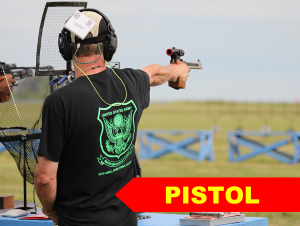
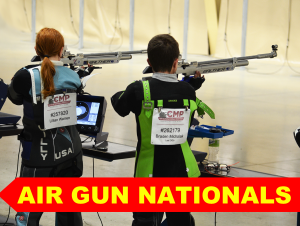
The National Matches will begin with Smallbore (rimfire) and Air Rifle events, followed by Air Pistol. The National Smallbore rifle series will utilize electronic targets, and the CMP Highpower Rifle Championships will now also be fired on electronic targets, with three 80-shot matches, followed by a 4-Man team event.
The National Matches are open to the public and have offered a wide range of events and matches since 1907. These matches are conducted by a partnership of the CMP and Ohio National Guard. Since their inception, the National Matches have become a huge, national shooting sports festival with well over 4,500 annual participants. The 2026 National Matches include the events listed below. Click on each discipline below for registration information, detailed match programs, and schedules.
Additionally, there will be multiple Garand/Springfield/Vintage/Modern Military (GSMM) Matches at the CMP Camp Perry National Matches this year. After the Rimfire Sporter match, the National Match Series concludes with Mid-Range (600-yard) and Long Range Matches.
The John C. Garand match is a Camp Perry classic. Note the signature Garand clip in the air.
Registration for the 2026 National Trophy Pistol and Rifle Matches is still OPEN. CLICK HERE to Sign up and review all the 2026 National Matches event info on the CMP website.






 In the archives of

 Gary Anderson served as the Director of the Civilian Marksmanship Program (CMP) from 1999-2009, and is now DCM Emeritus. In 1959, he joined the elite U.S. Army Marksmanship Unit. Just two years later, he won his first national championship. Over his competitive career, Anderson won two Olympic Gold Medals, seven World Championships, and sixteen National Championships. He is unquestionably one of the greatest American marksmen ever.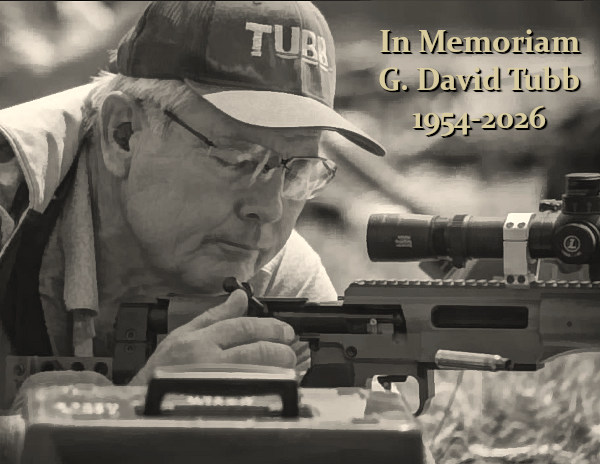
 David Tubb Biography Video



 3. Ammo Caddy on Joystick Arm – Charles shoots a Right Bolt/Left Port action, so he pulls his rounds with his left hand. Note that Huckeba’s record rounds rest in a small, wood ammo caddy attached to the end of the joystick shaft. Look carefully, you’ll see the wood ammo block in place of the normal black ball at the end of the joystick. That allows Charles to pull shots with the absolute minimum of hand movement. Ingenious! Huckeba is very fast, with a great economy of motion. I believe that because his ammo was literally at hand, Charles was better able to keep his focus on aiming and the flags.
 More and more folks are using Burris Signature Rings these days. These unique rings feature polymer inserts. That allows you to pre-load some elevation in your scope set-up, or you can center-up the windage. Additionally, the polymer inserts hold your scope securely without leaving marks on the tube. Lastly, some folks believe that Signature rings may offer advantages for benchrest competition. Rodney Wagner shot a world-record 600-yard group using Burris Signature Zee Rings (“Zee” denotes the Weaver-rail model). James O’Hara set multiple IBS 1000-yard records using Burris Signature Zee Rings. James will tell you he thinks “all his guns seem to shoot best with these rings”.









 1. Align Front Rest and Rear Bag
 5. Check Your Fasteners