AccurateShooter.com offers a dozens of free, printable targets in our Target Collection. However, we know that sometimes shooters may prefer a commercially-printed specialty target. These may offer unique designs, hi-viz colors, splatter effect, or special functions (such as scope checking). Here are a variety of excellent commercial grid targets you can buy via Amazon or the target-maker’s website.
EZ-AIM 12″x12″ Grid with Orange Bullseyes — $3.29 for 13-pack
We like this EZ-Aim Sight-in Grid Target for sighting-in, load development. and general practice. The full 12″x12″ target is covered with a precise black-lined grid on white background. There is a large center orange bullseye, plus four additional bulls, one in each corner. Right now this target is a bargain. You can get a 13-pack of targets for just $3.29 (#ad) on Amazon.
Freedom Targets — Bullseye Sight-In Grid Target, 25 for $13.89
Here’s a great Bullseye Sight-in Grid Target. This target provides a central bull on a 1″ grid pattern. There 8 additional small orange dot aim points, plus helpful numbers on the central vertical and horizontal lines. The outer four orange aim points are set inside heavier black lines to help align your scope crosshairs. This target is nicely printed, with sharp lines and bright orange circles. You get a pack of 25 targets for $13.89 — that’s $0.56 per target.
Birchwood Casey Grid — Black on White Splatter, 5 for $8.69
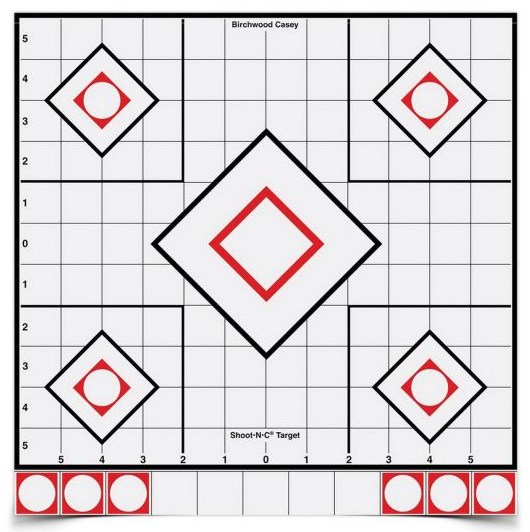
We’ve all seen conventional splatter targets with a black bullseye or grid. When a shot hits the target, a halo (usually neon yellow) appears around the bullet hole. Here is another kind of splatter target that creates a black circle on a white background. This can be very effective for spotting your hits at long range. Capture the same Shoot-N-C experience in white and black — the black “halo” can easily be seen at many distances. This Birchwood-Casey White Grid Target is $8.69 for a 5-pack. These Shoot-N-C Sight-In Targets have a self-adhesive backing, making for easy put up and take down. In addition, the target pack comes with corner pasters to cover holes or use as additional aim points.
High-Viz Option — Yellow on Black Grid with Yellow Halos
If you prefer seeing ultra-high-contrast yellow/green “halos” for your hits, Birchwood Casey also makes adhesive grid targets with five yellow-edged diamonds. Red circles provide precise aiming points in the middle of each box. You can quickly estimate group size or dial-in your zero using the hi-viz yellow 1″ grid lines. These yellow-on-black targets are available in three sizes: 8″ square, 12″ square, and 17.5″ square. These yellow-on-black grid targets start at $5.99 for an 8″ six-pack (#ad) on Amazon.
As an Amazon affiliate, this site can earn revenues through sales commissions.
This content Copyright 2026. Any republication on any other site is a violation of Federal Copyright laws and gives rise to penalties and damages.
Forum member Evan K. (aka “Katokoch”) has crafted a nice rimfire benchrest rig using a Suhl action fitted into a handsome home-built cedar and carbon fiber stock. This shows what a skilled hobbyist wood-worker can create in his garage.
When the rifle was crafted some years ago, Evan told us: “Here is my Suhl 150-1 with a factory 1:19″ twist barrel, Leupold 36X scope, Harrell tuner, and my handmade cedar/carbon fiber stock. I started working on the laminate blank a couple years ago and finally finished it earlier this year. I’ve been using it in my IR 50/50 matches this summer. I haven’t shot a 250 with it yet but I know the rifle is very capable — as usual, I am the weak link!”
We think Evan did a great job on his stock, though he has limited stock-building experience. Evan explained: “The stock is my first attempt at making a very lightweight laminate and also gluing both vertical and horizontal seams in a blank. The wood is Spanish and Red Cedar and I made the trigger guard and buttplate with carbon fiber too (great use for small scrap pieces). The finish is hand-rubbed spar urethane and the action is semi-glued-in with Devcon 10110 and stainless pillars.”
USRA-IR50/50 is a popular .22 rimfire benchrest discipline with three (3) classes: 13.5 lb., 10.5 lb., and 7.5 lb. (Sporter). The matches are shot at 50 yards and 50 meters.
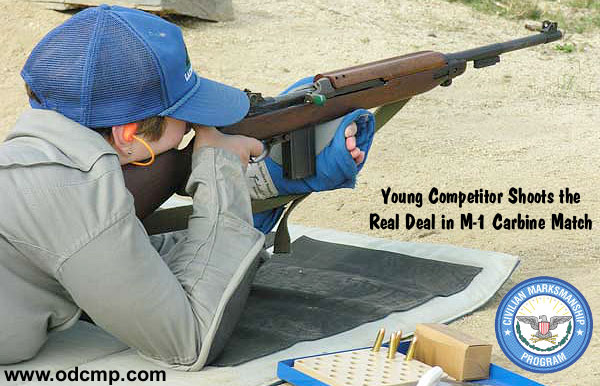
One of the CMP’s most popular competitions is the M1 Carbine Match. The little carbines are easy to hold and easy to shoot, with relatively low recoil compared to an M1 Garand or M1903 shooting the full-power .30-06 cartridge. Unfortunately, genuine GI-issue M1 Carbines are now hard to find at affordable prices. The CMP has announced: “CMP’S Carbine Inventory has been exhausted and we do not expect to receive any additional shipments.” Authentic, “all-original” M1 Carbines are going for $1800 to $2200.00 these days on Gunbroker.com.
CMP M1 Carbine Matches — Growing in Popularity
The CMP M1 Carbine Match is part of the CMP Games program that already includes Garand, Springfield and Vintage Military Rifle Matches. “As-issued” U. S. Military M1 Carbines are fired over a 45-shot course of fire at 100 yards on either the old military “A” target or the “SR” target. The course includes 5 sighters and 10 shots for record prone slow fire in 15 minutes, a 10-shot rapid fire prone series in 60 seconds, a 10-shot rapid fire sitting series in 60 seconds and 10 shots slow fire standing in 10 minutes.
CMP M1 Carbine Match at Western CMP Games
New Production M1 Carbines
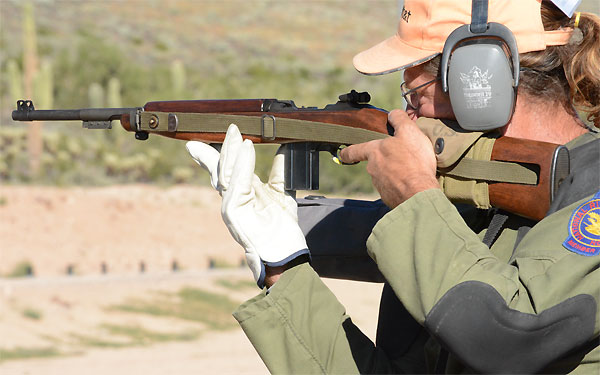
Thankfully, you don’t need to source a real WWII-era M1 to enjoy CMP M1 Matches. You can now get a brand new, American-made M1 Carbine clone for much less than an original CMP M1 rifle. And these new M1 clones are approved to shoot in CMP M1 matches. Auto-Ordnance sells new production .30-Caliber M1 Carbines that look, feel, and shoot just like the originals, for a lot less money. These are made in Kahr’s modern manufacturing plant in Greeley, PA. There are two versions:
Another producer of M1 Carbine replica rifles is Inland Manufacturing, a modern company which shares the name of a leading WWII M1 Carbine maker. These made-in-the-USA, newly manufactured M1 Carbines are very authentic copies of the original carbines from the World War II era. With a $1495.00 starting MSRP, they feature authentic 1944-type adjustable sights, push button safety, round bolt, “low wood” walnut stock, and a 10–round or 15-round magazine. There are three (3) versions: M1 1944 style, M1 1945 style, and M1A1 Paratrooper model.
GunsAmerica.com has compared Inland M1 Carbines with original vintage M1 Carbines: “We had to get in close to tell the difference. Overall, the two examples we were able to handle looked great and held up when next to the originals. The stampings are even close to correct with a few minor differences that were chosen to stop the new Inlands from being mistaken for originals.” READ M1 Carbine Review.
Keith Glasscock is one of America’s greatest F-Class shooters and one of highly respected wind coach. A High Master, Keith finished second overall at the 2021 NRA F-Class Long Range Championship in F-Open division. He also finished second at the 2020 F-Open Nationals, and second at the 2019 F-Open Nationals. His consistency is unrivaled, which means he definitely knows the secrets of competition shooting and loading ultra-accurate ammo. In recent seasons, Keith has started PRS/NRL competition, bringing his impressive shooting skills to those popular tactical disciplines.
Keith has a great YouTube Channel with multiple new video releases every month. On Keith’s Winning in the Wind channel, Keith offers 265+ informative videos on a wide range of topics including wind reading, reloading, component selection, load development, and training.
For today’s Saturday Video Showcase, we offer nine of our favorite Keith Glasscock videos. These cover many key topics — ballistics, barrel care, gunsmithing, bullet sorting, reloading, maintenance and more. Each video has important points that can benefit any competitive rifle shooter, whether you shoot in local 100-yard fun matches or compete at the National Level in F-Class, LR Benchrest, Palma, High Power, or PRS/NRL.
Top 10 Methods to Improve Your Shooting Accuracy
To shoot top scores, you need great skills and great hardware. This video covers 10 things that can improve accuracy, starting with the most important. The #1 item, notes Keith, is rifle shooting skill — you need to be able to hold on target properly and run the rifle consistently shot after shot. The second most important thing is an accurate rifle — you need a rifle with an excellent barrel, quality components, and top-tier inherent accuracy. Third, you need very accurate ammo, and this means you need to perfect your reloading skills. You need precise powder measurement and good, consistent bullet seating. Fourth in the list is related to ammo — you need the ability to do effective load development to pick the best load for your particular barrel. Number 5 is the “right bullet”. You need a high-quality, ultra-consistent bullet that is a good match for your particular barrel and discipline. Watch the video for the other five items.
Wind Direction vs. Wind Speed — Which is More Important
Most shooters find wind reading somewhat intimidating. That is understandable. The wind can change constantly during a match, with variations in both wind velocity and angles. Sometimes you think you have a cycle figured out, but then there can be an unexpected lull. Or you may start a string in what you think is a stable condition, but then a surprise shift changes everything. In addition, wind flows can be influenced by terrain features, such as berms, which have varying effects depending on wind angle (e.g. a tailwind hitting a berm will act differently than a 90-deg crosswind). That is why a good wind reader needs to identify both the wind speed AND the wind angle. In this video, Keith explains when to focus primarily on direction and when to pay most attention to velocity. With headwinds and tailwinds, Keith notes, you should monitor angle changes carefully. With crosswinds, speed is the key variable to watch.
KEY Points to Remember
— Small changes in wind direction changes alter POI drastically at long range
— During head or tailwinds, focus on wind direction
— During crosswinds, focus more on wind speed
— The wind is cyclic — always be aware of the pattern
Reloading for PRS/NRL vs. F-Class
Keith Glasscock is one of the very few PRS/NRL competitors who has shot F-Class at the very highest level, finishing second three times in F-Class National Championships. PRS/NRL and F-Class are very different disciplines with different challenges. F-Class is shot prone with time between shots and target distances from 600 to 1000 yards. In PRS/NRL competition, you are shooting from multiple positions, at many distances from 100 yards on out, with fast follow-up shoots. For F-Open, you want an extremely accurate load that can deliver sub-quarter MOA groups at 200 yards. For PRS/NRL you don’t necessarily need that level of accuracy (though it helps). But you also need a load that is very consistent, has relatively low recoil, but can also provide sufficient impact energy to clearly show a hit on distant steel. In this video, Keith Glasscock explains his reloading objectives for the two disciplines.
How to Find (and Fine-Tune) Seating Depth
This is Keith’s most popular video, with 295,000 views on YouTube. Keith definitely knows how to maximize accuracy by finding the optimal seating depth for each particular barrel. He is achieving groups in the high Ones for three shots. That would be good for a short-range benchrest cartridge, but Keith is achieving that with a .284 Winchester which has much more recoil. If you shoot F-TR or F-Open or even PRS, you should watch this video.
How to Remove Carbon Build-Up in Barrels
Hard carbon is the bane of rifle shooters. Hard carbon build-up in the barrel can adversely affect accuracy, and in extreme cases, can lead to increased pressure. If possible, you should clean your barrel(s) soon after a match (or shooting session) before the carbon fully hardens. We’ve used Wipe-Out Foam right after a match (with an hour soak time) and that dramatically reduced the amount of brushing required. In this video Keith Glasscock explains the negatives of hard carbon in your barrel, and he discusses how to diagnose the problem and how to remove the carbon build-up efficiently.
Key Methods for Precision Load Development
Keith starts this video with this adage: “The best do the basics better.” He then explains how that applies to load development and achieving great accuracy. Your need to start with high-quality components then do every step of the reloading process — case prep, powder mesauring, bullet seating with precision. Keith then goes through his recommended process for developing an accurate load that will sustain accuracy throughout a match.
Recommended Barrel Break-In Methods
Barrel break-in is a controversial subject. With premium finish-lapped barrels from top manufacturers, some ace F-Class shooters get away with hardly no break-in — just shoot for score right from the get-go. On high-quality custom barrels, we’ve had success with minimalistic break-in with a few wet patches ever 3 rounds for the first 20 rounds. However, with relatively rough factory barrels, you may get better long-term results with a systematic break-in process, even using specialized products on your patches. In this video Keith Glasscock explains break-in procedures he’s found to work for various barrel types and applications.
What Counts More — ES or SD?
In general, we have gotten the best match results with loads showing an Extreme Spread (ES) under 13 FPS and an extremely low Standard Deviation (SD). We know that F-Class and ELR shooters competing at 1000 yards and beyond definitely want an extremely low ES to minimize vertical dispersion at long range. That said, some short-range Benchrest competitors look at group size more than ES/SD. In this video, Keith Glasscock talks about the reloading process and methods for lowering ES and SD. Proper brass prep is important, as is precise powder measuring. And long range shooters may want to test 3 or 4 different powder types to find the one that offers the best combination of accuracy and low ES/SD.
Sorting Bullets — Various Methods Compared
Should you sort your bullets? If so, should you sort by weight, OAL, base-to-ogive, or max diameter? Which factor? Well the answer is “it depends”. You need to carefully examine a couple dozen bullets from each batch to see how consistent they are. We had some Lapua bullets that were ultra-consistent with 97 out of 100 within .0015″ base to ogive length. We used those bullets unsorted to set a local range record at 600 yards. On the other hand if you find significant differences in weights, diameters, or bearing surface lengths, you probably should sort. One tip — many shooters do not consider the width difference in bullets. We have seen 6mm bullet diameters vary from 0.2428″ to 0.2436″. We have one 3-groove 6BR barrel that likes the skinny bullets and another 6-groove barrel that definitely prefers the fatter bullets.
Good Guide for PRS/NRL Competitors
Currently, PRS/NRL tactical competition is the fastest growing rifle shooting discipline with both centerfire and rimfire matches around the country. Are you thinking of getting started in the Practical/Tactical shooting game? Looking for ways to be more stable when shooting from unconventional positions? Then you may want to read Marcus Blanchard’s Practical Shooter’s Guide (A How-To Approach for Unconventional Firing Positions and Training).
Unlike almost every “how to shoot” book on the market, Blanchard’s work focuses on the shooting skills and positions you need to succeed in PRS and NRL matches and similar tactical competitions.
Blanchard provides clear advice on shooting from barricades, from roof-tops, from steep angles. Blanchard says you need to train for these types of challenges: “I believe the largest factor in the improvement of the average shooter isn’t necessarily the gear; it’s the way the shooter approaches obstacles and how they properly train for them.”
Blanchard also offers good tips on shooting fundamentals. Here’s an example:
Blanchard on Trigger Control
“There will always be some amount of wobble when shooting in positions other than prone, and timing the shot to go off when the reticle is within the target is difficult to accomplish when poor trigger techniques are employed. The most common [mistake] I have seen is ‘slapping’ the trigger. The finger is usually hovering off the trigger, and when the shooter determines that NOW is the time to fire, they quickly pull their finger to the rear and ‘slap’ the trigger. The finger never pulls the trigger in the same place and often provokes a sympathetic contraction of the rest of the muscles in the hand, which results in unwanted movement before the bullet exits the muzzle.”
Author Marcus Blanchard has the credentials. A Marine Corps veteran, Blanchard is a regular Top 10 finisher in Precision Rifle Series events. In 2015 Blanchard was ranked 8th overall (nationwide) in the PRS series at year’s end. In 2016 Blanchard won the New Mexico Precision Rifleman’s Championship.
Check out the Table of Contents to see the Topics Covered:
Click image above to view larger Table of Contents.
6.5 Guys Recommend Practical Shooter’s Guide
The 6.5 Guys have reviewed Blanchard’s book and they recommend it highly: “What’s a good book for the beginning shooter who wants to get into long range precision rifle or the intermediate shooter who wants to improve his scores? [The Practical Shooter’s Guide] is particularly useful because it explores firing from various positions and props that are encountered in long range precision rifle [events]. This knowledge is completely missing from more traditional books where the shooter is usually slung up and shooting at a paper target. Marcus… goes into considerable detail about shooting from rooftops, reverse rooftops, side slopes, tank traps, barricades etc. This is the type of information that is very difficult to find. We consider ourselves reasonably knowledgeable shooters and this book provided us with new and useful information.” CLICK HERE for 6.5 Guys REVIEW.
6.5 Guys Review Marcus Blanchard’s Practical Shooter’s Guide
Former USMC scout-sniper Frank Galli explains that there is no voodoo when it comes to precision rifle marksmanship, but there ARE techniques that, when practiced, make the difference between good marksmanship and great marksmanship. Understanding the reasons that a bullet hits or doesn’t hit its intended target at ultra-long distances is a crucial element to learning.
Galli’s explanations of how to understand and compensate for wind speed and direction are excellent. In this book, Galli offers great wind-reading advice.
Published in 2020, Galli’s treatise is four years newer than Blanchard’s book, so it includes more of the latest gear and equipment. Galli’s book covers the fundamentals of precision marksmanship with easy-to-understand methodology. The book follow the same instruction process Galli uses in his live marksmanship classes (CLASS REPORT HERE).
This well-illustrated, 272-page book (2020 ed.) covers the latest equipment (scopes, LRFs, chassis systems, magazines, bags, bipods, tripods) favored by tactical competitors in PRS/NRL type matches.
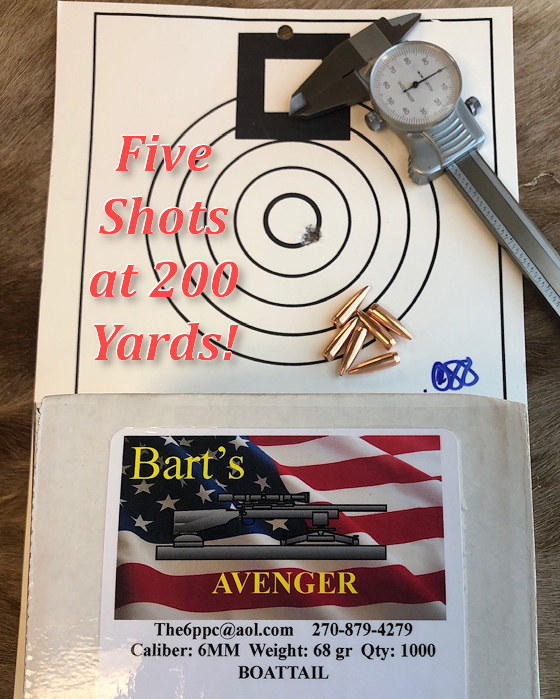
This would be an amazing group at 100 yards. But this 5-shot bughole was shot at TWO HUNDRED yards in competition by Bart Sauter of Bart’s Custom Bullets. And he did it with a borrowed barrel!
Be amazed. This five-shot group was shot at 200 yards in competition by bullet-maker Bart Sauter. Bart shot this astounding group with his 10.5-lb Light Varmint benchrest rifle at a East-West Match in St. Louis, Missouri. Had Bart been shooting an IBS match, this would have been a new IBS World Record, beating the .091″ by David Farrar in 2006. This .088″ group missed the NBRSA 200-yard 5-shot group record by a whisker — .013″ (thirteen thousandths). The listed NBRSA LV 200-yard Group record is 0.075″ shot by Johnnie Stewart in 2009.
New record or not, this is one remarkably impressive group, shot by one very talented shooter and bullet-maker. Bart tells us he initially “held center” for the first three shots in the group. Then, watching his wind flags he noticed slight increase in the left-to-right condition, so he held 0.200″ to the left on shot 4 and it worked. Before shot 5, Bart detected another slight change, so he held 0.300″ left for the fifth and final shot. He explained: “If I had not held off for those last two shots, this group would have been about a flat four (0.400″).” Well done Bart!
“First three … bang bang bang … all went in one hole. Then I held left on shot 4 and it worked. On the last shot I held a little more, got lucky and it went in.” — Bart Sauter
In our Shooter’s Forum, Bart posted “This is my personal best-ever 5-shot group at 200 yards. I knew it was small, but was shocked to see it was a Zero! This will be a range record and record for the East/West match. Last group of the day! A nice way to end the match!”
Here is the 6PPC LV rifle that shot the .088″ group. Yes that’s a concrete shooting bench inside a pretty nice cabin with hunting trophies on the walls. Bart explained: “We reload and shoot out of the Monkey Hut, especially during the winter. Most of the time we shoot outside at 100/200 from a a three-bench range.
Amazing Group Shot with Borrowed Krieger Barrel!
There’s a very interesting side-note to this story. You see Bart doesn’t even own the Krieger barrel that delivered this amazing .088″ 200-yard group. That’s right this superb barrel was a “loaner” — borrowed from Bart’s buddy Gary Sullivan. [Editor: Oh that we could all be so lucky with borrowed components.] With Sullivan’s blessing, Bart has since loaned the barrel yet again to ace Billy Stevens, who will be using it at the World Benchrest Championship in Canada, July 14-21, 2019.
This photo shots Bart on the right and his good friend Billy Stevens on the left. Bart notes: “Billy is a 2-time Super Shoot Winner and 3-time USA World Benchrest Team member!”
Bart Sauter’s LV 6PPC Rifle Specifications
Chambering/Caliber: 6PPC
Gunsmith: Stevens Accuracy
Action: BAT DS RBLP Right Eject
Trigger: Jewell
Stock: Scarborough Carbon Fiber over Wood Skeleton
Barrel: Krieger — and it was borrowed!
Tuner: Bukys TSI Tuner
Optic: 40x45mm IOR-Valdada 30mm tube
Rings: Benchsource Double Rings
Front Rest: Farley Joystick
Rear Bag: Edgewood Bunny Ear, very soft, gray leather — special order from Bruno’s.
Front Bag: Edgewood — same soft gray leather.
Here is Bart’s target with a bullet removed. Bart was shooting his own 6mm 68gr Avenger bullets, a double-radius ogive design. The Avengers were seated about .004″ away from the lands: “I tried going into the lands and that didn’t seem to work, then I backed it off four thousandths [from contact] and the rifle liked that.” Bart drove those 68gr Avengers with a stout load of Accurate LT30 powder running 3407 FPS.
Bart’s Comments on His Components and Accessories
OPTICS — Bart likes his new 40x45mm IOR-Valdada Benchrest Scope. He says that, so far, it has proved very reliable and holds zero exceptionally well. This new design features a worm drive side-focus, oversized ocular with true +/- diopter adjustment, long eye relief, and fast-focusing reticle. The 40X Valdada also boasts superb HD “double-compressed” Schott glass from Germany.
TUNER — Bart says the Bukys TSI Tuner definitely helps. He notes that once he finds the “sweet spot” for his barrel he can normally leave it alone: “With that type of tuner, I have to be in a very dire straight to move it. Normally I will set it for the lifetime of the barrel.”
REAR BAG — Bart’s rear bag is an unusual Edgewood with softer gray leather. He says this was a special order by Bruno Shooters Supply. Bart likes how the rear bag works with his carbon-stocked 10.5-lb rifle: “With PPCs we ‘ride on the ears’ — this older bag just seems to work really well for that style.”
SUPER FEET — Bart told us he uses Benchsource Super Feet for his front rest: “The bench tops at St Louis are very slick. Before I set up I’ll use a spray bottle with water and wet the bench where the Super feet and rear bag will go. This really helps to keep things from sliding around!”
Do you occasionally get completely unexplained flyers, or have a shot land straight down at 6 O’Clock, right below your point of aim? That could be caused by poor or inconsistent trigger technique. How you pull the trigger can and does affect your accuracy.
Many gun enthusiasts start with pistols. When they later start shooting rifles they may carry over some not-so-good practices acquired from shooting handguns with heavy 4 to 6-pound trigger pulls. You may want to “re-learn” your trigger techniques to get better rifle results.
Shooting Sports USA has a good article on trigger technique that offers many useful tips. That article also has many helpful illustrations, including the one shown above. Another illustration shows different types of trigger shoes (straight vs. curved) and explains how each makes a difference: “With a lightly curved trigger, the shooter’s finger can contact the trigger either high or low according to preference. Higher contact will increase the resistance.” READ ARTICLE HERE.
The article analyzes common errors, such as pulling the trigger with the very tip of the finger rather than the pad of the index finger: “Using the tip of the finger can lead to lateral pressure on the trigger, which throws off the shot.”
The article also explains that you should check your trigger regularly to make sure it is functioning properly and is not out of adjustment: “Just like any other moving part, the trigger can suffer from wear. In such a precise mechanism, tiny amounts of wear can cause major problems.”
The ergonomics of the Eliseo Tubegun allow a nice, straight trigger pull.
Trigger Tips
Six Suggestions for Making your Trigger Control More Consistent.
1. If your triggers are adjustable, set the pull weight appropriate to the discipline. For a hunting rifle, you don’t want an ultra-light trigger pull. For High Power, you may want a two-stage pull, while on a Benchrest rifle you may prefer a very light trigger.
2. If you have a two-stage trigger, experiment with different combinations of First Stage and Second Stage.
3. Have a friend watch you as you pull the trigger, and maybe even take a close-up video as you pull the trigger. This can reveal a variety of flaws.
4. Practice dry-firing to see if flaws in trigger technique are causing gun movement.
5. As an experiment, try pulling the trigger with your middle finger. Ergonomically, the middle finger has a more straight alignment with the tendons in your hand. This exercise can help you identify alignment issues with your index finger.
6. For stocks with adjustable Length of Pull you may want to set the LOP differently for bench shooting vs. prone or F-Class shooting.
When Only the Best Will Do…
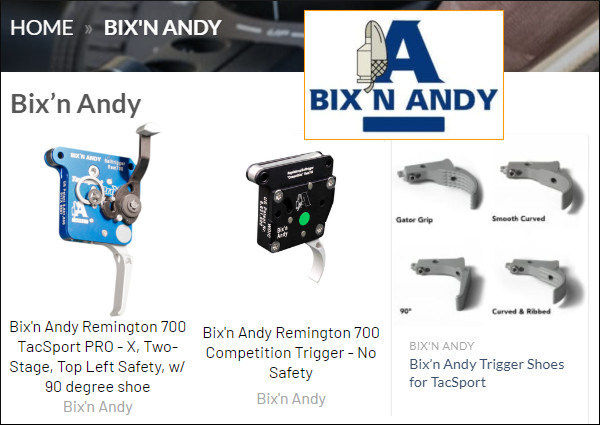
German-made Bix’N Andy triggers, available from BulletCentral.com, are among the very best you can buy. Available in both single-stage and two-stage, Bix’N Andy triggers are extremely precise, repeatable and smooth. The unique internal, friction-reducing roller ball system allows for extremely low reset force, yielding an ultra-crisp let-off. Bix’N Andy triggers can be fitted with a variety of trigger shoes according to shooter preference.
To get the best accuracy out of any benchrest rifle, you need to find the optimal position of front rest and rear bag. The important point to remember is that each rig is different. One gun may perform best with the front rest right at the tip of the forearm (Position ‘D’ in photo), while another gun will work best with the rest positioned much further back. This Editor’s own 6mmBR rifle has a laminated stock that is pretty flexy in the front. It shoots best with the front rest’s sandbag located a good 6″ back from the forearm tip (position ‘A’).
Here’s some benchrest advice that can help you reduce vertical and shoot tighter groups… without spending another penny. Many benchrest shooters spend a fortune on equipment and devote countless hours to meticulous handloading, but they never experiment with their rifle’s position/balance on the bags. This article explains why you should test your rifle in various positions. What you learn may surprise you (and improve your scores).
Next time you go to the range, experiment with the position of your rifle on the front rest, and try a couple different positions for the rear bag. You may find that the rifle handles much better after you’ve made a small change in the placement of your gun on the bags. Recoil can be tamed a bit, and tracking can improve significantly, if you optimize the front rest and rear bag positioning.
This competitor has the front rest positioned fairly far forward but not all the way out. Note the stop on the front rest — this limits forward stock travel.
A small change in the position of the forearm on the front rest, or in the placement of the rear bag, can make a big difference in how your gun performs.
Balance Your Gun BEFORE You Spend Hours Tuning Loads
In the pursuit of ultimate accuracy, shooters may spend countless hours on brass prep, bullet selection, and load tuning. Yet the same shooters may pay little attention to how their gun is set-up on their front rest and rear bag. When you have acquired a new rifle, you should do some basic experimentation to find the optimal position for the forearm on the front rest, and the best position for the rear bag. Small changes can make a big difference.
Joel Kendrick, past IBS 600-yard Shooter of the Year, has observed that by adjusting forearm position on the front rest, he can tune out vertical. He has one carbon-fiber-reinforced stock that is extremely rigid. When it was placed with the front rest right under the very tip of the forearm, the gun tended to hop, creating vertical. By sliding the whole gun forward (with more forearm overhang ahead of the front sandbag), he was able to get the whole rig to settle down. That resulted in less vertical dispersion, and the gun tracked much better.
Fore/aft stock position is important even with very wide fore-ends.
Likewise, the placement of the rear bag is very important. Many shooters, by default, will simply place the rear bag the same distance from the front rest with all their guns. In fact, different stocks and different calibers will NOT behave the same. By moving the rear bag forward and aft, you can adjust the rifle’s overall balance and this can improve the tracking significantly. One of our shooters had a Savage 6BR F-Class rifle. By default he had his rear bag set almost all the way at the end of the buttstock. When he slid the rear bag a couple inches forward the gun tracked much better. He immediately noticed that the gun returned to point of aim better (crosshairs would stay on target from shot to shot), AND the gun torqued (twisted) less. The difference was quite noticeable.
A small change in the position of the forearm on the front rest, or in the placement of the rear bag, can make a big difference in how your gun performs. You should experiment with the forearm placement, trying different positions on the front rest. Likewise, you can move the rear bag back and forth a few inches. Once you establish the optimal positions of front rest and rear bag, you should find that your gun tracks better and returns to battery more reliably. You may then discover that the gun shoots smaller groups, with less vertical dispersion. And all these benefits are possible without purchasing any expensive new gear.
MidwayUSA Foundation provides significant cash grants to youth shooting programs. Team grant applications are reviewed and decided upon by the MidwayUSA Foundation Board of Directors twice per year — in December and June. The current deadline to apply is June 15, 2026, just 12 days away. NOTE: Eligible teams and organizations must submit their application by the mid-June deadline.
MidwayUSA Foundation grants provide cash that youth shooting sports programs use to cover essential expenses, including ammunition, targets, entry fees, travel, and safety equipment. Programs with a MidwayUSA Foundation endowment receive 5% of their endowment balance. Youth shooting teams must have at least $2,000 in their Team Endowment Account before they can apply for a grant.
“The funding from MidwayUSA Foundation has helped our team to participate in more events throughout the season and buy gear for the team,” said Jason Giovannone, Heathwood Hall Highlanders Head Coach. This South Carolina youth shooting team has received nearly $50,000 in cash grants so far.
MidwayUSA Foundation’s endowment model helps youth shooting programs achieve financial stability. The Foundation’s nearly $500 million in endowment funds are invested, adding market earnings to every active endowment. And, along with industry sponsors, the public charity offers FREE fundraising product grants to help teams fundraise in their communities, and the Foundation’s website allows any donor the ability to give to the youth shooting team of their choice. These contributions are also matched, dollar-for-dollar with generous funding from Larry and Brenda Potterfield.
Since its inception, MidwayUSA Foundation has awarded over $99 million in cash grants to support youth shooting sports, including $7.6 million in 2026 alone. Teams are encouraged to apply for their grant every year and can do so through the Foundation’s online system. Learn more on the team grants webpage.
The MidwayUSA Foundation is a 501(c)(3) public charity providing long-term funding to youth shooting teams. Every donation made is 100% tax-deductible. The Foundation supports all shooting disciplines. For more information visit Midwayusafoundation.org or call 1-877-375-4570.
We really like to see this kind of major support for youth marksmanship programs. Young people are the future of recreational and competitive shooting.
Photo by SFC Brandon Green, 2018 National High Power Champion.
The prestigious CMP National Matches will be held at Camp Perry, Ohio this summer, July 12 through August 9, 2026. The President’s 100 Match runs Monday, July 27th, followed by Individual and Team Trophy Matches. And the Garand and Modern Military events kick off on August 1st, while 600-yard Mid-Range rifle matches run August 3-4, with Long Range following, concluding with the Palma Team match on August 9.
For those competing at Camp Perry this summer, we offer some insights from Tyrel Cooper, a multi-time National Champion. A past member of the USAMU, Cooper’s shooting resume includes five national championships (one each in 2008, 2011, 2012, and two in 2013). He won the 2013 NRA National Long Range Championship, as well as the 2013 NRA National Service Rifle Championship. In this article, written in 2014, Cooper explains the mental preparation that helped him win National Titles in 2013.
Below is a 2012 file photo of Ty Cooper shooting a service rifle. Cooper won the 2013 Long Range Championship using a Nesika-actioned bolt gun chambered in 7mm SAUM.
Mental Preparation by Tyrel Cooper Getting focused mentally is an important part of preparation for Perry. In 2011 I was chasing Sherri Gallagher, since then I have been chasing Brandon Green[.] If I get beat by a Service Rifle I am going to make him or her work for it. So there is your peak into my mental process. I go for the top and if I am hanging with them then the Service Rifle National Championship will come, Kind of like how I shoot for X’s and Tens will come.
Now I understand everyone is at different levels. You have to figure out what your goals are and then lie to yourself that you’ve already achieved them. Here is a trick that I used back in 2008: When I was a kid just starting out, my Dad made me read several books on shooting. One of them being With Winning In Mind by Lanny Bassham. One of the things I remember from his book is that he would make notes and place them where he would see them often. They contained his goals or stated he was already a world champion. I took a page from his book and did the same thing.
I made 3×5 cards and wrote my personal best 500 and 800 aggregate scores and taped on the horn of my truck, above the radio in my truck, on my laptop and a few other places I would see them often. Every time I saw those I would tell myself that I average those scores and I would get used to seeing them. By doing this you are lying to yourself to overcome the mental blocks the subconscious mind lays out for you.
I went from my worst year in 2007 to winning my first National Championship in 2008. I kind of slacked off in 2009 because I had reached my goals and didn’t set new ones and it showed, so I had to find new goals and motivation which I did and that pushed me back to the top.
Long story short, this is a mental sport and you have to figure out what you need to do to perform at your highest levels and breaking through those mental road blocks. You have to figure out how to get yourself to relax and control your mind keeping calm when you are shooting a personal best, either standing or on the day.
Here is a tip from my mental process from shooting. First I shoot for Xs, I took the line from the movie The Patriot and applied it to my shooting, “Aim small, miss small” and it is true. If you accept wide shots then you will keep shooting wide shots.
Winning Techniques for Rifle Competition
Slow, Solid, Smooth, Center
Always focus on the positive and good shots, and what you did physically and mentally, when you shot them. When I am nervous and need to calm myself down I tell myself: slow, solid, smooth, center.
Slow
I want my movement to be slow…
I can shoot Tens and Xs all day with slow movement.
Solid
Solid like a rock, a rock doesn’t move and that’s how I want my positions. By saying solid it reminds me to go through my little checks to make sure I am doing what I need to do make that happen.
Smooth
Smooth — that is my trigger word for smooth movement. You don’t want fast choppy movement but slow and smooth. This also reminds me to be smooth on the trigger. You can be smooth-fast or you can be smooth-slow but you have to be smooth and most people aren’t when they think they are. Just before leaving the USAMU, I walked up and down the line of five shooters during a rapid fire string and only one of them was smooth with their trigger control. It’s the second most important thing when it comes to shooting.
Center
This reminds me that I want my shots in the middle. It is just a positive reinforcement of where I want my shots to go. I shoot a reverse flat tire so it also kind of reminds me as to what I am looking for.
Countdown to CMP National Matches:
Story Tip from ELR Researcher. We welcome reader submissions.






 Keith has a great







 Getting focused mentally is an important part of preparation for Perry. In 2011 I was chasing Sherri Gallagher, since then I have been chasing Brandon Green[.] If I get beat by a Service Rifle I am going to make him or her work for it. So there is your peak into my mental process. I go for the top and if I am hanging with them then the Service Rifle National Championship will come, Kind of like how I shoot for X’s and Tens will come.


