Want to learn the basics of position shooting? Then you should check out an article by Gary Anderson, DCM Emeritus, in On the Mark digital magazine (Summer 2014, pp. 6-13). This article covers all the key elements: body position (prone, sitting, standing), sling use/adjustment, sight picture, aiming process, and trigger control. While this 8-page article was specifically written for Rimfire Sporter shooters, the techniques described by Anderson apply to all types of position shooting, whether you shoot air rifles, smallbore rifles, or centerfire rifles.
Here’s what Anderson says about aiming — how to keep your sights steady and get them centered on the middle of the target:
Trigger Contact and Center As soon as aiming at the target begins, the index finger must move from the trigger-guard to contact the trigger. It is important to get initial pressure on the trigger as soon as aiming begins. Then the shooter must focus on the sight picture and centering the sight picture movements over the aiming point. No one, not even champion shooters, can hold the aligned sights perfectly still. The sights are going to move a little bit or a lot, depending on the shooter’s skill level. The secret is to center those sight picture movements over the aiming point on the target (see trace illustration) before pulling the trigger.
When the sight picture movements on the target are centered, the last step in firing the shot is to add… smooth pressure on the trigger until the shot breaks.
Anderson also discusses the 5 Basics of Shot Technique:
BONUS: Olympic Gold Medalist Jamie Gray
Here’s an interesting video about three-position shooting. Produced by GOnra Media, this video demonstrates rifle hold and body alignment for prone, standing, sitting, and kneeling positions. Olympic Gold Medalist Jamie Gray demonstrates the proper stance and position of arms and legs for each of the positions. Ideally, in all of the shooting positions, the shooter takes advantage of skeletal support. The shooter should align the bones of his/her arms and legs to provide a solid foundation. A shooter’s legs and arms form vertical planes helping the body remain stable in the shooting position.
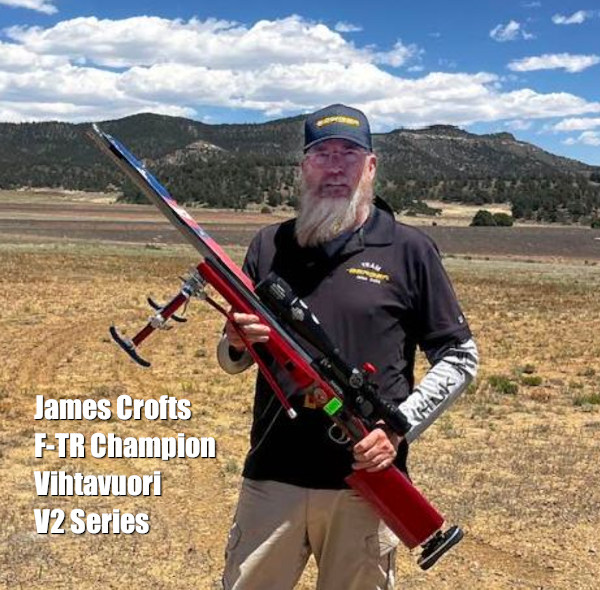
James Crofts of Team Berger has been crowned the 2026 F-TR Vihtavuori V2 Series Champion following an outstanding performance in Raton, New Mexico. Held May 13–16 at the NRA Whittington Center, the Vihtavuori V2 Finale is an invitation-only, long-range championship. The 3-day event features two, 32-shooter brackets in both F-TR and F-Open disciplines. Competitors earn their place in Ratopn by participating in F-Class Points Series qualifying matches, accumulating points based on their finishes. The top 32 shooters in each division advance to the Finale, where they compete in a double-elimination bracket to determine the champion.
Crofts competed in the F-Class Target Rifle (F-TR) category, which has strict equipment requirements. Rifles must weigh no more than 18 pounds, and competitors are limited to standard .308/7.62 NATO or .223/5.56 NATO chambers with no modifications. Crofts loads his .308 Win match ammo with Vihtavuori N150 powder in Lapua .308 Winchester Palma brass. His bullet choice is the Berger 208gr Long Range Hybrid Target, with a 0.689 G1 BC and 0.354 G7 BC.
“With the continued use and support of Berger and their components, I had 100% confidence in my ammunition,” said Crofts. “I knew if I missed or had a bad shot, it wasn’t the ammo — it was the conditions. Berger bullets, Lapua brass, and Vihtavuori powder are hands down the best.”
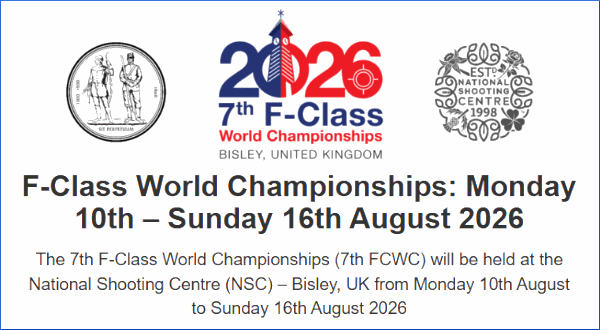
Berger congratulates James Crofts on his impressive V2 Series win at Raton, NM. What’s next? James will compete with Team USA this fall at the 2026 F-Class World Championships in Bisley, England.
With the 6mm Dasher cartridge becoming popular with PRS/NRL competitors as well as the benchrest crowd, we thought it was time to re-visit a special rifle chambered for the 6mm Dasher wildcat. This gun has a great story behind it. Forum member Bob A. (aka “Killshot”) used his “Forum Classifieds Special” to beat all comers in the F-Class Division in the American-Canadian Match and the Long Range Regional Match in 2013 in Sacramento, CA.
Bob’s 6mm Dasher sports a blue-printed Rem 700 action. Who says you need a high-dollar custom action to run with the big dogs? In fact, this same gun, built with components sourced from AccurateShooter Forum Classified Ads, set a Sacramento F-Class range record of 200-17X a few years back. In this story, Bob talks about the build, and he explains his methods for loading ultra-accurate Dasher ammo.
Bob’s Budget-Build Dasher F-Classer
I wanted to build a proper rifle for F-Open but needed to keep it simple and, well, cheap. I found a solid “base” to build on in the form of a Dave Bruno-built, “pre-owned” 6-6.5×47 Lapua that I located in the AccurateShooter Forum classifieds in late 2011. The base action was a trued and blue-printed Remington 700 receiver circa 1971 with a spiral-fluted bolt. It was in a Shehane ST1000 stock painted sky blue and had a Jewell 1.5-oz BR trigger. I sent the bolt to Greg Tannel (Gretanrifles.com) to have the firing pin hole bushed and sleeved, the ejector removed and the hole filled and the face trued. I upgraded to Tannel’s Light Steel firing pin assembly while it was out.
Having the working bits completed, I needed a barrel. So I went to the AccurateShooter classifieds again and found a 1:8″-twist, 30″ x 1.25″ (diam.) Bartlein with a 0.236″-land bore. I called Dave Kiff and explained my pursuit and he recommended his PT&G “world record” 6 Dasher reamer (.2704″ no-turn neck and .104″ freebore). A month or so later the reamer and gauges arrived.
I had the barrel chambered by Marc Soulie of Spartan Precision Rifles (510-755-5293, Concord, CA). Marc is a great builder and I’m pleased to call him a friend.
The rifle got its good looks from a Pennsylvania artist named Kenny Prahl. His Prahl Designs shop (724-478-2538) added the white ghost-flames over the existing sky blue metallic paint.
Looks Great, Shoots Better
Fire-forming showed great promise — ten-shot groups of half an inch at 200 yards were typical. I lost only one case to a split neck and the “blow lengths” are good and consistent. This was followed up with load development which saw 100-yard, five-shot groups in the .1s and .2s as the rifle showed its preference for Reloder 15 over Varget powder, and for CCI 450s over all other primers. The bullet of choice was the ever-popular Berger 105gr Hybrid Target.
In February 2012 I began shooting the Dasher in monthly club matches at the Sacramento Valley Shooting Center, the home range of a number of excellent F-Class, Benchrest and High Power shooters. Using a Farley Coaxial rest up front (also picked up from a WTB ad on AccurateShooter’s Forum) and an Edgewood bag in the back, I gradually improved my gun-handling to the point where I could shoot a respectable score. This was very different from the bipod shooting I’d done in the past in F/TR.
Dasher Loading Tips
My chamber is set up for blue box Lapua 6mmBR brass. My case preparation is straight-forward. I fire-form with virgin cases right out of the box. I don’t size them but I will give the primer holes a good look and clean up the flash hole with a .058″ bit in a pin vise. To fire-form, I seat a Berger 108gr BT .030″ into the lands over a standard 6mmBR load of Varget.
For match loads, I use Alliant Reloder 15. While Varget is less sensitive to temp changes, RL15 has given me lower extreme spreads and better long range control. [Bob acknowledges that every barrel is unique, so a different powder, such as H4895 might work better for you.]
I clean my fired cases with stainless steel media in a Thumler’s rotary tumbler after every firing. I anneal after every other firing using a Bench-Source machine which is very well made and easy to operate. I use a Whidden full length bushing die with Redding bushings for sizing.
After sizing, I chamfer the inside of the neck with the K&M tool which has a pilot rod centered in the flash hole. Then I’ll give the neck and mouth a “once over” with some 0000 steel wool. I finish loading off with a Redding Competition Seating Die with the micrometer top.
I use a carbide ball on the expander rod of the full length sizing die. I use a .266″ TiN-coated bushing and the ball just kisses the inside walls of the sized neck. I get very consistent neck tension this way and have had no issue with split necks.
Seating Depth Considerations
With fire-formed brass, the junction of the bullet’s bearing surface and boat-tail is above the neck/shoulder junction of the case, so I have no issues with donuts. You can see how a loaded round looks in the photo at left. For occasional trimming, I use a very nice little Possum Hollow trimmer that indexes on the case shoulder.
Are you looking to get started in tactical/practical competitions? Or perhaps you already have have some PRS/NRL experience but want to upgrade your equipment and enhance your match results. Here are eight videos that can help you improve your game. These videos feature top PRS/NRL competitors and knowledgeable manufacturers’ representatives. You’ll find other related videos on the Long Range Precision Shooters YouTube channel.
Shooting a PRS Match for the First Time
Here’s an amusing video from the land Down-Under — Australia. The video covers a club PRS match, showing various shooting positions. Around the world, the PRS discipline is growing rapidly, particularly with younger marksmen under 35. The matches are fun and fast-paced and the sport is much more dynamic and physically challenging than benchrest or F-Class competition.
Building a Custom PRS/NRL Rig
Action, trigger, barrel, chassis, rails, and optics — this video from Burris covers all the key components of the modern PRS/NRL rifle. This video discusses the pros/cons of various configurations and the explains what to look for in a PRS/NRL riflescope.
How Accurate Are the Top PRS Shooters?
In this video, MDT put three top centerfire PRS shooters to the test, running them through some of the most difficult stages. The goal? To showcase the level of accuracy and precision these top shooters can achieve. From shooting off barricades to hitting targets from rooftops and rocks, these shooters demonstrate why they are considered among the best in the world. Top-tier modern PRS/NRL rifles when shot prone from a bipod at 100 yards can do 1/3-MOA or better for three shots.
Cartridge Choice for PRS and Tactical Competition
This video reviews many of the different cartridge options popular for PRS-style competition. The video examines pros and cons of various cartridge choices, focusing on accuracy, recoil, mag-feeding, and value for money. This segment features G.A. Precision owner/founder George Gardner.
Most top PRS shooters are using 6mm cartridges these days. These deliver excellent accuracy with lower recoil and cheaper bullet cost. Popular choices include 6 Dasher, 6 BRA, 6mm Creedmoor, 6XC, and the new 6GT cartridge, which is sort of a stretched version of a 6mmBR. It has a bit more case length for better feeding, and greater case capacity than a 6BR so you can shoot 105-108 grain bullets at 2950 fps with ease. That’s a popular Dasher accuracy node that the 6GT can achieve at somewhat lower pressures.
CLICK HERE for a full write-up on a 6GT rifle build by Mike McCasland (Texas Precision). This includes load development suggestions and a 6GT reamer print. The popular 0.120″ freebore chamber allows for the majority of high-BC 6mm projectiles. Mike had good luck with the pointed 107gr Sierra Match Kings (SMK), as well as the 110gr Hornady A-Tips in his rifle.
Road to the PRS
This video from Kestrel offers good advice on getting started in PRS/NRL shooting. Experts demonstrate multiple shooting positions and offer advice on shooting from barricades. Topics covered include rate of fire, scope use, and equipment selection.
PRS Tactical Division Explained
In this video MDT Shooter Matt Stiner explains the basics of competition in the PRS Tactical division. The video covers rifle, cartridge choice, optics, and key accessories. He also explains how to set up your PRS Tactical rig for best results. In addition Matt talks about bullet and brass options.
Savage 110 Elite Precision — Good Production Class Choice
This Alabama Arsenal video shows the Savage 110 Elite Precision on PRS Match stages using bags, tripods, and bipods, firing from stone barriers, field frames, and wood platform supports. If you are in the market for a PRS rifle, this video, which now has 355,000 views, is well worth watching. It covers specific features including trigger, chassis, magazines, and Atlas attachment. NOTE: The price limit for Production Class has risen significantly over the years, with a current MSRP max of $3000 for the rifle and $2500 for the optic.
PRS on a Budget — Converting a Basic Rifle for PRS Use
Top of the line rifles for competition are exceedingly expensive, but there is another option if you have a rifle in the safe that doesn’t get much use. Top F-Class shooter and wind coach Keith Glasscock notes: “I converted my .223 Remington varmint rifle into a Tactical class/PRS training rifle to save costs on ammunition and barrels so I can get better, faster.” Keith shows a very logical way to get started in the PRS/NRL game.
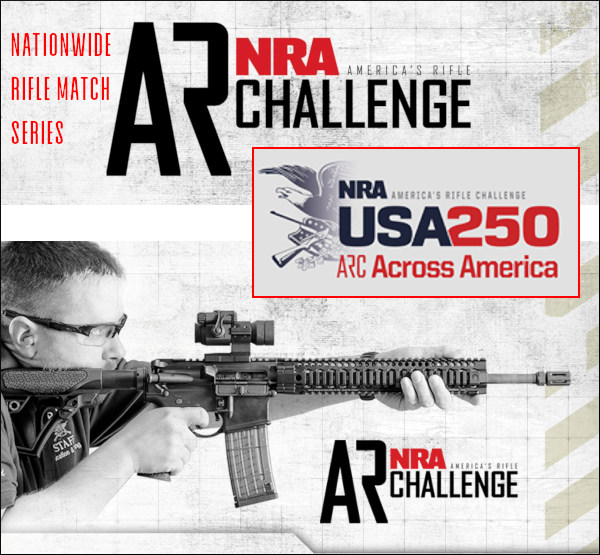
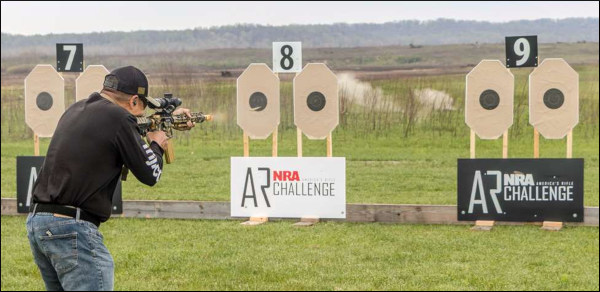
As the United States approaches its historic 250th Anniversary (July 4, 2026), the National Rifle Association invites Americans to celebrate freedom by competing in the NRA America’s Rifle Challenge (ARC). The expanded 2026 ARC Across America National Challenge is a nationwide competitive shooting event. From Memorial Day through Labor Day, gun owners across the country can compete in ARC matches at participating clubs and ranges with opportunities to win prizes from ARC partners and sponsors.
To learn more about participating in NRA America’s Rifle Challenge events, visit ARC.NRA.org.
The heart of the program is the ARC Level 1 format, the foundation of the USA250 national event and the entry point for gun owners of all experience levels.
Built around practical rifle skills across four stages of fire, the Level 1 course challenges participants to demonstrate accuracy, control, and safe firearms handling.
Every ARC match is more than a competition — it’s a training opportunity. Each run on the course helps shooters grow more capable with their rifles. Participants can:
— Develop new rifle skills through structured competition
— Challenge friends and family in a fun and exciting environment
— Compete multiple times in a “Re-entry Match” format, allowing competitors to improve their score.
And, at the end of each ARC match, participants can see where they rank nationally across the country with other ARC competitors. And Veterans can meet other former service members.
How Clubs Can Host ARC Matches
The NRA’s goal is to have more than 250 clubs and ranges host ARC matches between Memorial Day and Labor Day. The program was built so clubs can run an organized, safe, and engaging event without requiring complex stages or extensive infrastructure. Clubs interested in hosting NRA America’s Rifle Challenge events can sign up on the ARC.NRA.org website.
ARC Competition Format Options
Clubs can host ARC matches using one of two range configurations:
Full Level 1 Course Format – designed for ranges with 100-yard capability Reduced Course Format – designed for ranges with 25-yard capability
Note: Both formats provide the same structured experience and competitive opportunity, ensuring that nearly any club can participate regardless of range size.
The NRA America’s Rifle Challenge (ARC) is a national rifle competition program designed to help firearm owners develop safe gun-handling skills, practical marksmanship, and confidence through structured competition. ARC events are hosted by local clubs and ranges across the country and welcome participants of all experience levels. Clubs willing to host an event will join a growing network of ranges across the country helping bring this celebration to life.
Summer is almost here, so it’s time to focus on fun. Here are four specialty targets with game themes: Dartboard, Billiards Table, Bowling Alley, and Poker Cards. Each target features multiple aiming points. Shoot the dartboard like a regular game or make up your own sequence. For the billiards target shoot the balls in number sequence or alternate stripes/solids. Click any target to load FREE downloadable PDF files. Then print the targets and take them to the range for a fun shooting session. A big thanks to our friends at NRABlog.com and NSSF for creating these colorful “fun & games” targets. Enjoy!
Dartboard Target
With this fun Dart-Board Target, aim for the four outer bullseyes, then go for the center bull. The colored darts provide additional targets. With an accurate rifle you can also aim for the colored stripes.
NSSF Billiards Table Target
This Billiards Table Target offers 15 brightly-colored numbered balls with the cue ball at the bottom. Aim for the numbers, shooting 1-15 in sequence, or alternate between stripes and solids. You can also draw an “X” on the white cue ball (or attach a paster), and use that to set your zero. This target is fun for shooting outdoors with rifles at 50 or 100 yards or indoors with pistols.
This billiards target is part of a set of 12 Fun Targets from the NSSF. These were issued a couple seasons back for National Shooting Sports Month, held in August of each year. The other free targets include Golf Links, Bowling Pins, Fireworks, Baseball Diamond, Dutch Windmill, Water Balloons, Light Bulbs, Dartboard, and three Bullseye targets.
NRA Bowling Pins with Bowling Ball Target
Here’s a fun target for close-range pistol or 100-yard rifle shooting. This NRA Bowling set target has 8 bulleyes. The largest bullseye is on the blue bowling pin. Then there are three slightly smaller bulls on the center of three of the seven bowling pins. Finally there are four small bullseyes located on the top of the first, third, fifth, and seventh pin. To test your skills, start with the bowling ball and then work up to the more challenging bulleyes.
Poker Target — Get the Best Hand
With this playing card-themed target, each shooter takes five shots and the one with the highest hand wins. With the Poker Game Target you can also shoot for 4-of-a-kind, against the clock, fastest four (without a mistake) wins.
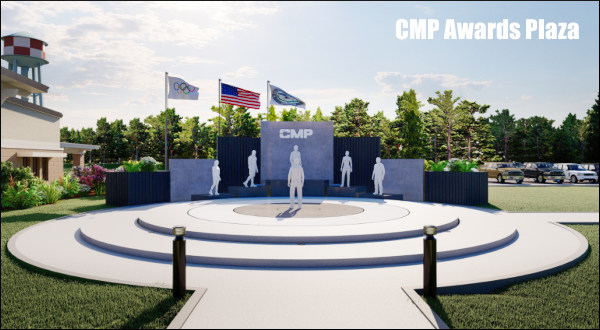
Camp Perry Expansion — New Competition Center and Awards Plaza
The Civilian Marksmanship Program (CMP) has announced a major expansion project at Camp Perry, Ohio — a new Competition Center building, plus an Awards Plaza. The new Competition Center, building upon the success of the existing Gary Anderson CMP Competition Center, will be a large modern facility. This will provide a large, modern indoor range, expanded retail space, competitor support areas, and gathering spaces for competitors, coaches, spectators, sponsors and visitors. The new Competition Center will support training and competition for air gun, smallbore, and pistol disciplines.
This major CMP Camp Perry expansion project is aimed to strengthen the future of marksmanship training, education, coaching, competitions and youth development in the United States. The project is scheduled to break ground on August 3, 2026, with an estimated completion date of December 2027.
The lead photo above features a rendering of the new Competition Center building and below is a rendering of the new Awards Plaza.
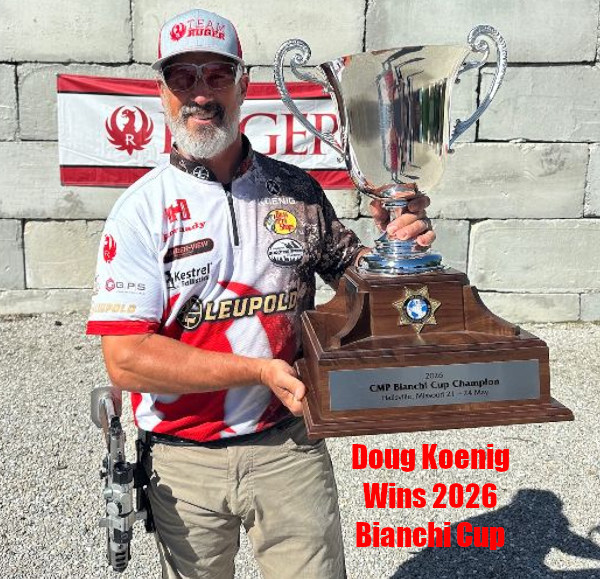
Congratulations to Team Vihtavuori member Doug Koenig on winning the 2026 CMP Bianchi Cup Championship, one of the world’s most prestigious pistol tournaments. Koening took the 2026 title with an impressive Grand Aggregate, shooting a Ruger SR1911 pistol. Koenig’s 2026 Bianchi Cup title marked a major milestone — his 21st Bianchi Cup Championship. The 2026 Bianchi Cup Championship brought together top competitors from across the country, making Koenig’s first place finish a major accomplishment. Throughout the Bianchi Cup match, Koenig demonstrated consistency, precision, and competitive excellence.
“I’m proud to represent Ruger and grateful for their continued support,” said Koenig. “This victory means a lot to me personally. I put in the work, trusted my preparation and trusted the products backing me.” To learn more about Doug’s accomplishments, visit KoenigShooting.com.
The 2026 CMP Bianchi Cup International Pistol Tournament was held at the Green Valley Rifle & Pistol Club in Hallsville, Missouri. The renowned competition, hosted by the Civilian Marksmanship Program (CMP), took place May 21–24, 2026 — just last week. The Civilian Marksmanship Program (CMP) has governed the international competition for the past few seasons. In partnering with Green Valley, the CMP seeks to grow the event with more shooters and new divisions. The Bianchi Cup, known as the gold standard in action pistol shooting, has a 40+ year history and attracts the world’s leading competitive pistol shooters.
These two videos show Doug Koenig in action in past years at the Bianchi Cup Range.
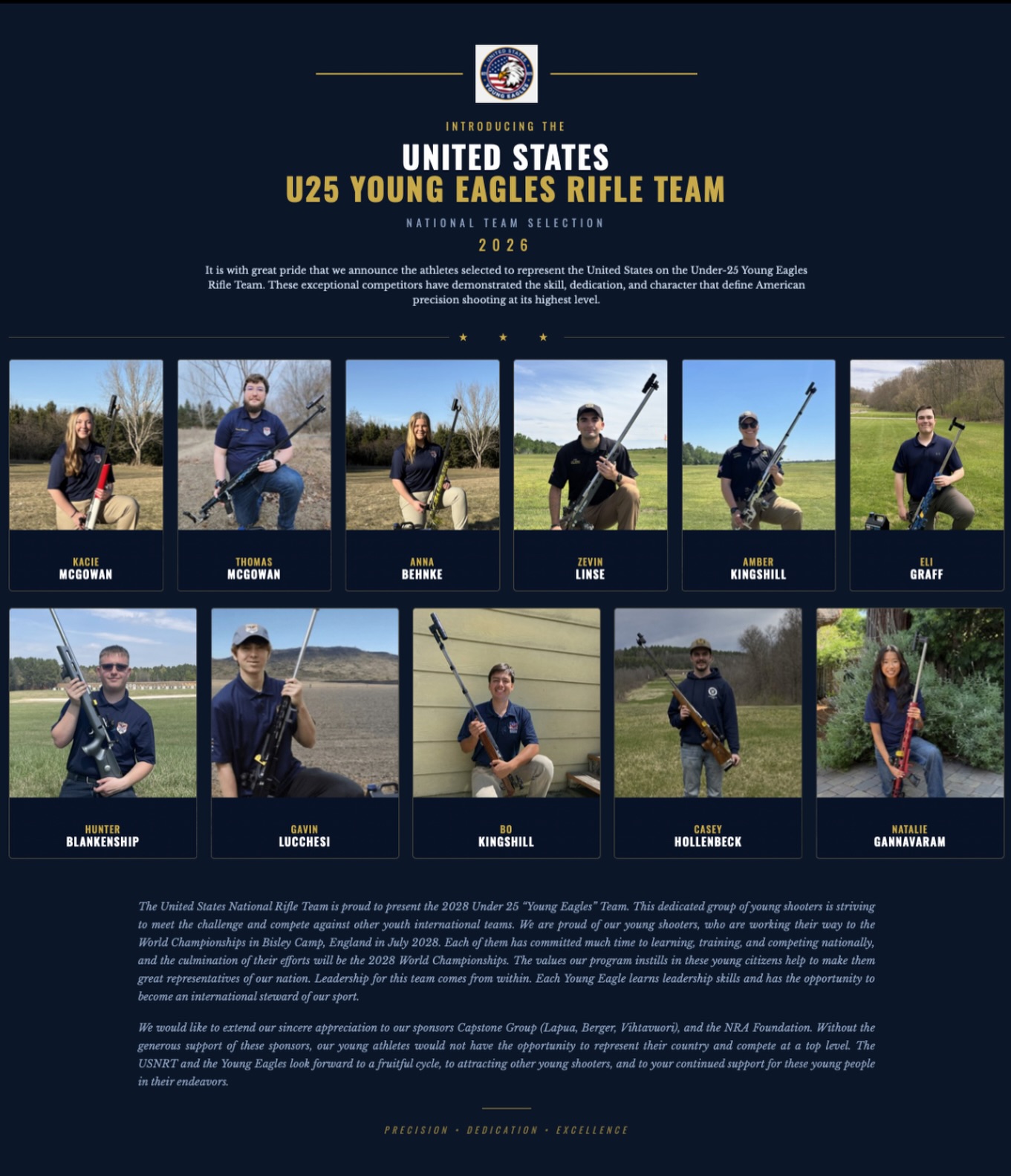
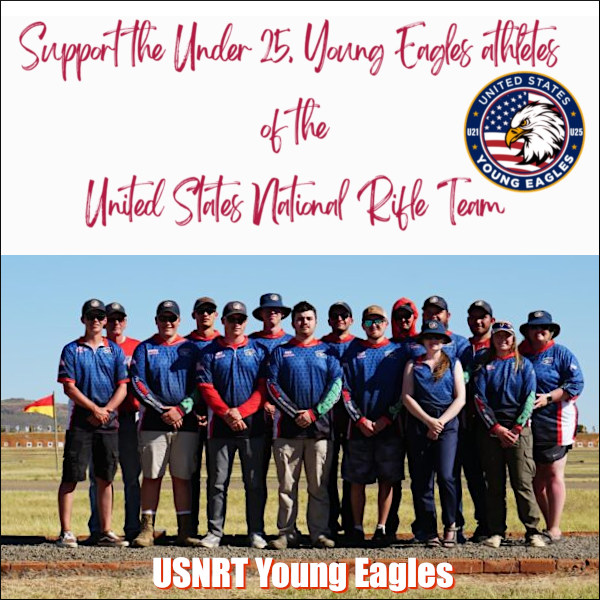
Say hello to the future of target rifle team shooting in the USA. Here are the young members of the U.S. Young Eagles shooting squad. You can show the Young Eagles support by contributing to their program. Go to USNRT.com to donate!
Brandon posted: “I just wanted to share an opportunity for you guys to help our Young Eagles rifle team in preparation for the 2028 World Long Range Championships. This team is comprised of shooters under the age of 25 and will compete for the U25 championship in Bisley, England. They will be traveling over in 2027 for the Imperial meeting and again in 2028 for the Imperial and the Worlds. Anything you guys can do will be truly appreciated and the MidwayUSA Foundation will match donations!”
CLICK HERE to go to the MidwayUSA Foundation webpage set up for donations to the USNRT Young Eagles program. You can donate any amount large or small and also make a recurring donation.
About the USNRT Young Eagles
The USNRT (United States National Rifle Team) Young Eagles is a junior shooting program for athletes aged 25 and under, focusing on fullbore and long-range rifle disciplines. This elite team competes internationally, developing young talent in under-19, under-21, and under-25 categories. The team enjoyed notable success at the 2024 World Championships in South Africa.
Key Aspects of the USNRT Young Eagles Program:
Purpose: To represent the USA in international, high-level, fullbore, and long-range rifle competitions.
Disciplines: Participants compete in matches involving, or similar to, the Palma match format, shooting at ranges from 300 to 1000 yards.
Structure: As part of the USNRT, the Young Eagles program serves as a development pathway for younger shooters to gain international experience.
Competition Levels: The program includes under-25, under-21, and sometimes under-19 divisions.
Achievements: The Young Eagles have achieved great results, with podium finishes at the 2024 World Long Range Championships in South Africa, and 2nd place in the Under-25 World Team Championship.
The United States National Rifle Team, Incorporated (USNRT INC) is a 501(c) (3) tax-deductible charitable organization (FEIN 84-4135396) that fosters, promotes, develops and supports the amateur athletic teams that represent the United States of America in domestic and international Fullbore Rifle and Long Range Rifle marksmanship competitions.
Kulzer Sets Eight IBS 1000-Yard IBS Benchrest Records with 6 BRA Rifle Report by Alex Wheeler
In 2021, Glenn Kulzer of Dillon, Montana had a season that will go down in 1000-Yard Benchrest history. Glenn set eight IBS records in 2021 at the Deep Creek range in Missoula, and then was named IBS 1K Shooter of the Year. What makes this so incredible is not just the number of records but the records themselves. Normally when a world record small group is shot that’s a singular event — never accompanied by Aggregate records set by the same shooter. Glenn’s IBS record small group wasn’t a one-time lucky string. Consider this — Glenn nailed that historic small group, but also recorded multiple IBS Aggregate records in 2021. And Glenn set these IBS Heavy Gun records actually using his 6 BRA (6mmBR Ackley) Light Gun! Mighty impressive.
[Editor: These were impressive records that have stood the test of time. A quick search of the IBS record site shows Glenn Kulzer still holds six of the ten listed IBS 1000-yard Heavy Gun records. Plus, Glenn broke the Light Gun 20-Target Agg group record, but that was later bettered by Tom Mousel.]
1000-yard Benchrest Aggregate records represent a series of targets shot over the course of multiple matches during a season. That really takes any luck out of the equation. You have to keep the rifle shooting at its peak all year long. It’s the ultimate test of accuracy. But the small groups do get the most notice and Glenn also broke the small group record with a remarkable 2.6853″ 10-shot group (photo below).
Eight IBS Records Set by Glenn Kulzer in 2021
Date: 06/13/2021
Class: Heavy Gun
Record: 10-Shot Group, 2.6853″
Date: 06/13/2021
Class: Heavy Gun
Record: 10-Shot Score 100/2.6853″
Date: 2021
Class: Heavy Gun
Record: 6-Match Group Aggregate, 4.349″
Date: 2021
Class: Heavy Gun
Record: 6-Match Score Aggregate, 99.167/4.679″
Date: 2021
Class: Heavy Gun
Record: 12-Target Group Aggregate, 4.529″
Date: 2021
Class: Heavy Gun
Record: 12-Target Score Aggregate, 98.583/5.058″
Date: 2021
Class: Heavy Gun
Record: 20-Target Score Aggregate, 95.2/6.422″
Date: 2021
Class: Light Gun
Record: 20-Target Group Aggregate, 5.202″
NOTE: Most of these records have been broken. In 2025 talented Montana shooter Tom Mousel set 8 multi-match and multi-target records, including an amazing 12-target Group Agg of 3.8790″ and 12-target Score Agg of 99.5.
This IBS record 1000-yard group, and Glenn’s other IBS records, were shot with Roy Hunter’s 103gr “A” bullet, Hodgdon H4895 powder, CCI BR4 primers, and Alpha Munitions 6 BRA brass. However, Glenn does use Lapua brass for some other 6 BRA rifles.
Glenn’s record-setting rifle is a Light Gun with a common setup used in long range Benchrest. The rig features a Borden BRM drop-port action with a Bix’n Andy trigger. The action is glued and screwed into a industrial wood laminate Deep Creek Tracker stock, a predecessor of the McMillan LRB. The Krieger barrel is a 4-groove, 1:8″-twist Heavy Varmint contour chambered for the 6 BRA (6mmBR Ackley) cartridge. All of Glenn’s rifles are topped with Vortex Golden Eagle scopes. Glenn notes that his Vortex Golden Eagles have show excellent point-of-aim stability when tested with a scope checker. The front rest was a Sinclair competition with Edgewood front bag, Field & Cave outfitters front rest plate, and speed screw. For rear support Glenn uses an Edgewood LRB rear bag.
Loading Procedures for Record-Setting 1000-Yard Shooting
Glenn’s loading process is pretty simple. He full-length sizes every time, bumping the shoulders back about .003″. Powder is weighed to the kernel, and bullets are seated with a Wilson seater. NOTE: Glenn does does not anneal his brass. He sorts primers by weight but does not otherwise measure them by dimensions. He seats the primers by feel using a relatively inexpensive primer seating tool — nothing fancy.
Glenn worked up a trim-and-point recipe for this lot of bullets based on group size. Load development is all performed at 1000 yards using the group ladder method. Glenn’s record load ended up being 30.3 grains of H4985 powder with the 103gr bullet seated very far into the rifling with .005″ of neck tension. This gave a velocity of 3030 fps in the 28″ Krieger.
Glenn shot Alpha Munitions 6 BRA brass all year with the .080″ flash hole. This year he shot Roy Hunter’s 103gr “A” bullet set quite deep into the rifling. NOTE: This deep jam has proven to be very stable IF you barrel likes it. Glenn used CCI BR4 primers and Hodgdon H4895 with .005″ of neck tension. His load delivered 3030 fps out of a 28″ barrel. NOTE: This is a “HIGH NODE” that may not be possible in an average barrel with different brass. Many 6 BRA shooters are reaching a 3000+ fps node, but you should always start low and work up. Some 6 BRA barrels will max out at 2950 FPS with 103-108gr bullets.
Glenn Interview Part I — All About the Rifle that Set Eight 1000-yard Records
Glenn Interview Part II — Load Development Process and Loading Methods
Glenn Interview Part III — Barrel Cleaning Discussion
Glenn Kulzer also shot his impressive 6 BRA at the 2021 IBS Nationals at Deep Creek (shown above). This Deep Creek range photo is by Forum member Dave Way.
Setting Records in June 2021 Report by Alex Wheeler
It was a typical match for June, nothing unique about it. Saturday was actually looking to be a really great day. Overall it was good but not great. Sunday had a clear blue sky with bright sun. I looked through a couple of scopes before the match and it was milky. I probably would have shot that relay at 30-35 power. But somehow Glenn Kulzer was able to pull off the best heavy gun group ever shot in 1000-yard IBS competition. With that group Glenn also broke the 6-match IBS Group Aggregate record (which was later broken by Tom Mousel in 2025). The group was no fluke, this rifle also shot great in previous matches with small groups at 1000. To my knowledge this may be the only time a small group record AND an Aggregate record were broken in the same season by the same gun. The ultimate achievement.
On June 13, 2021, Glenn shot a 2.6583″ 10-shot group, all shots in the 10 Ring for a 100 score. This group still stands as the current IBS Heavy Gun 1000-Yard 10-shot group record AND score record. It was also part of Aggregate Records listed above.
About Glenn Kulzer — Rising Star in the Long-Range Benchrest Game by Alex Wheeler
Kulzer is a pharmacist in Dillon, Montana. The attention to detail required for his job crosses over to Long-Range Benchrest. He started off a very competitive shooter right from the start. I have said it many times, but benchrest is not an elitist sport. Hard work and dedication will always rise to the top. Glenn took the sport seriously from the beginning. Accordingly, he displayed a rapid learning curve and quickly surpassed some of his mentors in match results. Glenn tunes mostly at 1000 yards using the Deep Creek variation of ladder testing. He will also load and tune at the range to try and nail the best tune for the conditions. Again, it all about the work done by competitors. But Glenn’s success shows that a bright, hard-working shooter can rise to the top of the game in just a few seasons.


As soon as aiming at the target begins, the index finger must move from the trigger-guard to contact the trigger. It is important to get initial pressure on the trigger as soon as aiming begins. Then the shooter must focus on the sight picture and centering the sight picture movements over the aiming point. No one, not even champion shooters, can hold the aligned sights perfectly still. The sights are going to move a little bit or a lot, depending on the shooter’s skill level. The secret is to center those sight picture movements over the aiming point on the target (see trace illustration) before pulling the trigger.




 Dasher Loading Tips
 I use a carbide ball on the expander rod of the full length sizing die. I use a .266″ TiN-coated bushing and the ball just kisses the inside walls of the sized neck. I get very consistent neck tension this way and have had no issue with split necks.








 Glenn worked up a trim-and-point recipe for this lot of bullets based on group size. Load development is all performed at 1000 yards using the group ladder method. Glenn’s record load ended up being 30.3 grains of H4985 powder with the 103gr bullet seated very far into the rifling with .005″ of neck tension. This gave a velocity of 3030 fps in the 28″ Krieger.


