Forest of Windflags at World Benchrest Championships in France in 2011
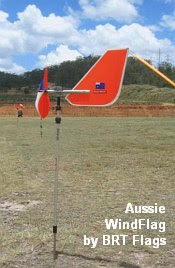
There’s a simple, inexpensive “miracle device” that can cut your groups in half. If you’re not using this device, you’re giving away accuracy. The “miracle device” to which we refer is a simple wind indicator aka “windflag”. Using windflags may actually improve your accuracy on target much more than weighing charges to the kernel, or spending your life savings on the “latest and greatest” hardware.
Remarkably, many shooters who spend $3000.00 or more on a precision rifle never bother to set up windflags, or even simple wood stakes with some ribbon to show the wind. Whether you’re a competitive shooter, a varminter, or someone who just likes to punch small groups, you should always take a set of windflags (or some kind of wind indicators) when you head to the range or the prairie dog fields. And yes, if you pay attention to your windflags, you can easily cut your group sizes in half. Here’s proof…
Which Windflag to buy? For starters, MTM makes a simple, inexpensive flag sold on Amazon for $24.99. For more sophisticated flags CLICK HERE for Benchrest Central windflag vendors.
Miss a 5 mph Shift and You Could DOUBLE Your Group Size
The table below records the effect of a 5 mph crosswind at 100, 200, and 300 yards. You may be thinking, “well, I’d never miss a 5 mph let-off.” Consider this — if a gentle 2.5 mph breeze switches from 3 o’clock (R to L) to 9 o’clock (L to R), you’ve just missed a 5 mph net change. What will that do to your group? Look at the table to find out.
Values from Point Blank Ballistics software for 500′ elevation and 70° temperature.
Imagine you have a 6mm rifle that shoots half-MOA consistently in no-wind conditions. What happens if you miss a 5 mph shift (the equivalent of a full reversal of a 2.5 mph crosswind)? Well, if you’re shooting a 68gr flatbase bullet, your shot is going to move about 0.49″ at 100 yards, nearly doubling your group size. With a 105gr VLD, the bullet moves 0.28″ … not as much to be sure, but still enough to ruin a nice small group. What about an AR15, shooting 55-grainers at 3300 fps? Well, if you miss that same 5 mph shift, your low-BC bullet moves 0.68″. That pushes a half-inch group well past an inch. If you had a half-MOA capable AR, now it’s shooting worse than 1 MOA. And, as you might expect, the wind effects at 200 and 300 yards are even more dramatic. If you miss a 5 mph, full-value wind change, your 300-yard group could easily expand by 2.5″ or more.
If you’ve already invested in an accurate rifle with a good barrel, you are “throwing away” accuracy if you shoot without wind flags. You can spend a ton of money on fancy shooting accessories (such as expensive front rests and spotting scopes) but, dollar for dollar, nothing will potentially improve your shooting as much as a good set of windflags, used religiously.
New Wind Reading App — High Power Wind Lab
There is a good, innovative Wind-Reading App, the High Power Wind Lab, that can help you figure your hold-offs in all wind conditions. This is available now for iOS devices, and an Android version is coming. In this video, our friend F-Class John reviews this sophisticated new Wind App:
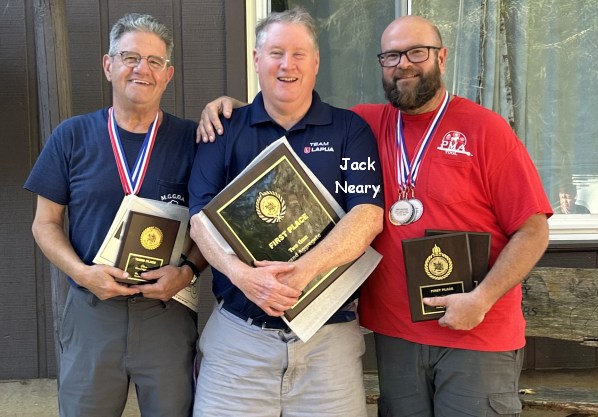
Team Lapua’s Jack Neary delivered an impressive performance at the NBRSA Eastern Region Fall Finale, held October 4–5 at the historic Shelby County Deer Hunters Association Benchrest Range in Sidney, Ohio. The Shelby County range, which was established in 1843, is said to be the oldest gun club in the United States. Neary claimed first place in the 2-Gun Grand Aggregate, showcasing extreme consistency and with his benchrest rifle chambered in 6mm PPC.
The match featured manageable conditions at 100 yards on Saturday, followed by challenging winds at 200 yards on Sunday afternoon. Despite the shifting conditions, Neary excelled, also securing first place in the Light Varmint 100-yard class on Saturday morning.
“After a very promising day of practice on Friday, I was pleased with the consistent small groups my rifle produced during the entire weekend match,” said Neary. “Using Vihtavuori N133 powder, Lapua .220 Russian Cases, and custom-built bullets with Berger J4 Jackets, I as able to navigate a talented field of accomplished Benchrest shooters for the two-gun win.”
We congratulate Jack Neary for his outstanding performance and well-earned victory in the 2-Gun Grand Aggregate, demonstrating exceptional marksmanship and consistency throughout the weekend.
Halloween (aka “All Hallows Eve”) will be celebrated in two weeks, on the 31st of October. Around the country pumpkins and Halloween decorations are on display in neighborhoods. Why not head to the range and shoot some Halloween-themed targets this month amidst the fall foliage. The folks at the NRA Blog have created a series of “spook-tastic” Halloween targets. Writer Kyle Jillson says, “In addition to stocking up on candy and finding great costumes, we thought you might like to have some fun at the range, so we created these spooky targets for you to use.”
Just click an image to launch its full-size version. You can then download the target and print it out on regular 8.5″x11″ paper. Now you have fun Halloween-themed targets to bring to the range in the next couple weeks.
In April 2020, the National Rifle Association (NRA) launched NRAWomen.com, a website dedicated to the fastest-growing group of firearm owners — America’s women. This website serves the increasing number of female gun owners, huntresses, and competitive shooters. Female involvement in firearms is growing significantly. Consider these numbers: Statistica estimates that 19% of women in the USA owned firearms in 2020, while 23% of women surveyed in a 2011 Gallup Poll stated they owned a gun.
Jessie Harrison is one of the greatest female pistol shooters on the planet.
Here are three excellent Articles from the NRAWomen.com website, all worth reading. For each example, Click the Photo or direct link to read the full article on NRAWomen.com.
1. Flying with Firearms — What You Need to Know
We recommend that any gun owner, female OR male, should definitely read this article. It is one of the better discussions on the web of airline travel with firearms, covering international travel as well as domestic flights. The article notes that you should obtain U.S. Customs Form 4457 before flying overseas with a firearm.
“Flying with a gun is actually a lot easier than you’d probably expect. You need a couple of specific gear items, and you need to know the proper procedure, but it’s a relatively simple process. I’ve flown with long guns and handguns dozens of times around the country and around the world. The process is generally the same, but with some additional steps and maybe additional hassle depending on the airport [and personnel.]” READ FULL ARTICLE on NRAWomen.com.
2. Modular Safes — Smart Option for Easier Moving
The second article features a great video showing how to assemble a modular safe in under 30 minutes. This article also explains the benefits of modular gunsafes — primarily easier transport and installation.
“Modular safes have been around for a few years now and are becoming more popular. Here’s why: The safe comes delivered to you in panels, so you can bring them into your home one at a time and put it together anywhere you like. This makes it easy to carry up and down stairs, onto elevators or anywhere! Security — Is it as secure as one that comes pre-assembled? The answer is, absolutely.” READ FULL ARTICLE on NRAWomen.com.
3. Rimfire .22 LR Handguns for Self-Defense
This article looks at a wide variety of .22 LR pistols and revolvers. The author discusses the pros and cons of a rimfire defense gun, concluding that while the stopping power is limited, having some protection is better than going unarmed.
“Over the last few months we’ve seen the launch of new handguns chambered for .22 LR that sport the same looks and features as center-fire handguns designed for daily concealed carry. The models I’ve had a chance to work with so far include the compact Taurus TX22 semi-automatic pistol, the pocket-size Ruger Lite Rack LCP II, Kel-Tec’s P17 semi-automatic and the Taurus 942 8-shot snubnose revolver.” READ FULL ARTICLE on NRAWomen.com.
Forum member Rardoin’s handsome F-Open rig features the Borden BRM-XD action.
One of the most popular items in our Shooters’ Forum is the ongoing “Pride and Joy” thread. Since 2009, Forum members have posted photos and descriptions of their most prized rifles. Here are some of the most recent “Pride and Joy” rifles showcased in our Forum. Do you have a gun you’d like to see featured there? Just Register for the Forum and you can add your favorite gun to the list.
Modern 6BRA Bench Rifle
This handsome benchrest rig belongs to Forum member Tillroot1. It boasts a Kelbly Panda action and a Krieger cut-rifled barrel chambered for the excellent 6BRA wildcat cartridge. The 6BRA is an improved version of the 6mmBR which retains the long neck. The 6BRA is easy to fire-form and very accurate, and can achieve the really good 2950 FPS node with 105-108gr bullets. This cool rig features a Jason Avila-made stock (Wheeler F-Open), with finish work by Brett Childress. Barrel was chambered by Dave Witt.
Bill Goad’s 6PPC Hunter “Ranch Rifle”
Forum member Grimstod tells us: “This is the personal rifle of Bill Goad. He has been experimenting with it on several levels. It is shooting great and has several matches on it now. Please enjoy these photos. More can be found on the website www.PremierAccuracy.com. We like the subtle barbed wire effect on the stock.
Twin-Upper AR with Custom Wood Furniture
This very unique AR belongs to Forum member Nuto-BR. He tells us: “Here are the two uppers I built. The top one is am X-caliber in 20 Practical with 24-inch, 1:11″-twist barrel. The bottom one is a WOA in .223 Rem, with 20″, 1-12″ twist barrel. They both shoot 1/2 MOA or better. Both stocks are laminated Maple and Walnut. I reversed the order of the two woods to tell them apart.”
Two Dashers and a Rimfire for Fun
Courtesy Forum member Dan H., here are two red-stocked Dashers plus an Anschutz 54.30 (Benchrest Stock) to make it a trio. Dan says: “The Anschutz provides good practice in trigger-pulling. It’s amazing what you can learn from a rifle that is as sensitive as this one.”
Dream Hunting Rifle with Custom Camo
Here is Forum member TyDaws’s “Dream Hunting Rifle” in 6.5-280 Ackley Improved. We love the custom paint work by by Melodie Yarbrough. Smithed by West Texas Ordnance, this rifle features a Rem 700 action with fluted bolt, PT&G tapered recoil lug, and Timney 510 2-lb trigger. The barrel is a fluted 26″ 1:8″-twist Bartlein 5R #3 contour. On top is a Huskemaw Blue Diamond 4-16x42mm optic in Warne Maxima rings. That’s an Atlas bipod up front.
Three Guns for Mr. Big
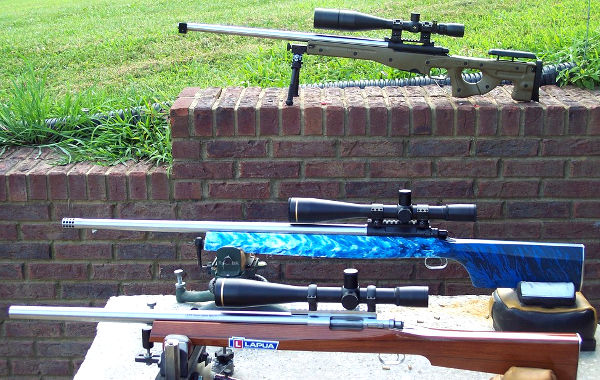
Forum Member Mr. Big offered up another trio of rifles — two bench guns and a tactical rig. Mr. Big says: “Here are the rifles I shoot most: Farley 6mm PPC, Stiller .243 Win, and Rem 6.5×47 Lapua. They will do just about anything I ask them to…” Challenge: Can you identify the makers of the three different stocks shown in this picture (and the different materials used in each)?
Classic M1917 Enfield Action in Hand-Carved Maple Stock
This impressive rifle features an “antique” 1917 Enfield action chambered for the .338 Win Magnum cartridge. The lovely Maple stock was hand-carved by Forum member Spitfire_ER. He tells us: “I found this piece of wood as a return at a lumber yard about [many] years ago. I asked the guy in the yard about it and he said it had been returned because it had too much figure for the job the customer was working on. First thing I thought was, ‘That would make a nice stock’.”
6mm Dasher in Robertson Spider Web Stock
Here is Forum member Vahena’s 6mm Dasher. It has a no-turn-neck chamber in a 28″, 1:8″-twist barrel with 1.25″ straight contour. This has an original Robertson fiberglass stock with spider web graphics. This rifle was originally built as a 6.5×284 with a fluted barrel. Now it sports a bigger barrel for a smaller cartridge. The front rest is a SEB Neo with counterweight up front.
Precision rifle shooters don’t have to hit a big-league fastball, or launch a top-fuel dragster in the blink of an eye. Nonetheless, reaction times are important in our sport — both for competitive shooters and hunters. Want to catch that prairie dog before he slips down his hole? You’ll need to be quick. Want to win at short-range benchrest? Then you’ll need to watch your windflags and respond quickly to a change. Miss a major wind-shift and you could ruin your whole weekend.
Here’s a fun test of reaction times from HumanBenchmark.com. The way it works is that, after clicking “Start”, you wait until the background color changes from red to green. The instant you see green, immediately click your mouse. The average (median) reaction time is 273 milliseconds, according to data collected so far. Hint: If you keep your finger “preloaded” in contact with your mouse button you can shave some milliseconds — but don’t “jump the gun”.
Tips for Faster Times
Here are three tips to speed up your reaction times:
1) Respond to the color change (by itself), rather than wait to read the word “CLICK!” after the box shifts to green.
2) Try focusing at the corner of the box, rather than the center. This may help you react “without thinking”.
3) Have your index finger “poised and ready” over the left button–you can shave milliseconds by very slightly depressing the button before you actually click.
Editor’s Note: This story was first published many seasons ago. In the interceding years, equipment has evolved — actions, optics, front rests and so on. But this rifle remains very competitive in the 600-yard silhouette game, and it remains a wicked weapon for long-range varminting.
The 6-284 may well be the “ultimate” 6mm cartridge, if speed AND accuracy are considered. While it burns a lot more powder than a 6mmBR or 6 Dasher, it also delivers a lot more velocity. Our friend John Southwick, owner of this week’s featured 6-284, can push 107gr SMKs past 3400 fps — velocities no 6BR, 6BRA, or 6 Dasher can touch. He normally dials that back to 3200 fps or so, but that’s still well beyond the limit of a 6 Dasher even a 6mm Creedmoor. John’s gun is more than a speed demon of course — it’s a hyper-accurate match rifle that has claimed many Varmint Silhouette wins. At his club, when John and the Black Borden come out to play, everyone else is usually competing for second place.
Building the Borden Black Beauty
John tells us: “I chose the 6-284 mainly because it appeared in the winning equipment lists of 1K BR matches, and it was becoming very popular with long-range varminters. Skip Talbot had also used a 6-284 to set an IBS 1000-yard record (subsequently lowered in the last decade). Norma and Lapua offered quality 6.5-284 brass, so case-forming would be easy. I wanted a fairly light-recoiling rifle, and after much research I came to the conclusion that a high-BC 6mm bullet driven at 3200+ fps would meet my needs.
I was looking for a very high performance long-range target/bench rifle, primarily to use in 600-yard matches at my local club (Ojai Valley Gun Club), and possibly 1000-yard bench matches, plus occasional varmint hunting. I wanted to have a rifle that was built by a prominent gunsmith. I chose to work with Jim Borden of Borden Rifles for several reasons: his rifles had set world records, his reputation was excellent, and his rifles often showed up in the winning equipment lists of IBS and NBRSA sanctioned shoots. Also I had decided that I wanted a Nesika-actioned gun. I was impressed that Jim had designed one of the Nesika’s key features – Borden Bumps. Likewise, I liked the Bald Eagle front rest, and found out that Jim contributed to its design as well. This gave me confidence that Jim understood every element that goes into precision rifle performance.
Loading for Accuracy
My match load consists of Norma 6.5-284 brass, 51.0 grains of Alliant Reloder 22, Fed 210m primers, and Sierra moly-coated 107gr MKs, seated about .010″ into the lands. This runs about 3250 fps from the 28″ barrel. Case necks are turned to .0133″ wall thickness for a .270″ loaded neck diameter. I use a .268 or .269 bushing, and bump the shoulders back each time. I set the “bump” so that, with firing pin removed, I can just feel the case in the chamber when closing the bolt. My loaded rounds typically show no more than .0015″ runout on a NECO concentricity gauge. I credit the low run-out in large part to the custom inline seating die and shoulder-bump neck-bushing die Jim made for me.
How the 6-284 Shoots
The rifle has fulfilled all my expectations. It is a superbly precise and accurate rifle, as long as I do my part in steering the gun and feeding it consistent, quality ammo. I haven’t done a lot of 100-yard group shooting, just enough to test loads. Typically the rifle easily puts five shots into half-MOA or less at 600 yards. I’ve logged several 3-shot groups between 1.06″ and 2.2″ at 600 yards. I’ve been told that kind of accuracy would be competitive in a 600-yard BR match. But most importantly, I have confidence the gun will hit where I aim. Our Ojai club uses half-size silhouette targets. This gun’s ability to pick off the relatively small steel targets, even in some of the worst conditions imaginable, is nothing short of amazing. At times it seems I’m launching 107gr silhouette-seeking guided missiles.”
Borden 6mm-284 SPEC SHEET
Borden Long-Range Rifle, 16.5 lbs
Nesika ‘K’ Action, 1.70″ diam., Right Bolt, Left Port.
Hart 28″, 1:9″ twist, .920″ at muzzle, cryo’d with .272″ neck diam. and 1.5° throat.
McMillan MBR stock, Borden texture finished, pillar-bedded, with action also glued in.
Nightforce 12-42x NXS,
NP-R2 reticle, 20 MOA ramped scope base, Leupold Mark IV rings.
A Special Brand of Silhouette Shooting
John’s rifle is a purpose-built gun, optimized for one task — hitting little half-size silhouettes at very long distances, at a shooting venue that demands serious wind wizardry. At Ojai, even though matches commence early in the morning, it’s not unusual to have a 10 mph wind blowing left to right at the firing line, no wind at the mid-course flag, and a swirling variable wind at the targets. To make matters worse, the little critters sit on top a ramped berm. When the wind switches to 6 o’clock, it can rise right in front of the target, sending shots high. Despite the often-wicked conditions, John and his Black Borden have excelled at the varmint matches — he’s the “smart-money” bet to win on any given weekend.
John reports: “The rifle has really proven itself at the 600-yard silhouette match at my local club. We shoot ten targets per match, usually three “matches” or relays per day. Targets are half-size NRA Hunter Pistol metallic silhouettes: 1 Ram, 2 Turkeys, 3 Pigs, and 4 Chickens (note, these are larger than the mini-silhouettes in the above photo). The Ram counts one point, Turkey two points, Pig three points and the Chicken counts four points. The Chickens have a “hit zone” roughly .6 MOA at 600 yards–about 3.6″. Trust me, that can be challenging, particularly in shifting winds. Unlike conventional silhouette matches, we shoot F-class fashion from the ground, using bipods or pedestal rests. That’s easier than shooting off your hind legs of course, but our targets are much smaller than standard high-power silhouettes.”
The Black Borden was the rifle to beat at Ojai for many years. John held the record for the most “cleans” (no misses) for the event, and he was the annual Champion for many years, including five years in a row. One year he won the championship in the very last match. John noted: “Thankfully, the gun was humming and I made the right wind calls. I picked up enough points in the final shoot to win the series for the year.” Yes, John’s flat-shooting Borden 6-284 had done its job once again.
Long-Range Silhouette Match Strategy and Techniques
In competition, John says watching the conditions, and minimizing mental mistakes is key: “I keep things pretty basic. Our varmint silhouette matches allow 20 minutes for sighters and 10 shots on target (one per animal). We usually get in three “matches” or relays per event. I try to wait for a favorable condition, then take a few sighters and adjust the scope as needed. If the condition holds steady, I’ll try to run my targets before the wind changes.
At the Ojai range, it is vital to watch the wind flags and heed your spotters’ calls. I’ve seen the wind go from 7mph right to 10mph left from one target to the next. That’s nearly a foot and a half of horizontal change for my gun. If there is a major change, I will try to wait it out. If the shift is small, I may hold off a bit. Scope corrections are a last resort; while you’re dialing, the wind may switch again.”
Technical Report from Jim Borden, Gunsmith
We set up John’s 6-284 as we would for 1000-yard Light Gun competition. We’ve also built some of these rifles in 6MM BR for use in 600-yard competition. For John, we used a Borden/Nesika Model K 1.70″ diameter action as the beginning basis of the rifle. The timing and cocking-piece system for this rifle has the Borden improvements to improve firing pin energy and lock time. The action was pillar-bedded and glued into a McMillan Tooley MBR pattern stock. The stock blank was gel-coated and then epoxy-finished with a texture.
About the Muzzle Brake — We normally blend the brakes into the barrel to make the transition smooth and unseen. John preferred to have the brake larger than the barrel so that it could also be used on future barrels.
9-Twist Barrel — The barrel is a 1:9″-twist Hart HV pattern 28 7/8 inches long. Our 6×284 reamer has a .272″ neck diameter. It is throated with a tight cylindrical section followed by the 1 ½ degree throat. Chambering of the barrel was done utilizing our proven Benchrest chambering techniques. The method of chambering ensures that the body, neck and throat of the chamber align concentrically with the bore and grooves of the barrel. [Editor: With a 6BR or 6 Dasher, we’d definitely recommend an 8-twist barrel to shoot 105-107 grain match bullets. However, with the extra velocity of the 6-284, the 9-twist Hart worked great for John.]
NOTE: Borden Accuracy (BordenRifles.com) now produces its own excellent Borden Custom Actions, which have won National Championships and set World Records. Borden offers precision bolt action receivers for competition, ELR, hunting, varmint, PRS, and other shooting applications.
Situated in the Coastal Mountains behind Ventura, California, the Ojai Valley Gun Club is a beautiful place to shoot. And the Hwy 33 route up to the range offers stunning views.
You can spend thousands on a rifle, but that expensive hardware won’t perform at its best if you have poor trigger technique. One key element of precision shooting is trigger control. Our friend Kirsten Joy Weiss has produced a good video that shows how to refine your trigger technique for better accuracy. In this video, Kirsten talks about the actual placement of a shooter’s index finger on the trigger. It is important to have the finger positioned optimally. Otherwise you can pull the shot slightly left or slightly right.
Kirsten tells us: “Finger placement on the trigger might not seem like a big deal, but it actually is. The reason for this is because, depending on where your index finger is placed on the trigger, [this] translates to different muscle interactions with the gun.” Watch this video to see Kirsten demonstrate proper finger placement (and explain problems caused by improper finger positioning).
When you pull the trigger, you only want to engage the last section of your finger, in order to avoid unwanted muscle engagement and to achieve a smooth shot. Remember there is a “sweet spot” between the crease (first joint) and the tip of the finger. If you position the trigger in that “sweet spot”, you should see an increase in your accuracy. Don’t make the mistake of putting the trigger in the crease of your finger, as shown below.
Effects of Incorrect Finger Placements
You want to place the trigger shoe between the end of your finger and the first joint. If you place the trigger on the very tip of you finger you’ll tend to push the rear of the rifle to the left when engaging the trigger, causing shots to go right (for a right-handed shooter). On the other hand, if you put the trigger in the crease (first joint), you’ll tend to bring the rear of the rifle to the right, causing shots to fall left. This is illustrated below for a right-handed shooter.
PMA Tool offers lightweight yet sturdy cleaning cradles that are handy, affordable, and easy to transport. PMA’s popular single-gun cradle, priced at $119.95, is ideal for benchrest and F-Class rigs. It measures about 17″ in length and weighs about one pound. You can choose among 2.25″, 3″, 4″, 5″, and 6″-wide saddles (U-shaped padded supports) to match your forearm width.
PMA also offers an excellent double cradles for $174.95. These twin cradles have 2.5″, 3″, or 4″ saddles, or a combo of 3″ / 2.25″ front saddles. All these cradle types secure your rifle(s) in a muzzle-down position that allows easy cleaning and prevents solvents from running back into the action. The front saddles and all contact surfaces are covered by thick silicone rubber padding which grips the rifle securely yet protects the stock and components from scratches.
These cradles are most commonly sold with a 3″-wide front saddle for Benchrest and F-Open style stocks, or a 2.25″-wide front saddle for rifles with narrower fore-ends such as those found on F-TR, Hunter Class, and varmint stocks. In addition, you can get 4″-wide cradle for the big, long range benchrest rifles.
Double Rifle Cradle is a Smart, Versatile Design
PMA’s double rifle cleaning cradle was was designed from the ground up to work perfectly for two rifles side-by-side. Using the same tie bar and protective saddles found on the single cradel, PMA widened the base and created new uprights to support the saddles, making the cradle as narrow and light as possible, while retaining all the protective and non-slip features from our single unit.
This PMA Tool double cradle unit is available with twin 3″ front saddles, double 2.5″ front saddles or combination 3″ / 2.25″ front saddle configurations to accommodate different classes of benchrest rifles.
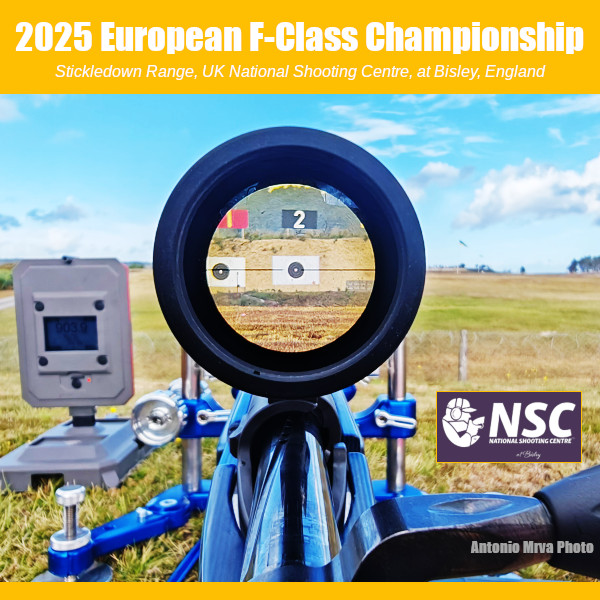
The 2025 European F-Class Championships took place September 1-8, 2025 at the famed NRA Bisley Shooting Centre in the United Kingdom. Hundreds of talented competitors attended the match, with shooters from the USA finishing at the top in both F-Open and F-TR class.
Here’s a report from the NRA UK Facebook Page: “That’s a wrap on the F-Class European Championship. As the biggest F-Class event in the world, it brought together the finest shooters to test their skills at our very own National Shooting Centre, Bisley. It was a true testament to the skill and dedication of every competitor, with Bisley’s Stickledown Range living up to its reputation as a challenging and dynamic range. The wind and conditions were relentless, but so were the competitors.
A huge well done to all the competitors who travelled from across the world to participate. And thank you to the incredible NRA staff and volunteers who made the event possible. We are so proud to have hosted this prestigious event at the National Shooting Centre and we are already looking forward to hosting the World Championships in 2026.”
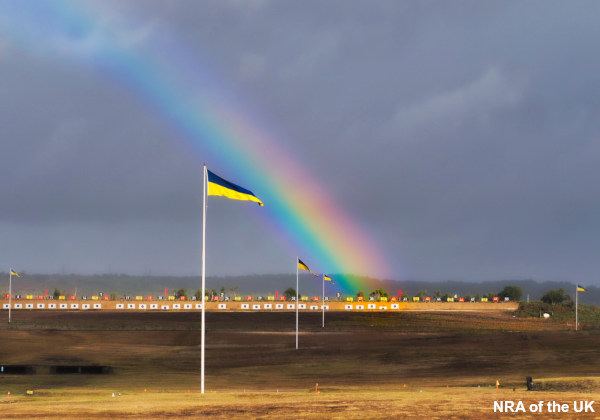
Stunning rainbow on the Stickledown range at Bisley, England, UK.
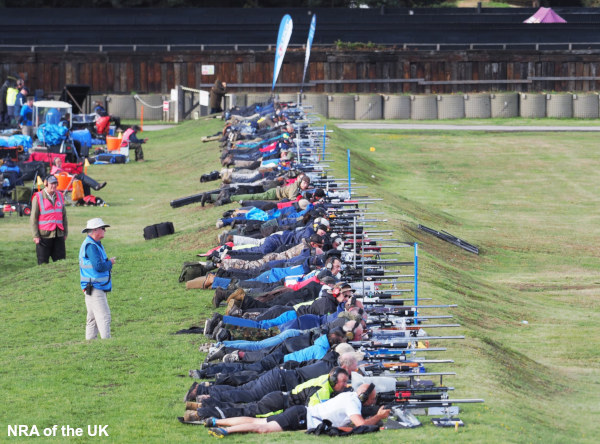
F-Class competitors on the firing line. CLICK HERE for more information about the famed Stickledown range at the NRA UK Bisley Centre.
The 2025 European F-Class Championships drew hundreds of shooters from around the globe, many from outside Europe. Top competitors from the USA wanted to gain experience at the challenging Stickledown range because the 2025 WORLD Championships will be held at the same venue. It was a demanding match, with very tough weather conditions during some sessions. CLICK HERE for full Individual and Team Results at 2025 Euro F-Class Championships.
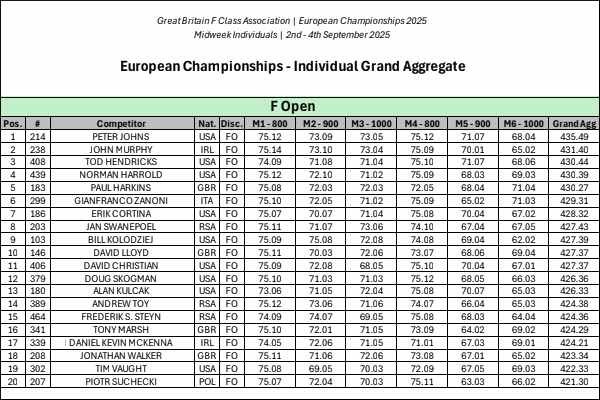
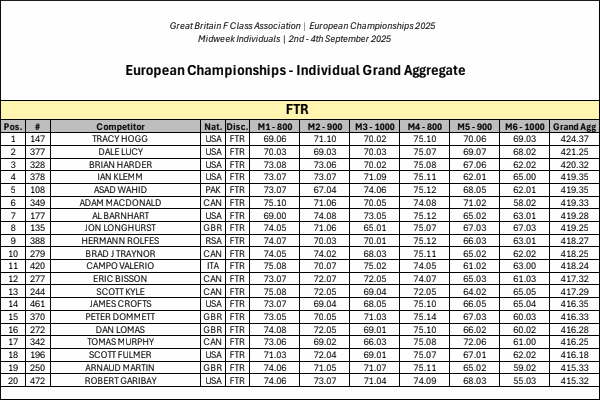
Top 20 Finishers at 2025 European F-Class Championships
Congrats to F-Open Champion Peter Johns, who surpassed runner-up John Murphy of Ireland by 4 points. American shooters took three of the top five places in the F-Open competition.
Praise to F-TR winner Tracy Hogg, who edged second-place Dale Lucy by 3 points. Americans took four of the top five place in the F-TR championships.
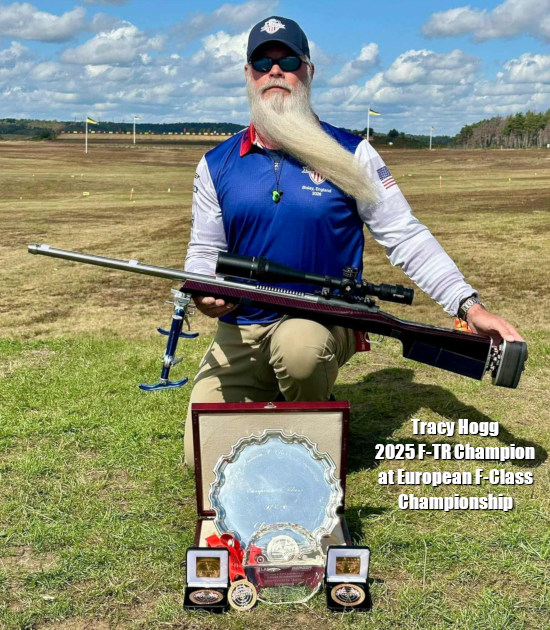
American Tracy Hogg Wins 2025 European F-TR Title
SEB Lambang, creator of SEB Rests and Joypod-X joystick bipods, posted: “Congratulations to Tracy Hogg for winning the 2025 F-TR European Championship!” Tracy, shown below with his awards, posted: “I’ll have to be honest I should have started years ago (using the Joypod-X). It really helped being able to move across the target so quickly in those tricky winds in Bisley”.
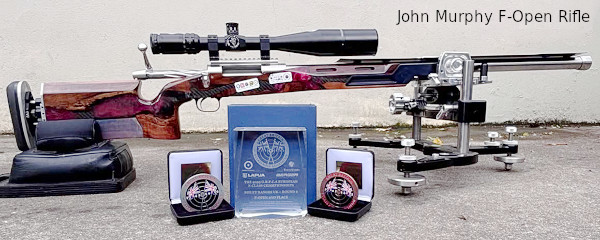
Report from John Murphy (2nd Place, F-Open)
American F-Open competitor John Murphy posted this report: “Finally back home and unpacked after an incredible week at the European F-Class Championship in Bisley. I’m thrilled to have finished 2nd overall [in F-Open], shooting through some of the toughest conditions I’ve ever faced and competing against many of the best in the world. Congratulations to Peter Johns on taking 1st place — he’s not only a world-class shooter but also a true gentleman.
A big thank you to Richie, the GBFCA, and the entire crew for organizing such a fantastic event. And of course, to my teammates, who made me proud in both the Team Matches and the America’s Cup. Already looking forward to seeing everyone again next August for the World Championships!”
Here’s a video report from Erik Cortina, who finished 7th overall in F-Open:
Rifle Images from the 2025 European F-Class Championships
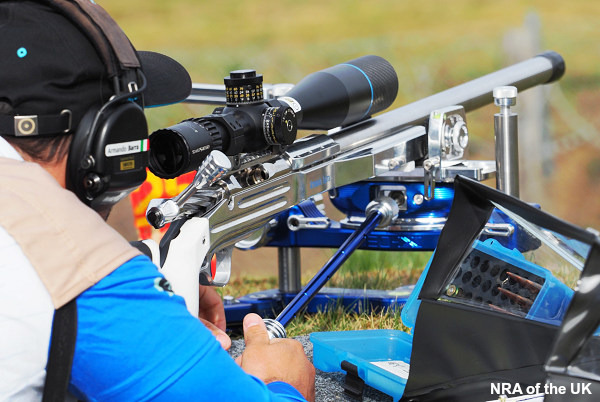
F-TR competitor with alloy stock. Note the extremely low-profile bipod mounted close to bore axis. That helps minimize twist/roll on recoil.
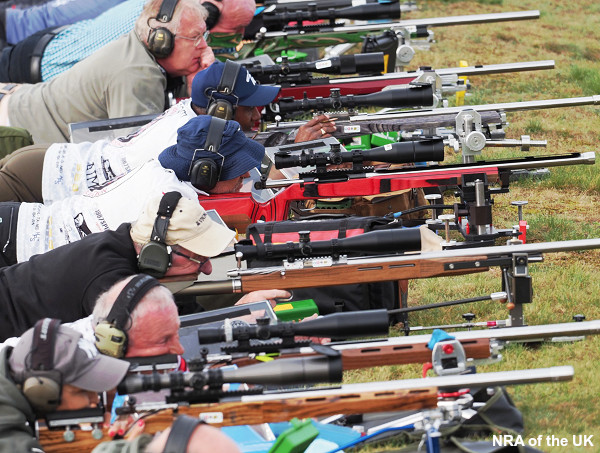
F-Class competitors on the firing line. All shooters shown here had laminated wood stocks.
F-Open shooter with SEB NEO-X Front Rest. This rest folds compactly for transport yet is extremely stable during shooting, with superb joystick control.
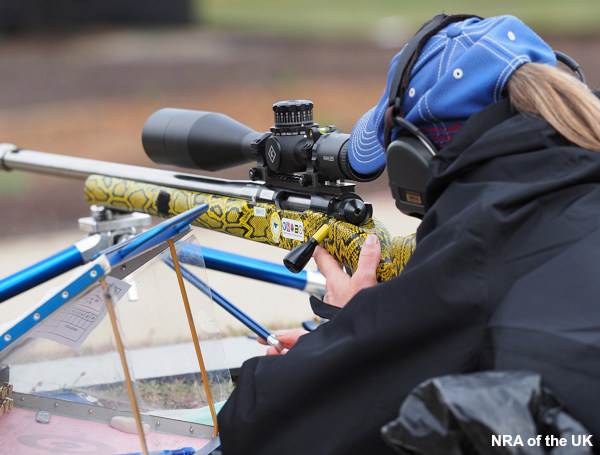
Lady F-TR competitor with a handsome gold snakeskin pattern on her stock, with matching gold bolt shaft.
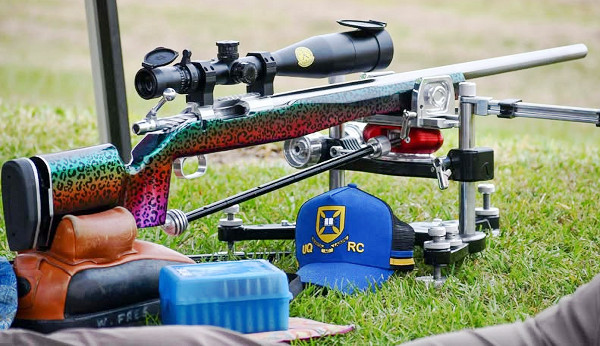
This rifle called “Sindy” features a leopard print on multicolour metallic. Very handsome. SEB Lambang posted: “Thank you Wendy LFree for sharing this lovely pix and for using my products!”
Heavy Rain and High Winds at Stickledown — Challenging Conditions
There were significant rainstorms during the 2025 F-Class Championship. Competitors needed tough wet-weather gear, and rainguards over their ammo and scoresheets. It was also wise to protect your scopes from moisture so that raindrops did not obscure the lens views.


 There’s a simple, inexpensive “miracle device” that can cut your groups in half. If you’re not using this device, you’re giving away accuracy. The “miracle device” to which we refer is a simple wind indicator aka “windflag”. Using windflags may actually improve your accuracy on target much more than weighing charges to the kernel, or spending your life savings on the “latest and greatest” hardware.









 Building the Borden Black Beauty
 Loading for Accuracy

 Long-Range Silhouette Match Strategy and Techniques
 We set up John’s 6-284 as we would for 1000-yard Light Gun competition. We’ve also built some of these rifles in 6MM BR for use in 600-yard competition. For John, we used a Borden/Nesika Model K 1.70″ diameter action as the beginning basis of the rifle. The timing and cocking-piece system for this rifle has the Borden improvements to improve firing pin energy and lock time. The action was pillar-bedded and glued into a McMillan Tooley MBR pattern stock. The stock blank was gel-coated and then epoxy-finished with a texture.