Are you looking to get started in PRS and NRL practical precision rifle competition? Or perhaps you’d like to advance your skill set so you can place higher in big matches (and get your hands on those prize table items)? Of course there is no substitute for trigger time in the field, but there ARE some great print resources. These four books can help you select the right equipment, improve your shooting skills, make better wind calls, increase your fitness, and develop a more efficient between-match training program.
1. Precision Rifle Marksmanship: The Fundamentals
Frank Galli, $26.03 Paperback, $15.99 Kindle
Frank Galli (aka “LowLight”) is the founder/head honcho of SnipersHide.com, the most active tactical community on the internet. Galli is also a retired USMC scout-sniper. Practical Precision Rifle shooting is one of the hottest trends in competitive shooting today. PRS and NRL matches draw big turn-outs and boast impressive prize tables. Galli’s Precision Rifle Marksmanship (#ad) book covers the fundamentals of precision marksmanship with easy-to-understand methodology. The book uses the same instruction process that Galli uses in his live marksmanship classes.
As Sniper’s Hide guru Frank Galli explains, there is no voodoo when it comes to precision rifle marksmanship, but there are techniques that, when practiced, make the difference between good marksmanship and great marksmanship. Understanding the reasons that a bullet hits or doesn’t hit its intended target at ultra-long distances is a crucial element to learning. Galli’s explanations of how to understand and compensate for wind speed and direction are excellent — Galli offers great wind-reading advice.
Published in 2020, this 272-page well-illustrated book covers the latest equipment (scopes, LRFs, chassis systems, mags, bags, bipods, tripods) favored by tactical competitors in PRS/NRL type matches.
2. Long Range Shooting Handbook
Ryan Cleckner, $22.46 Paperback, $9.99 Kindle
Ryan Cleckner’s Long Range Shooting Handbook (#ad) is the best-selling modern book on practical rifle skills. A former U.S. Army sniper instructor, Cleckner is knowledgeable, and his text is well-organized and chock full of good information. You can view Sample Chapters on Amazon.com.
Ryan Cleckner’s highly-regarded Long Range Shooting Handbook is designed as an intro to important fundamental concepts such as MOA vs. Mils, External Ballistics, and Environmental Effects. Included are personal tips and advice based on Cleckner’s years of experience as a sniper instructor and special operations sniper.
The Long Range Shooting Handbook is divided into three main categories: What It Is/How It Works, Fundamentals, and How to Use It. “What It Is/How It Works” covers equipment, terminology, and basic principles. “Fundamentals” covers the theory of long range shooting. “How to Use It” gives practical advice on implementing what you’ve learned, so you can progress as a skilled, long range shooter. This book will benefit any long-range shooter, not just PRS/NRL competitors.
3. IMPACT! — Training and Preparing for Precision Rifle Matches
Rodney Maze, $14.99 Paperback, $4.99 Kindle
Impact!, by PRS competitor Rodney Maze, is an entry/intermediate level guide to preparing yourself and your equipment to compete in precision rifle type matches. It will also benefit anyone looking to learn about practical-style long range and precision shooting. We recommend you check it out for yourself — there are 20 Pages of free sample content(#ad) on Amazon. Topics covered include:
— Rifle, optic, and equipment selection
— Setting up your rifle, bags, tripods for PRS/NRL matches
— Understanding ballistics and how to record and use ballistic data
— Techniques for using holdovers for multi-target stages
— Gun skills, rapid fire techniques, clearing malfunctions
— Shooting off of barricades, and specialty stages
— Effects of wind and how to improve your wind calls
— Tips for live fire and dry fire practice
— Preparing yourself and your equipment for a match
— Mental strategies and techniques
Impact! is illustrated with plenty of photographs. Topics are divided logically, and concepts are explained in clear language. Also included is an extensive glossary of terms used in precision shooting and a list of additional resources you can use to further pursue your precision shooting knowledge. This book also includes a handy Appendix with formatted pages for recording data about your rifle, scope, and ammunition. There is also a Wind table for recording your rifle “dope” and wind hold-offs. Lastly, Impact! has a useful table of unit conversions.
4. Practical Shooter’s Guide
Marcus Blanchard, $19.99 Paperback, $9.99 Kindle
Thinking of getting started in the Practical/Tactical shooting game? Looking for ways to be more stable when shooting from unconventional positions? Then you may want to read Marcus Blanchard’s Practical Shooter’s Guide (A How-To Approach for Unconventional Firing Positions and Training) (#ad). Unlike almost every “how to shoot” book on the market, Blanchard’s work focuses on the shooting skills and positions you need to succeed in PRS matches and similar tactical competitions. Blanchard provides clear advice on shooting from barricades, from roof-tops, from steep angles. Blanchard says you need to train for these types of challenges: “I believe the largest factor in the improvement of the average shooter isn’t necessarily the gear; it’s the way the shooter approaches obstacles and how they properly train for them.”
As an Amazon affiliate, this site can earn revenues through sales commissions.
What anti-corrosion products really fight rust effectively? You’ll hear many opinions, but what do actual field tests reveal? One rifle shooter, who posts on YouTube as BlueonGoldZ, wanted to separate myth (and marketing claims) from reality, so he completed his own long-term rust test using metal samples. First he used ordinary tap water spray, and then he did a second, longer-duration test with a salt-spray solution. Nine different products were tested: Break Free CLP, Corrosion-X, Frog Lube, M-Pro 7, Outers, Pro-Shot Zero Friction, Rem Oil, Slip 2000, and Tetra Gun Triple Action CLP.
BlueonGoldZ initially examined each product for its “beading” properties with a normal tap water spray. But the main test involved many multiple weeks of exposure after a “dense” salt-water spray. (No rust formed after two weeks tap water exposure, so the test was accelerated with salt-water exposure).
The clear winners in the test, as shown by the screen shot above, were Corrosion-X (Best), and Frog-Lube (Second Best). The photo shows the test samples two weeks after being sprayed with salt water. The results are pretty dramatic — you can see with your own eyes what happened. We think this is a very useful bit of real-world research.
Results from Similar Long-Term Salt Exposure Test
Unfortunately, BlueonGoldZ’s test did NOT include Eezox, which we have found to be extremely effective (on a par with Corrosion-X). In another long-term test of corrosion preventatives, the two best rust fighters were Eezox and Corrosion-X in that order. Since that test was completed, Corrosion-X, already an excellent product, has been enhanced. CLICK HERE for Long-Term Salt Exposure Test Report.
Forum member Erik Cortina has produced a series of YouTube videos about reloading hardware and precision hand-loading. Here we feature Erik’s video review of the Forster Co-Ax® reloading press. The red-framed Co-Ax is unique in both design and operation. It boasts dual guide rods and a central handle. You don’t screw in dies — you slide the die lock ring into a slot. This allows dies to float during operation.
Erik does a good job of demonstrating the Co-Ax’s unique features. At 1:00 he shows how to slide the dies into the press. It’s slick and easy. At the two-minute mark, Erik shows how sliding jaws clasp the case rim (rather than a conventional shell-holder). The jaws close as the ram is raised, then open as it is lowered. This makes it easy to place and remove your cases.
At the 5:20 mark, Erik shows how spent primers run straight down into a capture cup. This smart system helps keep your press and bench area clean of primer debris and residues.
While many Co-Ax users prime their cases by hand, the Co-Ax can prime cases very reliably. The priming station is on top of the press. Erik demonstrates the priming operation starting at 4:20.
Smart Accessories for the Co-Ax from Inline Fabrications
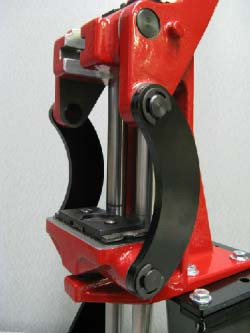
Forum member Kevin Thomas also owns a Co-Ax press, which he has hot-rodded with accessories from Inline Fabrication. Kevin tells us: “Check out the add-ons available from Inline Fabrication for the Co-Ax. I recently picked up a riser mount and a set of linkages for mine and love the results. The linkages are curved. When you replace the original straight links with these, the work area opens up substantially and the the press becomes much easier to feed.” CLICK HERE for Co-Ax Accessories.
Inline Fabrications Forster Co-Ax Accessories
Forster Co-Ax Curved Side Linkage (For Better Access)
The Cartridge Comparison Guide is a remarkably comprehensive 340-page, spiral-bound book. Covering over 250 cartridges, the Second Edition of the Cartridge Comparison Guide is the product of many years of labor by Andrew Chamberlain, a Utah-based hunter. Andrew says his Guide “compares every factory available cartridge from the 17 calibers up to the 50 caliber cartridges”. (Sorry, most wildcat cartridges are not covered.) Chamberlain’s Guide also compiles cartridge data from major ammunition manufacturers such as Barnes, Federal, Hornady, Norma, Nosler, Remington, Sierra, Swift, Weatherby, and Winchester. It shows the optimal velocity achieved for each bullet weight and calculates bullet energy, recoil, and powder efficiency. Large color photos illustrate handgun and rifle cartridges.
The Cartridge Comparison Guide provides data for thousands of cartridge/bullet/velocity combos. Quick reference sheets and ballistics charts cover Trajectory, Velocity, and Energy out to 500 yards. The Cartridge Comparison Guide also offers a firearms lexicon, plus Appendices covering Cartridge Selection for Game Animals, Bullet Selection/Design, Bullet Expansion, and Wound Channel Characteristics.
New Content in Second Edition of Cartridge Comparison Guide
The Cartridge Comparison Guide (Second Edition) costs $39.99 plus shipping and tax. CLICK HERE to visit the Online Store where you can order the 340-page book. Here’s what’s new in the Second Edition:
Addition of Shotgun Ammunition (Both Slug and Shot loads).
Momentum Calculation for all Rifle, Shotgun and Handgun loads.
Integration of Shotgun Slug Ammunition with Center Fire Rifle Data Tables.
Factory Load Summary Added (Shows manufacturers and loads produced).
One factory load and one hand load for every bullet weight available in each cartridge.
Over 90 pages of additional ballistics content (roughly 35% more than in First Edition).
Great Resource for Hunters
One of Chamberlain’s main goals in creating the Cartridge Comparison Guide was to help hunters select the right cartridge for the job: “This started as a personal project to gather information on the more popular cartridges commonly used for hunting. I wanted to find the best all-around performing cartridge and rifle that a guy on a budget could shoot. I began comparing cartridge performance, versatility, bullet selection, powder efficiency, recoil generation vs. energy produced, standing ballistic data for different environments….”
Giant Cartridge Poster for Computer Wallpaper (1665×1080 pixels)
Here’s a great illustration of hundreds of cartridges and shotshell types. For dedicated reloaders, this would work great as desktop “wallpaper” for your computer. CLICK HERE for full-size image.
In June 2020, Hornady introduced the 6mm ARC, a new SAAMI cartridge optimized for AR-platform rifles*. The new 6mm ARC is basically a 6.5 Grendel necked down to 6mm, with the shoulder moved back around .030″. That pushed-back shoulder does reduce case capacity (and velocity), but we assume Hornady did that to create a shorter, proprietary chamber so people could not simply neck-down Lapua 6.5 Grendel brass, as has been done for years with Robert Whitley’s outstanding 6mm AR wildcat.
What Is the 6mm ARC Cartridge? The 6mm ARC cartridge is a new SAAMI-spec cartridge based on the 6.5 Grendel case necked down for 6mm bullets, with the shoulder moved back 0.030. Yes it is designed to run in AR15-platform rifles. You’ll need a new barrel, bolt, and mags. If you already have an AR chambered in 6.5 Grendel, the ONLY thing you need to change is the barrel. Everything else — bolt, magazines, gas system – is compatible with 6mm ARC.
▶ Official SAAMI Cartridge (not wildcat)
▶ Fits standard AR15-platform rifles
▶ Fits Short/Mini action bolt rifles
▶ Efficient short, fat case design
▶ 30-degree case shoulder
What Do I Need To Shoot the 6mm ARC?
Faxon and Ballistic Advantage are already producing barrels, with more manufacturers sure to follow. All the other required components are already on the market for 6.5 Grendel rifles. Aero Precision already offers complete 6mm ARC uppers.
If you’re converting a standard 5.56×45 mm (.223 Rem) AR15 upper to shoot 6mm ARC, you’ll need a 6mm barrel, a Type II 6.5 Grendel bolt carrier group, and new magazines. Some folks have suggested standard AR mags will work, but trust us, you want the magazines that have been designed for 6.5 Grendel. Most of the hardware you need is available at Brownells.
* While 6-6.5 Grendel shooters are known to run stout pressures, the new 6mm ARC cartridge has a relatively moderate Maximum Average Pressure (MAP) rating of 52,000 psi according to the official SAAMI specifications. For a variety of reasons, is wise to keep pressures in a semi-auto rifle moderate. Don’t chase the velocities you might get in a bolt-action gun.
At the request of our readers, we provide select “Deals of the Week”. Every Sunday afternoon or Monday morning we offer our Best Bargain selections. Here are some of the best deals on firearms, hardware, reloading components, optics, and shooting accessories. Be aware that sale prices are subject to change, and once clearance inventory is sold, it’s gone for good. You snooze you lose.
NOTE: All listed products are for sale to persons 18 years of age or older. No products are intended for use by minors.
1. EuroOptic — ZEISS End of Year Sale LRP S3 and S5, 25% Off
⏺ Big 25% savings on awesome optics with superb glass
Right now you can save up to $1000 with the ZEISS Scope Sale at EuroOptic. All LRP S3 and LRP S5 scopes are discounted 25%. These ZEISS scopes offer best-in-class elevation travel, and extremely good glass. This great sale runs through 11:59 pm ET on Sunday, December 31, 2023. So grab your savings before the end of the month!
2. KYGUNCO — 12 Deals of Christmas, Rifles and Pistols
⏺ December Daily Deals on handguns, shotguns, and rifles
Starting 12/1/2023, KYGUNCO has released special deals through its 12 Deals of Christmas promotion. There are pistols, rifles, and shotguns deeply discounted, with the listed sale prices good through December 31, 2023. From the landing page, click each Day to see the available deals. Below are links for all Sale December Sale Days 1 through 12.
⏺ Under $175 for a decent bolt-action .22 LR rimfire rifle
Here’s a fun, super-affordable .22 LR rifle. This rimfire Citadel TRAKR could be a good training rig for NRL22 matches. It comes with iron sights plus scope bases. Three basic colors are available for the low $173.99 price: Flat Dark Earth, OD Green, and Matte Black. For $236.99 ($63 more) you can get the handsome Stars and Stripes American Flag version TRAKR.
4. Creedmoor Sports — $50 Off Shooting Cart, $50 Off Order
⏺ Save $50 on Excellent Range Cart and $50 on Shooting Jacket
Here are two nice bargains for High Power and XTC shooters. Right now you can get $50 off the price of a new Creedmoor Range Cart — absolutely the best product of its kind. And if you need a Competition Shooting Coat, you can save $50 on the price now through 1/11/2024. The discount should be applied when you place your order.
⏺ Nice, compact 9mm complete with integrated laser — great carry gun
Here is a great value in a 9mm carry/defense pistol. The Smith & Wesson SD9VE 9mm features a comfortable grip, high visibility sights, and a built-in laser. The Crimson Trace LG-457 Laserguard is a powerful red laser designed specifically for Smith & Wesson SD/SD VE pistols. Featuring Crimson Trace’s Instinctive Activation system, the laser system can be set to activate instantly when the pistol is gripped, via a button on the grip front. This two-tone pistol has a black polymer frame and stainless slide. Priced at just $329.99 on sale, this S&W handgun is $210 less than a similar-sized Glock 19 without a laser.
6. Amazon — Wheeler Digital Trigger Pull Gauge, $51.99
⏺ Digital Gauge is repeatable and has strong user reviews
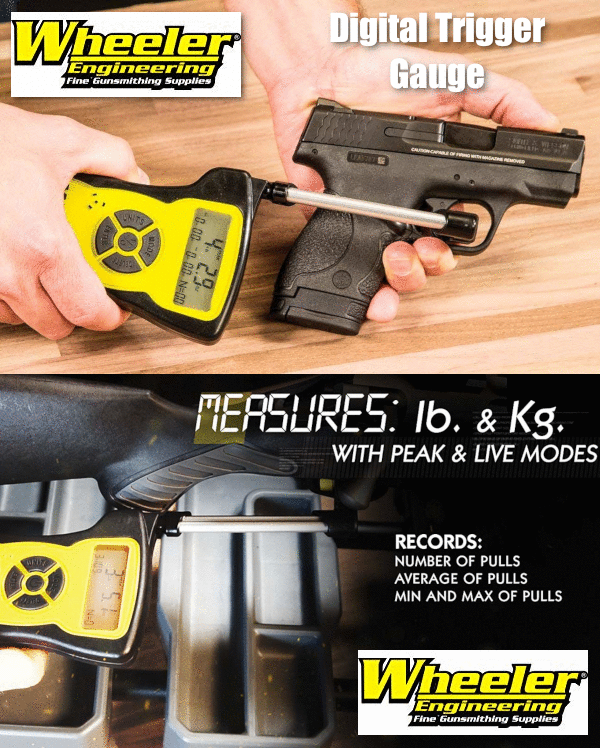
Every serious shooter needs a good trigger gauge. The Wheeler digital trigger gauge (#ad) is precise and repeatable, measuring pull weights up to 12 pounds. The load cell directly contacts the trigger making it extremely accurate with +/- 0.2 ounce precision. There are two modes: “Peak” and “Live.” Peak mode shows max force for each pull and calculates the minimum, maximum and average pull weights. Live mode continuously shows the force on the sensor. It even has a special adapter for Savage-style triggers with bladed inserts. This trigger gauge is now $51.99, 26% off MSRP.
7. Midsouth — Frankford Tumbler Lite + Depriming Tool, $119.99
⏺ Depriming Tool and Tumbler Work Great, save $45 with COMBO
The Frankford Arsenal Depriming Tool and Tumbler Lite are both excellent products. With the hand depriming tool you can knock out primers while watching TV. Spent primers are collected in the removable clear catch tube — so no mess on your press or loading bench. The Tumbler Lite is great for tumbling with liquid media to get your cases bright and shiny. Right now you can save $45 by getting the $119.99 Combo Pack from Midsouth.
⏺ Great price on high quality, reliable 9mm FMJ ammo
The 9mm Luger (9x19mm) is the most popular centerfire pistol cartridge. And now there are some great new 9mm carbines like the cool, folding S&W M&P PRC. So it’s wise to keep good supply of 9mm ammo on hand. Here’s a great deal on quality, major-manufacturer 9mm FMJ pistol ammunition. Get 1000 rounds of Fiocchi 9mm ammo for $219.99. That works out to just $13.50 per 50-count box, or $0.22 per round.
⏺ Great price on versatile, well-designed gun vise
Here’s an excellent gun vise on sale for just $35.99. The versatile MTM GV-30 CaseGard Gun Vise supports rifles and shotguns for cleaning/maintenance. High and low forks allow level or angled gun placement. The rubber-padded rotating stock clamp provides a firm hold. The base has 14 different compartments for tools/solvents, plus 11 slots for jags, brushes, and screwdrivers. On the side are tabs for two cleaning rods. This GV-30 vise is made from rugged, solvent-resistant polypropylene plastic. If this sells out on GunZoneDeals, Midsouth has the GV-30 Vise for $41.58.
⏺ Great price on insulated, polyester fabric blanket
For winter nights, save money by turning the heat down and using this on your bed instead. Spread horizontally, this will cover most of even a king size bed. The Editor bought this for his own home. This versatile sleeping blanket comes in very handy — use it outdoors in summer and indoors in winter. The blanket (we’ll call it a nylon quilt) measures 70″ L x 50″ W. It is machine-washable with a water- and dirt-resistant 190T polyester fabric cover. Inside is excellent TechLoft Silver insulation. This blanket stows neatly into a 13.5″ x 7.5″ roll in the provided carry sack.
Kestrel wind and weather meters are often regarded as the best on the market — for good reason. Here are a series of three videos by F-Class John that show how the Kestrel 5700 with Elite Ballistics works. This article reviews the advanced Kestrel 5700 Elite Wind Meter with sophisticated ballistics capabilities. Our review features three videos by F-Class John that show how the Kestrel 5700 Elite functions with Applied Ballistics APP software and LiNK connection.
This Part I Video starts with a basic Kestrel Anemometer (blue case, 00:00-00:40) wind meter. Then reviewer F-Class John looks at the “smart” Kestrel 5700 with Elite Ballistics. John explains the many features of the Kestrel 5700 and how it holds a powerful ballistics calculator in the convenient, easy-to-tote Kestrel package. With Elite Ballistics, once you enter data about your bullets, velocity, zero, and rifle, the Kestrel can calculate come-ups and wind corrections. If you don’t yet own a Kestrel, we highly recommend you watch this series of videos that explains advanced Kestrel features in detail.
This Part II Video shows the key features of the advanced software APP used by the Kestrel 5700 unit with Elite Ballistics. The Kestrel 5700 can “talk” to a mobile device that runs the Applied Ballistics software APP that contains bullet databases and allows you to enter key information such as muzzle velocity, bullet BC, zero distance, velocity, wind, and environmental factors (altitude, temperature etc.). There are also gun-specific factors such as scope height over bore and barrel twist rate. The video also explains how “range cards” are created and how to view them with your Elite Ballistics-enabled Kestrel. John notes: “The APP is great because you don’t have to fiddle with the Kestrel’s buttons. It’s much easier to enter data and change settings with the APP.”
This Part III video shows how to determine true wind direction by aligning the SIDE of the unit into the wind. You essentially want to set the unit 90 degrees to the wind direction so the impeller runs as slowly as possible. Then, after you set your target distance (See 3:03), the unit can give you precise come-ups for your intended target (10.28 MOA for 559 yards here). The Kestrel then calculates the cross-wind correction as well (See 3:12).
DISCLAIMER: This video and description contains affiliate links, which means that if you click on one of the product links, the video author may receive a small commission. This helps support F-Class John’s YouTube channel and allows him to continue to make videos like this.
For most larger centerfire cartridges, increased barrel length augments muzzle velocity. That’s why you see F-Open rifles with 30″ and even 32″ barrels. But there is a limit — at some point, increased barrel length may not yield any additional velocity. And in the case of rimfire, too much barrel length can reduce MV. Today’s showcase explores how barrel length affects muzzle velocity, both in centerfire and rimfire rifles.
In the photo above you can see a test rifle fitted with what may currently be the longest barrel fitted to a conventional rifle. This was created by the team at MDT (Modular Driven Technologies) to test how velocity varies with barrel length.
You can see the results of testing with this one-of-a-kind rifle in the MDT video below, the first in our Saturday video showcase. This is followed with an MDT rimfire barrel length/velocity test, and additional tests for the .308 Winchester, 6.5 Creedmoor, and .223 Rem cartridge types.
World’s Longest Rifle Barrel Cut to Determine Velocity Change
This may be the most interesting velocity by barrel length test ever put on video. The MDT (Modular Driven Technologies) team started with a 69″-long barrel, chambered for .308 Winchester. The ammo was Federal Gold Medal match with 175gr Sierra HPBT Bullets (Video 3:30). This barrel had actually been fabricated from multiple sections, a challenge in itself.
Velocity was measured in one-inch increments starting at 69″ and going down to 19″. The speed at 69″ was 2778 FPS while the final speed, at 19″ barrel length, was 2567 FPS. “That is a difference of 211 FPS from the longest point to the shortest point”, observed MDT’s tester. Note that, the velocity did show fairly constant change per inch from 19″ to 45″. So going beyond 36″ inches can actually increase velocity. However, from 45″ to 61″ inches the velocity actually declined a bit. SEE VIDEO at 6:55 time-mark, and check out the chart below.
Ultra-Long .22 LR Rimfire Barrel Cut-Down Velocity Test
This video features Part 2 of MDT’s “Cutting the World’s Longest Rifle” test. This time the team shoots the diminutive .22 LR cartridge from an ultra-long barrel. The results may surprise you: “Get ready to have your assumptions shattered as the MDT team chopped a .22 LR rimfire barrel away inch by inch, recording velocities at each barrel length. In this test, the MDT team looked to determine the optimal length for a .22 LR barrel, from the standpoint of velocity. How long is too long? How short is too short? Does shorter always mean faster? Does longer always mean slower?”
In fact, MDT’s testers determined that, with standard rimfire ammunition, the velocity started to decline after 16″ length. That surprised some of the testers. So with the small .22 LR cartridge, more barrel length can actually reduce muzzle velocity from increased in-barrel friction.
6.5 Creedmoor Barrel Length Test (24″ to 16″)
For this video, testers for Western Powders took a standard test barrel chambered for 6.5 Creedmoor and cut it down one inch at a time. The velocity for five rounds at each length was then measured with a chronograph to determine velocity loss per inch of barrel reduction. Overall the recorded velocity loss from 24″ to 16″ was 197 FPS, almost exactly 25 FPS per inch of length. The velocity loss rate was fairly constant inch by inch, as you can see from the graph displayed at the 4:00-minute mark in the video.
.223 Rem (5.56×45) Velocity Tests (9 Guns, 7.5″ to 20″ Barrels)
In this video, the team from Classic Firearms tests a variety of firearms chambered for .223 Rem (5.56×45). This starts with an Springfield Saint Victor AR-type pistol with a very short 7.5″ barrel. This yielded a 2183 FPS average. Then the team tested eight more guns with increasingly long barrel lengths, adding barrel length with each gun in sequence. The test concluded with a Colt XM16E1 rig with 20″ barrel. That Colt AR averaged 3052 FPS. The guns used (and barrel lengths) are listed below.
The overall results are discussed at the 13:45 Time-Mark.
Test Lengths at Video Time — 7.5″ to 20″
2:11 — 7.5″ Springfield St.V. AR Pistol, 2183 FPS
3:23 — 10.3″ DD MK18 SBR, 2513 FPS
4:34 — 11.8″ PWS MK111 AR Pistol, 2644 FPS
5:35 — 12.5″ IWI Zion AR Pistol, 2789 FPS
.308 Winchester — 16″ Barrel vs. 24″ Barrel Velocity
With the .308 Win cartridge, many hunters prefer a shorter barrel for lighter carry weight. In this video, Gavin Gear of UltimateReloader.com compares .308 Win velocities with a 16″ barrel and a 24″ barrel, shooting the same ammo. Gavin notes: “We asked for input on our .308 build. Overwhelmingly, you all wanted a 16″ barrel, so ‘Shorty’ was born! Looking to compare velocities, I brought out my match .308 Win with a 24″ barrel to compare the results with some Hodgdon data.” CLICK HERE to read full report on UltimateReloader.com.
RifleShooter.com Barrel Cut-Down Testing
Along with these videos, our friends at RifleShooter.com have conducted a number of barrel cut-down tests, starting with fairly long barrels. Velocities were measured with each inch reduction
Most of us own a .223 Rem rifle. Now, thanks to our friends at Rifleshooter.com we can assess exactly how velocity changes with barrel length for this popular cartridge.
Rifleshooter.com performed an interesting test, cutting the barrel of a .223 Rem rifle from 26″ all the way down to 16.5″. The cuts were made in one-inch intervals with a rotary saw. At each cut length, velocity was measured with a Magnetospeed chronograph. To make the test even more interesting, four different types of .223 Rem/5.56 ammo were chron’d at each barrel length. The Rifleshooter.com team that conducts these tests has a full-service gun shop, 782 Custom Gunworks — visit 782guns.com.
Test Barrel Lost 25.34 FPS Per Inch (.223 Rem Chambering)
How much velocity do you think was lost, on average, for each 1″ reduction in barrel length? The answer may surprise you. The average speed loss of the four types of .223/5.56 ammo, with a 9.5″ shortening of barrel length, was 240.75 fps total (from start to finish). That works out to an average loss of 25.34 fps per inch.
5.56/.223 Barrel Cut-Down Speed Test 26″ to 16.5″
Start FPS at 26″
End FPS at 16.5″
Total Loss
Average Loss Per Inch
UMC .223 55gr
3182*
2968
214
22.5 FPS
Federal M193 55gr
3431
3187
244
25.7 FPS
Win m855 62gr
3280
2992
288
30.3 FPS
Blk Hills .223 68gr
2849
2632
217
22.8 FPS
*There may have been an error. The 25″ velocity was higher at 3221 fps.
Rifleshooter.com observed: “Cutting the barrel from 26″ to 16.5″ resulted in a velocity reduction of 214 ft/sec with the UMC 223 55-grain cartridge, 244 ft/sec with the Federal M-193 cartridge, 288 ft/sec with the Winchester M855 cartridge and 217 ft/sec with the Back Hills 223 68-grain match cartridge.”
How the Test Was Done
The testers described their procedure as follows: “Ballistic data was gathered using a Magnetospeed barrel-mounted ballistic chronograph. At each barrel length, the rifle was fired from a front rest with rear bags, with five rounds of each type of ammunition. Average velocity and standard deviation were logged for each round. Once data was gathered for each cartridge at a given barrel length, the rifle was cleared and the bolt was removed. The barrel was cut off using a cold saw. The test protocol was repeated for the next length. Temperature was 45.7° F.”
See More Barrel Cut-Down Tests on Rifleshooter.com
Rifleshooter.com has performed barrel cut-down tests for many other calibers/chamberings including 6mm Creedmoor, .308 Winchester, and .338 Lapua Magnum. See these test results at Rifleshooter.com.
Looking for an Xmas gift for a shooting buddy? We found a dozen great deals on compact gifts that can easily be gift-wrapped, packed, and shipped. Typically there are 25-35% savings on these gift selections, but some are as much as 70% off. That will help your gift-giving dollars stretch farther this year.
12 GREAT GIFTS for Shooters and Hunters — All on SALE
CLICK each photo to access product sale page.
BONUS — More Gift Ideas for Gun Aficionados
If you want more suggestions for affordable gifts for your shooting buddies or family members who enjoy hunting and target shooting, here is a video that can provide some inspiration for the holidays:
The U.S. Army Marksmanship Unit regularly publishes reloading “how-to” articles on the USAMU Facebook page. One very good article, part 5 of a 6-part series, focused on Progressive Presses. This article explains proper procedures for Auto-Indexing Progressives, which advance the shell-plate with every pull of the handle. Auto Progressives are very efficient, but they also require special attention and focus, because so many things are happening at once. You need to train yourself to watch every station. If you run a progressive press now, or are considering getting a progressive, we recommend you read this article. Visit the USAMU Facebook page for other helpful handloading guidance.
Progressive Loading Presses — Self-Advancing Shellplate Type
Recently, we addressed manually-operated progressive presses for the beginning handloader. This type press requires one to manually advance the shellplate after each handle stroke. An advantage for beginners is that nothing happens at any station until the loader wants it to. This helps users avoid problems from clearing malfunctions without noticing that the shellplate has advanced itself. (Read Previous USAMU Article on Manual Progressives.)
The next, more luxurious type progressive press advances the shellplate automatically whenever the handle is cycled. [Editor: This is also called an “Auto-Indexing” Progressive Press.] Typically, each stroke automatically sizes and primes a case, operates the powder measure (if used) and seats a bullet. Some also have case feeders that automatically put a new case in the shellplate with every cycle. Others require the loader to insert a case each cycle. With both types, the loader usually puts a bullet on each sized/primed/charged case.
[CAVEAT: While our Handloading Shop has several progressive presses, ALL of our powder charges are thrown/weighed by hand. We do not use powder measures on our presses. Our progressives are used for brass preparation, priming, seating, etc., but not for fully-progressive loading.]
The manually-advanced press can be a boon to beginners, but as one gains experience it can be a mixed blessing, depending on one’s style. If one pays close attention to every operation and loads without distractions, the manual press is very reliable and allows full scrutiny of each round as it is loaded. However, if one easily drifts into day-dreaming, or isn’t focused on paying careful attention at all times, the manual progressive can be a bit of a liability. The opportunity for forgetting a powder charge, leading to a squib load, is ever-present. [Editor: A lock-out die can help reduce the risk of a squib load, or a double-charge. See below.]
The automatically-advancing progressives help prevent this by ensuring a powder charge will be dropped each time the handle is operated. Experienced handloaders often appreciate this feature due to the savings of time and effort. Individual preferences between the two press styles are influenced by several factors. These include one’s comfort with more- vs. less-complicated mechanisms, how often one changes calibers (case feeders often must be converted, in addition to dies and shellplates), how many rounds one loads annually, relative ease of changing primer mechanisms from small to large, etc. Automatic progressives and their caliber conversion kits tend to be significantly more expensive than manual progressives and caliber conversions from the same maker.
One USAMU handloader, who likes simple, bullet-proof machines and maximum efficiency when converting presses, owns two manually-advanced progressives. One is set up for large primers, and the other for small primers. He can change calibers in the twinkling of an eye. As he loads for many different calibers, this fits his style. Another handloader here is just the opposite. He loads for a few calibers, but in larger quantities. He much prefers his self-advancing press with case-feeder for its speed. He makes large lots of ammo in a given caliber before switching, to improve overall efficiency. His caliber conversion kits are more expensive than those for the manually-advanced progressive, but he uses fewer of them.
Whichever type one chooses, it is VERY important to buy quality gear from a manufacturer with a long, well-established track record for quality, durability and good customer support. Avoid jumping on the “latest, greatest” model until it has a proven track record. For example, this writer knows a loader who got a brand-new, expensive, self-advancing model press some years back, shortly after its introduction. As is too often the case these days, the manufacturer released it before all the “bugs” were worked out.
Better Safe Than Sorry — the RCBS Lock-Out Die
RCBS Makes a “Lock-Out Die” that senses the powder charge. This will halt the Progressive press if you have a double charge, or an undercharge. Your Editor has the Lock-Out Die on his RCBS Pro 2000. It has “saved his bacon” a half-dozen times over the years. It can be used on Dillon and Hornady progressives as well as RCBS machines.
It would not fully seat primers to the correct depth. No amount of adjustment, extra force, or fiddling would do better than to seat primers barely flush with the case head. Any inattention could result in a slightly “high” primer, protruding above the case head. It created a risk for slam-fires, particularly in semi-autos without spring-retracted firing pins, such as the M1 or M1A. In desperation, he had a machinist buddy study the problem and machine a new part to correct it. No dice. Its engineering didn’t permit full primer seating, even with extended parts. He now wishes he’d heeded his shooting buddies’ advice to stick with the “tried and true,” reliable performer they all used.
Whichever press one selects, see if the maker has a kit or list of commonly-replaced parts. Having needed springs, pins, etc. on hand in the rare event that one breaks or “goes missing” can save the day when one is busy loading for a match! Another tip for improving one’s overall loading efficiency (rounds loaded with minimal set-up/tear-down time) is to plan one’s handloading by primer size. For example, if your machine is set to use small primers, load all the calibers that you intend to that take small primers, before converting the press to load large-primer calibers.
In our next chapter, we’ll discuss peculiarities of progressive loading for rifle cartridges, with remedies for problems such as excessive cartridge-case headspace variation when sizing, tips for ensuring best powder charge consistency, and so on. Until then, be safe, and good shooting!




 The
The