It’s great to be able to access online load data for your cartridges. You can quickly get load data for a particular powder and bullet weight. However, there are times when we prefer to consult old-fashioned printed/bound load manuals. The primary reason is that manuals produced by bullet- and tool-makers will, for a particular cartridge, include data for powders from multiple manufacturers. Having a single source can save you time and trouble. For example, if you want to find 6.5 Creedmoor loads using H4350 (Hodgdon), Reloder 16 (Alliant), and N150 (Vihtavuori) you would have to visit three different powder-maker websites, one after another. OR you can pick up a modern load manual and find everything in one place.
There are many excellent printed load manuals on the market. We have used the Berger Manual, Sierra Manual, Nosler Manual, Lyman Manual, and Hornady Manual. We like the Berger and Sierra manuals for match rifle cartridges, and the Nosler, Lyman, and Hornady manuals for hunting loads and pistol cartridges.
The Lyman Reloading Manuals have earn praise over the years:
“Every other reloading book I’ve used favors their own bullets over every other manufacturers. With Lyman you get an honest representation of a wide variety of different… manufacturers. [Lyman has] a ton of reloading data on just about any bullet style you can imagine. I’ve tried a wide range of their recipes and everyone I’ve tried has been spot on. The overall breadth of information this book covers is impressive.” Review by RangetoReal.com.
Nosler #9 Manual Features New Cartridges
If you are looking for fairly recent cartridge/bullet/powder information, in late 2020 Nosler released the Nosler Reloading Guide #9, the latest in a respected series of Nosler load manuals.
This 800-page guide covers 101 cartridge types. New in this edition you’ll find the popular 6mm Creedmoor, 6mm XC, 6.5 PRC, and 7.62×39, along with 20 Nosler, 22 Nosler, 24 Nosler, 27 Nosler and 33 Nosler. This manual is a good resource for PRS shooters and hunters. The Nosler #9 book draws from thousands of hours in the Nosler Ballistic Lab, along with the experience of many respected experts.
The book is available for $31.99 at Midsouth or $29.95 on Amazon. Keep in mind that much of the book’s latest load data is available for free on the Nosler.com online LOAD DATA Center. But to get ALL the data, PLUS all the technical articles, you’ll need to buy the book.
Along with the Nosler #9 Manual (above), here are four other recommended Reloading Manuals:
Here Are Four General Instructional Books That Cover Reloading Procedures:
POWDER BURN RATE TABLE
Here is the most recent powder burn rate chart from Hodgdon/IMR that we could find. Click links below to access printable PDF. Note, some readers have suggested a couple powder ranking issues in the table. However, this is the latest official version from the Hodgdon website, released in October 2022.
Shown is the Redding Model 15-P Competition Piloted Inside Chamfering Tool with pilot rod that centers in the case flash hole. Also shown is a Forster 45° Rocket Tool.
There are a wide variety of reloading tools designed to cut a slight chamfer in case necks and deburr the edge of the case mouth. You don’t need to spend a lot of money for an effective tool. A basic “rocket-style” 45° chamfering tool, such as the Forster, actually does a pretty good job taking the sharp edge off case mouths, particularly if you use a little scotch-pad (or steel wool) to smooth the edge of the cut. The Forster chamfer tool, shown below, is a nicely-made product, with sharper cutting blades than you’ll find on most other 45° chamferers. It costs $24.99 at Brownells.com.
Redding sells a handy piloted chamfering tool with a 15° inside cutting angle and removable accessory handle. This Redding Model 15-P chamferer works really well, so long as you have consistent case OALs. The pilot rod (which indexes in the flash hole) is adjustable for different cartridge types (from very short to very long). This ensures the concentricity of the inside neck chamfer to the case mouth. This quality tool works with cases from .22 to .45 Caliber, and retails for $36.99.
Sinclair International offers a 28° carbide chamferer with many handy features (and sharp blades). The $28.99 Sinclair Carbide VLD Case Mouth Chamfering Tool will chamfer cases from .14 through .45 caliber. This tool features a removable 28° carbide cutter mounted in the green plastic Sinclair handle. NOTE: A hex-shaft cutter head power adapter can be purchased separately for $19.99 (Sinclair item 749002690). This can be chucked in a power screwdriver or used with dedicated power drives when doing large volumes of cases.
Many folks feel they can get smoother bullet seating by using a tool that cuts at a steeper angle. We like the 22° cutter sold by Lyman. It has a comfortable handle, and costs just $12.99 at MidsouthShooterssupply.com. The Lyman tool is an excellent value, though we’ve seen examples that needed sharpening even when new. Blade-sharpening is easily done, however.
K&M makes a depth-adjustable, inside-neck chamferer (“Controlled Depth Tapered Reaper”) with ultra-sharp cutting flutes. The latest version, which costs $59.95 at KMShooting.com, features a central pin that indexes via the flash hole to keep the cutter centered. In addition, the tool has a newly-designed handle, improved depth-stop fingers, plus a new set-screw adjustment for precise cutter depth control. We caution, even with all the depth-control features, if you are not careful, it is easy to over-cut, slicing away too much brass and basically ruining your neck. We think that most reloaders will get better results using a more conventional chamfer tool, such as the Forster or Redding 15-P.
One last thing to note — tools like the K&M and the Sinclair chamferer are often described as VLD chamferers. That is really a misnomer, as bullets with long boat-tails actually seat easily with very minimal chamfering. In reality, these high-angle chamferers may be most valuable when preparing brass for flat-base bullets and bullets with pressure rings. Using a 22° or 28° chamferer can reduce the risk of cutting a jacket when using VLD bullets though — so long as you make a smooth cut.
If you are looking to acquire a reliable, accurate rifle for a late fall hunt, Howa can be a good choice. Howas feature smooth-running actions with fine two-stage HACT triggers. A Howa barreled action can also be a good basis for a DIY project. But some folks have heard that it may be difficult to find stocks, or to fit an after-market barrel. That’s not true. There are many stock options available, and in this article, Bill of RifleShooter.com shows that it is easy to remove the factory-installed barrel with the right tools. We think a Howa makes a fine basis for a varmint rig or field rifle. Or you can build a tactical rifle as Bill did. You can start with the factory barrel and when you want/need more accuracy, then have a gunsmith install a custom barrel from Krieger Barrels, Lilja Barrels or other quality brand.
The Carbon Stalker is an excellent ultralight factory option, weighing just 4.6 lbs. with Mini Action (before optics). All Howa Carbon Fiber Stalker rifles come with a Sub-MOA Guarantee and Lifetime Warranty.
What You Need to Know About Howa 1500-series Rifles
Tech Feature by Bill, editor of RifleShooter.com
Consider this article the “Howa 1500 Overview”. There has been a lot of interest in Howa rifles and barreled actions imported by Legacy Sports International. In addition to being able to buy a complete rifle from a dealer, Brownells sells barreled actions in a wide variety of calibers and configurations. In this post we are going to take a look at the Howa 1500 series.
Howa Rifles — General Background
Howa is a Japanese heavy machinery company. One of its product lines are firearms, which are imported into the United States of America by two different companies, Legacy Sports International and Weatherby. Legacy sells the 1500 under the manufacturers name while Weatherby re-brands the guns as the Weatherby Vanguard. In general, the finishes on the Weatherby rifles are more refined than the LSI-imported 1500s.
General Evaluation of Howa 1500 Rifles
I’ve found Howa 1500s to be solid, entry-level rifles that are capable of sub-MOA accuracy out of the box. I’ve actually purchased two Howa rifles I’ve tested because I like them so much. The gun below, a Howa Mini-Action in 7.62×39 Russian, is one of my favorite factory guns to shoot.
Check out this three-shot group I drilled at 100 yards with the rifle above and 125-grain Sierras. It took a lot of work and load development to get there, but when it did, it worked well.
Howa 1500 HACT 2-Stage Trigger
Howa 1500s feature the very nice Howa HACT trigger. This is an adjustable, two-stage trigger, set for about 3 pounds (combined stages). Crisp and repeatable, this is an excellent trigger for a factory gun. There is no annoying Glock-style safety lever in the middle of the trigger blade. The 2-stage design and pull weight range works well for a hunting rifle or a rig for PRS competition. Rifleshooter.com says the Howa trigger is “one of the best factory triggers, along with Tikka. I’ve found the Howa trigger superior to a Remington 700 — the Howas doesn’t need to be replaced.”
Writing for the Western Outdoor News, WONews.com, Steve Comus has field-tested the HACT Trigger. Steve writes: “I always liked two-stage triggers, because of the way I could take-up the slack and then actually know when the rifle was going to go off. The take-up on the [HACT] trigger was fast and easy. The crisp, positive release when pressure was put on during the second stage [reminded me] of some of the target rifles I shot through the years.”
Howa Actions — Three Options
Howa offers three action lengths: Mini, Short, and Long. You can see the bolts for the three action lengths in the image below. The Mini-Action has similar external dimensions to the Remington Model Seven, however, the Mini-Action’s bolt does not travel as far to the rear. This is a mixed bag. The upside is you have a quicker action (shorter bolt throw). The downside is you are limited to shorter rounds such as the .223 Remington, 7.62×39mm Russian, and 6.5 Grendel. But if you need a bigger cartridge, just choose the standard or long action Howa variant.
Howa 1500 vs. Remington 700 — Important Differences
Is the Howa 1500 a Remington 700 clone, or some kind of improved Remington 700? No, not really. While the top radius of the Howa 1500 does match the Model 700, and they can both use the same two-piece scope bases, there are a number of differences.
If you look at the Howa 1500 alongside the Remington 700 you’ll note the M700 is a round action, while the Howa is a flat-bottom action. In many ways the Howa’s bottom half reminds me of a push-feed Winchester. This means the chassis and stocks that support a Howa 1500 are not V-block based like you’ll find on a 700, instead they have a flat bottom. While the bolt of the Howa is similar in external appearance to the Model 700, it does offer some improvements, notably an M16-style extractor and a firing pin assembly that can be easily removed without tools.
Howa 1500 action screws are metric and are in a different location from the 700. The Howa 1500 has an integral recoil lug that accepts the front action screw, this means you have more of the front action screw engaging the action. WARNING: If you install it into a poorly-fitted stock or action you may bind it.
Can a Howa Action Be Used for a Custom Rifle Project?
Absolutely! You can either buy a barreled action from Brownells and throw it in a chassis system/stock of your choice or you can use a stripped action to build a custom rifle. If you are in the chassis market, MDT offers a wide variety of chassis in different price ranges. All have worked well for me.
How to Remove Howa Factory Barrel from Action
You may have heard internet grumblings about removing Howa barrels. Some keyboard commandos say they are extremely difficult to remove without a relief cut. Well Bill at Rifleshooter.com demonstrates that Howa barrels can be removed without trouble, provided you have the right tools. Watch this video:
Watch Howa Barrel Removal Video — Quick and Easy (Click Speaker Icon for Audio)
Q: Is it difficult to remove a barrel from a Howa 1500?
A: Not very. I’ve heard from some smiths that worked on Howas (years ago) that the factory barrels are difficult to remove. However of the half dozen or so Howa barrels that I’ve pulled, they’ve been very easy. I use a Brownells action wrench with the top piece for a Rem Model 700 and the flat bottom resting against the flat on the wrench.
Howa Actions Require Metric Barrel Threads
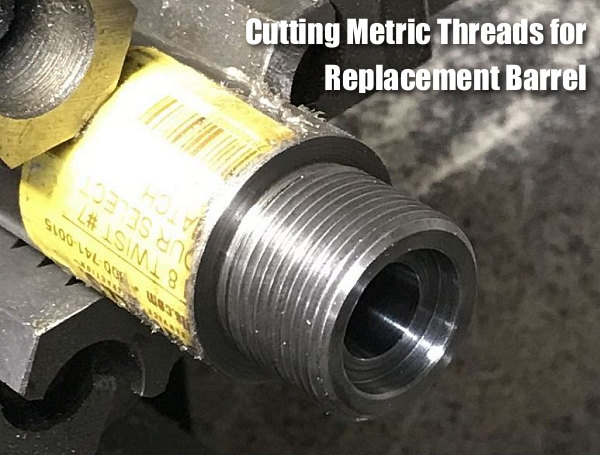
It’s easy to thread a barrel for a Howa action. You just have to cut metric threads — most lathes out there can cut them. I cut the threads below on a manual lathe using change gears. [Editor: John Whidden cuts metric tenon threads with a CNC lathe. “It’s easy,” John tells us, “No issue whatsoever.”]
Using Howa Actions for Custom Rifles
I have built a few customs with Howa actions. Below is one of my favorite, a .308 Winchester. It consists of a Howa 1500 action, Shilen Select Match Rem Varmint contour barrel\, and Modular Driven Technologies (MDT) ESS chassis. Great rifle and it hammers!
For this Saturday-at-the-Movies session we offer a selection of videos featuring interesting tools and products for handloaders. If you spend much time in your reloading room, these tools can save you time and help you load better ammo in less time. Today’s feature products range from sophisticated, premium tools such as 21st Century powered neck-turning lathe, to basic add-ons such as Lee Breech Lock Bushings, which are very handy if you load a variety of cartridge types.
21st Century Powered Neck-Turning Lathe
Power is activated by the red button on the end of the blue, horizontal feed handle:
Do you neck-turn hundreds of cases annually? Then you deserve this outstanding tool. The 21st Century Innovation Powered Neck-Turning Lathe may well be quite simply the best system ever created for quickly and precisely uniforming (and reducing) the neckwall thickness of cartridge brass. We have the original manual 21st Century neck-turning lathe, and can attest that it works great. With this powered system you can turn necks faster and more efficiently, with less effort. This is like going from a stick shift to an automatic transmission. The cases feed very smoothly and the results are beautiful. Note: The videos show the version as first marketed by 21st Century Shooting, which now operates as 21st Century Innovation.
The Powered Neck-Turning lathe is a modular system. Swing the bar from right to left to feed the case. The power head (with case holder) glides on stainless steel rails for smooth movement. This allows very precise feed rate. Power is supplied via a button that is built into the end of the feed handle. Push the red button to make the case spin. It’s as simple as that.
Hornady OAL Tool and Hornady Bullet Comparator
Gun Tech Steve Ostrem explains how to properly use Hornady’s Overall Length Gauge to determine length-to-land precisely. The OAL Gauge uses a “Modified Case” that threads onto the tool and holds a bullet. Push on the back of the gauge until you feel the bullet just touch the rifling. (We do this gently at first, tapping the rod a couple time to ensure the bullet is aligned correctly). Once you’ve got the length, then use the tool with a comparator on your calipers to get the length-to-lands. NOTE: We recommend taking the measurement 3-4 times in a row to get a reliable number. With a little practice your should be able to get repeatable measurements within .0015″.
Henderson Power Case Trimming/Chamfering Machine Test
F-Class John tests some of the finest reloading and shooting equipment you can buy. Recently he added the impressive Henderson Gen 3 Powered Trimmer to his inventory of tools. John is now a Henderson fan. He likes the speed, precision, and repeatability of the $779.00 Henderson machine, which trims-to-length and chamfers the case mouth all in one pass. Unlike some other trimming tools, the Henderson indexes off the overall case length NOT the shoulder. John found this worked just fine for his .284 Winchester brass, which has all been full-length sized prior to trimming.
Watch the video to see the Henderson trimmer in action. The dual, parallel horizontal support shafts provide precise alignment of the case as it moves inward toward the cutter blade. The Taper-Lock cutter provides a 14-degree inside chamfer and 30-degree outside chamfer. The trimming process is very consistent case after case, and the Henderson’s design captures brass shavings effectively.
This related video shows a comparison with the popular Giraud Powder Trimer
As noted in this comparison, John liked the precision of the Henderson trimmer and the overall design of the machine, which offers good ergonomics and very precise alignment of the cases. Cycling is smooth and positive, as you can see from the videos. The Giraud is also an excellent machine for bulk trimming/chamfering but the Henderson has some advantages.
Concentricity Checking with Accuracy One Gauge
Every serious hand-loader needs a quality concentricity gauge. The Accuracy One Concentricity Gauge boasts a smart design that delivers precise, repeatable results. We like the unit’s easy adjustability and its ability to work in a variety of configurations. The Accuracy One Gauge measures internal and external neck runout of cartridge cases as well as seated bullet runout. It can also measure the runout of the ogive, bearing surface, and boat-tail of individual bullets. And it can even measure your primer pocket runout.
Tools Galore — Affordable Tools and Accessories for Reloaders
This detailed 15-minute video from the Bolt Action Reloading YouTube Channels, features a variety of lower-cost products/tool that help with key reloading tasks. The video looks at hand priming tools, case prep tools, Lyman stepped loading blocks, powder tricklers, expander mandrels, powder trickler, long-tube funnels and more! If you are getting started in hand-loading, this is a very helpful video to watch. It covers a lot of ground, illustrating options for tool types.
This Lyman case prep tool is one of many products reviewed in this 15-minute video.
On the heals of the USA NRA F-Class Nationals held earlier this month in Phoeniz, we’ll take a look at the gear used by F-Class competitors who shoot in F-TR and F-Open divisions. On the firing line you’ll see the latest and greatest stocks, actions, optics, bipods (for F-TR), and Front Rests (for F-Open). This article looks at the two F-Class divisions.
A while back, our friend Vince Bottomley in the UK wrote an excellent article for Target Shooter Magazine. Vince offers “solid-gold” advice for new F-TR and F-Open shooters. Vince reviews the cartridge options, and offers suggestions for a shooter’s first (and hopefully affordable) F-Class rifle. Vince also reviews various bipod choices for F-TR and discusses optics options (from $300 to $3000).
Getting Started in F-Class by Vince Bottomley
As membership secretary of a large club, one of the questions I’m frequently asked – “What’s the best way to get started in F-Class?” My club has an F-Class shoot every couple of weeks at ranges from 300 to 1000 yards and, not surprisingly, it’s very popular.
F-TR or Open Class?
From a shaky start way back in 2004, the F-TR Class is now proving as popular as Open Class and, at GBFCA League shoots and club shoots, many shooters choose to start with a 308, shooting off a bi-pod – in other words F-TR. In Open Class, the 7mm WSM soon established itself as the “must have” cartridge – if you wanted to win but, the WSM’s appetite for barrels eventually brought another 7mm cartridge into play – the 284 Winchester. This 50-year-old stalwart was revived a decade or so ago as the 6.5-284 and indeed this cartridge found some favor with F-Class pioneers – before the potency of the WSM was discovered. If you don’t mind shelling out for a couple of barrels per year (barrel life is about 750 rounds with the WSM) go for the 7mm WSM but, if you require a decent round-count, then opt for the .284 Win and learn to read the wind a bit better!
[Editor: In the last couple of years, another option has emerged — the 6.5 PRC necked up to 7mm. This wildcat 7-6.5 PRC offers a bit more velocity than a .284 Win or its “improved” cousin the .284 Shehane.]
F-Open rifles on the firing line at the Ben Avery Shooting Facility in Phoenix, Arizona.
Scopes for F-Class
If you will be shooting 1000 yards then I would recommend at least 32 power and preferably a variable – like the 8-32. The cheapest “usable” scope in this range is the Sightron. It’s a great scope for the money and at under $900 (in the USA) it’s half the price of its nearest competitor. It’s also light – at 1.5 lbs – and there are some great reticles for the F-Class shooter – like the LRMOA.
When shooting targets, the closer to the center the better the result. But this is not necessarily true when it comes to using jags and patches. There are some good reasons to try spiking your patches away from the center. This Creedmoor Sports Tech Tip explains why you may want to spike (puncture) your patch away from the center. CLICK HERE to order patches and Swab-Its cleaning bore tips from Creedmoor Sports.
You begin to push your first patch down the barrel and you notice it is extremely tight and then it jams! How can this be? A commonly overlooked solution to remedy the frustrating occurrences of overly tight or jammed patches is what we like to call “Side-Spiking”. Side-Spiking is super simple and works!
“Side-Spiking”, as the words suggest, refers to moving your patch spiking position from the center of the patch towards the corner of a square patch or the edge of a round patch.
Moving From Center-Spiking To Side-Spiking
The closer toward the edge of the patch you spike your jag, the looser the patch will be when pushed down the bore.
Important: Be careful to not go to the very edge of the patch. Leave enough patch material to fully cover the first set of rings on your jag as this insures your jag is properly centered in the bore and that no contact with the rifling will occur.
Proper Side-Spiking Location Creedmoor Sports recommends side spiking all wet patches. This allows for a looser patch in the bore which removes gross powder fouling and leaves more cleaning solution behind to start working on the remaining fouling.
When a tighter patch is needed, simply move your spike closer toward the center of the patch. The closer to the center of the patch you get, the tighter the patch will become in the bore. The objective is to have a snug-fitting patch that allows you to smoothly push your rod down the bore. Remember you do not need to end up in the center of the patch!
Bore-Tech Patch Size Selection Chart Recommends Patch Sizes by Caliber:
With inflation, the increased cost of .223 Rem centerfire ammo has driven more folks to shooting .22 LR rimfire ammo, both for fun and practice. Thankfully, handy conversion kits will let you shoot .22 LR ammo from your existing .223/5.56 AR-15 platform rifle. This allows low-cost training with no change in rifle balance, ergonomics, and/or optics.
The CMMG Bravo .22 LR Conversion Kit provides a replacement bolt/bolt carrier along with three 25-round magazines with special .22 LR-fitted followers and ammo slots. This allows you to shoot rimfire ammo from any AR-15 chambered for the .223 Rem (5.56×45). The CMMG Bravo has an integrated extension that fits into your current chamber. The rimfire bullet passes through this extension and then enters the barrel. This conversion kit is now on sale at Brownells for $179.99 with three 25-rd mags.
The CMMG Bravo conversion Kit comes with blowback-operated .22 LR bolt carrier, rubber protector for bolt carrier tip, and three 25-round polymer magazines. To use, simply replace the rifle’s .223 Rem bolt and carrier with the Bravo .22 LR conversion unit and load up the included magazine(s) with rimfire ammo.
To use the CMMG Kit, simply remove the centerfire bolt/bolt carrier, and replace it with the CMMG silver colored bolt shown above. CMMG states: “For best performance use a round-style hammer as notched hammers can cause function issues.” Testers have stated that high-velocity .22 LR ammo works best, and CMMG notes that “36gr plated-nose bullets have proven to be the best choice for function.” The copper-plated bullets help reduce fouling.
Ultimate Reloader Tests CMMG .22 LR Conversion Kit
Our friend Gavin Gear of UltimateReloader.com recently tested the CMMG .22 LR AR Conversion Kit. He observed that installation was very straight-forward and the CMMG magazines worked well. He and fellow tester Travis Fox shot the unit both slow-fire and rapid-fire successfully.
Gavin and Travis found the CMMG Kit easy to install and fun to use. With an AR that can shoot both .223 Rem and .22 LR, it’s like having “two guns in one”. Travis was impressed with the ease of use: “It is so simple to change over to the CMMG .22 LR AR kit! It took me about 68 seconds the very first time I tried. Each time after that it took me about 40 seconds — it’s that simple. It takes longer to fully load one of the mags than it does to switch over from .223/5.56 to .22 LR and back.”
The AR shot very well with the higher-velocity ammo types. 100% functioning was achieved with both 40gr Federal Game Shok ammo and American Eagle High Velocity 38gr Copper-plated HP ammo. NOTE: CMMG does recommend high-velocity Copper-plated rimfire ammunition.
Maintenance Tip — After converting back to your centerfire .223 Rem (5.56), Travis says “make sure to clean the gas tube and components as .22 LR tends to run dirty”. READ Full Test on UltimateReloader.com.
CMMG Bravo Conversion Kit Gets Thumbs Up from Gavin and Travis
“Does this conversion kit get the Ultimate Reloader stamp of approval? Absolutely! In these times of ammunition/component scarcity this gives options to shooters. Finding bulk .22 LR can sometimes be easier than 223/5.56. This kit gives that option at a great price. Any chance to keep skills up and familiarize new shooters to a platform is a good thing. Basically two rifles for a lot less than another rifle.”
How to Install CMMG Bravo .22 LR Conversion Kit
The Brownells video below shows the installation process step-by-step:
In this instructional video, a Brownells gunsmith demonstrates (step by step) how to install, disassemble, clean, lubricate, and reassemble the CMMG AR-15 .22 LR Conversion Kits. Clear the rifle and make safe before you start the conversion. Separate the upper and lower, remove the standard bolt carrier group. You then install the conversion bolt and connect the upper and lower as normal.
Details of CMMG .22 LR Conversion Kit
“For years I’ve had a CMMG conversion kit. It’s a drop-in system that’s … very reliable and it’s accurate. The [CMMG conversion] has lower recoil [and is] great for training. Even though ammo prices have gone through the roof, .22 LR is still cheaper to shoot than anything else.” — SootchGear
At the request of our readers, we provide select “Deals of the Week”. Every Sunday afternoon or Monday morning we offer our Best Bargain selections. Here are some of the best deals on firearms, hardware, reloading components, optics, and shooting accessories. Be aware that sale prices are subject to change, and once clearance inventory is sold, it’s gone for good. You snooze you lose.
NOTE: All listed products are for sale to persons 18 years of age or older. No products are intended for use by minors.
1. Graf & Sons — Major Sightron Sale, Save 25%
⏺ SAVE big bucks on competition and hunting scopes
If you’re looking for new optics consider the Sightron Optics Sale at Graf’s. You can find everything from red dots to hunting scopes to high-magnification competition scopes at huge discounts, mostly 25% off the regular price. Long-Range Benchrest and F-Class shooters should check out the Sightron SIII 10-50x56mm Long Range Scope, now just $997.49, a $332.50 savings!
2. Powder Valley — Hodgdon and IMR Powders in Stock
⏺ Ultra-popular Hodgdon powders now available at good prices
This is your lucky day — the super-popular Hodgdon powders are in stock right now at Powder Valley. That’s right, you can order Hodgdon Varget, H4350, and H4831SC right now for $48.99/lb. And other Hodgdon powders are available starting at $27.99/lb. Plus many popular IMR powders are in stock at Powder Valley including IMR 8208 XBR, IMR 4064, and IMR 4350. NOTE: If your favorite powder sells out, Midsouth also has Varget, H4350, and other top choices at $50.99/lb.
⏺ Best price on excellent electronic scale/dispenser
The Hornady Auto Charge Pro provides precise, customizable powder dispensing in an easy-to-use, space-saving unit. Precise to within 0.1 grain, the Auto Charge Pro offers customizable trickle speeds for various powders, as well as custom time settings. Store settings for up to four custom loads or use the factory setting. The backlit touch screen is easy to read, while a large knob on the side simplifies powder emptying.
4. Sportsman’s WH — Maverick Arms Mossy Oak 12ga, $219.99
⏺ Get a 12ga shotgun for crazy low price — under $220
For shooting sporting clays or duck hunting, it’s nice to have a classic long-barrel pump shotgun. One very affordable option is the Maverick Arms 88 Mossy Oak 12 gauge shotgun, right now just $219.99 on sale at Sportsman’s Warehouse (19% off). This shotgun features dual extractors, twin action bars, positive lock-up, and an anti-jam elevator for trouble-free operation.
5. Brownells — LabRadar Chronograph, $499.95
⏺ Major price reduction on proven Radar Chronograph
LabRadar Doppler Chronographs are now on sale at Brownells. The LabRadar has been favored for many years by top benchrest, F-Class, and Long Range competitors. This radar chrono provides extremely accurate velocity data and the unit runs at your shooting station so you don’t have to place a tripod downrange. Brownell’s $499.95 price represents a significant discount on the LabRadar system. The LabRadar is now $100 less than the new Garmin Xero C1 PRO Chrono.
6. Bruno’s — PT&G Chamber Reamers, $159.95 and up
⏺ Great selection of quality reamers for 30+ cartridge types
To have a custom barrel crafted, you may need a chamber reamer for your gunsmith. However, good reamers can take months to get. But right now Bruno’s has a wide selection of quality PT&G reamers in stock. These are available for $159.95 (and up) in a wide assortment of chamberings including: .223 Rem, 22-250, 6 PPC, 6mmBR, 6 Dasher, 6GT, 6XC, 6.5×47, 6.5 PRC, .284 Win, .284 Shehane, 7 RSAUM, 7 PRC, 7mm WSM, 30 BR, .308 Win, 300 WSM, .338 Lapua and many more.
⏺ Popular modern Earbuds with good Noise Reduction Rating
Electronic earbuds provide hearing protection while still allowing you to hear range commands. And earbuds are more convenient than large, bulky ear muffs. Currently, Gloryfire Electronic Silencer Earbuds with a 26dB Noise Reduction Rating (NRR) are on sale for $135.99. These feature two noise level functions, indoor and outdoor mode, and the 26dB rating is better than some thin muffs. NOTE: Gloryfire also sells 26dB NRR Silencer Earbuds with BlueTooth capability for $169.99.
⏺ Quality forward-set mount for Service Rifles and ARs
If you shoot service rifle or have an AR that needs a forward-mounted scope check out the Creedmoor 30mm scope mount, now on sale for $59.95, a 47% savings off the regular $104.99 price. Made from aircraft-grade aluminum, this light-weight but durable mount offers generous 2.5″ forward offset. That allows optimal scope placement for correct eye relief and proper arm/head position.
9. Amazon — MTM R-100 Ammo Box, $17.99
⏺ Best 100-round ammo box on the market, now on sale
For transporting ammo to the range, we like the MTM R-100 Deluxe ammo box (#ad). These durable R-100 flip-top ammo boxes provide excellent protection for your ammo. When rounds are in the nose-down position special fingers in each hole prevent bullets from hitting the bottom of the box, thereby preventing tip damage. You can also pick up a semi-transparent blue version for $16.99 at MidwayUSA. We like being able to see the cartridges inside the box.
10. Amazon — Ditron Waterproof Calipers, $39.99
⏺ Versatile calipers with waterproof feature
You can’t reload quality ammo without calipers to measure many key dimensions. A good, affordable option is the DITRON 6″ Electronic Caliper (#ad). The calipers’ components are made of hardened stainless steel for durability and rust resistance. There is a a handy thumb roller and the caliper shell is dustproof and waterproof, which helps ensure longevity.
As an Amazon Associate, this site earns from qualifying purchases.
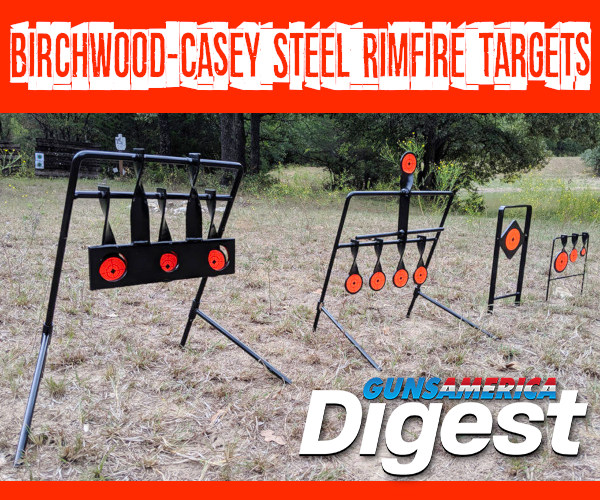
Rimfire plinking with reactive targets is FUN and affordable. We always like to include REACTIVE TARGETS during a trip to the range with our .22s. Decent .22 LR rimfire ammo is not expensive, and a wide variety of affordable steel targets are available. Rimfire-class steel is much less costly than the heavy AR500 steel plates used for centerfire rounds. In fact, Birchwood Casey makes a wide variety of reactive steel rimfire targets that retail for under $50.00. These offer great “Bang for the Buck”.
A fast-cycling, semi-auto .22 LR rifle like the Savage A22 is great for shooting reactive targets.
GunsAmerica Digest has reviewed a variety of reactive rimfire target systems from Birchwood Casey. We recommend you read this detailed article Little Targets, Big Fun, by Jordan Michaels. He acquired four different steel target systems and tested them at his Texas range. Michales was impressed: “At $30-$55 a pop, Birchwood-Casey’s targets are small enough to be challenging and cheap enough to buy four or five for the price of one centerfire-rated target. They’re also light, portable, reactive, and easy to set up.”
B/C Gallery
B/C Back Drop
B/C Qualifier Spinner
B/C King of Diamonds
Check out how these Birchwood Casey steel targets perform. These animated GIFs show actual shooting sessions with .22 LR rifles and pistols. The targets hold up well, though the black paint comes off. The reviewer notes: “You shouldn’t worry about durability as long as you stick to .22 LR. I shot the heck out of these targets with rifles and handguns using both standard and high-velocity cartridges, and I didn’t notice any denting or cracking. If the targets are going to be kept outside, however, keep an eye out for rust – the black paint comes off immediately.”
Safety Considerations with Steel Reactive Targets
The tester said the targets worked best with a .22 LR ammo with at least 1000 fps MV at the targets. He tested with .22 LR pistols as close as 7 yards, and .22 LR rifles out to 100 yards. Be advised — when shooting steel targets at relatively close ranges ALWAYS wear full-coverage eye protection because ricochets and splash-backs are definite risks. Also comply with all range rules.
Since its introduction in 2001, the .300 Winchester Short Magnum (.300 WSM), has proven very popular for hunting and long-range competition. The case has ample capacity to drive the heavy .30-caliber bullets, and with proper case prep and annealing, the WSM is capable of outstanding accuracy. When Nebraskan Greg Anderson decided to build his “ultimate long-range hunter”, he selected the .300 WSM for its accuracy and its ability to drop large game at long distances. Teaming up with Chris Matthews of LongShot Rifles, Greg developed an impressive long-range hunting rig, with high-tech components to reduce weight. The 26″ barrel is a carbon-wrapped composite over a Rock Creek stainless blank. The carbon technology saved about 3 pounds over an all-steel barrel of similar length/contour.
The Manners Composite stock also features carbon fiber construction for stiffness and reduced weight. Greg’s carbon/carbon rifle tips the scales at just 10.8 pounds, including scope and bipod. A conventional rig could easily weigh 15 pounds or more. Greg’s carbon hunter has proven accurate as well as innovative. With 175gr Sierra MKs, the gun shoots well under 1/2-MOA out to 600 yards and beyond.
The Ideal Spot and Stalk Rifle
by Greg Anderson
The purpose of this project was to create a hunting rifle that would be inherently accurate at long range and have an acceptable weight for hunting in rough country. I researched the question of overall weight with several gunsmiths. The smiths confirmed that while fat-contour barrels could deliver improved accuracy, there was a price to pay and a lot more weight. With a heavy barrel, the finished rifle would be most likely weigh about 15 pounds. That’s more than I wanted to haul around in the field. To reduce barrel weight, the suggested “traditional” solutions were fluting, which would reduce barrel weight by at least one-half pound, or going with a smaller diameter barrel.
The Quest for Reduced Weight without Accuracy Loss
Fluting didn’t promise enough weight savings, and a slim, sporter barrel probably wasn’t going to deliver the kind of consistent accuracy I wanted (particularly as the barrel heated up). Accordingly, I decided to “think outside the box”. My research on lightweight barrel options lead me to Advanced Barrel Systems, (ABS) a company in Lincoln, Nebraska that once produced custom carbon-wrapped barrels. ABS President Mike Degerness could wrap a barrel to virtually any shape and diameter, allowing great stiffness even with a huge reduction in barrel weight. As the “core” for his carbon-wrapped barrels, Mike recommends a cut-rifled blank made by any of the quality cut-barrel makers. [NOTE: ABS is not taking orders at this time. You can now get excellent carbon-wrapped barrels from Proof Research].
Significant Weight Saving with Carbon
How much weight can you save with a carbon-wrapped barrel? Well a 24-inch, #7 contour ABS carbon-wrapped barrel will weigh about 2.5 pounds compared to about 5.5 pounds for a steel barrel of the same length and contour. So, this means that you can put a fat, stiff competition-contour barrel on your hunting rifle and save over half the barrel weight compared to an all-steel barrel. Saving three pounds is a blessing when you’re carrying the rifle all day long in the field. I placed an order for a 30-caliber Rock Creek barrel blank with an 1:11.25″ twist and a finished length of 26″. Mike wrapped the barrel and finished it to an M24 contour.
Carbon Can Also Improve Barrel Vibration Damping
One interesting benefit of carbon barrel-wrapping is that the carbon components have a vibration-dampening effect. According to ABS, the extreme rigidity of the finished composite barrel dampens the vibration nodes of the barrel making it shoot like a plain steel barrel of much greater mass. Carbon fiber has a high modulus of elasticity that has the effect of lowering the amplitude of the vibration of the barrel when fired. This is what makes the ABS barrels perform so well, according to Mike.
Impressive Accuracy For a Hunting Rifle
Looking at the targets below, one may ask, “Does the rifle always shoot this well?” The answer, not surprisingly, is: “it depends on the trigger-puller”. The rifle is capable of outstanding accuracy. But it took some time and effort for me to develop the skills required to shoot up to the rifle’s inherent accuracy. I nearly always practice prone from bipod. Initially, I was getting horizontal stringing until I changed my grip and learned to be more consistent from shot to shot. Shooting a heavy-recoiling .30-caliber rifle from the ground is not the same as shooting a .223 Rem from the bench.
3-Shot Group at 200 yards | 6-Shot Group at 500 Yards
Completing the Project Build
To smith the rifle, I selected Chris Matthews of LongShot Rifles, LLC because of his expertise with the WSM cartridges and long-range shooting equipment. Because cost was a factor, we decided to use a donor Remington long action that had been used on a Remington 7mm magnum. Chris trued the action and we had Dave Kiff from Pacific Tool & Gauge grind us a bolt to fit the action more perfectly. Chris chambered the Rock barrel and installed a .300 Badger recoil lug.
Carbon-Reinforced Hunting Stock from Tom Manners
Being a fan of carbon fiber technology, I selected an MCS-T stock from Manners Composite Stocks. These stocks have an extremely high strength-to-weight ratio and the high comb of the MCS-T gave an almost perfect alignment with the scope. The finished rifle was topped off with a Leupold 4.5-14x40mm LR scope equipped with M1 windage and elevation turrets. A Harris bipod completed the package. All up, including scope, steel rings, and bipod, my .300 WSM rifle with 26″ barrel weighs 10.8 pounds.
Load Development for Accuracy
I developed a load using 63.0 grains of H4350, 175gr Sierra Match Kings with Federal 210M primers in Winchester-brand brass. This load gives 2960 FPS out of my rifle. The load would shoot sub-MOA from bipod from 100 yards to 600 yards and was adopted as the “go to” load. I have also tried the 208gr Hornady A-Max in this gun. The A-Maxs shot well but the Sierras work well for everything (paper punching and hunting) so the 175gr SMK is my bullet of choice.
Brass Prep and Annealing Are Very Important
The Winchester-brand brass is good, but you have to prep it thoroughly if you want good results. My brass prep consisted of turning the necks, de-burring the flash holes (inside and out), and chamfering the case necks. Using a Sinclair neck-turning tool, I turn the necks to .0135″ per side. That provides a complete clean-up of the necks, which run about .015″ neck-wall thickness out of the box.
One thing I’ve learned to do is anneal the brass every 3-4 firings. I started to do that after I noticed that the force required to seat bullets became inconsistent after just a few loading cycles. I also experienced flyers that were going out of the group for no apparent reason. Annealing the cases every 3-4 firings has eliminated most of the unexplained flyers and annealing has also made bullet seating much, much more consistent. I’ve also noticed a significant improvement in my groups at 500 and 600 yards now that I anneal regularly. Group sizes at 600 yards can be as much as 2″ smaller with annealed brass than with un-annealed, work-hardened brass.
Greg Anderson was successful with his .300 WSM on his very first hunt, dropping a nice buck at 364 yards. Chris reports: This was on some private land in Nebraska. As daylight faded… there were a couple of bucks, but one looked to be the best of the lot. The buck gave me a broadside shot ranged at 364 yards. I settled behind the scope and took one shot. It hit right where I aimed and the buck just folded.”


 Nosler #9 Manual Features New Cartridges


 Howa 1500 HACT 2-Stage Trigger





 “Side-Spiking”, as the words suggest, refers to moving your patch spiking position from the center of the patch towards the corner of a square patch or the edge of a round patch.




 One thing I’ve learned to do is anneal the brass every 3-4 firings. I started to do that after I noticed that the force required to seat bullets became inconsistent after just a few loading cycles. I also experienced flyers that were going out of the group for no apparent reason. Annealing the cases every 3-4 firings has eliminated most of the unexplained flyers and annealing has also made bullet seating much, much more consistent. I’ve also noticed a significant improvement in my groups at 500 and 600 yards now that I anneal regularly. Group sizes at 600 yards can be as much as 2″ smaller with annealed brass than with un-annealed, work-hardened brass.


