The U.S. Army Marksmanship Unit (USAMU) has published a series of reloading articles on its Facebook Page. In this article, the second in a 3-part series, the USAMU covers the process of loading competition pistol ammunition. The authors focus on two key elements — the taper crimp and the quality/uniformity of the original brass. If you shoot pistol competitively, or just want to maximize the accuracy of your handguns, read this article. The taper crimp tips are very important.
Loading Accurate Competition Pistol Ammunition — Part 2 of 3
Today, we resume our series on factors affecting accuracy in pistol handloads. Readers who missed Part One can visit our USAMU Facebook Page. Scroll down to March 28, 2018 to find that first installment which is worth reading.
One often-overlooked aspect of handloading highly-accurate pistol ammunition is the amount of taper crimp used, and its effect on accuracy. (NOTE: this article pertains to loading for semi-autos – revolver crimp techniques involve some quite different issues.) Briefly, different amounts of taper crimp are used with various handloads to obtain best accuracy. The amount is based on bullet weight, powder burn rate and charge, plus other factors such as case neck tension. During machine-rest testing of experimental Service Pistol ammunition, many variables are examined. Among these, our Shop often varies a load’s crimp in degrees of 0.001″ when re-testing for finest accuracy.
How to Measure Taper Crimp on Pistol Cartridges
One question that often arises is, “How do I measure the taper crimp I’m putting on my cartridges?” Using the narrow part of one’s dial caliper jaws, carefully measure the case diameter at the exact edge of the case mouth on a loaded cartridge. It’s important to take several measurements to ensure consistency. Also, be sure to measure at several places around the case mouth, as case wall thickness can vary. After measuring 2-3 cartridges with a given crimp setting, one can be confident of the true dimension and that it can be repeated later, if needed.
However, for good results, one must use brass from one maker due to variances in case wall thickness. For example, the same degree of crimp that imparts a measurement of 0.471″ with Brand X brass may result in 0.469″ with Brand Y. Thus, for best accuracy, using brass from the same manufacturer is important — particularly for 50-yard Slow Fire. In a perfect world, it is better still to use brass from one lot number if possible. With the popularity of progressive presses using interchangeable tool heads, keeping separate tool heads adjusted for each load helps maximize uniformity between ammunition lots.
Brass Uniformity and Accuracy
Brass is important to pistol accuracy. While accurate ammunition can be loaded using brass of mixed parentage, that is not conducive to finest results, particularly at 50 yards. It is important for the serious competitor to pay attention to his brass – even if only for the 50-yard “Slow Fire” portions of “Bullseye” matches and practice. By segregating brass as described above, and additionally keeping track of the number of times a given batch of cases has been fired, one can ensure case neck tension and case length are at their most uniform.
Given the large volumes of ammunition consumed by active pistol competitors, using inexpensive, mixed surplus brass for practice, particularly at the “short line” (25 yards), is understandable. In NRA Outdoor Pistol (“Bullseye”), the 10-ring is relatively generous — especially for a well-trained shooter with an accurate pistol and load. However, for the “long line” (50 yards), purchasing and segregating a lot of high-quality brass to be used strictly for slow-fire is a wise idea. To keep track of your brass on the line, use a unique headstamp marking with 1 or 2 colors of marking pen ink.
Uniform Cartridge Overall Length is Important
Cartridge case Overall Length (OAL) uniformity as it comes from the factory is important to achieving utmost accuracy. More uniform case lengths (best measured after sizing) contribute to greater consistency of crimp, neck tension, ignition/burn of powder charge, headspace (rimless cartridges), etc. Cartridge case-length consistency varies noticeably by maker and, with lesser manufacturers, also from lot to lot. Some manufacturers are more consistent in their dimensions than others, and also in the hardness/ductility of their brass. Similarly, pay attention to primer brands, powder lot numbers, etc.
Consider Using a Lock-Out Die with Progressive Presses
When reloading pistol ammo with a Progressive press, we strongly recommend the use of a lock-out die, or other system that can detect double charges or low charges. If your progressive is manually advanced, the possibility of a double charge is very real — and that can have disastrous consequences.
On UltimateReloader.com website you’ll find an excellent two-part series on the function and set-up of the RCBS Lock-Out Die. This die prevents loading if a high or low powder charge is detected. The video below shows setup of the RCBS Lock-Out Die on the Dillon XL-650 progressive press.
What are the top-selling new rifles in the USA? You might be surprised — there are no Remingtons among the Top 5 bolt guns. In the bolt-action category, the Ruger American is on top, followed by the Tikka T3X and the CZ 457. Among semi-auto rifles, a Ruger AR is in third place, the Springfield M1A is ranked second, and the venerable Ruger 10/22 is still the best-selling self-loading rifle.
Shopping for a rifle? Your buying decision may be simplified by seeing what other consumers have chosen, as revealed by nationwide sales trends. You can now check firearms sales figures using “Gun Genius”, a data-crunching service of Gunbroker.com. On GunGenius.com you can select any type of firearm (handgun, rifle, shotgun) and see the top sellers for that category. Here are the top-selling NEW bolt-action rifles and semi-auto rifles. On the Gun Genius site you’ll find links for gun specifications. There are separate listings for used rifles. The chart are based on May 2022 sales data.
Here are the FIVE top-selling NEW bolt-action rifles for May 2022:
Here are the FIVE top-selling NEW semi-auto rifles for May 2022:
Get Sales Rankings for Other Categories of Firearms
On GunGenius.com, in addition to the categories above, you can chose lever-action rifles, single-shot rifles, semi-auto pistols, revolvers, semi-auto shotguns, pump shotguns, and more. You can also filter for sales trends (upwards and downwards). Drill down to see detailed product specifications and current prices.
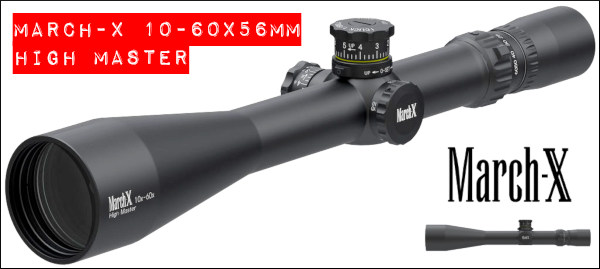
Review of March-X 10-60x56mm High Master Riflescope
By James Mock
This review is about the impressive new March-X 10-60x56mm High Master scope with Super ED lenses. We’ll start with some background. About 15 years ago, I saw Turk Takano at the Super Shoot and he seemed excited about a new rifle scope that he had on his benchrest rifle. It was a March 40x fixed power model that was a prototype. This was the first March to reach the USA. He told me that it was hand assembled in Japan by top optical engineers. When asked if I would like to look through it, I jumped at the opportunity. This scope was breath-taking in its clarity, brightness and quality of image. This scope soon was selling very well in a tough market. Some who made this possible were Turk Takano, the Kelbly family and Lou Murdica. All of these invested time and money into seeing that this new scope was available to American shooters.
I have had the pleasure of testing many high-magnification rifle scopes. Most have been exceptionally well suited to the task for which they were designed. Presently, I shoot 300- and 600-yard competition and the scopes that I favor are second focal plane (SFP) high-powered variables with an MOA-type reticle. Many in the optics industry have been very generous to enable me to test their scopes. Among those who have helped me over the years is Lou Murdica. When March first came to the USA, Lou loaned me his 40X fixed power scope, an exceptional scope for 100/200 yard BR shooting.
March-X 10-60x56mm High Master Scope — Impressive New Optic
I quit shooting short-range benchrest in 2013, but have been shooting 300- and 600-yard benchrest matches since then. It was quite a change for me to shoot a target to which I could not see my bullet holes. With my 78-year-old eyes and the Louisiana atmosphere, I have only been able to see 6mm bullet holes (in good conditions) at 600 yards with two scopes. They were the 15-55x52mm Nightforce Competition and the 12-52x56mm Valdada Terminator. Although I have not had the conditions with which to see small bullet holes at 600, Lou states that he can with this scope on days without mirage.
March introduced the world to ED lenses in rifle scopes and all of their scopes with lenses larger than 24mm have these superb lenses. Most of today’s premium scopes feature ED glass. However, March has now upped the ante and has a “Super ED” lens in certain tier 1 “High Master” scopes. According to March, these scopes produce images approaching the quality of the images produced by PURE fluorite lens.*
After reading some glowing reports about March’s High Master scopes, I contacted Lou Murdica and asked if he had a 10-60x56mm High Master he could loan me for an evaluation. The High Master Lens System has two Super ED lens elements within its lens system. By using Super ED lens elements, March was able to suppress chromatic aberration even more than with ED lenses and thus produce a sharper image with greater contrast, while still having a strong scope. March found a better way with this new objective lens system. High Master scopes also have addressed the problem of focus change with temperature variations.
Lou sent me a 10-60x56mm High Master for evaluation. I received the scope in July, when Louisiana’s weather is VERY hot. Although I tested with considerable mirage, this gives me a chance to test in less than ideal conditions. The scope that I received had a duplex reticle similar to the duplex made famous by Leupold. The section between the heavy lines subtends 3 inches at 25X, or 1.5 inches from the crosshair in the center to the heavy line. The technical data for this scope reveals why it carries a high price tag. Many believe that it is the Super ED lens that causes the high price, but that is only partially the reason. March designed a 56mm objective lens with THREE large segments (two of which are 50mm). These 50mm segments replace some of the 20mm lens others use in the tube body. The lenses used by March have high fluorite content and produce superb images. The lenses are fully multi-coated with the finest coatings for maximum light transmission. Chose either standard or illuminated reticle.
March-X 10-56x56mm High Master Scope Specifications:
34mm main tube, scope body machined from aluminum ingot
56mm front objective
Elevation adjustment range 60 MOA
Windage adjustment range 40 MOA
Length 16.2 inches
Weight 33.1 ounces
Eye Relief 3.98 inches at 10x and slightly less at 60x
Side Focus Parallax range 10 yards to infinity
High Master lens system (Super ED lenses)
Temperature Anti-Drift Lens System
All Japanese metal parts with no plastic part except for minimum essentials such as an insulator.
Hunting season is underway around the country. If you need a good hunting rifle, consider a Tikka. The Tikka T3 and newer T3x rifles are very popular with hunters around the globe — for good reason. These rifles offer smooth-running actions, easy sub-MOA accuracy with good ammo, crisp triggers, and ultra-reliable detachable box magazines. The Tupperware stocks aren’t super-rigid, but they are comfortable and easy to handle. If you are looking for a hunting rifle, the Tikka T3 and T3X models are smart choices, offering good performance for the price (starting at $649.99 for the T3X Lite version). The T3 series is offered in a wide selection of chamberings, from .204 Ruger up to the large magnums.
Here are three good Tikka T3/T3x video reviews. The first, from the popular Backfire YouTube channel covers the features of the Tikka T3 series. The second and third videos are from New Zealand and Scotland respectively. Both reviewers are experienced hunters who explain why the T3 is well-suited for hunting applications. These videos cover the T3’s controls and how to use the rifle most effectively during a hunt.
VIDEO One — Why the Tikka T3x Is Great for Hunting
With 550,000+ subscribers, the Backfire Channel is one of the most popular gun channel on YouTube. You can trust what the Backfire reviewer say because they pay their own money for the products they review. This video reviews Tikka’s current generation T3s rifle. Backfire had high praise for Tikka T3x rifles: “The Tikka T3x SL is an incredibly lightweight mountain rifle that should be in every hunter’s safe. We like it for its lightweight build, stainless steel barrel, superb trigger, and surprisingly accurate shooting. Overall, this is the hunting rifle we recommend more frequently than any other.”
VIDEO Two — Tikka T3 Controls and Function
In this video, New Zealander Mitch of BushBrothersNZ reviews a T3 with polymer stock and stainless barrel chambered for the .270 Win. Mitch focuses on the T3’s controls and functions, with particular attention to the operation of trigger, safety, and bolt.
VIDEO Three — Report from Scotland with .223 Rem Tikka T3
In this video, David, a hunter and wilderness skills teacher from Scotland, demonstrates the features (and remarkable accuracy) of a factory Tikka T3, chambered in .223 Remington. With David’s handloads, this rifle has grouped just over an inch at 250 yards, as shown near the end of the video.
David uses his rifle primarily for fox-hunting (often done at night). He employs a variable-power scope with an illuminated reticle to target his night-time prey. David offers many tips for predator hunters. He prefers an extra-high Harris bipod. With the bipod’s legs fully extended, he can assume a comfortable and solid sitting position. The rifle is supported on his shoulder and on the bipod, leaving both of his hands free. Being able to support the rifle without gripping it is a major advantage, David explains. This frees his hands to search for animals with binoculars or scan distances with his rangefinder.
At the request of our readers, we provide select “Deals of the Week”. Every Sunday afternoon or Monday morning we offer our Best Bargain selections. Here are some of the best deals on firearms, hardware, reloading components, optics, and shooting accessories. Be aware that sale prices are subject to change, and once clearance inventory is sold, it’s gone for good. You snooze you lose.
NOTE: All listed products are for sale to persons 18 years of age or older. No products are intended for use by minors.
1. KYGUNCO — Hunting Sale with Guns, Optics, Ammo, Camo Gear
⏺ Hunters save on guns, optics, ammo, camo gear and more
Hunting season is here. And right now you can get EVERYthing you need at a discount, thanks to KYGUNCO’s big Fall Hunting Sale. You’ll find hunting rifles, scopes, rangefinders, camo clothing, trail-cams, and scent-blockers on sale. In addition, there is a large selection of quality factory hunting ammunition from Federal, Norma, and Winchester. Shown above are some of the best deals, but there are hundreds of other items on sale including crossbows, knives, deer attractant feed, and even tree-stands. CLICK HERE for the full KYGUNCO Hunting Season Sale Flyer with all the deals.
⏺ Versatile, affordable — great for ARs and sighting-in hunting rifles
Here’s a great product for sighting-in your hunting rifles. This Caldwell Precision Adjustable Turret Rest, now just $76.11 on Amazon offers quick horizontal and vertical adjustment making it great for target shooting as well as varminting from a bench. Amazon user ‘Jet Mech 1′ reports “…it’s REALLY solid! Solid steel legs and everything is heavy duty. It’s really compact. Easily fits in the smallest car trunk. It holds your firearm very securely. The tilt and pan is super smooth and precise. This is the perfect platform for an AR-style rifle but works equally well for just about anything.”
3. Locked-N-Loaded — SAR USA Mete 9mm w/ Red Dot, $329.99
⏺ Amazing deal on modern 9mm pistol with installed Red Dot
Here’s a great deal on a versatile 9mm handgun for self-defense and/or action pistol matches. The SAR USA Mete 9mm with Riton Red Dot is ON SALE now for just $329.99 at Locked-N-Loaded. Yes that low price includes the Red Dot sight! These optics-equipped SAR USA Mete pistols are offered with Safari Tan frame. Great bargain for just $329.99. There is a OD Green frame version also, but it could sell out fast.
4. Midsouth — .22 LR, .22 WMR, .17 HMR Rimfire Ammo Sale
⏺ Big inventory of .22 LR and .17 HMR ammo at good prices
With the current high price of powders and primers, more shooters are turning to rimfire shooting. Bulk .22 LR ammo costs as little as six cents a round. Compare that to $1.00 or more for factory centerfire ammmo. Right now Midsouth is running a big sale on rimfire ammunition. Save big on .22 LR, .22 WMR, and .17 HMR.
5. Amazon — Frankford Arsenal Perfect Seat Priming Tool, $59.99
⏺ Precise Depth Control, 12 Shell Holders, Quick-Change, Carry Case
Seating primers to a consistent depth helps deliver enhanced accuracy and low ES/SD. However, most priming systems don’t allow precise depth control. If you’re looking for a priming tool that allows you to adjust primer seating depth, check out the Frankford Arsenal Perfect Seat Hand Primer. This tool comes in a protective case along with a full set of case holders and primer flip tray. A quick thumb release system allows you to switch from small to large primers quickly. Get this now for $59.99 on Amazon.
6. Palmetto SA — PSA 36″ Gun Case plus 7 Magpul Mags, $99.99
⏺ Great combo for AR owners — good value
Here’s an excellent bundle deal for AR and tactical rifle owners. You get a rugged, 36″ long gun case with 3 large storage pouches for ammo and accessories. The case features comfortable back-pack style shoulder straps. Choose either the Flat Dark Earth (FDE) model or the Black model case. Both cases come with SEVEN quality 30rd Magpul magazines. With either color choice, get both the 36″ case and 7 mags for $99.99.
7. Amazon — KUBEI USB Rechargeable Digital Scale, $24.99
⏺ Compact scale with USB-rechargeable battery at great price
Everyone can use an inexpensive, compact scale for loading at the range or sorting bullets or maybe even primers. One very affordable option KUBEI USB Rechargeable Digital Scale. Unlike most other inexpensive digital scales, this comes with a large dust cover with a “window” for your powder pan. Notably, this scale can be conveniently recharged with a standard USB cable — no batteries to replace ever! We have heard positive reports from Forum members about this $24.99 portable scale, which offers 9 types of weight units, calibration weight, and fold-down protective lid.
8. Amazon — F.A.T. Firearm Torque Wrench, $47.89
⏺ Versatile, precise, affordable Torque Wrench for gun owners
Here’s versatile tool every gun owner can use. This Wheeler Engineering F.A.T. (Firearm Accurizing Torque) Wrench performs a multitude of duties for rifles and handguns. The wrench provides a precise read-out of torque values for action screws, scope rings, and other vital connectors. The wrench is also handy for working on other projects (such as torqueing motorbike fasteners). This torque wrench comes complete with 10 bits, all in a handy, fitted case. Save 20% now with the $47.89 Amazon Sale Price.
9. Graf & Sons — Lockdown Safe Accessory Package, $12.50
⏺ Good accessories for every gun safe — now 75% Off
Here’s a great Lockdown Accessory Package for gun safes at a super-low price. The battery-powered vault light is a must-have item. You also get an excellent large organizer that can hold pistols, knives, Kestrels, and other items. The hardshell Document Holder takes documents up to 10″ x 12.5″. For interior mounting, Velcro pads and magnets are supplied for both the Organizer and the Document Holder, so fitting to fabric-covered or bare metal doors/safe walls will work. The price for all three items is just $12.50 — a whopping 75% savings off the regular $49.99 price.
⏺ Good compact electronic muffs plus 4-lens safety glasses
Here’s a quality ear and eye protection combo for shooters. The Walker’s Razor Slim electronic (amplified) muffs offer a 23 dB Noise Reduction Rating (NRR). These are pretty comfortable and have a slim profile — good for prone shooting. These muffs feature twin mics, volume control, and a handy audio input jack. This kit, now just $49.99 at MidwayUSA (41% Off), includes a nice set of ANSI Z87.1-approved safety glasses with four interchangeable lenses: Smoke Gray, Amber, Yellow, and Clear.
11. Amazon — 10000mAh Dual USB Battery Packs, $21.99
⏺ Recharge your smartphones and tablets — good for Labradar too
Do you have a cellphone, tablet, LabRadar, barrel cooler, or other device that needs mobile power? If so, we found a great deal on a pair of Miady 10000mAh Dual USB Portable Chargers. Yes you get TWO (2) charging packs for just $21.99 total! Featuring USB and USB-C ports and fast 2 amp charging capability, this pair of portable power banks is a very good deal.
One of the feature stories covers the increased popularity of “optics-ready” handguns. These come with slides configured to mount Red Dot optics. In some cases these new handguns are sold with the Red Dot optics pre-installed, ready to go. The Shooting Industry article explains:
“It wasn’t too long ago optics-ready handguns were little more than a novelty. But today, it’s difficult to talk about the handgun segment without delving into the increasing number of guns coming from the manufacturers with optics already installed, or ready to accept one.”
Mike Sfakianos, a senior manager at Bill Jackson’s in Pinellas Park, Florida, remembers customers coming into the store even three or four years ago and being skeptical about the utility of a Red Dot on a pistol:
“It was a slow start. People thought it was more of a competition-type thing. Now it seems like just about every manufacturer has gone to an optics-ready gun”, observed Sfakianos, noting customers are growing increasingly interested in carrying subcompacts with Red Dot optics.
If you are interested in a wide selection of optics-ready handguns, check out the recent Modern Carry: Best Optics-Ready Pistols article in the CheaperThanDirt Blog. This highlights ten current production pistols from Canik, CZ, FN, Hechler & Koch, Keltec, SCCY, SIG Sauer, Smith & Wesson, Springfield Armory, and Taurus. Below is the Taurus G3 T.O.R.O (Taurus Optic Ready Option), a full-frame pistol with 17+1 9mm capacity.
Gun Safes — Why Every Gun Owner Needs One
A second article in this month’s Shooting Industry magazine covers gun safes and security systems. This covers recent trends in gun safe design, marketing, and sale. The article notes that attacks on gun ownership and Second Amendment rights are increasing so it is more important than every for gun owners to have secure storage for their firearms both at home and in their vehicles. FYI, gun thefts from vehicles make up the largest source of stolen guns.
Based in Charlotte, NC, Hyatt Guns stocks over 7,000 guns in a vast 20,000 square-foot facility. To complement its massive firearms inventory, Hyatt Guns maintains the largest safe showroom in the region.
Cutting Edge Digital Gunsafe Technology — There Are Potential Problems
Hyatt Guns offers a range of mechanical and electronic gun storage options, though Hyatt Guns stays away from hyper-technology because it’s often expensive and difficult to service. V.P. Mitch Hyatt notes: “The mechanical dials and simple digital safes have great failsafe options. We can help customers set these up, and we work with several local locksmiths if they ever need one. But, with the larger vault safes, when you get into the fingerprint technology, often times it leads to replacing the whole unit, and you have to deal with whether the manufacturer will take it back or replace it.”
.243 Ackley Improved for Long-Range Varminting and Benchrest Competition
Whenever Matt Bianchini brings his bright yellow .243 Ackley to the firing line, heads turn. This is one truly handsome rig–as good-looking as it is accurate. Built to smoke varmints at long-range as well as compete in 1000-yard benchrest matches, this rifle is proof that competition improves the breed. Fitted with a Farley action, Jewell trigger, Leupold LRT scope, and Lilja or Krieger barrel, the Yellow Ackley is a “no compromise” match rifle that can run with the big dogs in 1K Benchrest competition. And with the Ackley’s ability to toss 106gr Clinch Rivers at 3350 fps, this is one flat-shooting, hard-hitting varmint rifle.
Ultra-Fast, Ultra-Smooth Farley Action…and One Wicked Paint Job
The heart of Matt’s rifle is a Farley action. Farleys have found favor with Benchrest competitors, because the bolt can be worked so fast. And the Farley is as smooth as it is speedy. The difference is quite noticeable if you compare it to a blue-printed Rem 700, or even a recent Stolle Panda. Farleys were true customs, built one at a time by the Farley family in Oklahoma. Unlike a BAT action which is machined from billet steel, a Farley starts with a stainless investment casting, much like Ruger pistol frames. It uses a cone bolt for smooth, yet solid lock-up.
One of the unique features of the Farley is the ejector–it can be switched on or off, depending on the shooter’s preference. So, if you’re load testing some hot rounds, you can turn the ejector off. In a match you can turn the ejector “on” to function normally. Matt is now a confirmed Farley fanatic. He tells us: “I’ve got quite a few other very nice actions, including Nesikas. But none of them are as slick as that Farley. When you work the bolt it feels like it’s on ball-bearings.”
Matt’s Screamin’ Yellow Ackley–The Need for Speed
.243 Ackley Improved Speed Demon
In a long-range varmint rifle, speed kills. Ultra-high velocities will deliver flatter trajectories and more explosive hits on critters. That’s where the .243 Ackley Improved really shines.
Matt has explored the upper limits of .243 Ackley Improved (AI) performance with his yellow long-range rig, fitted with a 29″ Lilja 3-groove, 1:8″-twist barrel. Using a stout load of Alliant Reloder 25, Matt’s “Screamin’ Yellow Ackley” has topped 3340 fps with Clinch River 106s. That’s serious speed for heavy 6mm bullets. This shows a well-built .243 AI leaves Dashers and 6XCs in the dust when it comes to pure velocity.
Ultimate Evolution of the .243 Winchester
Matt’s show-stopping rifle is a .243 Ackley Improved (40-degree shoulder, .271″ neck), chambered with a Manson reamer. On top of the stainless Farley “S” action, in Farley 30mm rings, sits a Leupold LRT (1/16 MOA dot) boosted to 18X-40X by Premier Reticles. Matt has SIX barrels for the gun, three Lilja 3-grooves, a couple Kriegers, and a Shilen.
Matt’s gun currently sports an 8-twist 29″ Lilja 3-groove HV taper that Matt says cleans up like a dream. The stock is a Shehane ST-1000 Tracker made in fiberglass by McMillan, with a BAT trigger guard and Shehane polished billet aluminum buttplate. Prior to final finishing, Matt worked over the flats and some of the angles. That’s why the facets are so well-defined on this rifle compared to some ‘glass Trackers you may have seen. The gun was chambered by Dave Bruno of Cheswick, PA.
Matt bedded the stock and applied the stunning Sikken “Viper” yellow paint job himself. That flawless, smooth-as-glass Screamin’ Yellow finish is no ordinary paint-job, but then Matt Bianchini is no ordinary do-it-yourself painter. His family runs an automotive body-shop, so he had access to premium paints and a quarter-million-dollar spray booth with all the latest technology. Still, Matt spent many hours on this stock to get everything right, trying a couple colors before he settled on a Sikken automotive “Viper Race Yellow” formulated for the Dodge Viper sports car. After careful prep work, Matt sprayed two coats of Viper Yellow, and then added three coats of high-grade automotive clear, which was then baked-on in a heat chamber. Matt also painted the Sinclair front rest to match the stock, and even polished the surfaces of the Hoehn windage top. A lot of effort, Matt told us, was required to achieve the results you see here.
3300 fps for 1000 Yards
Though Matt’s Ackley has harvested its share of varmints, the gun was built with 1000-yard benchrest competition in mind. At left is the firing line at Thunder Valley, Ohio. Yep those targets (upper right) are 1000 yards away. Now you know why Matt has a 40-power scope.
The Yellow Ackley weighs just under 17 pounds to meet IBS and NBRSA “Light Gun” weight limits. While Matt says his bullets don’t “go to sleep” for a couple hundred yards, this gun can still shoot 1/4″ groups at 100 yards and hold that accuracy much, much farther. Matt reports, “my best-ever group was five shots in .397″ at 400 yards. Yep, I got lucky with the conditions, but this is a very accurate rifle.”
.243 Ackley Improved–More Velocity, Less Case Stretch
by Bob Blaine, Sinclair International
Parker Ackley reluctantly developed the .243 Ackley Improved (“AI”). Ackley finally gave in to his customers’ requests to develop the .243 AI. He had always felt that the .243 Winchester was already an improved configuration, but he did say that the best thing to be gained by improving the .243 Winchester was to substantially reduce the case-stretching problems. The .243 Winchester parent case has always stretched brass, almost as bad as the Swift. Even though you get more velocity with the improved .243, I’ve also found that the improved version gives a bit more throat life than the parent case does.
The .243 AI delivers more velocity by virtue of enhanced case capacity–roughly five grains more H20 capacity than a standard .243 Winchester. The .243 AI has a water capacity of approximately 57 to 58 grains, compared to 52-53 grains for the standard .243 Winchester.
Loading for Long-Range
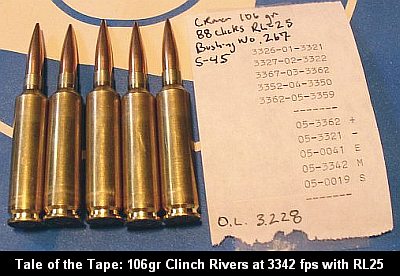
For long-range shooting, Matt loads 106gr Clinch Rivers with 47.5gr of Alliant Reloder 25 for his Krieger barrels, a little more powder with the Lilja 3-grooves. The Lilja load runs 3342 fps, with a 3.228″ OAL. Cases are neck-turned Lapua .243 Winchester. He uses Wilson inline seater and Wilson eck-sizer dies (.267″ bushing), and a custom, reamer-cut FL sizing die.
Not Just for BR, This Gun Can Hunt
While Matt has a big stable of varmint rifles, the Yellow Ackley has seen plenty of duty in the ‘Hog fields. Matt is from a farming family and he can shoot practically right out his back door (see top photo at the farm). He has nailed some big ground-hogs at 800 yards and beyond. The .243 AI does kick a bit compared to other varmint cartridges, but even with 105-106gr bullets, it’s not bad. He has considered adding a muzzle brake at some point to one of the barrels, just so he can see impacts better.
Screamin’ Yellow Dasher?
Matt originally thought of building the gun up as a 6BR or a 6BR Improved. He has a Manson reamer similar to a 6mm Dasher, with a 40-degree shoulder and .008″ body taper. He actually chambered a couple barrels with that 6BR Improved reamer, but he hasn’t shot them yet. He was so pleased with how the gun performed in .243 AI, that he saw no reason to change. And it may be a while before he slaps a Dasher-chambered barrel on the rig: “I really like the way it shoots as a .243 AI. I’m so impressed with it that I don’t want to mess with anything. And I don’t think I’ll be running out of Ackley barrels anytime soon.”
Since the .243 Win is such a popular cartridge, all the major die-makers offer reloading dies. It’s hard to go wrong with a Redding Type ‘S’ Full-length bushing die–item 77114 for the standard .243 Win and item 77420 for .243 AI. Whidden Gunworks also makes great .243 Win sizing dies (and custom .243 Win AI dies on request). These will both resize the case (and bump the shoulder) as necessary, and allow you to adjust neck tension with bushings. Alternatively, you can go with a body die, and a separate neck bushing die.
If you load primarily one brand of bullets, another slick set-up is to buy a Forster or Whidden full-length, non-bushing .243 Win sizing die, and then have Forster or Whidden hone the neck for your desired amount of tension. This elegant one-pass sizing solution produces very straight rounds with low run-out.
For bullet seating, both the Redding Competition Seater (item 55114) and the Forster Ultra-Seater (item U00034) work great for the standard .243 Win case. If you shoot a .243 Ackley, Redding’s .243 AI Comp Seater (item 55420) costs quite a bit more than the standard version Forster doesn’t list a .243 AI seater in their catalog. However, you can just run your chambering reamer into the inner sleeve of either seating die to fit the .243 Ackley Improved case.
If you want the “Cadillac” of production seater dies for the .243 Win, order the Wilson Stainless Micrometer seater (item 50-1114S) from Sinclair International. Costing only a few dollars more than a Redding Comp seater, this die is a joy to use, providing very positive control over bullet seating depth. When used with a quality arbor press, the Wilson offers unrivaled “feel” for bullet-seating force. This can help you monitor neck tension, one of the most critical factors in maintaining low ES and SD for long-range accuracy.
Put the same load in a variety of barrels (with the same length and chamberings) and you’ll see a wide variance in muzzle velocity. In fact, it’s not unusual to see up to 100 fps difference from one barrel to the next. We demonstrated this with a comparison test of Lapua factory ammo.
Chron Testing Lapua Factory Ammo
At our Southern California test range some years ago, we chronographed Lapua 105gr 6mmBR factory ammo in three different 8-twist barrels of similar length. The results were fascinating. Lapua specs this ammo at 2790 fps, based on Lapua’s testing with its own 26″ test barrel. We observed a speed variance of 67 fps based on tests with three aftermarket barrels.
Barrel Velocity Variance
Brand ‘S’ and Brand ‘PN’ were pre-fit barrels shot on Savage actions. Brand ‘K’ was fitted to a custom action. All test barrels were throated for the 100-108 grain bullets, though there may have been some slight variances in barrel freebore. With a COAL of 2.330″, the rounds were “jumping” to the rifling in all barrels.
Among the four barrels, Brand ‘PN’ was the fastest at 2824 fps average — 67 fps faster than the slowest barrel. Roughly 10 fps can be attributed to the slightly longer length (27″ vs. 26″), but otherwise this particular barrel was simply faster than the rest. (Click Here for results of 6mmBR Barrel Length Velocity Test).
IMPORTANT: Results Are Barrel-Specific, Not Brand-Specific
These tests demonstrate that the exact same load can perform very differently in different barrels. We aren’t publishing the barrel-makers’ names, because it would be wrong to assume that ‘Brand X’ is always going to be faster than ‘Brand Y’ based on test results from a single barrel. In fact, velocities can vary up to 100 fps with two identical-spec barrels from the SAME manufacturer. That’s right, you can have two 8-twist, 26″ barrels, with the same land-groove configuration and contour, from the same manufacturer, and one can be much faster than another.
Don’t Demand More Than Your Barrel Can Deliver
We often hear guys lament, “I don’t get it… how can you guys get 2900 fps with your 6BRs and I can only get 2840?” The answer may simply be that the barrel is slower than average. If you have a slow barrel, you can try using more powder, but there is a good chance it may never run as fast as an inherently fast barrel. You shouldn’t knock yourself out (and over-stress your brass) trying to duplicate the velocities someone else may be getting. You need to work within the limits of your barrel.
Factory Ammo Provides a Benchmark
If you have a .223 Rem, 6mmBR, .243 Win, 6.5×47 Lapua, 6.5 Creedmoor, 6.5×55, .308 Win, 30-06, or .338 LM Rifle, we recommend you buy a box of Lapua factory-loaded ammo. This stuff will shoot great (typically around half-MOA), and it can give you a baseline to determine how your barrel stacks up speedwise. [Editor’s NOTE: The original test was conducted in 2008. The velocity of current-production Lapua factory ammo might be higher or lower, so your results may vary.]
When you complete a new 6mmBR rifle, it’s definitely smart to get a box of the factory ammo and chronograph it. That will immediately give you a good idea whether you have a slow, average, or fast barrel. Then you can set your velocity goals accordingly. For example, if the factory 6BR ammo runs about 2780-2790 fps in your gun, it has an average barrel. If it runs 2820+ in a 26″ barrel (or 2835 fps in a 28″), you’ve got a fast tube.
Every serious hand-loader benefits from a precise, repeatable, and efficient powder dispensing system. There are many electronic powder dispensers on the market, starting at about $230 for a Frankford Arsenal Intellidropper and $240 for a Lyman Gen6. At the high end, the ultimate powder weighing/dispensing system would be an Auto-Trickler V4 mated to an top-tier electronic Force Restoration scale. Such a system can run $1200 or more, depending on scale cost.
In today’s Saturday video showcase we feature eight videos about electronic powder dispensers, as well as Auto-Trickler systems (both V3 and V4). If you are in the market for a new powder scale/dispenser system, we recommend you watch these videos. You may be surprised by some of the findings, and you will certainly learn more about these machines — their pros and cons. That knowledge can help you decide what electronic powder dispenser best deserves your hard-earned dollars.
Five Powder Dispenser Comparison Test (All Units Purchased)
If you are in the market for a sub-$500 electronic powder dispenser, definitely watch this review. This Backfire comparison test is notable because the tester spent his own money to purchase all five powder dispensers being reviewed. That means Backfire could tell the full truth, both good and bad, about the machines. In fact, Backfire bought TWO ChargeMaster Lites because one failed (See 14:12 time-mark). The reviewer liked the RCBS ChargeMaster Supreme, but his top choice overall was the Hornady Auto Charge Pro. He favored the overall design, and really liked the way the dispensing speeds could be easily set faster or slower. Here are highlights from the video review:
00:08 Speed Test
03:09 Accuracy Test
07:57 Frankford Arsenal Intellidropper
09:08 Lyman Gen 6
10:44 RCBS Chargemaster Supreme
12:03 Hornady Auto Charge Pro
14:12 RCBS Chargemaster Lite
14:41 Conclusions
AutoTrickler V3 vs. Hornady Auto Charge Pro
In the Backfire comparison video above, the Hornady Auto Charge Pro powder dispenser earned top marks among sub-$500 units. Here the Auto Charge takes on some tougher competition — an ultra-precise Force Restoration scale fitted with an Auto-Trickler V3, a system that cost upwards of $1150.00 U.S. Dollars. The Australian duo running the comparison found the Auto-Trickler system was more accurate and consistent. Notably, with a dispense speed of just 14 seconds. the Auto-Trickler V3 system was significantly faster than the Hornady machine. The Auto-Tricker V3 has been superseded by the new Auto-Trickler V4 which retails for $490.00 USD. Add $625 or more for a good Force Restoration scale such as the A&D FX-120i.
RCBS New ChargeMaster Supreme and Other ChargeMasters
In this well-made video, Gavin Gear of UltimateReloader.com does a detailed review of the new-generation RCBS ChargeMaster Supreme. He puts it through his paces, verifying its accuracy and repeatability. He shows how the unit can be programmed. At the 17:20 time-mark, Gavin employs an A&D FX-120i Force Restoration scale to check the ChargeMaster Supreme’s charge-weighing precision. The results were good.
Frankford Arsenal Intellidropper vs. RCBS ChargeMaster Link
The Frankford Arsenal Intellidropper, now just $230 on sale at Midsouth, was very innovative when first released, offering remote Bluetooth access and a wide range of programmable features. The downloadable App stores your load data and has preloaded bullet and powder databases. This video compares the Intellidropper with another Bluetooth-enabled modern powder dispenser, the RCBS Chargemaster Link. A free RCBS App allows you to control settings remotely.
Hornady Auto Charge Pro Review by Ultimate Reloader
As the $350 Hornady Auto Charge Pro dispenser was top-rated in the Backfire comparison at the start of this article, we thought we’d include a detailed review from Gavin Gear of UltimateReloader.com. If you are thinking of buying a Hornady Auto Charge Pro, definitely watch this video, as it is the most thorough Auto Charge Pro review on the web and Gavin is by far the most articulate tester. SEE FULL TEST.
AutoTrickler V4 and Force Restoration Scale
The AutoTrickler V4, paired with a quality Force Restoration scale, is the “Rolls Royce” of electronic powder dispensing systems, offering unrivaled charge-weight accuracy, great repeatability, and ultra-fast dispensing speeds. If you have the budget — $490 for the V4 plus $625+ for scale — the AutoTrickler V4 is a superb system that lets you load extremely accurate, consistent ammo. This detailed F-Class John video shows how to set up the system properly and control the dispensing and trickling functions.
RCBS MatchMaster vs. AutoTrickler V3 with A&D FX-120i Scale
This video is interesting because it compares the most advanced and expensive mass-market electronic dispenser, the $899 RCBS MatchMaster, with an AutoTrickler V3 mated to an ultra-precise Force Restoration scale. The AutoTrickler V3 + scale system offers wicked fast dispensing while delivering near-single-kernel precision and great repeatability. The MatchMaster has some interesting features, including dual dispensing tubes and a special slower, “Match Mode” dispensing function which provides enhanced precision.
BONUS Video: RCBS ChargeMaster Dispenser vs. Four Scales
This video answers the question “How does a common powder dispenser’s weighing accuracy compare to stand-alone scales?” Here the tester compares the weighing precision of an early-model RCBS ChargeMaster with four dedicated scales: A&D FX-120i (Force Restoration), Hornady G2-1500, Hornady GS-1500 (Gen 1), and a WAOAW milligram scale. These scales range significantly in price, with the FX-120i Force Restoration the most expensive by far. The features/prices of the four scales are listed at 4:41 time-mark. Accuracy/repeatability comparison testing with test weights starts at 10:12 time-mark.
Forster offers an innovative item for precision hand-loaders. The Forster Accu-Ring has precise markings so you can set your sizing dies with extreme precision in your press. The annodized black ring has laser-etched contrasting precision markings in .001″ increments. This allows you to more easily set the amount of sizing and shoulder “bump” you get when you move a die up or down in your press.
In addition, if you have a conventional seating die without a micrometer adjustment, this new Forster Accu-Ring can help you achieve more precise bullet seating. SEE Ultimate Reloader Review.
The precision Forster Accu-Ring was tested by UltimateReloader.com. The testers tried the new ring with both a sizing die and and seating die. The test confirmed the ring provides greater precision, compared to conventional die lock rings.
See the Forster Accu-Ring in this Ultimate Reloader product test video:
The product description from Midsouth Shooters explains:
Accu-Ring Cross Bolt Die Lock Ring (Anodized and Laser-Marked)
The Forster Accu-Ring makes setting up your Sizing Die easier by giving you reference marks in thousandth of an inch increments (.001″). To use these reference marks, simply use a fine ink marker to put a point of reference line on your die. Turn the die clockwise to increase the amount of shoulder bump or counterclockwise to decrease the shoulder bump (i.e. increase case’s headspace length).
There are many other factors that could influence the final amount of shoulder bump during sizing. Ductility of the brass or springback, type of case lube used, pulling an expander ball through the neck and the amount of slack in the linkage of your reloading press are a few things that cause variation in shoulder bump of sized cases. The reference marks on your lock ring will help you to zero in on what you want the headspace length of your cases to be.
Remember to lock up the Accu-Ring completely after you make an adjustment before you size a case again. Otherwise you will obtain inconsistent results if the ring is not tightened.
Another use is for non-micrometer seating dies. Instead of guessing with your seating stem, you can make fine adjustments to your seating depths using the Accu-Ring.









 Ultimate Evolution of the .243 Winchester


 If you load primarily one brand of bullets, another slick set-up is to buy a Forster or Whidden full-length, non-bushing .243 Win sizing die, and then have Forster or Whidden hone the neck for your desired amount of tension. This elegant one-pass sizing solution produces very straight rounds with low run-out.

 Barrel Velocity Variance


